By the autumn of 1992 Queensryche had spent eighteen months on the Building Empires tour, watched Silent Lucidity turn into a Grammy-nominated power ballad, and sold over three million copies of Empire in the United States alone. Their reward, when they finally came off the road, was a collective burnout severe enough that the band booked time on islands rather than in a studio and spent the better part of two years making an album about how empty success felt. Released on 18 October 1994, Promised Land is the sound of a band cashing in their commercial peak for something stranger.
It debuted at number 3 on the Billboard 200, the highest chart entry of their career, and was certified Platinum within months. It is also the album where the biggest progressive metal band in America stopped writing radio singles and started writing tape collages, eight-minute title tracks credited to all five members and acoustic ballads about a guitarist's dead father. This is the story of how a Seattle band recorded their commercial decline on purpose, who pushed for it, what it cost them and why Promised Land is the album classic-lineup Queensryche fans still argue about three decades on.
Album Facts
Before the long version, the headlines. The table below is the fact sheet hosts can read straight off air without notes.
| Field | Detail |
|---|---|
| Artist | Queensryche |
| Album | Promised Land |
| Release date | 18 October 1994 |
| Label | EMI |
| Producers | Queensryche and James Barton |
| Engineer | Tom Hall (with Eric Fischer assisting) |
| Mastering | Stephen Marcussen |
| Studios | At Home, The Dungeon, Big Log Studio (Seattle, WA), Triad Studios (Redmond, WA), Music Grinder (Hollywood, CA); mixed at Bad Animals Studio, Seattle, Summer 1994 |
| Recording dates | August 1992 to May 1994 |
| Genre | Progressive metal, progressive rock, heavy metal |
| Track count | 11 |
| Total runtime | 48:03 |
| Billboard 200 peak | 3 |
| UK Albums Chart peak | 13 |
| Other notable peaks | 4 Finland, 6 Sweden, 10 Germany, 14 Switzerland, 16 Netherlands, 16 Japan, 28 Canada, 38 Austria, 79 Australia |
| Certifications | Platinum (RIAA, USA), Gold (Music Canada) |
| Estimated sales | Over 1 million in the United States alone (RIAA shipments) |
| Key singles | I Am I (1994), Bridge (1994), Disconnected (1994) |
| Sleeve art | Hugh Syme (art direction, design, illustrations) |
The Album in One Paragraph
If a podcast guest asks the host to define Promised Land in a single breath, this is the version. Queensryche's fifth studio album was the deliberate anti-Empire: written and recorded over twenty months between island retreats and Pacific Northwest studios, self-produced with James Barton, packed with tape collages, sitars, cellos and Geoff Tate's saxophone, sequenced like one continuous mood piece, and released into a 1994 market that had moved on from arena metal toward grunge. EMI got a Top 3 debut and a Platinum plaque for their trouble, but the album closed the band's commercial peak as quickly as it opened. It is the last Queensryche record where the classic lineup wrote without looking over their shoulders.
Cultural Context: October 1994
The 1994 release calendar around Promised Land reads like the moment American rock changed shape. The album landed between Soundgarden's [Superunknown](/posts/the-making-of-superunknown-by-soundgarden/) (March), Nine Inch Nails' The [Downward Spiral](/posts/the-making-of-downward-spiral-by-nine-inch-nails/) (March), Hole's [Live Through This](/posts/the-making-of-live-through-this-by-hole/) (April), R.E.M.'s Monster (September), Pearl Jam's Vitalogy (December), Megadeth's Youthanasia (October) and the chart afterlife of Alice in Chains' [Jar of Flies](/posts/the-making-of-jar-of-flies-by-alice-in-chains/) EP, which in February had become the first EP ever to debut at number 1 on the Billboard 200. Kurt Cobain had died in April. The cultural air the album breathed was Seattle, but Queensryche, a Bellevue band that had already been on EMI for ten years, were the local progressive metal veterans rather than the new grunge insurgents.
Three other things were happening in October 1994 that frame the album:
- The Building Empires tour, which had run from late 1990 to mid-1992 across eighteen months, had only just stopped echoing. The band still privately referred to it as the source of the burnout that shaped the new record.
- EMI America was three years away from its 1997 bankruptcy. Promotion budgets were starting to feel the strain, and a 48-minute, mostly mid-tempo art-metal record was not the easiest sell to MTV programmers.
- Grunge had completed its commercial takeover of the genre slot Queensryche, Metallica and Megadeth had occupied at the start of the decade. The album was reviewed in that context whether the band wanted it to be or not.
The Band Up to This Point
Queensryche formed in Bellevue, Washington in 1980 as Cross+Fire, became The Mob in 1981 and finally settled on the Queensryche name with the metal umlaut over the y in 1982 after the success of their self-released EP. By the time Promised Land sessions began in August 1992 they had four studio albums behind them: The Warning (1984), Rage for Order (1986), the landmark concept record Operation: Mindcrime (1988) and the commercial breakthrough Empire (1990). Empire peaked at number 7 on the Billboard 200, was certified triple Platinum in the US and gave them Silent Lucidity, which earned two Grammy nominations and a viewers' choice MTV Video Music Award.
The lineup was the classic one. Geoff Tate on lead vocals (and, increasingly, keyboards and saxophone). Chris DeGarmo and Michael Wilton on twin guitars. Eddie Jackson on bass. Scott Rockenfield on drums and, for the first time on a Queensryche album, a co-author credit on the opening musique concrete piece. All five had been in the band together since 1982.
The band's mental state at the start of sessions was the dominant compositional fact. The Building Empires tour had been their first as headliners, eighteen months long, and included an MTV Unplugged appearance and a Belgian show in November 1990 at which a fan was stabbed and killed in the audience during Roads to Madness, prompting an immediate halt to the set. They came home exhausted. The album reflects exactly that.
Pre-Production and Songwriting
Where Empire had been written under deadline pressure for a band on a hot streak, Promised Land was written deliberately slowly. The band spent extended periods writing on islands in the Pacific Northwest before settling into the recording rooms, a process the press has often shorthanded into a single retreat anecdote but which was in practice a string of separate writing trips spread across late 1992 and 1993. The album's liner notes credit the early writing locations simply as At Home and The Dungeon, the band members' own home studios, which became the demoing engine for the entire record.
That domestic, low-pressure setup is audible in the finished album. There is no track that sounds like a band knocking out a single in a hired studio with the clock ticking. Even the heavier songs, such as I Am I and Damaged, were arranged around the textural ideas the band had been collecting on cassette, ADAT and DAT during their writing trips: water sounds, train sounds, hotel-room ambience, the sound of a baby crying. Scott Rockenfield had bought a portable ADAT recorder for the writing period and was given an open brief by the others to build a cinematic opening piece out of whatever he captured.
The other defining pre-production choice was format. The band decided early to sequence the album like one continuous mood piece, with the opener 9:28 a.m. segueing directly into the lead single I Am I, the title track ending on a long bar-scene field recording that bleeds into Disconnected, and the closer Someone Else? stripped back to Tate and DeGarmo alone on voice and piano. By the time they reached the studios proper, the running order was nearly final.
Four Studios, Twenty Months
Tracking began in August 1992 and continued, in non-continuous blocks, until May 1994. That is roughly twenty months of recording for an album that runs forty-eight minutes, an unusually long ratio even for a major-label progressive metal record. The work was spread across four rooms and a fifth mix room:
- At Home / The Dungeon - the band members' own home studios in the Seattle area, used for demos, writing and quieter overdubs.
- Big Log Studio, Seattle, Washington - the band's main tracking room for much of the record.
- Triad Studios, Redmond, Washington - a long-standing Pacific Northwest studio used for additional tracking.
- Music Grinder, Hollywood, California - used for further overdubs and additional sessions.
- Bad Animals Studio, Seattle - the Heart-owned Seattle facility where the album was mixed in the summer of 1994, with the band, James Barton and the engineering team sharing production, engineering and mix credits.
The producer credit is split between the band collectively and James Barton, the engineer-producer who had worked on both Operation: Mindcrime and Empire. By 1994 he was effectively the sixth member of the recording team. Tom Hall handled most of the engineering, with Eric Fischer assisting, Matt Gruber assisting on the mix, Don Tyler handling digital editing and Phil Brown credited as assistant production. Mastering was done by Stephen Marcussen at his own facility.
The pace and the room-hopping also reflect an album budget that was, by mid-1990s major-label standards, generous. EMI had every commercial reason to give the band time and money after Empire. What the label perhaps did not anticipate was that the band would use that runway to make a less radio-friendly record rather than a sharper one.
Signature Production Tricks
For a heavy band in 1994, the production palette is unusual. The most obvious flourishes are:
- Field recordings and processed ambient sound used as connective tissue between songs, captured by Rockenfield on a portable ADAT and run through racks of effects.
- Acoustic instruments treated as primary, not decorative: cello, sitar and piano on I Am I, acoustic guitar carrying both Out of Mind and Bridge, piano leading Lady Jane and Someone Else?.
- Saxophone, played by Geoff Tate on the title track and Disconnected, in a band whose previous five records had used keyboards as their only non-guitar lead voice.
- Long crossfades and bleed between tracks, sequenced to play as one piece rather than as separate cuts.
- A bar-scene field recording at the end of the title track, often compared by reviewers to the closing fade of Pink Floyd's Welcome to the Machine, which DeGarmo and Tate openly cited as a touchstone for the album's sonic ambition.
The album is also, technically, immaculate. Marcussen's mastering favours dynamic range over loudness, which is part of why retrospective listens, especially on the 2003 Capitol Records remaster by Evren Goknar, still hold up against louder, more compressed mid-2000s reissues.
Personnel and Credits
The Personnel table is short but instructive. There are no guest musicians on the record. Every note was played by the five band members or grew out of Rockenfield's tape effects. The production team is where the surprises sit.
| Role | Player | Notes |
|---|---|---|
| Core band | ||
| Lead vocals, saxophone, keyboards | Geoff Tate | First Queensryche album to feature his saxophone on record (title track, Disconnected). |
| Guitars, piano, cello, sitar | Chris DeGarmo | Multi-instrumentalist load on this record is unusually high; cello and sitar both appear on I Am I. |
| Guitars | Michael Wilton | Twin lead work with DeGarmo, particularly on the title track. |
| Bass | Eddie Jackson | First album where his name appears in a band-wide writing credit (Promised Land title track). |
| Drums, percussion, tape effects | Scott Rockenfield | Sole writer of 9:28 a.m., named for the time he was born. |
| Production and engineering | ||
| Producers | Queensryche and James Barton | Barton had produced Mindcrime and Empire; this is a full co-credit, not a hired-in role. |
| Assistant production | Phil Brown | |
| Engineering | Tom Hall | Lead engineer across the four tracking rooms. |
| Assistant engineering | Eric Fischer | |
| Assistant mixing | Matt Gruber | Mix at Bad Animals Studio, Seattle, Summer 1994. |
| Digital editing | Don Tyler | |
| Mastering | Stephen Marcussen | Original 1994 master. |
| 2003 remastering | Evren Goknar | For the Capitol Records reissue with bonus tracks. |
| Artwork | ||
| Art direction, design, illustrations | Hugh Syme | Best known for his long-running work with Rush; designed multiple Queensryche sleeves. |
Track by Track
Eleven tracks, forty-eight minutes, sequenced as one continuous arc. The tracklist as printed on the original 1994 EMI booklet (catalogue 7243-8-30711-2-8):
| # | Title | Writer(s) | Length | Single? | Notes |
|---|---|---|---|---|---|
| 1 | 9:28 a.m. | Scott Rockenfield | 1:44 | Musique concrete opener built on ADAT field recordings; the title is the time of Rockenfield's birth. | |
| 2 | I Am I | Chris DeGarmo, Geoff Tate | 3:57 | Single 1 | Mainstream Rock number 8, UK 40; cello and sitar by DeGarmo; lead single. |
| 3 | Damaged | DeGarmo, Tate | 3:58 | The heaviest straight rocker on the record; segues out of I Am I. | |
| 4 | Out of Mind | DeGarmo | 4:35 | Quiet acoustic piece; pairs thematically with Bridge. | |
| 5 | Bridge | DeGarmo | 3:29 | Single 2 | Album Rock Tracks number 6, UK 40; DeGarmo's lyric about his father, who died during sessions. |
| 6 | Promised Land | DeGarmo, Jackson, Rockenfield, Tate, Wilton | 7:58 | The title track and first song in the band's catalogue credited to all five members; Tate's debut on saxophone; closes on the bar-scene fade. | |
| 7 | Disconnected | Rockenfield, Tate | 4:45 | Single 3 | Mainstream Rock number 32; second sax appearance from Tate; opens on a train field recording originally cut for 9:28 a.m. |
| 8 | Lady Jane | DeGarmo | 4:14 | Piano-led ballad with another twin guitar solo from DeGarmo and Wilton. | |
| 9 | My Global Mind | DeGarmo, Rockenfield, Tate, Wilton | 4:21 | The most overtly political track on the record; thematically pairs with Disconnected. | |
| 10 | One More Time | DeGarmo, Tate | 4:18 | Acoustic-led rocker in the vein of the title track. | |
| 11 | Someone Else? | DeGarmo, Tate | 4:44 | Closing piano and voice piece; a longer 7:13 full-band version was recorded and released separately on the I Am I and Bridge singles. |
Listening from top to bottom, the arc is deliberate: a soul born into the world on the opener; an identity crisis through I Am I and Damaged; family loss through Out of Mind and Bridge; the title track's bar-scene meditation on the cost of success; the consumer-society sequence of Disconnected, Lady Jane and My Global Mind; the acoustic resignation of One More Time; and a closing question, Someone Else?, that the album refuses to answer.
The Singles: I Am I, Bridge, Disconnected
I Am I was the lead single, released in 1994 with Real World (the band's 1993 contribution to the Last Action Hero soundtrack), a previously unreleased song called Dirty Lil' Secret, and an extended seven-minute version of Someone Else? as B-sides on the CD single. It reached number 8 on the Billboard Mainstream Rock chart and 40 on the UK Singles Chart. It was the only single from the album to get a substantial QueensrycheVEVO video that has stayed online and uncontested for decades.
Bridge followed later in 1994 and outperformed it on the rock chart, peaking at number 6 on the US Album Rock Tracks chart and 40 in the UK. The lyric, written by DeGarmo, is about the relationship with his father, who died during the album's sessions. That biographical weight gave the song a status the chart numbers alone do not reflect: it remains one of the most requested DeGarmo-era Queensryche songs at live shows. The IMDb-dated 1995 music video, directed for the EMI America release, opens on an adult helping a child up after a bicycle fall and intercuts clips of children and adolescents across the song. The single's commercial B-side was a four-minute acoustic version of Real World.
Disconnected closed the campaign in late 1994 and 1995. It was issued in three commercial versions: a US 7" with Bridge on the B-side, a US CD single combining a 3:44 radio edit, a 3:57 fade-in version and the 4:38 album version with a live acoustic Silent Lucidity, Dirty Little Secret and the full-band Someone Else? as bonus tracks, and a UK CD. It charted at 32 on Mainstream Rock, the lowest single peak of the cycle.
Singles, Charts and B-sides
For hosts who want the chronology in front of them, here it is in table form.
| Single | Year | US Mainstream / Album Rock peak | UK peak | Notable B-sides and formats |
|---|---|---|---|---|
| I Am I | 1994 | 8 (Mainstream Rock) | 40 | Real World (Last Action Hero), Dirty Lil' Secret (unreleased), Someone Else? (extended 7:12) |
| Bridge | 1994 | 6 (Album Rock Tracks) | 40 | Dirty Lil Secret, Real World, Someone Else? (with Full Band) |
| Disconnected | 1994 | 32 (Mainstream Rock) | did not chart | Bridge (US 7"); CD single included radio edit, fade-in version, album version, live Silent Lucidity, Dirty Little Secret, Someone Else? (with full band) |
The B-side cycle is unusually rich for a 1994 release. Dirty Lil' Secret, never on a Queensryche studio album, was the most-traded fan favourite of the era. The extended full-band version of Someone Else? was, for many listeners, the canonical version of the song long before it reappeared on the 2003 remaster as a bonus track.
B-sides, Outtakes and Lost Songs
The two-year writing window left more material in the vault than a 48-minute album could absorb, and the singles campaign became the main release route for the survivors. Four pieces of Promised Land-era studio material sit outside the album proper and are worth knowing about by name.
- Real World - written by the band with composer Michael Kamen for the 1993 Last Action Hero soundtrack, recorded a year before the album sessions proper, and pulled back in as a CD-single B-side and 2003 bonus track.
- Dirty Lil' Secret (also spelled Dirty Little Secret on the Disconnected CD) - a previously unreleased studio cut from the album sessions, issued first on the I Am I single and re-used across the campaign. It has never appeared on a Queensryche studio album.
- Someone Else? (with Full Band, 7:13) - the longer, electric rearrangement of the album closer, written and tracked during the same sessions but cut from the running order in favour of the stark piano-and-voice take. It surfaced first on the Bridge and Disconnected singles before being canonised as a 2003 bonus track.
- Live Damaged and live Real World - both recorded at The Astoria, London on 20 October 1994 and released first as single B-sides and live promotional material, then attached to the 2003 reissue.
A handful of further demos and rehearsal tapes from the writing trips are known to circulate among collectors but have never been officially released. The band has been notably reluctant to commit to a deluxe-era archive dive of the sessions, partly because of the EMI America bankruptcy that complicated tape ownership a few years after the album closed its singles cycle.
Chart Performance by Territory
The album was Queensryche's strongest international showing to date and remains, to this day, their highest-charting US album. The country-by-country picture is more European than the band's previous releases.
| Territory | Chart | Peak |
|---|---|---|
| United States | Billboard 200 | 3 |
| United Kingdom | Official Albums Chart | 13 |
| Finland | Official Finnish Charts | 4 |
| Sweden | Sverigetopplistan | 6 |
| Germany | Offizielle Top 100 | 10 |
| Switzerland | Schweizer Hitparade | 14 |
| Netherlands | Album Top 100 | 16 |
| Japan | Oricon | 16 |
| Canada | RPM Top Albums / CDs | 28 |
| Austria | Oe3 Austria Top 40 | 38 |
| Australia | ARIA | 79 |
Certifications followed quickly. The RIAA certified the album Platinum in the United States, indicating over one million shipments. Music Canada awarded Gold for fifty thousand. No UK certification was registered.
Release and Reception
Contemporary reviews in autumn 1994 were respectful but divided. Q magazine, in its December 1994 issue, gave it four stars out of five. Chicago Tribune's Brad Webber, writing on 15 December 1994, awarded three. AllMusic's Stephen Thomas Erlewine eventually settled at three stars, calling the record a unique and progressive effort but noting that its insularity made it less immediate than Empire. Entertainment Weekly's Chuck Eddy, writing on 21 October 1994, was the dissenter, giving it a C+ and arguing the band had retreated into themselves. Collector's Guide to Heavy Metal: Volume 3: The Nineties by Martin Popoff later scored it 5/10.
The retrospective view has been kinder. In July 2014 Guitar World ranked Promised Land at number 23 in its "Superunknown: 50 Iconic Albums That Defined 1994" list, alongside Superunknown, Vitalogy, Jar of Flies, The Downward Spiral and Youthanasia. For a record that arrived without an obvious radio hit, that is a serious afterlife placement.
Touring and Live
Promotional touring for the album was much shorter than the eighteen-month Building Empires tour that preceded it. The band kept the production tight, focused on European and North American theatres and arenas, and recorded several shows for posterity. The most-bootlegged date of the cycle is the 20 October 1994 show at The Astoria Theatre in London, which the band drew on for live B-side material: live versions of Damaged and Real World from that night appear on the 2003 expanded reissue of the album.
The setlist was a careful balance, blending the new material with the Empire and Mindcrime back catalogue. Hosts looking for a single Promised-Land-era live moment to drop in conversation should reach for that London show: it is the cleanest contemporary document of how the new songs sat next to Eyes of a Stranger, Jet City Woman and Silent Lucidity on stage.
The CD-ROM: Promised Land the Game
In March 1996, roughly eighteen months after the album's release, EMI Interactive released a tie-in CD-ROM also called Promised Land. It was a standalone product, not bundled with the original CD as some retellings of the album's story have suggested. The disc combined a first-person adventure game built around five themed islands corresponding to album themes (or, in some descriptions, to five band members) with exclusive video footage, photography and music. It is a 1990s artefact in the most literal sense: very few rock bands followed Queensryche down that path, and the disc is now a sought-after collectors' item rather than a working piece of software.
Album Artwork and Packaging
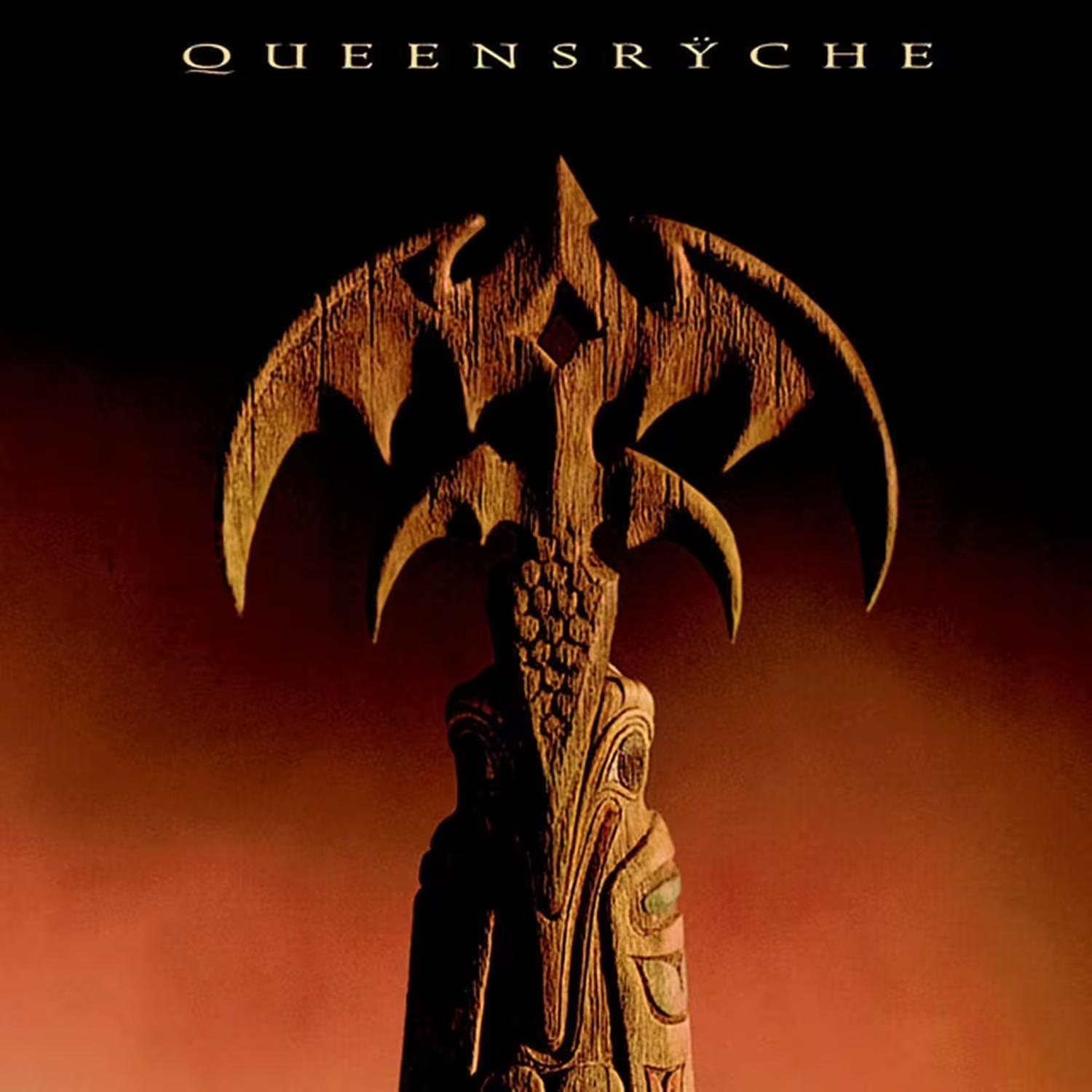
The sleeve was art-directed, designed and illustrated by Hugh Syme, the Canadian designer best known for his decades of work with Rush and who had already worked on Queensryche packaging earlier in the band's run. Syme's Promised Land illustrations sit in his signature register: surreal landscape, isolated figure, suggestive symbolic objects, no band photograph on the front. The look is deliberately at odds with the leather-and-stage-lights iconography of mid-1990s metal, and is closer in feel to a Rush Counterparts sleeve than to anything on the rest of EMI's metal roster that year.
The original 1994 CD booklet, EMI catalogue 7243-8-30711-2-8, prints full lyrics, the studio-by-studio recording credits and the engineering chain. The 2003 Capitol Records remastered booklet (72435-80529-2-3) adds the bonus-track credits and Evren Goknar's remaster note. A separate Japanese EMI issue (TOCP-8396) used the same artwork with Japanese-language inserts.
Critical Reviews Round-Up
| Publication | Reviewer / Year | Score |
|---|---|---|
| AllMusic | Stephen Thomas Erlewine, retrospective | 3 / 5 |
| Chicago Tribune | Brad Webber, 15 December 1994 | 3 / 4 |
| Entertainment Weekly | Chuck Eddy, 21 October 1994 | C+ |
| Q | December 1994 issue | 4 / 5 |
| Collector's Guide to Heavy Metal Vol. 3 | Martin Popoff, 2007 | 5 / 10 |
| Guitar World "50 Iconic Albums That Defined 1994" | July 2014 | Ranked 23 |
In TV, Film and Media
The album's only major sync moment predates it. Real World, written by Queensryche with composer Michael Kamen, appeared on the 1993 Last Action Hero soundtrack and was later included as a bonus track on the 2003 remaster. Songs from Promised Land itself have rarely surfaced in film and TV; the album's slower, more reflective tone made it a less obvious sync target than tracks from Empire. Within Queensryche's own live catalogue, I Am I, Bridge, Disconnected and the title track all reappeared regularly through the 1990s touring cycle and into the 2000s.
Controversy and Band Tensions
There is no single Promised-Land-era scandal in the classic sense. There is no banned cover, no parental advisory sticker controversy, no plagiarism suit. What there is, and what defines the album's place in band history, is the slow-burn tension that began during these sessions and ended with Chris DeGarmo's departure in late 1997.
The band has been careful in its public statements not to attribute that decision to any one event. Scott Rockenfield's most-cited explanation, given in a 2013 radio interview with The Signals of Intuition on 99.1 CJAM-FM, is the simplest summary the band has ever given:
"He wanted to pursue other things. He felt like he had done what he wanted musically in his life, and wanted to move on."
Scott Rockenfield, The Signals of Intuition (99.1 CJAM-FM), 2013
DeGarmo's father had died during the Promised Land sessions. The follow-up album, 1997's Hear in the Now Frontier, was made under intense schedule and label pressure as EMI America moved towards bankruptcy. The band has consistently described the late-1990s period as a low-trust environment by comparison with the Promised Land writing trips. DeGarmo's eventual exit was announced internally in late 1997 and publicly on 24 January 1998. He later trained and worked as a professional business jet pilot.
Covers, Samples and Tributes
For an album with a Platinum US plaque, Promised Land's songs have been covered surprisingly rarely on official tribute records. The acoustic songs, Bridge in particular, have had the most cover-version afterlife on YouTube and in fan acoustic-set circles. The title track has been performed in full by Queensryche's own subsequent lineups, including the Todd La Torre-fronted version that took over the band name in 2012, although La Torre himself has noted in interviews that he was less familiar with the Promised Land-era material than with Empire and earlier when he joined.
The album does not itself draw on prominent samples; the recurring field recordings on the record are original Rockenfield productions, not licensed sources.
Reissues, Remasters and Anniversaries
The headline reissue is the 2003 Capitol Records remaster, mastered by Evren Goknar, released on 10 June 2003 in CD and digital editions (catalogue 72435-80529-2-3). It restores and expands the album with bonus tracks: the full-band version of Someone Else? (7:13), Real World from the Last Action Hero soundtrack (4:23), and live versions of Damaged and Real World from the 20 October 1994 Astoria show.
The album has also reappeared on streaming platforms as the 2003 Capitol Records master, which is the version most listeners now hear. There has not, to date, been a deluxe-anniversary box set in the contemporary "remix from the multitracks" style that has been applied to other 1994 landmarks. Given the band's own ownership questions and EMI America's mid-1990s bankruptcy, the multitracks' chain of custody is part of why a more elaborate reissue has been slow to materialise.
| Edition | Format | Year | Catalogue |
|---|---|---|---|
| Original release | CD, cassette, vinyl | 1994 | EMI 7243-8-30711-2-8 |
| Japanese edition | CD with OBI | 1994 | EMI Japan TOCP-8396 |
| Remastered with bonus tracks | CD, digital | 10 June 2003 | Capitol Records 72435-80529-2-3 |
| Streaming master | Digital | 2003 to present | Capitol Records / UMG distribution |
Legacy and Influence
The arc of Queensryche's commercial story bends sharply at Promised Land. Empire, three years earlier, had sold over three million copies in the United States. Promised Land stopped at Platinum. Hear in the Now Frontier in March 1997 debuted at number 19 and vanished. Chris DeGarmo was gone by January 1998. EMI America was bankrupt that same year. The band, in retrospect, never quite returned to the audience size that Empire had given them.
For fans of the classic lineup, that makes Promised Land the most important record in their catalogue after Mindcrime. It is the last album where the five-man band wrote without external pressure, deliberately followed up their commercial peak with something less commercial, and got away with it on the chart even if the long-term audience did not follow. The album is regularly cited by Dream Theater, Porcupine Tree and the second wave of progressive metal acts that emerged in the late 1990s as a model of how to make a heavy album that does not sound heavy in the obvious ways.
The album also sits inside a wider 1994 conversation about what progressive American rock could be. The Guitar World 2014 placement, alongside Superunknown, Vitalogy, Jar of Flies, The Downward Spiral and Youthanasia, is the most useful retrospective framing: Promised Land is the entry in that group made by the band with the longest established arena career, taking the biggest step away from its own audience.
Things You Might Not Know
A dozen things worth pulling out of the research that did not fit naturally into the main narrative.
| Fact | Detail |
|---|---|
| The opener's title is a birthday | 9:28 a.m. is the time Scott Rockenfield was born. The track was given to him as a solo composition and built out of field recordings he captured on a portable ADAT. |
| The album closes on a bar scene | The seven-minute title track ends on a long field recording of people talking and drinking, often compared to the close of Pink Floyd's Welcome to the Machine, which DeGarmo and Tate openly cited as a touchstone. |
| Tate played sax for the first time on record | Promised Land introduced Geoff Tate's saxophone to the band's catalogue, on the title track and on Disconnected. He had played the instrument privately for years. |
| The title track is the band's first all-five credit | It is the first song in the Queensryche catalogue credited to DeGarmo, Jackson, Rockenfield, Tate and Wilton together. Every previous song had a tighter credit split. |
| Bridge is about DeGarmo's father | Chris DeGarmo's lyric refers to his relationship with his father, who died during the Promised Land sessions. The song became one of the most requested DeGarmo-era pieces at live shows. |
| The album mixed in a Heart-owned studio | Mix sessions took place at Bad Animals Studio in Seattle, the facility owned by Ann and Nancy Wilson of Heart, in the summer of 1994. |
| The CD-ROM came out eighteen months later | The Promised Land adventure game was released by EMI Interactive in March 1996, separately from the album, and was never bundled with the original 1994 CD. |
| It is their highest-charting album ever | The number 3 Billboard 200 debut remains the highest US chart peak of any Queensryche album, beating Empire's number 7 from 1990. |
| Bigger in Finland than at home, proportionally | Promised Land peaked at number 4 in Finland, the album's highest European position, beating its UK peak of 13 and the US debut at 3 as a proportion of population reach. |
| The same field recording is used twice | The train sound that opens Disconnected was originally recorded for 9:28 a.m. and is one of several Rockenfield ADAT captures that recur across the album. |
| Hugh Syme also designed for Rush | Sleeve designer Hugh Syme is best known for his decades of artwork with Rush. His Promised Land cover is deliberately closer in feel to Rush's Counterparts than to other 1994 metal sleeves. |
| The Q review was the kindest | Of the major 1994 reviews, Q magazine's four-star write-up in its December 1994 issue was the most positive contemporary verdict. Entertainment Weekly's C+ from 21 October 1994 was the harshest. |
Why the Album Still Matters
Thirty years on, Promised Land is the Queensryche record that has aged into its reputation. Empire is the bigger commercial story. Operation: Mindcrime is the bigger conceptual landmark. But Promised Land is the album that proves the band could write something genuinely strange after three million copies had given them every incentive not to. It is the album that explains why the classic lineup is the lineup fans still argue about, why DeGarmo's exit a few years later felt like such an obvious loss, and why progressive metal as a 1990s movement still treats Bellevue, Washington as one of its founding postcodes.
It is also the most rewarding Queensryche album to listen to end-to-end with no track-skipping, which is part of why anniversary discussions of 1994 keep returning to it. Hosts looking for a way to pitch the album to a listener who only knows Silent Lucidity should pitch it exactly that way: this is the record where the band that wrote Silent Lucidity decided to write something harder to like, and did it anyway, and got a Platinum plaque for the trouble.
The Riffology Podcast
If this deep dive has earned a place on the Promised Land rotation, the conversation continues on the Riffology podcast, where the hosts work through albums like this one in long form. New episodes drop regularly across all the major podcast platforms; listen there for the on-air version of the arguments above, plus the records the hosts could not get into this article without doubling its length.
Comments