The quick facts
| Fact | Detail |
|---|---|
| Album | Diary of a Madman |
| Artist | Ozzy Osbourne |
| Released | October 1981 |
| Label | Jet Records |
| Recorded | Ridge Farm Studio, Rusper, England, 1981 |
| Producers | Max Norman, Ozzy Osbourne, Randy Rhoads, Bob Daisley |
| Engineer | Max Norman |
| Mastered by | George Marino |
| Length | 43:19 |
| Tracks | 8 |
| Genre | Heavy metal, hard rock |
| Singles | Flying High Again, Over the Mountain, Tonight |
| Billboard 200 peak | Number sixteen |
| UK Albums peak | Number fourteen |
| RIAA certification | Three-times Platinum |
| Worldwide sales | Over three million copies |
| Tour | Diary of a Madman Tour, 5 November 1981 to 8 August 1982 |
| Distinction | Final studio album recorded with Randy Rhoads |
Where Ozzy stood after Blizzard of Ozz
By the time the Diary of a Madman sessions began at Ridge Farm in 1981, Ozzy Osbourne had spent barely twelve months as a solo artist. The release of [Blizzard of Ozz](/posts/ozzy-osbourne-blizzard-of-ozz/) in September 1980 had drawn a clean line under his post-[Black Sabbath](/posts/black-sabbath-a-complete-history/) wilderness years, with songs like Crazy Train, Mr Crowley and Suicide Solution rebuilding his commercial profile across both sides of the Atlantic. Within months, Blizzard had passed Gold certification in the United States and turned Ozzy from a faded former metal frontman into one of the highest-profile new acts on the heavy-rock circuit.
The pressure on the follow-up was sharp. The Blizzard of Ozz tour was still ongoing through the spring and summer of 1981, and the same nucleus of musicians that had assembled the debut, namely Ozzy on vocals, Randy Rhoads on guitar, Bob Daisley on bass and Lee Kerslake on drums, was expected to deliver a second studio album by the autumn. There was no time for a long writing campaign and no budget for an extended studio booking. The eight songs that ended up on Diary of a Madman had to come together quickly, and the team was working under the watch of a label and a management structure that wanted product on shelves before the touring momentum faded.
Signing with Jet Records
The label home for the Ozzy solo project was Jet Records, the imprint founded by Don Arden and distributed in the United States by Epic via CBS. Jet had carried Blizzard of Ozz from its UK release in September 1980 through to its eventual American campaign, and Diary of a Madman followed the same arrangement. Don Arden's daughter, Sharon, was managing the band by the time the Diary of a Madman sessions were under way, having taken over from her brother David Arden earlier in 1981 as the Osbourne project became too big for the Jet office to handle on a part-time basis.
The management transition would prove decisive. Sharon Arden, who would later become Sharon Osbourne, brought a much harder line into the band's business dealings, and the tensions that ran through the Ridge Farm sessions were partly downstream of the changeover. Within months of the album's completion Bob Daisley and Lee Kerslake had been removed from the band entirely, replaced for the touring cycle by Rudy Sarzo on bass and Tommy Aldridge on drums. The exact sequence of events around the firings has been disputed by both sides for the four decades since, but the outcome on the album itself is clear: the Diary of a Madman record was made by one band and toured by another.
The band around Randy Rhoads
The Diary of a Madman line-up was built around Randy Rhoads. The Californian-born guitarist, who had previously fronted Quiet Riot and was the son of music-school owner Delores Rhoads, was Ozzy's strongest collaborator. By 1981 his style had crystallised into a fusion of late-1970s hard-rock phrasing and the classical etudes he was studying with private teachers between tour dates. Rhoads was openly ambitious about turning his rock-band career into a stepping stone towards a classical-guitar future, and the Diary of a Madman compositions show that ambition pushing into the studio work.
Bob Daisley, a veteran Australian bassist who had previously played with Rainbow and Widowmaker, anchored the rhythm section. Daisley was also a substantial contributor to the songwriting, supplying the bulk of the lyrics across both Blizzard of Ozz and Diary of a Madman. Lee Kerslake, a long-serving drummer best known for his Uriah Heep tenure, occupied the kit and contributed both percussion ideas and additional songwriting input. The keyboard parts were handled in the studio by Johnny Cook, a session player who had worked with Daisley in Mungo Jerry during the 1970s. Don Airey, who is credited on the original sleeve, was actually on tour with Rainbow and unable to attend the sessions.
Sessions at Ridge Farm Studio
Recording was set at Ridge Farm Studio in Rusper, a residential complex in the Surrey countryside that had been operating as a major-label studio since the mid-1970s. The Ridge Farm sessions were short by 1981 standards. The band came in with most of the songs already roughed out from rehearsals and pre-production work, and the basic tracks were laid down with the minimum of overdub time the schedule allowed. Max Norman, who had engineered Blizzard of Ozz and was promoted to a full producer credit for the second album, ran the technical side.
The Ridge Farm environment was deliberately isolated. The band lived on site for the recording period and was largely cut off from the wider music business while the sessions were in progress. Lee Kerslake later described a working pattern that put most of the writing inside the studio rather than ahead of it: he stated that the basic demo tracks were "just Bob's words, my vocals, though some of the words I wrote, and Randy's playing", with Johnny Cook brought in afterwards to layer the keyboard parts. The piano-driven structure of much of the Diary of a Madman material reflects the studio-bound writing process, with Kerslake using the studio piano to sketch out song ideas with Rhoads.
Max Norman in the producer chair
Max Norman's role on Diary of a Madman was substantially larger than the engineering credit he had carried on Blizzard of Ozz. As both producer and engineer, Norman had effective control of the sonic palette across all eight tracks, and the Diary of a Madman mix carries his fingerprints in the careful balance between Rhoads's guitar layers and the rhythm-section foundation. The 43:19 running time, sat across only eight tracks, gave Norman the space to let songs breathe in ways that the more single-driven Blizzard of Ozz album had not allowed.
Norman would go on to produce a string of further Ozzy albums and would build a substantial separate career as the producer on records by Megadeth, Lynch Mob and Y&T, but Diary of a Madman is the album that established his reputation in the heavy-rock production circuit. George Marino mastered the original release, and the 1995 reissue was remastered by Brian Lee with Bob Ludwig. The Daisley and Ozzy production credits sit alongside Rhoads and Norman on the original liner; the four-man producer credit was a reflection of the genuinely collaborative way the songs had come together in the Ridge Farm room.
The credit controversy
The single largest controversy attached to Diary of a Madman has nothing to do with the music and everything to do with the credits. The original 1981 release listed Rudy Sarzo on bass, Tommy Aldridge on drums and Don Airey on keyboards. None of those three played on the record. Bob Daisley played every bass part. Lee Kerslake played every drum part. Johnny Cook played every keyboard part. The credits as printed reflected the touring line-up that took the album on the road, but did not reflect the studio reality.
Aldridge himself was open about the discrepancy from the start. He stated publicly that the drumming on Diary of a Madman was clearly not his and that he had always given Lee Kerslake the credit when interviewers raised the question. The legal dispute that followed was driven by Daisley and Kerslake. They were dropped from the band shortly after the Ridge Farm sessions ended and had no immediate route to claim either performance royalties or songwriting royalties. The litigation that resulted from that situation would take more than two decades to play out, and it would shape every reissue of the album in the meantime.
The personnel on the record
The actual performance personnel on Diary of a Madman, drawn from the corrected reissue notes and later interviews, can now be stated cleanly. Ozzy Osbourne handled all lead vocals. Randy Rhoads played all guitars. Bob Daisley played all bass. Lee Kerslake played all drums and percussion. Johnny Cook handled all keyboards. Louis Clark provided the orchestral string arrangements for the title track, lifting that song's closing section into the symphonic register that gave the album its name.
Production credits are shared by Max Norman, Ozzy Osbourne, Randy Rhoads and Bob Daisley. Max Norman is credited separately for engineering. George Marino mastered the original 1981 release. The 1995 reissue was remastered by Brian Lee with Bob Ludwig. The 2002 reissue replaced Daisley and Kerslake's parts with newly recorded bass from Robert Trujillo and drums from Mike Bordin, produced by Thom Panunzio and engineered and mixed by German Villacorta. The 2011 thirtieth-anniversary reissue restored the original Daisley and Kerslake tracks.
The sound of Diary of a Madman
The album is classified primarily as heavy metal, with some sources adding hard rock as a parallel descriptor. The closer "Diary of a Madman" pushes into orchestral territory with Louis Clark's string arrangement and is sometimes singled out as a precursor to what would later be called symphonic metal, but the overall record sits comfortably in the early-1980s British heavy-metal lineage. The signature element is Randy Rhoads's playing, which moves between conventional hard-rock riffing and overtly classical-style lead work, often layered into four-part guitar arrangements that exploit the studio's overdub capacity.
Rhythmically the album is more varied than Blizzard of Ozz had been. Kerslake's drumming brings a heavier swing on several tracks and a tighter, almost progressive precision on others. Daisley's bass lines hold the centre of the mix without ever pushing into spotlight passages. Ozzy's vocal delivery is more controlled than on the debut, with several tracks built around the kind of slow, dramatic intro that would become a fixture of the post-Sabbath Ozzy solo sound for the rest of the decade. The final result is a record that runs only forty-three minutes but contains some of the most ambitious arrangements of either Rhoads-era Ozzy album.
Over the Mountain and the opening statement
The album opens with "Over the Mountain", a 4:31 burst of drums-led hard rock that has Kerslake's snare and tom rolls as the entry hook before Rhoads's riff drops in. The song was reportedly one of Kerslake's primary writing contributions, with the drummer crediting himself with both the title and the verse structure in his 2009 retrospective interviews. Ozzy's lead vocal hits its first chorus inside the first sixty seconds, and the arrangement carries a level of energy that established the album's pace from the first bar.
The track became the album's second UK single, released on 4 December 1981, after Flying High Again had gone out as the lead. Although "Over the Mountain" did not match Flying High Again in commercial reach, it remained a fixture of Ozzy's live set across the next four decades, and reissue campaigns have consistently treated it as one of the album's defining moments. The official audio is embedded below from the OzzyOsbourneVEVO channel.
Flying High Again and the radio single
"Flying High Again", track two on the album and the first single off the record, was released in the United Kingdom on 16 October 1981. The 4:43 cut is the most overtly radio-shaped song on Diary of a Madman. The opening Rhoads riff drives directly into a vocal hook, the chorus arrives quickly and the bridge gives Rhoads a compact solo that became one of the most-quoted lead passages of his short career. The song's lyric, with its veiled references to drug-aided escape from depression, sat comfortably inside the early-1980s metal context without crossing the radio-acceptability lines that had hurt the Blizzard of Ozz single "Suicide Solution".
The Flying High Again video was filmed in 1981 with the studio line-up of Ozzy, Rhoads, Daisley and Kerslake, although by the time it reached MTV the touring band had already changed. It is one of the relatively small number of moving-image documents of Randy Rhoads playing the Diary of a Madman material, and the OzzyOsbourneVEVO upload below remains the canonical version on the official Ozzy channel.
You Cant Kill Rock and Roll and the power ballad
Track three, "You Can't Kill Rock and Roll", is the longest cut on the album at 6:58 and the closest the record comes to a power ballad. The arrangement starts on a clean Rhoads acoustic figure and Ozzy's softer vocal register, then drops into a layered electric-guitar bridge before returning to the quieter form. Daisley's bass is more melodic than on the heavier tracks, and Kerslake's drumming holds back through the opening sections in favour of a measured build that gives the closing solo its full impact.
Lyrically the song reads as a defence of the medium itself, written from the perspective of an artist who had been written off more than once during the late-1970s years before the solo album reset his career. Ozzy delivers the chorus as a statement of survival rather than a celebration. The track was not released as a single but became one of the album's most-streamed deeper cuts in the years since the digital reissues opened the catalogue up to wider playlist exposure.
Believer and the deeper cuts
"Believer", the fourth and final track on side one, brings the album back into heavier territory with a Daisley-led bass figure that opens the song before Rhoads's riff joins. The 5:17 cut became one of the staples of the Diary of a Madman live set and was the song the band opened many of the touring shows with. Ozzy's vocal stays in the lower middle of his range across the verses and rises only at the chorus, and Rhoads's solo is one of the more openly Eddie Van Halen-influenced moments on the record.
Side two opens with "Little Dolls" at 5:39, an unusually rhythm-section-forward cut that is the closest the album comes to a tom-driven Sabbath-style stomp. The song was rarely played live in the original Diary of a Madman touring cycle but has been revived for occasional Ozzy and tribute performances since. Together "Believer" and "Little Dolls" form the dense middle of the album, separating the radio-friendly opening pair from the more introspective material on the closing three tracks.
Little Dolls, Tonight and S.A.T.O.
"Tonight", the second cut on side two at 5:50, was issued as a US single in 1982 to support the touring cycle. It is a mid-tempo song built around a slow Rhoads arpeggio that opens into a heavier chorus, with Ozzy holding back across the verses before the bigger vocal push at the end. The single did not have the chart impact of Flying High Again or Over the Mountain, but it kept the album in front of US radio programmers through the early months of 1982.
"S.A.T.O.", the third cut on side two at 4:06, is the shortest song on the record and the most rhythmically aggressive. The title, an acronym whose meaning was never officially confirmed by the band, has been variously decoded by interviewers and fans across the years; the song itself is a high-tempo Rhoads showcase with a tighter structure than most of the longer cuts. The closing two tracks together establish the pacing that leads into the album's title-track finale.
The title track Diary of a Madman
The 6:15 closer is the album's most ambitious arrangement. "Diary of a Madman" opens on a classical-guitar sequence from Rhoads, supported by Louis Clark's orchestral string arrangement, and builds across multiple distinct sections before resolving into a heavier rock arrangement at the end. Clark, a long-standing arranger and member of the Electric Light Orchestra's touring band, brought the symphonic textures that lift the song's closing passage above anything else on the album.
The title and the music both pull from the album's late-period writing block at Ridge Farm. The song's structure, more progressive than the rest of the record, anticipates the direction that 1980s heavy metal would take in the second half of the decade as more bands began incorporating orchestral elements. The choice to close the album on this track, rather than on a heavier, more obviously single-shaped song, was the kind of decision that the Norman, Rhoads and Daisley production team made with confidence in the strength of the material.
The full tracklist
The original 1981 release contains eight tracks across two sides, with a total running time of 43:19. All songs are credited to Osbourne, Rhoads, Daisley and Kerslake, except where noted.
| No. | Title | Writer(s) | Length |
|---|---|---|---|
| 1 | Over the Mountain | Osbourne, Rhoads, Daisley, Kerslake | 4:31 |
| 2 | Flying High Again | Osbourne, Rhoads, Daisley, Kerslake | 4:43 |
| 3 | You Can't Kill Rock and Roll | Osbourne, Rhoads, Daisley | 6:58 |
| 4 | Believer | Osbourne, Rhoads, Daisley | 5:17 |
| 5 | Little Dolls | Osbourne, Rhoads, Daisley, Kerslake | 5:39 |
| 6 | Tonight | Osbourne, Rhoads, Daisley, Kerslake | 5:50 |
| 7 | S.A.T.O. | Osbourne, Rhoads, Daisley, Kerslake | 4:06 |
| 8 | Diary of a Madman | Osbourne, Rhoads, Daisley, Kerslake | 6:15 |
The album cover and Louis Osbourne
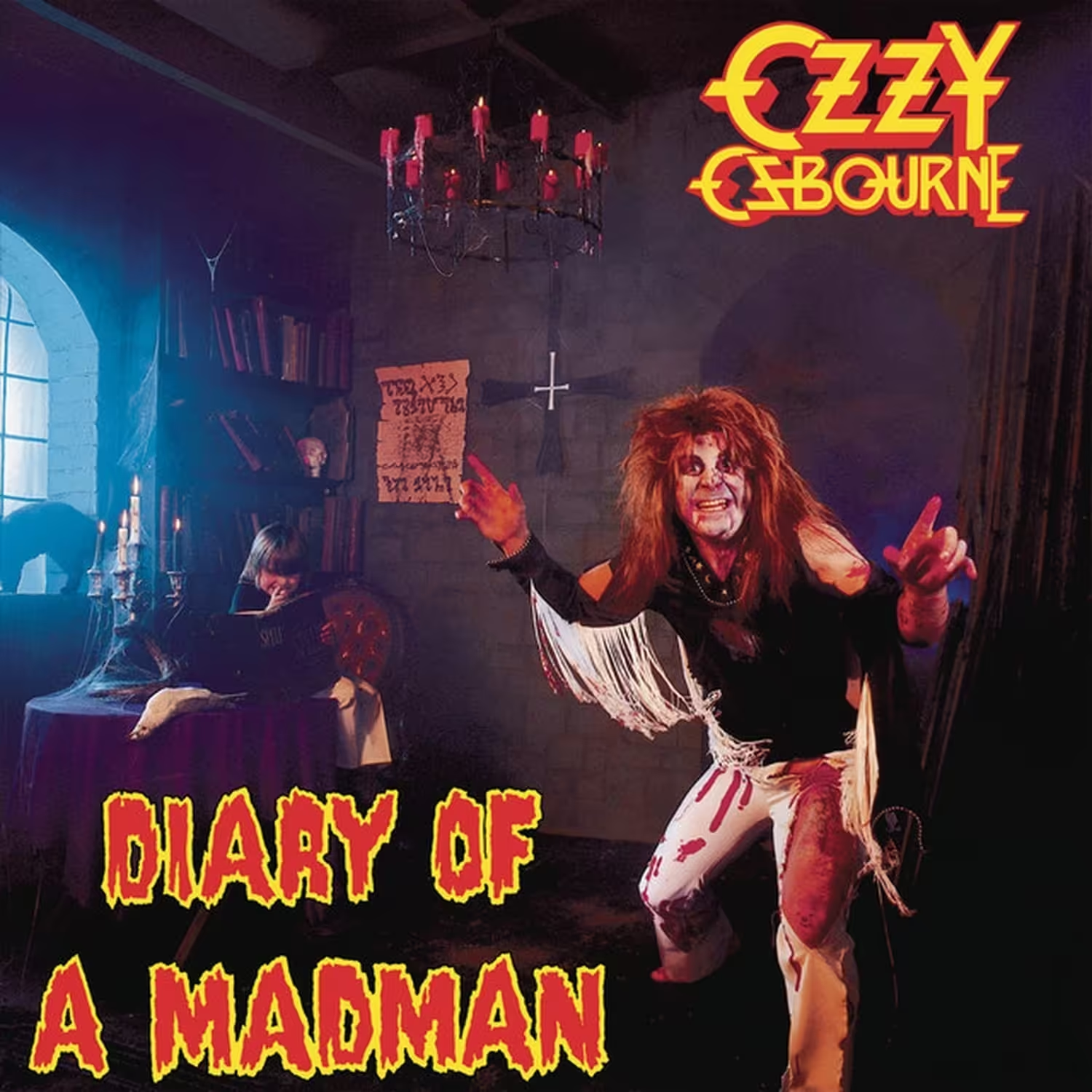
The cover image is one of the most-recognised photographs in early-1980s heavy metal. The shot, which features Ozzy Osbourne in heavy theatrical make-up posing with his young son Louis, was set in a candlelit gothic interior with Ozzy in a dramatic seated posture and Louis holding a kitten. The image was conceived to deliver a darker theatrical visual after the more straightforward photographic cover that Blizzard of Ozz had carried, and it would become a frequent reference point in the visual identity of subsequent Ozzy releases.
The artwork carries the distinctive Diary of a Madman logo, designed in a horror-poster typeface that was reused across single sleeves and tour merchandise. The reissue editions have generally retained the original cover image, although the 30th anniversary edition added expanded inner-sleeve material with photography from the Ridge Farm sessions and additional credits acknowledging Daisley, Kerslake and Cook. The 40th anniversary expanded edition cover used as the hero image on this article is the most recent presentation in the same visual lineage.
Release and rollout
Diary of a Madman was released in October 1981 through Jet Records, with the US release following on Epic via CBS later that month. The lead single, Flying High Again, had been issued on 16 October 1981. The second single, Over the Mountain, followed on 4 December 1981. The US single Tonight was released in 1982 to support the early months of the touring cycle. The promotional campaign was relatively lean compared with later major-label rollouts, and most of the early sales came from radio airplay on US rock stations and from the touring cycle that began almost immediately after release.
The album's rollout was supported by an extensive touring schedule that began on 5 November 1981. The Diary of a Madman Tour was originally planned to run through North America, Europe and Asia, and the early dates were configured around the album's heavier material with Over the Mountain or Believer opening the show and Mr Crowley or the closing title track in the encore slot. The touring cycle would continue until 8 August 1982, but it would be transformed in March of that year by the death of Randy Rhoads.
Chart performance
The chart story for Diary of a Madman was solid rather than spectacular at first release. The album debuted on the UK Albums Chart in November 1981 and peaked at number fourteen. In the United States, the album reached number sixteen on the Billboard 200. In Canada, it peaked at number seventeen on the RPM albums chart. In New Zealand, the album reached number forty-two on the national albums chart. The legacy charts have treated the record more generously: Diary of a Madman has returned to the UK Rock and Metal Albums chart on multiple reissue cycles, including number eleven in June 2011 around the thirtieth-anniversary edition and number twenty-four in December 2021 during a wider Ozzy catalogue refresh.
The genre-specific US Billboard charts have placed the album higher than the all-genre Billboard 200 reading. Diary of a Madman peaked at number three on the US Top Hard Rock Albums chart and at number nine on the US Top Rock Albums chart. The certification path is steady: the album was certified Platinum in the United States within its first decade, Double Platinum by the mid-1990s, and Triple Platinum by 1994. UK BPI certification reached Silver in the same period, with Music Canada certifying the record Platinum for sales above 100,000. Total worldwide sales have been reported as over three million copies.
Critical reception
Contemporary 1981 and 1982 reviews were mixed but largely positive on the Ozzy side and largely positive on the Rhoads side. AllMusic's Steve Huey, writing in the retrospective era, described the album as not uncommon to find fans preferring it to Blizzard of Ozz, citing the more mystical and eerie mood and Rhoads's playing reaching an even higher level. BBC Music's Helen Groom called the record a classic rock record in every way and credited the legendary rock axe god Randy Rhoads with lifting the material out of the ordinary.
The most-cited harsh contemporary review was J. D. Considine's piece in Rolling Stone, which dismissed the songs as little more than riffs with vocal lines pasted on top and described Rhoads as a junior-league Eddie Van Halen with chops but limited imagination. Rolling Stone would later revise its view substantially; in 2017 the magazine ranked Diary of a Madman as the fifteenth-best metal album of all time. Martin Popoff has called the album a lasting classic and the definitive showcase for Randy Rhoads, and Diary of a Madman has steadily climbed in retrospective greatest-of lists across the four decades since release.
The Diary of a Madman Tour
The Diary of a Madman Tour ran from 5 November 1981 through to 8 August 1982 across Europe, North America and Asia. The opening dates featured the new touring line-up of Ozzy on vocals, Randy Rhoads on guitar, Rudy Sarzo on bass and Tommy Aldridge on drums. The set drew almost evenly between Blizzard of Ozz and Diary of a Madman material, with selected Black Sabbath songs like Iron Man and Paranoid in the encore slot, and the tour built the kind of nightly two-hour metal show that became the template for the rest of the decade.
The tour was the platform that lifted Diary of a Madman from a strong-selling album into a commercial breakthrough. The North American leg, which ran from late autumn 1981 through to the late winter of 1982, was the heaviest concentration of dates and brought Ozzy face-to-face with the radio-driven US audience that had only encountered the Blizzard of Ozz material at radio rather than on stage. The Ozzy Live double LP, released in 2012 as the standalone vinyl version of the second disc from the 2011 Legacy Edition, contains professionally recorded performances from this North American leg.
The death of Randy Rhoads
On 19 March 1982, during the North American leg of the Diary of a Madman Tour, Randy Rhoads died in a small-plane crash near Leesburg, Florida. The aircraft was a 1955 Beechcraft Bonanza, and Rhoads had taken a sightseeing flight from the tour bus parking lot at the Flying Baron Estates with the bus driver, Andrew Aycock, at the controls. The plane clipped the band's tour bus during a low fly-over and crashed into a nearby house. Rhoads, hair-and-makeup artist Rachel Youngblood and Aycock were killed. Rhoads was twenty-five years old.
The Diary of a Madman touring cycle paused for two weeks. Bernie Torme, a former Gillan guitarist from London, joined the band as a temporary substitute and played a small run of shows. Brad Gillis, formerly of Night Ranger, then replaced Torme for the remainder of the cycle. The decision to continue the tour at all, made by Sharon Osbourne and Ozzy in the immediate aftermath of the crash, was controversial among parts of the fan base at the time and has been reflected on differently in subsequent Ozzy autobiographies. Rhoads was inducted into the Hollywood Rock Walk in 2004 and into the Hollywood Walk of Fame as a session musician honoree in 2021.
The 2002 reissue controversy
The 2002 Epic and Sony Music reissue of Diary of a Madman, paired with a parallel reissue of Blizzard of Ozz, replaced the original Bob Daisley bass tracks and Lee Kerslake drum tracks with new performances by Robert Trujillo on bass and Mike Bordin on drums. Trujillo and Bordin were both members of Ozzy's then-current touring band, and the new parts were produced by Thom Panunzio and engineered and mixed by German Villacorta. The Daisley and Kerslake credits were removed entirely from the reissue.
The move drew immediate criticism from the fan base. Daisley and Kerslake were engaged in royalty litigation against the Osbournes at the time of the reissue, and the timing was interpreted as retaliatory. Sharon Osbourne stated that the decision had been made because of what she described as the abusive and unjust behaviour of Daisley and Kerslake, framing the reissue as turning a negative into a positive by adding a fresh sound to the original albums. Ozzy Osbourne contradicted that account in his 2009 autobiography I Am Ozzy, attributing the decision entirely to Sharon and stating that he had no involvement in it. The Daisley and Kerslake lawsuit was dismissed in 2003. Original-bass-and-drums versions of the album would not be available again until the 2011 reissue.
The 30th anniversary edition
In May 2011, Sony Legacy released a Deluxe Thirtieth Anniversary Edition of Diary of a Madman alongside a parallel reissue of Blizzard of Ozz. The Diary edition restored the original 1981 Daisley and Kerslake performances across all eight tracks and added a second disc titled Ozzy Live, containing previously unreleased professionally recorded concert performances from the 1981 US tour with Randy Rhoads. A box set, simultaneously released, packaged remastered editions of both albums on CD and vinyl alongside a DVD documentary titled Thirty Years After The Blizzard.
Ozzy Live was also issued separately as a double 180-gram vinyl exclusively for Record Store Day 2012, with sides one, two and three carrying the live material from the 2011 Legacy Edition and side four adding two bonus tracks previously released on the 2011 Blizzard of Ozz reissue. The same Record Store Day release included a seven-inch vinyl reissue of the song "Believer". The thirtieth-anniversary edition has remained the canonical reissue of Diary of a Madman in the years since, with the 40th anniversary edition extending the same approach with additional expanded materials.
Legacy and influence
The long-term legacy of Diary of a Madman runs through two strands. The first is the album's role as the second pillar of the Rhoads era of Ozzy Osbourne's solo career. Together with Blizzard of Ozz, it established the visual, sonic and live-show template that Ozzy and his touring producers carried forward into [Bark at the Moon](/posts/the-making-of-bark-at-the-moon-by-ozzy-osbourne/) in 1983, [The Ultimate Sin](/posts/the-making-of-the-ultimate-sin-by-ozzy-osbourne/) in 1986 and [No Rest for the Wicked](/posts/the-making-of-no-rest-for-the-wicked-by-ozzy-osbourne/) in 1988. Each of those records pulled from a different guitarist, but each one carried structural and sonic decisions that were first worked out on Diary of a Madman.
The second strand is Rhoads's influence on the next generation of heavy-metal guitar players. The neoclassical phrasing on Diary of a Madman was being widely studied and quoted within five years of release, and the guitar solos on tracks like "Flying High Again", "Believer" and the title track became fixtures of the music-school heavy-rock curriculum. The album sits alongside Van Halen's debut and Iron Maiden's The Number of the Beast as one of the most-cited reference points for early-1980s heavy-rock guitar work, and the music has aged into a status considerably higher than the contemporary 1982 reviews would have predicted.
Things you might not know
Several details from the Ridge Farm sessions are worth flagging for context. The credited keyboard player Don Airey did not play on the album because he was on tour with Rainbow at the time of recording; Johnny Cook, a session player who had previously worked with Bob Daisley in Mungo Jerry, recorded all the keyboard parts. Lee Kerslake claimed to have written substantial portions of the music as well as the lyrics, including the title and verse structure of "Over the Mountain" and the original demo arrangement of "Flying High Again", although he was not credited in the original release.
The young child on the album cover is Ozzy's son Louis Osbourne. Both Lee Kerslake and Bob Daisley were dismissed from the band shortly after the Ridge Farm sessions ended and before the album reached shops, and both have stated in interviews that the firings were a surprise. The album was the last studio record Randy Rhoads completed before his death in March 1982; Rhoads had been studying classical guitar with private teachers during the touring breaks and had stated in interviews that he intended to leave rock for a formal classical-guitar career within a few years. The Louis Clark string arrangement on the title track was recorded with a small orchestral ensemble at a separate session and overdubbed onto the Ridge Farm master.