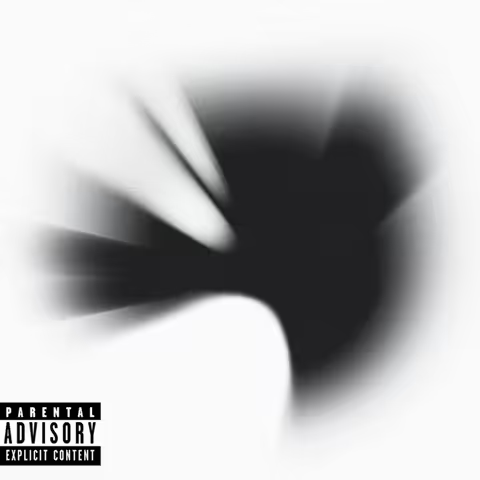
Linkin Park spent almost two years inside NRG Recording Studios in North Hollywood with Rick Rubin, decided their fourth album should be a single forty-seven-minute meditation on nuclear annihilation built mostly out of synthesisers and sampled speeches, named it after a line that J. Robert Oppenheimer recalled from the Bhagavad Gita while watching the first atomic bomb explode, then released it as the follow-up to a record that had already sold five million copies in the United States.
It still worked. A Thousand Suns arrived on 14 September 2010 in the United States and debuted at number one on the Billboard 200 with 241,000 copies sold in seven days, topped the album chart in more than ten other countries the same week, and was eventually certified Platinum by the Recording Industry Association of America. The reviews split along familiar lines, the fans were openly divided, and the band emerged with a record that critics would spend the next decade comparing to Radiohead's Kid A. This is the complete story of how Linkin Park made their strangest album.
The quick facts
| Field | Detail |
|---|---|
| Artist | Linkin Park |
| Album | A Thousand Suns |
| International release | 8 September 2010 |
| United States release | 14 September 2010 |
| Label | Warner Bros.; Machine Shop |
| Producers | Rick Rubin and Mike Shinoda |
| Mixing | Neal Avron |
| Mastering | Vlado Meller |
| Studio | NRG Recording Studios, North Hollywood, Los Angeles |
| Recording dates | November 2008 to August 2010 |
| Genres | Electronic rock, experimental rock, industrial rock, art rock, alternative rock |
| Track count | 15 |
| Total runtime | 47:48 |
| Singles | "The Catalyst"; Waiting for the End; Burning in the Skies; Iridescent |
| Billboard 200 peak | Number one (debut, 241,000 first-week United States sales) |
| UK Albums Chart peak | Number two (debut) |
| RIAA certification | Platinum (August 2017) |
| Metacritic score | 66 out of 100 |
| MusicBrainz release-group | 65404106-2976-4f98-a0e2-4e76923ea06d |
Where Linkin Park stood after Minutes to Midnight
By the time sessions for the fourth album began at the end of 2008, Linkin Park had already used their third record to break the rap-rock template that had defined them. [Minutes to Midnight](/posts/the-making-of-minutes-to-midnight-by-linkin-park/), released in May 2007 and co-produced by Rick Rubin and Mike Shinoda, had stepped away from the verse-rap, chorus-scream architecture of [Hybrid Theory](/posts/the-making-of-hybrid-theory-by-linkin-park/) and Meteora and into a broader alternative rock palette. It had debuted at number one on the Billboard 200 with 623,000 first-week United States copies and gone on to sell more than four million in the United States, which proved the audience would follow the band through a stylistic change.
That commercial result mattered for the fourth album in a specific way. It removed the argument that the band had to play it safe to protect the brand. The third album had been a controlled deviation from the formula; the fourth could go further still without the producers having to relitigate the basic question of whether a Linkin Park record needed to sound like Linkin Park.
The band itself had also been moving in directions that pulled away from the original template. Mike Shinoda had spent 2005 fronting his hip-hop side project Fort Minor on The Rising Tied. Chester Bennington had begun working with the side band that would become Dead by Sunrise, which would release its only studio album, Out of Ashes, in October 2009. By the time the fourth album sessions started, the members were a less narrowly defined group than they had been when Hybrid Theory came out a decade earlier.
Sessions at NRG Recording Studios
Recording for A Thousand Suns began in November 2008 and continued until August 2010. The full process took roughly twenty-one months, longer than the gap between many of Linkin Park's earlier albums and unusually long by major-label rock standards of the period. All of the primary tracking was done at NRG Recording Studios in North Hollywood, Los Angeles, which Rick Rubin had used for many of his late-2000s productions and which the band already knew from the later stages of Minutes to Midnight.
Rubin and Mike Shinoda again shared production duties. The arrangement was the same as it had been on the third album: Rubin functioned as the senior producer with executive sign-off on songs and performances, while Shinoda handled the day-to-day decisions about textures, programming and arrangement. The continuity in the production team was deliberate. The band had decided that the larger experiment they wanted to attempt on the fourth album was best supported by a production setup they had already tested, rather than introducing another variable on top of an already ambitious creative brief.
The engineering team was correspondingly stable. Ethan Mates and Josh Newell handled engineering and Pro Tools duties, mirroring the technical setup from Minutes to Midnight. Neal Avron, who had mixed the previous album, returned to mix A Thousand Suns. Mastering passed from Brian Gardner to Vlado Meller, with Mark Santangelo assisting.
The concept and the title
From the earliest interviews about the fourth album, Chester Bennington and Mike Shinoda described it as a concept record. In November 2008, Bennington told MTV that the new material would be built around an overarching idea, framing the choice as creatively risky but worth attempting. As work continued, the band oscillated publicly on whether the term "concept album" applied at all. By the end of the sessions, Shinoda was telling press that the record was not a concept album in the strict narrative sense but was "more abstract", with no single storyline but a shared set of preoccupations across the fifteen tracks.
Those preoccupations were political and existential. The album's title, A Thousand Suns, comes directly from the Bhagavad Gita: "If the radiance of a thousand suns were to burst at once into the sky, that would be like the splendour of the mighty one." J. Robert Oppenheimer, the physicist who led the Manhattan Project, recalled the line after watching the first nuclear weapon detonate in the New Mexico desert in July 1945, and that association turned the phrase into a permanent piece of nuclear-age vocabulary. The line also appears, paraphrased, inside the lead single "The Catalyst", in the lyric "God save us everyone, will we burn inside the fires of a thousand suns?".
The album's liner notes framed the title in continuity with that history rather than as a one-off reference. They described Oppenheimer's words as resonating "not only for their historical significance, but for their emotional gravity", and positioned A Thousand Suns as an attempt to grapple with what the band described as "the personal cycle of pride, destruction, and regret". That framing recurs across the record's interludes and short tracks, where samples of historical speeches do as much narrative work as the song lyrics themselves.
The personnel on the record
The five members of Linkin Park appear across the album with notably broadened instrumental credits. Chester Bennington is credited with vocals, lyrics, percussion and rhythm guitar on "Iridescent". Mike Shinoda is credited with vocals, lyrics, rhythm guitar, lead guitar on "Burning in the Skies", keyboards, sampler, piano, synthesiser, vocoder on "The Requiem" and "Fallout", producer, engineer, creative director and Pro Tools. Brad Delson is credited with lead guitar, rhythm guitar on "Burning in the Skies", sampler, backing vocals, keyboards, percussion, acoustic guitar on "The Messenger" and additional Pro Tools editing.
The production credits beyond Rick Rubin and Mike Shinoda were correspondingly extensive. Ethan Mates and Josh Newell handled engineering and Pro Tools work. Neal Avron mixed the album with Nicolas Fournier assisting. Vlado Meller mastered the album with Mark Santangelo assisting. Lindsay Chase and Ryan DeMarti handled production coordination, Jerry Johnson was credited as drum technician, and Frank Maddocks, Josh Vanover and Ellen Wakayama held the creative director and design credits across the album's visual identity.
Speeches and samples
Three notable speech samples appear across the album. "The Radiance", the album's second track, includes a portion of an interview with J. Robert Oppenheimer reflecting on the bomb. "Wretches and Kings" samples Mario Savio's 1964 "Operation of the Machine" speech, delivered on the steps of Sproul Hall at the University of California, Berkeley during the Free Speech Movement. "Wisdom, Justice, and Love" uses an excerpt of Martin Luther King Jr.'s 4 April 1967 speech "Beyond Vietnam: A Time to Break Silence", delivered at Riverside Church in New York City exactly a year before his assassination.
Those three samples function as more than decoration. They anchor the album in twentieth-century history at specific, named moments: the first nuclear test, the campus civil-rights and free-speech protests of the 1960s, and the American anti-war movement at one of its most articulate public peaks. Each is folded into the production with deliberate restraint, often slowed, processed or layered under instrumentation, in a way that signals that the speakers and their arguments are part of the album's subject rather than ornamental references.
The musical departure
Stylistically, A Thousand Suns went further than its predecessor in the same direction. Where Minutes to Midnight had reduced the rap-rock template by featuring fewer rap verses and more straightforward rock arrangements, A Thousand Suns reduced the role of guitar itself. Brad Delson plays lead guitar across the record, but on several tracks the prominent instruments are synthesiser, drum machine, sampler, piano and processed vocals rather than a recognisable rock-band lineup. Mike Shinoda's production credits across the album include keyboards, sampler, piano, synthesiser and vocoder.
The genres pinned to the album by critics on release reflect that shift. Reviewers variously described A Thousand Suns as electronic rock, experimental rock, industrial rock, art rock and progressive rock, with traces of trip hop, ambient and rap rock across individual tracks. No critic seriously described it as nu-metal or rap-rock in the sense that those terms had been applied to Hybrid Theory. Where rap appears on the record, on tracks such as "When They Come for Me" and "Wretches and Kings", it is presented in a sparser and more abrasive form than on the band's earlier hits.
The arrangement of the fifteen tracks reinforces that change. Five of them are short interludes or instrumentals of under two minutes: "The Requiem", "The Radiance", "Empty Spaces", "Jornada del Muerto" and "Fallout". They are not bonus material. They are sequenced as connective tissue between the longer songs, so that listening to the album in order is closer to listening to a single, segued forty-seven-minute composition than to a conventional collection of singles and album cuts. The band even released an iTunes version that presented the entire album as a single, unbroken track running 47 minutes and 56 seconds.
The Catalyst and the lead single
"The Catalyst", the album's first single, was released to digital retailers and radio on 2 August 2010, more than a month before the album itself. The song carries the album's title phrase inside its lyric and was framed in early press as the calling card for the new sound. It runs five minutes and thirty-nine seconds and is built around stuttering programmed beats, layered Bennington and Shinoda vocals, and a long instrumental passage that gives the track an unusual shape for a lead single from a major-label rock act.
Joe Hahn directed the music video, which premiered on 26 August 2010 and intercut footage of the band performing in a darkened space with imagery of natural disaster and water. The visual approach pulled away from the recognisable Linkin Park live-action aesthetic of the first three album cycles. The single's first public live performance came at the 2010 MTV Video Music Awards on 12 September 2010 at the Griffith Observatory in Los Angeles, with the venue kept secret until the broadcast itself.
On the United States charts the single reached number twenty-seven on the Billboard Hot 100 and peaked at number one on both the Billboard Alternative Songs and Rock Songs charts. It was certified Gold by the Recording Industry Association of America in July 2011. The video below is the official Linkin Park version.
Waiting for the End and the singles campaign
"Waiting for the End", the album's second single, was released on 1 October 2010 with a music video directed by Joe Hahn premiering on 8 October. The song is one of the most accessible tracks on the album, with a melodic Shinoda lead vocal in the verses that several critics compared to a reggae cadence, and a Bennington chorus that draws on the more open, less rap-driven side of the previous album's writing. The single reached number forty-two on the Billboard Hot 100, peaked at number one on the Billboard Alternative Songs chart for what was Linkin Park's tenth number-one on that list, and reached number two on the Billboard Rock Songs chart.
The band performed "Waiting for the End" at the Puerta de Alcala in Madrid as part of the 2010 MTV Europe Music Awards broadcast in November 2010, and the song appeared in an episode of CBS drama CSI: Crime Scene Investigation on 14 October 2010. It was certified Gold by the Recording Industry Association of America in April 2011.
"Burning in the Skies", the album's third single, was released on 21 March 2011 with a Hahn-directed video. "Iridescent", the fourth and final single, was confirmed by Mike Shinoda on 13 April 2011 and released on 28 May 2011, with a slightly shorter edit included on the soundtrack to Transformers: Dark of the Moon. The band performed the single edit of "Iridescent" at the film's premiere in Red Square, Moscow, on 23 June 2011. The video below is the official Linkin Park version of "Waiting for the End".
The full tracklist
| No. | Title | Length |
|---|---|---|
| 1 | The Requiem | 2:01 |
| 2 | The Radiance | 0:57 |
| 3 | Burning in the Skies | 4:13 |
| 4 | Empty Spaces | 0:18 |
| 5 | When They Come for Me | 4:53 |
| 6 | Robot Boy | 4:29 |
| 7 | Jornada del Muerto | 1:34 |
| 8 | Waiting for the End | 3:51 |
| 9 | Blackout | 4:39 |
| 10 | Wretches and Kings | 4:10 |
| 11 | Wisdom, Justice, and Love | 1:39 |
| 12 | Iridescent | 4:56 |
| 13 | Fallout | 1:23 |
| 14 | The Catalyst | 5:39 |
| 15 | The Messenger | 3:01 |
| Total length | 47:48 | |
All tracks were written by Linkin Park, with the exception of "Wisdom, Justice, and Love", which is credited to Linkin Park and Martin Luther King Jr. in recognition of the speech sample. The album is the band's longest studio record by total runtime to that point in their catalogue.
Key tracks and their roles
Several tracks across the album carry distinct musical and thematic roles. "Wretches and Kings" is the album's most aggressive hip-hop track and was identified by Mike Shinoda in an NME interview as a deliberate homage to Public Enemy and to Chuck D in particular. Ian Winwood of Kerrang! noted that the song references Public Enemy's "Fight the Power" and compared the album as a whole to Public Enemy's 1990 record Fear of a Black Planet. Chuck D later provided vocals on a remix of the song by HavocNdeeD.
"When They Come for Me" sits in a similar zone, with Shinoda rapping over heavy percussion and a chant-like chorus that pulls in all five band members. The song's title and structure reference Jay-Z's 2002 album The Blueprint 2: The Gift and The Curse, drawing a line back to Linkin Park's 2004 mash-up collaboration with Jay-Z on Collision Course.
"Iridescent" sits at the centre of the back half of the record and is one of the few tracks on the album where all five band members sing together. It served as the album's closing emotional statement on the original sequencing alongside "The Messenger", and its later use on the Transformers: Dark of the Moon soundtrack gave it a second life outside the album cycle. "Robot Boy" and "Blackout" sit on either side of the album's central run, with "Robot Boy" leaning towards art rock and "Blackout" pushing into industrial textures and processed vocals that distort Bennington's voice well past anything on the band's earlier records.
Release and rollout
Linkin Park rolled the album out across the international market over a single week in September 2010. A Thousand Suns was released on 8 September 2010 across Germany, Austria, Switzerland, Australia, New Zealand, France, the United Kingdom and most of Europe. It was released on 9 September 2010 in Hungary, on 13 September 2010 in Poland, and on 14 September 2010 in the United States and Brazil. Japan received the standard edition on 15 September 2010, with a special edition on 29 September 2010 and a Gunpla 30th anniversary bundle on 24 November 2010.
The day before the United States release, the band held a 3-D laser exhibition tied to the album at the Music Box Theater in Hollywood on 7 September 2010. They also pre-streamed the entire record through a "Full Experience" Myspace premiere on 10 September 2010, a move that reflected both the album's intended start-to-finish listening experience and the state of pre-release promotion in 2010, when on-demand streaming services were still emerging as the dominant listening model.
Promotional partnerships extended beyond music press. "The Catalyst" appeared in the trailer and gameplay for the 2010 video game Medal of Honor, with Joe Hahn directing the trailer. "Blackout" featured in the soundtrack for the EA Sports football game FIFA 11.
Chart performance
A Thousand Suns debuted at number one on the Billboard 200 with first-week United States sales of 241,000 copies, edging out Trey Songz's Passion, Pain and Pleasure by approximately 1,000 copies according to Nielsen SoundScan. It became Linkin Park's fourth consecutive number-one album in the United States, although the first-week sales were lower than those of Minutes to Midnight, which had opened at 623,000 in 2007. The album also entered the Billboard Rock Albums, Alternative Albums, Hard Rock Albums and Digital Albums charts at number one in the same week.
Internationally, the album debuted at number one in Australia, Austria, Canada, the Czech Republic, Germany, Italy, New Zealand, Portugal, Switzerland, the European Albums chart and the United States Top Alternative, Hard Rock and Rock Albums lists. In the United Kingdom it debuted at number two, with first-week sales of 46,711 copies, held off the top by The Script's Science and Faith. It topped the UK Rock and Metal Albums chart and held the Australian number-one position for four weeks across an eighteen-week run inside the top fifty.
Long-term sales were strong without matching the opening-week scale of the previous record. By December 2010, two months after release, United States sales had passed 500,000. On 11 January 2011 the album was certified Gold by the Recording Industry Association of America. It spent thirty weeks on the Billboard 200, and final RIAA Platinum certification, for one million United States units, was granted in August 2017. International certifications included Platinum in Australia, Canada, Italy, New Zealand, Poland, Russia and the United Kingdom, and three-times Gold in Germany.
Critical reception
Reviews on release were genuinely split. Metacritic, which converts published reviews into a normalised score, settled A Thousand Suns at 66 out of 100 based on ten reviews, indicating generally favourable reception. That number sits noticeably higher than Minutes to Midnight's aggregate score of 56, although the underlying spread of opinion was at least as wide.
The strongest positive reviews came from publications willing to engage with the album on the band's own conceptual terms. Rick Florino of Artistdirect gave it five stars out of five. Ian Winwood of Kerrang! rated it "excellent", described it as essentially a political album, and offered the Fear of a Black Planet comparison directly. Christopher Weingarten of The Village Voice called it "2010's best avant-rock nuclear-anxiety concept record" and compared it to Radiohead's [OK Computer](/posts/radiohead-ok-computer/). James Montgomery of MTV called the album a "sprawling, discordant, ambitious and an all-out game changer" and compared it to Kid A, while noting that A Thousand Suns was the more optimistic of the two.
The middle range of reviews fell in the three-star and seven-out-of-ten zone. Consequence of Sound gave it three and a half stars out of five. Rock Sound rated it seven out of ten. Sputnikmusic called it an extremely well-crafted rock album that improved on its predecessor without matching Hybrid Theory. Spin gave it six out of ten and singled out "The Messenger" as the most unexpected track on a deliberately ambitious record. Rolling Stone's Jody Rosen gave it three stars out of five and described the band as "feeling their way toward a new identity".
The negative reviews were equally direct. Jim Farber of the New York Daily News gave the album one star out of five and argued that several of its fifteen tracks were fragments rather than fully formed songs. Johnny Firecloud of Antiquiet condemned it as a "melodramatic farce". Stephen Thomas Erlewine at AllMusic, while treating it as a clear continuation of Minutes to Midnight, ultimately found the record "monochromatic" in its restrained tempos and textures.
Retrospective reassessment
Retrospective reception has moved in the opposite direction. Once removed from the immediate expectation that Linkin Park should keep producing variations on Hybrid Theory, the album has consistently been re-evaluated as the band's most artistically ambitious work. Blunt Magazine in 2021 described it as a "rap/metal supernova". Loudwire ran a 2022 retrospective listing ten reasons the record was better than listeners remembered, framing it explicitly as a re-evaluation rather than a defence.
That trajectory is unusual for a record that polarised its initial audience as openly as A Thousand Suns did. The shift in tone usually credited for the change is the way the album reads with more than a decade of context: as a clear predecessor to a strand of mainstream rock that became more electronic, more sample-driven and more comfortable with concept-album sequencing across the 2010s. The comparisons to Kid A and OK Computer that several critics offered on release look less hyperbolic in hindsight than they did in 2010, when the only available reference point was the previous Linkin Park record.
The album also picked up genuine awards recognition. Kerrang! placed it nineteenth on its top twenty albums of 2010 list. MTV's James Montgomery placed it twentieth on his own year-end list, calling it the year's most ambitious major-label rock album. At the 2011 ECHO Awards in Germany, Linkin Park won Best International Rock/Alternative Group for the record. At the 2011 MTV Video Music Aid Japan, A Thousand Suns was nominated for Album of the Year and "The Catalyst" was nominated for Best Group Video and Best Rock Video.
The A Thousand Suns World Tour
The album campaign was supported by the A Thousand Suns World Tour, which began on 7 October 2010 in Buenos Aires and concluded on 25 September 2011 in Singapore. The entire setlist was performed at the Puerta de Alcala in Madrid on 7 November 2010 as part of the 2010 MTV Europe Music Awards broadcast.
Live, the new material had to coexist on a setlist that still retained Hybrid Theory, Meteora and Minutes to Midnight staples. The contrast between the older rap-rock singles and the new material from A Thousand Suns made the stylistic distance the band had travelled audible inside a single show.
The band also released a partial live document of the tour. A Thousand Suns +, a limited European reissue published on 28 March 2011, bundled a live DVD of the Puerta de Alcala performance alongside the original album. On 19 June 2012, a Spotify-only live release titled A Thousand Suns: Live Around the World compiled ten of the album's fifteen songs from performances recorded across the tour.
How it was marketed
The pre-release marketing for the album leaned hard on the idea of A Thousand Suns as a complete experience rather than a singles vehicle. The "Linkin Park, Featuring You" remix contest, which ran from 9 July to 25 July 2010, distributed stems from "The Catalyst" and invited fans to remix or add their own instrumental parts. The winning entry, by Czeslaw "NoBraiN" Sakowski from Swidnica in Poland, was credited inside the album's liner notes for supplemental programming on "When They Come for Me" and was included as a bonus track on a Best Buy and Napster edition of the album.
The album's iTunes deluxe edition also bundled bonus content, and a Japanese limited edition packaged the standard album with a 1/144-scale Gunpla plastic model kit of the RX-78GP01Fb "Zephyranthes" Gundam from the Mobile Suit Gundam 0083: Stardust Memory OVA series, with custom colouring and artwork tying the figure into the album's visual identity.
The same approach extended to broadcast television promotion. Linkin Park performed "Waiting for the End" and "When They Come for Me" live on Saturday Night Live on 5 February 2011, signalling that the album would be evaluated on its more challenging material rather than only on the singles closest to the band's earlier sound.
How the fans reacted
The fan response to A Thousand Suns in 2010 was openly split. MTV ran a poll asking listeners how they had received the lead single "The Catalyst" on its release, and although most poll responses were positive, a large minority were openly dissatisfied with the new direction. That divide carried over into the album cycle itself. Sara Ferrer of Orange County Reloaded later described the album as having split fans and critics into "love-it versus hate-it groups" with very little middle ground.
The band itself addressed the response directly. On 27 September 2010, two weeks after the album's United States release, Mike Shinoda published a blog post titled "Haters and Believers" thanking fans who had accepted the new sound and defending the record against those who had not. Chester Bennington framed the split in similar terms in a later interview, saying that the band had known the record was "definitely something that we knew people would need to digest and get over the fact that it's not what they thought we would do". Both responses treated the divide as expected rather than as a problem to be managed.
The split also produced one of the more visible internal debates inside the Linkin Park audience. Listeners who had come to the band through Hybrid Theory and Meteora were not uniformly hostile to A Thousand Suns, and the band's later catalogue work, particularly the way [Living Things](/posts/the-making-of-living-things-by-linkin-park/) reconnected the new electronic textures with rap-rock structures, has been credited with restoring much of the audience that the fourth album had unsettled.
What came next, Living Things
The follow-up to A Thousand Suns was Living Things, released in June 2012 and again co-produced by Rick Rubin and Mike Shinoda. Where the fourth album had been deliberately long-form and conceptual, Living Things pulled back towards more conventional song lengths and put the rap-rock dynamic between Bennington and Shinoda back closer to the surface, while keeping much of the electronic and industrial texture work that A Thousand Suns had introduced into the band's vocabulary.
The line from the fourth album to the fifth is clear in retrospect. A Thousand Suns functioned as the band's furthest extension of the Minutes-to-Midnight experiment, and Living Things reads as a partial consolidation of what that extension had taught them. Several of the production techniques that felt most jarring on the fourth album, in particular the heavy use of programmed beats and vocoder-treated vocals, returned on the fifth in more compressed, more song-shaped form.
By the time of the band's seventh studio album, One More Light, released in May 2017, the through-line from A Thousand Suns was visible across the broader catalogue. The decision in 2010 to step further away from guitar-led rap-rock had set a direction the band continued to develop across the rest of Chester Bennington's lifetime, and the records that followed are easier to map back to A Thousand Suns than to Hybrid Theory or Meteora.
The 2024 reformation with Emily Armstrong
Following Chester Bennington's death in July 2017, Linkin Park entered an extended hiatus that lasted until September 2024. The band returned with a new line-up that retained Mike Shinoda, Brad Delson, Dave Farrell and Joe Hahn, brought in Colin Brittain on drums in place of Rob Bourdon, and added Emily Armstrong, previously of the Los Angeles band Dead Sara, as co-lead vocalist alongside Mike Shinoda. The announcement was made through a global livestream on 5 September 2024, with the new line-up performing material from across the band's catalogue.
The reformation produced the band's eighth studio album, From Zero, released on 15 November 2024 by Warner Records and Machine Shop. The album was the first studio Linkin Park release in seven years and the first to feature any new band members since the original line-up consolidated in 1998. From Zero debuted at number one on the United Kingdom Albums Chart and at number two on the Billboard 200, with the lead single "The Emptiness Machine" reaching the top of multiple international rock charts.
For listeners following the band's trajectory in retrospect, the reformation reframes A Thousand Suns as part of an unbroken creative line rather than as the start of a late-career drift. The decisions taken in 2010 to widen the band's musical palette, to lean harder on electronic and industrial textures, and to treat each album as an opportunity to redefine the band's sound, are all visible inside the post-2024 work in ways that they would not be if the band had ended at the end of the original Bennington era.
Legacy
A Thousand Suns sits in the Linkin Park catalogue as the band's most artistically ambitious studio record and as the point where the post-rap-rock direction of Minutes to Midnight was taken to its furthest available extreme. Whether a listener prefers the earlier or later sound, the fourth album is the record on which the band committed most decisively to the broader, more experimental palette that defined the rest of their work.
Singles from the album have remained durable. "The Catalyst", Waiting for the End and Iridescent continue to define public memory of the record, while the speech-driven interludes and tracks such as "Wretches and Kings" have become reference points in retrospective discussions of the album.
For the band themselves, A Thousand Suns has been described in subsequent interviews as the record that proved the experimental direction was sustainable rather than a one-off. The split fan response in 2010 has, twelve years on, become the cleanest indicator that the band had made a record significant enough to actually divide the audience rather than simply please it.
Things you might not know
| Fact | Detail |
|---|---|
| The fan remix contest produced a real credit | Czeslaw "NoBraiN" Sakowski's winning entry from the "Linkin Park, Featuring You" contest is credited inside the album's liner notes for supplemental programming on "When They Come for Me". |
| The album has an unbroken single-track iTunes version | Linkin Park released an iTunes edition of A Thousand Suns presented as a single track 47 minutes and 56 seconds long, designed to be listened to without track breaks. |
| A Japanese edition was bundled with a Gundam model kit | A limited Japanese edition included a 1/144-scale Gunpla model of the RX-78GP01Fb "Zephyranthes" Full Burnern from Mobile Suit Gundam 0083: Stardust Memory, with custom colouring and artwork tying it to the album. |
| Chuck D appeared on a Wretches and Kings remix | Public Enemy's Chuck D provided vocals on a HavocNdeeD remix of "Wretches and Kings" released in 2011, formalising the Public Enemy homage that Mike Shinoda had described to NME on the album's original release. |
| The album was first played live in a secret venue | "The Catalyst" was given its first full live performance at the Griffith Observatory in Los Angeles on 12 September 2010 for the MTV Video Music Awards, with the venue kept secret until broadcast. |
| Joe Hahn directed the Medal of Honor trailer too | Beyond directing the music videos for "The Catalyst", Waiting for the End, Burning in the Skies and Iridescent, Joe Hahn also directed the official trailer for the 2010 video game Medal of Honor, which featured "The Catalyst". |
| The album is Linkin Park's longest studio record to that point | At 47 minutes and 48 seconds across fifteen tracks, A Thousand Suns was the longest studio album the band had released up to that point in their career. |
| The Wretches and Kings sample comes from Berkeley in 1964 | The Mario Savio speech sampled on "Wretches and Kings" is the "Operation of the Machine" address, delivered on the steps of Sproul Hall at the University of California, Berkeley during the Free Speech Movement. |
| The mastering engineer changed between albums | Where Minutes to Midnight had been mastered by Brian Gardner, A Thousand Suns was mastered by Vlado Meller at the end of the recording sessions, with Mark Santangelo assisting. |
| The album reached number one across more than ten countries | In the week of release, A Thousand Suns debuted at number one in Australia, Austria, Canada, the Czech Republic, Germany, Italy, New Zealand, Portugal, Switzerland and the European Albums chart, in addition to the United States Billboard 200. |
Comments