Linkin Park spent about 15 months and roughly 150 song ideas trying to get rid of their own sound, and Minutes to Midnight is what was left. It is the album with their first guitar solos, their first studio album with a Parental Advisory sticker and a producer, Rick Rubin, who encouraged them to record what they wanted rather than what fans expected. It followed a public fight with their own record label, and it went to number one in the US and the UK anyway.
It was met with a split verdict that has never quite gone away: Rolling Stone gave it four stars while NME gave it two out of ten. Chester Bennington promised before release that the way the band had been classified "is all going to die". Whether that was liberation or a misfire is still argued over, and this is the story of how the record got made.
Album Facts
| Field | Detail |
|---|---|
| Artist | Linkin Park |
| Album | Minutes to Midnight |
| Release Date | 14 May 2007 (Canada 15 May) |
| Label | Warner Bros. Records |
| Producer(s) | Rick Rubin, Mike Shinoda |
| Studio(s) | The Mansion, Laurel Canyon; NRG Recordings, Los Angeles |
| Genre / Subgenre | Alternative rock, alternative metal, hard rock |
| Track Count | 12 |
| Total Runtime | About 43:30 (sources differ by seconds) |
| Billboard 200 Peak | 1 |
| UK Albums Chart Peak | 1 |
| Other Notable Chart Peaks | Number one in Germany, France, Japan and Italy, among others |
| Certifications | US 5x Platinum; Canada 4x Platinum; UK 2x Platinum |
| Estimated Sales | Over 3.3 million shipped worldwide in the first four weeks |
| Key Singles | "What I've Done", "Bleed It Out", "Shadow of the Day", "Given Up", "Leave Out All the Rest" |
The Week It Landed
Chart reports from the weeks around the debut show what the record was up against.
- Wilco's Sky Blue Sky entered at number four with 87,000 copies, the band's highest placing.
- Megadeth's United Abominations entered at number eight with 54,000, their first top ten debut since Youthanasia in 1994.
- Michael Bublé held the Billboard 200 summit the week before, and Maroon 5 took it the week after.
The Band's Story Up to This Point
Linkin Park's first album, Hybrid Theory, came out on 24 October 2000 and sold more than 4.8 million copies in its debut year, making it the best-selling album of 2001. Meteora followed on 25 March 2003 and sold more than 800,000 in its first week. A remix album with Jay-Z, Collision Course, arrived in November 2004.
Work on a third album began in 2003, but it stalled while Mike Shinoda formed Fort Minor and Bennington formed Dead by Sunrise. The bigger obstacle was Warner. On 2 May 2005 the band announced it wanted out of its contract over the financial implications of Warner Music Group's planned stock offering, and said it would not record the next album, due in 2006, for the label. Its statement, issued through its management, said the band feared Warner's "diminished resources will leave it unable to compete". The band claimed to account for 10 per cent of the company's record sales; Warner, citing Nielsen SoundScan data, said the band's albums made up about 3 per cent of its US sales over the previous five years, and accused the band's management of using "fictitious numbers".
A new deal was negotiated in December 2005. Rick Rubin was announced as producer in February 2006, and it became the first Linkin Park studio album made without Don Gilmore, who had produced the first two.
Pre-production & Demos
Shinoda has said the band had "exhausted that sound" and "just needed to move on". The numbers show how hard they worked at it. According to Metal Hammer's retrospective, the writing ran for over 15 months and produced about 150 tracks. About 100 were demoed and 17 recorded properly, and 12 made the final album. Other accounts say the band wrote over 100 songs, against roughly 40 for earlier albums, and spent 14 months on the record, where earlier ones had taken three to six.
"The way we've been classified, and how people think they know us, that's all going to die."
Chester Bennington, NME, March 2007
The songs that survived often changed names. "Leave Out All the Rest" was variously "Fear" and "When My Time Comes", with more than thirty lyric variations along the way. A demo with Shinoda on lead vocals can be heard on the making-of documentary, and appears as "Fear" on the LP Underground 9.0 CD. Fan wiki Linkinpedia lists the working title "Japan" for the outtake "Across the Line" and notes that "Patience" and "Ebow Idea", later "No Roads Left" and "No More Sorrow", were the first songs recorded live as a full band.
Creating Minutes to Midnight
Sessions ran from January 2006 to March 2007, at The Mansion in Laurel Canyon and at NRG Recordings in Los Angeles. Reports vary on how much was recorded in August 2006: Wikipedia's album article says the band recorded 50 to 60 songs that month, while its band article gives 30 to 50. The release date slipped from summer 2006 to autumn 2006 and then into early 2007.
Rubin pushed for a break from the old template. Metal Hammer reports that he steered the band towards new textures and different instruments, including a drum machine of the type used on the Beastie Boys' 1986 debut Licensed to Ill. Bassist Dave Farrell said "Rubin has a touch of genius".
"With what we'd done before, we almost put ourselves in a cage. It was time to break free of that."
Chester Bennington, Classic Rock, quoted by Louder, 2023
Rubin summed up the result in the same piece: "It doesn't sound like rap-rock; it's a very melodic, progressive sound." The production detail came down to small, specific decisions. Brad Delson's EBow experiments, begun for "The Little Things Give You Away", ended up as "No More Sorrow". David Campbell arranged strings for six songs, four of which made the album. On "Hands Held High" a church organ and military drumbeat had been intended as a backdrop for melodic vocals until Rubin suggested the opposite approach. Joe Hahn's turntable scratching is largely absent, surviving only on "What I've Done", "Wake", "The Little Things Give You Away", "Valentine's Day" and "In Pieces".
"What I've Done" was the last song written for the record. Bennington told MTV in March 2007 it was about "saying goodbye to how we used to be", after Hahn asked the group to apply the album's theme to the band's own change.
The title is, Bennington told MTV News, "a reference to the Doomsday Clock", the symbol created by University of Chicago scientists after the atomic bombing of Japan.
Personnel & Credits
| Role | Player | Notes |
|---|---|---|
| Core band | ||
| Vocals, rhythm guitar | Chester Bennington | |
| Drums, percussion | Rob Bourdon | |
| Lead guitar | Brad Delson | Also EBow, sampling, string arrangements |
| Bass | Dave "Phoenix" Farrell | |
| Turntables, programming | Joe Hahn | Sampling and creative direction |
| Vocals, rhythm guitar, keyboards | Mike Shinoda | Co-producer, string arrangements |
| Guest and session musicians | ||
| String arranger, conductor | David Campbell | Strings on four album tracks |
| Violins | Charlie Bisharat, Mario DeLeon, Armen Garabedian, Julian Hallmark, Gerry Hilera, Songa Lee-Kitto, Natalie Leggett, Josefina Vergara, Sara Parkins | |
| Violas, cellos, bass | Matt Funes, Andrew Picken; Larry Corbett, Suzie Katayama; Oscar Hidalgo | |
| Production and engineering | ||
| Producers | Rick Rubin, Mike Shinoda | |
| Engineers | Andrew Scheps, Ethan Mates, Dana Nielsen | Assistant: Phillip Broussard, Jr. |
| Mixing | Neal Avron | Assisted by Nicolas Fournier, George Gumbs |
| Mastering | Dave Collins | |
| Artwork | ||
| Design, art direction | Frank Maddocks | Creative direction with Ellen Wakayama; art direction with Nikas Constant |
The Songs
Music is credited to Linkin Park throughout, with lyrics by Bennington and Shinoda.
| # | Title | Writer(s) | Length | Single? | Notes |
|---|---|---|---|---|---|
| 1 | Wake | Linkin Park | 1:40 | No | Instrumental opener; Hahn scratching |
| 2 | Given Up | Linkin Park | 3:09 | Yes | Delson jingles keys in the intro |
| 3 | Leave Out All the Rest | Linkin Park | 3:29 | Yes | Working titles "Fear" and "When My Time Comes" |
| 4 | Bleed It Out | Linkin Park | 2:44 | Yes | Shinoda raps; live debut Webster Hall, 11 May 2007 |
| 5 | Shadow of the Day | Linkin Park | 4:50 | Yes | Over 60 beats tried; strings by Campbell |
| 6 | What I've Done | Linkin Park | 3:25 | Yes | Last song written; Transformers end credits |
| 7 | Hands Held High | Linkin Park | 3:53 | No | Church organ, military drumbeat; Shinoda raps |
| 8 | No More Sorrow | Linkin Park | 3:41 | No | Grew from Delson's EBow experiments |
| 9 | Valentine's Day | Linkin Park | 3:16 | No | One of five tracks with Hahn's scratching |
| 10 | In Between | Linkin Park | 3:16 | No | Shinoda sings lead |
| 11 | In Pieces | Linkin Park | 3:38 | No | Guitar solo; Hahn scratching |
| 12 | The Little Things Give You Away | Linkin Park | 6:23 | No | Longest track; guitar solo; strings |
"Given Up" has the album's most notorious moment, a scream of about 17 seconds in the bridge. Shinoda told Vulture in 2020 that Bennington had not yet learned the song's structure and simply held the note, after which Shinoda rearranged the song around it. It was first played live in Berlin on 28 April 2007, and in concert Bennington often split the scream in two to catch his breath.
"Bleed It Out" got its live debut at Webster Hall in New York on 11 May 2007, the night before the band played it on Saturday Night Live, and it is one of the album's profanity-laced tracks.
"Shadow of the Day" took some finding. According to Bennington the band tried more than 60 different beats before settling on one, and early experiments included banjos. The song is built around the Doomsday Clock counting down.
"Hands Held High" is the track Rubin reshaped, with its church organ and military drumbeat. Reviewers were unkind to it: NME called it "far and away the funniest thing you will hear all year".
"The Little Things Give You Away" is the album's closer and its longest track. Bennington said before release that it was "the pinnacle of what we can achieve as a band".
B-sides, Outtakes & Lost Songs
Seventeen songs were recorded and twelve used. Several songs from the sessions surfaced later:
- "No Roads Left": a Campbell string arrangement and a Tour Edition and iTunes bonus track.
- "Across the Line": a 2013 iTunes deluxe bonus track, first released on LP Underground 9 in 2009.
- "Blackbirds": also strung by Campbell, later used in the mobile game 8-Bit Rebellion! and as an A Thousand Suns bonus track.
- "What We Don't Know": released on LP Underground X in November 2010.
- "Chance of Rain": a sessions song that Shinoda said did not make the cut, released on LP Underground 15 in November 2015. Linkinpedia does not count it among the four confirmed outtakes.
That leaves one of the seventeen unaccounted for: Linkinpedia says its identity is still unknown, with "Chance of Rain" one of several possibilities; Shinoda said in a May 2020 stream it was "Probably something that is unreleased."
Album Artwork & Packaging
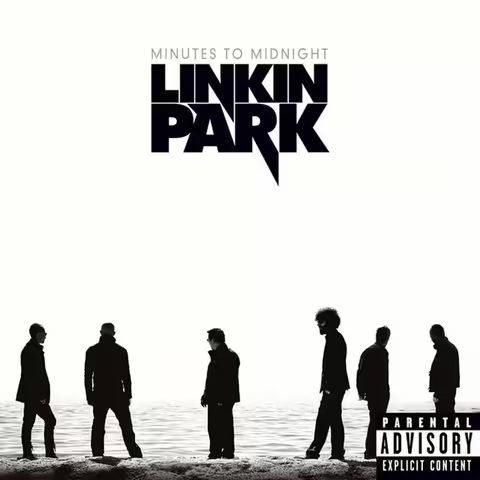
The sleeve is almost empty. A white field carries the band's black angular logo, with the title above it in thin grey capitals. Along the bottom, six dark silhouettes stand on a pale shoreline facing different directions, and the Parental Advisory sticker sits in the lower right corner. Wikipedia says the front and back covers were shot around the ruins of the North Shore Beach and Yacht Club in North Shore, California; Linkinpedia credits the photograph to James Minchin III and places it on the Salton Sea.
Frank Maddocks handled design and art direction, with Ellen Wakayama on creative direction and Nikas Constant on art direction. A year after release the band offered ten alternative covers for fans to use on iTunes.
Release & Reception
The album entered the Billboard 200 at number one on the issue dated 2 June 2007, with about 623,000 copies. Launch Radio Networks reported it as the biggest week of 2007 so far, the largest since Jay-Z's Kingdom Come (680,000) the previous December. It was later overtaken for the year by Kanye West's Graduation (957,000), Alicia Keys' As I Am (742,000) and the Eagles' Long Road Out of Eden (711,000). Spin printed 662,000, a figure other reports do not support. In the UK it debuted at number one on the chart dated 26 May 2007 and spent 53 weeks in the top 100. Year-end US placings were number 10 for 2007 and 46 for 2008.
Delson said the band was "shocked and humbled by this extraordinary show of support".
Critics were split. Metacritic's average is 56 out of 100. Rolling Stone's David Fricke gave four stars and the magazine placed it 25th on its 2007 albums list. The Guardian gave it three stars, objecting that the band stayed "roughly within the shrieky boundaries of their genre". NME's two out of ten called it the "sound of a band trying and failing to forge a new identity".
"On 'Minutes To Midnight' Linkin Park feel insignificant and stale."
Shane Richardson, Gigwise, 2007
PopMatters' Andrew Blackie argued that the band had "become an ambient rock band". Gigwise's reviewer allowed that "Given Up" was "a promising start". Loudwire staff, looking back in 2024, picked it as the best hard rock album of 2007. It is certified 5x Platinum in the US, 4x Platinum in Canada and 2x Platinum in the UK. The band won Favorite Alternative Artist at the 2007 American Music Awards.
Singles & Music Videos
| Single | Released | US Hot 100 | UK | Video director |
|---|---|---|---|---|
| "What I've Done" | 2 April 2007 | 7 | 6 | Joe Hahn |
| "Bleed It Out" | 17 August 2007 | 52 | 29 | Joe Hahn |
| "Shadow of the Day" | 16 October 2007 | 15 | 46 | Joe Hahn |
| "Given Up" | 3 March 2008 (UK 17 February) | 99 | Not found | Mark Fiore |
| "Leave Out All the Rest" | 2008 (sources vary on the date) | 94 | 90 | Joe Hahn |
"What I've Done" went to number one on the US Alternative Airplay chart, and Hahn's video, filmed in the California desert, intercuts the band with footage of pollution, racism, terrorism, war and deforestation. It reached number one on TRL six times. "Bleed It Out" was filmed and then reversed to look like one continuous shot, with a bar fight that runs backwards; it was named MuchMusic's top rock video of 2007. The "Shadow of the Day" video, shot at 20th Century Fox in Los Angeles, shows civil unrest with Bennington as the only band member, and won Best Rock Video at the 2008 MTV Video Music Awards. "Leave Out All the Rest" has no performance footage: Hahn set it in space, influenced by the British film Sunshine. "Given Up" was edited from the band's January 2008 shows at the MEN Arena and the O2 Arena.
Touring & Live
Live promotion began before release, with the Webster Hall show on 11 May and Saturday Night Live the next night. In July 2007 the band played Live Earth in Japan. The band headlined Projekt Revolution in both 2007 and 2008:
- 2007: 25 July to 3 September, 29 North American shows, with My Chemical Romance, Taking Back Sunday, HIM, Placebo and Julien-K on the main stage.
- 2008 Europe: four shows from 21 to 29 June; at Milton Keynes on 29 June Jay-Z joined for "Numb/Encore" and "Jigga What/Faint".
- 2008 North America: 16 July to 24 August; Chris Cornell sang on "Crawling" and performed "Hunger Strike" with Bennington. Busta Rhymes left after eleven days.
The Milton Keynes show became the CD/DVD Road to Revolution, and a live version of "What I've Done" from it earned a Grammy nomination for Best Hard Rock Performance at the 52nd Grammys. It did not win.
In TV, Film & Media
- "What I've Done" plays over the closing credits of Transformers (2007) and appears on Transformers: The Album and in Guitar Hero World Tour.
- "Leave Out All the Rest" plays over the closing credits of Twilight.
- "Bleed It Out" featured in the closing video package for Game 3 of the 2007 World Series and in Guitar Hero: Warriors of Rock.
- "Given Up" appears in Grave Encounters 2 (2012) and Red 2 (2013).
Reissues, Remasters & Anniversaries
The Special Edition added a DVD, The Making of Minutes to Midnight (39 minutes 42 seconds). The Tour Edition added "No Roads Left", a "Distorted Remix" of "What I've Done" and a "Third Encore Session" version of "Given Up", and a Japanese edition included a live "Faint". The 2012 live album Minutes to Midnight: Live Around the World, produced by Shinoda, collects live versions of all twelve tracks, recorded in cities from Taipei to Shanghai between 2007 and 2010.
In 2017 the album returned to the charts, reaching number 15 in the UK and 27 on the Billboard 200. For the 15th anniversary a digital-only deluxe edition arrived on 13 May 2022 with four bonus tracks: "No Roads Left", "Across the Line", the "Given Up" Third Encore Session and the Distorted Remix of "What I've Done".
Linkin Park's Legacy & Influence
The next record carried the experiment further. In May 2009 the band announced a fourth album, and Rubin returned to produce it, and A Thousand Suns followed on 8 September 2010 (14 September in the US) with more electronic sounds. Metal Hammer calls Minutes to Midnight the most experimental of their first three albums.
"Now that we've done that, we feel like we can do anything."
Mike Shinoda, Spin, December 2009
Shinoda said in the same interview that the band had wanted "to break down that sound and go outside its confines".
Things You Might Not Know
| Fact | Detail |
|---|---|
| Rap rationing | Shinoda raps on only two tracks, "Bleed It Out" and "Hands Held High", and has three solo lead songs: "Hands Held High", "In Between" and "No Roads Left". |
| A new key | "Shadow of the Day", in B major, was the first song the band wrote in a major key. |
| Modest hopes | Bennington said that if they sold 250,000 copies in week one he would be "super happy"; the album sold more than twice that. |
| Why the sticker | The album's profanity is on "Given Up", "Bleed It Out" and "Hands Held High", which earned the band its first full-length Parental Advisory. |
| Three cuts | The "Shadow of the Day" video exists in three edits: a director's cut, an alternate ending for MTV Europe and an MTV Overdrive version. |
| Australia's own video | An Australia-only alternate "What I've Done" video tells a fictional story about a pharmaceutical conspiracy. |
Listen on the Riffology Podcast
Riffology is the podcast that digs into albums like this one, and you can find it on all major podcast platforms. Subscribe, and tell us whether you think Minutes to Midnight was liberation or a stumble.
Comments