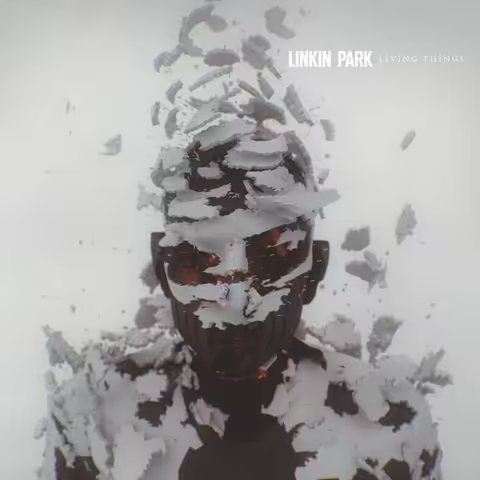
Living Things is the album where Linkin Park stopped trying to choose between the band that wrote Crawling and the band that wrote The Catalyst, and built the sound that argued they had always been the same group. Fifth in the studio sequence, recorded with Mike Shinoda and Rick Rubin at NRG over thirteen months, it answered the cool, conceptual sprawl of A Thousand Suns with a deliberately compact thirty-six minutes of songs that ran short, hit hard and slipped past the political abstractions of the previous record into something more personal.
The reward was immediate. Living Things landed at number one on the Billboard 200 with 223,000 first-week sales, took the top of the UK Albums Chart with a 41,000 opening, and reached number one in seventeen countries before the band rolled it out across North America on the 2012 Honda Civic Tour with Incubus and Mutemath. It is, by some distance, the most efficient album Linkin Park ever made, and the last record before The Hunting Party that found them comfortable mixing rap, electronic textures and rock guitars on the same song without apology.
Living Things at a glance
The signposts of the record, before any of the longer story is unpacked.
| Field | Detail |
|---|---|
| Artist | Linkin Park |
| Album | Living Things |
| Release date (Japan) | 20 June 2012 |
| Release date (worldwide) | 26 June 2012 |
| Recorded | March 2011 to April 2012 |
| Studio | NRG Recording Studios, North Hollywood, California |
| Producers | Mike Shinoda, Rick Rubin |
| Mixing engineer | Manny Marroquin |
| Mastering engineer | Brian Gardner |
| Label | Warner Bros. Records, Machine Shop |
| Genre | Alternative rock, electronic rock, rap rock, industrial rock |
| Track count | 12 |
| Total length | 36:59 |
| Lead single | Burn It Down (16 April 2012) |
| Further singles | Lost in the Echo, Castle of Glass, Powerless |
| Billboard 200 peak | 1 (debut, 223,000 first week) |
| UK Albums Chart peak | 1 (debut, 41,000 first week) |
| Number-one territories | 17 countries |
| Certification (United States) | Platinum (RIAA) |
| Supporting tour | 2012 Honda Civic Tour with Incubus and Mutemath |
| MusicBrainz release group | af682b63-021e-4806-afac-9aa4380fc6bd |
Coming out of A Thousand Suns
To understand why Living Things sounds the way it does, the previous album has to be in the room. A Thousand Suns, released in September 2010, was the most divisive record Linkin Park had made: a long, sequenced concept album with interludes, samples, choirs and synths, with the rapping and the rock riffing largely sequestered into separate corners of the running order. It was the band stretching as far from the nu-metal frame of Hybrid Theory as Mike Shinoda and Rick Rubin could push them, and the reaction was split.
What Living Things did not do was retreat from that experiment. The electronic textures, the programmed drums, the willingness to put a piano or a string line where a guitar might once have sat, all of it carried over. What changed was the form. Where A Thousand Suns asked listeners to sit through a forty-eight minute arc, Living Things broke the same instinct down into self-contained songs that started, hit and finished, and then handed the mic to the next idea. The longest track on the album runs three minutes and fifty-one seconds. Three songs come in under three minutes.
The band described this in interviews around release as a deliberate attempt to combine elements from all four of their previous studio albums in a single record. Living Things is not a return to Hybrid Theory. It is the first Linkin Park record that treats Hybrid Theory and A Thousand Suns as two halves of the same band rather than two different careers.
The Shinoda and Rubin partnership, third time around
By 2012 the Mike Shinoda and Rick Rubin co-production credit had been on three Linkin Park records in a row. Rubin first joined the band for Minutes to Midnight in 2007, the album that pulled them out of the Hybrid Theory and Meteora formula. He stayed for A Thousand Suns. Living Things made it a trilogy.
The two producers worked in well-defined complementary roles. Shinoda was inside the band, the rapper, keyboardist and rhythm guitarist who also wrote much of the music and ran the demoing process. Rubin sat outside, asking the kind of questions that force a band to defend a chord change or cut a verse. On Living Things that division of labour produced a record that is denser and more electronic in its detail than many listeners expected, while still benefiting from the editorial discipline Rubin brought into the room.
The combination was also pragmatic. Shinoda could spend long stretches building tracks alone in the box, layering programmed drums, synths and vocal samples; Rubin could be parachuted in to listen, prune and challenge before the band moved on. Thirteen months of sessions across that workflow is not a lot of studio time for a major-label rock record, and the speed shows in the running order.
NRG Recording Studios, North Hollywood
The album was tracked at NRG Recording Studios on Cahuenga Boulevard in North Hollywood, California. For a band whose previous album had been built piece by piece across multiple environments, picking a single facility and staying there for the duration was itself a statement about how Living Things would be made.
The choice fitted the album's shape. NRG offered a large live room, a control room set up around vintage and modern outboard, and the kind of producer-friendly layout that lets a band cut drums and rhythm tracks in the morning and overdub vocals or programme synths in the afternoon. With Shinoda comfortable in laptop-led production and Rubin pushing for live takes where they served the song, the studio doubled as a programming suite and a tracking room.
The March 2011 to April 2012 sessions
Recording began in March 2011, less than six months after the band had finished touring A Thousand Suns, and continued in stretches through to April 2012. The total of roughly thirteen months sounds long, but for a band that had taken nearly two years on each of its previous two records it was a relatively quick turnaround, and the time included writing, demoing, tracking, overdubs and the back-and-forth with Rubin.
The sessions overlapped with the band's usual touring rhythm, and members were in and out of the studio rather than locked down for a single uninterrupted block. Shinoda's working method, often building entire arrangements in the laptop before bringing them to the rest of the band, suited that schedule. Chester Bennington tracked vocals across multiple visits as songs were finalised, with Rubin leaning on him for performances that captured the emotional centre of each track without over-singing it.
A deliberate return to shorter songs
Almost every decision on Living Things runs in the direction of compression. The album is twelve tracks long. The total runtime is thirty-six minutes and fifty-nine seconds. That works out at an average of just over three minutes per song, the shortest average length of any Linkin Park studio album to that point and a clear contrast with the eight, ten and twelve-minute pieces that had begun to creep into the band's live shows on the back of A Thousand Suns.
The shape of the songs themselves moved with the runtime. Verses are tight. Choruses arrive early and repeat. Bridges are often replaced by a programmed breakdown or a single shouted couplet from Bennington over a stripped beat. Tinfoil, the album's only instrumental, runs a minute and eleven seconds. Victimized, one of the most aggressive performances Bennington had committed to tape in years, ducks under two minutes.
- Twelve tracks in 36:59, an average of around three minutes per song.
- Three songs under three minutes (Lies Greed Misery, Victimized, Tinfoil).
- The longest track, Burn It Down, runs 3:51.
- Tinfoil into Powerless functions as a single closing statement.
- No song on the album hits four minutes, a first for the band.
Blending four albums into one
The pre-release framing for Living Things, repeated in interviews by both Shinoda and Bennington, was that the band wanted to take elements from each of their four previous studio records and combine them. Hybrid Theory's vocal interplay between the rap verse and the screamed chorus comes back on Lies Greed Misery and Victimized. Meteora's brevity and chorus-first writing returns across most of side one. Minutes to Midnight's piano ballads find their echo in Roads Untraveled. The programmed beats, sampled choirs and processed vocal lines from A Thousand Suns are everywhere.
The trick, and the reason the album works as more than a checklist, is that the previous records were not stitched together as discrete sections but folded together inside individual songs. Burn It Down opens with an electronic hook, drops into a rap verse over programmed drums, and lands on a stadium-sized chorus that any rock band would recognise. Castle of Glass moves between an electronic folk pulse and a guitar-led second half. The combination is the song, not the structure of the album.
Personnel and credits
Living Things is the work of the same six-piece line-up that had recorded every Linkin Park studio album since the band signed to Warner Bros. The principal additional name in the credits is Owen Pallett, the Canadian musician credited for strings on one track.
| Role | Player | Notes |
|---|---|---|
| Linkin Park | ||
| Lead vocals | Chester Bennington | Lead vocals across the album |
| Vocals, rhythm guitar, keyboards, samples | Mike Shinoda | Co-producer |
| Lead guitar | Brad Delson | |
| Bass | Dave "Phoenix" Farrell | |
| Turntables, samples, programming | Joe Hahn | |
| Drums | Rob Bourdon | |
| Guest musicians | ||
| Strings | Owen Pallett | Strings on "I'll Be Gone" |
| Production and engineering | ||
| Producer | Mike Shinoda | |
| Producer | Rick Rubin | |
| Mixing | Manny Marroquin | |
| Mastering | Brian Gardner | |
Owen Pallett and the strings on "I'll Be Gone"
Pallett's strings on "I'll Be Gone" are easy to miss on a first pass and clearer on repeated listens. They sit underneath the verse rather than over it, doubling the sustained synth pad and lifting the chorus without ever taking the lead. It is a small contribution by minutes-on-tape, but it is a distinctive orchestral touch inside the Living Things track list.
For Linkin Park, hiring an outside arranger for one song highlighted how broad the album's palette had become compared with the band's earliest records. It also gave the middle of the running order a clear tonal contrast before the sequence moves back into heavier material.
The track listing
The full standard edition of Living Things, in running order.
| # | Title | Length | Single |
|---|---|---|---|
| 1 | Lost in the Echo | 3:25 | Yes |
| 2 | "In My Remains" | 3:20 | |
| 3 | Burn It Down | 3:51 | Yes |
| 4 | Lies Greed Misery | 2:27 | Promo |
| 5 | "I'll Be Gone" | 3:31 | |
| 6 | Castle of Glass | 3:25 | Yes |
| 7 | Victimized | 1:46 | |
| 8 | Roads Untraveled | 3:49 | |
| 9 | Skin to Bone | 2:48 | |
| 10 | Until It Breaks | 3:43 | |
| 11 | Tinfoil | 1:11 | |
| 12 | Powerless | 3:43 | Yes |
Lost in the Echo as the opener
Lost in the Echo is the album's calling card and its opening track. An electronic pulse establishes the song before any guitars arrive, Shinoda's verse runs over programmed drums and a synth bassline, and Bennington's chorus comes in at a pitch that sets the emotional ceiling for the rest of the record. The arrangement holds back its rock element until the final chorus, by which point the song has already declared its allegiances.
Released as a single in October 2012, Lost in the Echo doubled as the lead promotional video for the entire album cycle and as the first track audiences heard whenever they pressed play on Living Things. Coming first on a record that runs only thirty-six minutes, it carries an outsized share of the responsibility for setting the tone, and it does the job in three minutes and twenty-five seconds.
"In My Remains" and Burn It Down
"In My Remains" follows the opener with one of the most direct rock arrangements on the album. Bennington's vocal carries the verse, the chorus opens out into stacked harmonies, and Brad Delson's lead guitar takes a more conventional supporting role than it does almost anywhere else on the record.
Burn It Down, third in the running order, was the album's lead single and remains the song most listeners associate with Living Things. The synth hook and the rap-then-sing structure work as an executive summary of the album's whole thesis. The chorus is built for radio and arena alike, and the song's rhythm of programmed drums under live guitar would become the template for half of the album's singles.
Lies Greed Misery and "I'll Be Gone"
Lies Greed Misery is the album's most aggressive piece of writing. Two minutes and twenty-seven seconds of distorted electronic stabs, shouted Shinoda verses and a hook that punches without resolving, it was the song the band offered up for the trailer of Medal of Honor: Warfighter, a placement that took it into living rooms well beyond the band's existing audience.
"I'll Be Gone", sequenced immediately after, is the closest thing on the album to a ballad until Roads Untraveled arrives later. It is also the track that benefits most directly from Owen Pallett's strings, with a sustained arrangement that supports rather than dramatises the chorus. The two songs back-to-back show Living Things at its most extreme range: the most violent track on the album cuts straight into one of its most restrained.
Castle of Glass and Victimized
Castle of Glass is the third single, and one of the songs that most visibly extended beyond the initial album cycle. An electronic figure carries the verse, Shinoda and Bennington share the lead vocal, and the chorus opens into a guitar arrangement that is closer to anthemic alternative rock than anything else on the record. Released as a video on 10 October 2012, it later appeared in prominent sync contexts and stayed visible beyond the first release window.
Victimized, sequenced immediately after, is its tonal opposite. One minute and forty-six seconds of hardcore-leaning vocal performance from Bennington, the closest the album comes to the screamed delivery of Hybrid Theory, and a clear demonstration that the band had not abandoned that mode even as they leaned into electronic production around it.
Roads Untraveled, Skin to Bone and Until It Breaks
The middle of side two is where Living Things does its quietest and its strangest writing in the same five minutes. Roads Untraveled is a piano-led song with a marching beat that allows Bennington to use the upper register of his voice in a way the album mostly avoids elsewhere. It is one of the most direct lyrical pieces on the record, and one of the only tracks where the production gets out of the way of the singer.
Skin to Bone follows with one of the album's most processed vocal arrangements, treated, layered and sequenced into a chant-like chorus. Until It Breaks then shifts the centre of the song from a single lead vocal to a passed-baton structure that hands sections between Shinoda, Bennington and a deliberately distorted Joe Hahn vocal sample. It is the track on Living Things that most clearly carries the DNA of A Thousand Suns into the new record.
Tinfoil and Powerless
The album closes with a paired statement. Tinfoil, the seventy-one-second instrumental that opens the closing run, sets up Powerless rather than standing on its own. A piano figure builds into a programmed swell, the percussion drops in late, and then Powerless takes over without a break.
Powerless itself is the album's clearest ballad. Bennington carries the lead vocal across a sparse arrangement, and the song builds rather than detonates. It served as the placement track for the end credits of the 2012 film Abraham Lincoln: Vampire Hunter, a sync that put Powerless in front of a much larger audience than the closing track of an album would normally reach. As the final song on Living Things it has the unenviable job of finishing a thirty-six-minute record on a moment of restraint, and it does that without overplaying its hand.
Burn It Down as the lead single
Burn It Down was released as the album's lead single on 16 April 2012, more than two months ahead of the record. The video premiered on MTV on 24 May 2012, by which point the song was already a fixture on rock and alternative radio, and the launch was timed to take the band into the summer with their highest-profile new song since The Catalyst.
The song's structure does the album's work in advance: a synth lead, a Shinoda rap verse, a stadium chorus from Bennington, and a final third that drops the electronic backing for a more guitar-led drive. As a thesis statement for the record it would be hard to improve.
Lost in the Echo as the second single
Lost in the Echo had been the album opener since release day, but it was issued as a single in stages across the autumn of 2012. An official lyric video appeared on 29 June 2012, three days after the worldwide release of the album. The full music video, a narrative piece in which a young woman returns home and watches her own past unwind in front of her, was released on 4 September 2012, and the song was issued as a single on 5 October 2012.
The video took the song's title at face value: a young woman holding a photograph, a chain of rooms inhabited by people she has lost, and the gradual revelation that the band themselves are present only as figures in those rooms rather than as the centre of the story. It was one of the more ambitious single videos the band released across the Living Things cycle, and it carried Lost in the Echo through a second wave of attention months after the album had landed.
Castle of Glass and its second life in sync
Castle of Glass arrived as a video on 10 October 2012 and was rolled out as a single across the following weeks. Of all the tracks on Living Things it is the one with the strongest afterlife, picked up by film and television placements and by sports broadcasts, and the song most likely to be the entry point for a new listener finding the album years after release.
That sync life is the kind of trajectory the band's catalogue had not previously enjoyed. Linkin Park had always been a singles band, but Castle of Glass moved into the kind of incidental cultural use that takes a song out of its parent album entirely. By the late 2010s it was as recognisable in placement contexts as Numb or In the End, even though Living Things had not enjoyed the same blanket radio saturation as either of the records that produced those songs.
Powerless and Abraham Lincoln: Vampire Hunter
The closing track on Living Things found its way out of the album through the end credits of Timur Bekmambetov's 2012 film Abraham Lincoln: Vampire Hunter. The placement landed in the same release window: Powerless ran as the credits song on a film that opened in cinemas only days after Living Things itself reached shops.
Sync placements of this scale were never a defining feature of Linkin Park's promotional strategy in the way they were for some of their peers, but Powerless and the Lies Greed Misery placement in the Medal of Honor: Warfighter trailer represent two of the more visible film and game tie-ins of the band's career, and both arrived in the same year.
Release week and the charts
Living Things was released in Japan on 20 June 2012 and worldwide during the following week, with most territories taking 26 June 2012 as their street date. The album debuted at number one on the Billboard 200 with first-week sales of 223,000 copies in the United States, and at number one on the UK Albums Chart with a 41,000 opening week. It also reached number one in another fifteen countries, taking its total to seventeen number-one debuts.
The chart performance carried the band's run of consecutive United States number-one studio albums into a fifth title. The record was eventually certified Platinum by the RIAA in the United States, alongside multiple international certifications.
Release history and rollout timing
The release schedule for Living Things followed a staged rollout that was common for major albums in 2012, with Japan first, then a region-by-region launch over the next several days. Japan received the album on 20 June 2012. Australia and several European markets followed on 22 June, parts of Asia and Europe rolled in through 24 and 25 June, and the United States and a wide set of other territories landed on 26 June. That sequence gave the campaign nearly a full week of international momentum before the first complete chart week had even closed.
That timing also worked with the single strategy. Burn It Down had already been out since 16 April, so radio and streaming familiarity were established before albums shipped. During release week, the band maintained daily visibility through videos, interviews and live performance clips, then kept attention moving with follow-up singles in the second half of 2012. The lyric video for Lost in the Echo arrived on 29 June, the official video followed on 4 September, and the single release came on 5 October. Castle of Glass then entered the public cycle with its own video and single timeline, while Powerless circulated through film-end-credit exposure and regional single handling.
In practical terms, Living Things was marketed as both a compact album and a long campaign. The record itself runs under thirty-seven minutes, but the release window, single sequence and touring support stretched across many months. That split between short runtime and extended campaign helps explain why the album felt omnipresent in 2012 even though its track list is one of the briefest in the band's studio catalogue.
The 2012 Honda Civic Tour
The album's main touring vehicle was the 2012 Honda Civic Tour, a North American outing on which Linkin Park headlined and Incubus and Mutemath provided the support. The tour ran across the summer of 2012, with arena and amphitheatre dates that gave Living Things its first sustained live presence less than two months after release.
The 2012 edition's pairing of Linkin Park and Incubus put two large alternative rock bands of the era on the same bill. Mutemath, opening, gave the running order a third and very different sonic profile, and the tour's set lists drew heavily on Living Things while still leaning on the Hybrid Theory and Meteora staples that the audience came for.
- Headliner: Linkin Park
- Main support: Incubus
- Opener: Mutemath
- Region: North America
- Span: Summer and into autumn 2012
Mixing by Manny Marroquin, mastering by Brian Gardner
Living Things was mixed by Manny Marroquin and mastered by Brian Gardner. Both were established names in mainstream pop and rock by 2012, and their involvement aligned with the band's aim to combine punchy modern production with a concise rock-song framework.
The mix on Living Things sits closer to the modern pop record than the rock record. The drums are tight and forward, the vocals heavily compressed, the synths placed centrally where a guitar might once have lived in a Linkin Park song. Mastering carries that approach into a final loudness that lets the album hold its own next to the dance and pop records it would compete against on radio and playlists, while still leaving enough headroom for the quieter moments of Roads Untraveled and Powerless to breathe.
Legacy and place in the discography
Living Things sits in a particular niche in Linkin Park's run of albums. It is not the first record where the band experimented with electronic production, that honour belongs to Minutes to Midnight and especially A Thousand Suns. It is not the most commercially successful, that remains Hybrid Theory by some distance. It is the album where the band reconciled the two halves of their identity into a single, compact statement and then moved on; the next record, The Hunting Party in 2014, was a deliberate swing back towards heavy guitar rock.
For listeners who came to the band through Hybrid Theory and Meteora, Living Things often plays as the moment the modern Linkin Park sound clicked into place. For listeners who first met the band through A Thousand Suns or later, it is the record where the band slimmed their concept-album ambition down to song-by-song discipline. Either way it functions as the bridge album, and it has aged well precisely because it never tried to be either a comeback or a manifesto.
Things you might not know
A short reel of points that do not always make it into the released-by-numbers summary of Living Things.
| Fact | Detail |
|---|---|
| Twelve tracks, 36:59 | Living Things has the shortest total runtime of any Linkin Park studio album to that point in their career, with no song reaching the four-minute mark. |
| Japan first | The album was released in Japan on 20 June 2012, six days ahead of the worldwide street date of 26 June. |
| Seventeen number ones | Living Things debuted at number one in seventeen countries, including the United States and the United Kingdom. |
| Owen Pallett's strings | Owen Pallett provided the string arrangement on "I'll Be Gone", the album's only credited guest musician. |
| The Rubin trilogy | Rick Rubin and Mike Shinoda had now co-produced three Linkin Park albums in a row, starting with Minutes to Midnight in 2007. |
| NRG, start to finish | The whole record was tracked at a single studio, NRG Recording in North Hollywood, between March 2011 and April 2012. |
| Lies Greed Misery in a trailer | The album's most aggressive track was used in the launch trailer for the video game Medal of Honor: Warfighter. |
| Powerless and the President | Powerless ran over the end credits of the 2012 film Abraham Lincoln: Vampire Hunter, a placement timed to coincide with the album release window. |
| Lost in the Echo, the long single rollout | The Lost in the Echo lyric video appeared on 29 June 2012, the music video on 4 September 2012 and the single release on 5 October 2012. |
| Castle of Glass after the cycle | Castle of Glass has aged into one of the band's most-synced songs, picked up across film, television and sports broadcasts in the years after the Living Things era. |
| Last record before the heavy turn | Living Things was the band's final album before The Hunting Party in 2014 sent them back towards a guitar-led, hardcore-adjacent sound. |
| Mixed by Manny Marroquin | Manny Marroquin handled the album's final mix, with Brian Gardner mastering. |
Closing and the Riffology podcast
Living Things is the album that argues, more cleanly than any other in the Linkin Park catalogue, that the band's nu-metal beginnings and their electronic experimentation were always part of the same project. It is also one of the most playlistable Linkin Park records: short songs, hooks that arrive on time, and a running order that does not punish a listener for putting it on while doing the washing up. Twelve years on it has settled into the catalogue as the record between the great experiment and the heavy reset, which is exactly the role it was built for.
For more long-form coverage of Linkin Park and related records, browse the Album Deep Dive archive on Riffology.
Comments