Radiohead produced OK Computer themselves alongside Nigel Godrich, with a £100,000 equipment budget from Parlophone and a Tudor mansion near Bath that belonged to the actress Jane Seymour. Their American label heard the finished record and cut its sales forecast from two million to half a million; Philip Selway said Capitol saw it as "commercial suicide".
It went to No. 1 in the UK in its first week, won a Grammy, and has sold at least 6.9 million copies. A record built from a sampled drum loop, a computer voice called Fred, a ballroom session at 3am and a six-minute single in four sections became a Grammy winner and, in 2014, an entry in the Library of Congress's National Recording Registry.
Album Facts
| Field | Detail |
|---|---|
| Artist | Radiohead |
| Album | OK Computer |
| Release Date | 21 May 1997 (Japan); 16 June 1997 (UK); 1 July 1997 (US) |
| Label | Parlophone (UK); Capitol (US) |
| Producer(s) | Nigel Godrich and Radiohead |
| Studio(s) | Canned Applause, Didcot; St Catherine's Court, Bath; The Church, Crouch End; Abbey Road (strings, mastering) |
| Genre / Subgenre | Alternative rock, art rock |
| Track Count | 12 |
| Total Runtime | 53:21 |
| Billboard 200 Peak | 21 |
| UK Albums Chart Peak | 1 (two weeks) |
| Other Notable Chart Peaks | Ireland 1, New Zealand 1, Canada 2, Netherlands 2, France 3, Sweden 3, Australia 7 |
| Certifications | UK 5x Platinum; US 2x Platinum; Canada 5x Platinum; IFPI Europe 3x Platinum |
| Estimated Sales | At least 6.9 million worldwide |
| Key Singles | Paranoid Android, Karma Police, No Surprises |
Radiohead's Road to OK Computer
Abingdon School gave Radiohead their start. Thom Yorke and Ed O'Brien started a band there, recruited Colin Greenwood and Philip Selway, and in 1985 the group became On a Friday; Colin's younger brother Jonny was the last to join. EMI signed them to a six-album deal on 21 December 1991 and asked for a new name, so they borrowed one from a Talking Heads song.
The debut, Pablo Honey, reached No. 22 in the UK in 1993, and "Creep" became a slow-burning hit in Israel and America before reaching No. 7 at home on re-release, despite Radio 1 blacklisting it as "too depressing". The Bends followed in March 1995 and gave them real British success with "Fake Plastic Trees" and "High and Dry", but in America it stalled at No. 88. Jonny Greenwood later felt it had been "under-reviewed possibly and under-received".
That year they toured North America and Europe as support to R.E.M., and had their van and gear stolen before a show in Denver. In August 1996 they opened for Alanis Morissette in America, where Jonny remembered "playing interminable Hammond organ solos" to a mostly teenage crowd. Nobody in the band wanted a sequel. Selway said doing The Bends' soul-searching again "would be excruciatingly boring", Yorke ruled out "another miserable, morbid and negative record", and O'Brien recalled that everyone told them a "Bends Pt 2" would sell six or seven million, and they did the opposite.
Lucky, Demos and a Hundred Grand
The record's first brick went down ten months before the sessions. Brian Eno asked Radiohead for a song for The Help Album, a War Child charity compilation, and on 4 September 1995 they cut "Lucky", a song shaped by the war in Bosnia, in five hours with Nigel Godrich. Godrich, born in 1971, had come up as John Leckie's tape operator at RAK and engineered The Bends and the My Iron Lung EP under him. Yorke called "Lucky" "the first mark on the wall".
"We did Lucky as a try-out, we used this engineer Nigel Godrich and got on great with him."
Jonny Greenwood, The Guardian, 1997
Jonny said the band's one concept was to get out of the city and record themselves. Parlophone handed over £100,000 to buy their own equipment, and the shopping included a plate reverb bought from the songwriter Jona Lewie. Godrich said he "had a free rein in what equipment I wanted to buy", and Yorke's brief to him was simple: "write a wish list".
Some songs were already old. Yorke had played "No Surprises Please" to the band in an Oslo dressing room on 3 August 1995, on the R.E.M. tour. "Exit Music (For a Film)" came from Baz Luhrmann, who asked for a song for Romeo + Juliet while the band were on the road with Morissette and sent them the last 30 minutes of the film; Yorke started work straight after watching Claire Danes hold a gun to her head. Early in 1996 the band demoed at Chipping Norton Recording Studios, and they road-tested new songs in front of Morissette's audiences.
Even the title was a leftover. Yorke picked up "OK Computer" from the 1978 radio series of The Hitchhiker's Guide to the Galaxy during the 1996 tour, and it was first the working title of the B-side "Palo Alto". He called it "a really resigned, terrified phrase".
Recording OK Computer at St Catherine's Court
Recording started in July 1996 at Canned Applause, a converted shed near Didcot in Oxfordshire. "No Surprises" was cut there, and the band could never beat the first take. Godrich had them play it faster than the slow tempo they wanted and then slowed the tape so Yorke could sing over it. But the band found the shed unsatisfactory. Selway put the trouble down to producing themselves: "We're jumping from song to song."
In September and October 1996 they moved into St Catherine's Court, the Tudor mansion near Bath owned by Jane Seymour, and made most of the album there. Godrich put the control room in the library and recorded onto an Otari MTR-90II two-inch machine. Vocals went through either a Neumann valve 47 or a Rode valve mic, with a Urei 1176 compressor and a Pultec valve EQ on a few things. He told The Mix he had used little processing beyond "a bit of plate reverb, or a short delay", and that he took about half a day per mix.
"This was literally the band, me, and a cook."
Nigel Godrich, The Mix, 1997
The house became an instrument. Yorke sang "Exit Music" on a stone staircase for its natural reverb, and called it "the first performance we'd ever recorded where every note of it made my head spin". "Let Down" was tracked in the ballroom at 3am. Jonny found the place "less like a laboratory experiment" than a studio, and O'Brien reckoned about 80 per cent of the album went down live: "I hate doing overdubs, because it just doesn't feel natural." Godrich said "Paranoid Android" and a few others were one takes.
The mansion also had a reputation. When the band and Godrich looked back for a 2017 Rolling Stone oral history, Yorke admitted he "got really spooked while recording the vocals for 'Exit Music'", and Godrich summed it up as "very Scooby-Doo". Seymour was unmoved.
"Everyone who ever wanted to find a ghost had been at that house and nobody found anything."
Jane Seymour, Rolling Stone, 2017
The finishing work moved to London. The band did further recording at The Church in Crouch End, and in January 1997 strings were recorded at Abbey Road, conducted by Nick Ingman to the band's own arrangements. Jonny "got very excited at the prospect of doing string parts that didn't sound like Eleanor Rigby". Chris Blair mastered the record at Abbey Road and it was finished on 6 March 1997. For O'Brien, "the biggest pressure was actually completing" it.
Personnel and Credits
| Role | Player | Notes |
|---|---|---|
| Core band | ||
| Vocals, guitar, keyboards | Thom Yorke | Also co-designed the artwork |
| Guitar, keyboards | Jonny Greenwood | Composed the Climbing Up the Walls strings |
| Guitar, backing vocals | Ed O'Brien | |
| Bass | Colin Greenwood | |
| Drums | Philip Selway | His drums sampled for Airbag |
| Strings | ||
| String conducting | Nick Ingman | Abbey Road, January 1997 |
| String arrangements | Radiohead | |
| Production and engineering | ||
| Producer | Nigel Godrich | Credited with "committing to tape, audio level balancing" |
| Co-producers | Radiohead | Also credited with "committing to tape" |
| Studio assistance | Gerard Navarro, Jon Bailey, Chris Scard | |
| Mastering | Chris "King Fader" Blair | Abbey Road |
| Artwork | ||
| Pictures | Stanley Donwood and The White Chocolate Farm | The White Chocolate Farm is Yorke |
| Additional artwork | Matt Bale | |
The credits are deadpan. Godrich and the band share "committing to tape", and every song is credited to all five members. Godrich began the project as an adviser and ended it as co-producer.
"OK Computer was such a big thing for me because I was given power for the first time."
Nigel Godrich, The Guardian, 2013
The Songs on OK Computer
| # | Title | Writer(s) | Length | Single? | Notes |
|---|---|---|---|---|---|
| 1 | Airbag | Radiohead | 4:44 | No | Drum loop sampled from Selway, edited on a Mac |
| 2 | Paranoid Android | Radiohead | 6:23 | Yes | Four sections; first version ran over 14 minutes |
| 3 | Subterranean Homesick Alien | Radiohead | 4:27 | No | Title nods to Dylan; keys chase Bitches Brew |
| 4 | Exit Music (For a Film) | Radiohead | 4:24 | No | Written for Romeo + Juliet; sung on a staircase |
| 5 | Let Down | Radiohead | 4:59 | Promo | Recorded in the ballroom at 3am |
| 6 | Karma Police | Radiohead | 4:21 | Yes | Title from a band in-joke |
| 7 | Fitter Happier | Radiohead | 1:57 | No | Spoken by "Fred", a Macintosh SimpleText voice |
| 8 | Electioneering | Radiohead | 3:50 | No | Cowbell, poll tax riots, Chomsky |
| 9 | Climbing Up the Walls | Radiohead | 4:45 | No | Jonny's strings for 16 instruments, after Penderecki |
| 10 | No Surprises | Radiohead | 3:48 | Yes | Cut at Canned Applause; first take kept |
| 11 | Lucky | Radiohead | 4:19 | France only | Recorded in five hours for The Help Album |
| 12 | The Tourist | Radiohead | 5:24 | No | Jonny's song; ends on a small bell |
Airbag sets the terms. Its beat is a few seconds of Selway's drumming, sampled and edited on a Macintosh because the band wanted something like DJ Shadow, and admitted their programming was not up to a straight copy. Yorke took the lyric from a magazine piece titled "An Airbag Saved My Life" and from The Tibetan Book of the Dead.
Paranoid Android stitches parts of three songs together on the model of the Beatles' "Happiness Is a Warm Gun", with Queen and the Pixies in the mix. The first version ran past 14 minutes with a long Hammond outro from Jonny, and O'Brien said the band would "be pissing ourselves" playing it. Cut to six and a half minutes, it still needed surgery.
"I managed to stick the whole thing together so it runs from one piece of 24-track tape."
Nigel Godrich, The Mix, 1997
The lyric came from a bad night in a Los Angeles bar where a woman turned violent after someone spilled a drink on her, and the title from Marvin the Paranoid Android in Hitchhiker's. For the ending, Yorke shouted gibberish into a Dictaphone, and Godrich edited the song's parts together on tape.
Exit Music (For a Film) plays over the end credits of Romeo + Juliet, hence the double meaning of "exit", but the band kept it off the soundtrack album to save it for their own. Yorke compared the opening voice and acoustic guitar to Johnny Cash's At Folsom Prison and called it "a song for two people who should run away before all the bad stuff starts". The climax, fuzzed bass reaching for Portishead, came out more "stilted and leaden and mechanical", in Colin's words.
Let Down layers arpeggiated guitars and electric piano in a nod to Phil Spector, while Jonny plays his part in a different time signature from the rest of the band, a Steve Reich-style phasing trick, and adds an arpeggio generated on a ZX Spectrum.
Karma Police took its title from a band joke about calling the karma police on anyone who misbehaved, and its piano from somewhere near the Beatles' "Sexy Sadie". Yorke called it "a song against bosses". O'Brien made the "melting" sound at the end by driving a delay into self-oscillation and dropping its rate, and the closing section was rebuilt from loops and samples. "It was the first time we did anything like that," said Godrich.
Fitter Happier is a short piece of musique concrete whose words are read by Fred, a synthesised voice from the Macintosh SimpleText application. Yorke wrote the words in ten minutes and called them "the most upsetting thing I've ever written". Climbing Up the Walls drew on Yorke's time as an orderly in a mental hospital, with Jonny's 16-part string arrangement modelled on Penderecki's Threnody to the Victims of Hiroshima. No Surprises, which Yorke called a "fucked-up nursery rhyme", aimed for Pet Sounds and "What a Wonderful World". And The Tourist, Jonny's deliberately unhurried closer, was inspired by American tourists rushing round France. Its message, per Yorke: "Idiot, slow down."
Critics have long called it a concept album. The band have always disagreed, though O'Brien allowed that "there is a continuity there".
B-sides, Outtakes and Lost Songs
The singles carried eight B-sides between them:
- Paranoid Android: "Polyethylene (Parts 1 & 2)", "Pearly*", "A Reminder", "Melatonin"
- Karma Police: "Meeting in the Aisle", "Lull"
- No Surprises: "Palo Alto", "How I Made My Millions"
Three songs from the period stayed in the vault for 20 years. "I Promise", with its Mellotron and marching-band drums, "Man of War", whose strings were played by the Royal Philharmonic Orchestra, and "Lift", a ballad fans already knew from live bootlegs of the period, finally came out on OKNOTOK in 2017. A failed session for "Man of War" appears in Grant Gee's tour film Meeting People Is Easy, and an early "Exit Music" titled "Poison" surfaced in the 2019 MiniDisc leak.
The OK Computer Artwork
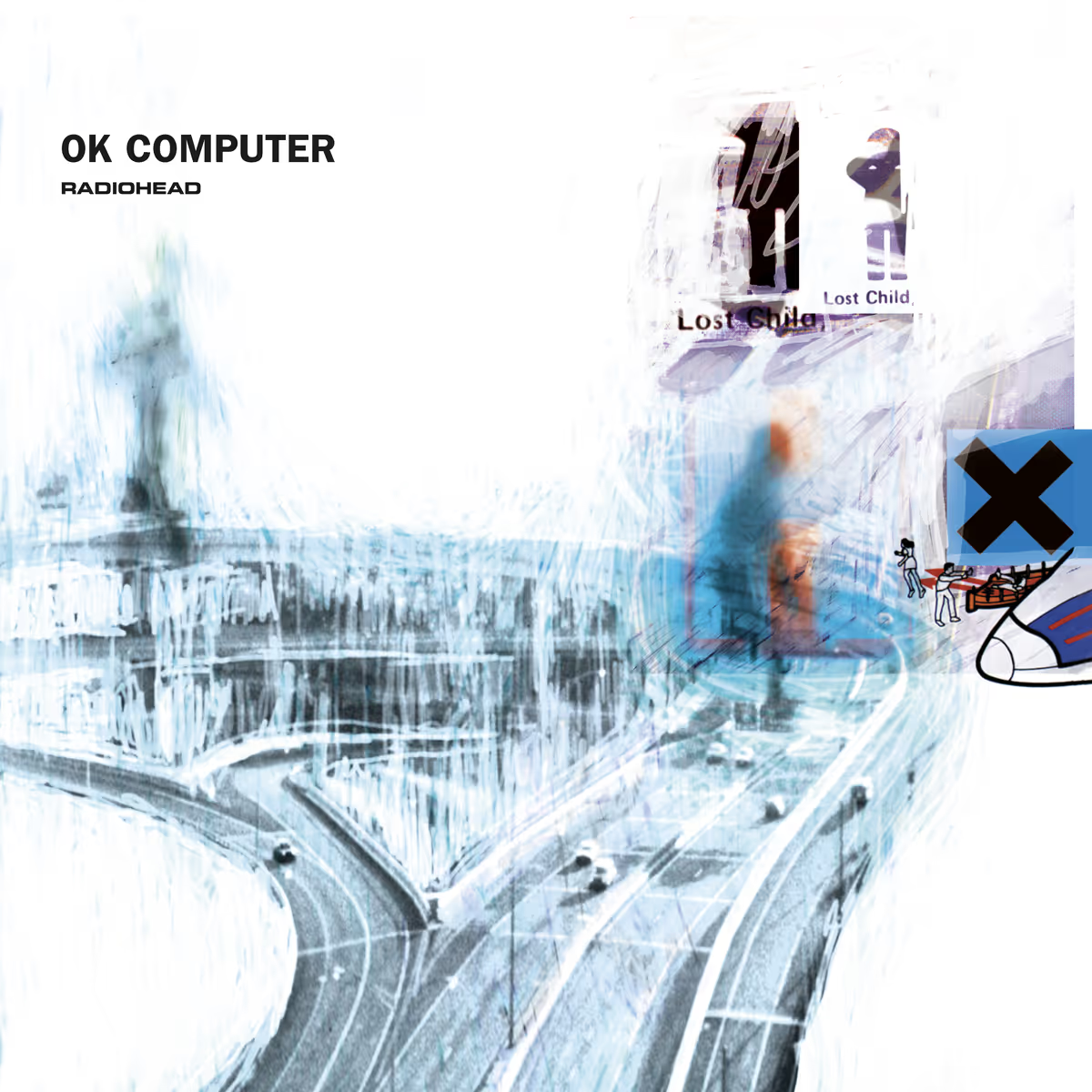
Stanley Donwood and Yorke, credited as The White Chocolate Farm, built the sleeve as a collage. Look at it closely and almost everything is under a layer of white scratches: a motorway interchange with cars on its curving lanes fills the lower half, two blurred figures hover like ghosts, a pair of "Lost Child" signs with pictograms sit top right beside a blue box with a black X, and tiny stick figures are tucked against the right-hand edge. The title and band name sit small in black type in the top left corner.
The motorway is the I-84 and I-91 interchange in Hartford, Connecticut. Donwood said the washed-out palette came from "trying to make something the colour of bleached bone". Yorke said the stick figures shaking hands in the liner notes stood for exploitation: "Someone's being sold something they don't really want." The liner notes keep the joke going, with lyrics "reproduced by kind permission even though we wrote them".
Release and Reception
Parlophone advertised the album in newspapers and on tube stations with lines from "Fitter Happier". Capitol, despite its lowered expectations, still pushed hard: it sent 1,000 cassette players to key press and industry figures with the album glued inside. OK Computer came out in Japan on 21 May 1997, the UK on 16 June and the US on 1 July, on CD, double vinyl, cassette and MiniDisc.
It entered the UK chart at No. 1 with 136,000 copies in its first week, the band's first chart-topping debut, and stayed there for two weeks. In America it debuted at No. 21. Most reviews were raves: ten out of ten from NME and from Ryan Schreiber at Pitchfork, five stars from Q and Select, and four from Rolling Stone, which called it "a stunning art-rock tour de force". Nick Kent predicted it would be "the key record of 1997", and Alex Ross said the band had "pulled off one of the great art-pop balancing acts in the history of rock". Several critics reached for Pink Floyd and The Dark Side of the Moon.
Not everyone was won over. Robert Christgau called the songs "soulless", and Andy Gill found it "hard to love, an album that luxuriates so readily in its own despondency".
- Mercury Prize 1997: shortlisted, lost to Roni Size/Reprazent's New Forms
- Brit Awards 1998: nominated for Best British Album
- Grammys 1998: won Best Alternative Music Performance; nominated for Album of the Year, lost to Bob Dylan's Time Out of Mind
Singles and Music Videos
| Single | Released | UK Peak | Other | Video |
|---|---|---|---|---|
| Paranoid Android | 26 May 1997 | 3 | Ireland 4 | Magnus Carlsson |
| Karma Police | 25 August 1997 | 8 | US Modern Rock 14 | Jonathan Glazer |
| Let Down (promo) | September 1997 | US Modern Rock 29 | ||
| Lucky (France only) | 26 December 1997 | Did not chart | ||
| No Surprises | 12 January 1998 | 4 | Grant Gee |
Choosing a six-and-a-half-minute, four-part song as the lead single was the band's way of warning people what was coming. "Paranoid Android" was premiered on Radio 1's Evening Session in April 1997 and gave Radiohead their highest UK chart placing to that point. The animated video came from Swedish animator Magnus Carlsson, creator of the cartoon Robin, which the band loved. MTV put it in heavy rotation but cut the mermaids' bare breasts for America.
Jonathan Glazer's "Karma Police" clip, with Yorke in the back of a car pursuing a man who ends up setting the car alight, won Best Direction at the 1997 MTV Video Music Awards. Grant Gee shot "No Surprises" on 28 November 1997 as a single close-up of Yorke singing in a helmet that slowly fills with water. Yorke could hold his breath for over a minute in calm conditions but managed about ten seconds on the day, which Gee called "repeated torture". Plans for a video for every track were dropped, and Gee said the "Paranoid Android" and "Karma Police" videos had gone over budget.
Touring OK Computer
The Against Demons tour opened in Barcelona on 22 May 1997 and closed in New York on 18 April 1998. The pivotal night came early: Radiohead's first Glastonbury headline set, on 28 June 1997, when technical problems almost drove Yorke off the stage. Q named it the greatest concert of all time in 2004, but the band did not see it that way at the time.
"I think we came off stage and I think we thought we'd blown it."
Ed O'Brien, Apple Music, 2020
Yorke later said the tour "was a year too long". Grant Gee filmed it for Meeting People Is Easy, shooting about 40 hours of footage, leaving microphones running in hotel interview rooms and putting surveillance cameras in the dressing room, and catching a Late Show with David Letterman performance of "Karma Police". It came out on VHS in the UK on 30 November 1998 and was nominated for a Grammy. Colin later called the tour the lowest point of the band's career, and Yorke described the period as a "real low point".
Covers, Tributes and Screen Life
- Radiodread (2006): Easy Star All-Stars' full reggae version of the album
- OKX (2007): Stereogum's tribute album, with Vampire Weekend among the contributors
- Paranoid Android: covered by Brad Mehldau, Sia and Weezer
- Exit Music: covered by the Cinematic Orchestra, Matt Heafy of Trivium and Kelly Clarkson
- Ergo Proxy (2006): the anime series used "Paranoid Android" as its main theme
Reissues and Anniversaries
EMI's 2009 Collector's Edition added B-sides, sessions and a DVD, but was released without the band's involvement and nothing on it was remastered. A 2008 double-vinyl reissue was the tenth bestselling vinyl record of that year.
The version the band stand behind is OKNOTOK 1997 2017, released by XL on 23 June 2017 after it acquired the back catalogue. It paired the remastered album and B-sides with "I Promise", "Man of War" and "Lift", entered the UK chart at No. 2 and was dedicated to Yorke's ex-wife Rachel Owen, who had died months earlier. The boxed edition added books of art and notes and a cassette of demos and session experiments.
Two years later the archive forced the issue. On 5 June 2019 more than 16 hours of OK Computer-era MiniDisc recordings leaked online, and on 11 June the band put the lot on Bandcamp for 18 days as MiniDiscs [Hacked], raising about £500,000 for Extinction Rebellion. Jonny called it "only tangentially interesting".
The Legacy of OK Computer
What came next was Kid A in October 2000, a sharp stylistic change built on electronic beats, ondes Martenot, strings and jazz horns, and Radiohead's first American No. 1. Spin's 1997 review had called OK Computer "a DIY electronica album made with guitars".
The honours have kept coming. The Library of Congress added it to the National Recording Registry in 2014, and it entered the Grammy Hall of Fame in 2026. Rolling Stone moved it from 162nd to 42nd in its 2020 list of the 500 Greatest Albums, and Colin Larkin's All Time Top 1000 Albums had it at No. 4 in 2000. Chris Martin said the album "changed my life". Not everyone agrees: a BBC Radio 6 Music poll named it the sixth most overrated album.
Its songs still find new audiences. In August 2025 "Let Down", never a commercial single, entered the Billboard Hot 100 at No. 91 after a TikTok surge, Radiohead's first Hot 100 entry since "Nude" in 2008. Jonny always insisted the album came from the band being "in love with all these brilliant records" and missing as they tried to recreate them.
Things You Might Not Know
| Fact | Detail |
|---|---|
| A Mac in the title? | Wired writer Leander Kahney suggests the title also nods to Macintosh speech recognition, which responded to the phrase "OK computer". |
| Homework from Abingdon | "Subterranean Homesick Alien" has its roots in an Abingdon School assignment to write "Martian poetry". |
| Garden views | Godrich remembered St Catherine's Court for its "beautiful lattice windows that we could open, and these glorious gardens". |
| Electioneering's politics | The album's most directly political song was inspired by the poll tax riots and Noam Chomsky's Manufacturing Consent. |
| A ZX Spectrum easter egg | The final track on the OKNOTOK cassette, "OK Computer Program", loads a short ZX Spectrum program listing the band members. |
| Bitches Brew | Yorke named the "incredibly dense and terrifying sound" of Miles Davis's Bitches Brew as the album's starting point. |
Hear More on the Riffology Podcast
Riffology has a full podcast episode on OK Computer, RIFF007, and it is available on all the major podcast platforms. Put it on, then put the album on again.
Comments