A band in a hurry
By the spring of 1988 Anthrax were the rarest thing in late-Eighties American metal: an underground thrash band with a real commercial pulse. The previous year's Among the Living had broken them out of the basement-show circuit and onto MTV at the same moment as the goofy, genre-bending I'm the Man rap-metal EP gave them a novelty crossover hit. Megaforce Records, the New Jersey indie founded by Jon and Marsha Zazula that had launched both Anthrax and Metallica, had just upgraded its international distribution by signing a deal with Island Records. The infrastructure to push an Anthrax album into European chart positions normally reserved for arena rock acts was now in place. All the band had to do was hand over a record.
That record became State of Euphoria, written on the bus, demoed between legs of a relentless tour cycle and tracked at Quadradial Studios in Miami in a tight April to June 1988 window. It is the album the band themselves have spent the longest portion of their career apologising for, and it is also the album that pushed Anthrax higher up the global album charts than any of their previous records had managed. The contradiction at the heart of it, the gap between the band's later embarrassment and the actual commercial trajectory of the thing, is the story of State of Euphoria.
From Among the Living to the studio door
To understand why State of Euphoria sounds the way it sounds, it helps to walk back through the eighteen months that preceded it. Among the Living, released in March 1987, had been the moment American thrash stopped being a regional phenomenon and started being a movement. It was tight, urgent, lyrically literate, full of Stephen King and Judge Dredd and X-Men references, and it had given the band their first genuinely loved single in Indians. The supporting tour kept Anthrax on the road through most of 1987, including a UK run with Metallica that has since passed into thrash mythology.
In the middle of all that, in the summer of 1987, Scott Ian, Charlie Benante and Frank Bello recorded I'm the Man, a half-serious EP built around an Aerosmith Walk This Way pastiche and a parody-rap title track that became a Billboard Hot 100 entry and, against everyone's expectations, a Headbangers Ball staple. Run-D.M.C. and Aerosmith's own collaboration the year before had cracked the door; Anthrax kicked through it for the thrash audience. The EP went Gold in its own right, and by the time the band came off tour at the end of 1987 they were in the unusual position of having two parallel audiences pulling at them: the thrash purists who wanted another Among the Living and the wider metal-rock crowd that I'm the Man had alerted to Anthrax's existence.
That double pull, and the corresponding pressure from Megaforce and the new Island partnership to keep the momentum hot, framed every decision the band would make on the follow-up. There was no eight-month writing retreat. Most of the new material came together in soundchecks and bus jams, with drummer Charlie Benante, the principal composer, sketching out arrangements that the rest of the band would learn at speed in rehearsal rooms in Yonkers.
The Megaforce and Island upgrade
The label situation in 1988 deserves its own paragraph because it shaped both what the album sounded like and how widely it would be heard. Megaforce had been a passionate but logistically limited indie when it released Fistful of Metal, Spreading the Disease and Among the Living. By 1988 the Zazulas had brokered a worldwide distribution arrangement with Island Records, the British label that had given the world U2, Bob Marley and Tom Waits. For Anthrax this meant proper European pressing, proper European promotion and proper European chart eligibility for the first time. It is the practical reason State of Euphoria debuted at numbers that would have been unthinkable for Megaforce two years earlier: 12 in the UK, 4 in Finland, 15 in Germany, 17 in Norway, 20 in Switzerland, 21 in Sweden, 57 in the Netherlands, and it became the first Anthrax album to break the charts in Australia and Canada at all.
It also meant a deadline. Island wanted product in the racks for the autumn 1988 release window and an album cycle that would feed into a 1989 European tour. The window was tight, the budget was real, and the band were not given the luxury of letting the songs breathe for six months before tracking.
Hiring Mark Dodson
The producer choice was deliberate and, in retrospect, fateful. Anthrax wanted to leave the dry, room-mic'd thrash sound that Alex Perialas had built for them at Pyramid Sound in Ithaca, New York, and step into something louder, glossier and more recognisably mid-Eighties metal. Mark Dodson had the CV they wanted. He had just engineered Judas Priest's Ram It Down for Tom Allom, he had worked with Metal Church, and he had a reputation as a metal producer who knew how to make guitars sound expensive without making them sound soft.
The compromise was that Perialas was not removed from the picture: he came down to Miami as engineer and associate producer, a continuity hire that kept some of the Pyramid Sound knowhow in the room. Jon and Marsha Zazula were credited as executive producers, the standard Megaforce arrangement of the era. Bridget Daly and Paul Speck handled assistant engineering duties.
The result, audible on the finished record, is a slightly hybrid sonic identity. The drums are bigger and more processed than on Among the Living, the rhythm guitars are stacked in a glossier mid-range, and the room sound that gave the earlier album its precision is largely gone. Whether that is an improvement is a matter of taste; Anthrax themselves have spent thirty years saying it is not.
Quadradial Studios, Miami, spring 1988
Recording took place at Quadradial Studios in Miami, Florida, between April and June 1988. The geography matters. Miami in the late Eighties was a long way from any thrash scene of consequence. There was no local circuit to drop into, no friends to drag down to listen to playback, and no familiar New York comfort zone. The band lived in a holiday town while making a record nobody around them cared about.
The recording lineup was the classic Among the Living five: Joey Belladonna on lead vocals, Dan Spitz on lead guitar, Scott Ian on rhythm guitar, Frank Bello on bass and Charlie Benante on drums. The only outside musician on the record was the cellist Carol Freedman, who added textural string work to the album's darker corners. Benante composed the bulk of the music, often presenting near-finished riff cycles to the band, while Ian handled the bulk of the lyrics and again drew heavily on novels, films and headlines for raw material.
Sessions were quick by the standards of late-Eighties major-label metal. The band tracked basics live as a four-piece, layered guitars in pairs and stacks, and let Belladonna track vocals last in concentrated bursts. There was no long pre-production retreat, no extended mix-tweaking phase, no Bob Rock-style writers' room. The album was assembled at speed and mixed before the band themselves had really lived with the songs. For comparison, Metallica spent a substantial portion of 1988 recording and mixing ...And Justice for All, and even the famously efficient Slayer camp gave South of Heaven a longer mix window than Anthrax allowed themselves at Quadradial. The choice to move fast was partly logistical and partly philosophical: Benante in particular has spoken about the band's late-Eighties belief that a thrash record should sound like a band committing to tape, not a band agonising over a mix.
The Make Me Laugh embed below is the album cut as streamed from the official Anthrax Topic channel, an audio-with-album-art upload run by the label rather than a promo video, and is the clearest way to hear what Dodson and Perialas actually committed to tape.
Be All, End All and the opener problem
Be All, End All is the song the band fronted the album with for a reason. At 6:22 it is one of the longer cuts on the record and its slow churn into a galloping mid-tempo riff is the closest the album gets to the cinematic stride of Among the Living's title track. Belladonna's vocal sits on top of the rhythm section rather than wrestling with it, and the lyric, an apocalyptic warning about human self-destruction, gives him room to phrase rather than sprint. It is also the song that has aged best in the live set. Be All, End All is one of only two cuts from the record to have stayed in semi-regular Anthrax rotation over the long arc of the band's career.
Out of Sight, Out of Mind, the second track, is a different beast: a narrative piece sung from the perspective of a man losing his grip on reality, and an early showcase of Belladonna's ability to carry a story-song rather than just ride a thrash riff. It is also one of the moments where the Dodson mix flatters the band most, with the guitars stepping back to let the vocal sit in front rather than behind the wall of rhythm.
Make Me Laugh and the war on televangelism
Make Me Laugh was the lead single and the album's most explicitly political moment. Ian's lyric is a barbed direct attack on the American televangelist industry of the late Eighties, and it names names. Jim Bakker and Tammy Faye Bakker, whose PTL Club empire had collapsed in 1987 in a tangle of sex scandals, financial fraud and federal investigations, are the unambiguous targets. The air-conditioned doghouse the Bakkers reportedly kept for their pets and the Heritage USA Christian amusement park they had built in South Carolina both turn up in the imagery.
The song does not exist in a vacuum. Thrash bands hammered televangelism throughout 1986 to 1988 in a way that now reads as a coherent movement: Megadeth's Peace Sells, Slayer's broader anti-organised-religion stance on South of Heaven, Nuclear Assault's Brainwashed and Game Over all pulled from the same well of late-Reagan-era disgust at the marriage of mass media, money and televised piety. Make Me Laugh is Anthrax's version, snarkier than Megadeth's and less apocalyptic than Slayer's, but pulling at the same thread. The video, with Ian and Belladonna mocking the on-air televangelist style direct to camera, gave MTV a song they could play with a knowing wink during the news cycle that followed the Bakker collapse.
Antisocial: a French thrash detour
Antisocial is the song that broke the album, and it is not even an Anthrax song. The original was a 1980 track by the French metal band Trust, written by vocalist Bernie Bonvoisin and guitarist Norbert Krief and sung in French on Trust's Repression album. Trust were a significant act in their own country and across continental Europe, close associates of Iron Maiden during the early New Wave of British Heavy Metal years (Bonvoisin and Bruce Dickinson were and remain friends, and Iron Maiden recorded their own version of Trust's Letter to a Friend). For an American thrash band to cover them in 1988 was an unusual and slightly nerdy move, a sign of how plugged-in Ian and Benante were to the wider international metal underground.
The English lyric, adapted by the band, kept the original's outsider stance and gave Belladonna a chorus he could pin to the back wall of an arena. Released as a single on 6 March 1989, Antisocial became the most successful single of the entire Megaforce era for Anthrax. The video, with the band miming in matching costumes to the Trust riff, went into heavy rotation on MTV's Headbangers Ball and became the visual the casual MTV viewer most strongly associated with the band for the rest of the decade.
Who Cares Wins and Now It's Dark
Who Cares Wins is the album's most ambitious cut and its longest at 7:35. Anchored by Frank Bello's bass line, it tackles urban homelessness in New York City, a subject Anthrax had genuine claim on as a band built out of Queens, Long Island and the surrounding boroughs. The lyric refuses easy heroism; the chorus is wearier than it is angry, and Belladonna sings most of it in his lower register. It is also the song where Carol Freedman's cello is most audible, weaving a counter-melody under the guitars in the long instrumental section.
Now It's Dark, sequenced six tracks in, lifts its title directly from David Lynch's 1986 film Blue Velvet, where Dennis Hopper's portrayal of the sociopath Frank Booth made the line a stage whisper of menace. Ian wrote the song as a sustained character study of Booth, leaning into the film's sense that suburban respectability and amyl-nitrate violence sit alongside each other without contradiction. It is one of several late-Eighties metal songs that took Lynch's film as raw material, but it is one of the most direct: less an allusion, more a transcription.
Schism, Misery Loves Company and 13
The album's third quarter runs through three of its most distinctive cuts in quick succession. Schism is a political rant, lyrically the bluntest moment on the record, and one of the most thrash-shaped songs on it. Misery Loves Company is the album's other novel adaptation: Scott Ian's reading of Stephen King's then-recent novel Misery, published in 1987, told from the perspective of the captured writer Paul Sheldon as the nurse Annie Wilkes keeps him prisoner in her remote Colorado farmhouse. The chorus quotes Wilkes's signature line of menacing affection. Anthrax had built songs around King's work before (A Skeleton in the Closet on Among the Living drew on Apt Pupil) and they would do it again, but Misery Loves Company is the most claustrophobic of the cycle.
13, sequenced second from last and clocking in at 49 seconds, is the album's instrumental interlude and the band's signature triskaidekaphobia gag, Benante's running joke about the unlucky number that had been a Not Man-style visual motif since the start of their career. It is a curio rather than a song, and it is the album's most-cut moment in retrospective listening.
The strangest fact about this three-song run is that, by most credible accounts, none of these tracks has ever been played live by Anthrax. Schism, Misery Loves Company and 13 entered the band's catalogue in September 1988 and stayed on the album. For songs from a Gold-certified record by a touring band with a thirty-five year history, that is a remarkable statistic, and it is the clearest single piece of evidence for the band's own quiet verdict on the material. None of the three is a bad song in isolation. Misery Loves Company in particular has a chorus that, in the parallel universe where it had been the second single instead of Make Me Laugh, would probably have settled into the live set for the rest of the band's career. That it did not is partly an accident of sequencing and partly an indication of how hard the band found it to live with the record once the tour started.
The record closes with Finale, a long, brooding piece that drops the gallop entirely and leans into a slower, almost doomy mid-tempo. Belladonna's vocal is more controlled than anywhere else on the album, and the arrangement is the closest State of Euphoria ever gets to anticipating the slower, denser sound that would define Persistence of Time two years later. As an album closer it does the job, but it also accidentally sketches the shape of the next record more clearly than anything else on this one does. Finale also features Carol Freedman's second significant cello contribution, a low drone that sits underneath the rhythm guitars and gives the closing minutes a colour that nothing else on the album reaches for. It is the song on the record where the band's ambition is most clearly running ahead of its execution, and that is not necessarily a criticism.
Heard end to end, the album is longer, more progressive and structurally more ambitious than Among the Living, and at the same time it is less precise. Dodson's mix is drier in the room sense but glossier in the mid-range than Perialas's previous Anthrax records, and the songs themselves stretch out in ways that the band's earlier writing had not encouraged. There are moments on it, especially Be All, End All, Antisocial and Now It's Dark, that stand alongside anything on the previous record. There are also stretches where the band's later self-assessment, that the album was simply not finished, is hard to argue with. The average song length on State of Euphoria is over five minutes; the average on Among the Living is closer to four. That single arithmetic difference, more than any individual production choice, is the reason the two records hit the listener so differently.
Mort Drucker and the back cover
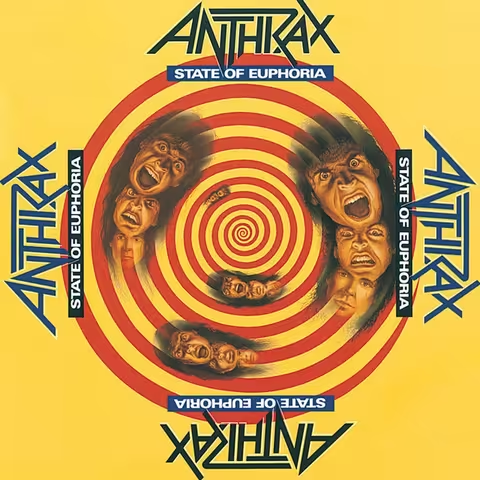
The front cover, painted by Don Brautigam in the saturated late-Eighties metal style, was the obvious sales image. The back cover was the one fans talked about. Anthrax commissioned Mort Drucker, the MAD Magazine legend whose decades of film and television parodies had made him one of the most recognisable caricaturists in American satirical comics, to draw the band. The result is a one-off Drucker portrait of Belladonna, Spitz, Ian, Bello and Benante in his unmistakable line-and-wash style, and it remains one of the most-loved pieces of Anthrax sleeve art.
It also fits the band's broader visual identity in a way that no other thrash band of the period attempted. Anthrax had built their image around the Not Man mascot, around cartoon shorts and Bermuda shorts and a refusal to take heavy-metal seriousness entirely seriously. Hiring Drucker, a household name in American comedy art, married that aesthetic to a household-name signature. Gene Ambo's photography of the band rounded out the sleeve. The packaging is the part of the record that nobody has ever wished was done differently.
The Drucker connection also reads, in retrospect, as a small piece of evidence that Anthrax were paying attention to a tradition of American popular satire that their thrash peers largely ignored. Metallica's sleeve identity in the same period was austere, monochrome, and built around the gothic visual language of Pushead and Stephen Gorman. Slayer's was a near-religious commitment to occult iconography. Megadeth's was the Ed Repka Vic Rattlehead cartoon that read closer to horror than humour. Anthrax, alone among the four bands the world would later group together, were happy to be seen taking visual cues from MAD Magazine. The Drucker back cover is the most explicit statement of that aesthetic position the band ever made.
Release, charts and certifications
State of Euphoria was released on 19 September 1988, on Megaforce in North America and Island in the rest of the world. The international chart performance was the strongest of the band's career to that point. The album reached number 30 on the Billboard 200, number 12 on the UK Albums Chart, number 4 in Finland, number 15 in Germany, number 17 in Norway, number 20 in Switzerland, number 21 in Sweden, and number 57 in the Netherlands. It was the first Anthrax album to chart in Australia at all, peaking at 82, and in Canada, peaking at 87.
Certifications followed quickly. The RIAA awarded the record Gold status on 8 February 1989, less than five months after release, for 500,000 copies sold in the United States. Music Canada certified it Gold for 50,000 Canadian copies, and the BPI awarded it Silver in the UK for 60,000 copies. Crucially, all of these numbers were above the equivalent figures for Among the Living. The album the band themselves were least confident about was, in raw commercial terms, the most successful record they had ever made.
Critical reception then and now
Press reaction at the time was mixed and has stayed mixed. AllMusic's retrospective review gives the album 2.5 out of 5, and notes a band that has moved away from its strongest material. The New Rolling Stone Album Guide is more generous at 3 out of 5. The Encyclopedia of Popular Music sits below both at 2 out of 5. Martin Popoff's Collector's Guide to Heavy Metal, the closest thing thrash has to a hymn book, gives it 7 out of 10, which in Popoff's scale puts it in the company of solid second-tier records rather than essentials.
The most enthusiastic contemporary review came from Metal Forces, the British metal magazine, which awarded the album a perfect 10 out of 10, an outlier verdict that has not aged especially well but does capture the genuine excitement among British thrash readers when the record landed. The broad critical consensus then and now is that State of Euphoria failed to live up to Spreading the Disease, Among the Living and the I'm the Man EP, but that it has aged better than its reputation suggests, and that several individual tracks deserve more attention than the album's reputation tends to allow them.
The tour cycle: Maiden, Ozzy and Metallica
The touring around the album is where its lasting cultural significance was really built. Before the record dropped, Anthrax went out as support to Iron Maiden on the European leg of the Seventh Tour of a Seventh Tour, a substantial promotional push aimed squarely at the European market that the Island deal had just opened up to them. On release the band flipped to North America and opened for Ozzy Osbourne on the No Rest for the Wicked tour from November 1988 through January 1989, sharing the bill with a Zakk Wylde-era Ozzy band that was at full velocity.
They also did dates on Metallica's Damaged Justice tour, the cycle behind ...And Justice for All, which is the early historical link in what would later become the Big Four marketing event of 2010 onward. Two of the four thrash bands the wider world would eventually agree to call the genre's leaders were on the road together in late 1988 and early 1989, more than two decades before anyone formalised the concept on a festival flyer.
In 1989 the band ran their own cycles. Six UK shows with Living Colour in March put Anthrax in front of British audiences for the first time as an album-charting act in their own right. The Headbangers Ball Tour through April and May, with Helloween and Exodus as support, was a proper headline run on a bill that read like a thrash and power-metal manifesto. June and July took them across Europe with Suicidal Tendencies, King's X and M.O.D., a bill that quietly mapped out the alternative-leaning future direction American metal would take in the early Nineties.
Legacy and the road to Persistence of Time
In the long arc of the Anthrax discography State of Euphoria sits in an awkward and important spot. It is the bridge between the band's tightest, most concentrated thrash phase, Spreading the Disease and Among the Living, and their first big stylistic pivot, 1990's Persistence of Time, the slower, denser, more political record that would finally earn them the Grammy nomination they had been chasing for years. The seeds of Persistence of Time are audible in Finale and in the long mid-section of Who Cares Wins; the urgency of Among the Living is largely gone.
It is also the record that proved Megaforce and Island could move Anthrax product in genuine commercial volume across multiple continents, which is the precondition for everything that happened next. Without the chart positions State of Euphoria hit, the deal that took the band over to Island proper for Persistence of Time looks very different. Without the tour cycle alongside Metallica, the implicit Big Four pecking order that would eventually become a festival event in 2010 takes longer to settle into place. And without Scott Ian's anti-televangelist lyrics on Make Me Laugh, the thrash-metal political-satire wave of the late Eighties has one fewer named target.
The album's reputation was given a partial reset in 2018, when Megaforce reissued it as a 30th-anniversary deluxe edition with bonus material including period demos and live tracks. The reissue did not fundamentally change the critical view, but it did put the record back in front of a generation of metal fans who had grown up on the post-2010 Big Four tours and were working backwards through the catalogue. For that audience, with no investment in the 1988 expectation of another Among the Living, the album plays as a flawed, ambitious, occasionally brilliant transitional record by a band who could clearly do better and were about to.
What the long view also clarifies is how much of the album's reputation is a function of the surrounding records rather than of the music itself. Held next to Spreading the Disease and Among the Living, two of the tightest thrash records of the decade, State of Euphoria can only lose. Held next to Persistence of Time, the more ambitious and more confident record that immediately followed it, it again finishes second. Placed in the wider context of late 1988 metal, alongside Metallica's ...And Justice for All, Slayer's South of Heaven and Megadeth's So Far, So Good... So What!, it is a more competitive piece of work than its in-band reputation suggests. The verdict it most deserves is not the dismissal it has often received, but the more interesting one of a transitional record by a band caught between two clearly distinct phases of its own career, made too fast and yet pointing in the right direction.
Personnel
- Joey Belladonna - lead vocals
- Dan Spitz - lead guitar
- Scott Ian - rhythm guitar, backing vocals
- Frank Bello - bass, backing vocals
- Charlie Benante - drums, percussion, principal composer
- Carol Freedman - cello
- Produced by Anthrax and Mark Dodson
- Engineered and associate-produced by Alex Perialas
- Assistant engineering by Bridget Daly and Paul Speck
- Executive production by Jon Zazula and Marsha Zazula
- Front cover artwork by Don Brautigam
- Back cover band caricature by Mort Drucker
- Photography by Gene Ambo
Tracklist
| # | Title | Length |
|---|---|---|
| 1 | Be All, End All | 6:22 |
| 2 | Out of Sight, Out of Mind | 5:13 |
| 3 | Make Me Laugh | 5:41 |
| 4 | Antisocial | 4:27 |
| 5 | Who Cares Wins | 7:35 |
| 6 | Now It's Dark | 5:34 |
| 7 | Schism | 5:27 |
| 8 | Misery Loves Company | 5:40 |
| 9 | 13 | 0:49 |
| 10 | Finale | 5:47 |
Things you might not know
| Fact | Detail |
|---|---|
| Why Mark Dodson | Anthrax hired Dodson on the strength of his work on Judas Priest's Ram It Down and his earlier engineering for Metal Church, looking for a bigger and glossier guitar sound than the dry Pyramid Sound rooms had given Among the Living. |
| The studio | The album was tracked at Quadradial Studios in Miami, Florida, between April and June 1988, a long way from the New York scene the band came from and the Ithaca studio they had used for their previous three records. |
| The back cover artist | The band caricature on the back of the sleeve was drawn by Mort Drucker, the MAD Magazine institution best known for decades of film and television parodies, and remains one of the most-loved pieces of sleeve art in the Anthrax catalogue. |
| The Stephen King song | Misery Loves Company is a track-length adaptation of Stephen King's 1987 novel Misery, written from the perspective of the captive author Paul Sheldon as Annie Wilkes holds him prisoner. |
| The David Lynch song | Now It's Dark takes its title and its central character study directly from Dennis Hopper's portrayal of Frank Booth in David Lynch's 1986 film Blue Velvet. |
| Antisocial is a cover | The album's biggest single was originally a 1980 song by the French metal band Trust, written by Bernie Bonvoisin and Norbert Krief, with Anthrax adapting the lyric into English. |
| First charts in Australia and Canada | State of Euphoria was the first Anthrax album to chart in Australia, at number 82, and in Canada, at number 87, with the Island Records distribution deal a key reason why. |
| Gold in under five months | The RIAA certified the album Gold on 8 February 1989, less than five months after its 19 September 1988 release, for 500,000 US copies sold. |
| The band's own verdict | Charlie Benante has said the band felt the album was not finished properly, a quiet apology that has shadowed the record across the rest of the band's career. |
| Three songs never played live | By most credible accounts, Schism, Misery Loves Company and 13 have never been played live by Anthrax, an unusually high attrition rate for a Gold-certified record by a heavily touring band. |
How to listen now
The album is on every major streaming service in its original ten-track running order. The version most worth hunting down on physical formats is the 2018 30th-anniversary deluxe reissue, which packages the album with period demos, live tracks and contextual material that flesh out the picture the studio album leaves incomplete. Original 1988 Megaforce and Island vinyl pressings turn up regularly on the second-hand market at sensible prices and are still the best way to experience the Mort Drucker back cover at scale. The European Island pressings are slightly easier to find than the American Megaforce ones, a small artefact of the distribution deal that pushed the album so much further into Europe than any earlier Anthrax record had reached.
For the live picture, dig out video footage of Anthrax's 1988 and 1989 tours, where Be All, End All and Antisocial still detonate the way Quadradial never quite let them on tape. Current Anthrax setlists rarely include more than one or two tracks from the album, so the contemporary footage remains the best record of how this material actually worked at full volume in front of a paying audience.
Comments