Tool released their second studio album Aenima on 17 September 1996, four years on from the EP Opiate and three from the breakthrough Undertow. The record arrived into a marketplace already exhausted by the post-Nevermind alt-rock gold rush, with grunge a spent commercial force and nu-metal still a year from its commercial peak. Most of the bands selling out American sheds that summer were leaning into shorter songs, brighter mixes and label-friendly singles. Tool turned in 77 minutes and 18 seconds of suite-form heavy music with a Jungian title, a tribute to a dead comedian and a 13-minute closer.
What Aenima did, more than any other heavy record released that year, was rebuild the bridge between metal and progressive rock that grunge had spent half a decade demolishing. The riffs were still loud and the down-tuned guitars still recognisably the product of the Sub Pop and Epitaph era, but the song shapes owed more to King Crimson and Peter Gabriel than to Soundgarden or Alice in Chains. By the time the album reached its third single, the conversation about what heavy music in the 1990s could sound like had moved several rooms over.
A 1996 release into uncharted territory
The summer of 1996 belonged, at the top of the Billboard 200, to Alanis Morissette, Hootie and the Blowfish and the Fugees. The heavy end of the chart was thinner. Metallica had released Load in June to a divided audience, Pantera's The Great Southern Trendkill had landed in May, and Rage Against the Machine's Evil Empire was holding a respectable mid-table position. There was a clear gap between mainstream heavy and the underground prog and post-hardcore scenes, and Tool walked straight into it.
The label, Zoo Entertainment, had been restructuring throughout the recording, and would within months fold its operations into the new Volcano Entertainment imprint. That commercial uncertainty made the album's number two debut, with first-week SoundScan sales of roughly 148,000 copies, all the more striking. New Zealand sent it to number one, Australia to number six and the United Kingdom, where the band had barely toured, to a more modest number 108. The record's chart life would be measured in years rather than weeks: the RIAA certified Aenima three times platinum on 4 March 2003, with the ARIA and Music Canada awarding matching 3x Platinum certifications and the BPI eventually settling at Gold.
The release also put a hard date on the end of one Tool and the beginning of another. The Undertow-era line-up, the four-piece that had played second-stage at the inaugural Lollapalooza in 1993 and worked its way up to main-stage status the following year, was gone. The Aenima line-up would last twenty-five years and counting.
From Undertow to Aenima: the band at a crossroads
Undertow had taken Tool from the Los Angeles club circuit to platinum status almost by stealth. The MTV banning of the 'Prison Sex' video, far from killing the band, had hardened the cult around them, and the Lollapalooza slots had connected them to an audience that ranged from Jane's Addiction fans to early Helmet and Melvins followers. By the time the Undertow touring cycle ended in late 1994, the band had spent the better part of two years on the road and were, by their own later accounts, exhausted and uncertain about what should come next.
The first writing sessions for the follow-up began in early 1995 with the original four-piece intact. Demos from that period circulate among collectors and confirm that Stinkfist, Eulogy, H. and Pushit were all in some recognisable form before the bass chair changed hands. Adam Jones' guitar approach had moved decisively away from the chunkier mid-range tone of Undertow towards something cleaner at the top and looser in the low end, leaving space for whoever was holding down the bottom octave.
That ambiguity about who the bassist would be ran into the studio. Tool were, in a literal sense, half-finished as a band when David Bottrill arrived to start tracking. The decision to keep the songwriting credits intact, with Paul D'Amour still listed as co-writer on the four tracks he had helped shape, became one of the small but telling editorial choices that defined the record's eventual identity.
The bassist swap: D'Amour out, Chancellor in
Paul D'Amour announced his departure from Tool in 1995. His stated reason, repeated in interviews over the following years, was a desire to play guitar rather than bass and to work in a less prog-leaning context. The split was amicable enough that his contributions to the in-progress record stayed on the page: ASCAP filings credit him as a co-writer on Stinkfist, Eulogy, H. and Pushit, four of the most musically ambitious cuts on the eventual album.
His replacement came from a quarter that few American observers had been watching. Justin Chancellor was the bassist for the London-based four-piece Peach, whose 1994 album Giving Birth to a Stone had impressed Adam Jones when the two bands toured together in Europe. Chancellor was invited to audition, flew to Los Angeles, and was offered the gig before he flew home. His arrival changed the band's low end fundamentally. D'Amour's playing had been busier and more guitar-like, leaning on a thinner pick attack; Chancellor brought a heavier fingerstyle approach, a fondness for lower tunings and a willingness to act as a melodic counterweight to Adam Jones rather than a rhythmic shadow.
The effect is audible across Aenima. On the tracks D'Amour helped write, you can still hear the original architecture: Stinkfist's main figure sits in roughly the same register as the guitar. On the newer material, particularly Forty Six & 2 and Hooker with a Penis, the bass drops to a position that anchors the song while leaving the guitars free to drift, double, or fall silent. That basic division of labour would define every Tool record that followed.
David Bottrill, Ocean Way and the tracking aesthetic
The producer Tool chose for the second album was an unusual fit on paper. David Bottrill was an English engineer and producer whose CV ran through Peter Gabriel's Real World setup, where he had worked on So and Us, and on to Crash Test Dummies' God Shuffled His Feet. He had a reputation for capturing complex acoustic spaces and for being patient with bands that liked to take their time. None of that obviously suggested a heavy record, which was rather the point. Tool wanted someone who would not push them towards a more commercial mix and who would treat Danny Carey's drum kit as the orchestra it effectively was.
Tracking took place across Ocean Way Recording in Hollywood, The Hook in North Hollywood, and Larrabee North and Larrabee West for additional sessions and overdubs. Ocean Way's Studio B, with its long sightlines and live-room ambience, provided the drum sound that runs through the heavier cuts. Bottrill miked Carey's kit with an unusually high count of room mics, capturing the natural decay rather than gating it tight, and the result is the spacious, almost orchestral percussion attack that opens Stinkfist and reaches its fullest expression on Third Eye.
Adam Jones' guitar tone on the record was built around high-gain heads run into 4x12 cabinets, paired with the Gibson Les Paul Custom that had been his on-stage signature throughout the Undertow cycle. He has spoken in subsequent interviews about preferring fewer overdubs than other bands of the era, often building a riff from two carefully matched takes rather than the stacked walls of guitar that defined contemporary alt-metal. Chancellor's bass sat lower in the mix than D'Amour's had on Undertow, the British player favouring a thicker mid-range tone that locked into Carey's kick drum and gave the album its distinctive ribcage thump.
Building a 77-minute statement
The compact disc, in 1996, was at the absolute peak of its commercial dominance and its physical capacity was very much on producers' minds. A standard CD could hold around 74 minutes; later 80-minute discs were beginning to appear. Aenima's 77 minutes and 18 seconds was a deliberate statement, sitting just at the edge of what the format could comfortably deliver and demanding to be experienced as a single sitting.
That length was achieved partly by the song-form ambition of the major tracks and partly by the placement of interludes. Useful Idiot, Message to Harry Manback, Intermission, Die Eier von Satan, Cesaro Summability and (-) Ions function as connective tissue rather than filler, breaking the heaviest material into movements and giving the listener space to breathe before the next escalation. The sequencing puts the most overtly accessible track, Stinkfist, first; ends side one of the original vinyl with the locked-groove gag of Useful Idiot; and reserves the longest, slowest and strangest pieces for the back half.
The decision to dedicate the album to Bill Hicks, made formally on the back panel of the booklet, was taken by Maynard James Keenan in consultation with the rest of the band during the final assembly. Hicks had died of pancreatic cancer in February 1994, midway through the writing of the record, and his presence runs through the lyrics, samples and stage banter of the entire Aenima period.
The lenticular jewel-case and the visual world of Cam de Leon
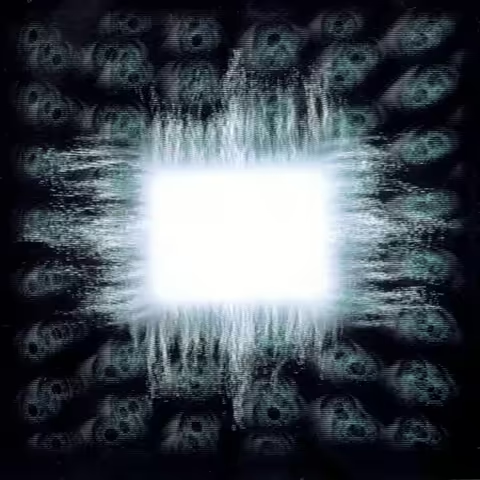
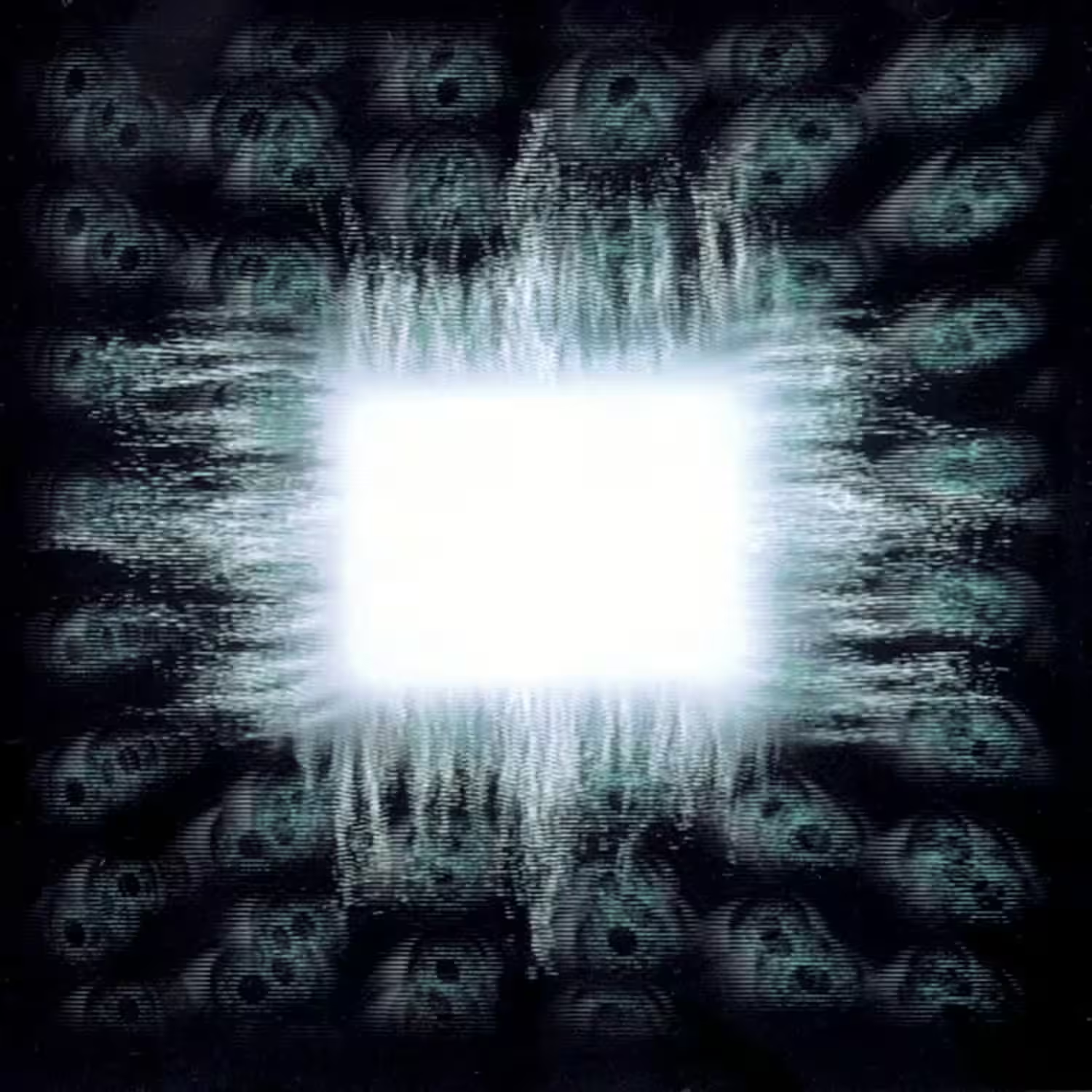
The packaging of Aenima was, in commercial terms, ridiculous. Cam de Leon's Smoke Box, the front-panel image, was rendered as a lenticular print that shifted as the buyer tilted the case in their hand, an effect more commonly associated with novelty postcards than platinum-selling rock albums. The inner booklet expanded the visual language into a series of photographic and painted images, including a contortionist photograph of the performer Alana Cain that became one of the most-discussed visuals of the era. Art direction was credited jointly to Adam Jones and Kevin Willis.
The lenticular packaging earned the album a nomination for Best Recording Package at the 40th Annual Grammy Awards, alongside the Best Metal Performance win for the title track. It is a small detail that says a lot about Tool's relationship with the record industry around them: they were prepared to spend more on the physical artefact than the unit margin really allowed, on the assumption that buyers would treat the album as an object rather than a delivery system for songs.
Cam de Leon, who had also designed the Undertow sleeve and would continue working with the band for years, treated the Aenima brief as a chance to push the visual identity towards the surreal and ritualistic imagery that Maynard James Keenan was drawing on in the lyrics. The result is one of the few mid-1990s rock packages that still functions as a small art object rather than as a marketing wrapper.
Maynard's lyrical framework: Jung, Hicks and the futants
The lyrics on Aenima draw on a small number of intellectual sources that Keenan returned to repeatedly across interviews of the period. Carl Jung's writing on the anima, the unconscious feminine aspect of the psyche, provides both the album's title and the framing concept of Forty Six & 2, a song built around Drew Wilson's speculative reading of Jung as predicting a coming evolutionary leap to a 46-plus-2 chromosomal arrangement. Timothy Leary's late writing on 'futants', the mutant futurists whom Leary believed were already living among the rest of us, surfaces in the same song's lyrical imagery.
Ritual magic, particularly the writings of Aleister Crowley and the broader Thelemic tradition, provides another vein, although Keenan's relationship to that material is consistently more sceptical than devotional. The hardest-edged lyrics on the record are aimed not at religion in the abstract but at American religious fundamentalism and at what Keenan saw as the empty consumer culture of late-century Los Angeles. The title track, with its repeated wish for 'one big flush' to take the city into the Pacific, is the clearest expression of that disgust.
Bill Hicks supplies the comic spine to all of this. Hicks' Arizona Bay routine, in which he imagines the San Andreas Fault finally giving way and turning the Arizona desert into beachfront property, is the direct source of the Aenema lyric. His voice appears on Third Eye, sampled from a 1993 stand-up set. The dedication on the back panel, 'Another dead hero', is taken from Hicks' own framing of comedians who told the truth.
Stinkfist and the one concession to radio
Stinkfist was the only commercial single from Aenima, the only track to receive a full promotional video and the only piece of music on the record that anyone reasonably expected to hear on alternative radio. The song's stop-start main figure, anchored by Chancellor's bass and punched by Carey's snare-and-rack-tom interplay, is the closest thing on Aenima to a traditional rock arrangement.
The lyric, frequently misread as literal, is in Keenan's account a song about emotional desensitisation, about the constant escalation required to feel anything in a culture saturated by stimulation. The title was a deliberate provocation: MTV, in the United States, would not air the song under its original name and rebranded it as 'Track No. 1' in onscreen captions, while leaving the video itself intact. That video, directed by Adam Jones with co-direction credit to Fred Stuhr, used stop-motion figures and unsettling prosthetic effects to build a visual world that became the band's calling card for the Aenima cycle and beyond.
Stinkfist also performed the structural function of an opening track: it set the rhythmic vocabulary of the record, introduced the listener to Chancellor's bass without making a fuss about the line-up change, and ended on a long fade that pushed into Useful Idiot's locked-groove gag on the vinyl pressing. As an entry point, it remains the song most casual listeners reach for first, twenty-eight years on.
The prog spine: Eulogy, H. and Forty Six & 2
The middle of Aenima is where the prog ambition of the record is most concentrated. Eulogy, the second song proper, is an 8 minute and 28 second elegy whose subject has been debated since the album's release. Critics paired it almost immediately with the Hicks dedication on the booklet; Keenan himself has at various points pointed at the figure of the self-appointed saviour more generally, and has explicitly resisted a single-name reading. The track's slow build, its eventual eruption into Carey's most physical performance on the record, and its long instrumental fade are the closest Tool come on Aenima to the kind of suite construction that Lateralus would later expand into a full-length method.
H. is the most personal song on the record, a co-write with Paul D'Amour that Keenan has described, in a now-famous between-songs explanation at Philadelphia's Electric Factory on 23 November 1996, as a song about the shoulder angel and shoulder devil that surround a parent making difficult choices about their child. That explanation has been quoted and re-quoted in fan circles for decades and remains the canonical reading of the song.
Forty Six & 2 is the most explicitly progressive cut on Aenima and the one that most clearly points forward to the Lateralus-era band. The lyric, framed around the Wilson-Leary reading of Jungian evolution, sits on top of a 6/8-leaning groove that Carey treats as a polyrhythmic playground. ASCAP credits show the song as a full-band co-write, with Chancellor's contribution properly logged. It became, alongside Stinkfist, the second of the album's permanent live-set fixtures.
Hooker with a Penis and the OGT rebuttal
Hooker with a Penis is the bluntest piece of writing on Aenima and the most direct response to a specific real-world event. The song's narrative, in Keenan's own telling, is built around an encounter with a self-described long-time fan, the 'OGT' or 'Original Gangster Tool fan' of the lyric, who confronted Keenan at a meet-and-greet to accuse the band of selling out. The song is Keenan's reply, delivered in character but unmistakably his own, and it functions as both a refusal of the purity test and an admission that yes, the band are signed to a major label, and yes, they are being paid.
The track is musically the most straightforward on the album, a four-on-the-floor riff with Carey's snare hammering on the off-beats and Adam Jones' guitar taking an unusually direct, blues-adjacent approach. It is the closest Aenima comes to a straight rock song, and the sequencing places it deliberately at a point in the record where the listener might be in danger of taking the whole project too solemnly. Live, it became the moment where the band's relationship with their audience was, half-jokingly, renegotiated for the rest of the night.
The OGT shorthand has, in the years since, become part of the wider Tool vocabulary, used by fans to describe a particular kind of in-group gatekeeping. It is a piece of feedback the band invited and then folded into the work, which is roughly the relationship Tool would maintain with their audience for the next quarter century.
Jimmy and Pushit: the personal undercurrent
If Hooker with a Penis is the most public song on Aenima, Jimmy is the most private. Keenan has spoken of it as a sequel to Undertow's Prison Sex, returning to material from his own childhood and to the eleven-year-old self that the earlier song addressed obliquely. The track sits in the middle of side two on the vinyl and builds slowly, with Adam Jones playing one of his most restrained guitar parts on the record and Chancellor's bass carrying the harmonic weight underneath. The lyric is more confessional than the surrounding songs and the track's relative quietness is part of its impact.
Pushit, the album's longest song proper at 9 minutes and 55 seconds, is one of the four D'Amour co-writes and has the most complicated subsequent life of any Aenima track. The studio version is built around a riff that the band had been touring for over a year before recording it, with Carey and Chancellor pulling the song's quiet middle section into a long, almost ambient passage. A radically different live version, with Aloke Dutta on tabla and a different rhythmic emphasis throughout, appeared on the 2000 compilation Salival and is, for some listeners, the definitive reading of the song.
Both tracks point at something that Aenima does almost uniquely well: it allows the album's heaviest moments to share space with material that is quiet, internal and slow. That dynamic range is part of what made the record so difficult to file alongside the rest of the 1996 heavy releases, and part of why it has aged so much better than most of them.
The interludes and Die Eier von Satan
The interlude tracks on Aenima are not throwaway. Useful Idiot, less than a minute long, closes side one of the vinyl with a locked-groove of needle-skip noise, a piece of physical-format humour that does not survive the transition to streaming. Message to Harry Manback is a recording of a profane Italian-accented voicemail left on a friend's answering machine, set against a delicate piano line. Intermission is a circus-organ rendition of the main theme of Jimmy. Cesaro Summability is a recording of an infant crying, processed and looped, that serves as the introduction to Aenema. (-) Ions is a passage of crackling electrical interference that introduces Third Eye.
Die Eier von Satan, 'The Eggs of Satan', is the strangest of the lot and the one most often singled out by writers attempting to describe Aenima to a sceptical newcomer. The track features Marko Fox reciting, in German, what sounds like a Nazi-rally harangue and is in fact a Mexican wedding cookie recipe. The translation was supplied by Gudrun Fox. The musical backing is built from hydraulic-press percussion and metallic clatter, and the obvious comparisons are to Einsturzende Neubauten on one side and Tom Waits' Bone Machine on the other. The joke, which only lands once the listener has the translated lyric in front of them, is a small masterclass in tonal misdirection.
The interludes are also where the album's progressive-rock heritage is most explicit. Pink Floyd's The Dark Side of the Moon and Wish You Were Here both used connective tissue in a similar way, and the construction of Aenima as a single 77-minute experience rather than a collection of songs sits squarely in that lineage.
Aenema, Hicks and the Grammy
The title track is the album's centrepiece in every meaningful sense. Aenema, spelled with the dipthong and pronounced 'enema', extends Hicks' Arizona Bay routine into a six-minute thrash-leaning anthem in which Keenan inventories the cultural targets of his disgust and asks the San Andreas to finish them off. The song's structure is unusually direct for Aenima, with a long verse build and a chorus that the band could and did treat as a singalong moment in arenas. The lyric's roll-call of targets, from television personalities to self-help culture to Los Angeles itself, has aged in places and remained painfully relevant in others.
At the 40th Annual Grammy Awards, held on 25 February 1998, Aenema won Best Metal Performance, beating nominations from Megadeth, Pantera, Rammstein and the Rollins Band. The same evening, the lenticular packaging was nominated, though did not win, for Best Recording Package. For a band that had spent the previous five years cultivating a hostile relationship with mainstream media, the Grammy was an awkward kind of validation, and Keenan's acceptance was characteristically brief.
The accompanying video, again built around the stop-motion aesthetic of the Stinkfist promo and again co-directed by Adam Jones with Fred Stuhr, is the more visually ambitious of the two clips Tool produced for the album. It is also, of all the Aenima visuals, the one most often cited as a template for the kind of unsettling, hand-built imagery that the band would carry forward into the Lateralus and 10,000 Days cycles.
Third Eye: the 13:47 closer
Third Eye is the longest song on Aenima at 13 minutes and 47 seconds, and the most explicitly indebted to the prog-rock tradition the band were otherwise circling rather than naming. The track opens with samples of Bill Hicks, taken from his 1993 set Revelations, riffing on the idea that the people who claim drugs have never helped anyone have, conveniently, also never tried them. From there the song builds through a series of distinct movements, with Chris Pitman's analog synthesiser providing a textural undercurrent that the rest of the band weave around rather than over.
Pitman, who would later play a long stint with Guns N' Roses, contributed the only non-Tool instrumental performance of significance on the record. Bottrill's keyboard work elsewhere on the album is mostly textural and is buried in the mix; Pitman's synth on Third Eye, by contrast, is allowed to sit forward and to act as a sixth voice in the arrangement.
The song's lyrical concern, the awakening of the third eye and the perception of a reality beyond the consensual one, is by now familiar territory for Tool but on Aenima it was framed for a mass audience for the first time. Closing the record with thirteen and a half minutes of sustained build, with the loudest passages reserved for the final third, is a structural choice that almost no other band of the period would have attempted. It is also the choice that more than any other made Lateralus possible.
Reception, charts and certifications
Critical reception was strong but more divided than the band's later catalogue tends to suggest. AllMusic's Rob Theakston gave the album a five-star review and called it the moment Tool fully integrated their progressive influences. Entertainment Weekly's Jon Wiederhorn handed in an A minus. The Houston Chronicle awarded four out of five. The Los Angeles Times, in a review by Sandy Masuo, gave it three and a half out of five and praised the production while finding the lyrics overwrought in places. Rolling Stone's David Fricke wrote a notably positive piece that placed the album in the lineage of King Crimson and Pink Floyd.
The dissenters were notable. Spin's Chuck Eddy gave the album 5 out of 10 and accused the band of taking themselves too seriously. Robert Christgau, characteristically, marked it a 'dud' in his Village Voice consumer guide. Pitchfork did not review the album on release; James P. Wisdom's belated 2000 review gave it 7.9, and Jeremy D. Larson's 2026 retrospective re-review pushed the score to 8.7, placing it among the magazine's higher-rated 1990s heavy records. Kerrang!, in a 2003 readers' poll, named Aenima the sixth most influential album of all time.
Commercial reception followed a slow-burn pattern. The number two debut on the Billboard 200 set the headline, but the album's real story was its longevity: it remained on the chart for over a year, was certified platinum within three months and went on to its current 3x Platinum status with the RIAA in March 2003. Aenima outsold most of its 1996 chart peers over the decade that followed and remains, by some distance, Tool's most-played catalogue album on streaming services in the late 2020s.
Legacy: Lateralus, A Perfect Circle and the prog-metal revival
The most visible legacy of Aenima is the two Tool albums that followed it. Lateralus, released in May 2001, took the suite-form construction, the long-song ambition and the polyrhythmic drumming of Third Eye and built an entire 79-minute album around them. 10,000 Days, released in May 2006, extended the project further. Bottrill remained involved through both records and the trio of releases is best understood as a single body of work that begins with Aenima's first cut.
The wider influence is harder to map but easy to hear. Mastodon's mid-2000s shift towards long-form prog-metal songwriting; Karnivool's two decades of debt to Tool's rhythmic vocabulary; Gojira's Magma and Fortitude albums; the entire Periphery-adjacent djent scene; the prog-metal revival that Sumerian Records and Inside Out have spent the last fifteen years catering to: all of it traces some part of its DNA back to the 77 minutes of Aenima.
The other Aenima-era legacy is A Perfect Circle. Billy Howerdel had worked as Tool's guitar tech during the recording and touring of the album, was credited in the liner notes and was sharing a house with Keenan when the two began writing the songs that would become Mer de Noms. A Perfect Circle's 2000 debut went platinum on its first day on sale, in large part because the Aenima audience followed Keenan into the new project on faith. Without the cultural weight of the 1996 album, that handover does not happen.
Almost thirty years on, Aenima stands as the album where Tool finished being an interesting alternative-metal band and started being something stranger and more durable. The records that followed are arguably more accomplished, but Aenima is the one that did the hard work of building the audience and the vocabulary that made the rest possible.
Personnel
- Maynard James Keenan: lead vocals
- Adam Jones: guitars, art direction
- Justin Chancellor: bass
- Danny Carey: drums, percussion
- Paul D'Amour: co-writer on Stinkfist, Eulogy, H. and Pushit (per ASCAP)
- Chris Pitman: analog synthesiser on Third Eye
- David Bottrill: keyboards (additional textural parts)
- Kabir Schletter: organ
- Marko Fox: German recitation on Die Eier von Satan
- Gudrun Fox: German translation on Die Eier von Satan
- David Bottrill: production, engineering and mixing
- Cam de Leon: front cover (Smoke Box) and visual concept
- Alana Cain: contortionist photography in booklet
- Adam Jones and Kevin Willis: art direction
- Billy Howerdel: guitar tech, credited in liner notes
Tracklist
| # | Title | Length |
|---|---|---|
| 1 | Stinkfist | 5:11 |
| 2 | Eulogy | 8:28 |
| 3 | H. | 6:07 |
| 4 | Useful Idiot | 0:39 |
| 5 | Forty Six & 2 | 6:03 |
| 6 | Message to Harry Manback | 1:53 |
| 7 | Hooker with a Penis | 4:33 |
| 8 | Intermission | 0:56 |
| 9 | Jimmy | 5:24 |
| 10 | Die Eier von Satan | 2:17 |
| 11 | Pushit | 9:55 |
| 12 | Cesaro Summability | 1:26 |
| 13 | Aenema | 6:39 |
| 14 | (-) Ions | 4:00 |
| 15 | Third Eye | 13:47 |
Things you might not know
| Fact | Detail |
|---|---|
| Dedicated to a comedian | The album is formally dedicated on the back of the booklet to the comedian Bill Hicks, who had died of pancreatic cancer in February 1994 while the band were still writing the record. |
| The locked-groove gag | On the original vinyl pressing, the track Useful Idiot closes side one with a locked groove of needle-skip noise, an analogue-format joke that does not survive on CD or streaming. |
| A wedding cookie recipe in German | Die Eier von Satan, which sounds like a Nazi-rally harangue, is in fact a Mexican wedding cookie recipe recited in German by Marko Fox, translated from English by Gudrun Fox. |
| The meaning of OGT | The 'OGT' in Hooker with a Penis stands for 'Original Gangster Tool fan' and refers to a real meet-and-greet encounter Keenan had with a self-described long-time fan accusing the band of selling out. |
| The Lateralus production lineage | David Bottrill went on to produce both Lateralus (2001) and 10,000 Days (2006), making the three-album run from Aenima onwards a single, coherent producer-and-band collaboration. |
| The A Perfect Circle connection | Billy Howerdel, the guitar tech credited in the Aenima liner notes, was sharing a house with Maynard James Keenan when the two began writing what would become A Perfect Circle's 2000 debut Mer de Noms. |
| A Grammy for the packaging, almost | The lenticular Cam de Leon jewel-case was nominated for Best Recording Package at the 1998 Grammys, alongside the Best Metal Performance win for the title track. |
| D'Amour's lingering ASCAP credits | Paul D'Amour, who left the band in 1995, is still credited as a co-writer on Stinkfist, Eulogy, H. and Pushit through the ASCAP repertory database. |
| Chancellor's previous band | Justin Chancellor was the bassist of the London four-piece Peach, whose 1994 album Giving Birth to a Stone caught Adam Jones' attention when the two bands toured Europe together. |
| Chris Pitman on Third Eye | The analog synthesiser texture that runs through the 13-minute closer Third Eye was performed by Chris Pitman, later of Guns N' Roses, in the only guest instrumental performance of significance on the record. |
How to listen now
Aenima is available on all major streaming services in remastered form, with the original 77-minute running order intact and the interludes retained in sequence. Vinyl pressings have surfaced intermittently over the years and the original 1996 jewel-case lenticular pressing remains a sought-after collectable, turning up regularly on the second-hand market. Listeners encountering the record for the first time on streaming should bear in mind that the vinyl-locked-groove gag at the end of Useful Idiot is, by its nature, a format-specific joke that cannot be reproduced digitally.
Listen to Riffology
Riffology is the podcast that goes deep on the albums that shaped heavy music, one record at a time. New episodes land regularly on Apple Podcasts, Spotify and every other major platform; the full back catalogue, including more on the Tool discography, is available at riffology.co.
Comments