Jonathan Davis says he refused to start singing on Korn's Follow the Leader unless Toby Wright got him an eight-ball of cocaine right away. Around him was more than $750,000 of Sony's money, eighteen weeks in NRG Studio B in North Hollywood, a live web show every Thursday, a liquor bill Davis estimates topped out at $60,000, and a producer fired midway through, which meant every vocal track had to be re-recorded.
It was the first Korn record not produced by Ross Robinson, and even the title was intended as a raised middle digit to the copyists. It went straight in at number one on the Billboard 200, with 268,000 copies sold in its first week.
Follow the Leader Album Facts
| Field | Detail |
|---|---|
| Artist | Korn |
| Album | Follow the Leader |
| Release Date | 18 August 1998 (US) |
| Label | Immortal Records, Epic Records |
| Producer(s) | Steve Thompson, Toby Wright, Korn |
| Studio(s) | NRG Recording Studios, North Hollywood, California (March to May 1998) |
| Genre / Subgenre | Nu metal, alternative metal |
| Track Count | 13 songs; 25 tracks on the original CD (12 are five-second silences) |
| Total Runtime | 70:01 (67:03 digital) |
| Billboard 200 Peak | 1 |
| UK Albums Chart Peak | 5 |
| Other Notable Chart Peaks | 1 in Australia, Canada and New Zealand |
| Certifications | US 5x Platinum; Australia 3x Platinum; Canada 3x Platinum; UK Gold |
| Key Singles | "All in the Family", "Got the Life", "Freak on a Leash" |
| Riffology Vault | Release dates, pressings and cover art |
Why Korn Took a Left Turn
"We know we rushed it... We settled." That was Davis on Life Is Peachy in 1998. The 1996 record had seemed formulaic and rushed, by the band's own admission a "fast food" album to capitalise on their success, and Head says half of them "didn't really like Life Is Peachy compared to the first album". Munky puts the choice plainly: "either we're gonna make the same record for the next 25 years or we're gonna be a band that evolves".
Playing Lollapalooza in 1997 with Tool, Snoop Dogg and Tricky, they were all over MTV, and their audiences had grown from clubs and theatres to sheds. And other bands were starting to sound like them. Munky recalls: "Man, this is bullshit, people trying to sound like Korn."
"We'd created something that was different, but right after the ...Peachy album we were starting to hear bands that sounded like us, so we took a left turn."
James "Munky" Shaffer, Metal Hammer, 2023
Davis was blunter in Paris in 1998, just before release: "We blew this whole scene open, I don't care what anybody says. We did all the work, and now there's this new market, all these Korn bands are popping up." He also called the new songs "my album of self-destruction", with "none of my childhood stuff going on any more". And he knew what was riding on it: "If the third album does well then you're set for life."
Writing Follow the Leader in a Room With a PA
The writing began in the summer of 1997 in a small rehearsal room in Redondo Beach. "We were writing by ourselves in a little studio, just a room with a PA," Davis told The Fader. Head remembers being "without any producer or leader, just us friends hanging out". Davis told Metal Hammer they "wanted to push boundaries and go somewhere else".
The ingredients were Pantera, Biohazard, Helmet, Portishead, Far and Praxis, with early Outkast, Faith No More, 1980s new wave and a lot of hip-hop. Davis says they started experimenting with hip-hop-inspired basslines against rock guitar. Head says he and Munky wanted the guitars to sound "not so much like the guitar, but like samples, keyboards, or synths", and Munky names DigiTech and Whammy pedals and "a lower-tuned seven-string guitar".
By the time Korn moved into NRG, two future classics were already written: "Freak on a Leash" and "Got the Life".
Steve Thompson Out, Toby Wright In
Instead of returning to Indigo Ranch, where the first two records were made with Robinson, Sony gave the band a budget of over $750,000 to move into NRG Studio B for eighteen weeks. It was a huge space with separate rooms for loops, guitar parts and the people constantly passing through. Recording ran from March to May 1998, and by June the band were mixing.
Midway through, Korn fired their producer, Steve Thompson. "We started bumping heads in the studio," Davis said in 1998, and his complaint was a production row: "We'd do our beats or something that we thought was best and we'd leave that and then I'd come in and he'd changed it! Without telling us!" Eventually, he says, "We were like, 'You know what, man? Get out. It's time for you to go.'"
"He didn't have the same vision that we had for our album, he wanted to make it all... just not us."
Jonathan Davis, Metal Hammer, 1998
Munky remembers it differently. In his 2023 version Thompson "was kinda going through some personal stuff so he kinda wasn't showing up", though he was there for "three or four big songs". Toby Wright, who had worked with Alice in Chains, Slayer and Metallica, "took over from that point and helped us engineer and produce the album". The firing delayed the album, because every vocal track had to be re-recorded.
Davis was also facing the microphone without the man who had produced both earlier Korn records. It was, he says, "my first record without Ross Robinson, so I had Ross come in and produce the vocals with me." "He was my crutch," he adds. "I was very afraid to do an album without him." In 1998 he had played it down, saying Robinson "didn't produce anything on the album, he was just there as my cheerleader". Wright remembers what the coaching involved.
"One of the first thing Ross did while Jonathan was trying to sing was punch him in the back, right on his spine. A couple of times."
Toby Wright, The Fader, 2018
Wright doesn't think it lasted "more than two or three vocal sessions". Davis places Robinson's nails in his back on "Freak on a Leash". "He came in for a couple songs and then I didn't need him anymore," he says. "I did the rest with Toby."
Korn TV and No Work Thursday
The sessions ran alongside Korn TV, a live web show every Thursday. Guests included Deftones, Marilyn Manson, Ron Jeremy and Limp Bizkit. "We were in the studio six days a week, but we were only really working maybe three days," Wright says. "We had No Work Thursday, which was the internet broadcast, and then we had Friday..." Sessions would go from three in the afternoon until three at night, sometimes with nothing getting done. Munky says the show was "so distracting to our process". When somebody asked them midway through whether they wanted to stop, the answer was "Hell no, this is fun."
"We were 25 to 28 years old, so it was like party central," Head says. "There was a lot of alcohol. Thousands and thousands of dollars!" Davis estimates the liquor bill for the three months of sessions topped out at $60,000. Munky says "he'd want some Jack Daniel's and a line of blow", and Davis says he refused to start singing without his eight-ball: "Toby started freaking the fuck out, because he knows if I do coke I only get a couple takes."
"You're giving a bunch of kids money that are already drunks and drug addicts," Munky says. "Probably not the best thing."
Personnel & Credits
| Role | Player | Notes |
|---|---|---|
| Core band | ||
| Lead vocals, bagpipes | Jonathan Davis | |
| Guitar | Brian "Head" Welch | |
| Guitar, talk box | James "Munky" Shaffer | Talk box on "Freak on a Leash" and "Dead Bodies Everywhere" |
| Bass, vocals | Reginald "Fieldy" Arvizu | Sings on "Earache My Eye" |
| Drums | David Silveria | |
| Guests and additional musicians | ||
| Vocals | Ice Cube | "Children of the Korn" |
| Vocals | Fred Durst | "All in the Family" |
| Vocals | Tre Hardson (Slimkid3) | "Cameltosis" |
| Vocals | Cheech Marin | "Earache My Eye" |
| Additional drums, programming | Justin Z. Walden | |
| Programming | Tommy D. Daugherty | |
| Production and engineering | ||
| Producer | Steve Thompson, Toby Wright, Korn | Thompson left mid-sessions |
| Vocal coach | Ross Robinson | Brought in briefly for vocals |
| Engineer | Toby Wright, John Ewing Jr. | Ewing also assistant engineer |
| Mixing | Brendan O'Brien | |
| Mastering | Stephen Marcussen | |
| Digital editing | Don C. Tyler | |
| Artwork | ||
| Cover art | Todd McFarlane, Greg Capullo, Brian Haberlin | Todd McFarlane Entertainment |
| Graphics | Brent Ashe | |
| Photography | Joseph Cultice | |
Inside the Songs of Follow the Leader
| # | Title | Writer(s) | Length | Single? | Notes |
|---|---|---|---|---|---|
| 1 to 12 | [silence] | 0:05 each | A full minute of nothing | ||
| 13 | It's On! | Korn | 4:28 | Davis sang it with sex going on around him | |
| 14 | Freak on a Leash | Korn | 4:15 | Yes | Talk box from Munky; scat breakdown instead of a solo |
| 15 | Got the Life | Korn | 3:45 | Yes | Recorded April 1998; Silveria's disco beat |
| 16 | Dead Bodies Everywhere | Korn | 4:44 | Talk box from Munky | |
| 17 | Children of the Korn | Korn, Ice Cube | 3:52 | Yes | Ice Cube guests; copyrighted 1998 |
| 18 | B.B.K. | Korn | 3:56 | Yes | Single issued ahead of "Freak on a Leash" |
| 19 | Pretty | Korn | 4:12 | Drawn from Davis's time in a coroner's office | |
| 20 | All in the Family | Korn, Fred Durst | 4:48 | Yes | Fred Durst duet; first single |
| 21 | Reclaim My Place | Korn | 4:32 | Closes on a screamed outburst | |
| 22 | Justin | Korn | 4:17 | About a boy dying of cancer who wanted to meet the band | |
| 23 | Seed | Korn | 5:54 | Deathmarch funk and echoey dub stretches | |
| 24 | Cameltosis | Korn, Tre Hardson | 4:38 | Tre Hardson guests; copyrighted 1998 | |
| 25 | My Gift to You | Korn; Tommy Chong, Gaye Delorme, Richard Marin ("Earache My Eye") | 15:40 | Hidden "Earache My Eye" with Cheech Marin follows |
"Freak on a Leash" was, Munky says, "one of the first tracks we wrote for that album". Davis says he wrote it about "the music industry, entertainment in general, how the machine worked". It opens with Munky wringing high-pitched noises from his guitar and Davis muttering "Something takes a part of me", and Fieldy's bass clacks through the chorus. Where most bands would drop a solo, it stops two and a half minutes in for Davis's scat.
"We were jamming and I started mixing beatboxing and this scat thing I do," Davis says, citing Doug E. Fresh. Fieldy thought it "almost made the whole song, what everybody waits for". Fricke called it "caged-animal babble", the "Busta Rhymes-in-Bellevue outburst".
"Got the Life" was recorded in April 1998. Metal Hammer, hearing five tracks in Paris before release, noted that the probable first single "grinds away to a disco beat", and Fricke called Silveria's "bona fide disco beat" the "sucker bait" in the song. Fieldy came up with the video concept, and McG directed it.
"Pretty" is the album's darkest turn. Davis started at the Kern County coroner's office in Bakersfield at sixteen, and the song comes from a baby girl who was brought in while he was there. He says he was about seventeen and a half at the time and still has nightmares about it. Fricke wrote that Davis "doesn't flinch from the horror".
"Children of the Korn" is the Ice Cube track. "He listened to the track a few times, studied it, didn't talk much and was very serious about his craft," Munky says. Head, who was "all over NWA" at nineteen or twenty, says: "My heart was pounding!"
"All in the Family" is a duet with Fred Durst, "the album's most controversial track" in The Ringer's words. Fricke took the pair to task for homophobic insults that he said cheapened an album "otherwise devoted to kickin' it against cruelty and prejudice". Davis told The Ringer it would not be in the 2018 anniversary set.
"Earache My Eye", the hidden Cheech and Chong cover, may have been Fieldy's idea. "I think the Cheech thing came about from Fieldy," Munky says, after they had been messing around with "Lowrider", Korn's War cover from Life Is Peachy: "he was like, 'Wouldn't it be awesome if we could get Cheech in the studio!'" Cheech Marin appears on the track, and Fieldy sings on it.
B-sides, Remixes & Extras
The "Got the Life" single came with a "Deejay Punk-Roc Remix" and a "D.O.S.E.'s Woollyback Remix", and a second part was backed with "I Can Remember" and an OOMPH! vs. Such A Surge remix of "Good God". At participating stores, 100,000 copies of a free compilation CD were shrink-wrapped to the album by Concrete Marketing. It featured Kid Rock, Orgy, Powerman 5000 and Limp Bizkit, plus a previously unreleased Korn track.
Hopscotch on the Edge of a Cliff
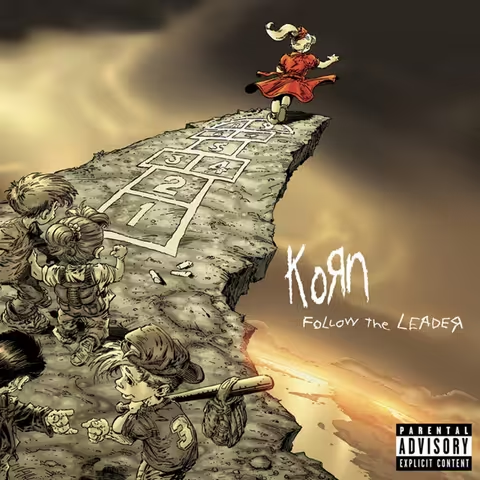
The sleeve is an illustration. A chalk hopscotch grid runs along a rocky ledge that ends in a sheer drop. At the edge, a girl in a red dress and hair ribbon is about to step off, while cartoon children wait their turn behind her, one in a baseball cap with a bat and glove, his jersey numbered 3. A stormy sky glows gold on the horizon. The Korn logo is scrawled in white, the title carries a reversed R, and a Parental Advisory sticker sits in the corner.
Todd McFarlane Entertainment made it, with McFarlane, Greg Capullo and Brian Haberlin on the art and Brent Ashe on graphics. The original concept began with Fieldy and was sketched by a friend of Davis. McFarlane told Rolling Stone that he and Capullo asked: "what if we do hopscotch, but it's on the edge of a cliff. So the question is, will she keep going or will she do what you're supposed to do in hopscotch, which is turn around, and come back?"
Korn wanted McFarlane after hearing he had called them "the Doors of the '90s", and Silveria told the Mitch Schneider Organization it "got everyone really excited". It was Korn's third straight cover with children in a disturbing context. McFarlane says he had looked at their earlier sleeves and found that "they all had this weird sort of mystery about them, like looming shadows", and says they did it to "play with some of the stuff that Korn had already established with some of their prior album covers".
Follow the Leader Puts Rock Back at Number One
Korn were out on the Korn Kampaign, a North American promotional tour for fans styled after a political campaign, which began on 17 August 1998 at Tower Records in Los Angeles and ended in early September. Follow the Leader came out the next day, 18 August, on Immortal and Epic.
Rock had been missing from the top of the American album chart for fourteen straight weeks. Dave Matthews Band's Before These Crowded Streets was the last rock record to get there, in the week of 10 May. Since then it had been mostly rap (DMX, Master P, Snoop Dogg, the Beastie Boys) and film soundtracks (City of Angels, Armageddon). Korn's 268,000 first-week copies put the Beastie Boys' Hello Nasty (167,000) into second, with Snoop Dogg on 156,000 and the Armageddon soundtrack on 154,000. Head learned they had gone to number one while signing records in a store on the Kampaign: "Dad, we went to Number One!"
The record also topped the charts in Canada, Australia and New Zealand, reached number five in the UK and went 5x Platinum in the US. David Fricke had reviewed it for Rolling Stone on 12 August, in what he called "a thin-fun year of bilge-water soundtrack albums and glucose-shock R&B". He heard "NIN meet N.W.A; Rollins Against the Machine", concluded that "for Korn, the maelstrom is the message", and wrote that they had "released their best album just as alternative punk-funk-metal whatever is in commercial and creative eclipse".
"...an ideal record for those long, black days when all you can do is stand up and scream, 'What the fuck! What the fuck! What the fuck!' at bloody-murder volume."
David Fricke, Rolling Stone, 1998
Robert Christgau gave it a C. Davis, he wrote, "raps, recites, scats, and sings dull tunes landscaped with eerie licks, odd bridges, and a hyperactive rhythm section".
"Korn deny they're metal; that's Judas Priest, all four-four pomp and guitar solos."
Robert Christgau, Consumer Guide
Korn, TRL and the $800,000 Bullet
| Single | Released | Notes |
|---|---|---|
| "All in the Family" | July 1998 | Duet with Fred Durst |
| "Got the Life" | 1998 | No. 15 on Mainstream Rock; video by McG |
| "Children of the Korn" | 1998 | Ice Cube guest |
| "B.B.K." | 1998 | Released ahead of "Freak on a Leash" |
| "Freak on a Leash" | February 1999 | No. 6 Alternative Songs, No. 10 Mainstream Rock, No. 24 UK Singles |
"Got the Life" was the first video retired from MTV's Total Request Live, in January 1999, because viewers would not stop requesting it. Davis says "Freak on a Leash" did it: "We were the first band to be retired because our video would not get out." Head disagrees: "It was actually the second [video to retire from TRL]. 'Got the Life' was the first."
For the "Freak on a Leash" video, McFarlane did the animation, drawing on the hopscotch cliff of the cover, and says he used the bullet "as a baton" with the live-action directors, the husband-and-wife pair who went on to make Little Miss Sunshine. A cop's gun fires, the bullet escapes the cartoon, wrecks a suburban neighbourhood, flies into a Korn poster and circles the band until Davis yells "Go!". It then reverses back into the animation, where a girl in red catches it and hands it back.
The directors say they "shot real bullets through all the objects" on a closed shooting range. Head puts the budget at "$800,000, or whatever it ended up being". Davis, who performed inside a box with light holes, says he "felt like how the producers of The Matrix felt when they were handed the script to that movie". The video debuted on TRL at number eight on 9 February 1999, hit number one on the 25th and was retired on 11 May. It collected nine MTV Video Music Award nominations, won Best Rock Video and Best Editing, and took the Grammy for Best Short Form Music Video at the 2000 ceremony.
Korn, Family Values and the Korn Kage
Korn's own Family Values Tour ran from 22 September to 31 October 1998.
- Support came from Limp Bizkit, Ice Cube, Orgy and Rammstein.
- Incubus replaced Ice Cube for the final leg of the tour.
- A steel cage called the Korn Kage, Fieldy's idea, held radio contest winners at the back of the stage.
- The tour grossed $6.5 million at an average attendance of 9,000.
"Freak on a Leash" was the first song played on the tour. Korn went out again in February 1999 on the co-headlining Rock Is Dead tour with Rob Zombie, where the band swapped instruments for "Earache My Eye", with Davis on drums, Silveria on bass and Fieldy singing.
"Jonathan got suicidal because he was drinking so much Jack and Coke and doing cocaine," Head says. "He was losing his mind, and he decided to stop it all and get sober during that tour cycle." On the Family Values tour the partying continued, but Davis sat out on the sidelines. He remembers "a lot of pain and anxiety and horrible shit". As he puts it: "I took it too far. It was time to stop the stupid shit or I was going to die."
In TV, Film & Media
- "Freak on a Leash" appeared in the MTV animated series Daria ("Mart of Darkness") and in The Simpsons in 2007.
- It featured in Guitar Hero World Tour in 2008 and on the Madden NFL 26 soundtrack in 2025.
- "Got the Life" was used in the 2017 CNN series The Nineties.
Reissues & Anniversaries
- 2010: a US CD reissue on Epic with 13 tracks.
- 15 September 2014: a gatefold double vinyl "golden edition" from Music on Vinyl.
- 21 October 2016: a digital release of 14 tracks.
- September 2018: three anniversary shows in San Francisco, Los Angeles and Las Vegas; beforehand, Davis told WMMR the band would play the "majority" of the record.
Follow the Leader's Legacy: The Last Guard
Fricke's review also made a prediction: "It is easy to hear in Follow the Leader the last great roar of a once-good idea." "I think we were the last guard," Davis told The Ringer in 2018, the year Revolver readers voted it the third-greatest nu metal album. "Freak on a Leash" has more than 300 million Spotify plays, and Davis says "after that record we never had to depend on a record label again. That was the vehicle to get where we are now." Of the song itself, he says: "It took us off the leash!"
It reached beyond metal, too. "There's also a lot of hip hop guys who got into that album," Munky says, and "that stuff influenced a lot of urban kids".
"...we had hardcore fans from the first records and Follow The Leader blew us up. I'm floored by it."
James "Munky" Shaffer, Metal Hammer, 2023
Things You Might Not Know
| Fact | Detail |
|---|---|
| The silent minute | The first twelve CD tracks are each five seconds of silence. One theory is Davis's superstition about the album ending on track 13, another a moment of silence for a dying fan named Justin. |
| The Spawn connection | Korn had recorded "Kick the P.A." for the Spawn soundtrack, and McFarlane thinks his Grammy-nominated Pearl Jam video "Do the Evolution" is why they then called him about the "Freak on a Leash" video. |
| The fifth member | At a Korn signing in Phoenix, McFarlane says, one member was sick and they sat him in the middle: "I think most of the people thought I was one of the band members." |
| Dita von Teese on Korn TV | Munky says she "came on one of the shows and tied Jonathan up in some weird knot and whipped him". |
| The Unplugged strings | Korn teamed up with Evanescence's Amy Lee on "Freak on a Leash" for MTV Unplugged in 2006, and Davis says Richard Gibbs helped arrange all the strings. |
Hear More on the Riffology Podcast
The Riffology podcast covers albums like Follow the Leader in conversation, and is available on all major podcast platforms.
Comments