September 1991 belonged, by every reasonable measure, to the wrong band. Guns N' Roses had released Use Your Illusion I and II simultaneously on the seventeenth, shifting 685,000 and 770,000 first-week copies respectively in the United States and turning every record-shop midnight queue from Los Angeles to Glasgow into a news segment. Michael Jackson's Dangerous was six weeks from landing with a marketing campaign rumoured to have cost more than most independent record labels would earn in a decade. MTV was still in the business of putting Whitesnake, Warrant and Skid Row into heavy rotation. The Billboard 200 told an unambiguous story: hair metal, dance pop and arena rock owned the top of the chart, and the underground belonged in the underground.
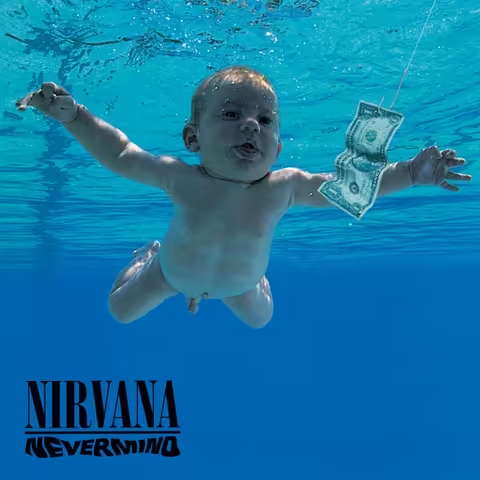
On 24 September 1991, a three-piece from Aberdeen and Olympia by way of Seattle released their second album. DGC Records had budgeted around $65,000 for the recording and had hoped, on the strength of Sonic Youth's Goo the previous summer, that they might shift 250,000 copies in a year. The cover photograph, taken at a Pasadena swimming pool, showed a four-month-old boy underwater reaching for a dollar bill on a fishhook. By 11 January 1992 the album had displaced Dangerous at the top of the Billboard 200 at a peak weekly run rate of around 300,000 copies. The band were Nirvana, the album was Nevermind, and the conversation about what rock music was supposed to sound like had been quietly, irreversibly rewired.
From Bleach to a major-label deal
Nirvana arrived at Nevermind out of a particular kind of frustration. Bleach, their 1989 debut on Sub Pop, had cost $606.17 to record at Reciprocal Recording in Seattle with engineer Jack Endino, and although it had built a devoted regional following and respectable college-radio play, the band were watching Sub Pop wobble through a well-publicised cashflow crisis. Royalty statements that did not arrive, tour support that turned up late and a sense that the label simply could not keep up with what its bands were doing on the road combined to push Kurt Cobain and Krist Novoselic towards the conversations they had once sworn they would never have.
The conduit was Sonic Youth. Kim Gordon and Thurston Moore had moved to DGC the year before for the Goo album, had found the experience tolerable, and were happy to point Nirvana at their manager Gary Gersh and at the lawyer Alan Mintz. By the spring of 1990 the band were in conversation with seven major labels, listening to pitches that ran the gamut from the predatory to the openly besotted. The eventual deal with DGC, a Geffen imprint set up by David Geffen and run by Ed Rosenblatt, was signed in April 1991 and came with a $287,000 advance. After legal fees, management commissions and the cost of buying out the remainder of the Sub Pop contract, the band were left with a sum that felt life-changing only by the standards of musicians who had been sleeping on floors a year earlier.
DGC had ideas about producers. Scott Litt, who had made R.E.M. into a major-label proposition, was on the shortlist. So were David Briggs of Neil Young infamy, the southern jangle specialist Don Dixon, and the Hsker D survivor and Workbook auteur Bob Mould. Cobain had different ideas. He had been listening obsessively to a record made for Touch and Go by a Wisconsin trio called Killdozer, and the man who had recorded it was a slight, calm, almost academic figure called Butch Vig who ran a basement studio in Madison.
Chad Channing leaves, Dave Grohl arrives
Nirvana had in fact already worked with Vig. In April 1990, before the major-label scramble, the band drove from Seattle to Madison to spend a week at Vig's Smart Studios cutting demos that were initially intended for a Sub Pop follow-up to Bleach. The sessions produced rough versions of In Bloom, Lithium, Stay Away (then titled Pay to Play), Polly, Sappy and Dive, and they did two crucial things: they pushed Vig high up the band's list of preferred collaborators, and they made the limitations of their drummer Chad Channing impossible to ignore. Channing had played beautifully on Bleach and on the road, but his light, jazz-influenced touch was at odds with the bigger, more concussive sound that Cobain and Novoselic could already hear in their heads. He left, by mutual agreement, in May 1990.
The interregnum was short and chaotic. Dan Peters of Mudhoney sat in long enough to record the single Sliver. Dale Crover of the Melvins helped out at shows. The breakthrough was a Seattle gig by a Washington DC hardcore band called Scream. Cobain and Novoselic went to watch and came away talking about almost nothing other than the drummer, a teenage powerhouse called Dave Grohl who hit the kit as though it had personally offended him. When Scream's tour collapsed a few weeks later because their bassist had to fly home, Grohl was suddenly available. Buzz Osborne of the Melvins passed his number to Novoselic. Grohl flew to Seattle in September 1990, played one informal rehearsal in a barn and was hired more or less on the spot. Novoselic later described the moment with characteristic understatement, saying that with Grohl in the room everything had simply fallen into place.
The new line-up gigged hard through the winter and into 1991, breaking in songs that were obviously going to belong to the next album. By April they had played the first ever live performance of a song Cobain had been calling Smells Like Teen Spirit at the OK Hotel in Seattle, and the response in the room had been startling enough that the band knew they had something they could not casually throw away.
Choosing Butch Vig and Sound City
With Vig confirmed as producer in early 1991, the question became where to record. Vig had assumed the sessions would happen at Smart, but DGC wanted somewhere closer to the label, somewhere with the equipment to handle a major-label rock record, and somewhere whose hourly rate could absorb the inevitable overruns. After a survey of options in Los Angeles and around, the choice fell on Sound City Studios in a Van Nuys industrial park.
Sound City was an unlikely temple. From the street it looked like a tyre wholesaler. Inside it housed one of only four Neve 8028 consoles ever built, a custom-modified British desk whose summing electronics gave drums a depth and weight that no software emulation has ever quite reproduced. The live room had been designed for Fleetwood Mac's Rumours sessions and had hosted Tom Petty, Foreigner, Dio, Cheap Trick and Rick Springfield. The 24-track Studer A800 tape machines were maintained obsessively by an in-house staff who had worked with everyone and were impressed by nobody. The hourly rate was around $500, comfortably within the $65,000 budget if the band could keep to a schedule.
Vig flew out, walked the room, listened to the Neve and the natural reverb of the concrete floor, and pronounced himself satisfied. The band sent ahead a set of rehearsal-room cassette tapes that included the first studio attempt at Smells Like Teen Spirit and a fully formed Come as You Are, both already arranged almost exactly as they would appear on the finished record. Sessions were booked from 2 May 1991, with a notional finish date that everyone privately suspected would slip.
Recording at Sound City, May and June 1991
The band arrived in Van Nuys with rented gear, fresh haircuts and a producer determined to use every hour they had paid for. Vig set a schedule of eight to ten hour days, six days a week, which by major-label standards was disciplined to the point of austerity. Basic tracks, drums and bass and a guide guitar, were tracked first, mostly in two or three takes a song, with Grohl playing through a Gretsch kit that the rental company had delivered when his preferred Tama gear failed to arrive. Cobain's guitars went down next, and here the gear choices that would define a decade of alternative rock fell quietly into place.
Cobain liked cheap, left-handed Japanese Fenders. He recorded most of the album on Fender Stratocasters fitted with humbucking pickups in the bridge position, a 1965 Fender Jaguar with DiMarzio replacements front and back, and a 1969 Fender Mustang that he later identified as his favourite guitar of the period. The signal path was a Mesa/Boogie Studio preamp into a Crown power amp into a wall of Marshall cabinets, with a Vox AC30 for cleaner moments. The pedalboard was small and specific: an Electro-Harmonix Big Muff for the wall-of-fuzz choruses and an Electro-Harmonix Small Clone for the watery clean tones, the latter of which would become the most identifiable single sound on Come as You Are.
Vocals were the part of the process Cobain most distrusted. He was suspicious of overdubs in general and of double-tracking in particular, regarding it as a slick studio trick that belonged to the kind of records he had spent the eighties despising. Vig got around this by appealing to the only authority Cobain accepted on the subject, telling him repeatedly that John Lennon had double-tracked almost every vocal he ever recorded with The Beatles. Cobain, grumbling but not arguing, doubled the lead vocal on most of the album. He also habitually finished his lyrics minutes before he was due to sing them, scribbling lines on hotel notepaper in the live room while Vig tactfully checked microphone levels. Polly survived from the earlier Smart sessions almost untouched, including the cymbal crashes played by Chad Channing, which Vig left on the tape because re-recording them would have been pointless and because the loose, slightly drunken feel they gave the song was the point.
Andy Wallace, Howie Weinberg and the mix that defined a decade
By the end of June the basic recording was finished and Vig had delivered a set of rough mixes that the band thought were exactly right. DGC disagreed. The roughs were honest, weighty and broadly faithful to how the band sounded in a room, and the label feared that honest, weighty and broadly faithful was not what would get a Seattle three-piece played between Bryan Adams and C+C Music Factory on Top 40 radio. A list of potential mix engineers circulated. Scott Litt and Ed Stasium were the favourites. Cobain, allergic to anything that smelled of a corporate fix, asked for somebody less famous, and somebody whose recent credits suggested the right kind of heaviness rather than the right kind of polish. His choice was Andy Wallace, on the strength of the work Wallace had done co-producing Slayer's Seasons in the Abyss the year before.
Wallace flew to Scream Studios in Studio City and mixed the record between 1 and 9 June 1991. His method was simple in description and extraordinarily effective in execution. Rather than replace the drum sounds Vig had captured, he triggered short samples of kicks and snares to feed a parallel reverb send, so that every backbeat gained a subliminal bloom of room without losing the body of the original hit. He compressed the master bus aggressively, pushed the guitars forward in the chorus and tucked the rhythm section into a tighter, more radio-friendly stereo image than the band had ever sounded on tape. The effect was transformative, and Cobain spent the rest of his life uncomfortable about it. He told interviewers more than once that the finished Nevermind sounded closer to a Motley Crue record than to a punk record, and that the band's third album would have to undo the polish. The label had no such reservations, and on hearing the masters reportedly began to revise their sales projections upwards within hours.
Howie Weinberg mastered the record alone at The Mastering Lab in Hollywood on 2 August 1991. He worked at speed, cut a reference lacquer in a single afternoon, and made one mistake that became part of the album's folklore. The hidden track Endless, Nameless, an improvised six-minute-and-43-second collapse of feedback and noise that the band had captured at the end of the Lithium session, was supposed to appear after roughly ten minutes of silence at the end of Something in the Way. Weinberg, working from a tape that did not clearly mark its purpose, left it off the master. Around twenty thousand initial CDs and a corresponding pressing of cassettes and vinyl shipped without it. When the first finished copies arrived, Cobain phoned Weinberg directly to ask, with some heat, where the hidden track was. Subsequent pressings reinstated it, and the absence of Endless, Nameless on a first-pressing CD is one of the small, easily verified collector markers that distinguishes the very earliest copies of the album.
The cover, the title and the artwork
The idea for the cover arrived in Cobain's flat one afternoon while he and Grohl were watching a television documentary about water births. Cobain, charmed and unsettled by the imagery, told Geffen's art director Robert Fisher that he wanted an underwater baby on the cover. Fisher began pricing up the stock-photo options and found that licensing existing water-birth imagery would cost five figures, an absurd outlay for a band whose entire recording budget had been $65,000. The cheaper solution was to commission an original shoot. Fisher hired the photographer Kirk Weddle, who specialised in underwater work, and arranged a session at the Rose Bowl Aquatics Center in Pasadena.
Several babies were photographed, dunked briefly by their parents for the camera. The baby whose frame made the cover was four-month-old Spencer Elden, the son of Weddle's friend Rick Elden. The original photographs did not include the dollar bill on the fishhook; Cobain added that himself as a piece of art direction during the layout meetings, a deliberately heavy-handed comment on what he saw as the rotting commercialism of the rock industry into which his band were about to step. Geffen's lawyers worried about the visible infant penis. The compromise Cobain offered them, if the question ever became a legal one, was a sticker bearing the words "If you're offended by this, you must be a closet paedophile." The sticker was never required.
The back cover, with its rubber chimpanzee posed in front of a collage assembled by Cobain himself, hid a small museum of in-jokes. The collage included raw-meat advertising clipped from a butcher's magazine, images cut from an illustrated edition of Dante's Inferno and a half-buried promotional photograph of Kiss in full makeup. The album's title moved through several iterations before settling. Cobain had wanted to call the record Sheep, in mocking reference to the demographic he assumed would buy it. He flirted briefly with Sacagawea, a reference to the Lemhi Shoshone guide who had travelled with Lewis and Clark, before fixing on Nevermind, a phrase he liked for its weary shrug and for the unforced echo of Never Mind the Bollocks by the Sex Pistols.
Track by track
| # | Title | Writer(s) | Length | Single? |
|---|---|---|---|---|
| 1 | Smells Like Teen Spirit | Cobain, Novoselic, Grohl | 5:01 | September 1991 |
| 2 | In Bloom | Cobain | 4:14 | November 1992 |
| 3 | Come as You Are | Cobain | 3:39 | March 1992 |
| 4 | Breed | Cobain | 3:03 | |
| 5 | Lithium | Cobain | 4:17 | July 1992 |
| 6 | Polly | Cobain | 2:57 | |
| 7 | Territorial Pissings | Cobain, Chet Powers | 2:22 | |
| 8 | Drain You | Cobain | 3:43 | |
| 9 | Lounge Act | Cobain | 2:36 | |
| 10 | Stay Away | Cobain | 3:32 | |
| 11 | On a Plain | Cobain | 3:16 | |
| 12 | Something in the Way | Cobain | 3:52 | |
| Endless, Nameless (hidden) | Cobain, Novoselic, Grohl | 6:43 |
Smells Like Teen Spirit began, as so many Cobain songs did, with a phrase scrawled in marker pen. Kathleen Hanna of Bikini Kill had spray-painted "Kurt smells like teen spirit" on the wall of his Olympia flat, an allusion to the Mennen deodorant brand Teen Spirit that his then-girlfriend Tobi Vail wore and that Cobain had never heard of. He took the phrase for a song title, then wrote a verse-chorus-verse-chorus structure around a riff he was happy to admit he had borrowed almost wholesale from the Pixies, whose loud-quiet-loud dynamic he revered. Wallace's mix lacquered the four-chord chorus into a tidal wave; the verses, sung over single notes, are nearly the same key but feel half a room away.
In Bloom is a song about its own future audience. Cobain wrote it as a dig at the kind of fan he could already see arriving in the front row, the meathead who liked all the pretty songs and liked to sing along but who knew not what they meant. Grohl's backing vocals on the chorus, locked an octave below Cobain's lead, are one of the album's quietest production triumphs. Come as You Are walks an awkward line. The descending watery riff, played through the Small Clone with the chorus depth pushed high, sounds disconcertingly close to the song Eighties by Killing Joke, a similarity that the British band noticed and resented but which never matured into formal legal action. Lithium is the album's most theological song, a sketch of a man finding religion as a refuge from collapse, with a verse Tobi Vail reportedly rewrote substantially before Cobain finalised it. The bass line, which Novoselic played in two takes, is the closest Nevermind comes to a hymn.
Breed, sequenced fourth and originally written under the working title Imodium, is the album's most straightforward punk song, a three-chord blast in which Grohl's snare effectively replaces the guitar as the lead instrument and Cobain's vocal slides into a grin somewhere around the second chorus. Stay Away, the song that had begun life in the Smart Studios demos as Pay to Play, was rewritten lyrically by Cobain during the Sound City sessions because he had decided he no longer believed in the original chorus, and the rewrite turned it from a complaint about the music industry into something more general and more cathartic. On a Plain, which Cobain admitted in interviews he had finished writing in the live room minutes before tracking the vocal, is the album's most quietly hopeful song, all major-key chord changes and lyrics that meander past the point of meaning. Grohl's backing vocals lock to Cobain's lead in tight thirds throughout the chorus, one of the few moments on the record where the harmony work sounds deliberately, beautifully arranged rather than improvised.
Polly is the album's quietest moment and its bleakest. Cobain recorded it on a battered five-string Stella acoustic he said he picked up from a Tacoma pawn shop for around $20, and the lyric is a near-direct retelling of a 1987 incident in Tacoma in which a fourteen-year-old girl had been abducted and assaulted by a man called Gerald Friend. Cobain told the story from the perpetrator's point of view, a writerly decision that has unsettled listeners for thirty-five years and was meant to. Territorial Pissings opens with Novoselic shouting the first lines of the Youngbloods' Get Together (written by Chet Powers and originally cut by the Youngbloods for their 1967 debut album) through a deliberately blown-out vocal channel, before the song proper detonates. Drain You is, in Cobain's own telling, the love song he was most proud of writing, and the "one baby to another" couplet is widely understood to nod to Tobi Vail. Lounge Act takes its name from the K Records logo Cobain had tattooed on his forearm. Something in the Way, sung in a near-whisper over an acoustic guitar tuned almost slack, was recorded around a single condenser microphone with Cobain sitting cross-legged on Vig's office floor, and Kirk Canning added a single cello line later that lifted the song from sketch to elegy. The story that Cobain had lived under a bridge in Aberdeen, which the lyric appears to invite, has been repeatedly debunked by his family and by people who knew him at the time, but it never quite goes away.
Personnel and guests
| Role | Player | Notes |
|---|---|---|
| Core band | ||
| Vocals, guitars | Kurt Cobain | Credited; sound effects on Drain You |
| Bass | Krist Novoselic | Credited as Chris Novoselic; intro vocal on Territorial Pissings |
| Drums | Dave Grohl | Credited as David Grohl; backing vocals on In Bloom, Drain You, On a Plain |
| Guest musicians | ||
| Cymbals on Polly | Chad Channing | Performance retained from April 1990 Smart Studios session, uncredited on original sleeve |
| Cello on Something in the Way | Kirk Canning | Added at Sound City after the basic acoustic take |
| Production and engineering | ||
| Producer | Butch Vig with Nirvana | Sound City, May to June 1991 |
| Mixer | Andy Wallace | Scream Studios, 1 to 9 June 1991 |
| Mastering | Howie Weinberg | The Mastering Lab, 2 August 1991 |
| Artwork | ||
| Art direction | Robert Fisher | Geffen in-house |
| Cover photograph | Kirk Weddle | Rose Bowl Aquatics Center, Pasadena |
| Band photography | Michael Lavine | New York and Los Angeles sessions |
| Cover subject | Spencer Elden | Four months old at the time of the shoot |
The original LP sleeve credited "music by Nirvana," a deliberate gesture of band solidarity insisted on by Cobain himself, who at the point of release was still uncomfortable with the implication that he was the songwriter and his bandmates were merely employees. Later pressings, after Cobain's relationship with the others had grown more openly competitive, reverted to individual writing credits that gave Cobain the vast majority of the publishing. It is a small detail with significant downstream consequences for royalty distributions, and one of the quieter ironies of a record that was supposed to be a single creative voice but was sold, at first, as a collective work.
Release, slow burn and the climb to number one
DGC shipped 46,251 copies of Nevermind to American shops on 24 September 1991 and around 35,000 to British shops a fortnight later. The press release was modest. The internal sales target, benchmarked against Sonic Youth's Goo from the previous summer, was around 250,000 over twelve months. Nobody at the label was promising anything more, and the band themselves had returned from Sound City planning a short American club tour and a longer European one, intending the album to do whatever it was going to do while they played small rooms and built the audience the slow way.
The album entered the Billboard 200 at number 144 in the first week of October. The interesting numbers were the ones Geffen could not yet see on a national scan. In Seattle and Portland and across the Northwest, shops were selling out within forty-eight hours of restock. MTV's specialist alternative show 120 Minutes premiered the video for Smells Like Teen Spirit, directed by Samuel Bayer in a deliberately scuzzy faux-pep-rally setting, and within three weeks it had moved out of the late-night ghetto and into the channel's daytime rotation. By the end of November Nevermind had crossed into the Top 40 at number 35, and DGC president Ed Rosenblatt told a Billboard reporter that the label had stopped trying to push and had decided, as he put it, to get out of the way and duck.
The European leg of the tour in November and December was the moment the band realised what was happening. Venues that had been booked to hold a few hundred people were selling tickets to thousands, and shows in Amsterdam, Frankfurt and Vienna had to deal with crowds that posed genuine safety concerns. Cobain was visibly uneasy, often shrinking from the size of the response, but on stage he was still capable of one of the most physically committed performances in rock. On 11 January 1992 Nevermind reached number one on the Billboard 200, replacing Michael Jackson's Dangerous at the top. It returned to number one at the end of February for a second non-consecutive week, by which point the album was selling around 300,000 copies a week in the United States alone. Come as You Are followed Smells Like Teen Spirit as a single on 2 March 1992 and reached number 32 in America and number 9 in the United Kingdom.
Lithium was released as the third single on 13 July 1992 and reached number 11 in the United Kingdom, paired with the live recording of Curmudgeon and a memorable B-side of the album-closing improvisation Been a Son. In Bloom followed as the fourth and final single on 30 November 1992, peaking at number 28 in the United Kingdom and supported by a Kevin Kerslake-directed video that staged Nirvana as a clean-cut sixties beat group on a black-and-white television variety show, an exercise in deadpan satire whose joke depended on the audience knowing exactly what the band actually looked like. Across the four singles the band shot promotional videos with three different directors, none of whom were given much in the way of budget by the standards of the era, and all of whom produced clips that became MTV staples for the better part of two years. Samuel Bayer's faux pep rally for Smells Like Teen Spirit, Kevin Kerslake's underwater dream sequences for Come as You Are, the open-air mental-ward parody Cobain himself helped storyboard for Lithium and Kerslake's beat-group pastiche for In Bloom together formed a small, coherent visual world that did almost as much for the album's mythology as the music did.
Reception, Grammys and reappraisal
The contemporary press was, briefly, slower than the public. The first major reviews trickled out through October and November. Q magazine gave the record four stars (and would, in a later anniversary print, raise the rating to the maximum five). Kerrang awarded it five out of five. Spin was favourable, NME ran a glowing notice, and the British monthly Select gave it four out of five. Entertainment Weekly settled on an A minus. Rolling Stone alone misread the moment; Ira Robbins's three-out-of-five notice praised the songwriting but worried that the album's polish blunted its punk roots, an assessment the magazine reversed comprehensively in subsequent retrospectives, eventually re-rating the album at the maximum five stars and placing it as high as number six on the most recent edition of its 500 Greatest Albums list (it ranked number 17 on the 2003 and 2012 versions, and number six on both the 2020 and 2023 revisions).
The Village Voice's annual Pazz and Jop critics' poll, the closest thing the American music press had to a collective verdict, named Nevermind the album of the year for 1991, Smells Like Teen Spirit the single of the year, and the song's music video the video of the year. Robert Christgau, the poll's editor, gave the album an A and devoted his essay to what he called amerindie values reaching the centre of the chart. NME named Nevermind its album of the year. Three Grammy nominations followed, spread across the 34th and 35th ceremonies, including Best Alternative Music Album, Best Hard Rock Performance and Best Rock Song. Smells Like Teen Spirit was inducted into the Grammy Hall of Fame in 2017. In 2004 the album was added to the Library of Congress's National Recording Registry, a list that exists to preserve recordings of cultural, historical or aesthetic significance.
Cobain's death in April 1994, less than three years after Nevermind's release, would inevitably colour everything written about the album afterwards. It is worth resisting, in a discussion of the record itself, the temptation to read every lyric and every interview through the lens of what came later. Nevermind was made by a young band who thought they were starting an argument, not ending one, and the strangeness of its commercial success is best understood as the world having shifted around them, not as a prophecy fulfilled.
Reissues, the Spencer Elden lawsuits and legacy
Nevermind has been reissued repeatedly. Mobile Fidelity Sound Lab released a 24-karat gold CD in 1996 sourced from a flat-mastered transfer of Wallace's original mixes. In September 2011 Universal Music issued a 20th-anniversary edition in standard, deluxe and super-deluxe formats; the super-deluxe boxed set, which ran to four CDs and a DVD, included Vig's original mix in full for the first time, alongside outtakes, BBC sessions, the Halloween 1991 Paramount Theatre concert and a hardback book. The reissue itself sold strongly enough to be reported by the IFPI as having shifted around 800,000 additional copies of the album worldwide by the end of 2012. A further 30th-anniversary edition in 2021 was issued in five-CD and eight-LP formats and added previously unreleased live recordings from concerts in Amsterdam, Del Mar, Melbourne and Tokyo.
The album's most uncomfortable afterlife belongs to its cover star. In August 2021, Spencer Elden, by then in his early thirties, filed suit in the United States District Court for the Central District of California against the surviving members of Nirvana, the estate of Kurt Cobain, several record labels and the photographer Kirk Weddle, alleging that the cover photograph constituted child sexual exploitation. The action was dismissed in January 2022 on statute-of-limitations grounds. The Ninth Circuit Court of Appeals reversed that dismissal in December 2023, reinstating the case on the basis that each republication of the image potentially restarted the limitations clock. In October 2025 a lower-court ruling held that the photograph did not meet the legal definition of pornography under federal child-protection statute, and Elden's legal team filed a renewed appeal. As of this writing the litigation is unresolved.
None of which has dented the album's place in the canon. Nevermind sold more than 30 million copies worldwide and is certified 13-times platinum (Diamond) by the RIAA in the United States, Diamond by Music Canada, nine-times platinum by the BPI in the United Kingdom, seven-times platinum by RMNZ in New Zealand and five-times platinum by ARIA in Australia. It topped the Billboard 200 for a non-consecutive total at the start of 1992, finished the year at number three on the Billboard year-end album chart, and reached number one in Belgium, Finland, Sweden and Canada, number two in Australia, number three in Germany and number seven in the United Kingdom. Pitchfork awarded the 2011 reissue a 10 out of 10. The critic Chuck Eddy, writing in retrospect, called Nevermind the end of the high album era, a phrase that captures something true: this was the last album of its kind to detonate in this way, in a market that still believed in albums as cultural events and that was about to be dismantled by Napster, the iTunes Store and the playlist.
What Nevermind did, in the small set of months between September 1991 and the spring of 1992, was reorganise the entire commercial mainstream of rock music around a sensibility that had previously been treated as a regional curiosity. Hair metal did not die overnight, but it stopped being signed. Major labels began frantically buying up regional underground acts in search of the next Nirvana. The kind of guitar tone Cobain pulled from his Mustang through his Small Clone became, briefly, the default sound of American radio. And a four-month-old boy in a swimming pool, reaching for a dollar bill, became one of the most reproduced images in the history of recorded music. The album that DGC had hoped might sell a quarter of a million copies in a year sold a quarter of a million copies in three days, then went on selling for the next three decades, and shows no sign of stopping.
Comments