
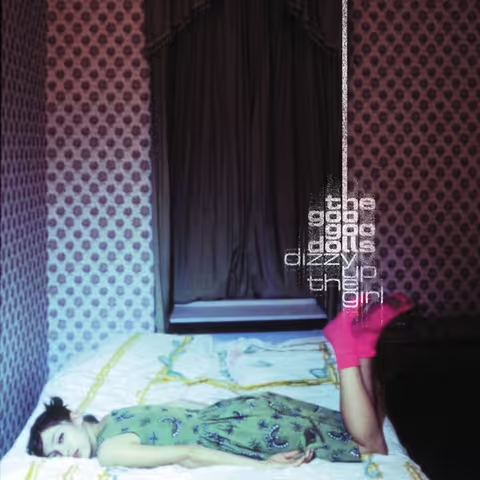
By the autumn of 1998 the Goo Goo Dolls had spent the best part of three years stuck inside the most awkward kind of music-industry purgatory: famous enough that strangers in airports could hum the chorus of one of their songs, broke enough that the royalty cheques for it had been sitting in escrow while lawyers argued. A Boy Named Goo, the band's fifth album, had crept up the American charts in 1995 on the back of Name, an acoustic ballad that reached number five on the Billboard Hot 100 and refused to leave the radio for the rest of the year. Instead of vaulting John Rzeznik, Robby Takac and their long-time drummer George Tutuska from cult-punk obscurity into the rock mainstream, the success had triggered a corrosive dispute with Metal Blade Records over publishing and royalties that took most of 1996 to settle. By the time the band emerged from the litigation, they were two members lighter, one record label heavier, and badly in need of an album.
Dizzy Up the Girl, released on 22 September 1998, is the record that finally did the job they had been trying to do for a decade. Produced by Rob Cavallo, the man Warner Bros. had used to turn Green Day into a household name, mixed by Jack Joseph Puig and mastered by Bob Ludwig, it is a deliberately glossy, melodically heavy, thirteen-track pop-rock album recorded by a Buffalo bar band who had spent the previous five years inching away from their hardcore origins one mid-tempo chorus at a time. It is also the album that contains Iris, a song written in a hotel room over five days for a Nicolas Cage film, which would go on to spend eighteen consecutive weeks at number one on the Billboard Hot 100 Airplay chart and hold that record for very nearly twenty-two years. Dizzy Up the Girl produced five top-forty singles, was certified five-times platinum in the United States, four-times platinum in Canada and platinum across most of the English-speaking world. It is, by any honest reckoning, the commercial peak of a forty-year career.
| Field | Detail |
|---|---|
| Artist | Goo Goo Dolls |
| Album | Dizzy Up the Girl |
| Release date | 22 September 1998 |
| Label | Warner Bros. Records |
| Producers | Rob Cavallo and Goo Goo Dolls |
| Engineer | Ken Allardyce; Allen Sides engineered "Iris" |
| Mixer | Jack Joseph Puig |
| Mastering | Bob Ludwig |
| Genre | Alternative rock, pop rock, power pop |
| Track count | 13 |
| Total runtime | 45:27 |
| US Billboard 200 peak | 15 |
| UK Albums Chart peak | 47 |
| Canada RPM peak | 4 |
| Other notable peaks | Australia 17, New Zealand 19, Sweden 17, Austria 20, Germany 30 |
| Certifications | USA 5x Platinum, Canada 4x Platinum, New Zealand 2x Platinum, Australia Platinum, UK Gold, Denmark Gold |
| Estimated US sales | Over 5,000,000 |
| Key singles | Iris, Slide, Dizzy, Black Balloon, Broadway |
From A Boy Named Goo to a new deal
To understand how strange the run-up to Dizzy Up the Girl actually was, it is worth dwelling for a moment on what the Goo Goo Dolls were before Name landed in heavy rotation on American FM radio. They were a Buffalo three-piece who had spent the late 1980s and early 1990s opening for Soul Asylum and The Replacements, releasing scrappy, well-reviewed records on Metal Blade that nobody outside of college radio bought, and gradually replacing the snotty Westerberg-isms of their first two albums with bigger choruses and tidier arrangements. By the time Superstar Car Wash arrived in 1993, Rzeznik was writing songs that sounded a great deal like Paul Westerberg might if he had grown up watching MTV. A Boy Named Goo in 1995 pushed that instinct one step further, but it was Name, the album's quietest and least characteristic track, that broke them.
The fallout was almost entirely financial. Their original Metal Blade contract had been written for a band nobody expected to sell anything, with royalty splits and recoupment arithmetic that began to look indefensible the moment they actually sold something. Rzeznik later told several interviewers that the band saw little of the money that Name generated. In late 1995 they began the legal process of trying to extract themselves from the deal. The case dragged through most of 1996 and was settled mid-year, freeing them to sign a new contract directly with Warner Bros., the parent that had been distributing Metal Blade's product anyway. Anyone who has read the standard biographies of Tom Petty, John Fogerty, Prince or George Michael will recognise the shape of the story: a slow, expensive battle for the right to make the next record.
Inside the band the upheaval was just as severe. George Tutuska, who had been the drummer for almost a decade, was fired in 1995 in the middle of the A Boy Named Goo album cycle, in circumstances that have never been fully explained on the record but which Rzeznik and Takac have both alluded to in interviews as a friendship that simply could not survive the pressure. His replacement, Mike Malinin, was a Boston-trained session drummer who had played with Brian May and Marshall Crenshaw and who, by his own account, joined the touring band almost by accident and stayed for the next eighteen years. Crucially, Dizzy Up the Girl is the first Goo Goo Dolls studio record on which Malinin appears as a fully credited band member rather than a hired hand, and that promotion fundamentally changed how the band worked in the studio.
The other piece of the new architecture was the producer. Warner Bros. wanted Rob Cavallo, the in-house producer who had done Green Day's Dookie and Insomniac and Jawbreaker's Dear You, and who would shortly do the bulk of the work on Nimrod. Cavallo's reputation by 1997 was for taking bands with strong pop instincts and a punk hangover and persuading them to commit to the pop instincts without losing the energy. That was exactly the chemistry the Goo Goo Dolls needed. Cavallo also brought with him a fixed set of collaborators who would shape the sonics of the finished album: Ken Allardyce on engineering, Jack Joseph Puig on mixing, and a deep Rolodex of Los Angeles session players that he could call on at short notice when a song demanded a string arrangement, a pedal-steel part or, as it turned out, a five-day hotel-room rewrite of an entire song.
The contract with Warner Bros. was signed in 1996, but pre-production for the new album did not begin in earnest until late 1997. Rzeznik, in particular, had been struggling with a serious bout of writer's block in the aftermath of Name's success, terrified of falling into the trap of writing more of the same. The lawsuit had eaten most of his enthusiasm; the band's road schedule had taken care of the rest. The story of Dizzy Up the Girl really begins with the song that finally broke the block, and that song was not initially intended to be on the album at all.
City of Angels and the Iris bombshell
In early 1998, while pre-production work on the next Goo Goo Dolls record was crawling along in Los Angeles, Rzeznik was approached by music supervisor Danny Bramson to write an original song for City of Angels, the Brad Silberling-directed romantic drama starring Nicolas Cage and Meg Ryan that Warner Bros. was preparing for an April release. The pitch was specific: the song would soundtrack the film's emotional climax, where Cage's character, an angel who has chosen to fall, looks at Ryan and decides to give up immortality. Rzeznik watched a rough cut of the scene and, by his own account in multiple interviews afterwards, immediately froze.
What broke the block was a hotel room in Los Angeles and a guitar tuning he had never used before. Looking for a sound that felt suspended and unresolved, Rzeznik retuned his acoustic to D-A-D-A-A-D, an open tuning that drones around a fifth and refuses to settle into either major or minor. The shape of the chords forces the player into voicings that ring out instead of resolving, which is why the verse of Iris sounds like it is hovering somewhere above the ground rather than walking along it. Rzeznik has said the song came together in about five days, written in the hotel and demoed quickly so that it could be sent back to Bramson for approval. The lyric, written from the perspective of someone who would give up anything for one moment of being truly seen, mapped onto Cage's character almost by accident; Rzeznik has been clear in subsequent interviews that he was writing about his own emotional situation rather than the film.
The recording session for the master take of Iris was assembled in Los Angeles in early 1998. Cavallo produced and Allen Sides engineered. Jamie Muhoberac played the song's distinctive piano part, an instrument that drifts in under the second verse and then carries the bridge. Tim Pierce, one of the most-recorded session guitarists in Los Angeles, played mandolin and contributed the slide guitar solo. David Campbell, who had been writing string charts in the city for thirty years and would soon become better known as the father of Beck, arranged and conducted the strings. Malinin played the drums; Robby Takac played bass; Rzeznik played the acoustic in the strange tuning and sang. The finished master, four minutes and forty-nine seconds long, is one of the most carefully arranged pieces of music the band ever recorded, and it bears almost no resemblance to anything else on Dizzy Up the Girl.
Iris was released as a single on 1 April 1998, almost six months before the album it would eventually anchor. The City of Angels soundtrack, which also featured Alanis Morissette, Sarah McLachlan, Peter Gabriel and U2, came out the same week. Within two months Iris was at the top of the Billboard Hot 100 Airplay chart, where it would stay, in one of the most remarkable runs in chart history, for eighteen consecutive weeks. It was nominated for three Grammy awards, including Record of the Year, Song of the Year and Best Pop Performance by a Duo or Group with Vocals, though it famously lost all three on the night to Celine Dion's My Heart Will Go On. By the time Dizzy Up the Girl was released in late September the album had a built-in lead single that had already been on the radio for six months. The band, who had spent half a decade trying to follow up Name, suddenly had a much larger problem to solve: how to follow up Iris.
Recording with Rob Cavallo
The bulk of Dizzy Up the Girl was recorded in Los Angeles during the first half of 1998, with sessions running in parallel to and around the Iris commission. Cavallo's working method was already well documented from his Green Day records: long pre-production phases at his house in the Hollywood Hills, where arrangements were rehearsed until they were close to final, followed by relatively quick tracking dates with the band playing together in the room. Ken Allardyce, who had engineered Dear You for Cavallo a few years earlier, ran the tape machines. The basic tracks for most of the album were cut live, with overdubs and vocals added in subsequent passes.
The sonic upgrade from A Boy Named Goo is immediately obvious if the two records are played back to back. Where the 1995 album has a slightly rough, mid-fi quality, with guitars that crunch rather than ring, Dizzy Up the Girl is open, glossy and unapologetically pop. Cavallo's signature trick of doubling rhythm guitars hard left and right, layering acoustic guitars under the electrics to add air, and pushing the lead vocal high in the mix is all over the album. Takac's bass sits forward in a way that gives songs like Slide and Dizzy real propulsive weight. Malinin, finally working as a full band member rather than a session player, plays with a kind of bright, controlled aggression that is closer to the polished punk of mid-1990s Green Day than to the looser swing of Tutuska's playing on the earlier records.
Cavallo himself contributed additional instrumentation across the album, as did a small army of guests recruited largely from his usual circle of Los Angeles players. Tommy Keene, the late, much-loved power-pop songwriter who had been one of the band's heroes from the Replacements era, contributed across several tracks. Benmont Tench, the Heartbreakers' keyboard player, contributed organ. Luis Conte added percussion. Nathan December played additional guitar. Tim Pierce, beyond his contribution to Iris, played mandolin and additional guitar on several other songs. The cumulative effect of all this colour is a record that sounds far bigger than a three-piece bar band on a 24-track tape, without ever quite leaving the three-piece behind.
Jack Joseph Puig mixed the album. Puig's late-1990s mixes, which include Sheryl Crow, No Doubt's Tragic Kingdom and Semisonic's Feeling Strangely Fine, have a recognisable signature: hot, slightly compressed, with guitars that have a thick low mid and vocals that sit at the very front of the soundstage. That signature is all over Dizzy Up the Girl. Bob Ludwig, who has mastered more multi-platinum records than almost anyone alive, finished the album at Gateway Mastering in Maine. The finished record sounds expensive in a way the band's previous albums never had, which is a polite way of saying that it sounds like exactly the kind of record Warner Bros. had spent good money making.
The contrast with the band's earlier records is also a contrast in songwriting discipline. Where Superstar Car Wash and A Boy Named Goo had treated the album as a place to assemble whatever twelve or thirteen songs were ready, Dizzy Up the Girl was conceived as a single sustained statement. Rzeznik has said in interviews that Cavallo pushed hard on lyric rewrites, asking him to be more specific, to use proper names, to put real cities and real streets and real people in the songs, on the basis that audiences trust details and distrust generalities. Broadway, the most obviously autobiographical track on the record, is the clearest result of that pressure, but the same instinct is audible across the album: Slide names a Catholic family rather than a generic teenage couple, Iris reads as a confession rather than a sentiment, and even the Takac songs commit to a specific tone rather than a vague mood. It is a more grown-up record than its predecessors not because it sounds slicker but because it knows what it wants to be.
Track by track
Dizzy Up the Girl is structured, deliberately or otherwise, as a Rzeznik record with four Takac tracks scattered through it as palate cleansers. The Rzeznik songs are mostly mid-tempo melodic pop-rock with confessional lyrics and big choruses; the Takac songs are noisier, faster and rougher, and serve as a reminder that the band started life as a hardcore-adjacent trio. The sequencing alternates the two voices throughout, which keeps the album moving when it might otherwise get bogged down in mid-tempo glossiness.
| # | Title | Writer(s) | Length | Single? | Notes |
|---|---|---|---|---|---|
| 1 | Dizzy | John Rzeznik | 3:09 | Yes (1999) | Title track, fifth single |
| 2 | Slide | John Rzeznik | 3:32 | Yes (1998) | US Hot 100 number 8 |
| 3 | Broadway | John Rzeznik | 3:53 | Yes (2000) | Written about Rzeznik's late father |
| 4 | January Friend | Robby Takac | 2:53 | No | Takac lead vocal |
| 5 | Black Balloon | John Rzeznik | 4:09 | Yes (1999) | US Hot 100 number 16 |
| 6 | Bullet Proof | John Rzeznik | 4:09 | No | Album cut, often a live encore |
| 7 | Amigone | Robby Takac | 3:08 | No | Takac lead vocal |
| 8 | All Eyes on Me | Rzeznik (music), Goo Goo Dolls (lyrics) | 3:30 | No | Sole collective lyric credit on the record |
| 9 | Full Forever | Robby Takac | 2:25 | No | Shortest track |
| 10 | Acoustic #3 | John Rzeznik | 1:57 | No | Interlude, voice and acoustic guitar |
| 11 | Iris | John Rzeznik | 4:49 | Yes (1998) | From City of Angels soundtrack |
| 12 | Extra Pale | Robby Takac | 3:21 | No | Takac lead vocal |
| 13 | Hate This Place | John Rzeznik | 4:32 | No | Album closer |
Dizzy, the opener and eventual fifth single, is the album in microcosm: a punchy three minutes of strummed acoustic and overdriven electric guitar, a chorus that pivots cleanly into a major key, and a lyric about emotional confusion that resolves into an admission rather than a complaint. Rzeznik's writing here, as on much of the record, is unusually direct. There are no metaphors that require unpacking; the song does what it does and then steps aside for Slide.
Slide, the album's second single and arguably its most enduring track outside of Iris, is built on a chord progression that rings out across a capo'd acoustic and a half-time drum part that lets the chorus open up. The lyric, which Rzeznik has discussed in interviews as being about a young Catholic couple weighing up the consequences of an unintended pregnancy, is far darker than the song's chiming exterior suggests. "What you feel is what you are, and what you are is beautiful," sung in the chorus, has been used as a wedding song so often that the irony of its origin tends to get lost. It reached number eight on the Billboard Hot 100 in early 1999, the band's second top-ten single in twelve months.
Broadway, sequenced third, is one of the album's quiet triumphs. Rzeznik wrote it about his late father, a Polish-American Buffalo native who had died when Rzeznik was a teenager, and about the street the family had lived on. It is a small, specific song that pays off because its details are real, not generic. Released as the fifth and final single in early 2000, it reached number twenty-four on the Hot 100 and remains one of the album's most-covered tracks.
Takac's four songs sit at tracks four, seven, nine and twelve, a clean every-third-song pattern that suggests Cavallo or the band did some deliberate sequencing work. January Friend, Amigone, Full Forever and Extra Pale are all sung by Takac in his rougher, higher voice and lean back toward the band's earlier punk sound. Amigone in particular, with its yelped chorus and short running time, sounds like it could have come from a different album entirely. Their inclusion is one of the things that prevents Dizzy Up the Girl from slipping into the same trap that swallowed several of its 1998 contemporaries, where every track is a potential single and the album as a whole becomes airless.
Black Balloon, the album's third single, is a slow-build ballad with one of Rzeznik's most affecting vocals on the record and a sweeping David Campbell string arrangement in the second half. The song has been variously interpreted as being about heroin addiction and as being a more general meditation on watching someone disappear, and Rzeznik has at times encouraged both readings. It reached number sixteen on the Hot 100 in mid-1999.
Acoustic #3, a brief interlude of just under two minutes, is exactly what its title suggests: voice and acoustic guitar, no overdubs, sequenced as the breath before Iris arrives at track eleven. Hate This Place closes the record on something approaching a sour note, a deliberate refusal to send the audience home humming. Bullet Proof and All Eyes on Me, both deeper album cuts, became live staples for years after the record's release.
Personnel and guests
The credit list for Dizzy Up the Girl is unusually long for a record nominally made by a three-piece. Beyond the band themselves and Cavallo's small team of regulars, the album draws on a guest list that includes some of the most-recorded session players in Los Angeles. Most of the additional musicianship is felt rather than foregrounded, which is partly a tribute to Puig's mixing and partly a reflection of how carefully arranged the songs are beneath their apparent simplicity.
| Role | Player | Notes |
|---|---|---|
| Core band | ||
| Vocals, guitars | John Rzeznik | Lead vocal on all Rzeznik-written tracks |
| Bass, vocals | Robby Takac | Lead vocal on January Friend, Amigone, Full Forever, Extra Pale |
| Drums | Mike Malinin | First studio album as a full band member |
| Guest and session musicians | ||
| Piano | Jamie Muhoberac | Piano on Iris |
| Mandolin, slide guitar | Tim Pierce | Mandolin and slide solo on Iris, additional guitar elsewhere |
| Strings (arranged and conducted) | David Campbell | Arrangements on Iris, Black Balloon and others |
| Organ | Benmont Tench | Of Tom Petty and the Heartbreakers |
| Additional instrumentation | Tommy Keene | Long-time friend of the band |
| Percussion | Luis Conte | Latin percussion specialist, frequent Cavallo collaborator |
| Additional guitar | Nathan December | Touring guitarist for the band on the subsequent tour |
| Additional instrumentation | Rob Cavallo | Producer-as-player credit on multiple tracks |
| Production and engineering | ||
| Producer | Rob Cavallo with Goo Goo Dolls | Co-production credit to the band |
| Engineer | Ken Allardyce | Tracking and overdubs |
| Engineer on "Iris" | Allen Sides | Owner of Ocean Way Recording |
| Mixer | Jack Joseph Puig | Late-1990s pop-rock signature mix |
| Mastering | Bob Ludwig | Gateway Mastering, Portland, Maine |
| Artwork | ||
| Art direction | Steve Gerdes | Cover design |
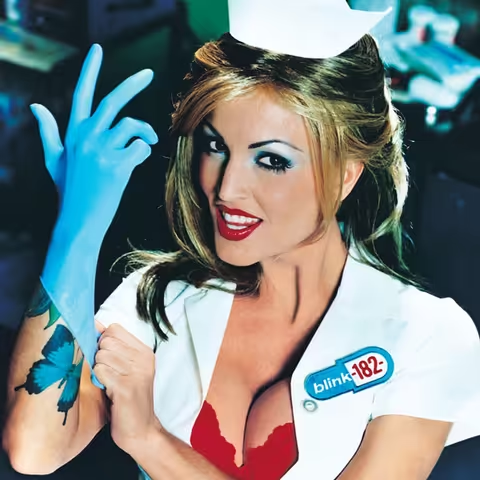
| Photography | Melanie Nissen | Sleeve photography |
Release and reception
Dizzy Up the Girl was released on 22 September 1998. By that point Iris had already spent the better part of the summer at the top of the airplay charts, and Slide had been released as a single five days earlier, on 17 September. The album entered the Billboard 200 at a modest position and climbed slowly, eventually peaking at number fifteen and staying inside the top two hundred for over two years. In Canada the album performed even better, peaking at number four on the RPM chart and going on to four-times platinum. Across continental Europe it was a more middling success, peaking at number seventeen in Sweden, twenty in Austria, twenty-seven in Belgium, thirty in Germany and thirty-five in Norway. In the United Kingdom, where the band had never had a serious commercial profile, the album reached number forty-seven and was eventually certified Gold.
The contemporary critical response was decidedly mixed, which is part of why the album's status as a commercial juggernaut is more often discussed than its reputation as a record. AllMusic's Stephen Thomas Erlewine, ordinarily a sympathetic reviewer of melodic guitar pop, gave it four stars and called it the album where the band finally pulled their various impulses into a coherent shape. The Encyclopedia of Popular Music gave it five. Spin gave it six out of ten. Rolling Stone gave it three stars. Entertainment Weekly graded it B-minus. The Boston Phoenix gave it two and a half stars and accused it of being too smooth for its own good. The consensus, broadly, was that Dizzy Up the Girl was a competent and well-made record that smoothed away too much of what had made the band interesting in the first place. The criticism was not entirely unfair; it is also, almost word for word, the criticism that was levelled at Dookie four years earlier, and at Tragic Kingdom three years earlier, and at every other Cavallo-adjacent record of the period.
What the critics missed and what the public did not was that Dizzy Up the Girl arrived at exactly the right moment for the American radio landscape it walked into. Alternative rock was beginning to fragment; nu-metal was on the rise; the boy bands and Britney Spears were a year away from owning the singles chart. Adult alternative radio was looking for songs that could sit between Sarah McLachlan, Counting Crows, Matchbox Twenty and Third Eye Blind without offending anybody, and Dizzy Up the Girl provided five of them. Top 40 radio, which had not played a Goo Goo Dolls song in their lives before Iris, suddenly had a band whose every single it could comfortably add.
Singles and chart life
The album's singles campaign is one of the longest and most successful of the late 1990s. Iris had been released to radio on 1 April 1998, ahead of the City of Angels soundtrack and almost six months before the album. Slide followed on 17 September, five days before the album release, and was effectively the launch single from a band perspective. Dizzy was released on 5 February 1999 in some territories. Black Balloon followed on 7 June 1999. Broadway, the long tail of the campaign, did not arrive until 27 March 2000, eighteen months after the album. Five top-forty singles in a row is the kind of run that even bands with much larger initial profiles rarely achieve.
- Iris peaked at number nine on the Billboard Hot 100 and spent eighteen consecutive weeks at number one on the Hot 100 Airplay chart.
- Slide peaked at number eight on the Hot 100 in early 1999.
- Black Balloon peaked at number sixteen on the Hot 100 in mid-1999.
- Broadway peaked at number twenty-four on the Hot 100 in 2000.
- Dizzy, released as the late fifth single, charted on the Adult Top 40 chart.
Iris was nominated for three Grammy awards at the 41st ceremony in February 1999: Record of the Year, Song of the Year and Best Pop Performance by a Duo or Group with Vocals. It lost all three on the night to Celine Dion's My Heart Will Go On, a record that had spent much of 1998 trading places with Iris at the top of various charts. The Grammy losses became a kind of running joke in the band's interviews for years afterwards, but the nominations themselves marked the first time a Goo Goo Dolls song had been considered at the level of the year's biggest pop records.
The accompanying music videos for the singles were a significant part of the campaign. The Iris video, directed by Nancy Bardawil, intercut performance footage of the band with scenes from City of Angels and put the song on MTV's heavy rotation for most of the second half of 1998. The Slide video, set inside a high school, captured exactly the demographic the song was being marketed to. The Black Balloon video, with its washed-out colour palette and slow-motion fall imagery, leaned into the song's darker reading. Broadway's video was shot in Buffalo, a deliberate return to the city the song was about and the city the band had always claimed.
Certifications and chart positions
| Territory | Chart peak | Certification |
|---|---|---|
| United States (Billboard 200) | 15 | 5x Platinum (RIAA) |
| Canada (RPM) | 4 | 4x Platinum (Music Canada) |
| Australia (ARIA) | 17 | Platinum |
| New Zealand (RMNZ) | 19 | 2x Platinum |
| United Kingdom (OCC) | 47 | Gold |
| Sweden | 17 | |
| Austria | 20 | |
| Belgium (Flanders) | 27 | |
| Germany | 30 | |
| Norway | 35 | |
| Netherlands | 38 | |
| Denmark | Gold |
The American sales figure, five million certified units, understates the album's total reach by some distance. Iris alone has been certified multi-platinum as a single several times over in various territories, and digital sales and streaming have continued to add to both the album's and the song's totals across the two decades since release. The album's catalogue performance has been remarkably consistent; it has rarely fallen out of the Billboard catalogue charts in any given month since the late 2000s.
Legacy
For most of the two decades after its release, the most striking single fact about Dizzy Up the Girl was that Iris held the record for the longest run at number one on the Billboard Hot 100 Airplay chart. Eighteen consecutive weeks is a long time at the top of any chart, and the record was not seriously threatened until The Weeknd's Blinding Lights began its own historic chart run in late 2019. Blinding Lights eventually surpassed Iris in 2020, almost twenty-two years after the original had set the mark, and went on to set new records of its own. The handover is one of those moments where pop music history acknowledges itself, and the Goo Goo Dolls were generous about it; Rzeznik publicly congratulated Abel Tesfaye and noted that records exist to be broken.
The album also marked the practical commercial peak of the band's career, though it would be unfair to call everything that followed an anti-climax. Gutterflower in 2002 produced two top-twenty singles of its own and went platinum. Let Love In in 2006 spawned Better Days, which became one of the band's most consistently licensed songs. Something for the Rest of Us in 2010, Magnetic in 2013, Boxes in 2016 and Miracle Pill in 2019 all charted respectably and kept the band on the road. But none of those records produced anything that could compete with Iris for radio reach or with Dizzy Up the Girl as a whole for commercial weight.
Mike Malinin, the drummer whose first credited Goo Goo Dolls album this was, played with the band for the next fifteen years before parting ways in 2013 in circumstances that, like Tutuska's exit in 1995, were not fully explained at the time. Brad Fernquist and Korel Tunador remained long-term touring musicians with the band through the years that followed. Rzeznik and Takac, the constant Buffalo two-piece at the centre of the operation, kept the band on Warner Bros. for an unusually long stretch by the standards of the modern major-label era, and the album's continued catalogue performance is part of why.
The wider influence of Dizzy Up the Girl is easier to feel than to point at. The Cavallo-Puig-Ludwig sound that the record embodies became the default texture of adult alternative rock for most of the early 2000s. Bands like Lifehouse, Matchbox Twenty in its second-album phase, Train, the Calling and dozens of others built careers on a glossier, slightly more grown-up version of the same template. Iris in particular has become a kind of permanent cultural fixture: it is one of the most-performed songs at American weddings, has been covered in everything from talent-show audition rooms to opera halls, and has been licensed into films and television shows so often that an entire generation associates the opening twelve-string figure with emotional weight before they associate it with the band who wrote it.
What makes Dizzy Up the Girl interesting twenty-eight years on, beyond the chart statistics, is the unlikely shape of the story. Three musicians from Buffalo, two of whom had been playing together since their late teens, spent ten years making records that nobody bought before they accidentally wrote a soft-rock ballad that broke them. They then spent three more years trapped inside a lawsuit, fired their drummer, hired a new one, signed to a major, were handed a film soundtrack commission, wrote one of the biggest pop songs of the decade in a hotel room over five days, and finished an album in which that song appears at track eleven, almost as an afterthought. The album sold more than five million copies in the United States alone and made Goo Goo Dolls one of the very small handful of guitar bands of their era whose songs are still on commercial radio today. It is, on every measurable axis, an unlikely record, and the unlikeliness is the point.
For more deep dives into the bands and albums that shaped the late 1990s and the decades around them, the Riffology podcast is available on all major platforms.
Comments