Sonne, the lead single from Mutter, was first written as a ring entrance for Ukrainian heavyweight Vitali Klitschko. The boxer never used it. By the time Rammstein were done rewriting the song in darker shades and slotting it as track three of their third album, the Berlin sextet had turned a discarded sports anthem into a German number-two single fronted by Snow White, seven leather-clad dwarfs and Till Lindemann staggering through a mineshaft of glittering ore.
Mutter, released on 2 April 2001, is the record that took Rammstein from European cult shock-rockers to a global arena act in German. It was recorded in a Provence chateau-studio better known for hosting Pink Floyd and Sade, mixed with the help of a full film orchestra from Babelsberg, and rolled out across six singles, the last of which did not appear until 2012. It is the album their hardest fans usually pick as the best, and the one even reluctant critics quietly concede broke the back of the language barrier for German rock.
Album Facts
| Field | Detail |
|---|---|
| Artist | Rammstein |
| Album | Mutter |
| Release date | 2 April 2001 |
| Label | Motor / Universal Music |
| Producers | Jacob Hellner and Rammstein |
| Studios | Studio Miraval (Correns, Provence, France); pre-production at Haus Weimar, Heiligendamm |
| Engineer | Ulf Kruckenberg |
| Genre / Subgenre | Neue Deutsche Härte, industrial metal, with symphonic elements |
| Track count | 11 |
| Total runtime | 45:02 |
| German Albums (Offizielle Top 100) peak | 1 |
| Austrian Albums peak | 1 |
| Swiss Albums peak | 1 |
| Swedish Albums peak | 2 |
| European Top 100 Albums peak | 2 |
| Australian Albums (ARIA) peak | 10 |
| US Billboard 200 peak | 77 |
| UK Albums Chart peak | 86 |
| Certifications | 3x Platinum (Germany, BVMI, 900,000+); 3x Platinum (Spain); 2x Platinum (Denmark); Platinum (Switzerland, Poland); Gold (Austria, Belgium, Finland, Italy, Mexico, Netherlands, Norway, Sweden, UK) |
| Key singles | Sonne, Links 2 3 4, Ich Will, Mutter, Feuer Frei!, Mein Herz Brennt (2012) |
Cultural Context: Spring 2001
The world Mutter walked into was the last few minutes of the long Nineties. George W. Bush had been inaugurated three months before. The euro was still a notional currency on bank statements. The iPod did not yet exist. The September that would change the cultural temperature was still half a year away, and metal in particular was busy with a very specific argument: was nu-metal eating itself, and what came next.
The competition in the rock and metal charts of 2001 told a story of fragmentation. Tool released Lateralus in May. Slipknot delivered Iowa in August. System of a Down dropped Toxicity in September. Linkin Park's Hybrid Theory, released the previous October, was still selling at an obscene clip. Into that landscape arrived a six-piece from the former East Germany who sang exclusively in their own language, dressed like Weimar cabaret fetishists, set themselves on fire on stage, and had just spent a year and a half writing a record they hoped would prove there was a third album in them.
- Tool, Lateralus (15 May 2001)
- Staind, Break the Cycle (22 May 2001)
- System of a Down, Toxicity (4 September 2001)
- Slipknot, Iowa (28 August 2001)
- Slayer, God Hates Us All (11 September 2001)
- Incubus, Morning View (23 October 2001)
None of those records sang to a European in their own tongue. Mutter did, and what it offered the German-speaking world in particular felt closer to national event than album release.
The Band Up to This Point
Rammstein had formed in Berlin in 1994 around six musicians whose previous bands, Feeling B and First Arsch chief among them, had been fixtures of the East German underground. Their 1995 debut Herzeleid was a slow burn that caught the ear of Nine Inch Nails' Trent Reznor and David Lynch, and ended up with two tracks placed on Lynch's 1997 film Lost Highway. The exposure changed everything.
Sehnsucht, released later in 1997, was the album that made them famous. Its lead single Engel hit number three in Germany, and Du Hast became the song every English-speaker knew them for, regardless of whether they could pick out a word. The Stripped video, a 1998 cover of Depeche Mode that used black-and-white footage from Leni Riefenstahl's 1938 film Olympia, gave the UK music press a fresh excuse to ask whether the band were Nazis. Rammstein were not, and said so on the record. The damage stuck anyway.
By 1999 they had released a live album and video, Live aus Berlin, supported Korn in the United States, and toured Australia and New Zealand on the Big Day Out circuit. Anna Maslowicz, the British PR brought in to handle their UK profile, recalled the band's view of their own prospects in the territory as bleak.
"The first time I met them, I said, 'You're gonna be playing stadiums in the future.' And they said, 'Never. We'll never be accepted here. We sing in German.'"
Anna Maslowicz, PR, in Metal Hammer / Louder, 2021
The third album would decide whether that pessimism was right.
Pre-production at Haus Weimar
From September to December 1999, the band rented a house called Haus Weimar in Heiligendamm, the Baltic Sea spa town that had once played host to East Germany's political elite. The place was, by all accounts, half-derelict; Rammstein stayed in the caretaker's quarters rather than the main building, which had been worn down by decades of state use and post-Wende neglect.
This is where the foundations of Mutter were poured. The band wrote and demoed in the house, away from Berlin, away from press, away from the temptation to road-test new material before they were ready. Producer Jacob Hellner, who had worked with them on both previous records, has described the period in plain workshop terms.
"With how the music world worked back in those days, your third album would define whether you were there to stay or just a flash in the pan. They realised that, and even though they'd had massive hits with Sehnsucht, they still had the bravery to follow their artistic instinct and go where they went."
Jacob Hellner, producer, in Metal Hammer / Louder, 2021
In April 2000, before they decamped to record, the band played the bulk of the new material to fan-club members at a private Berlin show. Almost every Mutter song appeared in early form that night. Sonne went under its working title Klitschko. Feuer Frei! was called Punk. Ich Will and Nebel were held back. The audience for that gig was, in effect, the focus group.
Creating the Album at Studio Miraval
The sound recording sessions ran for roughly six weeks, May and June 2000, at Studio Miraval, the residential complex in Correns, Provence, then owned by French jazz pianist Jacques Loussier. Miraval had hosted Pink Floyd's The Wall, AC/DC's The Razors Edge, Sting's The Soul Cages and Sade's Diamond Life. Brad Pitt and Angelina Jolie would buy the estate later in the decade and turn it into a celebrity rosé winery; in mid-2000 it was still working as a high-end residential studio, with stone outbuildings, vineyards on the slope and one of the best-regarded SSL rooms in Europe.
The choice was deliberate. Berlin in 2000 was a city Rammstein could not move through anonymously, and Sehnsucht's success had made the prospect of an open-ended writing-and-recording stretch at home unworkable. Miraval offered isolation, residential accommodation, a full kitchen, and the kind of slow rural pace that suited a band who wanted to layer guitars endlessly and re-record vocals until Till Lindemann's rolled R was exactly where he wanted it.
Hellner produced with the band, as on every Rammstein studio album until 2019. Engineer Ulf Kruckenberg ran the room day to day. Mixer Ronald Prent, the man responsible for the core Rammstein guitar tone on Herzeleid and Sehnsucht, oversaw preliminary Mutter mixes in June 2000. His view of Hellner's role on the album is the clearest single description anyone has put on the record.
"Composition-wise, Jacob is a very important key in the chain, that was a role not many people got to see, except the band. The band has great ideas, great riffs, and Till writes amazing lyrics and controls the German language like no other, but Jacob was the common denominator that brought it together into a song."
Ronald Prent, mixing engineer, in Metal Hammer / Louder, 2021
Musically, Mutter was a swerve. Where Sehnsucht had leaned into the hyperactive, almost video-game side of industrial metal, the new record was slower, heavier, more grand. Hellner wanted Richard Wagner more than he wanted Nine Inch Nails, and to get there he brought in the Deutsches Filmorchester Babelsberg, the Potsdam-based ensemble best known for German film scoring, conducted by Gunter Joseck. String arrangements on Mein Herz Brennt, the title track Mutter and the closer Nebel were written by Olsen Involtini.
- Mesa Boogie Dual Rectifier guitar amps stacked for the layered Kruspe / Landers tone
- One of France's earliest SSL mixing consoles in the main Miraval room
- Spectrasonics' Symphony of Voices sample library, the source of the female vocal in Sonne
- Live-room tracking for acoustic-sounding drum overheads, mechanical riff parts cut tight
- Full string and brass sections from the Deutsches Filmorchester Babelsberg, arranged by Olsen Involtini
The album was tracked digitally and mixed for hi-fi clarity. The drums sit forward and dry, the guitars are panned in tight stereo slabs, Flake's keyboards are placed as ornament rather than carpet, and Till's voice is dropped into the centre with so much room around it that any single consonant carries weight. None of this was an accident; the band had spent two albums learning how to fill a stereo image and on Mutter they used all of it.
Personnel and Credits
| Role | Player | Notes |
|---|---|---|
| Core band | ||
| Lead vocals | Till Lindemann | Operatic baritone, the rolled R as signature |
| Lead guitar | Richard Kruspe | Sole lead guitarist, later founder of Emigrate |
| Rhythm guitar | Paul Landers | Backing vocals on several tracks |
| Keyboards, samples | Christian "Flake" Lorenz | The visual focal point of the live show |
| Bass | Oliver Riedel | The Sonne video concept reportedly originated with him |
| Drums | Christoph Schneider | Co-credited as a songwriter on every track |
| Guest and session musicians | ||
| Background vocals | Bobo (Margita Stefanovic) | Track 11, Nebel |
| Child vocal | Khira Li Lindemann | Track 7, Spieluhr, Till Lindemann's daughter |
| String arrangements | Olsen Involtini | Tracks 1, 6 and 11 (Mein Herz Brennt, Mutter, Nebel) |
| Orchestra | Deutsches Filmorchester Babelsberg | Conducted by Gunter Joseck |
| Production and engineering | ||
| Producers | Jacob Hellner and Rammstein | Hellner's third Rammstein studio album |
| Recording engineer | Ulf Kruckenberg | |
| Mixing (preliminary) | Ronald Prent | Carried over from Herzeleid and Sehnsucht |
| Artwork and packaging | ||
| Photography | Daniel and Geo Fuchs | The dead-fetus cover image plus interior portraits |
| Sleeve design | Dirk Rudolph | Long-time Rammstein art collaborator |
Bobo, credited only by stage name on Nebel, was the Yugoslav singer Margita Stefanovic of Ekatarina Velika. Khira Li Lindemann, the child voice that twists through the music box of Spieluhr, was Till's daughter; the song's lyric is about a buried child whose toy keeps playing under the earth, and having his actual child sing it is one of the most quietly disturbing decisions on a record full of them.
The Songs
| # | Title | Writer(s) | Length | Single? | Notes |
|---|---|---|---|---|---|
| 1 | Mein Herz Brennt (My Heart Burns) | Rammstein | 4:39 | Yes (2012) | Sandmännchen TV reference, full orchestra |
| 2 | Links 2 3 4 (Left 2 3 4) | Rammstein | 3:36 | Yes | The political reply to the Nazi smear |
| 3 | Sonne (Sun) | Rammstein | 4:32 | Yes | Originally a ring entrance for Vitali Klitschko |
| 4 | Ich Will (I Want) | Rammstein | 3:37 | Yes | Bank-robbery video, Goldene Kamera satire |
| 5 | Feuer Frei! (Fire at Will!) | Rammstein | 3:11 | Yes | Working title Punk, later used in xXx |
| 6 | Mutter (Mother) | Rammstein | 4:32 | Yes | Lab-born child seeks the mother he never had |
| 7 | Spieluhr (Music Box) | Rammstein | 4:46 | Khira Li Lindemann sings as the buried child | |
| 8 | Zwitter (Hermaphrodite) | Rammstein | 4:17 | One body, two appetites | |
| 9 | Rein Raus (In Out) | Rammstein | 3:09 | The most cheerfully obscene three minutes on the record | |
| 10 | Adiós (Goodbye) | Rammstein | 3:49 | B-side to Sonne; the only English-titled track | |
| 11 | Nebel (Fog) | Rammstein | 4:54 | The closing ballad, Bobo on backing vocals | |
| Total | 45:02 |
Mein Herz Brennt opens the album with a German children's-television line so familiar to Germans of a certain age that it lands as a small assault. "Nun, liebe Kinder, gebt fein Acht. Ich habe euch etwas mitgebracht" is the opening of Sandmännchen, the bedtime cartoon that closed the broadcast day in both German states for decades. Lindemann then reframes the Sandman as a predator carrying tears, fear and dread to children in their beds. Olsen Involtini's strings march underneath the riff in lockstep. The song was held back as a single for eleven years; when it finally got there in December 2012, it took two videos, a piano version and a Boys Noize remix to roll out properly.
Links 2 3 4 is Rammstein's answer to the Riefenstahl furore, written between Sehnsucht and Mutter while the Nazi accusations were still in the air. The title is the standard German military marching cadence, "left, two, three, four", with the old military-radio variant zwo for two, and it alludes to Bertolt Brecht's Einheitsfrontlied, the communist marching song of the 1930s. The chorus is unambiguous: "Sie wollen mein Herz am rechten Fleck, doch sehe ich dann nach unten weg, da schlägt es links." They want my heart on the right; when I look down it beats on the left. Zoran Bihać directed the video, in which CGI ants representing the political left wage war on CGI beetles representing fascism, and the band perform on a cinema screen behind crossed-hammer banners.
Sonne is the song everyone knows. Vitali Klitschko, then the WBC heavyweight champion, asked Rammstein to write him a ring entrance; the band wrote it, the boxer never used it, and Till rewrote the lyric into something more Rammstein. The female vocal that drifts through it comes from the Spectrasonics Symphony of Voices sample library rather than a guest singer. The single, released on 12 February 2001 ahead of the album, hit number two in Germany and number one's-worth of cultural footprint in central Europe; the Snow White video, with the band as the Seven Dwarfs and Yulia Stepanova as the dead-but-not-dead princess, is the image most people see when they hear the song. The concept reportedly came from a video Oliver Riedel had cut at home, mixing the album track with footage from the Disney film.
Ich Will takes aim at the audience itself. Lindemann demands attention, applause, understanding, then complicity. The video, filmed in Berlin in the former State Council of the GDR building, stages a bank robbery in which Flake wears the bomb, the gang are arrested in slow motion, and the closing scene shows them receiving a Goldene Kamera, the German Emmy. Rammstein were calling out the media culture that had made monsters of them on the front cover. The song became the band's go-to encore for the rest of the decade and, depending on the tour, was paired with Sonne at almost every show.
Feuer Frei! went under the working title Punk at the April 2000 fan-club gig. By release it had become the album's most direct mid-tempo stomp, its title borrowed from the German military command "fire at will". Rob Cohen, director of the Vin Diesel film xXx, took the band to Prague to film them performing the song in the opening club scene of the picture, and edited a music video for MTV out of the same footage. Live, three of the band wear flamethrower masks that shoot fire several metres into the air whenever the chorus lands.
Mutter, the title track, is sung from the perspective of a child grown in a laboratory rather than a womb, a clone who has no real mother and resolves first to kill her and then himself. He fails at the second part, ends up mutilated, and prays for help to the woman who never gave birth to him. The lyric is one of the bleakest in the Rammstein catalogue and the song closes side one of the LP with a string-arranged coda that genuinely earns the word symphonic.
Spieluhr is the music box. A child is buried alive holding his toy; the toy keeps playing under the earth; passers-by hear it and dig. Khira Li Lindemann, Till's daughter, sings the wordless child melody. The closing image, a small child's voice fading inside a metal box of riffs, is the kind of decision that explains why some German parents banned Rammstein from the house.
Zwitter celebrates a hermaphroditic figure who never needs anyone else, both partners in one body. Rein Raus is the album's bluntest joke, a three-minute pounding lyric whose translation reads exactly as you would expect a song called In Out to read. Adiós, the only English-titled cut, was paired as the B-side to Sonne and rides on a Flake keyboard hook. Nebel closes the album with a slow, regretful narrative of two lovers on a beach, the woman dying of an unnamed illness, Bobo's backing vocals haunting the chorus.
B-sides, Outtakes and Lost Songs
Mutter generated an unusually rich set of off-album tracks for a Rammstein record. Halleluja, the Limited Edition bonus track and Japanese hidden track, was a fixture on the Mutter Tour setlist and was later included on the soundtrack album for the first Resident Evil film, although the song does not actually appear in the picture. 5/4, the instrumental B-side of the Mutter single in 2002, opens with a sampled Speak and Spell toy voice and was repurposed years later as the introduction music for the giant uterus stage prop on the touring show. Kokain, a punkish cover-adjacent piece, appeared on the Feuer Frei! single. The Westbam, Paul van Dyk and Clawfinger remixes of Ich Will, Links 2 3 4 and Sonne were the band's first serious flirtation with German club culture and remain easier to find on the original maxi-CDs than anywhere else.
- Halleluja, Limited Edition bonus, Japanese hidden track, Resident Evil soundtrack inclusion
- 5/4, instrumental B-side to Mutter, Speak and Spell sample, later live intro
- Kokain, B-side to Feuer Frei!, sung in German
- Westbam, Paul van Dyk and Clawfinger remixes across the Sonne / Links 2 3 4 / Ich Will singles
- Live cover of the Ramones' Pet Sematary, sung by Flake, on the Ich Will single
- A remix of Du Hast by Jacob Hellner, tucked into the UK Ich Will release
Album Artwork and Packaging
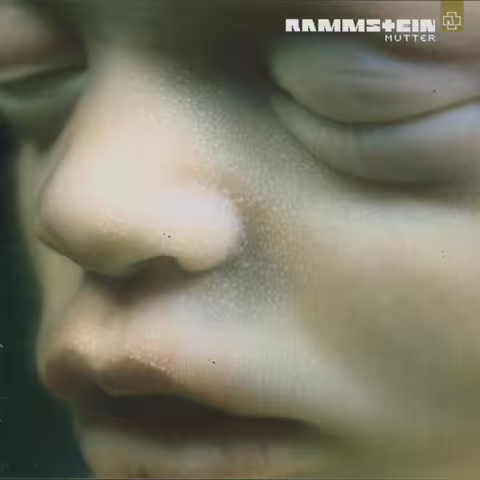
The cover photograph is the single most argued-about image in Rammstein's catalogue. It depicts a preserved human foetus, taken by the German husband-and-wife photographic team Daniel and Geo Fuchs as part of their long-running Anatomy series of laboratory specimens. The image, paired with the title Mutter, reframes the act of motherhood as a question rather than a comfort.
"The cover was a big scandal in Germany, as everyone said, 'You cannot show a dead baby!' Then they said, 'Well, is it really dead? Is it not dead? Are you allowed to show a dead baby on the front cover of a major record?' Then you saw the photos of all the guys in the liquid too. This was something that they directed. They wanted it. They're a magnet for provocation."
Thorsten Zahn, then editor at Metal Hammer Germany, in Louder, 2021
The inner sleeve, designed by Dirk Rudolph, shows each band member submerged in liquid in poses that echo the cover. The Limited Tour Edition kept the same image but printed it in red, with the Rammstein crossed-hammers logo embossed on the front and a bonus disc of four live recordings. A Japanese edition added Halleluja as a hidden track two minutes after the album's regular end. A US double-CD added the Sonne video and the same hidden track again. A 12-inch vinyl was pressed in Germany at release; everything else followed in subsequent years.
Release and Reception
Mutter went on sale on 2 April 2001 and entered the German Albums Chart at number one. It hit number one in Austria and Switzerland in the same week, number two in Sweden and on the European Top 100 Albums, number four in the Netherlands and Poland, number seven in Belgium and Finland. In the United States it landed at number 77 on the Billboard 200, a noteworthy figure given that Rammstein were singing in German, on Universal's Republic imprint, with no FM radio support to speak of. The UK Albums Chart placed it at 86, a position that hugely understates how loud the album was in the British rock press and on Kerrang! TV that summer.
Critical reaction was split in a way that says more about 2001 than about Mutter. Rolling Stone gave it three and a half stars and praised the orchestral muscle. AllMusic's Stephen Thomas Erlewine wrote it up at four and a half stars. Entertainment Weekly gave it a B-plus. Drowned in Sound rated it 8 out of 10. Alternative Press handed over four out of five. Sputnikmusic, with the benefit of retrospect, would later score it 5 out of 5. NME, predictably, gave it 5 out of 10. AllMusic and Rolling Stone reviews live behind various cookie walls in 2026; the scores are widely cited and not in serious dispute.
Awards followed steadily. Rammstein took home a Kerrang! Award for Best International Album in 2002. In 2005, Rock Hard magazine's German-language book The 500 Greatest Rock and Metal Albums of All Time placed Mutter at number 324. The album has been cited by producers as a reference recording ever since.
"I think, if you are not into death metal or something like that, but if you are into metal, I would say maybe Rammstein's Mutter is very good, because it has a lot of different elements, it has orchestra parts, heavy guitars, good drum sound, that could be a good reference."
Peter Tägtgren, producer (Hypocrisy, Pain, Lindemann), Noizr Zine, 2017
Singles and Music Videos
| Single | Released | Director / Video | Notable territories |
|---|---|---|---|
| Sonne | 12 February 2001 | Jörn Heitmann; Snow White and the Seven Dwarfs | Germany 2, Austria 5, Spain 6, Finland 9, Switzerland 18; Gold in UK, Germany 3x Gold |
| Links 2 3 4 | 14 May 2001 | Zoran Bihać; CGI ants vs beetles | Finland 15, Germany 26, Austria 33 |
| Ich Will | 10 September 2001 | Jörn Heitmann; bank robbery in the former GDR State Council building | Germany 29, UK Rock 2, UK 30; Gold in Germany |
| Mutter | 25 March 2002 | Philipp Stölzl; lake, swamp, underground cage | Finland 7, Belgium 15, Germany 47 |
| Feuer Frei! | 14 October 2002 | Rob Cohen; xXx film tie-in, club scene in Prague | UK Rock 2, UK 35, Germany 33; Silver in UK, Gold in Germany |
| Mein Herz Brennt (Piano) | 7 December 2012 | Zoran Bihać; Beelitz-Heilstätten sanatorium | Germany 7, UK Rock 8; Gold in Germany |
The most unusual feature of the Mutter singles campaign is its sheer length. Five singles were pulled from the album between February 2001 and October 2002, and a sixth, Mein Herz Brennt, was held back for over a decade before being released as a single to promote the band's Videos 1995-2012 collection. No other Rammstein album has yielded as many singles. The UK Feuer Frei! release came in three separately coloured editions, yellow, green and orange, each with different track listings and B-sides, in a singles-collector strategy that felt like a throwback to the Eighties even in 2002.
Touring and Live
The Mutter Tour ran from May 2001 through the summer of 2002, taking in clubs, theatres, festivals and, finally, full arenas. The production was a step change in scale from the Sehnsucht tour. LeRoy Bennett, the A-list lighting designer who had worked with Prince and Nine Inch Nails, came in to handle the rig and contributed one of the most-discussed pieces of stage furniture in modern metal: a giant inflatable red uterus suspended above the stage, from which the band, in nappies, slid down a fireproof tube to begin Mutter live.
"I designed a huge uterus that they came out of. The birthing canal they were coming out of was a tube that was used for escaping out of a fire, and it had fireproof webbing on the inside that zig-zagged through it. Normally you'd have clothes on while going down it, but because they were coming through in diapers, their skin would get web-burned, so we had to cut the tube short so they could slide out easier."
LeRoy Bennett, lighting and production designer, Metal Hammer, 2019
Highlights from the tour cycle:
- Big Day Out 2001, Australia and New Zealand, where Links was previewed before the album release
- The 1 May 2001 Fan Area show in Berlin, where Ich Will was first played live
- A North American leg in September and October 2001, supporting Slipknot and System of a Down, cut short by the September 11 attacks
- Headlining shows in arenas across Germany, France, Scandinavia and the UK through late 2001 and 2002
- Pyro mask flamethrowers worn by Kruspe, Landers and Lindemann on Feuer Frei!, which became the visual signature of the show
The 9/11 attacks landed mid-tour while the band were in the United States with Slipknot and System of a Down. Richard Kruspe has said he saw the second plane hit the World Trade Center from a New York hotel window. Flake Lorenz, by his own account, lost his stomach for the situation immediately.
"We totally slipped into this wave of hysteria, and I found the frenzied atmosphere very frightening."
Christian "Flake" Lorenz, in Rammstein in Amerika, 2015
Rammstein cancelled the remainder of the US dates and did not return to North America for nine years.
In TV, Film and Media
Feuer Frei! is the Mutter cut that travelled furthest into the wider culture. It opens xXx (2002), Rob Cohen's Vin Diesel vehicle, with Rammstein playing the song on screen in a Prague nightclub scene shot specifically for the picture, and was used in episodes of CSI: Crime Scene Investigation including Slaves of Las Vegas. Sonne appeared on the soundtrack to FeardotCom (2002). Halleluja, the Mutter-era B-side, was included on the first Resident Evil soundtrack album the same year. Mein Herz Brennt would later open the 2002 Swedish film Lilja 4-ever by Lukas Moodysson, the song scoring a scene of the title character bruised and beaten on a Stockholm overpass, in one of the bleakest sync placements of the decade.
Controversy, Censorship and Lawsuits
The cover image attracted the loudest German press attention but, in the end, no formal censorship at home. Some American chain retailers were reported to have stickered or rebagged the disc; the image stayed put across all official releases. The Stripped Riefenstahl video controversy that preceded Mutter continued to colour Anglophone coverage of the band, and Links 2 3 4 was their direct, in-language answer; it did not, mostly, persuade the British music press to stop reaching for the easy Nazi pun in headlines. There were no significant plagiarism or sampling lawsuits arising from the album.
Covers, Samples and Tributes
Mutter has been covered, sampled and reinterpreted at the edges rather than the centre. Swedish dark symphonic metal band Eleine released a cover of Mein Herz Brennt in November 2019. Apocalyptica, the cello-quartet-turned-metal-band who share Jacob Hellner as a producer, covered Rammstein songs across multiple albums and toured with the band on related tours. A 2001 Battery tribute album, A Tribute to Rammstein, included covers of Du Hast and Bück Dich rather than Mutter cuts. The album's own samples are limited; the female vocal in Sonne is the most famous, lifted wholesale from Spectrasonics' Symphony of Voices library, and the Speak and Spell line in 5/4 is the kind of object trouvée joke that pre-dates the SuperCollider era.
Reissues, Remasters and Anniversaries
The Limited Tour Edition, with its red cover and second live disc, appeared during the 2001-2002 tour cycle. A Limited Edition with the Halleluja bonus disc and Sonne CD-ROM video shipped alongside the standard release. Mein Herz Brennt's 2012 single rollout served as a de facto eleventh-anniversary marker, complete with two music videos and remix package. The 20th-anniversary year of 2021 prompted heavy retrospective coverage in the European rock press, including the long Metal Hammer feature that supplies much of the quoted material in this article, but the band did not issue a formal expanded box. Mutter remains in print, in standard CD, vinyl LP and digital editions, and has chart-re-entered repeatedly in the streaming era, including a 2025 placement on the US World Albums chart at number 21.
Legacy and Influence of Mutter
Mutter is the record on which Rammstein became Rammstein in their current shape. The follow-up, Reise, Reise, arrived in 2004 and went straight to number one in Germany again; Rosenrot followed in 2005, Liebe ist für alle da in 2009, the untitled Rammstein album in 2019, and Zeit in 2022. The Made in Germany compilation in 2011 and the run of Stadium Tour dates across the late 2010s and 2020s only made sense because Mutter had done the work of converting the Du Hast novelty audience into something durable.
The album also widened the definition of Neue Deutsche Härte from a Berlin scene into an export style. Megaherz, Eisbrecher, Oomph!, and the next wave of Lord of the Lost and Mono Inc. all owe a part of their stylistic vocabulary, the orchestral chug, the Wagnerian phrasing, the rolled R, to what Mutter did with the form. Outside the German-language scene, the album sits on every short list of records that proved a major rock release in a language other than English could chart globally without translation, alongside Rammstein's own later work and the occasional Sigur Rós or Mike Shinoda side-trip.
It is, by most fan polls and critical retrospectives, the Rammstein album most often picked as their best.
Things You Might Not Know about Mutter
| Fact | Detail |
|---|---|
| The working title of Sonne | Klitschko. The song was commissioned by Ukrainian heavyweight Vitali Klitschko as a ring entrance, and debuted live under his name on 16 April 2000 before the band rewrote the lyrics. |
| The Sonne female vocal | Not a guest singer at all. It is a sample from the Spectrasonics Symphony of Voices library, the same source many film scores were leaning on in 2000. |
| Feuer Frei! was nearly called Punk | The song debuted at the April 2000 fan-club gig under the working title Punk; nobody seems to know why it was changed to a military command. |
| The Sandman quote | The opening line of Mein Herz Brennt, "Nun, liebe Kinder, gebt fein Acht", is lifted from the East and West German children's bedtime show Sandmännchen; Lindemann recasts the Sandman as a predator. |
| The child on Spieluhr | Khira Li Lindemann, Till's daughter, sings the buried child melody. She was a young child at the time of recording. |
| The cover photographers | Daniel and Geo Fuchs are best known not for album art but for the Anatomy series of preserved laboratory specimens. The Mutter cover is drawn from that body of work. |
| Haus Weimar | Pre-production happened at a Baltic Sea spa-town caretaker's house. The main building had been a hangout for the East German political elite. |
| Miraval before the Pitts bought it | The studio Rammstein used in 2000 was owned by jazz pianist Jacques Loussier and had previously hosted Pink Floyd's The Wall and AC/DC's The Razors Edge. |
| The Ich Will video location | Filmed in the former Staatsratsgebäude, the State Council of the GDR building in Berlin, which now houses the European School of Management and Technology. |
| The Goldene Kamera punchline | The Ich Will video ends with the band, in prison uniforms, being awarded the Goldene Kamera, Germany's Emmy equivalent, as a satire of celebrity-criminal media coverage. |
| The xXx connection | Rob Cohen, director of xXx, also directed the Feuer Frei! music video, using footage from the film's Prague club scene where the band perform on screen. |
| The uterus | The Mutter Tour set piece was a giant inflatable red uterus designed by LeRoy Bennett, from which the band, in nappies, slid down a fireproof escape tube onto the stage. |
| The 9/11 cut-short | Richard Kruspe says he watched the second plane hit the World Trade Center from his hotel window; the band cut the supporting tour with Slipknot and System of a Down, and did not return to North America for nine years. |
| The six-single rollout | Mutter is the only Rammstein album to date to yield six singles. The sixth, Mein Herz Brennt, did not appear until 7 December 2012. |
| The Halleluja Easter egg | The Japanese edition hid Halleluja as a hidden track two minutes after Nebel; the same track was later included on the Resident Evil soundtrack but does not appear in the film. |
Riffology: the Album Deep Dive Podcast
If you would rather hear two long-time fans argue about whether Mutter or Reise, Reise is the high-water mark of the Rammstein catalogue, the Riffology podcast covers the same kind of ground in a different format. Episodes are available on Apple Podcasts, Spotify, Amazon Music and every other major platform.