At around four in the morning, in a borrowed bedroom on the top floor of Ringo Starr country house in Berkshire, Rob Halford was woken up by Glenn Tipton playing a guitar riff at deafening volume in a room two doors down. Halford padded out onto the landing, half-asleep, and shouted that Tipton was really living after midnight. Tipton stopped playing, looked at him through the doorway and said that was a great title for the song he was working on. Twenty-odd minutes of writing later, Judas Priest had the chorus of the song that would lift them out of leather-clad cult status and onto the radio playlists of the world.
That single anecdote, sourced from Halford to Rolling Stone in 2012, contains almost everything you need to know about British Steel. A band that had spent five albums chasing the dragons of progressive heavy metal, suddenly writing their biggest hit in their pyjamas. A studio that was really John Lennon old house, repurposed for steel-plated riffs. A producer, Tom Allom, learning that this Birmingham five-piece were funnier, harder-working and a lot more commercial than their reputation suggested. And a creative restlessness so insistent that even the drummer change and the unfamiliar surroundings could not break the flow. Released on 11 April 1980, British Steel was the record that codified what heavy metal would sound like for the next decade, and arguably the next forty years.
Album Facts
| Field | Detail |
|---|---|
| Artist | Judas Priest |
| Album | British Steel |
| Release Date | 11 April 1980 (UK, CBS); May 1980 (US, Columbia) |
| Label | CBS in the UK, Columbia in the US |
| Producer | Tom Allom |
| Studio | Tittenhurst Park, Ascot, Berkshire (with Startling Studios on the same estate) |
| Genre / Subgenre | Heavy metal; an early commercial flagship of the New Wave of British Heavy Metal |
| Track Count | 9 |
| Total Runtime | 36:10 |
| Billboard 200 Peak | 34 |
| UK Albums Chart Peak | 4 |
| Other Notable Chart Peaks | Canada 45, Sweden 20, Japan 69 |
| Certifications | UK Silver (BPI), US Platinum (RIAA, 1,000,000 shipments), Canada Platinum, Sweden Gold |
| Estimated Sales | Reported as over 2 million worldwide |
| Key Singles | Living After Midnight (UK 12), Breaking the Law (UK 12), United (UK 26) |
Cultural Context: 1980 and the Year Metal Woke Up
The first months of 1980 were, in retrospect, the most fertile twelve weeks in the history of British heavy music. Saxon released Wheels of Steel on 1 March. Iron Maiden self-titled debut followed on 14 April, three days after British Steel hit the racks. Def Leppard On Through the Night arrived later the same month. By the autumn, AC/DC had answered the death of Bon Scott with Back in Black, Motorhead had unleashed Ace of Spades, Black Sabbath had reinvented themselves with Ronnie James Dio on Heaven and Hell, and an enterprising promoter named Paul Loasby had convinced Rainbow to headline a new festival at Donington Park called Monsters of Rock. The shorthand was already in use by the music weeklies: New Wave of British Heavy Metal.
Judas Priest were older than any of those bands, and their pedigree showed it. They had been gigging since 1971, signed in 1974, and were already five studio albums into a career that ought to have made them figureheads of the new scene. Instead, they were widely viewed as 1970s relics, leather-clad survivors of a sound the punks had supposedly killed. British Steel was their answer to that condescension. By trimming the song lengths, sharpening the hooks and embracing the political weather of late-Callaghan, early-Thatcher Britain, Priest produced a record that did not sound like one of the NWOBHM debuts in any obvious way, yet provided the template every NWOBHM band would chase for the rest of the decade.
The Band Story Up to This Point
By December 1979 the line-up that mattered, Rob Halford on vocals, K. K. Downing and Glenn Tipton on guitars and Ian Hill on bass, had been together for six years. They had recorded Sad Wings of Destiny for £2,000 in 1975, signed to CBS in 1977 for a budget of £60,000, and used the move up to deliver three increasingly heavy studio albums: Sin After Sin, Stained Class and Killing Machine (titled Hell Bent for Leather in North America). The live souvenir of that run, Unleashed in the East, was their first platinum record in the US in 1979 and gave them a public-facing identity built on Halford operatic range and the band twin-guitar attack.
It also broke their drummer. Les Binks, the talented and underrated drummer who had played on Stained Class, Killing Machine and Unleashed in the East, quit in late 1979 in a dispute with manager Mike Dolan over royalties on the live album. His replacement was Dave Holland, formerly of the Birmingham hard-rock band Trapeze. Holland was a simpler player than Binks, less inclined to flashy double-kick fills, and exactly the rhythm anchor Tipton and Downing now wanted. The new feel of the band was already audible in rehearsal: shorter songs, harder backbeats, riffs designed to be chanted back from the floor of an arena rather than admired by hi-fi enthusiasts at home.
The other shift in the band sense of themselves was visual. Halford had adopted the studded leather look the previous year, partly inspired by punk and partly by the gay leather scene he was quietly part of. Downing has said in interviews that the moment the leather, the studs and the razor-blade-on-Sheffield-steel sleeve idea came together in his mind was the moment heavy metal as a self-aware genre was born. Whether or not that is overstated, the look and the new sound were converging at the same point.
Pre-production, Demos and Working Titles
Priest wrote and rehearsed most of British Steel in a Birmingham warehouse in late 1979, then carried the material to Tittenhurst Park with the songs largely arranged but not finished. K. K. Downing has consistently described the album as the moment the band cracked the code of writing for radio without sacrificing weight. Songs were being trimmed down on the rehearsal-room floor. Tipton, the more methodical of the two guitarists, was running the writing on tracks like Rapid Fire and Metal Gods. Halford was supplying lyrics in great washes, then editing them down to slogans.
Several pieces of the record were not yet songs when the band moved into Tittenhurst. Living After Midnight was a Tipton instrumental riff that only became a song because of the four-in-the-morning incident described above. Breaking the Law was reportedly written in an afternoon once Tipton had its descending two-note motif. Metal Gods had been kicked around in earlier rehearsals as a heavier Black Sabbath-style march before being stripped back to the cold, mechanical groove that ended up on tape. Of the album that finally emerged, only You Don't Have to Be Old to Be Wise had any real lineage to the band 1970s prog instincts, and even that was disciplined into a four-minute song.
Creating the Album: Tittenhurst, Tom Allom and a Kitchen Drawer
The decision to work with Tom Allom is the unsung hinge of the entire Judas Priest story. Allom had cut his teeth as an engineer on the first three Black Sabbath albums under Rodger Bain, and had recently produced parts of Def Leppard debut and mixed Unleashed in the East with Priest. Tipton later admitted that the band had turned Allom down once already, thinking he was too posh for them. They reversed the decision in time for British Steel, and Allom would go on to produce or co-produce every Priest studio album through 1988 Ram It Down, returning again for Firepower in 2018 and Invincible Shield in 2024.
"Tom really was a great man to be with. He knew how to party as well. There were many nights when we would have to get him home and tuck him in bed."
K. K. Downing, quoted by Malcolm Dome, Louder Sound, 2020
Tittenhurst Park was a 72-acre Berkshire estate that John Lennon had bought in 1969 and used as the location for the Imagine album cover and film. Lennon sold the property to Ringo Starr in September 1973, and Starr renamed Lennon on-site Ascot Sound Studios as Startling Studios. By the time Priest arrived in December 1979, Starr was in Los Angeles courting his future wife Barbara Bach, his first wife Maureen had moved out, and the house was empty. The band had originally planned to record in Startling itself but, after a few false starts, abandoned the purpose-built studio and set up to track in the rooms of the main house. Halford remembers practically having the run of the place.
"Ringo wasn't there at the time we were in. He'd met Barbara Bach, his future wife, and had gone off to Los Angeles to be with her. And Ringo's then-wife, Maureen, had also left. So we had the place totally to ourselves."
Rob Halford, quoted by Malcolm Dome, Louder Sound, 2020
Starr was not, however, naive about lending a country house to a heavy metal band on the cusp of a creative tear. According to Downing, he removed the valuables before the band moved in, banned motorbikes from the grounds and left a list of house rules. What he could not anticipate was the band raiding his kitchen cupboards in the name of art. British Steel is famous in production circles for its found-percussion sound effects, all of which were necessitated by the fact that digital sampling was still years away from being widely available. Bands of 1980 had to make their noises in the room and capture them on tape.
Three pieces of household kit became part of the album sonic identity:
- The scything whoosh at the end of Rapid Fire was a billiard cue swung in front of a microphone, reportedly wielded by Halford himself in Tittenhurst games room.
- The marching robot footsteps on Metal Gods were made by loading a kitchen drawer with cutlery taken from Starr cupboards and shaking it in front of a mic. Tipton said the band spent ages removing knives and forks one by one until the rattle was exactly right.
- The smashing glass on Breaking the Law was a literal smashing of milk bottles in the hallway, then mic'd up and laid into the master.
"There was no such thing as samples in those days, so bands had to be a lot more imaginative. I often feel sorry for young musicians now, because they have got everything at their fingertips. That sort of thing can stunt creativity."
Rob Halford, quoted by Malcolm Dome, Louder Sound, 2020
The album was tracked on analogue tape with Lou Austin engineering and Ray Staff cutting the final lacquer. The drum sound that Allom captured for Holland kit became one of the most influential in the genre, a dry, smacking thump with the kick drum well forward, deliberately closer to AC/DC than to the cavernous reverb-soaked drums of Led Zeppelin. The twin guitars of Downing and Tipton were panned hard left and right, each instrument double-tracked, with very little reverb added in the mix. The whole record sounds like a band in a room playing loud, which is more or less what it was.
The Tittenhurst sessions ran from late December 1979 through the first week of February 1980. The band were home for an early-March start to the tour. From writing the last songs in Birmingham to mastering the lacquer at Allom mixdown, the whole record took barely three months.
Personnel and Credits
| Role | Player | Notes |
|---|---|---|
| Core band | ||
| Lead vocals | Rob Halford | His first album with the now-classic studded leather and motorbike image fully established |
| Guitars | K. K. Downing | Generally the rhythm and effects-textured guitar in the panning |
| Guitars | Glenn Tipton | Most of the lead breaks and the primary riff-writer on Living After Midnight, Metal Gods and Breaking the Law |
| Bass | Ian Hill | Founder member; played on every Judas Priest album then and since |
| Drums | Dave Holland | His first album with Priest, having replaced Les Binks in late 1979 after Binks royalties dispute over Unleashed in the East |
| Production and engineering | ||
| Producer | Tom Allom | First Judas Priest production credit; would produce or co-produce every studio album through Ram It Down (1988) and return for Firepower (2018) and Invincible Shield (2024) |
| Engineer | Lou Austin | Tracking and mixing at Tittenhurst Park |
| Mastering / disc cutting | Ray Staff | Cut the lacquer at the time of release |
| Artwork | ||
| Cover design | Roslaw Szaybo | Polish-born CBS art director responsible for the razor-blade hero image |
| Photography | Robert Elsdale and Robert Ellis | Both credited on the original sleeve; the dramatic close-up razor shot is generally attributed to Elsdale |
One detail worth noting in any honest credits round-up: Dave Holland was convicted in 2004 of attempted rape and indecent assault on a young boy he had been teaching to play drums, and served eight years in prison before his death in 2018. None of that has any bearing on the music he played in 1980, but it does explain why his contributions to British Steel are often discussed without the warmth shown to his bandmates. The work itself, the four-on-the-floor swing of Living After Midnight and the iron tread of Metal Gods, is foundational to the record sound.
The Songs
The 1980 UK pressing arranged the album in the running order Priest preferred. Columbia in the US flipped the first three tracks for impact, putting Breaking the Law at the top of side one. Both versions contain the same nine songs, the same nine writing credits to Halford, Downing and Tipton, and the same compressed 36 minutes.
| # | Title | Writers | Length | Single? | Notes |
|---|---|---|---|---|---|
| 1 | Rapid Fire | Halford, Downing, Tipton | 4:08 | Opener on UK release; speed-metal blueprint | |
| 2 | Metal Gods | Halford, Downing, Tipton | 4:00 | Cutlery-drawer percussion; the song that gave the band their nickname | |
| 3 | Breaking the Law | Halford, Downing, Tipton | 2:35 | UK 12 | Smashed milk bottles for sound effects |
| 4 | Grinder | Halford, Downing, Tipton | 3:58 | Mid-paced industrial stomper | |
| 5 | United | Halford, Downing, Tipton | 3:35 | UK 26 | Football-terrace singalong; oddly out of place for some critics |
| 6 | You Don't Have to Be Old to Be Wise | Halford, Downing, Tipton | 5:04 | The closest the record gets to the bluesy 70s Priest sound | |
| 7 | Living After Midnight | Halford, Downing, Tipton | 3:31 | UK 12 | Written at four in the morning at Tittenhurst; the band first true crossover hit |
| 8 | The Rage | Halford, Downing, Tipton | 4:44 | Opens with a reggae-influenced bass intro from Ian Hill before exploding into metal | |
| 9 | Steeler | Halford, Downing, Tipton | 4:30 | Galloping closer, a clear template for later thrash and speed metal bands |
Rapid Fire sets the tone. The song is two and a half minutes of pure forward propulsion, Holland riding the snare and bass drum in a pattern that a Bay Area thrash band three years later would have recognised as the speed-metal feel. The lyric is pulp dystopia, Halford bellowing about pounding the world like a battering ram. The track ends with that billiard-cue whoosh, an effect so subtle most listeners never identify it as anything but a faint piece of studio strangeness.
Metal Gods is the strangest song on the record and arguably its most important. Halford lyric is a piece of science-fiction paranoia about machines rising up against their creators, but its real legacy is the title. By 1981 the band fans had taken to calling Judas Priest themselves the metal gods, a nickname that has stuck for forty-five years and was etched in the band official Rock and Roll Hall of Fame citation in 2022. Halford has been quite clear, in interviews with Billboard and elsewhere, that he wrote the lyric by word association out of his love for science fiction. Downing has been just as clear that the marching footsteps were made by shaking Ringo Starr cutlery in front of a microphone, take after take, until the rhythm felt right.
"When we were recording that track we had loads and loads of fun trying to make it sound as metal as we can. We were shaking cutlery trays in front of the microphones to create the sound of metal marching feet. So I guess it's Ringo's knives and forks that created the true Metal Gods sound, which is pretty funny to realise."
K. K. Downing, interview reproduced in Billboard, 2010
Breaking the Law is the song everyone knows. Two minutes and thirty-five seconds, no guitar solo to speak of, a descending two-note opening figure from Tipton that any half-competent guitarist can learn in an afternoon. The lyric, about unemployment and aimless youth in Thatcher-era Britain, hit hard in a country whose unemployment rate would more than double over the next three years. The smashing milk bottles in the bridge are a slightly absurd flourish that should not work and somehow do.
Grinder sits between the two singles like industrial connective tissue, all riff and minimal melody. United is the album most divisive song, a Hands-Across-the-Stadium chorus that Priest themselves have admitted was inspired by football terraces. It charted at 26 in the UK as a single in August 1980 and was used by the band as a tour singalong for years, but more than one early reviewer thought it was a misjudged piece of populism.
You Don't Have to Be Old to Be Wise opens the original side two with a chugging mid-tempo riff and the closest thing on the record to a blues-rock structure. Of all the tracks here, this one would have sat happily on Killing Machine. Living After Midnight, by contrast, would have sat happily on the radio. Its 12/8 swing, its anthemic chorus and Tipton compressed solo make it the moment Judas Priest fully committed to the idea that a metal song could also be a pop song.
The Rage is the deep cut beloved of Priest obsessives. It opens with an extended Ian Hill bass figure that, on a heavy metal album, sounds startlingly close to dub reggae. After a minute the band crash in with a heavy gallop, but the unexpected intro tells you something about the breadth of the band influences that year. Steeler closes the album with another fast, two-guitars-in-flight workout, and a band of American teenagers called Anthrax were taking very careful notes.
B-sides, Outtakes and Lost Songs
The original 1980 singles came with B-sides drawn from the band recent past rather than from the British Steel sessions. Living After Midnight had Rock Forever, a Killing Machine cut, on its 7-inch flip. Breaking the Law was backed in some markets with Metal Gods, in others with Grinder. United was paired with Genocide, a much older Priest track from Sad Wings of Destiny, on its 7-inch and with Living After Midnight on its 12-inch.
The most-asked-about lost track from the sessions is Red, White and Blue, an obvious arena anthem that was demoed for British Steel, set aside, attempted again during the Twin Turbos sessions that would become 1986 Turbo, and finally released in 2001 as a bonus track on the remastered British Steel. Other than that, the band have always insisted there is no hidden vault of unreleased British Steel-era material; whatever they wrote that year went onto the record.
Album Artwork and Packaging
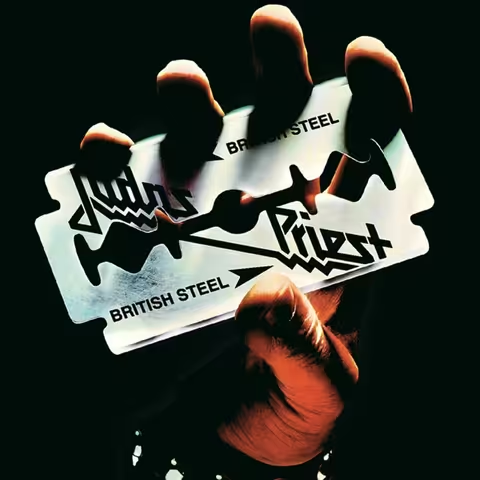
The sleeve is one of the most reproduced images in heavy metal. The hand-and-razor concept was the work of Roslaw Szaybo, the Polish-born art director who headed up CBS UK creative department through the 1970s and was responsible for sleeves by Janis Joplin, Wishbone Ash and the Clash. Szaybo wanted a single image that could be reduced to a t-shirt or a back-patch without losing its punch, and the band wanted something that suggested both their Birmingham steel-town heritage and the sharp new direction of the music inside. A razor blade engraved with the band name, gripped tight enough to draw blood, did both jobs in one go. The principal photograph is generally credited to Robert Elsdale, with additional photography by Robert Ellis.
The original LP came in a single sleeve with full lyrics on the inner bag. Some early UK pressings used a slightly different alternative cover with a different background colour, which now commands a small premium on the second-hand market. The 30th anniversary reissue in 2010 used a third, embossed variant of the same razor-blade image.
Release and Reception
CBS released British Steel in the UK on 11 April 1980, deliberately keeping the price low. Adverts in the music weeklies bore the deliberate misspelling British Steal, hammering home the discount £3.99 sticker. The album debuted in the UK Top 5 and peaked at number 4, the band first top-five album. In the US, where Columbia held the file, it climbed to number 34 on the Billboard 200, by far the highest Priest had ever reached there. Canada, Sweden and Japan all picked it up; certifications followed across all those territories.
Contemporary press was warmer than Priest were used to but not universally kind. Sounds in the UK liked it. NME, predictably hostile to anything not punk or post-punk, was cooler. Rolling Stone ran a favourable review in October 1980. Critical revaluation came later: AllMusic Steve Huey would give the album a full five stars and write that it "kick-started heavy metal glory days of the 1980s". BBC Music called Living After Midnight the song that "epitomised the new breed of radio friendly metal". In 2017, Rolling Stone placed British Steel third on its list of the 100 Greatest Metal Albums of All Time, behind only Master of Puppets and Paranoid. The book 1001 Albums You Must Hear Before You Die includes it. Max Cavalera of Sepultura has said flatly that without British Steel, Metallica would not exist.
"It's the essential thrash metal album everyone needs to hear. I'm sure you can ask Metallica, if it wasn't for British Steel they wouldn't be here."
Max Cavalera, Wall of Sound Educate Ebony podcast, 2021
Awards have followed at a steady drip. Kerrang! placed the album in its Hall of Fame. The band Rock and Roll Hall of Fame induction in 2022, finally awarded as the Musical Excellence Award after three nominations in the Performer category, leaned heavily on the songs from British Steel when they performed at the ceremony.
Singles and Music Videos
Three singles were lifted from the album, in this order:
| Single | Release | B-side | UK | Notes |
|---|---|---|---|---|
| Living After Midnight | 21 March 1980 | Rock Forever | 12 | Music video directed by Julien Temple, filmed live at Sheffield City Hall; opens with Dave Holland miming on an invisible drum kit |
| Breaking the Law | 30 May 1980 | Metal Gods / Grinder (territory-dependent) | 12 | Promo video shot in a fake bank robbery, with the band as masked raiders |
| United | 15 August 1980 | Genocide (7"); Living After Midnight (12") | 26 | No standalone video; mostly performed live in support of the tour |
The Living After Midnight clip is the better-known artefact of the two videos. Julien Temple, who had directed the Sex Pistols The Great Rock and Roll Swindle in 1980 and would go on to a long film career, captured Priest on the Sheffield City Hall date of the British Steel Tour. The famous detail is the front row of fans miming along on cardboard cut-out guitars, a fan-made motif that became one of the visual signatures of the NWOBHM. The Breaking the Law promo, by contrast, is a piece of low-budget studio comedy: the band in balaclavas, Halford with a sawn-off, robbing a bank for the album master tape, which a security guard is busy mimicking on air guitar. It is silly, it is short, and it has been parodied countless times since.
Touring and Live
The British Steel Tour ran from 7 March to 23 August 1980 across Europe and North America, 83 shows in total. The UK leg in March was supported by Iron Maiden, then still touring their self-titled debut and a long way from the dressing-room headliner status they would acquire within two years. Priest were giving the future biggest metal band in the world their first proper run at British arenas. Across the US leg from late May, Def Leppard opened many dates, with Scorpions, Wishbone Ash and Saxon picking up support slots in different territories. The tour concluded at the very first Monsters of Rock festival at Donington Park on 16 August 1980, a bill headlined by Rainbow and including Scorpions, Saxon, Riot, Touch and April Wine.
A handful of notable moments from the run:
- The 11 March 1980 Sheffield City Hall show was filmed by Julien Temple for the Living After Midnight video.
- The 1 April 1980 Rainbow Theatre date in London was the band first time as headliners at the venue, then a key London barometer for any rising rock act.
- The 16 August 1980 Donington Park appearance put Priest fourth from top on the bill of the first Monsters of Rock festival, alongside Rainbow, Scorpions and Saxon. It became the founding instalment of an event that ran annually at Donington until 1996.
- The 23 August 1980 Nuremberg show at Zeppelin Field, supporting Ted Nugent at the Golden Summer Night Festival, closed the tour.
Setlists across the run typically opened with Hell Bent for Leather and dipped into British Steel for Living After Midnight, Breaking the Law, Grinder, Steeler and, on US dates, Metal Gods. United was used as a singalong on the European dates.
In TV, Film and Media
For an album made by an unfashionable Birmingham metal band in 1980, British Steel has soundtracked an extraordinary amount of mainstream popular culture in the decades since. Breaking the Law has been used as a comic shorthand for petty rebellion so often that it almost qualifies as a punchline genre of its own. The most-cited examples:
- The Simpsons, "Steal This Episode" (Season 25, January 2014). The band appeared as themselves and performed a parody of Breaking the Law. The episode initially described them as death metal; Rolling Stone, The Guardian and the band themselves protested, and the producers ran a chalkboard apology in a later opening credits gag.
- Adventureland (2009), the Greg Mottola coming-of-age film with Jesse Eisenberg, used Breaking the Law on its 1980s-set soundtrack.
- The track appears in the Tony Hawk Pro Skater games, Rock Band, SingStar and Brutal Legend, all of which embedded it in the gaming consciousness of a generation born after the song was released.
- Metal Gods and Living After Midnight have both been used in WWE promotional packages and in numerous beer, motorbike and sports advertisements.
- The famous Wayne Campbell-style impression of Halford screech opens countless mock-rock comedy sketches.
Covers, Samples and Tributes
The list of bands who have covered material from British Steel is long, and reads like a roll-call of metal: Disturbed covered Living After Midnight on the Tribute to British Steel CD given away by Metal Hammer in 2010, splicing in the opening drum salvo from Painkiller. The Donnas recorded a punk-pop Living After Midnight on The Donnas Turn 21 in 2001. L.A. Guns covered it on the 2008 tribute album Hell Bent Forever. Italian rock star Vasco Rossi lifted the Living After Midnight riff wholesale for his 1981 song Dimentichiamoci questa citta, and has been quite open about the borrowing in subsequent interviews.
Breaking the Law has been covered by Doro, Helmet, Six Feet Under and many others. Metal Gods has been covered by Halford solo band, by Doro again and was performed by Metallica on the Big 4 tour as a tribute. Steeler gave its name to the early 80s Hollywood band that briefly featured Yngwie Malmsteen on guitar and Ron Keel on vocals.
Reissues, Remasters and Anniversaries
The original 1980 LP was remastered for CD in 2001 with two bonus tracks: the 1985 Turbo-sessions outtake Red, White and Blue, and a live Grinder recorded at Long Beach Arena on 5 May 1984 during the Defenders of the Faith tour. The 30th anniversary edition followed in 2010 and came in deluxe-edition packaging with both the original album and a live disc plus DVD recorded on 17 August 2009 at the Seminole Hard Rock Arena in Hollywood, Florida. That show was the kickoff of a 30th-anniversary tour during which the band performed British Steel in its original UK running order, a first for any Judas Priest record. The live versions of every British Steel track were then made available as downloadable content for the Rock Band game from 11 May 2010, the first full studio-album release on that platform from any metal band.
A 40th anniversary in 2020 was overshadowed by the pandemic; what was meant to be a tour was scaled back to social-media features and a Louder Sound retrospective. The album has appeared in the band several career-spanning box sets, including Metalogy (2004), The Complete Albums Collection (2011) and the recently announced The Best of Judas Priest compilation set for 19 June 2026 release. Bootlegs of the Tittenhurst sessions are not known to circulate; whatever tapes existed beyond the masters are widely believed to have been wiped or never archived.
Legacy and Influence
British Steel is the album that made it possible to be a heavy metal band without being a 1970s heavy metal band. Iron Maiden, Saxon, Def Leppard and the rest of the NWOBHM had the sound of metal coming out of their pores already, but Priest provided the actual production template: dry drums, hard-panned twin guitars, shorter songs, hookier choruses, lyrics that worked on the page as much as on the stage. Within two years Number of the Beast, Pyromania and The Number of the Beast's American chart success had carried that template into the mainstream. Within five, the Bay Area thrash bands were openly worshipping Priest in interviews. Within ten, Pantera were doing groove metal that traced back to Grinder, and within twenty, the entire power-metal scene of Helloween, Gamma Ray and Blind Guardian had built itself on the speed-metal launch ramp of Rapid Fire and Steeler.
The Guardian Roy Wilkinson, in a long 2010 piece pegged to the 30th anniversary, called British Steel simply "the record that defines heavy metal". The Rock and Roll Hall of Fame, after a long and slightly embarrassed wait, agreed in 2022 by inducting Priest under the Musical Excellence Award and selecting Living After Midnight, Breaking the Law and Metal Gods as the three songs performed at the ceremony with K. K. Downing rejoining his old band on stage for the first time in eleven years. Even the album razor-blade sleeve has had a second life as a corporate logo, as fan tattoos, as the visual shorthand for the kind of metal that is both hard and accessible.
Halford himself, who came out as gay in a 1998 MTV interview, has since helped reframe the studded-leather Priest aesthetic as one of the great accidental queer codings in rock music. None of which was visible in 1980, when the audience reading the cover took it at face value, but the longer view has only added depth to a record that already had plenty.
Things You Might Not Know
| Fact | Detail |
|---|---|
| The drawer of cutlery | The marching robot footsteps on Metal Gods were made by shaking a kitchen drawer full of cutlery in front of a microphone. Halford has said he picked the drawer up and dropped it about a hundred times to get the take right. |
| The pool cue | The scything noise at the very end of Rapid Fire was a billiard cue swung in front of a mic in Tittenhurst Park games room. |
| Smashed milk bottles | The broken glass sound on Breaking the Law was created by literally smashing milk bottles in the hallway of Ringo Starr country house. |
| The four-in-the-morning song | Living After Midnight was written after Glenn Tipton woke Halford at 4 AM by playing a riff at high volume. Halford complaint became the chorus. |
| Ringo not at home | The band recorded with the house effectively empty. Starr was in Los Angeles courting Barbara Bach, and his ex-wife Maureen had already moved out. |
| The British Steal advert | CBS UK launch ads in the music press deliberately misspelled the title as British Steal, pushing the £3.99 discount price as the joke. |
| Tom Allom Sabbath roots | Producer Tom Allom got his start as an engineer on the first three Black Sabbath albums under Rodger Bain, the same producer who made the debut Priest album they spent the rest of the decade trying to live down. |
| Iron Maiden as support | Iron Maiden opened for Priest on the UK leg of the 1980 British Steel Tour, before either band knew Maiden would soon eclipse Priest in NWOBHM hype. |
| The Sheffield video | The Living After Midnight promo was directed by Julien Temple, filmed live in Sheffield, and shows fans in the front row playing along on cardboard cut-out guitars, a NWOBHM in-joke that became a visual symbol of the era. |
| The bank robbery video | The Breaking the Law promo casts the band as balaclava-clad bank robbers stealing the album master tape; the security guard ignores them in favour of playing air guitar. |
| The reggae bass intro | The Rage opens with a dub-style bass figure from Ian Hill that sounds startlingly close to reggae before the song erupts into metal. |
| The Metal Gods nickname | The song gave Judas Priest the nickname Metal Gods, which their fans began using in 1981 and which the Rock and Roll Hall of Fame used in their 2022 induction citation. |
| The Rolling Stone ranking | Rolling Stone placed British Steel third on its 100 Greatest Metal Albums of All Time list in 2017, behind only Black Sabbath Paranoid and Metallica Master of Puppets. |
| Played in full at last | Priest did not perform British Steel in full live until 2009, nearly thirty years after release, when they kicked off the 30th anniversary tour at Seminole Hard Rock Arena in Florida. |
The Riffology Podcast
If you have made it this far, the next logical step is to listen to two old friends argue about whether Living After Midnight or Breaking the Law is actually the better Priest song. The Riffology podcast does deep, song-by-song talks about records like British Steel, the bands that made them and the world that made the bands. You can find it on Apple Podcasts, Spotify, Pocket Casts and every other major platform; new episodes drop regularly, and we always love hearing from listeners about the records they want us to take on next.
Comments