Desmond Child was the most expensive songwriter in rock when the call from Phoenix came in late 1988. He had just finished writing or co-writing the hits that defined the second half of the decade for two of the biggest bands on earth, Bon Jovi and Aerosmith, and his rate reflected it. The voice on the other end of the line was a sober, forty-one year old former shock rocker who had spent the previous three years releasing horror-themed concept records on MCA that almost nobody had bought. Cooper had a proposal. He wanted to make a glam metal album, he wanted to make it with Child, and he wanted every famous friend in his address book on it.
Child said yes. What followed was Trash, the record that took Alice Cooper from cult curiosity to MTV mainstay in the space of one summer, delivered his first US top ten single in twelve years, and proved that the man who had invented theatrical rock could compete in a chart now dominated by twenty-five year olds wearing his hand-me-downs.
Album facts
| Field | Detail |
|---|---|
| Artist | Alice Cooper |
| Album | Trash |
| Release date | 25 July 1989 |
| Label | Epic Records |
| Producer | Desmond Child |
| Studios | Bearsville (Woodstock), Power Station (NYC), Right Track (NYC), Sigma Sound (Philadelphia), Mediasound (NYC), Grog Kill, Village Recorder (LA), The Complex (LA), Record Plant (NYC), Blue Jay, Sanctuary Sound |
| Genre / subgenre | Glam metal, hard rock, pop-metal |
| Track count | 10 |
| Total runtime | 40:11 |
| Billboard 200 peak | 20 |
| UK Albums Chart peak | 2 |
| Other notable chart peaks | Finland 1, Austria 4, Norway 4, Australia 5, New Zealand 6, Sweden 6, Switzerland 10, Germany 16, Canada 19 |
| Certifications | Platinum (US, Canada, Australia, New Zealand); Gold (Germany, Sweden, Switzerland, Austria, Finland) |
| Estimated sales | Over 2 million worldwide |
| Key singles | Poison, Bed of Nails, House of Fire, Only My Heart Talkin' |
Cultural context: the summer hair metal owned the world
July 1989 was the peak commercial moment of the hair metal era. Bon Jovi's New Jersey, released eighteen months earlier, was still in the top forty of the Billboard 200 and still pulling tens of thousands of arena fans a night. Skid Row's self-titled debut had broken in January and was on its way to five times platinum. Motley Crue were halfway through tracking Dr Feelgood with Bob Rock in Vancouver; Aerosmith were finishing Pump in Los Angeles with Bruce Fairbairn. Guns N' Roses had spent the previous twelve months turning Appetite for Destruction into the best-selling rock debut ever made.
MTV, the genre's home network, was at the height of its cultural power. A single Marty Callner-directed video could put a song on heavy rotation for six months and turn an unknown band into headliners. The visual codes were locked: leather, hairspray, smoke machines, a topless model glimpsed across the room, a balcony scene where the singer flicks his hair and points at the camera. Power ballads were guaranteed top ten hits. Anything else was treated as a bonus.
Into this scene walked a man whose career had peaked sixteen years earlier with Billion Dollar Babies. Cooper had invented several of the genre's visual conventions in 1973 and then watched a generation of kids who first saw him on the cover of Creem build entire careers around what they had learned. Most of the bands now crowding the charts had Cooper posters on their teenage bedroom walls. By 1989 he was, on paper, a heritage act. Trash was an attempt to prove that the original could still beat the copies on their own ground.
The band's story up to this point
The original Alice Cooper band had imploded in 1975, leaving Vincent Furnier with the stage name and the persona but no rhythm section. He had spent the next six years making a sequence of theatrical solo albums, the best-loved of which was Welcome to My Nightmare in 1975. The 1977 single You and Me had reached number nine on the Billboard Hot 100 and would, until Poison, remain his last appearance in the US top ten.
The early eighties had been brutal. Cooper's drinking, which had become public legend during the original band era, escalated to the point of physical collapse. He spent time in a sanitorium in 1977 and tried to write himself out of the addiction with the autobiographical From the Inside in 1978. A string of new-wave-tinged records, Flush the Fashion, Special Forces, Zipper Catches Skin and DaDa, made little commercial impact and would later become known as the blackout albums; Cooper has said in interviews that he has no clear memory of recording most of them.
In 1983 he stopped drinking. He has stayed sober since, married since 1976 to dancer Sheryl Goddard, and built a parallel life as a daily golfer in Phoenix. The horror trilogy he made for MCA, Constrictor in 1986, Raise Your Fist and Yell in 1987 and the 1988 Live in the Flesh, restored his touring base but never broke beyond the metal underground. The Nightmare Returns tour of 1986 to 1987 had been a hard-ticket success in Europe. The studio albums had not.
By the time Cooper sat down to plan a new record, the maths was straightforward. He had a contract decision to make with MCA, he had no top forty single in over a decade, and he had watched a wave of younger bands turn the theatre he had invented into a commercial juggernaut he was not part of. The plan that emerged was to leave MCA, sign with Epic, and bring in the producer who had written the rule book for the genre that was now eating his lunch.
Pre-production and the Desmond Child decision
Cooper and Child began writing together in late 1988 and early 1989, mostly in New York. The working method Child had refined with Jon Bon Jovi and Richie Sambora on Slippery When Wet, and with Steven Tyler and Joe Perry on Permanent Vacation, was a chorus-first system. The hook went down first, on cassette, in any room with a piano or an acoustic guitar; the verse was reverse-engineered from it; the bridge was a chord change away from the chorus rather than a separate section. Verses existed to deliver listeners to choruses; choruses existed to be sung by stadiums.
Cooper brought lyrics. Child brought melodies. Of the ten tracks that eventually made the album, Child has a writing credit on eight. The songs were demoed in small east coast rooms before the full sessions began, with John McCurry, a guitarist Child had been using on side projects, playing most of the guitar parts and bassist Hugh McDonald (already familiar to anyone in the Bon Jovi orbit, where he had ghosted bass on Slippery When Wet and would later become a full Bon Jovi member from 1994) holding the bottom end.
One song was already half-written before Cooper got near it. McCurry had cut a guitar riff for the John Waite track Encircled, from the 1987 Rover's Return album. The riff sat largely unnoticed. McCurry brought it back to the Trash sessions, Child sat at a keyboard and wrote a chorus over the top, and Cooper supplied the lyric, snake-metaphor and all. The result was Poison.
Creating the album
Recording proper ran from May into June 1989 and ate roughly eleven different studios in the process. Bearsville in Woodstock, the upstate New York complex built by Albert Grossman, was the nominal base. Power Station, Right Track and Mediasound covered Manhattan; Sigma Sound in Philadelphia handled some of the keyboard overdubs; The Complex and Village Recorder picked up the Los Angeles guest sessions; Sanctuary Sound, Blue Jay, Grog Kill and Record Plant filled in around the schedule.
The reason for the studio sprawl was diary management. Child wanted live, in-the-room performances from the core band, but he also wanted Jon Bon Jovi, Steven Tyler, Joe Perry, Richie Sambora, Joey Kramer, Tom Hamilton, Kip Winger, Steve Lukather, Joan Jett, Stiv Bators and Kane Roberts on the record. None of them had matching diaries. The compromise was to book whichever studio was nearest whichever guest had two free hours that week, fly Cooper or Child to it, and ship the tapes back to Bearsville for assembly.
Engineers were swapped in and out studio by studio. Sir Arthur Payson and Obie O'Brien handled the bulk of the tracking, the latter a longtime Bon Jovi engineer brought across by Child. Nick DiDia, then early in his career and decades from his future work with Pearl Jam and Rage Against the Machine, assisted at Sanctuary. George Cowan covered Bearsville, Mark Tanzer was at Blue Jay, Lolly Grodner at Mediasound, Ben Fowler at Power Station, John Herman at Right Track, Brian Peterofsky at Sigma Sound. The final mixes were handled by Steve Thompson and Michael Barbiero, the Manhattan team whose previous credits included Guns N' Roses' Appetite for Destruction. Mastering went to George Marino at Sterling Sound.
The core band on the record was Cooper on lead vocals, McCurry on most of the guitars, McDonald on bass and the rhythm section borrowed wholesale from Billy Squier's solo band: drummer Bobby Chouinard and keyboardist Alan St. John. Chouinard, a New Yorker who had played on every Squier record since Don't Say No, would die of a cocaine-related heart attack in 1997 at the age of forty-three. On Trash he is one of the tightest, most economical rock drummers of the era; almost nothing he plays is for show.
Production tricks were largely the standard Child playbook. Drums tracked dry, then re-amped through a large room with the reverb returns gated short. Guitars doubled, sometimes quadrupled, panned hard. Lead vocals comped from multiple takes and stacked under big backing-vocal arrangements of five or six voices, in which Cooper himself sang the bottom line and a rotating cast of guests sang the top. The aim was the same aesthetic Mutt Lange had locked into place on Hysteria two years earlier: a record that sounded thicker on the radio than anything around it.
"Highly slick and commercial yet edgy pop-metal effort that temporarily restored him to the charts in a big way."
Alex Henderson, AllMusic review of Trash
Personnel and credits
| Role | Player | Notes |
|---|---|---|
| Core band | ||
| Lead vocals | Alice Cooper | Backing vocals on most tracks |
| Guitar | John McCurry | Most lead and rhythm parts; co-wrote Poison and I'm Your Gun |
| Bass, backing vocals | Hugh McDonald | Ghost bassist for Bon Jovi from 1986; permanent Bon Jovi member from 1994 |
| Drums | Bobby Chouinard | Drawn from Billy Squier's band; died 1997 aged 43 |
| Keyboards, backing vocals | Alan St. John | Also from Billy Squier's band |
| Guest musicians (credited) | ||
| Vocals | Steven Tyler | Track 5, Only My Heart Talkin' |
| Vocals | Jon Bon Jovi | Track 8, Trash |
| Vocals | Kip Winger | Track 10, I'm Your Gun |
| Backing vocals | Stiv Bators | Dead Boys / Lords of the New Church frontman; died May 1990 |
| Guitar | Joe Perry | Track 3, House of Fire |
| Guitar | Richie Sambora | Track 9, Hell Is Living Without You |
| Guitar | Steve Lukather | Track 9, Hell Is Living Without You |
| Guitar | Kane Roberts | Track 6, Bed of Nails; former Cooper sideman, co-wrote the song |
| Guitar | Guy Mann-Dude | Tracks 2, 4 and 7 |
| Bass | Tom Hamilton | Track 8, Trash |
| Drums | Joey Kramer | Track 8, Trash |
| Additional guitar | Mark Frazier, Jack Johnson | Track 8, Trash |
| Keyboards | Paul Chiten | Various tracks |
| Synth programming | Steve Deutsch | Various tracks |
| Keyboards, special effects | Gregg Mangiafico | Various tracks |
| Songwriters (non-band) | ||
| Co-writer | Desmond Child | Eight of ten tracks |
| Co-writer | Joan Jett | House of Fire |
| Co-writer | Diane Warren | Bed of Nails |
| Co-writer | Jon Bon Jovi, Richie Sambora | Hell Is Living Without You |
| Co-writer | John McCurry | Poison, I'm Your Gun |
| Co-writer | Bruce Roberts, Andy Goldmark | Only My Heart Talkin' |
| Production and engineering | ||
| Producer | Desmond Child | His first full Cooper production |
| Mix | Steve Thompson, Michael Barbiero | Manhattan team, also mixed Appetite for Destruction |
| Mastering | George Marino | Sterling Sound, New York |
| Engineers | Sir Arthur Payson, Obie O'Brien, Nick DiDia, George Cowan, Mark Tanzer, Lolly Grodner, Ben Fowler, John Herman, Brian Peterofsky | One engineer per studio, broadly |
| Assistant engineers | Duane Seykora, Robert Hart | The Complex and Village Recorder respectively |
The guest list reads like a roll-call of late-1980s American hard rock royalty. Four of the five members of Aerosmith appear (only rhythm guitarist Brad Whitford does not); two-thirds of Bon Jovi contribute either performance or writing; the rest of the album is dotted with names from Toto, Winger, the Dead Boys and the wider New York glam circuit. By 1989 standards this was the closest thing rock had to a tribute project, except that the man being paid tribute was still very much present and singing on every track.
The songs
| # | Title | Writer(s) | Length | Single? | Notes |
|---|---|---|---|---|---|
| 1 | Poison | Cooper, Child, McCurry | 4:29 | Yes | US #7, UK #2; McCurry riff salvaged from a John Waite B-side |
| 2 | Spark in the Dark | Cooper, Child | 3:52 | Album-side opener, Mann-Dude guitar | |
| 3 | House of Fire | Cooper, Child, Joan Jett | 3:47 | Yes | Jett co-write originally pitched for her own album; Joe Perry on guitar |
| 4 | Why Trust You | Cooper, Child | 3:12 | Shortest cut on the album | |
| 5 | Only My Heart Talkin' | Cooper, Bruce Roberts, Andy Goldmark | 4:47 | Yes | The ballad; Steven Tyler all over the chorus |
| 6 | Bed of Nails | Cooper, Child, Kane Roberts, Diane Warren | 4:20 | Yes | UK top 40; Diane Warren's only Cooper credit |
| 7 | This Maniac's in Love with You | Cooper, Child, Bob Held, Tom Teeley | 3:48 | Deep cut, deliberate B-movie lyric | |
| 8 | Trash | Cooper, Child, Mark Frazier, Jamie Sever | 4:01 | Title track; Jon Bon Jovi, Tom Hamilton and Joey Kramer all play on it | |
| 9 | Hell Is Living Without You | Cooper, Child, Jon Bon Jovi, Richie Sambora | 4:11 | Co-written by Bon Jovi and Sambora; twin leads from Sambora and Steve Lukather | |
| 10 | I'm Your Gun | Cooper, Child, McCurry | 3:47 | Closer; Kip Winger on backing vocals |
Poison
The opening guitar figure is so iconic now that it is easy to forget it began life as a discarded John Waite hook. McCurry's riff is built on a two-bar chromatic descent that resolves into a power-chord turnaround; Child's chorus is the kind of melody that sounds inevitable on first listen because it has been engineered to do exactly that. Cooper's lyric uses the snake-and-venom imagery he had been working with since the original band days, but he frames it as a love song addressed to the wrong woman, which puts the listener in the position of the addict pleading with his own dealer. There is a reason it became, and remains, his signature later-career song.
House of Fire
Joan Jett had been knocking the song around with her co-writer Kenny Laguna for her own next record when Child suggested it would suit Cooper. Jett rewrote the lyric with Cooper and Child, kept her writing credit, and Joe Perry came in to add the lead guitar. The result is one of the leanest things on Trash, all chorus and very little detour, and it is one of three songs from the album to chart as a single in the UK.
Only My Heart Talkin'
The mandatory power ballad. Bruce Roberts and Andy Goldmark wrote the bones of it, Cooper added a verse, and Steven Tyler is so prominent in the chorus harmony that on first listen many listeners assumed it was an Aerosmith track Cooper had borrowed. Tyler sings the high line; Cooper sits underneath in his lower register. Released as the fourth single in April 1990, by which point hair-metal radio was beginning to tire of the format.
Bed of Nails
The Diane Warren co-write. Warren, by 1989 already on her way to becoming the most successful songwriter of the era, contributed one of the song's two main hooks; Kane Roberts, Cooper's touring guitarist on the previous two tours, returned for the lead. The lyric leans hard on bondage imagery and is one of several Cooper songs the parental advisory boards of the late eighties tutted over without ever quite acting on. UK reception was strong enough to push it into the top forty.
Trash and Hell Is Living Without You
The title track is the song with the strongest Bon Jovi pedigree, partly because Jon Bon Jovi sings audibly on the chorus and partly because the rhythm section on it is Aerosmith's: Tom Hamilton on bass, Joey Kramer on drums. Hell Is Living Without You sits between them on the running order, co-written by Bon Jovi and Sambora and finished by Cooper and Child, with Sambora trading the lead solo with Steve Lukather. The two tracks together are the clearest statement of what Trash is: a record made by Alice Cooper with the active participation of the bands that learned from him.
"Poison sounds like a typical eighties pop-metal number at times, but Cooper's intensity brings it to a whole other level."
Matthew Wilkening, Ultimate Classic Rock, "Top 10 Alice Cooper Songs", 2016
B-sides, outtakes and bonus cuts
The Poison single carried the title track Trash on its B-side, an unusually generous choice that doubled as advance promotion for the album. Bed of Nails was issued in the UK with a live cover of Spirit's I Got a Line on You as its B-side, recorded on the early Trashes the World dates and later included as a bonus track on certain Japanese pressings of the album. House of Fire's twelve-inch carried an extended remix that runs close to six minutes.
Anniversary reissues have added an alternate edit of Only My Heart Talkin' and the Spirit cover as bonus material, but a full archival expansion of the album has yet to appear. Cooper has spoken in interviews of unreleased demos from the Child sessions, including a discarded ballad and an alternate take of Spark in the Dark with a different guitar solo, none of which has yet found official release.
- Trash (title track) appeared as the Poison B-side three weeks before it appeared on the album itself.
- I Got a Line on You (Spirit cover, live) became a Bed of Nails B-side in the UK.
- An extended remix of House of Fire ran to roughly six minutes on the twelve-inch format.
- Japanese CD pressings added the Spirit cover and a radio edit of Only My Heart Talkin'.
- Bonus live cuts on later editions include period performances of Cold Ethyl and The Ballad of Dwight Fry from the Welcome to My Nightmare era catalogue.
Album artwork and packaging
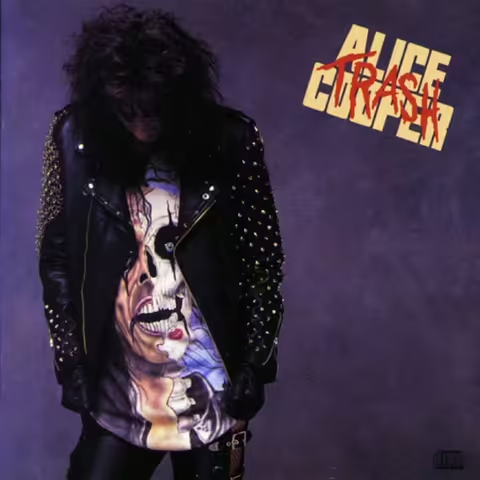
The cover is a stark black-and-white portrait of Cooper, stripped to a leather waistcoat, hair slicked back with sweat, shot in tight close-up against an entirely black background. The album title appears in a single red scrawl across the lower third, the only colour anywhere on the sleeve. The image is closer in design language to a perfume advertisement than to a 1980s metal record, which is exactly what the marketing team wanted. The aesthetic was modelled on the celebrity portraiture coming out of Herb Ritts's Los Angeles studio in the same period; the record was deliberately positioned to sit on the same shelf as the most fashionable pop and rock product of the moment, not the back wall with the rest of the metal section.
Inner-sleeve photography expanded the theme, with shots of Cooper in matching black-and-white setups, the guest musicians credited in a small grid of names rather than featured in pictures. There is no horror imagery anywhere on the packaging. The implied bargain with the listener was clear: this is a glam record, not a shock-rock record, and the cover is going to behave accordingly.
Release and reception
Trash entered the UK Albums Chart at high speed in late summer 1989, peaking at number two in the week of 20 August; it was kept off the top spot by a compilation. In the US it climbed more slowly, eventually reaching number twenty on the Billboard 200, where it stayed inside the top hundred for the best part of six months. It was Cooper's first album to chart inside the US top twenty since 1975's Welcome to My Nightmare.
Critical reception was warmer than Cooper had grown used to. AllMusic's Alex Henderson gave it four stars out of five. Rolling Stone's contemporary verdict was lukewarm but the magazine later placed Trash at number thirty-six on its 2019 list of the fifty greatest hair metal albums of all time. Kerrang! ranked it sixth in its full Cooper discography ranking. MetalSucks placed it seventh in its 2010 list of the ten essential glam metal albums. Trash is, by some distance, the most critically rehabilitated record Cooper made in the 1980s.
International chart action was even stronger than the US numbers suggest. Trash hit number one in Finland, number four in Austria and Norway, number five in Australia, number six in New Zealand and Sweden, and inside the top twenty across Germany, Switzerland and Canada. By the end of 1990 Music & Media's pan-European year-end chart had it at number ninety-nine, a full eighteen months after release.
"The biggest hit among his hair metal albums."
Martin Popoff, The Big Book of Hair Metal, Voyageur Press, 2014
Singles and music videos
| Single | Release | US Hot 100 | UK Singles | B-side | Notes |
|---|---|---|---|---|---|
| Poison | 17 July 1989 | 7 | 2 | Trash | Cooper's first US top ten since 1977; Platinum (UK), Gold (US) |
| Bed of Nails | 25 September 1989 | not charted | top 40 | I Got a Line on You (live) | Marty Callner video |
| House of Fire | November 1989 | 56 | charted | Spark in the Dark | Joe Perry guitar feature |
| Only My Heart Talkin' | April 1990 | 89 | not charted | Trash (live edit) | Released to power-rock radio months after album launch |
The Poison video, directed by Marty Callner, was the visual statement that anchored the campaign. Callner had built the modern hair-metal video grammar with Whitesnake's Here I Go Again and Aerosmith's Dude (Looks Like a Lady), and the Poison clip applies the same playbook: a soundstage performance, a leather-clad Cooper in close-up, a wordless model who appears in the corners of the frame in two recurring shots, and an aggressive cutting rhythm tied to the kick drum. The version that aired on MTV in the day-parts was a sanitised edit; the original cut included a brief nude scene featuring actress Rana Kennedy and a body double, and the daytime version trimmed it out. The original soundstage and surrounding lot in Los Angeles where the video was shot in spring 1989 has since been demolished.
Bed of Nails, House of Fire and Only My Heart Talkin' all received their own promo videos, all of them in heavy MTV rotation for at least one chart cycle each. The Bed of Nails clip leant into the bondage imagery the song was already trading on; House of Fire used a straightforward concert-performance style; Only My Heart Talkin' followed the late-eighties power-ballad template of slow pans and back-lit silhouettes. Together, the four videos kept Cooper on the network's playlist for nearly a year.
Touring: Trashes the World
The Trashes the World tour ran in a near-continuous loop from late 1989 through to spring 1991, taking Cooper across North America, Europe, South America, Australia and Japan. It was the first Cooper tour since the original Welcome to My Nightmare run of 1975 to lean unapologetically into theatrical production at full arena scale: a guillotine, a hangman's gallows, the snake, a giant inflatable spider, costume changes between songs and a backing band led by guitarist Pete Freezin' and bassist Tommy Caradonna. The Bobby Chouinard / Hugh McDonald studio rhythm section did not tour; Chouinard was committed to Squier dates and McDonald, by this point quietly the working Bon Jovi bassist, was unavailable.
Highlights on the tour included a triumphant headline appearance at the 1990 Monsters of Rock festival at Donington Park in the UK, sharing the bill with Whitesnake, Aerosmith, Poison and Thunder; a packed run of European arena shows in early 1990 where Cooper was among the highest-grossing rock touring acts of the year on the continent; and a 1990 stop at the Wembley Arena which was later released on home video as Alice Cooper Trashes the World. South American dates extended into 1991 and bled into early promotion for the Hey Stoopid follow-up.
- Tour name: Trashes the World, late 1989 to spring 1991, roughly seventeen months.
- First leg: North American theatres and arenas, autumn and winter 1989.
- European arena run: spring 1990, including the Wembley Arena show documented on video.
- Festivals: Monsters of Rock at Donington Park, August 1990.
- South America: 1991, Cooper's first continent-wide visit there in over a decade.
- Documented release: Alice Cooper Trashes the World, home video, 1990.
In TV, film and media
Poison became one of the most-licensed Cooper recordings of all time. It anchored the soundtrack to the 1989 buddy-action film Tango and Cash within months of release, returned for The Jackal in 1997, ran under the closing credits of End of Days in 1999, played in Mean Creek in 2004 and surfaced again in Pineapple Express in 2008. A re-recorded version was used in a 2011 Volkswagen Passat television advertising campaign in multiple territories. The song has appeared in episodes of Spartacus: Vengeance, in trailers for at least two video games and in regular rotation on MTV Classic's Metal Mayhem programming block. House of Fire and Bed of Nails have had a quieter sync history; both still appear regularly in 1980s-themed film and television soundtracks.
Controversy and censorship
The Poison video was the principal flashpoint. The presence of a topless model, briefly visible in the original cut, was enough to attract the early Parents Music Resource Center generation of complaint letters; MTV's response was to air the trimmed version during the day and the full one in the late-night Headbangers Ball slot. The album itself was sticker-stickered with a parental advisory warning in the United States, more for the suggestive imagery on Bed of Nails and I'm Your Gun than for anything obviously profane. No territory withdrew or banned the record. The most colourful "controversy" in the public-relations file is a much-circulated Christian-radio campaign in the American Midwest in late 1989, which advised parents that the album cover proved Cooper was now openly recruiting children to the dark arts, and which Cooper's press office happily quoted in interviews to drive curiosity sales.
Covers, samples and tributes
Poison has been covered more often than anything else in the Cooper catalogue from this period. The pop-punk band The Vandals took it on in 1993; Tarja Turunen, after leaving Nightwish, recorded a symphonic version in 2007; Powerwolf put out a tribute reading in 2023 to mark Cooper's seventy-fifth birthday; Exit Eden included it on the 2024 Femmes Fatales covers album. Husky Rescue's 2007 indie reinterpretation is the most stylistically distant. The Vandals version is the most aggressive. Robert Fripp and his wife Toyah Willcox cut a domestic-lockdown video performance of the song in 2021 that became one of the most-watched entries in their cottage-industry YouTube series.
Trash has been name-checked as a formative influence by Avenged Sevenfold, In This Moment, Halestorm and Steel Panther, all of whom have either covered Cooper songs from the period live or referenced the album in interviews. The wider impact has been more atmospheric than direct: the late-eighties production language Child codified on Trash carried into the early-nineties albums by Skid Row, Trixter, Vince Neil's solo Exposed and the Bon Jovi-adjacent satellite acts. Trash itself sampled nothing of consequence; Child's preferred working method was original composition end to end.
Reissues, remasters and anniversaries
Trash was reissued on remastered CD in 2002 as part of Epic's catalogue refresh of Cooper's late-eighties run, with new sleeve notes and the cover restored to its original layout. A 180-gram vinyl pressing followed in the late 2010s as part of the Music On Vinyl reissue programme. A twenty-fifth-anniversary edition appeared in 2014 as a limited-run product across European territories, repackaging the original album with a small selection of bonus tracks drawn from B-sides and promo edits, but without the full archival treatment the period record typically receives.
There has been no full deluxe box of the Child sessions, no separate disc of demos and outtakes, and no remix of the album in spatial audio at the time of writing. Bootleg copies of working mixes and rough vocal takes from the Bearsville sessions have circulated quietly among collectors for decades but have never been formally released. Cooper, asked in interviews several times whether a fortieth-anniversary deluxe edition is in planning for 2029, has hedged: the master tapes exist, the demand exists, the archival economics of his late-eighties catalogue remain less certain.
Legacy and influence
Trash is now generally treated as the moment Cooper's career restarted for its second long phase. The follow-up, Hey Stoopid, kept the Child template, kept many of the same guests and reached its own commercial peak. The Last Temptation in 1994 marked Cooper's deliberate exit from the glam-metal sound he had momentarily owned; everything after, from Brutal Planet in 2000 through to Detroit Stories in 2021 and Road in 2023, treats Trash as the door he passed through to get back to the wider rock audience.
Critically, the album sits awkwardly in retrospective consensus. The contemporary rock press dismissed it at the time as a bandwagon move; the hair-metal nostalgia industry of the 2010s reclaimed it as a touchstone; serious Cooper scholarship has tended to file it between the more respected concept records of his 1970s peak and the more idiosyncratic late-period releases. Rolling Stone's 2019 hair-metal list ranking, Kerrang's catalogue ranking and MetalSucks's essential glam ten all agree on a similar conclusion: Trash is the most commercially important record Cooper made in his entire solo career, even if it is not necessarily the best.
The wider cultural footprint has outlived the album sales. Poison is now a karaoke standard, a sports-arena interlude staple, a Halloween-playlist fixture and one of perhaps fifteen songs that defined American rock radio's last great power-ballad-adjacent year. The Trashes the World tour established the modern Cooper live show, with its theatrical interludes and full-band glam aesthetic, in a form that Cooper continues to tour with a generation later. If the joke about Cooper is that he has been writing his own first comeback album since 1989, the answer is that he has never had to write a second one. Trash worked.
Things you might not know
| Fact | Detail |
|---|---|
| The Poison riff's first life | John McCurry originally cut the riff for John Waite's track Encircled on the 1987 Rover's Return album, where it sat largely unnoticed until McCurry recycled it for the Trash sessions. |
| The studio count | Trash was recorded across roughly eleven studios in roughly six weeks, the sprawl driven entirely by guest-musician diary management rather than artistic choice. |
| The first US top ten in twelve years | Poison's peak at number seven on the Billboard Hot 100 was Cooper's first top ten US single since You and Me reached number nine in summer 1977. |
| The borrowed rhythm section | Drummer Bobby Chouinard and keyboardist Alan St. John were both members of Billy Squier's solo band, lent to Cooper for the duration of the album. |
| The bassist who became a Bon Jovi member | Hugh McDonald, the studio bassist on Trash, had already been ghosting bass on Bon Jovi records since Slippery When Wet in 1986 and would be made a permanent member of Bon Jovi from 1994. |
| The Aerosmith count | Four of the five members of Aerosmith play or sing on Trash. Only rhythm guitarist Brad Whitford does not appear anywhere on the record. |
| The Joan Jett donation | House of Fire was originally being workshopped for Jett's own next album before Desmond Child suggested it would suit Cooper better; she kept the writing credit. |
| The Diane Warren one-off | Bed of Nails is the only Cooper song Diane Warren has ever co-written, a single instance from a career that has otherwise centred on power ballads for Aerosmith, Cher, Celine Dion and the soundtrack market. |
| The cover scrawl | The album's red Trash logotype is the only flash of colour anywhere on the original sleeve; everything else, including the inner-sleeve credit grid, is monochrome. |
| The Tango and Cash sync | Poison was licensed for Tango and Cash within four months of release; the cheque was the first significant sync-licence income of Cooper's solo career. |
| The video edit | The Poison music video exists in two cuts; the original includes a brief topless scene featuring a body double for actress Rana Kennedy, and the daytime MTV edit trims it. |
| The Christian-radio backlash | A Midwest-American Christian-radio campaign in late 1989 claimed the album cover proved Cooper was recruiting children to the occult; his press office reportedly quoted the complaint in interviews to drive sales. |
| The drummer's later fate | Bobby Chouinard, the album's drummer, died of a cocaine-related heart attack in February 1997 aged forty-three; Cooper, who has been sober since 1983, paid tribute to him as one of the most underrated rock drummers of the era. |
| The Wembley document | The Trashes the World home video, released in 1990, was edited primarily from the spring 1990 Wembley Arena show on the European leg of the tour. |
| The follow-up reunion | Desmond Child returned to produce most of 1991's Hey Stoopid and brought back several of the Trash guests, including Joe Satriani, Slash and Steve Vai in place of Joe Perry and Richie Sambora. |
"It is the closest I have come to making another Billion Dollar Babies in terms of quality and commercial appeal."
Alice Cooper, interview, RAW magazine, July 1989
Listen to more on the Riffology podcast
The Riffology podcast goes deeper into the records that shaped rock and metal, from the genre-defining albums of the 1970s to the comeback stories that reshaped the 1980s and 1990s. Episodes cover the sessions, the personnel, the fights and the chart battles, and are available on Apple Podcasts, Spotify, Amazon Music and every other major podcast platform.
Comments