Kirk Hammett boarded a flight from San Francisco to JFK in late April 1983 with a Walkman, a cassette of Dave Mustaine's guitar parts and four days to learn ten songs. He had been in Metallica for less than a week. He had never met two of the men he was about to fly across America to record an album with, and the one he had met, James Hetfield, was barely speaking to anyone after a sleepless night driving a U-Haul from El Cerrito to Jamaica, Queens. Mustaine, the guitarist Hammett was replacing, was at that moment somewhere in Pennsylvania on a Greyhound bus, sacked four days earlier with a one-way ticket and no warning.
Kill 'Em All was made in the seventeen days that followed, at a barely-equipped Rochester studio called Music America, on $15,000 of mortgage money belonging to a New Jersey record-shop owner who had never released an album in his life. It would not chart anywhere on release, would not be certified gold in the United States for fifteen years, and would invent an entire genre.
| Field | Detail |
|---|---|
| Artist | Metallica |
| Album | Kill 'Em All |
| Release date | 25 July 1983 |
| Label | Megaforce Records (US/Canada via Relativity); Music for Nations (Europe) |
| Producer | Paul Curcio |
| Studio | Music America Studios, Rochester, New York |
| Genre | Thrash metal, speed metal |
| Track count | 10 |
| Total runtime | 51:20 |
| Billboard 200 peak | 120 (1988 Elektra reissue); 155 (original, charted 1986) |
| UK Albums Chart peak | Did not chart on release |
| Other notable peaks | Finland 12, German Albums 17 (vinyl reissue, 2023), Polish Albums 13 |
| Certifications | RIAA 4× Platinum (US); ARIA 2× Platinum (Australia); BPI Gold (UK); BVMI Gold (Germany) |
| Estimated sales | 4.5 million (US); ~6 million worldwide |
| Key singles | Whiplash; Jump in the Fire |
Cultural context
Heavy music in the first half of 1983 was British, expensive, and on the radio. Def Leppard's Pyromania had landed in March from Mutt Lange's Battery Studios sessions in Dublin and Stockholm at a reported cost of nearly half a million dollars, with Rick Allen's drums punched in one hit at a time and Lange demanding hundreds of takes of vocal stacks. Iron Maiden's Piece of Mind, with Nicko McBrain newly installed behind the kit, was out in May. Quiet Riot were weeks from releasing Metal Health. Ozzy Osbourne was preparing Bark at the Moon. Glam metal was about to walk into the mainstream wearing Aqua Net and white spandex.
Punk had splintered into hardcore. The British New Wave of Heavy Metal that Metallica grew up taping off late-night radio - Diamond Head, Angel Witch, Tygers of Pan Tang, Sweet Savage - was already eating itself, with most of its key bands either signed to majors who didn't know what to do with them or back working day jobs. The Bay Area scene the band had moved to that February was a few small clubs, a tape-trading network, and a couple of fanzines. There was no thrash metal yet. The word existed - Anthrax's Scott Ian and Kerrang!'s Geoff Barton had both used it in print earlier in the year - but the records didn't.
Three weeks before Metallica entered Music America Studios, the British charts were topped by Spandau Ballet's True. Three weeks after they came out, the American charts were topped by The Police's Synchronicity. Nothing in the commercial music environment of mid-1983 wanted what Metallica had brought to Rochester. Within five years, it would.
The band's story up to this point
Lars Ulrich's Recycler classified, placed in early 1981, asked for musicians who liked Diamond Head, Iron Maiden and Tygers of Pan Tang. James Hetfield answered it. The version of the band that emerged in Norwalk, California a few months later was sketchy: Hetfield on guitar and vocals, Ulrich on a drum kit he could only just play, Hetfield's childhood friend Ron McGovney on bass, and Dave Mustaine, a Huntington Beach guitarist they recruited via newspaper ad who could play circles around all of them. Their first gig was at the Radio City club in Anaheim on 14 March 1982. Two-thirds of the setlist was NWOBHM covers.
The No Life 'til Leather demo, recorded that July, did the impossible. Through the tape-trading underground it travelled from Norwalk to New Jersey, where it landed on the desk of a record-shop owner called Jon Zazula. "Jonny Z" had been promoting heavy metal gigs at the Old Bridge Metal House and selling imports out of a flea-market stall. He invited the band to drive across the country in a rented U-Haul on the promise that he would fund their debut album. They arrived in late March 1983.
McGovney had already gone, replaced in December 1982 by Cliff Burton, a long-haired bassist Ulrich had seen with the band Trauma at The Troubadour in West Hollywood. "We heard this wild solo going on," Hetfield later told Mick Wall, "and thought, 'I don't see any guitar player up there.' We were both counting the strings and I finally turned to Lars and said, 'Dude, that's a bass!'" Burton accepted on one condition: Metallica had to move to the Bay Area. They did, settling in February 1983 in a rented house in El Cerrito belonging to Exodus manager Mark Whitaker, immediately christened "the Metallica Mansion".
Mustaine made it as far as 11 April 1983. After a gig in New York the night before, Hetfield and Ulrich woke him in the apartment they were sharing and told him he was out, citing drug and alcohol problems and his habit of starting fights with bandmates. They handed him a bus ticket. He spent the next four days on a Greyhound back to Los Angeles, plotting Megadeth. On Whitaker's recommendation, Metallica recruited Kirk Hammett from Exodus. Hammett had been a guitar student of Joe Satriani in Berkeley. He took a phone call, flew to New York, and started recording about a month later.
Pre-production and demos
Most of the songs on Kill 'Em All were already old by the time tape rolled. The 1982 No Life 'til Leather demo contains recognisable, faster-than-published versions of seven of the ten tracks: "Hit the Lights", "The Mechanix" (later "The Four Horsemen"), "Motorbreath", "Seek & Destroy", "Metal Militia", "Jump in the Fire" and "Phantom Lord". The earlier Power Metal demo from April 1982 had added "Motorbreath". "Hit the Lights" predated all of it: Hetfield had written most of it in his teenage band Leather Charm with school friend Hugh Tanner before Metallica even existed, and a version with Lloyd Grant on lead guitar had appeared on Brian Slagel's Metal Massacre compilation in mid-1982 - Ulrich's drumming on that take was considered weak enough that the song was re-recorded for the second pressing.
The original recording plan was for an $8,000 budget on Slagel's Los Angeles independent Metal Blade. Slagel could not afford it. Ulrich's call to Zazula in early 1983 was the back-up. By the time the band were in New Jersey, Zazula was telling them he had no label to put it out on either, which is when Megaforce Records was effectively invented as a vehicle for this one record. To keep the band alive until sessions began, Zazula let them sell copies of No Life 'til Leather by hand at his shop.
The working title at this point was not Kill 'Em All. It was Metal Up Your Ass, with a planned cover by Gary L. Heard showing a hand thrusting a dagger up out of a toilet bowl. The phrase had been used as the title of a 1982 bootleg of a Metallica show at San Francisco's Old Waldorf. The band loved it.
Creating the album
Music America Studios on Lake Avenue in Rochester was not a metal studio. Paul Curcio had run it since the late 1960s; his most famous credit was a stint as guitarist with the Bay Area psych band Mojo Men in 1966, and the studio's regular work was local rock acts, jingles and the occasional Grateful Dead-adjacent session. Curcio took the Metallica gig because Zazula offered it and the dates fit. He had no experience producing this kind of music. He had little interest in producing this kind of music. The band had no money for anywhere else.
Sessions ran from 10 to 27 May 1983 - seventeen days, including mixing. With no budget for accommodation, the band slept on floors in friends-of-friends' houses around Rochester and at the Music Building in Jamaica, Queens, where Anthrax also rehearsed. They drove a battered rented car back and forth.
The clash with Curcio was immediate and almost entirely about distortion. Curcio set the desk up as he would for a working rock band - moderate gain, room for the vocal, no instrument running so hot it lost definition. The tapes came back sounding, to his ear, broken. He quietly turned the guitar amp knobs down. Hetfield turned them back up. The cycle repeated until Curcio gave up trying. "When we came to mixing," Curcio said in a 2018 Billboard interview, "I didn't have them in the control room a few times because they were reaching over the engineer and grabbing the control knobs and just getting in the way. So I locked them out of the control room. My son always tells me that I was mean to them. I wasn't mean; I was trying to get the album done."
The bulk of the studio relationship therefore ran through engineer Chris Bubacz, with Andy Wroblewski as assistant. Burton's bass was tracked through his usual chain of a Rickenbacker 4001 into an Electro-Harmonix Big Muff and a Morley wah. Hetfield's rhythm guitar was a Gibson Flying V into a Marshall, cranked. Hammett used his Gibson Flying V and was instructed by Zazula to copy Mustaine's solos as far as possible. He didn't, quite - the first four bars of most solos remain Mustaine's, but the rest are Hammett's own improvisations from the floor of Music America, tracked in single days per solo.
Burton tracked "(Anesthesia) - Pulling Teeth" alone in an empty live room after about twenty minutes of preparation, in a single take. Bubacz can be heard on the recording introducing it: "Bass solo, take one." Burton had reportedly insisted on tracking it without the rest of the band or Curcio in the building.
When tracking finished, Zazula listened to the rough mix and hated it. He thought Lars's drums were too loud and the guitars too quiet - the opposite of what most listeners would later describe. Bubacz remixed the record under Zazula's direction. The band were not present. The whole package - tape, studio time, mastering at Jack Skinner's room in New York, the lot - came in at roughly $15,000. "This was mortgage money I'm spending," Zazula said years later, "not something I've got put by I'm going to invest."
"This was mortgage money I'm spending, not something I've got put by I'm going to invest."
Jon Zazula, quoted in Mick Wall's Enter Night, 2010
Personnel and credits
| Role | Player | Notes |
|---|---|---|
| Core band | ||
| Rhythm guitar, lead vocals | James Hetfield | Gibson Flying V into a Marshall. Wrote or co-wrote every track except "(Anesthesia)". |
| Drums | Lars Ulrich | Ride-cymbal-heavy style; the double-time snare pattern across "Whiplash" and "Metal Militia" became a Metallica signature. |
| Bass | Cliff Burton | Rickenbacker 4001 through Big Muff and Morley wah. Sole composer of "(Anesthesia) - Pulling Teeth". |
| Lead guitar | Kirk Hammett | Joined days before recording. First four bars of most solos retained from Mustaine's parts; the rest improvised at Music America. |
| Songwriting (credited but absent from the record) | ||
| Co-writer, four tracks | Dave Mustaine | Credited on "The Four Horsemen", "Jump in the Fire", "Phantom Lord" and "Metal Militia". Fired 11 April 1983. |
| Co-writer, "Hit the Lights" | Hugh Tanner | Hetfield's Leather Charm bandmate, on the Metal Massacre version only; credit dropped on the album. |
| Production and engineering | ||
| Producer | Paul Curcio | Owner of Music America. Famously turned the distortion down when Hetfield wasn't looking. |
| Executive producer | Jon Zazula | Funded the $15,000 budget; supervised the remix when he hated the first one. |
| Engineer | Chris Bubacz | Tracked and remixed the album; speaks the "Bass solo, take one" intro on "(Anesthesia)". |
| Assistant engineer | Andy Wroblewski | |
| Mastering | Jack Skinner | Original 1983 mastering, New York. |
| Mastering (1988 Elektra reissue) | Bob Ludwig | |
| Mastering (1995 remaster) | George Marino | Sterling Sound, New York. |
| Mastering (2016 remaster) | Howie Weinberg | Source for the deluxe box-set reissue. |
| Artwork | ||
| Front and back cover photography | Gary L. Heard | The bloodied hammer was Cliff Burton's own, brought from the house. |
| Inner sleeve photographs | Kevin Hodapp | |
| Graphics, design and layout | Shari and Harold Risch | |
The most consequential name on that table is the one whose hands never touched the multitrack. Mustaine's four co-writing credits - "The Four Horsemen", "Jump in the Fire", "Phantom Lord" and "Metal Militia" - meant that four of the ten songs on the album owe their riffs to a guitarist who had been on a Greyhound bus when the tapes were rolling. Hammett's job was effectively part covers band, part improvisation: Zazula initially asked him to copy Mustaine's solos note-for-note for legal cleanliness; he split the difference, keeping the openings and reworking the rest.
The songs
| # | Title | Writer(s) | Length | Single? | Notes |
|---|---|---|---|---|---|
| 1 | Hit the Lights | Hetfield, Ulrich | 4:17 | Re-recorded from the Metal Massacre version. Opening fade-in, 160 bpm. | |
| 2 | The Four Horsemen | Hetfield, Ulrich, Mustaine | 7:13 | Reworked from Mustaine's "The Mechanix"; bridge said by Mustaine to be inspired by "Sweet Home Alabama". | |
| 3 | Motorbreath | Hetfield | 3:08 | Hetfield-only writing credit, dating back to Leather Charm. | |
| 4 | Jump in the Fire | Hetfield, Ulrich, Mustaine | 4:41 | Yes (UK EP, Jan 1984) | First song Mustaine ever wrote, originally about teenage sex; Hetfield rewrote it from Satan's point of view. |
| 5 | (Anesthesia) - Pulling Teeth | Burton | 4:14 | Burton bass solo, tracked alone in one take after twenty minutes of preparation. | |
| 6 | Whiplash | Hetfield, Ulrich | 4:08 | Yes (Aug 1983) | Straight 16ths at ~200 bpm. Mick Wall called it "the very moment thrash metal arrived". |
| 7 | Phantom Lord | Hetfield, Ulrich, Mustaine | 5:01 | Opens with a synth-bass drone; clean arpeggiated middle section. | |
| 8 | No Remorse | Hetfield, Ulrich | 6:26 | Mid-tempo song that abruptly doubles in tempo around the five-minute mark. | |
| 9 | Seek & Destroy | Hetfield, Ulrich | 6:54 | First song tracked for the album. Riff written by Hetfield in his truck outside a Los Angeles sticker factory. | |
| 10 | Metal Militia | Hetfield, Ulrich, Mustaine | 5:11 | One of the fastest tracks. Closes with marching footsteps and bullet ricochets. |
"Hit the Lights" was the song Metallica wanted the world to hear first, and the song the album opens with - a fade-in of distorted guitars built deliberately to sound like a stage going hot. Hetfield's lyric is metal as identity: "no life till leather, we are gonna kick some ass". Hammett's lead is one of the more melodic on the album, reflecting his stated wish to "really be flashy" on his first recorded appearance with the band.
"The Four Horsemen" is the album's centrepiece and its most awkward credit. It is a thorough rewrite of Mustaine's "The Mechanix" - originally a sniggering double-entendre about an auto mechanic and a one-night stand, performed at twice the speed. Hetfield slowed it, added a clean-picked middle section, and replaced the lyric with apocalyptic-horsemen imagery. Mustaine told Metallica not to use any of his music; they used it anyway. He later put his original "Mechanix" on Megadeth's Killing Is My Business... and Business Is Good! in 1985, at his speed, with his lyric, in part to make a point.
"Motorbreath" is the lone Hetfield-only writing credit on the album. A two-and-a-half-minute road song built on a four-chord verse and stop-start chorus, it dates back to Leather Charm and survives mostly for Ulrich's tom rolls into each chorus and the riff that locks around Hammett's solo.
"Jump in the Fire" was the first song Mustaine ever wrote, a teenage lyric about sex carried over from his pre-Metallica band Panic. Hetfield rewrote it from Satan's perspective, watching humans kill each other and confident they will end up in hell. Mustaine has since traced the original lyric and "Mechanix" to a reaction against his mother's Jehovah's Witness upbringing: "That kind of stuff really affected the way my myopic of the world and the prism that I saw it through." The song became the album's only single after "Whiplash", reissued as a UK EP in January 1984 to promote a tour with Venom.
"(Anesthesia) - Pulling Teeth" is the bass solo that got Burton into the band. He had been playing a version of it live with Trauma since high school in his earlier band Agents of Misfortune; it was the piece he was playing the night Ulrich and Hetfield first saw him. On the album it sits between sides one and two of the original vinyl, in an empty room of Music America Studios, with Ulrich's drums brought in halfway through. The "Bass solo, take one" introduction is Chris Bubacz speaking the slate. Burton refused to track it with anyone else present. It is, by some distance, the first wah-pedal bass solo ever to appear on a major-distributed metal record.
"Whiplash" is the track Lars Ulrich points to when asked when thrash metal became a thing. Sixteenth notes at roughly 200 beats per minute, palm-muted with metronomic precision, lyrics about a Metallica gig pit ("adrenaline starts to flow, you're thrashing all around, acting like a maniac"). Rock journalist Mick Wall's verdict has become the standard one: "If one wishes to identify the very moment thrash metal arrived spitting and snarling into the world, 'Whiplash' is indisputably it." The chorus tag "because we're Metallica" is the band's first recorded use of their own name as a self-mythologising trademark.
"If one wishes to identify the very moment thrash metal arrived spitting and snarling into the world, 'Whiplash' is indisputably it."
Mick Wall, Enter Night, 2010
"Phantom Lord" opens with a synthesised bass drone, the most overtly NWOBHM-derived moment on the album. Mustaine's central riff sits in the lineage of Diamond Head and Angel Witch; the clean arpeggiated middle section is one of the album's two pieces of dynamic relief.
"No Remorse" is the slow-burn cut, a mid-tempo grinder that abruptly accelerates around the five-minute mark into a sprint. Of all the songs on Kill 'Em All, this one received the most reworking in the studio to match the rest of the record's tempo and aggression.
"Seek & Destroy" was the first song tracked for the album. Hetfield wrote the main riff in his truck, parked outside the 3M sticker factory in Los Angeles where he was working a day job in his late teens. The opening was inspired by Diamond Head's "Dead Reckoning"; the simple, two-word chorus was deliberately built as a crowd singalong. The strategy worked: it has been Metallica's standard live set-closer since 2004 and has been performed live more times than any other song in the band's catalogue.
"Metal Militia" closes the album with one of its fastest tempos and the closest thing the record has to a manifesto: a band of misfits, set against the world, looking after their own. The marching footsteps that bring the album to a close are the four members of Metallica stomping in unison around the Music America car park, recorded with a microphone pointed at the asphalt. Bullet-ricochet sound effects were dubbed in for the fade. The phrase "metal militia" itself became one of the most quoted band-to-fan slogans of the decade.
B-sides, outtakes and lost songs
Megaforce's bare-bones release schedule and the speed of the sessions meant Kill 'Em All generated almost no studio offcuts. There are no album-era outtakes in commercial release: the band tracked exactly the ten songs they had and got out. What the album does have, as an offshoot, is the strange parallel B-side life of "Jump in the Fire".
- Jump in the Fire EP (UK, 20 January 1984): Released by Music for Nations to promote the Seven Dates of Hell tour with Venom. The B-side featured "Phantom Lord" and "Seek & Destroy" as "live tracks" - except they weren't. They were the studio recordings from Kill 'Em All with fake crowd noise dubbed over the top, a fact admitted years later. The sleeve carried an oil painting, The Devils of D-Day, by artist Les Edwards, painted in 1978.
- "Am I Evil?" and "Blitzkrieg": The Diamond Head and Blitzkrieg covers that Metallica had been playing live since 1982 were tracked properly the following year as B-sides for the "Creeping Death" single. From 1988 they were attached to Kill 'Em All reissues as bonus tracks, and from 1998 collected on Garage Inc. They are not strictly Kill 'Em All material, but they are the closest the album has to a B-side legacy.
- The shelved No Life 'til Leather re-record: In 2015 Metallica announced and then quietly de-emphasised plans for an official cassette reissue of the 1982 demo, partly because the band itself, partly Mustaine's estate of credits, made it legally awkward. Bootleg copies of the demo remain the most widely circulated piece of pre-album Metallica audio.
Album artwork and packaging
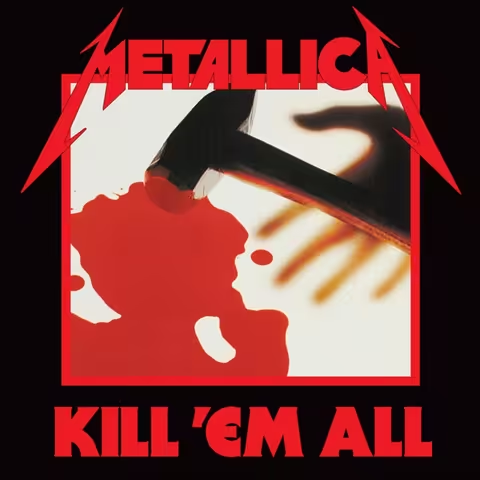
The cover that exists - the shadow of a hand letting go of a bloodied hammer in a bright red pool, black border, red Metallica logo - is the result of distributors refusing the cover that didn't. Metal Up Your Ass, as originally planned, was to feature a hand thrusting a dagger out of a toilet bowl. Zazula was told by every distributor he approached that no chain would stock the record with that title and that art. The band held out until Burton snapped during a meeting at Zazula's house: "Those record company fuckers... kill 'em all!" Ulrich, who had been quietly looking for an exit, immediately said it was a great name. Zazula agreed. The toilet was out, the hammer was in.
The hammer itself belonged to Burton. He carried it with him most places. "Cliff carried a hammer with him everywhere he went," Hammett told MusicRadar in 2008. "He always had a hammer in his luggage, and he would take it out occasionally and start destroying things." For the cover shoot Burton handed it to Gary L. Heard, who photographed it lying in a pool of theatrical blood. The shadow of the hand letting go of it was Heard's idea. The original pressing's inner sleeve carried lyrics and photographs and a silver record label; subsequent pressings replaced it with a blank white sleeve before the 1988 Elektra reissue reinstated the artwork. Every issue of the album, original or reissue, carries the phrase "Bang That Head That Doesn't Bang" - a dedication to San Francisco fan Rich Burch, a regular at the band's earliest Bay Area shows, known for headbanging hard enough to draw blood.
The proposed "Metal Up Your Ass" art was not entirely lost. The band sold T-shirts featuring the toilet-and-dagger image for years, and the bootleg of the band's 1982 Old Waldorf show, titled Metal Up Your Ass (Live), used it as a sleeve.
Release and reception
The album was issued on 25 July 1983, with an initial pressing of 15,000 copies stamped in batches of 500 because Megaforce could not afford a single bigger run. Distribution in the US and Canada went through Relativity Records, the only American distributor Zazula could persuade to take it; Music for Nations took the European rights. By the end of 1983 it had sold around 17,000 copies in the US. By the end of the Seven Dates of Hell European tour in spring 1984 it had passed 60,000 worldwide.
Contemporary reviews were better than the sales suggested. Bernard Doe in Metal Forces gave it 10/10 in August 1983 and called it one of the fastest and heaviest records ever made. Greg Kot in the Chicago Tribune later described it as "the speed metal prototype". Kerrang! reviewed it positively when it arrived in the UK. Mainstream rock press largely ignored it. Rolling Stone did not file a review until 1989, when the magazine retrospectively included the album at number 35 on its 100 Best Albums of the Eighties list. AllMusic's Steve Huey would later call it "the true birth of thrash" and praise Hetfield for "playing with tightly controlled fury even at the most ridiculously fast tempos".
"The true birth of thrash... playing with tightly controlled fury even at the most ridiculously fast tempos."
Steve Huey, AllMusic, retrospective review
The chart history is one of the strangest in rock. Kill 'Em All did not enter the Billboard 200 on release. It did not enter the Billboard 200 at all until 1986, when the success of Master of Puppets pulled it up to number 155 from the back catalogue. The 1988 Elektra reissue, with the "Am I Evil?" and "Blitzkrieg" bonus tracks, took it up to number 120. It would take until 1999 for the RIAA to certify it 3× Platinum, and until 2025 for it to reach 4× Platinum at roughly 4.5 million US copies. Worldwide sales are now estimated at around six million.
Retrospective accolades have been generous. Beyond the Rolling Stone 80s list, the magazine later ranked it 54th on its 100 Best Debut Albums of All Time and 35th on its 100 Greatest Metal Albums of All Time. Kerrang! placed it 29th on its 100 Greatest Heavy Metal Albums of All Time. Pitchfork's 2016 reissue review scored it 8.6/10.
Singles and music videos
Two singles came off the album, both small-format affairs, both more interesting than their chart impact suggests.
| Single | Released | Format | B-sides | Notes |
|---|---|---|---|---|
| Whiplash | 8 August 1983 | 7-inch / 12-inch (US, Megaforce) | Live versions on later 12-inch reissues | The first Metallica single under their own name. No promotional video was made. |
| Jump in the Fire (EP) | 20 January 1984 (UK) | 7-inch / 12-inch (UK, Music for Nations) | "Phantom Lord" and "Seek & Destroy" - studio cuts with dubbed crowd noise passed off as live | Sleeve: Les Edwards's 1978 oil painting The Devils of D-Day. Issued three days later in the US. |
There were no contemporaneous music videos. Metallica's first official promo clip would not arrive until "One" in 1989. MTV's first regular play of any Kill 'Em All material came retrospectively, via the 1985 Cliff 'Em All home-video compilation. The band's promotion of the record was almost entirely physical: tapes mailed to fanzines, gigs played in tiny clubs, and Zazula working the phones from a New Jersey kitchen table.
Touring and live
The Kill 'Em All for One tour ran from late July 1983 to early September 1983 - roughly two months, US only, co-headlined with the British heavy metal band Raven, whose own album All for One Megaforce was releasing at the same time. Both bands and a crew of five travelled together in a single Winnebago, with Mark Whitaker doing sound. Hetfield painted "No Life 'til Frisco" along the side of the bus before the run wrapped with three Bay Area shows. Attendance varied wildly. A show at the Cheers club in Babylon, New York, drew around fifty people. A show at the Stone in San Francisco came close to selling out.
The European leg came in February and March 1984 as Seven Dates of Hell, supporting Venom across the continent, with Twisted Sister also on the bill. The first show was at the Volkshaus in Zurich on 3 February. The Aardschok Festival in Zwolle, Holland, on 11 February drew 7,000 people - by some distance the largest audience Metallica had played to. The tour finished with two sold-out shows at London's Marquee Club. The tour also produced the Jump in the Fire EP, designed to give the British arm of the band's distribution something to sell on the merch table.
Other notable live moments from the album's lifetime:
- The cancelled Boston gig on 14 January 1984 - the band's equipment was stolen the night before from a Boston parking lot, and most of Ride the Lightning's working tapes went with it.
- A short Midwest and East Coast US tour in December 1983 with a three-man crew (Whitaker, John Marshall on guitar tech, Dave Marrs on drum tech).
- The first live debut of "Fight Fire with Fire", "Creeping Death" and an early "Call of Ktulu" at the Country Club in Reseda, California, in autumn 1983 - all songs that would shape Ride the Lightning.
- The Orion Festival in Detroit on 8 June 2013, where Metallica played Kill 'Em All in its entirety for the first time, billed as the fictional opening act "Dehaan", to mark the album's 30th anniversary.
In TV, film and media
Tracks from Kill 'Em All have outlived the album's first commercial run by some distance through sync use. "Seek & Destroy" is the most-used by a margin: it has been a recurring sports anthem (NHL, NFL and MLB walk-out music for multiple teams), appeared in films including Bad Lieutenant: Port of Call New Orleans and Zombieland, and been used in video games from Guitar Hero to Tony Hawk's American Wasteland. "Whiplash" appears in the Beavis and Butt-Head 2022 film and as a playable track in Guitar Hero: Metallica. "The Four Horsemen" was Metallica's first contribution to Rock Band. "Hit the Lights" features prominently in This Is Spinal Tap's spiritual successor, the 2003 mockumentary School of Rock, in a montage scene. None of these placements were chased; all came to the band.
Controversy, censorship and lawsuits
The two genuine flashpoints were both about Dave Mustaine. The first was the title and cover negotiation in spring 1983: Zazula and the band only reached agreement on dropping Metal Up Your Ass because there was a real risk the album would be unstockable. The second, longer-running, was Mustaine's compositional credit on "The Four Horsemen". Mustaine has spoken publicly for forty years about Metallica recording his music after telling them not to, has re-recorded the original "Mechanix" multiple times with Megadeth, and used the dispute as part of the structural rivalry that defines both bands' early years.
Censorship was minimal. Kill 'Em All was released two years before Tipper Gore's PMRC hearings, so no Parental Advisory sticker. The album's lyrics carry no overt obscenity, even where the imagery is violent or Satanic, and no major chain pulled it from shelves. The 1988 Elektra reissue, which added the Diamond Head cover "Am I Evil?", briefly attracted attention from a small group of US religious organisations who pointed at the song title, but no boycott of any consequence followed. There is a long-running underground rumour that an early American radio promo of "Jump in the Fire" was rejected by several stations on the grounds of "Satanic content"; nobody has ever produced a documented example.
Covers, samples and tributes
Kill 'Em All's songs have been covered widely, although less so than the post-1984 catalogue.
- Motorhead covered "Whiplash" for the 2005 Metallica tribute album Metallic Attack: The Ultimate Tribute; that version won a Grammy for Best Metal Performance in 2005, ironically Motorhead's only Grammy for a song they did not write.
- Megadeth have effectively been "covering" "The Four Horsemen" since 1985, in the form of Mustaine's parallel-universe "Mechanix" - the lyrically pre-rewrite, faster version of the same song.
- Anthrax opened their 2016 European tour set with a Cliff Burton tribute including a snatch of "(Anesthesia) - Pulling Teeth".
- Apocalyptica's 1996 debut Plays Metallica by Four Cellos included "Seek & Destroy".
- The Bay Area thrash scene Metallica had moved into - Exodus, Possessed, Death Angel, Testament - cited Kill 'Em All as the moment their own demos found a commercial precedent. Kerry King of Slayer has said the album made clear that the band were "still finding our sound" while Metallica had already arrived at theirs.
What Kill 'Em All itself sampled or interpolated is harder to pin down because nothing on the record uses samples in the modern sense. Mustaine has said the middle bridge of "The Four Horsemen" was inspired by the main riff of Lynyrd Skynyrd's "Sweet Home Alabama" - an interpolation rather than a sample, but a startling one if you go looking for it. "Seek & Destroy"'s opening lifts the cadence of Diamond Head's "Dead Reckoning". "Hit the Lights" carries echoes of Hetfield and Tanner's Leather Charm material that has never been released in finished form.
Reissues, remasters and anniversaries
For a record that took fifteen years to go gold in the US, Kill 'Em All has been reissued an enormous number of times.
- 1988 Elektra reissue: Reinstated lyrics and inner-sleeve photographs, added live versions of "Am I Evil?" and "Blitzkrieg" as bonus tracks, mastered by Bob Ludwig. The version most American fans now know.
- 1995 remaster: George Marino at Sterling Sound, New York. Released through Elektra as part of a wider Metallica catalogue refresh.
- 2016 Remastered Deluxe Box Set: The big one. Howie Weinberg remaster of the original 10-track album on vinyl and CD, plus a picture disc of the Jump in the Fire EP tracklist, four CDs of interviews, rough mixes and live recordings from 1983 to 1984, and a DVD of a 1983 Chicago Metro show. The most archival release Metallica have ever issued for this record.
- 2016 standalone remaster: The Weinberg remaster also issued as a standard single-CD and single-vinyl edition for the general market.
- 40th anniversary (2023): A limited-edition red marbled vinyl reissue saw German Album chart re-entries at number 17 and Polish chart placements in the top 20. No new audio was created for the anniversary.
Bootlegs in active circulation include the original Metal Up Your Ass (Live) tape from the 1982 Old Waldorf show, multiple early-pressing white-label test pressings of the Megaforce vinyl, and unmastered rough mixes attributed to Chris Bubacz that circulate among collectors. None has been issued officially in their unedited form.
Legacy and influence
The four men who recorded Kill 'Em All made one more album as a unit. Metallica returned to El Cerrito within weeks of the Kill 'Em All for One tour wrapping in September 1983, began writing what would become Ride the Lightning in their rehearsal room, and recorded it at Sweet Silence Studios in Copenhagen with Flemming Rasmussen in early 1984. Ride the Lightning remains the closest Metallica ever came to a sequel to Kill 'Em All in spirit: same lineup, same speed, but with the production budget the debut had been denied. Master of Puppets in 1986 turned them into headliners. Burton's death on 27 September 1986 in a tour-bus accident in Sweden ended the band that made Kill 'Em All, twenty-seven months and three records into a career.
The record's wider influence is the more interesting story. By any commercial measure, Kill 'Em All was an underperformer in 1983. By 1986 it had inspired Anthrax's Spreading the Disease, Slayer's Reign in Blood, Megadeth's Peace Sells... But Who's Buying?, Exodus's Bonded by Blood, Testament's The Legacy and a German wave around Kreator and Sodom. Mike Portnoy of Dream Theater has said the record's bass solo alone "surpassed the NWOBHM bands in terms of sheer velocity". Scott Ian of Anthrax has put it on a level with Iron Maiden's debut. Kerry King has acknowledged Slayer were "still finding our sound" when this one arrived.
"Metallica had already determined its image and musical identity. We were still finding our sound."
Kerry King, quoted in Joel McIver, Justice for All: The Truth About Metallica
What Kill 'Em All codified - the riff-and-gallop tempo, the alternating clean and crushing dynamic, the working-class anti-glamour stance, the "we are Metallica" tribal phrasing - became the playbook for everything described as thrash for the rest of the decade. The Big Four template (Metallica, Megadeth, Slayer, Anthrax) starts on this record. The whole apparatus of independently-funded, tape-traded, fanzine-promoted heavy music as a viable commercial category starts on this record. The album does not appear on any list of greatest debuts compiled before about 1989, and ranks in most lists of greatest debuts compiled since.
The British music press, which had paid the record almost no attention in 1983, spent the late 1980s and early 1990s working out how to write about a record they had missed. Where Pyromania ended up being the more profitable record of 1983, Kill 'Em All ended up being the more important one. Forty years later, the bands cited as influenced by it run from death metal to djent to almost every metal subgenre with a double-kick.
Things you might not know
| Fact | Detail |
|---|---|
| The hammer was Cliff's | The stonemason's hammer on the album cover belonged to Cliff Burton, who carried it in his luggage everywhere and occasionally used it to smash things in hotel rooms. |
| The bass slate is the engineer | The voice saying "Bass solo, take one" at the start of "(Anesthesia) - Pulling Teeth" is engineer Chris Bubacz speaking the slate, not a band member. |
| The original title | The album was meant to be called Metal Up Your Ass, with a hand-and-dagger-out-of-a-toilet cover painted by Gary L. Heard. |
| Cliff named it | Burton coined "Kill 'Em All" while ranting about the distributors who wouldn't stock the original title: "Those record company fuckers... kill 'em all!" |
| The Greyhound firing | Mustaine was fired the morning after a New York gig on 11 April 1983 with a one-way Greyhound bus ticket - four days, no warning, back across the country to Los Angeles. |
| Hammett learned on the plane | Kirk Hammett learned the entire album on a cassette Walkman during his flight from San Francisco to JFK, having joined the band days earlier. |
| Bay Area thrash exists because of Cliff | Burton's condition for joining Metallica was that the band relocate from Los Angeles to the San Francisco Bay Area. That move arguably created Bay Area thrash as a regional scene. |
| Recorded in seventeen days | Tracking and mixing of Kill 'Em All took just 17 days, between 10 and 27 May 1983 at Music America Studios in Rochester, New York. |
| Mortgage money | Jon Zazula funded the $15,000 recording budget with money he later said was earmarked for his mortgage. The total cost almost bankrupted him. |
| Pressed in batches of 500 | Megaforce could not afford a single 15,000-unit vinyl run, so the initial pressing was stamped in batches of 500 copies until the order was filled. |
| Bang That Head That Doesn't Bang | The phrase printed on every issue of the album, original or reissue, is dedicated to a San Francisco fan called Rich Burch, known at early Metallica shows for headbanging hard enough to draw blood. |
| The fake live B-sides | The "live" versions of "Phantom Lord" and "Seek & Destroy" on the 1984 Jump in the Fire EP are actually the studio recordings with crowd noise dubbed over them. |
| Played in full just once | Metallica did not play Kill 'Em All in its entirety until the Orion Festival in Detroit on 8 June 2013, where they performed it under the fictional band name "Dehaan" to mark the 30th anniversary. |
| Marching feet were the band | The marching footsteps in the fade-out of "Metal Militia" are the four members of Metallica stomping in unison around the Music America car park, with a microphone aimed at the asphalt. |
| Fifteen years to gold | Despite its later canonical status, Kill 'Em All took until 1999 to be certified 3× Platinum by the RIAA, and only reached 4× Platinum (4.5 million US copies) in 2025. |
The Riffology podcast
Riffology is the podcast that takes records like Kill 'Em All apart - the people, the rooms, the rows, the riffs - and puts them back together for the people who lived with them. Every episode tracks an album, a story or a moment in heavy music in the same depth as the article above. Find it on Apple Podcasts, Spotify, Amazon Music, Pocket Casts and every other major platform.
Comments