
Introduction
Some albums don’t just reflect their time; they change the sound of music for generations. Black Sabbath’s Master of Reality is one of those rare records. Released in 1971, this third studio album from the Birmingham pioneers pushed heavy music into uncharted territory. From its down-tuned guitars to its blend of doom, protest, and hope, the album set a new standard for what heavy metal could be.
In this article, I’ll explore the story behind Master of Reality, examining its origins, recording process, commercial success, and the lasting mark it has left on music. We’ll look at the band’s evolution, break down each track, dig into the lyrics, and see how the album was promoted and received. You’ll also find a look at its cultural legacy, media appearances, and some fascinating facts you may not know. Let’s get started with the essentials.
| Attribute | Details |
|---|---|
| Album Title | Master of Reality |
| Release Date | 6 August 1971 (UK), August 1971 (US) |
| Genre | Heavy metal, doom metal |
| Total Runtime | 34:29 |
| Number of Tracks | 8 |
| Record Label | Vertigo (UK), Warner Bros. (US) |
| Recording Studio | Island Studios, London |
| Producer(s) | Rodger Bain |
Master of Reality had an immediate impact. It reached number 5 on the UK Albums Chart and number 8 on the US Billboard 200. The record is now double platinum in the US, with more than 4.8 million copies sold worldwide (Rock and Roll Garage). Its influence stretches from doom and stoner rock to grunge and sludge metal. Tony Iommi, Black Sabbath’s guitarist, later said, “We were more confident in the studio, and we experimented more. We wanted to make something heavier than anything before.” (Sounds, 1971).
Drummer Bill Ward has called it his favourite Sabbath album, and Billy Corgan of Smashing Pumpkins once said it “spawned grunge” (Wikipedia). In the decades since its release, critics have come to view Master of Reality as a cornerstone of heavy music, and its tracks continue to inspire musicians and fans alike.
Here’s what you can expect in this guide: the album’s genesis, recording process, commercial journey, track-by-track analysis, lyrical themes, touring, influences, legacy, media appearances, critical reviews, and much more.
The Genesis of “Master of Reality”
By the time Black Sabbath began work on Master of Reality, they had already shaken up the music world with their first two albums. The self-titled debut and Paranoid (1970) introduced a darker, heavier sound that many now credit as the birth of heavy metal. Their music, built on Tony Iommi’s riffing, Geezer Butler’s lyrical depth, Ozzy Osbourne’s voice, and Bill Ward’s drumming, offered something different from the blues and psychedelia dominating the late 1960s.
Leading up to Master of Reality, Black Sabbath had become known for their relentless touring and hard-hitting live shows. Their rise wasn’t easy. The band’s early years saw little support, but by 1971, they had built a loyal following. In a 1971 interview, Iommi reflected, “We would rather starve than change. We played what we liked, not what was popular.” (Sounds, 1971).
The creative force behind the album was the original line-up, with each member bringing something unique. Geezer Butler, in particular, shaped the lyrics, often writing about religion, war, and social issues. The band wanted to take their sound further. Iommi’s decision to down-tune his guitar—partly to ease the strain on his injured fingers—gave the album its famously heavy, sludgy sound. This approach also helped Ozzy’s vocals fit more comfortably into the mix.
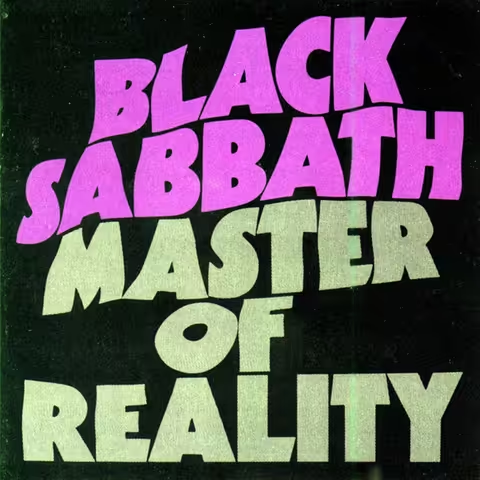
The album title, Master of Reality, reflected the band’s desire to confront the real world rather than escape into fantasy. The concept extended to the artwork, which featured a stark, embossed cover with the album’s name in black letters and a fold-out poster in the original release. Mike Stanford handled art direction, and Keef was responsible for the photography and poster design (Wikipedia).
The band financed the recording through their label advances, but with the commercial success of Paranoid, they had more resources to spend on studio time. This allowed them to experiment with acoustic pieces, effects, and different tunings, even though Iommi later said he preferred the spontaneity of earlier sessions.
Below is a table listing the band members and their roles on the album:
| Member | Instrument(s) / Role(s) |
|---|---|
| Ozzy Osbourne | Lead vocals |
| Tony Iommi | Guitar, acoustic guitar, flute, piano, synthesiser, effects |
| Geezer Butler | Bass guitar, lyricist |
| Bill Ward | Drums, percussion, sleigh bells |
Recording Process
When Sabbath entered Island Studios in London in February 1971, they were determined to create something heavier than anything before. The sessions stretched from 7–15 February and 6–13 April 1971, giving the band more time than their previous albums. Island Studios was a top facility, used by acts like Led Zeppelin and Roxy Music, and known for its state-of-the-art equipment.
Rodger Bain produced the album—his third and final collaboration with the band. Tom Allom served as the engineer, later gaining fame for his work with Judas Priest. Bain was known for a straightforward approach, preferring to capture the band’s live energy rather than rely on overdubs or studio trickery. Still, the group took advantage of the studio’s capabilities, using effects and experimenting with acoustic instruments and delay on Ozzy’s vocals (notably on “Solitude”).
The gear used was crucial to the sound. Tony Iommi’s setup included Laney Supergroup amplifiers, often paired with a modified Rangemaster treble booster to push the amp into saturated overdrive (Marshall Amp Forum). His guitar of choice was a 1964 Gibson SG, with altered pickups and a custom bridge. The band down-tuned their instruments (Iommi by one and a half steps), giving the record its signature heaviness. Geezer Butler’s bass followed suit, and Bill Ward adapted his drumming to the slower, sludgier tempos. The studio likely featured Neumann and AKG microphones, EMI mixing desks, and tape machines common at Island in the early ‘70s.
Below is a table of likely hardware and techniques used in the studio, based on available information and common practices at Island Studios in 1971:
| Equipment/Technique | Details |
|---|---|
| Guitar Amplifier | Laney Supergroup head (with Rangemaster treble booster) |
| Guitar | 1964 Gibson SG (modified pickups/bridge) |
| Bass Amplifier | Likely Laney or Ampeg bass rig, down-tuned |
| Drums | Ludwig kit, with close-miking (Neumann/AKG mics assumed) |
| Mixing Desk | EMI/Neve desk (common at Island Studios, 1971) |
| Tape Machine | Studer 8-track |
| Effects | Delay (on vocals), reverb, some overdubs for flute/piano |
The sessions were not without difficulty. Recording “Into the Void” proved especially challenging, as Bill Ward struggled with the drum parts. Iommi played flute and piano on “Solitude,” and even the infamous coughing at the start of “Sweet Leaf” was a real moment—captured as Iommi coughed after sharing a marijuana joint with Ozzy. The band was more confident in the studio than ever before, and it shows in the record’s sound and scope.
Rodger Bain’s work as a producer shaped early Sabbath. Here is a table of other albums produced by Bain, making his role clear:
| Producer | Artist | Album | Year |
|---|---|---|---|
| Rodger Bain | Black Sabbath | Black Sabbath | 1970 |
| Rodger Bain | Black Sabbath | Paranoid | 1970 |
| Rodger Bain | Judas Priest | Rocka Rolla | 1974 |
| Rodger Bain | Budgie | Budgie | 1971 |
| Rodger Bain | Budgie | Squawk | 1972 |
| Rodger Bain | Budgie | Never Turn Your Back on a Friend | 1973 |
Commercial Performance and Reception
When Master of Reality arrived in August 1971, it quickly became one of Black Sabbath’s most successful albums. In the UK, it peaked at number 5, and in the US, it reached number 8 on the Billboard 200. The album is certified double platinum in the US (over 2 million units), platinum in Canada, and gold in the UK. Worldwide sales exceed 4.8 million copies (Rock and Roll Garage).
To put the album in context, here’s a table of Black Sabbath’s studio albums, showing release year and sales data where available. The row for Master of Reality is highlighted.
| Album | Year | Sales Data |
|---|---|---|
| Black Sabbath | 1970 | 4.9 million |
| Paranoid | 1970 | 9.9 million |
| Master of Reality | 1971 | 4.8 million |
| Vol. 4 | 1972 | 4.1 million |
| Sabbath Bloody Sabbath | 1973 | 4 million |
| Sabotage | 1975 | 2.5 million |
| Technical Ecstasy | 1976 | 1.49 million |
| Never Say Die! | 1978 | 1.42 million |
| Heaven and Hell | 1980 | 3.4 million |
| Mob Rules | 1981 | 1.9 million |
| Born Again | 1983 | 1.4 million |
| Seventh Star | 1986 | 790,000 |
| The Eternal Idol | 1987 | 620,000 |
| Headless Cross | 1989 | 740,000 |
| Tyr | 1990 | 610,000 |
| Dehumanizer | 1992 | 1 million |
| Cross Purposes | 1994 | 510,000 |
| Forbidden | 1995 | 410,000 |
| 13 | 2013 | 1.2 million |
Although the album was a commercial hit, early reviews were mixed. Critics like Robert Christgau called it “dim-witted, amoral exploitation,” while Lester Bangs of Rolling Stone dismissed it as “monotonous.” Yet, the public disagreed, and the album’s reputation has only grown. Retrospective lists now place it among the greatest heavy metal albums ever made.
In 1971, other major albums from the heavy music world included:
- Fireball by Deep Purple
- Who’s Next by The Who
- Led Zeppelin IV by Led Zeppelin [Physical sales: 23 million US]
- Aqualung by Jethro Tull
- Sticky Fingers by The Rolling Stones
- L.A. Woman by The Doors
- Electric Warrior by T. Rex
- Meddle by Pink Floyd
- Killer by Alice Cooper
Master of Reality has received many recognitions. It is certified double platinum by the RIAA in the US, platinum in Canada, and gold in the UK. Rolling Stone ranked it in their 500 Greatest Albums of All Time, and Q magazine placed it in their “50 Heaviest Albums of All Time.” In 2019, Black Sabbath received a Grammy Lifetime Achievement Award, further highlighting the album’s legacy.
Heavy music in 1971 was thriving. Bands like Uriah Heep released Look At Yourself, Mountain issued Nantucket Sleighride, and Budgie released their debut. The year also saw the rise of bands like Pentagram and Captain Beyond, and the tragic death of Duane Allman, which sent shockwaves through the rock community. The genre was growing rapidly, and Master of Reality was at the centre of it all (Wikipedia: 1971 in heavy metal music).
Track Analysis
Singles from Master of Reality include “Children of the Grave” and “After Forever,” both released in 1971. “Children of the Grave” became a live staple and has appeared in several films and TV shows. “After Forever” was released as a single alongside “Fairies Wear Boots.” Both songs feature lyrics by Geezer Butler and music by the whole band.
Below is a table listing every song on the album, its length, and writing credits. Singles are marked with a *.
| Track Name | Length | Writing Credit |
|---|---|---|
| Sweet Leaf | 5:05 | Black Sabbath |
| After Forever* | 5:27 | Tony Iommi |
| Embryo | 0:28 | Tony Iommi |
| Children of the Grave* | 5:18 | Black Sabbath |
| Orchid | 1:31 | Tony Iommi |
| Lord of this World | 5:27 | Black Sabbath |
| Solitude | 5:02 | Black Sabbath |
| Into the Void | 6:13 | Black Sabbath |
Note: Songs marked with * were singles (“After Forever” and “Children of the Grave”). Chart data for these singles is limited, but both became classic Sabbath tracks.
Song Meaning and Lyrics
The lyrics on Master of Reality reflect Geezer Butler’s thoughtful, sometimes provocative style. The singles “After Forever” and “Children of the Grave” both stand out for their themes and writing.
“After Forever” is often misunderstood. Many listeners thought Sabbath promoted Satanism, but Butler wrote the song as a Christian-themed piece, questioning what people would do at the moment of death and whether they would regain faith (Rock and Roll Garage). The lyrics ask, “Could it be you’re afraid of what your friends might say / If they knew you believe in God above?” The song urges listeners to think for themselves and not reject faith out of fear or peer pressure. According to The Berean Test, the track calls for open-mindedness and self-examination, using direct questions to challenge the listener.
“Children of the Grave” is a protest song, urging young people to fight for peace and not give in to hatred or violence. The lyrics, “Revolution in their minds / The children start to march / Against the world in which they have to live,” make it clear that the song is about social change, not horror or the occult. Fans have sometimes misinterpreted it as a song about zombies, but it’s actually a call for unity and action (Reddit). The chorus warns that if love doesn’t conquer fear, “the children of the world won’t be children of the grave.”
Most tracks were written by all four members, but Tony Iommi composed the acoustic interludes (“Embryo” and “Orchid”) and the main body of “After Forever.” Collaboration was the norm, with Iommi providing riffs and melodies, Butler writing lyrics, and the band working together to shape arrangements.
Touring and Promotion of Master of Reality
To promote Master of Reality, Black Sabbath embarked on a world tour spanning the UK, North America, and Europe from 1971 to 1972. Their live shows were loud, heavy, and often sold out. They performed in cities like Detroit, St. Paul, Atlanta, Montreal, Toronto, San Francisco, Vienna, and Palermo. The setlists typically included new tracks like “Sweet Leaf,” “Children of the Grave,” and “Into the Void,” alongside earlier hits such as “Paranoid” and “Iron Man” (Ozzy Osbourne Official Site).
The band played more than 60 shows on this tour, with notable performances at venues such as the Eastown Theatre in Detroit (13 May 1971), Borough of York Stadium in Toronto (18 July 1971), and Winterland Arena in San Francisco (1–2 October 1971). Setlists often featured 10–12 songs, including solos and extended jams. In 1972, the tour continued with stops in Birmingham, Glasgow, Manchester, San Francisco, Seattle, and more. The group toured with acts like Humble Pie and YES at various points, and ticket prices were a fraction of what you’d pay today—sometimes as little as $4.
Promotion included radio appearances, interviews, and features in magazines like SOUNDS and Rolling Stone. The album’s stark artwork and inclusion of a fold-out poster in the original pressing helped it stand out in record shops. The band’s relentless touring and word-of-mouth buzz did the rest.
Influences and Legacy
Master of Reality was shaped by the music Black Sabbath loved—blues, jazz, and the heavy rock of bands like Cream and Led Zeppelin. Iommi’s injury and subsequent down-tuning became a key influence on the album’s sound. The record, in turn, inspired generations of musicians and helped launch new genres.
Below is a table showing some of the album’s influences and those it influenced:
| Influences on “Master of Reality” | Artists Influenced by “Master of Reality” |
|---|---|
| Cream | Kyuss |
| Led Zeppelin | Sleep |
| John Mayall & the Bluesbreakers | Monster Magnet |
| Fleetwood Mac | Orange Goblin |
| Jimi Hendrix | Soundgarden |
| Blue Cheer | Alice in Chains |
| Jazz (Gene Krupa, Buddy Rich) | Melvins |
| Smashing Pumpkins | |
| Nirvana | |
| Down |
Released in 1971, the album arrived during a year of major cultural shifts. The Vietnam War was raging, and anti-war protests reached their peak. In the UK, decimalisation changed the currency, and new technology like the Intel 4004 microprocessor began to reshape society. Musically, 1971 saw the release of Led Zeppelin IV, Sticky Fingers, Aqualung, and Blue by Joni Mitchell. The year also saw the deaths of Jim Morrison and Louis Armstrong, and the founding of Starbucks in Seattle. Greenpeace was founded, and the first e-book was posted online. The world was changing, and so was music (Wikipedia: 1971).
Five Things About Master of Reality
There are plenty of myths about this album, but here are five verified facts, cross-checked with reliable sources:
| Fact | Details |
|---|---|
| First album to feature lyrics on the back sleeve | The original UK pressing included printed lyrics, a first for Black Sabbath (Wikipedia). |
| Coughing intro on “Sweet Leaf” was real | Tony Iommi’s cough was recorded accidentally after he and Ozzy shared a marijuana joint in the studio. |
| Early US editions had the wrong album title | Some first US pressings listed the title as “Masters of Reality” before being corrected. |
| First Sabbath album to use extensive down-tuning | Iommi and Butler tuned down by one and a half steps, influencing countless bands after them. |
| Double platinum in the US | Certified by the RIAA for over 2 million sales in the United States alone. |
Media and Television Usage
Several songs from Master of Reality have appeared in films, TV shows, and games. Below is a table of confirmed uses:
| Song Title | Media Appearance | Year |
|---|---|---|
| Children of the Grave | 1971: The Year That Music Changed Everything (TV, S1E8), The Continental (TV, S1E1), Guitar Hero: Warriors of Rock (Game), Brütal Legend (Game), That ’70s Show (TV, S2E25, S2E15), Beavis and Butt-Head Do the Universe (Film) | 2000–2023 |
| Into the Void | The Tonight Show Starring Jimmy Fallon (TV, S2018E87), CSI: Crime Scene Investigation (TV, S9E23), Guitar Hero: Warriors of Rock (Game) | 2009–2018 |
Other tracks from the album have not been confirmed in major media placements, based on available data from Tunefind.
Critical Reviews and Retrospectives
At the time of its release, Master of Reality was panned by some critics. Robert Christgau called it “dim-witted, amoral exploitation,” and Rolling Stone’s Lester Bangs labelled it “monotonous.” Over time, though, the album’s stature has grown. It now appears on numerous “greatest albums” lists and is praised for its heaviness and innovation.
Below is a table of notable reviews and retrospective comments:
| Publication | Review Score | Notable Quote | Link |
|---|---|---|---|
| Rolling Stone | N/A (original review negative) | “Monotonous” (Lester Bangs, 1971) | Read |
| Q Magazine | N/A | Included in “50 Heaviest Albums of All Time” (2001) | Read |
| MusicHound Rock | N/A | “A brilliant skull crusher” (1999) | Read |
| Colin Larkin’s Top 50 Heavy Metal Albums | #28 | Listed as one of the best metal albums (1994) | Read |
| Rolling Stone (2020) | #234 (500 Greatest Albums) | “Defined doom, stoner, and sludge metal” | Read |
After Master of Reality
Following Master of Reality, Black Sabbath continued to evolve. The next album, Vol. 4 (1972), saw the band experimenting with new sounds and production techniques. Although the original line-up remained intact for several more albums, by the late 1970s, internal tensions and substance abuse led to Ozzy Osbourne’s departure. Ronnie James Dio replaced him for the acclaimed Heaven and Hell (1980). The band’s line-up changed frequently in the 1980s and 1990s, but Tony Iommi remained the anchor.
Black Sabbath’s popularity dipped in the late ‘70s and ‘80s, but the original line-up reunited several times, most notably for the Reunion live album in 1998 and the final studio album 13 in 2013. As of April 2025, the band is set for a final reunion show at Villa Park, Birmingham, on 5 July 2025, with all original members expected to appear. The event will raise money for charity and feature major guests (Black Sabbath Official Site).
Today, Black Sabbath are widely recognised as the pioneers of heavy metal. Their influence extends to countless bands, and their music continues to find new audiences through streaming, reissues, and media appearances.
Remasters and Reissues
There have been several remasters and reissues of Master of Reality. Notable among them is the 2009 Deluxe Edition, remastered by Andy Pearce, which included a bonus disc of outtakes and alternative versions. In 2021, a limited-edition purple vinyl pressing was released for Record Store Day UK, complete with a folded poster from the Ten Year War box set (Black Sabbath Official Site).
Here’s a table of major remasters and reissues:
| Release | Format | Date | Notes |
|---|---|---|---|
| Original UK LP | LP | August 1971 | Embossed sleeve, poster, swirl label |
| Warner Bros. US LP | LP | August 1971 | Incorrect title on some early pressings |
| Castle Communications CD | CD | 1992 | First official CD release |
| Sanctuary Deluxe Edition | 2CD | 29 June 2009 | Remastered, bonus disc with outtakes |
| Record Store Day UK Edition | LP (purple vinyl) | April 2021 | Limited edition, poster included |
Box sets and digital reissues have also kept the album in circulation, introducing it to new generations of listeners.
Conclusion
Master of Reality remains a landmark album, not just for Black Sabbath but for the whole world of heavy music. Its sound, themes, and legacy are as powerful today as they were in 1971. With a final reunion show planned for July 2025 and continued interest in their back catalogue, Black Sabbath’s influence shows no sign of fading. This record is essential listening for anyone interested in the roots and evolution of heavy metal.
Further Reading
If you want to explore more about Black Sabbath and related music, here are some of our own articles and podcasts, as well as key external links:
- Black Sabbath: Celebrating Their Legendary Journey (Riffology Blog)
- Paranoid: Black Sabbath’s Defining Heavy Metal Album (Riffology Blog)
- Unraveling Sabotage: Black Sabbath’s Iconic Album (Riffology Blog)
- Wikipedia: Master of Reality
- Official Black Sabbath Website
- Warner Music Group (Label site)
Let us know in the comments what your thoughts are on Master of Reality by Black Sabbath. Did we miss anything? Share your experiences and join the conversation!

Comments