No hard rock album before or since has matched what New Jersey did on the American singles chart: five Billboard Hot 100 top ten hits drawn from a single twelve-track LP, two of them at number one, a run that began with Bad Medicine in September 1988 and was still playing on US radio when Bon Jovi rolled into Moscow eleven months later. The record was not supposed to be a single LP at all. The band handed Mercury a seventeen-song double album titled Sons of Beaches, the label refused, and what came back across the kitchen table was the most commercially decisive hard rock record of the late 1980s.
Released on 19 September 1988, New Jersey was the album that ended any remaining argument about whether Bon Jovi were a Slippery When Wet fluke. It debuted at number eight on the Billboard 200, climbed to number one the following week, and parked there for four. It topped the album chart in the United States, the United Kingdom, Canada, Australia, New Zealand, Switzerland and Sweden. It eventually shifted seven million copies in the US alone, two million in Britain, and gave Bon Jovi the distinction, still unmatched, of being the first American rock band whose album was officially pressed and sold in the Soviet Union. Then it almost broke them.
Album Facts
| Field | Detail |
|---|---|
| Artist | Bon Jovi |
| Album | New Jersey |
| Release date | 19 September 1988 |
| Label | Mercury (North America), Vertigo (worldwide) |
| Producer | Bruce Fairbairn |
| Studio | Little Mountain Sound Studios, Vancouver, BC; Chalet Sound, Allenwood, NJ (pre-production and "Love for Sale") |
| Genre | Glam metal, hard rock, arena rock |
| Track count | 12 (LP), 15 with the 2014 deluxe sides |
| Total runtime | 57:30 |
| Billboard 200 peak | 1 (four consecutive weeks) |
| UK Albums Chart peak | 1 (band's first UK number one) |
| Other notable chart peaks | 1 in Canada, Australia, New Zealand, Switzerland and Sweden; 2 in Japan; 3 in Canadian RPM |
| Certifications | 7x Platinum (RIAA), 2x Platinum (BPI UK), 5x Platinum (Music Canada), 2x Platinum (ARIA) |
| Estimated sales | Over 10 million worldwide; 7 million United States |
| Key singles | Bad Medicine, Born to Be My Baby, I will Be There for You, Lay Your Hands on Me, Living in Sin |
Cultural context: what 1988 sounded like
The autumn of 1988 was the high tide of American glam metal. Appetite for Destruction, released the previous summer, had finally clawed its way to number one in August and was still in the Billboard 200 top five when New Jersey arrived. Def Leppard's Hysteria, the album most often compared with Slippery When Wet, was a year old and selling steadily, its hits still on radio. Poison's Open Up and Say... Ahh!, Cinderella's Long Cold Winter and Whitesnake's self-titled blockbuster all jostled for arena bookings. MTV played the genre on rotation almost as a default setting.
The biggest competitor for New Jersey in chart terms was George Michael's Faith, which by then had spent most of 1988 at the top of the Billboard 200. Tracy Chapman's debut, U2's Rattle and Hum, the soundtrack to Dirty Dancing and Anita Baker's Giving You the Best That I Got were all releases jockeying for the same end-of-year slot. Bon Jovi were the only hard rock band of the moment expected to deliver a record that would top the chart in the first month of its release rather than slowly climb there. The expectation, by September 1988, was that Bon Jovi would shift platinum without trying. The pressure inside the band was to do that without ending up dismissed as Slippery When Wet 2.
The band's story to that point
Bon Jovi's path to New Jersey ran through four years of relentless work. The Sayreville quintet (Jon Bon Jovi on vocals, Richie Sambora on guitar, David Bryan on keyboards, Alec John Such on bass and Tico Torres on drums) released their debut Bon Jovi in January 1984 off the back of "Runaway", a song Jon had cut with hired session players two years earlier in his cousin Tony Bongiovi's Power Station studio. Tony's connection was how the band's name came to be on records at all. The debut and its 1985 follow-up 7800 Fahrenheit were workmanlike glam metal that sold respectably without breaking the band globally.
The pivot came when manager Doc McGhee paired the band with two outsiders: Vancouver-based producer Bruce Fairbairn, who had just had his first big international hit with Loverboy, and New York songwriter Desmond Child, the man who wrote I Was Made for Lovin' You with Paul Stanley for Kiss. Fairbairn and Child reshaped how the band wrote. The result was Slippery When Wet, released in August 1986: eight weeks at number one on the Billboard 200, "You Give Love a Bad Name" and "Livin' on a Prayer" both at the top of the Hot 100, a record that has now sold over twenty-eight million copies worldwide. The Tour Without End ran 130 shows in 1986 and 1987 and grossed twenty-eight million dollars.
By the time the band staggered off the Slippery When Wet Tour in October 1987 the unanswerable question was the only question that mattered. Could they do it again. Doc McGhee had bigger problems of his own by then. He had been arrested in 1988 for conspiracy to import 40,000 pounds of marijuana through a North Carolina port, a charge that would end with him agreeing to organise the Make a Difference Foundation as part of his sentencing. The foundation's flagship event would, the following year, drop Bon Jovi into Lenin Stadium in Moscow.
Pre-production, Sons of Beaches and the demos
The band took roughly three weeks off after the Slippery When Wet Tour ended. Jon Bon Jovi and Richie Sambora then started writing again, working up demos for seventeen songs in the back room of Chalet Sound, a small studio in Allenwood, New Jersey, engineered by John Allen and Chris Cavallaro. The first batch was, by both writers' later admission, a mess of anxiety. Wanting another "You Give Love a Bad Name" so badly that they wrote one. The song "Love Is War" came out with what was effectively the same chord progression as the earlier hit, and they shelved it. It eventually surfaced as a B-side on the "Living in Sin" single and as an outtake on the 2014 deluxe edition.
The working title for the album was Sons of Beaches, a smutty pun on Slippery When Wet. Another title batted around the studio, according to the writers, was 68 and I Owe You One. Both were dropped because the band did not want to be read as comedians. The eventual album title was a deliberate retreat from cleverness towards plainness. Naming the record after the state was a statement about working-class belonging and refusal to perform sophistication, and it carried over into the album's stripped-back cover treatment.
Crucially, what Bon Jovi delivered to Mercury was not the final twelve-song LP at all. It was a seventeen-track double album. The label, looking at the higher list price a 2-LP package would force on the consumer and the squeeze that would put on units shifted, refused. The band cut the running order down. Five songs that had been demoed and partly tracked were held back. Several would later be re-recorded for other artists. "House of Fire" went to Alice Cooper for his 1989 album Trash. "Does Anybody Really Fall in Love Anymore?" was given to Cher for Heart of Stone. "Diamond Ring" was held back and re-recorded for These Days in 1995. The remaining unreleased material would not be heard officially until the 2014 super-deluxe edition.
- Original 1988 submission: 17 songs across a proposed double LP titled Sons of Beaches.
- Mercury's mandate: cut to a single LP.
- Final 1988 release: 12 tracks, 57 minutes 30 seconds.
- 2014 deluxe release: original LP remastered plus a second disc of B-sides, outtakes and the Sons of Beaches demos.
"I really wanted to do it again, not for monetary reasons, I have plenty of money, but it was such an amazing feeling to have done what we have done. There was a real fear of not being able to write You Give Love a Bad Name again."
Jon Bon Jovi, quoted by Louder Sound, 2021
Creating the album: Vancouver, take two
Recording proper began on 1 May 1988 at Little Mountain Sound Studios in Vancouver and ran through 31 July. Bon Jovi and the entire creative team essentially repeated the experiment that had worked two years earlier. Bruce Fairbairn produced. Bob Rock, who had engineered Slippery When Wet and gone on to work on Aerosmith's Permanent Vacation in the same building, returned to engineer and mix. George Marino, at Sterling Sound in New York, mastered. Desmond Child travelled in to co-write the singles. The band again moved into the Sutton Place Hotel up the road from the studio. There is a strong case to be made that no hard rock album of the period was more methodically engineered as a follow-up than New Jersey; every variable from the previous hit was held constant.
What was not the same was the room temperature. Fairbairn was a more polished producer in 1988 than he had been in 1986, with Aerosmith now under his belt and an international reputation. Bob Rock was on the cusp of leaving the engineer's chair for the producer's: within four years he would be sitting in the same Vancouver studio cutting Metallica's Metallica. The recording sessions for New Jersey were Bon Jovi's last collaboration with Fairbairn. By the time the band returned to Little Mountain for Keep the Faith in 1992, Bob Rock would be the producer.
The sessions were long. Fairbairn pushed for a richer, more diverse album than the brisk hit-machine of Slippery When Wet. "Lay Your Hands on Me" was built around a Sambora riff and given a slow, atmosphere-building intro that pushed the running time past five and a half minutes. "Wild Is the Wind", a Diane Warren co-write, opened on flamenco guitar. "Homebound Train" set a harmonica and a Hammond organ against each other for the song's central duel. "Ride Cowboy Ride", credited to "Captain Kidd and King of Swing" (Bon Jovi and Sambora's road nicknames), was recorded in deliberately scratchy mono as a fake-radio segue into "Stick to Your Guns".
The most famous late-stage change concerned "Born to Be My Baby". Jon and Richie had written the song as an acoustic ballad and demoed it that way. Fairbairn made them re-cut it as an electric rocker with a stadium-sized chorus. Jon has said publicly, more than once, that he believes the song would have gone to number one in its original form. As issued it stalled at number three, the only single from the album that did not reach the top two. The acoustic demo was eventually released on the 2014 deluxe.
One song was cut entirely in New Jersey rather than Vancouver. "Love for Sale" was tracked at Chalet Sound in Allenwood, engineered by John Allen and Chris Cavallaro, to give it a deliberately looser, almost demo-like feel after eleven studio-polished cuts. It closes the album running just under four minutes.
"Jon and I do not walk into the studio with the band without ten songs that are kind of written. You can take a song into a studio with a producer and you can put all the bells and whistles all over it, but if you do not have the basic architecture of the song properly written, it does not matter."
Richie Sambora, MusicRadar, 2010
Personnel and credits
| Role | Player | Notes |
|---|---|---|
| Bon Jovi | ||
| Lead and backing vocals | Jon Bon Jovi | Also harmonica and acoustic guitar. |
| Electric and acoustic guitars | Richie Sambora | Also mandolin and backing vocals. Talk box on Bad Medicine outro. |
| Keyboards | David Bryan | Backing vocals. |
| Bass | Alec John Such | Backing vocals. |
| Drums, percussion | Tico "The Hit Man" Torres | |
| Guest and session musicians (credited) | ||
| Cello | Scott Fairbairn | Brother of the producer. |
| Cello | Audrey Nordwell | |
| Additional percussion, horn | Bruce Fairbairn | The producer regularly played horn on his own sessions. |
| Arrangement, additional and vocal arrangement | Peter Berring | |
| Production and engineering | ||
| Producer | Bruce Fairbairn | Final Bon Jovi album as producer. |
| Engineering, mixing | Bob Rock | Soon to break out as a producer himself. |
| Engineering | John Allen, Chris Cavallaro | Pre-production at Chalet Sound, plus "Love for Sale". |
| Engineering assistance | Chris Taylor, Jim Williams | |
| Mastering | George Marino | Sterling Sound, New York. |
| Artwork and photography | ||
| Artwork and design | Hugh Syme | Best known for Rush sleeves; later worked on Megadeth, Dream Theater. |
| Cover photography | Cameron Wong | |
| Photography | Tim White | |
| Photography | Isabella Lento, Carmela Lento | Wikipedia notes association is unconfirmed. |
The lineup is leaner than many fans assume. There is no horn section, no string quartet, no celebrity guests on backing vocals. Two cellists and one producer playing extra percussion is the entire list of outsiders on the album proper. Sambora plays more instruments than he is credited for at a glance; the mandolin work on the quieter passages, the talk box on Bad Medicine and the doubled rhythm guitars under the choruses are all his.
The songs: side by side through New Jersey
| # | Title | Writer(s) | Length | Single? | Notes |
|---|---|---|---|---|---|
| 1 | Lay Your Hands on Me | Bon Jovi, Sambora | 5:58 | Yes (4th) | Built from a Sambora riff. Album opener with long atmospheric intro. |
| 2 | Bad Medicine | Bon Jovi, Sambora, Desmond Child | 5:16 | Yes (1st) | Band's third Billboard Hot 100 number one. Fake-ending becomes a live signature. |
| 3 | Born to Be My Baby | Bon Jovi, Sambora, Child | 4:40 | Yes (2nd) | Originally acoustic; re-cut at Fairbairn's insistence. |
| 4 | Living in Sin | Bon Jovi | 4:39 | Yes (5th) | Sole solo writing credit on the album. Music video banned then re-edited by MTV. |
| 5 | Blood on Blood | Bon Jovi, Sambora, Child | 6:16 | No | Anthem about three childhood friends. Live favourite. |
| 6 | Homebound Train | Bon Jovi, Sambora | 5:10 | No | Harmonica and Hammond organ duel. |
| 7 | Wild Is the Wind | Bon Jovi, Sambora, Child, Diane Warren | 5:08 | No | Flamenco guitar intro. Only Diane Warren credit on the record. |
| 8 | Ride Cowboy Ride | Bon Jovi, Sambora | 1:25 | No | Mono throwaway segue, credited to "Captain Kidd and King of Swing". |
| 9 | Stick to Your Guns | Bon Jovi, Sambora, Holly Knight | 4:45 | No | Co-write with Holly Knight (Love Is a Battlefield, The Warrior). |
| 10 | I will Be There for You | Bon Jovi, Sambora | 5:46 | Yes (3rd) | Album's second US number one. Longest number one of 1989. |
| 11 | 99 in the Shade | Bon Jovi, Sambora | 4:29 | No | Summer rocker; later live staple of the Have a Nice Day Tour. |
| 12 | Love for Sale | Bon Jovi, Sambora | 3:58 | No | Recorded at Chalet Sound in New Jersey, not Vancouver. Album closer. |
"Bad Medicine" works as a piece of writing because it is two ideas held together by Sambora's talk box. Verse one sets up a love-as-drug conceit ("there ain't no paramedic gonna save this heart attack") and the chorus turns the medical analogy on its head: "bad medicine is what I need". It was the third number one in a row that Jon, Sambora and Desmond Child had written together, following "You Give Love a Bad Name" and "Livin' on a Prayer". The fake ending at 4:20 ("wait a minute, wait a minute, I am not done") became the band's most-loved live trick.
"I will Be There for You" is the album's most unguarded performance. Running 5:43, it was the longest song to reach number one on the Hot 100 in all of 1989. Sambora has said in interviews, including one with Fuse TV, that the song was written about a real relationship that had ended. The "I guess this time you are really leaving, I heard your suitcase say goodbye" lyric is the album's sharpest piece of imagery. Sambora's backing vocal under the second verse is what makes the track work; it doubles Jon's lead in the gaps the way a Greek chorus would, repeating the confessions back at him.
"Blood on Blood", at six minutes sixteen, never released as a single, was the song that the band themselves rated most highly. Co-written with Desmond Child, it dramatises three childhood friends ("Bobby was the leader of our gang... Danny was the first one in our crowd to ever score") and the loyalty that survives between them. It became a live anthem the band played on every leg of the Syndicate Tour, often extending it past ten minutes.
"Living in Sin" is the most overlooked top ten hit from the album. Written by Jon alone, it argues that a couple committed to each other does not need a marriage certificate to be honourable. Its music video presented the unmarried couple in bed and was banned by MTV at first issue. After re-editing it went into heavy rotation and the single reached the top ten in late summer 1989.
B-sides, outtakes and the lost double album
The unreleased Sons of Beaches material is one of the more interesting B-side stories in late-1980s rock because so much of it was good enough to become a hit somewhere else. The songs Bon Jovi could not fit on the 1988 LP did not stay buried.
- "House of Fire" was given to Alice Cooper for his 1989 comeback album Trash (also produced by Desmond Child). Bon Jovi's own demo eventually surfaced on the 2014 deluxe edition.
- "Does Anybody Really Fall in Love Anymore?", co-written with Diane Warren, was later cut by Cher on her 1989 Heart of Stone and by Kane Roberts on Saints and Sinners.
- "Diamond Ring" was held back, reworked and finally released as a track on Bon Jovi's 1995 album These Days.
- "Love Is War" appeared as the B-side to "Living in Sin" and as a studio outtake on the 2014 deluxe; it is the writers' shelved attempt at a "You Give Love a Bad Name" rewrite.
- "The Boys Are Back in Town" (Thin Lizzy cover) appeared on the 12-inch B-side in the UK and on the Stairway to Heaven/Highway to Hell charity compilation.
- The 2014 deluxe also includes the original acoustic "Born to Be My Baby", confirming Jon's long-held argument about its original form.
Album artwork and packaging
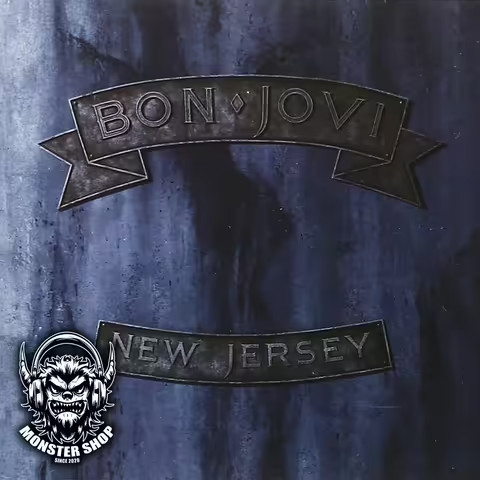
The visual identity for New Jersey was a deliberate move away from the cleavage-soaked airbrush that had defined late-80s glam sleeves. Hugh Syme, the Canadian designer best known for his decades of work on Rush covers, handled the artwork and design. Cameron Wong shot the cover. The result is a stark black-and-white portrait of the five members of the band, plain white type, no airbrushing, no logo theatrics, almost the opposite of Slippery When Wet's wet-T-shirt-on-a-bin-bag joke cover. The interior gatefold on the LP doubled down on the same monochrome treatment with shots by Tim White. The aesthetic was intentional: the band wanted something that felt like home, and the front sleeve reads that way; quiet, almost municipal, more like a regional newspaper portrait than a hair-metal flyer.
The lyric sheet inside the original LP gatefold credited the album to a small list of names, no thank-yous to record-company executives, no production team headshots. It read more like the back of an indie record than a multi-platinum major-label hard rock release. That decision aged well; the original 1988 sleeve still presents better than the airbrushed sleeves of the records released around it.
Release and reception
The album was released on 19 September 1988, with "Bad Medicine" already on radio as the lead single from a week earlier. It debuted at number eight on the Billboard 200, became the band's first US number one in its second week and stayed there for four consecutive weeks. The UK was even more decisive. New Jersey debuted at number one on the Official Albums Chart on 25 September 1988 (Slippery When Wet had only reached number six in Britain), the band's first ever British chart-topper. Australia, Canada, New Zealand, Switzerland and Sweden all delivered number ones. Japan put it at number two on the Oricon. Year-end, New Jersey finished as the fourth biggest album of 1989 in the United States.
Critical reception was, depending on the publication, friendly or condescending. AllMusic gave it four and a half stars retrospectively, calling it the band's most ambitious and consistent record of the decade. Kerrang! gave it three and a half. Rolling Stone, in its initial 1988 review by Michael Azerrad, gave it three stars and described it as a workmanlike refinement of the formula. Robert Christgau, never the band's natural constituency, awarded it a C+. The most damaging early review came from the British teen pop magazine Number One, which gave it a single star. None of that mattered. The album was certified gold in the US within a fortnight and platinum within a month.
"Bon Jovi attempts to widen its sound on New Jersey, and although there is more variation than on the band's previous albums, they still excel at hard rock tunes like Bad Medicine and Born to Be My Baby."
William Ruhlmann, AllMusic
Certifications kept rolling in over the following decade. By 1996, ten years after release, the RIAA had certified the album seven times Platinum, equivalent to seven million American sales. The BPI had it at two times Platinum (600,000) in the UK. Music Canada certified it five times Platinum. The ARIA put it at two times Platinum in Australia. Worldwide totals are over ten million.
Singles and music videos
The singles run from New Jersey is the album's single most extraordinary achievement and the reason it is still recited at industry trivia nights. Five top ten singles in the US from one twelve-track LP, in the era when "top ten" still meant top ten on a chart that was actually about radio and singles sales rather than streaming.
| Single | Release | US Hot 100 | UK Singles | B-side | Video director / notes |
|---|---|---|---|---|---|
| Bad Medicine | 12 Sep 1988 | 1 | 17 | "99 in the Shade" (live) | Wayne Isham. Fan-shot footage: 250 audience members were given handheld cameras with film and told to shoot the show themselves. |
| Born to Be My Baby | Nov 1988 | 3 | 22 | "Love for Sale" | Wayne Isham. Black-and-white studio performance with Jon's wife Dorothea making a cameo. |
| I will Be There for You | Feb 1989 | 1 | 18 | "Homebound Train" (live) | Wayne Isham. Soundstage footage cut with live shots. Longest US number one of 1989 at 5:43. |
| Lay Your Hands on Me | May 1989 | 7 | 18 | "Edge of a Broken Heart" | Wayne Isham. Filmed live at the Tacoma Dome and the Memorial Coliseum in Portland during the Syndicate Tour. |
| Living in Sin | Sep 1989 | 9 | 35 | "Love Is War" | First version banned by MTV for sexual content. Re-edit became heavy rotation. |
The Bad Medicine video stands out as a piece of MTV-era experimentation. Wayne Isham, who would also shoot the other four singles' videos, gave 250 fans handheld cameras with reels of film and told them to point them wherever they wanted during the band's California shows. The ten best amateur cinematographers were promised a slot on the band's plane to come on tour. Jon's brother Matt and comedian Sam Kinison both turn up in the cut.
Touring: the New Jersey Syndicate Tour
The Syndicate Tour, billed at various points as The Brotherhood on Tour and New Jersey: The Tour, ran from 31 October 1988 in Dublin to 17 February 1990 in Guadalajara. Eight legs across Europe, Asia, North America, Australasia, South America and back to Europe. 238 shows in total. Sixty-one in Europe, seven in Asia, 151 in North America, ten in Australasia, nine in South America. Support acts rotated by leg: Lita Ford in Europe early on, Skid Row across North America at Jon Bon Jovi's personal invitation, the Dan Reed Network in Europe, Roxus in Australia, Cinderella and Scorpions for the December 1988 Munich Olympiahalle date, Billy Squier and Sam Kinison sharing the bill in East Rutherford that June.
The Skid Row booking carries its own story. Jon's old neighbour Dave "The Snake" Sabo, who had briefly been Bon Jovi's lead guitarist before Sambora joined, had formed Skid Row in 1986. The two men had a deal between them that whoever made it big first would help the other. Jon kept his side of it. Skid Row's self-titled debut shipped in January 1989 and opening the Syndicate Tour put them in front of arena-sized US crowds for the first time. The Bon Jovi-Sambora publishing company also held a percentage of Skid Row's songs, which would later cause friction.
Three dates stand out. The homecoming show at Giants Stadium on 11 June 1989 sold 72,641 tickets and grossed $1.47 million in a single night. The 12 and 13 August 1989 dates at Central Lenin Stadium in Moscow were Bon Jovi's two performances at the Moscow Music Peace Festival, organised by Doc McGhee as part of his court-imposed Make a Difference Foundation work and headlined by Bon Jovi alongside Motley Crue, Skid Row, Cinderella, Ozzy Osbourne and Scorpions. Bon Jovi were officially sanctioned by the Soviet government for the appearance, and New Jersey was simultaneously pressed by the state-owned Soviet label Melodiya, making it the first American album to be officially released in the USSR.
By the time Bon Jovi played their final Syndicate Tour date in Mexico in February 1990, the band had been on the road essentially continuously since the start of 1984. Jon's voice was holding together only with the help of a hired coach. Richie Sambora was, by his own admission, drinking more than he should be. The band agreed at the end of the tour, without a formal announcement to anyone, that they would not speak to each other for two years. Jon Bon Jovi spent the silence making Blaze of Glory, the 1990 soundtrack to Young Guns II, as a solo record. The band would not reconvene as Bon Jovi until they checked into a Caribbean retreat with Doc McGhee's replacement in October 1991 and rebuilt the working relationship from scratch.
"By the end of the New Jersey tour, the band had sixteen months of concerts under its belt. The bandmates were exhausted physically, mentally and emotionally. Following the final tour date in Mexico, the members of the band simply went home."
Bon Jovi biography, Rolling Stone
In TV, film and media
"Bad Medicine" has been a sync staple for decades. It appears in Jay and Silent Bob Strike Back (2001) in the scene where Jason Mewes' character first sees Justice. It later shows up in Girl Most Likely (2012) and in dozens of episodes of US sports broadcasts as a between-innings standard. "Lay Your Hands on Me" has been used as a wrestling and US sports anthem for thirty years and was famously covered by Dolly Parton in a gospel arrangement on her 2014 album Blue Smoke. "I will Be There for You" remains one of the most-played wedding-reception ballads of the late 1980s.
Controversy and censorship
The genuinely controversial moments cluster around two songs. "Living in Sin" was the first to attract censorship: its music video, depicting an unmarried couple in bed, was banned by MTV. After re-editing it returned and went into heavy rotation. The song itself drew complaint letters from American conservative Christian groups for endorsing cohabitation outside marriage. The second was the album's title and cover treatment in some territories. The Soviet pressing by Melodiya issued only five of the album's twelve tracks, and the band could not extract their royalties from inside the country because Soviet rouble revenue was not convertible at the time.
Covers, samples and tributes
- Dolly Parton covered "Lay Your Hands on Me" as a gospel song on Blue Smoke (2014), with Jon Bon Jovi and Richie Sambora's blessing.
- Alice Cooper recorded a Bon Jovi outtake from these sessions, "House of Fire", on his 1989 album Trash.
- Cher cut another Sons of Beaches reject, "Does Anybody Really Fall in Love Anymore?", on Heart of Stone (1989).
- Kane Roberts recorded the same song on his Saints and Sinners album.
- "Blood on Blood" has been covered live by bands as varied as Sebastian Bach (formerly of Skid Row) and Steel Panther in tribute sets.
- The fake ending of "Bad Medicine" has been borrowed, sometimes wholesale, by every Bon Jovi tribute act that has ever existed.
Reissues, remasters and anniversaries
The album has been remastered for vinyl by Universal twice, most thoroughly as part of the 25-LP Bon Jovi: The Albums box set released on 10 February 2017. The most substantive reissue, though, was the 30th-anniversary trail run. On 1 July 2014, Mercury and Island reissued New Jersey as a 2CD deluxe edition containing the original LP remastered plus a second disc of Sons of Beaches demos, B-sides and live takes. A super-deluxe version added a DVD of the documentary Access All Areas: A Rock and Roll Odyssey and the New Jersey: The Videos compilation, previously only available on VHS. The deluxe second disc finally let fans hear "Love Is War", the acoustic "Born to Be My Baby", "Judgement Day", "Now and Forever", "Backdoor to Heaven" and the rest of the unreleased Vancouver session work for the first time. Long-circulating bootlegs of the 1989 Wembley Arena shows and the Giants Stadium homecoming have never been issued officially.
Legacy and influence
The historical importance of New Jersey by Bon Jovi is now bound to its singles record. Five top ten Billboard Hot 100 hits from a single hard rock album has not been matched in the thirty-eight years since release, and given the way the modern singles chart now ingests streaming data from album cuts, the figure may simply not be matchable in the same form again. The album confirmed Bon Jovi as one of the so-called "Big Four" of glam metal alongside Motley Crue, Def Leppard and Poison; the band were inducted into the Rock and Roll Hall of Fame in 2018 with over 1.1 million fan votes. The album sits at the moment the band became a stadium-only act in every territory that mattered.
Its less commented-on legacy is the precedent it set for what a follow-up to a mega-selling rock album should look like. Almost every band in the genre that subsequently tried the same trick (returning to the same producer, the same studio, the same co-writer, the same publishing arrangement) found out that the formula is non-trivial to repeat. Def Leppard's Adrenalize, Guns N' Roses' Use Your Illusion double, even Aerosmith's own Get a Grip all attempted versions of what New Jersey had achieved with Slippery When Wet. None of them produced five top ten singles. The other lasting legacy is what the touring schedule did to the band. The two-year freeze that followed the Syndicate Tour was the moment Bon Jovi taught everyone else in the industry what touring at that intensity actually costs, and arguably set the template for the more sustainable, less self-destructive touring rhythm that Bon Jovi themselves would adopt from Keep the Faith onwards.
Things you might not know about New Jersey
| Fact | Detail |
|---|---|
| The working title | The album was originally a seventeen-song double LP titled Sons of Beaches, a smutty pun on Slippery When Wet; Mercury refused the higher list price and forced the cut to twelve tracks. |
| Another title considered | According to Songfacts, the band also briefly considered 68 and I Owe You One, but dropped it because they did not want to be read as comedians. |
| Five-singles record | The five US top ten singles from one hard rock album set a record that has never been matched; two of them (Bad Medicine and I will Be There for You) hit number one on the Hot 100. |
| Hand-held Bad Medicine | The video for Bad Medicine was shot by 250 fans handed film cameras at the band's California concerts; the ten best amateur shooters were rewarded with a slot on the tour plane. |
| The acoustic Baby | Born to Be My Baby was written and demoed as an acoustic ballad; Bruce Fairbairn forced an electric re-cut, and Jon believes the original would have hit number one. |
| The longest number one | I will Be There for You ran 5:43 and was the longest single to reach number one on the Billboard Hot 100 in all of 1989. |
| Captain Kidd and King of Swing | Ride Cowboy Ride is credited to "Captain Kidd and King of Swing", the road nicknames of Jon Bon Jovi and Richie Sambora; the track is deliberately recorded in mono. |
| The Soviet pressing | State-owned Melodiya pressed New Jersey in 1989 with only five of its twelve songs and paid royalties in non-convertible roubles the band could not extract. |
| Bruce Fairbairn played horn | The producer is credited on the record for additional percussion and horn; he was a trained brass player and routinely played on his own sessions. |
| Cellos by family | Of the two cellists on the album, one is Scott Fairbairn, the producer's brother. |
| Hugh Syme did the sleeve | The artwork was designed by Canadian Hugh Syme, best known for over forty years of sleeve work for Rush, not by Bon Jovi's usual American sleeve photographer Mark Weiss. |
| The Moscow community service | Bon Jovi's August 1989 headline slot at the Moscow Music Peace Festival was arranged through the Make a Difference Foundation, which manager Doc McGhee had been required to organise as part of his US drug-trafficking sentencing. |
| 72,641 in one night | The Giants Stadium homecoming on 11 June 1989 sold 72,641 tickets and grossed $1.47 million in a single show, the highest-grossing Syndicate Tour date. |
| The Skid Row deal | Skid Row opened for Bon Jovi on the Syndicate Tour at Jon's personal invitation, honouring a teenage promise to Dave Sabo; the Bongiovi-Sambora publishing company also held a percentage of Skid Row's songs. |
| Living in Sin banned | The original cut of the Living in Sin video, showing an unmarried couple in bed, was banned outright by MTV before a re-edit returned it to heavy rotation. |
| Two-year silence | At the conclusion of the Syndicate Tour in Mexico in February 1990, the five members agreed informally not to speak for two years; Jon used the gap to make Blaze of Glory, his first solo album. |
| Outtakes with afterlives | House of Fire became an Alice Cooper hit on Trash (1989); Does Anybody Really Fall in Love Anymore? was cut by Cher on Heart of Stone (1989); Diamond Ring was reworked for Bon Jovi's own These Days in 1995. |
| Dolly's gospel cover | Dolly Parton recorded a gospel arrangement of Lay Your Hands on Me on Blue Smoke in 2014, after personally calling Jon Bon Jovi and Richie Sambora to ask permission. |
Hear the full story on the Riffology podcast
RIFF005 on the Riffology podcast is a fifty-minute deep dive into New Jersey by Bon Jovi: the Sons of Beaches double album, the Vancouver sessions, the five-singles run, the Syndicate Tour, the Moscow gigs and the two-year silence that followed. The episode is embedded at the top of this page and is available on Apple Podcasts, Spotify and every other major platform. New episodes appear regularly. Subscribe and have a poke around the rest of the album deep dives on riffology.co.
Comments