The Who walked into 1971 with a problem most bands would envy and almost none would survive. Tommy had made them a phenomenon, the new live show was the most physical rock spectacle on the planet, and Pete Townshend was already telling anyone who would listen that what came next had to be bigger. What came next was Lifehouse, a sci-fi rock opera in which a population sealed inside government experience suits would be liberated by a single perfect note generated from their own biographical data, played live in a London theatre, then filmed.
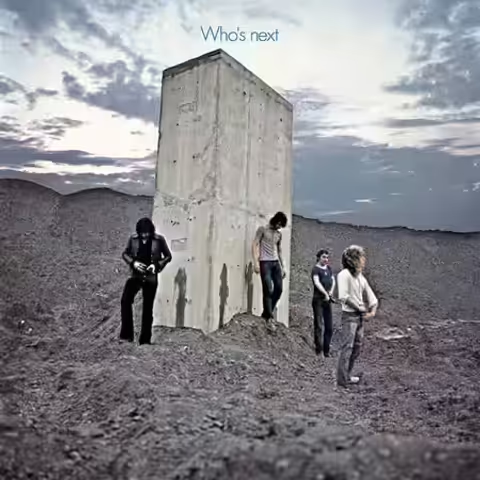
Lifehouse did not happen. Townshend did not quite have a nervous breakdown but came close enough to write about it later. The Who's manager Kit Lambert disappeared into Manhattan and a heroin habit. The band recorded a chunk of the project at the Record Plant in New York in March 1971 and hated it. They came home, handed the tapes to engineer Glyn Johns, and effectively asked him to find them an album in the wreckage. Nine tracks fell out. Eight of them are from Lifehouse. The ninth is by the bass player. The cover shows the four of them having apparently urinated against a concrete pillar in a Derbyshire slag heap. It was called Who's Next because nobody could think of anything better, and it became, by every measure that matters, the best record they ever made.
| Field | Detail |
|---|---|
| Artist | The Who |
| Album | Who's Next |
| Release date | August 1971 (UK and US) |
| Label | Track Records (UK), Decca Records (US) |
| Producer(s) | The Who, Glyn Johns (associate producer) |
| Studio(s) | Olympic Studios, Barnes, London; Stargroves, East Woodhay (Rolling Stones Mobile); Record Plant, New York (rejected) |
| Genre | Hard rock, arena rock |
| Track count | 9 |
| Total runtime | 43:39 |
| UK Albums Chart peak | 1 (the band's only UK number one) |
| US Billboard 200 peak | 4 |
| Other notable peaks | Australia 3, Canada 5, Netherlands 2, Denmark 3, Norway 6 |
| Certifications | RIAA 3x Platinum (US), BPI Platinum (UK), FIMI Platinum (Italy) |
| Key singles | Won't Get Fooled Again, Baba O'Riley, Behind Blue Eyes |
The aftermath of Tommy
By the start of 1970 the original audience The Who had built in Shepherd's Bush had aged out of being teenagers. Tommy had taken them from the West London mod circuit to opera houses and the Metropolitan in New York. Live at Leeds had documented the band on stage at full force in February 1970 and made the studio version of the same material seem thin by comparison. Tommy had been a triumph, but Townshend had also begun to resent it. The band were performing it almost in full every night, an hour-and-a-half lump that had to be unpicked before they could play anything else, and the audience were arriving wanting to hear the rock opera, not the band.
The Who tried, in 1970, to ease themselves out of the Tommy cycle without quite saying so out loud. They released a non-album single, The Seeker, and recorded an EP of new material that was never put out because they did not feel it was a strong enough successor. Live at Leeds came out in May. By the autumn Townshend was writing columns for Melody Maker about what a rock concert could become if you treated the audience as a participant. Lifehouse grew out of those columns. So did the breakdown.
"We were never nearer to breaking up."
Roger Daltrey, recalling the Lifehouse months, quoted in Andrew Neill and Matthew Kent, Anyway Anyhow Anywhere (Virgin, 2002)
The Lifehouse project
Lifehouse, Townshend has variously described as a futuristic rock opera, a live-recorded concept album, the score to a film he was writing in his head, and a working theory about how rock music actually functioned on a human nervous system. The plot, as outlined to Disc and Music Echo on 24 October 1970, was set in a near future in which pollution had driven the population indoors into government-issued Lifesuits, plugged into a mainframe called the Grid that simulated weather, food and entertainment. A rebel hacker named Bobby pirated rock music into the suits, allowing people to remove them. The climax was a concert at which audience biographical data, fed through synthesisers, would resolve into a universal chord that would set everyone free.
It is hard to say with a straight face that some of this was prescient, but some of it was. The Grid is not a bad description of an internet that did not yet exist. The personal-data-into-music idea, half-remembered by Townshend from the writings of the Sufi musician Inayat Khan, prefigures by thirty years the kind of generative-audio software his own Lifehouse Method website would attempt to build in 2007.
The plan was for the Who to take over the Young Vic theatre in Lambeth, develop the songs in front of the same audience for several months in a row, gradually fold real concertgoers into the film as characters and end with a notional musical apocalypse on celluloid. They held a press conference on 13 January 1971 to announce it. They installed a four-channel quadraphonic PA that cost thirty thousand pounds. Keith Moon finished his work on Frank Zappa's film 200 Motels and joined the band for the first Young Vic show on 15 February.
The audience wanted to hear My Generation and watch Townshend smash a guitar. The Who wanted them to participate in the construction of a fictional universe. These two desires never met. Lambert, Townshend's "interpreter" through the Tommy years, was not interpreting. He had become preoccupied with running Track Records, and was using heroin. He had also, without telling Townshend, gone to Universal Pictures and pitched Lifehouse to them as essentially a sequel to Tommy. By the time of the second pair of Young Vic gigs on 25 and 26 April, Townshend had given up.
- 13 January 1971: Lifehouse announced at a press conference.
- 15 February 1971: first Young Vic concert; the audience treats it as a regular Who gig.
- March 1971: Lifehouse sessions at Record Plant, New York with Kit Lambert producing.
- 25-26 April 1971: final Young Vic concerts, recorded on the Rolling Stones Mobile; Townshend cancels further dates.
- Early April 1971: Won't Get Fooled Again backing track cut at Stargroves; bulk of recording moves to Olympic.
- May-June 1971: Glyn Johns assembles the album from Olympic sessions.
The Record Plant disaster
Lambert's contribution to Lifehouse, when there still was a Lifehouse, was to insist that the album be recorded in New York. The Who flew over in March 1971 and set up at the Record Plant on West 44th Street. The musical guests around them were stronger than the production. Al Kooper, who had founded Blood, Sweat and Tears and played the Hammond on Like a Rolling Stone, came in to play organ. Ken Ascher of the Plastic Ono Band added piano. Leslie West, the cement-bricked guitar of Mountain, played lead on a version of Baby Don't You Do It and an electric arrangement of Love Ain't for Keeping. Townshend himself was using a 1957 Gretsch 6120 that Joe Walsh had given him as a gift earlier that year, an instrument that would remain his main studio guitar for the rest of the decade.
Lambert, by then, was barely in the room. The mixes he attempted afterwards were unusable. Glyn Johns, who had originally been brought in only to make safety copies of the New York multitracks, listened to the tapes back in London and politely told the band the entire album would have to be cut again from scratch. The Record Plant material was shelved. Most of it would not be heard until the 2003 Deluxe Edition, where the Leslie West takes finally surfaced as bonus tracks alongside an alternate Behind Blue Eyes featuring Al Kooper's organ.
Recording with Glyn Johns at Olympic and Stargroves
The first session for what became Who's Next happened at the start of April 1971 at Stargroves, Mick Jagger's seventeenth-century country house above Newbury. The Who set up in the great hall and used the Rolling Stones Mobile parked on the gravel outside. The backing track of Won't Get Fooled Again was cut there, including the synthesiser pulse that would dominate the finished record, lifted directly from Townshend's home demo and synced to a click. After that single Stargroves session the operation moved south-west to Glyn Johns' home base, Olympic Sound Studios in Barnes. The first attempt at Bargain went down on 9 April. The bulk of the sessions ran through May.
The defining quality of the Olympic recordings, and the thing that elevates Who's Next above any earlier Who studio album, is sound. Johns spent his career insisting he was an engineer who occasionally produced rather than the other way around, but his ear for room sound, microphone placement and drum tuning is what makes Won't Get Fooled Again sound the way it does. The drum sound on the album, in particular, is one of the great achievements of early-1970s engineering: Moon's kit captured close, dry and unfussed-with, the cymbals shimmering rather than splashing, the bass drum heavy without being soupy.
"We were just getting astounded at the sounds Glyn was producing."
Pete Townshend, quoted in Neill and Kent, Anyway Anyhow Anywhere (2002)
Johns' habit was to demand a take that worked, then move on. Moon's drumming, Wikipedia points out and the engineer-biographer Tony Fletcher confirms in Dear Boy, is markedly more disciplined on Who's Next than on any earlier Who record, leaning on figures rather than fills. Some of that is the synthesisers underneath demanding a steadier pulse. Most of it is Johns' refusal to let Moon turn every bar into an event.
The synthesisers themselves are the other story. Townshend had bought an EMS VCS 3 and an ARP, two of the first commercially available analogue synths in Britain, and figured out that if he plugged a Lowrey organ into them and held a chord he could turn the organ's notes into a stuttering, sequencer-like pattern. The opening of Baba O'Riley is one of those Lowrey-through-VCS3 patterns. The closing two-note pulse of Won't Get Fooled Again is another. Where most rock musicians of 1971 used synths as decoration on top of an arrangement, Townshend used them as the foundation underneath.
Lambert was nominally still executive producer on the released album and is credited on three Record Plant outtakes that ended up on bonus discs. In practice the production credit reads "The Who, Glyn Johns (associate producer)", with Doug Sax handling the mastering at The Mastering Lab in Los Angeles. Sax's lacquer cut is part of the reason early US Decca pressings still sell for serious money.
| Role | Player | Notes |
|---|---|---|
| The Who | ||
| Lead vocals | Roger Daltrey | All tracks except My Wife and Going Mobile |
| Guitars, vocals, synthesisers, Lowrey organ, piano | Pete Townshend | VCS 3 and ARP across the album; piano on Baba O'Riley |
| Bass, brass, vocals, piano on My Wife | John Entwistle | Lead vocal and overdubbed brass on My Wife |
| Drums, percussion | Keith Moon | Sits out the first half of Behind Blue Eyes |
| Guest musicians | ||
| Piano | Nicky Hopkins | The Song Is Over and Getting in Tune |
| Violin | Dave Arbus | Coda of Baba O'Riley; suggested by Keith Moon |
| Hammond organ | Al Kooper | Alternate Behind Blue Eyes (Record Plant; bonus track) |
| Lead guitar | Leslie West | Record Plant sessions only; Baby Don't You Do It and Love Ain't for Keeping (bonus tracks) |
| Production and engineering | ||
| Production | The Who | Released album credit |
| Associate producer, recording, mixing | Glyn Johns | Olympic Studios |
| Mastering | Doug Sax | The Mastering Lab, Los Angeles |
| Executive production | Kit Lambert, Chris Stamp, Pete Kameron | Lambert credited on three Record Plant outtakes |
| Artwork | ||
| Album design | John Kosh | Sleeve art direction; added the dramatic sky to the cover |
| Photography | Ethan Russell | Cover, gatefold and rear shot at De Montfort Hall, Leicester |
The songs
Eight of the nine tracks on Who's Next were originally written for Lifehouse. The exception is My Wife, John Entwistle's contribution, written after a row with his wife Alison and exaggerating it for comic effect. The track lengths and writing credits below are taken from the original UK Track release.
| # | Title | Writer(s) | Length | Lead vocal |
|---|---|---|---|---|
| 1 | Baba O'Riley | Pete Townshend | 5:08 | Daltrey (verses), Townshend (bridge) |
| 2 | Bargain | Pete Townshend | 5:34 | Daltrey, Townshend (bridge) |
| 3 | Love Ain't for Keeping | Pete Townshend | 2:10 | Daltrey |
| 4 | My Wife | John Entwistle | 3:41 | Entwistle |
| 5 | The Song Is Over | Pete Townshend | 6:14 | Townshend, Daltrey (chorus) |
| 6 | Getting in Tune | Pete Townshend | 4:50 | Daltrey |
| 7 | Going Mobile | Pete Townshend | 3:42 | Townshend |
| 8 | Behind Blue Eyes | Pete Townshend | 3:42 | Daltrey |
| 9 | Won't Get Fooled Again | Pete Townshend | 8:32 | Daltrey |
Baba O'Riley
The title is the most-explained joke in The Who's catalogue: Baba for Townshend's guru Meher Baba, Riley for the American minimalist composer Terry Riley, whose 1969 album A Rainbow in Curved Air had given Townshend the idea of building a song over a static, repeating keyboard pattern. The opening Lowrey-through-VCS 3 pattern is the surviving fragment of a much longer Townshend demo, an "experiment" he had run by feeding Meher Baba's biographical data into a sequencer. Townshend later said the part as released has "two or three thousand edits to it", an extraordinary admission for an analogue tape recording. Dave Arbus, the violinist Moon brought in, had been playing in the prog-folk band East of Eden; his coda is one of two takes.
Bargain
Built on a phrase Meher Baba had used about losing the self to find God, Bargain is the album's closest thing to a straightforward rock song with a synthesiser hidden inside it. Townshend's solo, doubled by an ARP figure, sits on top of one of Entwistle's most aggressive bass takes on the record.
My Wife
Entwistle's track is also one of the most complicated to assemble. The brass arrangement, played entirely by Entwistle himself (he had taken French horn at school), was overdubbed in a single half-hour session, with Glyn Johns refusing to let him spend any longer on it.
The Song Is Over
Originally conceived as the closing piece of the Lifehouse film, with the surviving humans walking out into a new world. The opening line "I'll sing my song to the wide open spaces" was supposed to be a callback to the lost track Pure and Easy, whose opening line ("There once was a note") was tagged onto the end of The Song Is Over as a coda. Nicky Hopkins' piano carries the verses; Daltrey takes the choruses.
Behind Blue Eyes
Written from the point of view of the villain in Lifehouse, a security boss called Jumbo, Behind Blue Eyes is the only track on the album where Keith Moon sits out for an extended stretch. Dave Marsh in Before I Get Old (1983) memorably described the first half as "the longest time Keith Moon was still in his entire life". Daltrey, Townshend and Entwistle harmonise across the verses; Moon arrives on the bridge like a door being kicked in.
"The longest time Keith Moon was still in his entire life."
Dave Marsh, Before I Get Old: The Story of The Who (Plexus, 1983), on the first half of Behind Blue Eyes
Won't Get Fooled Again
The longest, last and most photographed track on the album. Recorded at Stargroves, with the synthesiser part again lifted whole from Townshend's home demo and the band playing live around it. Townshend has spent fifty years being asked whether the song is left-wing or right-wing and has spent fifty years giving the same answer.
"A revolution is only a revolution in the long run, and a lot of people are going to get hurt."
Pete Townshend on Won't Get Fooled Again, sleeve notes to the 1995 remastered Who's Next, MCA
The cover
On 4 July 1971, en route from Sheffield to a gig in Leicester, the Who stopped at Easington colliery, a slag heap in north-east Derbyshire that the photographer Ethan Russell had scouted because it featured a concrete drainage pillar protruding from the spoil. The idea, John Entwistle and Keith Moon had decided over a Stanley Kubrick conversation, was a parody of the monolith from 2001: A Space Odyssey. The band would walk away from the structure as if they had just done something to it. According to Russell only Townshend actually urinated against the pillar; rainwater was tipped from a film canister to give the rest of them visible streaks. John Kosh, the art director, added the apocalyptic sky in post.
The original concept had been an overweight nude woman with the four band members' faces in place of her genitals. An alternative shoot had Moon dressed in black lingerie and a brown wig, holding a whip. Some of those photos surfaced inside the gatefold of the 1995 and 2003 reissues. The rear cover, of the band slumped on a battered sofa backstage, was shot the same night at De Montfort Hall, Leicester.
The pillar still exists. Most of its height has been buried as the slag heap was reclaimed for farmland, but the stub is now logged on Google Maps as the Who's Next Monolith and tourists still find it. In 2003 the cover was named one of the greatest album covers of all time by VH1.
Release and reception
The lead single Won't Get Fooled Again, edited down from eight and a half minutes to three and a half, came out on 25 June 1971 and reached number 9 in the UK and number 15 in the US. Who's Next followed in August on Track in the UK and Decca in the US. It became the only Who studio album ever to top the UK chart. In the US it stalled at number four, behind Carole King's Tapestry, but it stayed on the Billboard 200 for forty-eight weeks.
| Single | Released | UK | US | Notes |
|---|---|---|---|---|
| Won't Get Fooled Again (3:35 edit) | 25 June 1971 | 9 | 15 | Lead single, edited from 8:32 |
| Baba O'Riley | October 1971 (Europe only) | Not released | Not released | Not issued as a single in the UK or US at the time |
| Behind Blue Eyes | October 1971 (US only) | Not released | 34 | US single backed with My Wife |
| Let's See Action | October 1971 | 16 | Lifehouse track held back from the album, released as a stand-alone single |
Reviews at the time were strong but circumspect. John Mendelsohn in Rolling Stone, on 2 September 1971, called it "an old fashioned long-player containing intelligently-conceived, superbly-performed, brilliantly-produced and sometimes even exciting rock and roll", a back-handed verdict that praised the playing while gently warning the band against tidying themselves into sterility. Robert Christgau in The Village Voice was less hedged.
"The best hard rock album in years. The Who now achieves the same resonant immediacy in the studio that it does live."
Robert Christgau, Consumer Guide, The Village Voice, 19 August 1971
The Village Voice's annual American critics' poll, the Pazz and Jop, voted Who's Next the best album of 1971 in a year that also produced Tapestry, Sticky Fingers, Led Zeppelin IV, There's a Riot Goin' On and Hunky Dory. Retrospective opinion has only firmed up. Mojo's 2003 retrospective put it at the top of any Who album list; AllMusic's Stephen Thomas Erlewine wrote that where Tommy and Lifehouse "were art", Who's Next "even with its pretensions, is rock and roll". Rolling Stone placed it at number 28 on the original 2003 edition of its 500 Greatest Albums list, held that position in the 2012 update, and recalibrated to number 77 on the 2020 edition. Pitchfork ranked it 15 on its 2004 100 Best Albums of the 1970s list.
Touring and promotion
The Who began touring the US just before the album was released. The set list ditched most of Tommy and built itself instead around the new material. My Wife, Baba O'Riley and Won't Get Fooled Again all became permanent fixtures, with the synthesiser intros and codas played live to backing tape, an unprecedented thing for a rock band of their stature in 1971. Bob Pridden, the Who's long-suffering soundman, hated the technical demands and never quite forgave Townshend for them.
The autumn UK leg included a free show at the Oval cricket ground in Kennington in front of 35,000 fans, and the opening night of the new Rainbow Theatre in Finsbury Park. The tour returned to the United States and ended on 15 December 1971 in Seattle. The band then took eight months off the road, the longest break of their career to that point, before regrouping for what would become Quadrophenia.
- Oval cricket ground, Kennington, 18 September 1971: roughly 35,000 in attendance.
- Rainbow Theatre, Finsbury Park, 4 to 6 November 1971: opening shows for the venue.
- Forest Hills Tennis Stadium, New York: a four-night stand on the US run.
- Civic Auditorium, Seattle, 15 December 1971: closing show of the Who's Next tour.
B-sides, outtakes and lost songs
Lifehouse, before it collapsed, had been intended as a double album. Glyn Johns shrank it to nine tracks. The discarded material has trickled out over fifty years across compilations, deluxe editions and Pete Townshend's solo work. Pure and Easy, considered by Townshend the central song of Lifehouse, was cut from the album entirely apart from the closing line being tacked on to The Song Is Over; the full version surfaced on Odds and Sods (1974). Time Is Passing went to the same compilation. Too Much of Anything also lived on Odds and Sods. Let's See Action was released as a stand-alone Townshend single in October 1971 and reached number 16 in the UK.
I Don't Even Know Myself, written for the unreleased follow-up EP to Tommy in 1970, surfaced as the B-side of Won't Get Fooled Again. Naked Eye and Water, both attempted at the Young Vic in April 1971, only ever appeared in live form. The 16-track master tapes for Won't Get Fooled Again and the 8-track tapes for most of the rest of the album are now believed to survive; the Olympic mixing tapes themselves are thought to have been destroyed when Virgin Records bought Olympic in the 1980s and discarded large parts of its tape library.
Reissues, remasters and anniversaries
Who's Next has been reissued more often than almost any record in the Who catalogue. The first CD edition appeared on Polydor in the 1980s, replaced in 1995 by a remixed and remastered single disc with bonus tracks. In 2003 a 2-CD Deluxe Edition added the surviving Record Plant material, including Leslie West's lead guitar on Baby Don't You Do It, and the almost-complete second Young Vic concert from 26 April 1971. Heavyweight vinyl reissues followed in 2012. The fiftieth anniversary in 2021 was marked by a re-cut LP and a half-speed remaster.
The biggest of the lot was 2023's Who's Next / Life House Super Deluxe Edition, a ten-CD plus Blu-ray box set assembled by Pete Townshend with multichannel mixes by Steven Wilson. It bundled the album with 155 tracks of demos, alternate mixes, the Record Plant and Young Vic recordings, two live shows from the 1971 tour and a graphic novel telling the Lifehouse story for the first time in finished form. The video game publisher Harmonix, conversely, had spent the late 2000s trying to release Who's Next as Rock Band downloadable content and given up because they could not locate the multitracks; the eventual settle was a three-track Best of The Who pack.
Legacy
Who's Next is the moment The Who stopped trying to be a rock-opera company and re-emerged as a rock-and-roll band that happened to use synthesisers. Quadrophenia in 1973 and The Who by Numbers in 1975 followed; Keith Moon was dead by September 1978. The band's later catalogue contains good records and several that they themselves no longer rate, but no later Who album has the unity of purpose of this one. Mojo's 2003 retrospective wrote that the album's "hook-laden songs" had pioneered the use of rock synthesisers "without diluting the power-quartet attack that had defined the group since the mid-60s", and that is the most useful one-line description anyone has written of what is actually going on inside it.
"Tommy and the aborted Lifehouse project were art. Who's Next, even with its pretensions, is rock and roll."
Stephen Thomas Erlewine, AllMusic review of Who's Next
Baba O'Riley has now spent four decades as the kind of song that is used in trailers, sports broadcasts and television finales because it has more cinematic punch in its first eight bars than most films manage in two hours. Behind Blue Eyes was a US top-forty single in 1971 and was famously, and badly, covered by Limp Bizkit in 2003. Won't Get Fooled Again has soundtracked CSI: Miami, every American election cycle since 1980 and at least three different funerals of public figures. It is the rare song whose meaning has stayed roughly intact across half a century of being deployed for purposes its writer never intended.
Things you might not know
| Fact | Detail |
|---|---|
| The first attempt | The album was first recorded at the Record Plant in New York with Kit Lambert producing in March 1971; the entire session was scrapped and re-cut at Olympic with Glyn Johns. |
| Townshend's near breakdown | In the liner notes to the 1995 reissue, Townshend wrote that the failure of Lifehouse pushed him to the verge of a nervous breakdown; Daltrey said the band were "never nearer to breaking up". |
| The Stargroves session | Won't Get Fooled Again's backing track was cut at Mick Jagger's house Stargroves with the Rolling Stones Mobile parked outside. |
| Two thousand edits | Pete Townshend later said the Lowrey-through-VCS 3 part on Baba O'Riley contained "two or three thousand edits" by the time the version on the album was assembled. |
| Joe Walsh's gift | Townshend's main electric guitar on the album, a 1957 Gretsch 6120, had been given to him by Joe Walsh earlier in 1971 and remained his go-to studio guitar for the rest of the decade. |
| The unused covers | Original sleeve concepts included an overweight nude woman with the band's faces in place of her genitals, and Keith Moon photographed in lingerie holding a whip; the lingerie shoot resurfaced inside the 1995 and 2003 CD packaging. |
| Only Townshend | Photographer Ethan Russell has confirmed only Townshend actually urinated against the cover monolith; the streaks coming off the others were rainwater tipped from a film canister. |
| The pillar today | The concrete pillar in the cover photo is a drain from Bond's Main colliery near Easington, Derbyshire; most of its height has now been buried in reclaimed farmland but the stub is logged on Google Maps as "Who's Next Monolith". |
| The lost master tapes | The Olympic mixing masters are believed to have been destroyed when Virgin Records bought Olympic in the 1980s and discarded large parts of the tape library. |
| Harmonix's failed Rock Band release | Video game publisher Harmonix wanted to release Who's Next as Rock Band downloadable content in the late 2000s but could not locate multitracks for most of the album; only three tracks were ever made playable. |
| The brass session | John Entwistle played every overdubbed brass instrument on My Wife himself, in a single half-hour session at Olympic, after Glyn Johns refused to let him spend longer. |
| Their only UK number one | For all their critical reputation, this is the only Who studio album ever to reach number one on the UK Albums Chart. |
Comments