
Van Halen never planned to make Diver Down. The fifth Van Halen album exists because a throwaway idea got out of hand, and the band who recorded it spent decades afterwards arguing about whether it should exist at all. The plan, coming off the Fair Warning tour at the end of 1981, was to take a long break and write at leisure. David Lee Roth had a different thought: keep the band visible over the winter by dropping a quick one-off single. He wanted to cover "Dancing in the Street" and handed Eddie Van Halen the original Martha and the Vandellas tape. Eddie could not find a riff in it, suggested Roy Orbison's "(Oh) Pretty Woman" instead, and the band knocked it out in a single day at Sunset Sound.
Then the plan collapsed. "(Oh) Pretty Woman" climbed the charts, Warner Bros. smelled a hit and demanded a full album to capitalise, and a band who had wanted a rest found themselves back in the studio with no songs ready and a label breathing down their necks. What came out twelve days and roughly forty-six thousand dollars later was Diver Down: twelve tracks, five of them covers, three of them short instrumental sketches, a clarinet cameo from the guitarist's father, and a barbershop a cappella closer. It reached number three in America and sold four million copies, and Eddie Van Halen would spend the rest of his life calling it a mistake. This is the complete story of the most argued-over record Van Halen ever made.
Album Facts
| Field | Detail |
|---|---|
| Artist | Van Halen |
| Album | Diver Down |
| Release Date | April 1982 (sources cite both 14 and 19 April) |
| Label | Warner Bros. Records |
| Producer | Ted Templeman |
| Studio(s) | Amigo Studios, North Hollywood; Sunset Sound, Hollywood |
| Genre / Subgenre | Hard rock, power pop |
| Track Count | 12 |
| Total Runtime | 31:04 |
| Billboard 200 Peak | 3 |
| UK Albums Chart Peak | 36 |
| Other Notable Chart Peaks | Canada 5, France 9, Norway 19, Finland 20, Japan 22 |
| Certifications | US 4x Platinum (RIAA); Canada Platinum |
| Estimated Sales | Four million in the US by 1998 |
| Key Singles | "(Oh) Pretty Woman", "Dancing in the Street", "Secrets" |
Cultural Context: 1982
Nineteen eighty-two was the year MTV changed the rules. The channel had launched the previous August, and by 1982 a band's fortunes were starting to hinge on whether they had a video in rotation. Van Halen, already one of America's biggest live draws, understood the new landscape instinctively, and the "(Oh) Pretty Woman" video would become both a calling card and a scandal. The album landed in a hard-rock marketplace that was about to be reshaped by the very channel that would, within two years, turn Van Halen's "Jump" into an inescapable hit.
It was also a transitional moment for the band's own sound. Their previous album, Fair Warning, had been their darkest and least commercial, a tense, aggressive record that reflected the strain inside the group. Diver Down swung hard in the opposite direction: lighter, poppier, full of jokes and cover versions and sunshine. The contrast was deliberate, and it set up the tension that would define the band for the next two years, between Eddie Van Halen's appetite for heavier, more ambitious music and Roth's instinct for showbiz, fun and accessibility.
- MTV was less than a year old and beginning to dictate which rock acts broke nationally.
- Fair Warning (1981), the band's previous album, had been a commercial step down and a famously tense session.
- The 1960s revival was in the air, and Diver Down leaned into it with covers of Orbison, the Kinks, Martha and the Vandellas and a vintage jazz tune.
- Van Halen were a colossal touring act whose album sales had not yet caught up with their live reputation.
The Band's Story Up to This Point
By the start of 1982 Van Halen had released four albums in four years and toured almost without pause. The self-titled 1978 debut had detonated the hard-rock scene, largely on the strength of Eddie Van Halen's guitar playing, which made every other rock guitarist in the world stop and rethink what was possible. "Eruption", the instrumental showcase on that first record, rewired the instrument overnight. Van Halen II, Women and Children First and Fair Warning followed in quick succession, each one consolidating the band as the most exciting live act in American rock and Eddie as its most copied musician.
That relentless schedule was the problem. The band were exhausted. Fair Warning had been a difficult, combative album to make, with Eddie reportedly sneaking back into the studio at night to redo parts, and the group came off its tour wanting time off. The single-that-became-an-album scenario was the direct result of trying to stay in the public eye while doing as little as possible, and the irony was not lost on anyone: the laziest idea the band ever had turned into one of their most labour-intensive scrambles.
The other long-running tension that shaped Diver Down was the creative tug-of-war between Roth and the Van Halen brothers. Roth, the showman, loved the covers, the comedy, the vaudeville touches. Eddie, the musician, wanted to push the band somewhere more serious and more his own. Diver Down is the sound of Roth winning that argument for one record, and the resentment it bred in Eddie would echo all the way to the singer's departure a few years later.
Pre-production and Demos
There was almost no pre-production, which is the whole story of the album in a sentence. Because the record was a reaction to a hit single rather than a planned project, the band walked into the studio without a finished set of new songs. What they had instead was a grab-bag of fragments, old ideas and covers they could play in their sleep, and they assembled the album out of whatever was to hand.
Several of the original songs were not new at all. "Hang 'Em High" traced its roots back to 1976, when the same music carried different lyrics under the title "Last Night". "The Full Bug" borrowed heavily from an old demo called "The Bottom Line", which would eventually leak in 2023. The instrumental "Cathedral" had been part of Eddie's live arsenal throughout 1981, with earlier versions going back to 1980. Even the closing a cappella romp "Happy Trails" had been recorded as far back as the band's 1977 demos. The covers, meanwhile, came from the band's bar-band years: Roth had bought a budget-label Kinks double album in their club days, and the group had learned a whole side of it to fill out their sets.
In other words, Diver Down was built almost entirely from material that already existed in some form. The twelve days the band spent in the studio were less about writing than about quickly arranging, recording and assembling a record from spare parts. That improvised, make-do quality is exactly what its detractors hold against it and what its defenders love about it.
Creating the Album
The sessions ran fast and cheap. The bulk of the album was cut at Amigo Studios in North Hollywood, later renamed Warner Brothers Recording Studios, with the earlier "(Oh) Pretty Woman" single recorded at Sunset Sound in Hollywood. The producer was Ted Templeman, the band's regular studio partner since the debut, with Donn Landee engineering and Ken Deane assisting. The total cost came to roughly forty-six thousand dollars, a tiny sum even by 1982 standards, and the whole thing was finished in about twelve days. Eddie Van Halen's own account of how it happened is the clearest window into the album's chaotic birth.
"We said, 'Wait a minute, we just did that to keep us out there, so that people know we're still alive.' But they just kept pressuring, so we jumped right back in without any rest or time to recuperate from the tour, and started recording. We spent 12 days making the album."
Eddie Van Halen, Guitar Player, 1982
Working at that speed forced the band to be inventive on the spot. The album is full of studio experiments thrown together quickly: Eddie running the edge of his pick up and down the strings through an Echoplex to create the swirling effects in the "Where Have All the Good Times Gone" solo; the "cascade effect" on "Cathedral", where he plays steady eighth notes and lets a delay unit fill in the gaps to double the apparent speed; the Gibson doubleneck twelve-string he used on "Secrets", where the solo was reportedly nailed in a single take. For a record made in a rush, the guitar playing is astonishingly inventive, and that contradiction is central to the album's enduring appeal.
The speed also pushed the band toward genre tourism. Pressed for material, they padded the record with detours into jazz, country blues, doo-wop, a cappella and neo-classical music, alongside the mid-1960s covers. Some of it was Roth's vaudevillian sense of humour, some of it was Eddie chasing sounds he found interesting, and some of it was simply filling thirty-one minutes of vinyl as quickly as possible. The genre-hopping gives Diver Down its reputation as the band's strangest, most scattershot album, a record that lurches from a flamenco-flavoured instrumental to a barbershop quartet inside a few minutes.
Personnel and Credits
| Role | Player | Notes |
|---|---|---|
| Van Halen | ||
| Lead vocals, synthesizer, acoustic guitar, harmonica | David Lee Roth | Lead vocals throughout; synthesizer on "Intruder"; acoustic guitar and harmonica on "The Full Bug" |
| Guitars, backing vocals, synthesizer | Eddie Van Halen | Electric and acoustic guitars and backing vocals; synthesizer on "Dancing in the Street" |
| Bass, backing vocals | Michael Anthony | Bass guitar and backing vocals; also appeared in the "(Oh) Pretty Woman" video as a samurai |
| Drums | Alex Van Halen | Drums |
| Additional musician | ||
| Clarinet | Jan Van Halen | Eddie and Alex's father; clarinet on the "Big Bad Bill (Is Sweet William Now)" cover |
| Production and engineering | ||
| Producer | Ted Templeman | The band's regular producer since the 1978 debut |
| Engineer | Donn Landee | Long-time Van Halen engineer |
| Second engineer | Ken Deane | |
| Production coordination | Jo Motta | |
| Artwork | ||
| Art direction | Pete Angelus, Richard Seireeni | Angelus also co-directed the "(Oh) Pretty Woman" video |
| Photography | Richard Aaron, Neil Zlozower | Aaron shot the back-cover live photo at the Tangerine Bowl, Orlando, October 1981 |
The personnel list holds one genuine surprise: Jan Van Halen, the father of Eddie and Alex, playing clarinet on "Big Bad Bill". Jan was a professional clarinettist and saxophonist who had emigrated with the family from the Netherlands, and his cameo is one of the warmest moments on any Van Halen record. The rest of the credits are the classic four-piece, with Roth stepping out from behind the microphone to play synthesizer and harmonica, and Eddie adding the synth that would, two years later, define the band's biggest hit.
The Songs
| # | Title | Writer(s) | Length | Single? | Notes |
|---|---|---|---|---|---|
| 1 | "Where Have All the Good Times Gone!" | Ray Davies | 3:02 | No | The Kinks cover; a bar-band staple from the club days |
| 2 | "Hang 'Em High" | Van Halen | 3:28 | No | Reworked from a 1976 song called "Last Night" |
| 3 | "Cathedral" | Van Halen | 1:23 | No | Instrumental built on the "cascade" delay effect |
| 4 | "Secrets" | Van Halen | 3:28 | No | Lyrics inspired by greeting cards; doubleneck guitar |
| 5 | "Intruder" | Van Halen | 1:39 | No | Instrumental written to fill out the "Pretty Woman" video |
| 6 | "(Oh) Pretty Woman" | William Dees, Roy Orbison | 2:53 | Yes | The surprise hit that triggered the album |
| 7 | "Dancing in the Street" | Marvin Gaye, Ivy Hunter, William Stevenson | 3:43 | Yes | Martha and the Vandellas cover; Eddie on synth |
| 8 | "Little Guitars (Intro)" | Van Halen | 0:42 | No | Flamenco-style instrumental inspired by Carlos Montoya |
| 9 | "Little Guitars" | Van Halen | 3:47 | No | Played on a miniature Les Paul |
| 10 | "Big Bad Bill (Is Sweet William Now)" | Milton Ager, Jack Yellen | 2:44 | No | 1924 jazz tune; Jan Van Halen on clarinet |
| 11 | "The Full Bug" | Van Halen | 3:18 | No | Roth on acoustic guitar and harmonica |
| 12 | "Happy Trails" | Dale Evans | 1:03 | No | A cappella barbershop cover that closes the album |
The covers are the album's headline and its lightning rod. "(Oh) Pretty Woman" is the centrepiece, a muscular reading of the Orbison classic that turns the original's romantic ache into a strut. "Dancing in the Street", the Martha and the Vandellas song Roth had originally wanted as the band's stopgap single, opens with a shimmering Eddie Van Halen synthesizer line that pointed straight at the keyboard textures of 1984. "Where Have All the Good Times Gone", the Kinks song, became a high-octane opener, and even the slight "Happy Trails", a barbershop a cappella version of the old Roy Rogers and Dale Evans sign-off, has its defenders as a charming closing joke.
The instrumentals are where Eddie's restless creativity shows. "Cathedral" was named because the band thought it sounded like a church organ, and it remains a beloved showcase of his delay-driven "cascade" technique. "Little Guitars" grew out of his fascination with the flamenco playing of Carlos Montoya; unable to replicate Montoya's fingerpicking, Eddie used a pick, and he played the song on a tiny custom Les Paul built by Nashville luthier David Petschulat. And then there is "Intruder", the shrieking, dissonant instrumental that precedes "(Oh) Pretty Woman", which exists for one of the most unusual reasons in the catalogue: the band had to write it to pad out a music video.
Roth explained the origin of "Intruder" with characteristic flair. The promotional film for "(Oh) Pretty Woman" had run long, and rather than cut it, the band simply wrote new music to cover the surplus footage.
"It was about three minutes too long. So I said, we won't cut any of it, we'll write soundtrack music for the beginning. So we went into the studio and I played the synthesizer and I wrote it. It took about an hour to put that together."
David Lee Roth
The original songs hold up better than the album's reputation suggests. "Hang 'Em High" is a furious hard-rock workout, "The Full Bug" pairs Roth's harmonica with a swaggering riff, and "Secrets" is a genuinely lovely, almost wistful piece with one of Eddie's most melodic solos. Critics at the time complained there were too few originals and too many of them buried among the covers and interludes, but taken on their own, the band's own compositions on Diver Down are among the more underrated in the Roth-era catalogue.
B-sides, Outtakes and Lost Songs
Because Diver Down was assembled at speed from existing fragments, its "lost songs" story is really a story of where the album's parts came from rather than what got left off. The clearest example is "The Full Bug", which drew heavily on an old, unreleased demo called "The Bottom Line". That demo circulated among collectors for years and finally leaked in 2023, giving fans a glimpse of the raw material the band cannibalised to fill the record.
- "Last Night" (1976): the musical basis of "Hang 'Em High", with completely different lyrics, dating back to the band's earliest club years.
- "The Bottom Line": an unreleased demo reworked into "The Full Bug"; not to be confused with the later Roth solo song of the same name, it leaked in 2023.
- "Cathedral": not written for the album at all, but a live instrumental Eddie had been performing since 1980 and throughout the 1981 tour.
- "Happy Trails": recorded by the band as far back as their 1977 demos, years before it closed the album.
The pattern tells you everything about how the record was made. Diver Down is less a fresh batch of songs than a clearing of the band's shelves, which is precisely why it sometimes plays, in the words of one later critic, more like a superior rarities collection than a coherent studio album.
Album Artwork and Packaging
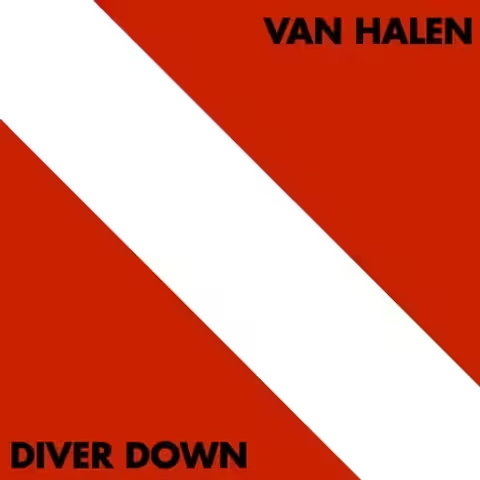
The cover is one of the most striking in the band's catalogue precisely because it shows nothing. The artwork is simply the "diver down" flag, the red banner with a diagonal white slash used in American and Canadian waters to warn boats that a scuba diver is submerged nearby. There is no band photo on the front, no faces, just the flag and minimal lettering, a starkness that critics noted made it look almost like a record by one of the era's austere post-punk groups rather than a Los Angeles party band.
David Lee Roth, ever the marketer, gave the image a deeper reading.
"It means there was something going on that's not apparent to your eyes. You put up the red flag with the white slash. Well, a lot of people approach Van Halen as sort of the abyss."
David Lee Roth
There was a saltier interpretation too. The band's manager Noel Monk, in his 2017 memoir Running with the Devil, explained the sleeve also carried a sexual double-entendre, "dive her down", which was very much in keeping with Roth's sense of humour. The back cover, by contrast, was pure rock spectacle: a Richard Aaron photograph of the band on stage at the Tangerine Bowl in Orlando, Florida, taken on 24 October 1981 as they closed a set opening for the Rolling Stones.
Release and Reception
Commercially, the gamble paid off handsomely. Diver Down reached number three on the Billboard 200, spent sixty-five weeks on the American chart, and actually sold faster than the more respected Fair Warning before it, eventually moving four million copies in the United States. The label's instinct to rush the band back into the studio had been vindicated by the numbers, whatever the band thought of the result.
Critics were divided then and remain divided now. Some loved the looseness and the humour. Don Waller, writing in the Los Angeles Times, was effusive.
"The best heavy-metal record to come along in several years."
Don Waller, Los Angeles Times, 1982
Others were scathing about the reliance on covers and filler. Parke Puterbaugh, reviewing the album for Rolling Stone, delivered the most quoted putdown.
"If you disregard the five cover versions and three instrumentals, Diver Down suddenly seems like a cogent case for consumer fraud. There's more excelsior here than in a shipment of glassware."
Parke Puterbaugh, Rolling Stone, 1982
British critics were similarly split, with the New Musical Express praising Ted Templeman's production for holding the experiments in "expert balance" while Record Mirror grumbled that reworking old standards and "messing around on the flip side" did not make a great album. The critical argument that started in 1982, is this a delightful lucky dip or a lazy cash-in, has never really been settled, which is part of what keeps the record interesting.
Singles and Music Videos
| Single | Original artist | Released | Notes |
|---|---|---|---|
| "(Oh) Pretty Woman" | Roy Orbison | 18 January 1982 | The surprise hit that forced the album into being; its video became one of MTV's first bans |
| "Dancing in the Street" | Martha and the Vandellas | May 1982 | Eddie Van Halen on synthesizer; a US hit that kept the album selling |
| "Secrets" | Van Halen original | 23 August 1982 | A gentler third single drawn from the band's own compositions |
The singles tell the album's backwards story in order. "(Oh) Pretty Woman" came out in January 1982, before the album even existed as a concept, and its success is the entire reason Diver Down was made. "Dancing in the Street", released that May, was the song that started the whole chain of events, the cover Roth had first wanted as a standalone single, finally released after Eddie reshaped it around a synthesizer hook. "Secrets" followed in August, a quieter choice that showed the label still had faith in the band's original material.
The "(Oh) Pretty Woman" video, directed by Roth with Pete Angelus, was a surreal mini-movie featuring the band members in costume, and it ran into trouble almost immediately, a story told in full in the controversy section below. It was, Roth said, made rather like a surrealistic art project where the makers paint the picture and come back later to figure out what they meant.
Touring and Live
Van Halen took Diver Down on the road through 1982 on the Hide Your Sheep tour, a typically enormous Roth-era production that kept the band's reputation as one of the most thrilling live acts in the world fully intact. The album's looser material translated well to the stage, where Eddie's instrumental showcases like "Cathedral" and "Little Guitars" gave the set room to breathe between the heavier numbers and the covers gave the crowd singalongs.
The tour also set the stage for the band's commercial peak. By the time it wound down, Eddie had built his own home studio, 5150, and the band were about to make the album that would eclipse everything before it. Diver Down, in that sense, was the last gasp of the band's first phase: the scrappy, covers-and-jokes Van Halen, before the keyboards and the stadium pop of 1984 changed the picture entirely.
- The Diver Down material was carried on the 1982 Hide Your Sheep tour, one of the band's biggest productions to that point.
- Eddie's instrumental pieces became live set-pieces, giving the show its quieter, virtuosic moments.
- The tour directly preceded the building of the 5150 home studio and the recording of 1984.
In TV, Film and Media
The album's biggest media footprint is, fittingly, a music video rather than a song. The "(Oh) Pretty Woman" clip became a notorious early MTV talking point, and its banning generated more publicity than any amount of airplay could have. The band's reading of "(Oh) Pretty Woman" also kept the Orbison standard alive for a new generation of rock fans, several years before the song's resurgence through the 1990 film of the same name reintroduced the original to a mass audience.
Beyond that, Diver Down's afterlife is mostly bound up with Van Halen's own legend. The story of the album, the one-day single, the twelve-day scramble, the clarinet-playing father, has been retold endlessly in documentaries, magazine retrospectives and band biographies, to the point where the making of the record is now more famous than several of the songs on it.
Controversy and the Banned Video
The "(Oh) Pretty Woman" video was one of the first clips MTV pulled from rotation, and the reasons were as strange as the video itself. Directed by Roth and Pete Angelus, it featured a surreal cast of characters, including the band members in costume, and two scenes drew complaints. One was a sequence in which bassist Michael Anthony appeared dressed as a samurai, which some viewers felt mocked what Roth later described as an almost theological figure. The other, more seriously, showed two little people appearing to molest a woman, played by a Los Angeles area transgender performer, who was being tied to a pole.
MTV, still finding its feet as a broadcaster in 1982, decided the imagery was too much and stopped airing it. The ban, as bans tend to do, only added to the band's outlaw mystique and the song's profile. Roth, never one to apologise, framed the whole video as deliberately surreal and open to interpretation, and the clip has since been aired freely on classic-video channels. It remains one of the odder footnotes in early MTV history, a banned video for a cover song from an album the band had not even meant to record.
Covers, Samples and Tributes
There is a layered irony in discussing covers of Diver Down, an album that is itself nearly half cover versions. The record is best understood as Van Halen paying tribute, turning Roy Orbison, the Kinks, Martha and the Vandellas, a 1924 jazz number and an old cowboy sign-off into vehicles for their own sound. In doing so they sent younger rock fans back to the originals, and the band's beefed-up "(Oh) Pretty Woman" became, for many listeners of a certain age, the definitive rock version of the song.
The album's most-loved instrumental, "Cathedral", has become a rite of passage for ambitious rock guitarists, its delay-cascade technique studied and imitated by players trying to understand how Eddie Van Halen made one guitar sound like a stream of impossibly fast notes. "Little Guitars" and "Cathedral" together are a large part of why Diver Down is so well regarded specifically as a guitar album, even by people who dismiss it as a song collection.
Reissues, Remasters and Anniversaries
Diver Down has followed the rest of the early Van Halen catalogue through the standard cycle of CD reissues and remasters since its original 1982 release. It was remastered as part of the wider campaign to bring the band's Warner Bros. albums up to modern audio standards, and it has been a fixture of the band's boxed retrospectives and digital reissues. The fortieth anniversary in 2022 prompted a fresh round of retrospective features and reappraisals, many of which made the case that the album had been unfairly dismissed for decades.
It is worth noting that the album's reputation has genuinely improved over time. Where contemporary critics often filed it under filler, later writers and the band's own fanbase have increasingly embraced its summery, playful character. In 2022 Guitar World ranked it number three on its list of the greatest rock guitar albums of 1982, a striking accolade for a record so often dismissed as a stopgap.
Legacy and Influence
Diver Down occupies a peculiar place in the Van Halen story: commercially successful, critically divisive, and disowned by its own principal author. In rankings of the band's catalogue it tends to land in the middle, rated seventh best by Ultimate Classic Rock and the staff of Consequence, and ninth by Loudwire. Its defenders point to its consistent, sun-drenched mood and its run of dazzling guitar interludes. Stephen Thomas Erlewine, in his retrospective AllMusic review, went further than most.
"One of Van Halen's best records, one that's just pure joy to hear."
Stephen Thomas Erlewine, AllMusic
Eddie Van Halen never came round to it. In later years he repeatedly criticised the album for being rushed to meet Warner Bros.' demands and for leaning too heavily on covers, viewing it as a compromise forced on him rather than a record he was proud of. That tension, between Eddie's discomfort and the affection the album inspires in fans, is the heart of its legacy. It is the ultimate example of the Roth-era Van Halen's gift for turning chaos, exhaustion and label pressure into something fun, even when the band themselves were not having much fun making it.
It also marked the end of an era. The very next album, 1984, would bring synthesizers to the foreground, deliver the colossal hit "Jump", and then break the classic lineup apart when Roth left. Diver Down is the last record of the band's first chapter, a messy, charming, argued-over goodbye to the scrappy club band Van Halen had been before they became a global pop phenomenon. Country star Kenny Chesney, who later became friendly with Eddie, has said it was the first album he ever bought, which is as good a testament as any to how far its reach extended beyond the hard-rock faithful.
Things You Might Not Know
| Fact | Detail |
|---|---|
| The album that nearly wasn't | Van Halen only made Diver Down because their one-day cover of "(Oh) Pretty Woman" became a hit and Warner Bros. demanded a full album to follow it. |
| Twelve days, forty-six grand | The whole album was recorded in roughly twelve days for about 46,000 dollars, making it one of the fastest and cheapest records the band ever made. |
| Roth wanted a different song | The single that started it all was meant to be "Dancing in the Street"; Eddie could not find a riff in it and suggested "(Oh) Pretty Woman" instead. |
| Dad on clarinet | Eddie and Alex's father, Jan Van Halen, a professional clarinettist, plays on the cover of "Big Bad Bill (Is Sweet William Now)". |
| A song to fill a video | The instrumental "Intruder" was written purely to pad out the "(Oh) Pretty Woman" promo film, which Roth said ran about three minutes too long. |
| The cover shows a warning flag | The sleeve is simply the diver-down flag used to warn boats a scuba diver is submerged, chosen by Roth to suggest hidden depths beneath the band. |
| A hidden double meaning | Manager Noel Monk revealed in his 2017 memoir that the title also carried the sexual pun "dive her down". |
| Banned by MTV | The "(Oh) Pretty Woman" video was one of the first clips MTV pulled, over a mock-samurai scene and an apparent assault sequence. |
| The miniature guitar | "Little Guitars" was played on a tiny custom Les Paul built by Nashville luthier David Petschulat and sold to Eddie on the Fair Warning tour. |
| The cascade trick | "Cathedral" uses a delay effect to fill the gaps between Eddie's eighth notes, doubling the apparent speed and mimicking a church organ. |
| Recycled from the shelves | "Hang 'Em High" dates to a 1976 song called "Last Night", and "Happy Trails" was first recorded for the band's 1977 demos. |
| Shot opening for the Stones | The back-cover live photo was taken at the Tangerine Bowl in Orlando in October 1981, when Van Halen opened for the Rolling Stones. |
| Eddie disowned it | Despite its four million sales, Eddie Van Halen spent years criticising Diver Down as a rushed, covers-heavy compromise he never wanted to make. |
| Kenny Chesney's first album | The country superstar has said Diver Down was the very first album he ever bought. |
Riffology Podcast
If you enjoyed this complete story of Diver Down, the Riffology podcast goes deep on the albums that shaped hard rock and heavy metal, from the records that made bands to the ones that nearly broke them. Riffology is available on Apple Podcasts, Spotify, Amazon Music, Pocket Casts and every other major platform; subscribe wherever you listen, and we will see you for the next deep dive.

Comments