Peter Buck spent the second half of the 1980s quietly bored with the electric guitar. In 1987, on the Document tour, he bought a mandolin from a music shop, decided he would teach himself, and recorded his practice sessions onto a domestic cassette in case anything useful turned up. Three years later he played one of those tapes back and found, hidden in the noodling, the four-bar figure that would become the lead single from R.E.M.'s seventh studio album.
That figure was barely 30 seconds long, contained no chorus, and was led by an instrument that had not been heard on a number-one American rock record since the 1960s. Warner Bros. Records did not want to release it as a single. The band insisted. Five months later Losing My Religion sat at number four on the Billboard Hot 100, Out of Time was at number one in both the United States and the United Kingdom, and an Athens, Georgia college-rock band who had spent a decade selling 300,000 albums at a time were, suddenly and entirely on their own terms, the biggest band in the world. They did not tour the record. They never had to.
Album Facts
| Field | Detail |
|---|---|
| Artist | R.E.M. |
| Album | Out of Time |
| Release Date | 12 March 1991 |
| Label | Warner Bros. Records (catalogue 9 26496) |
| Producers | Scott Litt and R.E.M. |
| Studios | John Keane Studios, Athens GA (demos and overdubs); Bearsville Sound Studios, Woodstock NY (3-22 September 1990); Soundscape Studios, Atlanta (strings); Paisley Park, Minneapolis (mixing) |
| Genre | Alternative rock, jangle pop, folk rock, pop rock |
| Track Count | 11 |
| Total Runtime | 44:18 |
| Billboard 200 Peak | 1 (two separate runs; 109 weeks on chart) |
| UK Albums Chart Peak | 1 (183 weeks on chart) |
| Other Notable Chart Peaks | 1 in Australia, Canada, Germany, Ireland, the Netherlands, New Zealand and Switzerland |
| Certifications | 4x Platinum (US, RIAA); 3x Platinum (UK, BPI); Diamond-eligible globally |
| Estimated Sales | Over 18 million worldwide |
| Key Singles | Losing My Religion, Shiny Happy People, Near Wild Heaven, Radio Song |
Cultural Context
March 1991 was the moment American rock was visibly shifting under its own feet. Nirvana's Nevermind was six months from release and still being demoed in Van Nuys. Pearl Jam were rehearsing in Seattle under their old name, Mookie Blaylock. Metallica's Black Album was a month from its own seismic launch. The Billboard 200 going into release week was a snapshot of the old order: Mariah Carey at the top, Madonna's Immaculate Collection, Vanilla Ice's To the Extreme, C+C Music Factory, Wilson Phillips. The Gulf War had ended a fortnight earlier; Operation Desert Storm's victory parades were still being scheduled.
Into this landscape arrived an album with KRS-One on the opening track and a mandolin on track two, made by four men who had spent the 1980s as the most quietly influential band in American underground rock. The records sitting around Out of Time in the alternative section that month give a fair picture of the company R.E.M. were keeping and the company they were about to leave behind:
- Jane's Addiction, Ritual de lo Habitual, released the previous August and still on the chart.
- Pixies, Bossanova, the band's most accessible record to date but still firmly on 4AD.
- Sonic Youth, between Goo and Dirty, having just signed to DGC.
- The Replacements, six months from disbanding after All Shook Down.
- Dinosaur Jr., touring Green Mind at clubs that R.E.M. had outgrown five years earlier.
Out of Time would, within three months of release, share a top-ten chart slot with all of those acts being heard but mostly only at college radio. The album was the proof that an alternative rock band could go straight from 120 Minutes to the top of the Billboard 200 without changing what they sounded like. The path that Nevermind's autumn release would widen was, in commercial terms, opened by R.E.M. that March.
The Band's Story Up to This Point
R.E.M. had been a working band for almost exactly eleven years by the time Out of Time appeared. Michael Stipe, Peter Buck, Mike Mills and Bill Berry had met as students at the University of Georgia in Athens in early 1980, played their first show in April that year at a converted Episcopal church called St. Mary's, and signed to I.R.S. Records on the basis of a self-released seven-inch (Radio Free Europe, 1981) that John Peel played on the BBC and college DJs across the eastern seaboard fell on with the kind of devotion usually reserved for British post-punk imports.
The I.R.S. run, Murmur (1983), Reckoning (1984), Fables of the Reconstruction (1985), Life's Rich Pageant (1986), Document (1987), made them by stages the most critically revered band in America. Rolling Stone put Murmur at number one on its album-of-the-year list in 1983, above Michael Jackson's Thriller. By Document, with Scott Litt now producing, the band had its first US top-ten single (The One I Love) and a platinum album. The 1988 jump to Warner Bros. produced Green, the world tour that supported it, eleven months of arena dates ending in November 1989, and a band that finished 1989 exhausted and openly debating whether they wanted to continue at all.
What changed their minds was a low-key handshake decision in early 1990. They would still make records and still make them together. But they would stop touring on the old model. They would experiment in the studio. They would swap instruments. Buck would put down the Rickenbacker. Mills would step up to a microphone. They would invite people in. Whatever the next record sounded like, it would not sound like another Green.
Pre-production and Demos
Writing began at John Keane's studio in Athens in the early summer of 1990 with Stipe deliberately absent. The singer was in Europe on a low-profile, mostly acoustic political tour with Billy Bragg and Natalie Merchant; the instrumentalists tracked roughly twenty backing demos in his absence, then handed him a single cassette of the lot when he returned to Athens that July. Stipe drove around town with the tape in his car for several weeks, sketching melodies and lyric fragments while he drove, and decided, partly in reaction to the political polemics of the Bragg tour, that this would be the record where he tried to write love songs.
Several of the album's most distinctive songs already existed in some form by the time the band reconvened. Losing My Religion had emerged from one of Buck's mandolin practice tapes under the working title Sugar Cane, with banjo, Hammond organ and a McVie-influenced bass line; the Bearsville arrangement would strip it back. Country Feedback did not exist at all. Shiny Happy People had been written by Mills on acoustic guitar in a much darker key and would only find its bubblegum form in the studio. Two songs that would appear on the follow-up, Drive and Nightswimming, were demoed during the same sessions and held back.
Creating the Album
The principal sessions ran from 3 to 22 September 1990 at Bearsville Sound Studios, the Albert Grossman-built complex in Woodstock, New York where the band had mixed Green the previous year and felt at home. Scott Litt, the New Yorker who had produced Document, Green and most of Eponymous, was back as co-producer and chief engineer. The instruction in the room was the one the band had given themselves over the winter: nobody plays what they played on Green. Buck divided his time between mandolin, acoustic guitar and only occasional electric. Mills moved between bass, Hammond B-3, piano, harpsichord and lead vocals (his first on a band-original studio track). Bill Berry, who had a degree in songwriting from his Macon, Georgia days and had been the band's bassist long before drummer, played bass on at least three tracks (Half a World Away, Low, Endgame), congas on others, and on Country Feedback ended up handling percussion while John Keane himself sat in on pedal steel.
Overdubs were tracked back at John Keane's studio in Athens through October. The string arrangements, written and conducted by the New Orleans-based arranger Mark Bingham, were cut at Soundscape Studios in Atlanta with members of the Atlanta Symphony Orchestra reading Bingham's charts. The whole record was then trucked to Minneapolis to be mixed at Paisley Park, Prince's gold-leaf-and-purple compound on Audubon Road, between late October and early December 1990. The choice was practical (Paisley Park had then-state-of-the-art SSL desks and a relationship with Litt) rather than personal: Prince was on tour in Europe for most of the mixing window and the band recall seeing him in the building only twice. It was at Paisley Park that the demos for Drive and Nightswimming were cut.
Mills told Pitchfork in 2011 how naturally the instrument swap had landed:
"If you want to talk about life-changing, 'Losing My Religion' is the closest it gets. Peter on mandolin, me on bass with my eyes on John McVie, Bill on congas, Michael in a vocal booth half-undressed because he couldn't bear the heat of what he was about to sing. That's the whole record in one room."
Mike Mills, Pitchfork, 2011
Personnel and Credits
| Role | Player | Notes |
|---|---|---|
| Core band | ||
| Lead vocals | Michael Stipe | Lead on all tracks except Near Wild Heaven and Texarkana; spoken word on Belong |
| Guitar, mandolin | Peter Buck | Lead mandolin on Losing My Religion, Half a World Away, Endgame; acoustic guitar across the record; electric only on Radio Song, Texarkana, Me in Honey, Country Feedback |
| Bass, Hammond organ, piano, harpsichord, lead vocals | Mike Mills | Lead vocals on Near Wild Heaven and Texarkana; harpsichord on Half a World Away |
| Drums, bass, congas, vocals | Bill Berry | Bass on Half a World Away, Low and Endgame; congas on Shiny Happy People and Country Feedback |
| Guest and session musicians | ||
| Rap, vocals | KRS-One | Radio Song; recorded in New York and flown to Bearsville |
| Backing and co-lead vocals | Kate Pierson (The B-52s) | Shiny Happy People, Me in Honey, Country Feedback |
| Tenor, alto, baritone saxophone, bass clarinet | Kidd Jordan | Atlanta free-jazz veteran; Radio Song, Low, Endgame |
| Acoustic guitar, bass | Peter Holsapple | Formerly of the dB's; R.E.M.'s 1989 touring guitarist; Losing My Religion, Low, others |
| Flugelhorn | Cecil Welch | Henry Mancini's long-time brass player |
| Pedal steel guitar | John Keane | Studio owner and Athens fixture; Country Feedback |
| Strings | Members of the Atlanta Symphony Orchestra | Arranged and conducted by Mark Bingham; recorded at Soundscape Studios, Atlanta |
| Production and engineering | ||
| Producers | R.E.M. and Scott Litt | Their third album together after Document and Green |
| Engineer | Scott Litt | At Bearsville and Paisley Park |
| Additional engineering | John Keane, Clif Norrell, Brendan O'Brien | O'Brien's first major credit; he would produce Pearl Jam's Vs. two years later |
| Mastering | Stephen Marcussen | Precision Mastering, Hollywood |
| String arrangements | Mark Bingham | New Orleans-based arranger |
| Artwork | ||
| Art direction | Michael Stipe and Tom Recchion | Recchion was Warner Bros.' in-house design lead |
| Cover photograph | Doug and Mike Starn | Yellow Seascape with Film and Wood Blocks (1988-89), used by permission of the artists |
| Interior illustrations | Ben Katchor | Comic-strip vignettes throughout the booklet |
| Hand lettering | Ed Rogers | Song titles |
The Songs
| # | Title | Writer(s) | Length | Single? | Notes |
|---|---|---|---|---|---|
| 1 | Radio Song | Berry, Buck, Mills, Stipe | 4:14 | Fourth single (Nov 1991) | Features KRS-One; Hammond organ from Mills |
| 2 | Losing My Religion | Berry, Buck, Mills, Stipe | 4:28 | Lead single (Feb 1991) | Mandolin throughout; Stipe vocal in one take |
| 3 | Low | Berry, Buck, Mills, Stipe | 4:55 | No | Mills lead organ; Jordan on bass clarinet; Berry on bass |
| 4 | Near Wild Heaven | Berry, Buck, Mills, Stipe | 3:18 | Third single (Aug 1991, UK only) | Mills lead vocal; first R.E.M. original with Mills singing lead |
| 5 | Endgame | Berry, Buck, Mills, Stipe | 3:48 | No | Instrumental closing of side one; Welch flugelhorn |
| 6 | Shiny Happy People | Berry, Buck, Mills, Stipe | 3:44 | Second single (May 1991) | Pierson duet; mid-song waltz break suggested by Buck |
| 7 | Belong | Berry, Buck, Mills, Stipe | 4:04 | No | Stipe vocal recorded into Litt's personal Walkman in a garage |
| 8 | Half a World Away | Berry, Buck, Mills, Stipe | 3:26 | No | Harpsichord, mandolin, Berry on bass |
| 9 | Texarkana | Berry, Buck, Mills, Stipe | 3:36 | No | Mills lead vocal; lyrics finished by Mills in roughly half an hour |
| 10 | Country Feedback | Berry, Buck, Mills, Stipe | 4:07 | No | Recorded in two passes; Stipe vocal improvised in one take |
| 11 | Me in Honey | Berry, Buck, Mills, Stipe | 4:06 | No | Stipe-Pierson duet; closes the record |
Radio Song
The album's most contentious opener is a deliberate provocation: a funk-tinged piece with a sardonic KRS-One verse aimed at Top 40 radio programming, built on a Buck guitar riff that takes its cue from late-1960s Stax-Volt and a Mills organ part doing service as a horn section. Kidd Jordan's baritone saxophone anchors the bottom end. The song was sequenced first because nobody, including the band, could decide where else it would fit. As an opening statement it tells the listener that the record they are holding will not behave like the previous one.
Losing My Religion
The mandolin figure had been on the practice tape for weeks before Buck noticed it. The full band wrote the song from his demo in roughly five minutes on the floor of John Keane's studio. The title is a Southern American expression for being at the end of one's patience, not a statement about faith; Stipe later said the emotional template was The Police's Every Breath You Take, which he called "one of the most beautiful and creepy songs ever written," and that the lyric was leaning towards Gabriel Garcia Marquez's Love in the Time of Cholera in its picture of obsessive love. The vocal at Bearsville was a single take with Stipe, by his own and the band's account, stripping off most of his clothes in the booth because of the heat of the performance. Buck refused to punch in the spot where his live mandolin pick muffles a note: the take stood as recorded.
Warner Bros.' singles department, Russ Thyret in particular, were openly unsure about leading with a five-minute song that has no chorus and is led by an instrument most of their A&R team did not recognise. The band insisted. The Tarsem Singh-directed video, which lifts its lighting and tableaux from Caravaggio and the iconography of saints, took six MTV Video Music Awards at the September 1991 ceremony (including Video of the Year) and two Grammys. The single reached number four on the Billboard Hot 100, R.E.M.'s highest US chart placing then or since, and number 19 on the UK Singles Chart.
Shiny Happy People
The most defended and most disowned song in the catalogue. The phrase "shiny happy people" is widely (though not definitively) traced to a piece of post-Tiananmen Chinese government propaganda; Stipe has cited the phrase as appearing in English-language coverage of the 1989 crackdown and intended the song's relentless cheerfulness as a kind of overdrive irony. By the time it was recorded, with Kate Pierson handed the studio with instructions to "do whatever you want," any irony had been buried under a wall of Pierson's harmonies, a mid-song shift into waltz time that Buck modelled on Chicago's Saturday in the Park, and Berry's congas. It went to number 10 on the Billboard Hot 100 and number six on the UK Singles Chart, R.E.M.'s only single to reach the top ten in both territories. The band have been variously embarrassed by and resigned to it ever since; the 1999 Sesame Street rework as Furry Happy Monsters, with a Muppet Pierson, may be the most graceful re-contextualisation any band has ever performed on its own back catalogue.
Country Feedback
The album's spiritual centre and, by Stipe's own and oft-stated estimation, his single favourite R.E.M. recording. The song did not exist on the demo tape. Buck and Berry were killing time at John Keane's waiting for the others; Buck had a chord progression he had been picking at, Berry sat down with percussion and bass, Keane sat in on pedal steel, and Mills arrived to add a funereal Hammond organ part. The title is literal: the two overdubbed guitar parts are country (Keane's pedal steel) and feedback (Buck's electric).
The next day Stipe came in carrying a scrap of paper with phrases from what he later described as an unsent letter about a failed relationship. He sang the lyric, semi-improvised, in one take and walked out of the room. Buck described it later in straightforward terms:
"It's exactly what was on his mind that day. It was real."
Peter Buck, Musician magazine, 1992
Bill Berry, by his and Mills's recollection, listened to the playback and said the line that decided the matter:
"I think this song is finished. We don't need to re-record this one."
Bill Berry, recalled by Mike Mills in Q magazine, 1992
They never did. In 1998 Neil Young joined the band on stage at his Bridge School Benefit at Shoreline Amphitheatre for an unrehearsed performance of Country Feedback that ran past nine minutes; Stipe visibly broke down in the second half. Courtney Love has claimed in interview that the lyric was in part about her, citing specific lines she says Stipe explained to her; Stipe has not confirmed and has continued to describe the song in more general terms as one about the ugly end of love.
Deep Cuts
Low, the album's third track, is a hymn-paced piece built on Mills's organ and Berry's bass, with Kidd Jordan's bass clarinet adding a low woodwind layer that the band have never used before or since. Half a World Away is a Baroque-pop miniature with harpsichord, mandolin and a chord movement that openly nods to British psychedelic-folk records of 1967-68. Near Wild Heaven, the first R.E.M. original song with Mike Mills singing lead, is a Beach Boys pastiche so warm and well-built that the band released it as a third (UK-only) single in August 1991; Texarkana, also a Mills lead, has lyrics that Mills wrote and tracked himself in roughly half an hour after Stipe gave up on the second verse.
Belong, track seven, is the record's most experimental moment: Stipe's spoken-word vocal was recorded into Scott Litt's personal Sony Walkman in a garage outside John Keane's studio to deliberately get a lo-fi, room-noise quality, then dropped onto a single sustained bass note and an instrumental backing that builds across the song's four minutes. Endgame is a near-instrumental closing-credits piece with Cecil Welch's flugelhorn on top of a slow Buck/Mills chord progression. Me in Honey, the final track, sends the record out on a Stipe/Pierson duet driven by Berry's drumming, the most propulsive thing on the record after Radio Song and a deliberate counterweight to the funereal middle.
B-sides, Outtakes and Lost Songs
R.E.M.'s singles policy in 1991 was generous by major-label standards. The CD and 12-inch versions of Losing My Religion carried live takes of Rotary Eleven (a Buck/Mills instrumental that never appeared on a studio album), an acoustic Fretless (a song that would later appear on the soundtrack to Wim Wenders's Until the End of the World in November 1991), and the live show staple After Hours, a Velvet Underground cover. The Shiny Happy People single added the early electric-guitar demo of Forty Second Song (one minute fourteen of pure jangle, never given a studio version) and the country-blues B-side L.A. Rain.
Two of the album's most significant outtakes did not appear as B-sides at all: the early demos of Drive and Nightswimming that the band tracked at Paisley Park while mixing Out of Time. Both were held back for Automatic for the People (October 1992). The Drive demo from Paisley Park surfaced on the 25th anniversary reissue of Out of Time in November 2016 and is recognisably the song in skeletal form, with Stipe singing a placeholder melody over Mills's piano. A working-title piece called Memo to Mike, an instrumental sketch from the Bearsville sessions, also appeared on the 25th anniversary set.
Album Artwork and Packaging
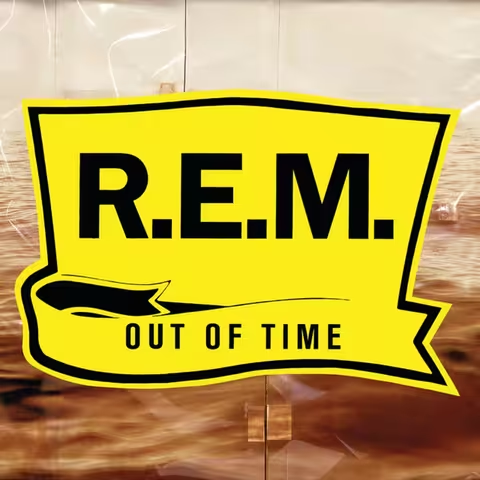
The cover photograph is Yellow Seascape with Film and Wood Blocks, a 1988-89 work by the twin-brother artists Doug and Mike Starn. The Starns built their reputation in the late 1980s on photographic prints that they then ripped, taped, scratched, pinned and reassembled into objects; the Yellow Seascape piece is two halves of a manipulated Pacific Ocean photograph held together with metal push pins on a stained yellow ground. Over this, Tom Recchion at Warner Bros.' art department and Michael Stipe placed a large rounded white banner bearing the album title in a hand-drawn typeface. The result divided contemporary reviewers (Amazon would later describe the sleeve as matching "their ugliest album cover with some of their most sublime music"), but it placed the album visually in the fine-art camp at a time when most major-label rock covers were still doing band-photo-against-a-wall.
The CD booklet carried comic-strip vignettes by the cartoonist Ben Katchor, who had been drawing his Julius Knipl, Real Estate Photographer strip for New York Press since 1988 and would later win a MacArthur Genius grant; the song titles were hand-lettered by Ed Rogers. The US release came in the then-standard CD longbox, the wasteful cardboard sleeve the major labels used to make CDs fit existing vinyl racks. R.E.M., who had been vocal about the format's environmental cost, used the back of the longbox for a Rock the Vote petition supporting the National Voter Registration Act (the "Motor Voter Act"). The petition collected enough signatures to be cited by Congressional sponsors when the bill was reintroduced; President Clinton signed it into law in 1993.
Release and Reception
The album was released on Tuesday 12 March 1991. It debuted at number ten in the United States, climbed to number one within four weeks, was displaced briefly by Mariah Carey, returned to the top for a second run in May, and ultimately stayed on the Billboard 200 for 109 weeks. In the United Kingdom it entered the chart at number one and stayed in the top 75 for 183 weeks; it was the second-best-selling album of 1991 in the UK behind Simply Red's Stars. It hit number one in Australia, Canada, Germany, Ireland, the Netherlands, New Zealand and Switzerland.
Contemporary reviews were almost uniformly positive. Rolling Stone's David Browne gave it four stars and called it "the boldest album R.E.M. have ever made, a deliberate dismantling of the things that made them a college-radio totem." NME's Stuart Maconie placed it ninth on his year-end albums list and singled out the "indecent confidence of a band who can put a five-minute mandolin ballad next to a Kate Pierson dance track and make it feel inevitable." Select magazine called it R.E.M.'s finest album, ahead of Murmur. The Village Voice's Pazz & Jop poll had it at second place for 1991, narrowly behind Public Enemy's Apocalypse 91.
The 1992 Grammy haul, three wins from seven nominations, made Out of Time R.E.M.'s breakthrough at the Recording Academy. They took Best Alternative Music Album for the record itself, Best Pop Performance by a Duo or Group with Vocal for Losing My Religion, and Best Short Form Music Video for the Tarsem Singh-directed clip. It remains the only R.E.M. studio album to win a Grammy. The MTV Video Music Awards in September 1991 gave the Losing My Religion video six trophies including Video of the Year, Breakthrough Video and Best Direction; only Peter Gabriel's Sledgehammer had ever taken more in a single night.
AllMusic's Stephen Thomas Erlewine wrote in a 1995 retrospective that the album was the moment R.E.M.'s recordings stopped sounding like documents of a band playing live and started sounding like deliberate studio constructions, comparing the shift to The Beatles' move from Help! to Rubber Soul. The comparison has stuck.
"This is the boldest album R.E.M. have ever made, a deliberate dismantling of the things that made them a college-radio totem and a rebuilding of those same parts in a shape that even the band themselves don't seem to fully understand yet."
David Browne, Rolling Stone, 4 April 1991
Singles and Music Videos
Four singles were released from the record across 1991, with the territorial picking and choosing typical of major-label releases of the period.
| Single | Release | B-sides | US Hot 100 | UK Singles | Video director |
|---|---|---|---|---|---|
| Losing My Religion | 19 February 1991 | Rotary Eleven; Fretless (live); After Hours | 4 | 19 | Tarsem Singh |
| Shiny Happy People | 6 May 1991 | Forty Second Song; L.A. Rain | 10 | 6 | Katherine Dieckmann |
| Near Wild Heaven | 26 August 1991 (UK only) | Pop Song 89 (acoustic) | - | 27 | Katherine Dieckmann |
| Radio Song | 4 November 1991 (UK) | Love Is All Around (live) | - | 28 | Peter Care |
The Tarsem Singh-directed Losing My Religion video was shot at Splash Studios in Los Angeles over two days in January 1991 on a then-large budget of around $80,000. Tarsem, an Indian-born commercials director who had not yet made a feature film, drew the imagery from Caravaggio's biblical paintings, Russian Orthodox iconography and a Gabriel Garcia Marquez short story, A Very Old Man with Enormous Wings. Stipe lip-synced his vocal in the round room while a sequence of tableaux played out around him; the video was banned in Ireland for a single shot of Stipe slumped against a religious icon. The six MTV Video Music Awards it took in September 1991 placed it second only to Sledgehammer in the awards' history at that point.
Katherine Dieckmann directed the Shiny Happy People clip and the UK-only Near Wild Heaven clip; both lean into the album's deliberately colourful side. Peter Care's Radio Song video features KRS-One in the studio and is the most overtly comic of the four. Shiny Happy People was banned by the BBC's Top of the Pops for a fortnight in May 1991 not for its content but because R.E.M. refused to mime; their performance via a satellite-fed pre-recorded clip set a precedent for the show that the producers spent the next two years contesting.
Touring and Live
The single biggest decision the band made around Out of Time was that there would be no tour. Berry, in particular, had been pushing for a tour break since the closing dates of the Green World Tour in November 1989; the band had spent eleven months on the road across thirty-five countries and Berry had played the final two months with a chest infection. The decision, taken in early 1990 and stuck to through release week, meant the band became the biggest album-of-the-year act of the early 1990s to promote a record entirely without live shows.
What they did do, in 1991, was television. The most-remembered single appearance was on Saturday Night Live on 13 April 1991, hosted by Catherine O'Hara, where they played Losing My Religion and Shiny Happy People with Kate Pierson; Stipe arrived wearing the now-iconic shaved-head, black-eyeliner look that he would wear for most of the year. They appeared on Late Night with David Letterman on 17 April, on Jonathan Ross's The Last Resort in the UK on 26 April, on the MTV Unplugged stage in New York on 10 April (the broadcast included a then-unreleased Half a World Away and a striking acoustic Losing My Religion; the full Unplugged set was released as a standalone album in 2014). Stipe also conducted a much-covered series of solo interviews and political appearances that year for Rock the Vote and the Athens, Georgia AIDS charity People Living With AIDS Coalition.
The decision not to tour was not without commercial cost (Warner Bros.' marketing department had budgeted on a North American leg), but the album sold through anyway. The next R.E.M. tour, the Monster World Tour, would not begin until January 1995, three and a half years after release; by the time R.E.M. played live full-band shows again, Out of Time's successor Automatic for the People had also come and gone without a tour.
In TV, Film and Media
Sync placements for Out of Time material have been numerous and high-profile. The most significant include:
- Vanilla Sky (2001). Cameron Crowe's Tom Cruise vehicle uses Sweetness Follows from Automatic for the People on its soundtrack but pivots its plot around a key scene scored to Losing My Religion, with the song's Garcia Marquez subtext flagged in dialogue.
- The Sopranos (2001). The fourth-season episode Whoever Did This closes on Country Feedback, a placement Tony Soprano's lyric-shouting brings up again in a later episode.
- Sesame Street (1999). R.E.M. perform Furry Happy Monsters, a lyric-rewritten Shiny Happy People with a Muppet Kate Pierson; the segment is the show's single most-shared online segment to this day.
- The Bear (2024). The third-season finale uses Country Feedback across its final eight minutes; Spotify reported a 1,900% week-on-week US streaming uplift the day after broadcast.
- Black Mirror: Striking Vipers (2019). The closing montage uses Half a World Away; the placement was personally selected by Charlie Brooker.
Reissues, Remasters and Anniversaries
The album has been reissued three times in its commercial life. A 2005 DualDisc edition paired the standard album with a 5.1 surround mix by Elliot Scheiner. The most substantial reissue was the 25th anniversary edition released by Warner Bros. and Concord on 18 November 2016, supervised by Buck and Litt: three CDs and a Blu-Ray, including a remastered album, the full Bearsville demo session (twenty backing demos with Stipe vocals tracked over later), the MTV Unplugged 10 April 1991 set in full, all the B-sides and rarities, three previously unreleased Stipe vocal alternates (Belong, Endgame, Texarkana), the early Drive and Nightswimming demos from Paisley Park, and a Dolby Atmos 5.1 mix on the Blu-Ray. The 30th anniversary in 2021 was marked by a half-speed-mastered 180-gram vinyl edition cut at Abbey Road by Miles Showell. There has been no Atmos-only release; Apple Music's 2024 Spatial Audio mix of Losing My Religion uses the Scheiner 5.1 elements upmixed.
Bootleg traders circulate three known pre-album recordings of note: the September 1990 Bearsville rough mixes (a fan-traded copy known as the "Woodstock acetate"), an October 1990 rehearsal at Athens for the SNL appearance, and a 12 December 1990 mixing-session recording from Paisley Park that includes a take of Country Feedback with an alternate Stipe vocal that has never been officially released. None of these are commercially available but all three circulate widely on lossless trading networks.
Legacy and Influence
The commercial template Out of Time set, an alternative band selling fifteen-plus million copies of an unapologetically left-field record without a tour, was the one Nirvana borrowed and then exploded six months later with Nevermind. The list of bands and writers who have cited Out of Time as their entry point into alternative rock is too long to enumerate; the more useful list is the sub-list of bands who have specifically named it as their model for how to handle major-label success. Radiohead's Thom Yorke and Ed O'Brien have both repeatedly named R.E.M. as the band who showed them you could be commercially huge without becoming Bono; Coldplay's Chris Martin has cited the Losing My Religion video as the moment he understood that a serious band could make a serious pop video. Outside rock, Stevie Nicks has covered Country Feedback live, calling it in interview "the greatest song ever written, full stop." Eddie Vedder has performed the same song solo on the Pearl Jam stage on at least a dozen documented occasions.
The retrospective list placements have been generous and steady. Rolling Stone's 2003 "500 Greatest Albums of All Time" list placed the album at 184; the 2012 update moved it to 121; the 2020 reissue dropped it to 387 in a list that was widely criticised for under-representing the early-1990s alternative wave. Time magazine's 2006 "All-Time 100 Albums" included it; Colin Larkin's All Time Top 1000 Albums third edition (2000) placed it at number 49. The Grammy Hall of Fame inducted Losing My Religion in 2019. In a 2018 fan poll by R.E.M.'s own online archive, Out of Time finished third behind Automatic for the People and Murmur as the band's most-loved album.
The album's place within R.E.M.'s own arc is now clear. It is the record that took the band out of the alternative ghetto, paid for the artistic latitude that Automatic for the People would spend, paid for the four-year gap before Monster, and bought Stipe and Buck and Mills and Berry the right to make any record they wanted from that point on. Berry would suffer a brain aneurysm on stage in Lausanne in March 1995 and would leave the band in 1997; the four-piece R.E.M. ended with him, but the financial and creative freedom that bought the next decade of records and the dignity of a chosen disbanding in September 2011 was, by Buck's repeated public admission, paid for by Out of Time.
Things You Might Not Know
| Fact | Detail |
|---|---|
| The mandolin's previous owner | Peter Buck bought the mandolin on the Document tour from a music shop in Bloomington, Indiana in September 1987 for $135. He has owned it ever since and still plays it on stage. |
| Stipe sang it in his underwear | The single-take Losing My Religion vocal at Bearsville was recorded with Stipe stripped to his underwear in the vocal booth because, by his and Litt's later account, he could not bear the heat of the performance. |
| The mandolin pick is muffed on the record | Buck refused to punch in the spot where his live pass muffles a note. The take stood as recorded; the muffed note remains audible on every commercial pressing. |
| The producer's Walkman | Scott Litt's personal Sony Walkman was used to record the Belong spoken-word vocal in a garage outside John Keane's studio for its lo-fi, room-noise quality. |
| Rejected titles | The band seriously considered Imitation Crab Meat, Borehole, Trolling for Olives, and a Stipe pitch of Cat Butt before someone in the room observed they were "out of time" on the deadline phone call with Warner Bros. |
| An untitled album was off the table | R.E.M. had considered leaving the album untitled but their I.R.S. compilation Eponymous had used that joke first, so a nameless record would have caused retail confusion. |
| The CD longbox petition | The US longbox carried a Rock the Vote petition for the Motor Voter Act. Signatures collected from the longbox were cited by sponsors when the bill was reintroduced; Clinton signed it into law in 1993. |
| The two unreleased successors | Both Drive and Nightswimming, the lead and closing tracks of Automatic for the People, were demoed at Paisley Park during the Out of Time mixing sessions and held back deliberately. |
| The Bridge School moment | At Neil Young's Bridge School Benefit in October 1998, R.E.M. and Young played a nine-minute Country Feedback; Stipe visibly broke down in the second half. The performance circulates on bootleg and was never officially released. |
| The first Mills lead | Near Wild Heaven is the first R.E.M. original-song studio recording with Mike Mills singing lead. (His earlier lead vocals had all been on cover versions.) |
| The Tarsem budget | The Losing My Religion video was shot in two days at Splash Studios, Los Angeles, in January 1991 for around $80,000, a then-large alternative-rock video budget but a fraction of contemporary Michael Jackson clips. |
| The Ireland ban | The Tarsem video was banned by Ireland's RTE for a single shot of Stipe slumped against a religious icon. RTE quietly reinstated the video in 1992 after the song had already become a hit in the territory. |
| The Top of the Pops standoff | Shiny Happy People was briefly removed from BBC's Top of the Pops in May 1991 because R.E.M. refused to mime; the band's satellite-fed pre-recorded compromise set a precedent the show contested for two years. |
| Brendan O'Brien was an assistant | Pearl Jam's eventual producer Brendan O'Brien earned one of his earliest major credits as an assistant engineer at Bearsville; he would produce Pearl Jam's Vs. two years later. |
| The Atlanta Symphony charts | The Atlanta Symphony Orchestra members who played the Bingham string charts at Soundscape Studios were paid Atlanta Symphony scale by union rule; the session ran half a day under budget. |
The Riffology Podcast
This week's Riffology podcast covers Out of Time in full, including the long Bearsville-to-Paisley Park making-of, the mandolin practice tape, the single-take Country Feedback vocal, and the decision not to tour. Find the show on Spotify, Apple Podcasts, Amazon Music and every other major platform. Drop a comment with your own ranking of the record against the rest of the R.E.M. catalogue.
Comments