Alice in Hell by Annihilator: The Story Behind a Thrash Metal Landmark
Few albums in metal history arrive with the intensity and technical skill of Alice in Hell by Annihilator. Released in April 1989, this debut thrust a Canadian band led by Jeff Waters onto the world stage, delivering a precise, relentless form of thrash that set new standards for musicianship. While thrash was reaching a peak, Annihilator managed to stand out, not by copying their American or German peers, but by blending speed, melody, and dark storytelling into something unique.
In this article, I’ll take you through every corner of Alice in Hell: from its creation and recording, to the tour and its legacy. We’ll explore the people who made it, the gear and studio tricks used, and the meaning behind the songs. You’ll find tables with all the album’s details, the complete tracklist, and insights from the band and their peers. I’ll also set the scene with what was happening in metal and the wider world in 1989, and share five things you may not know about this iconic record. Whether you’re a die-hard thrasher or a newcomer, you’ll find everything you need to understand why Alice in Hell still matters.
Let’s begin with the essential facts that define this album.
| Attribute | Details |
|---|---|
| Album title | Alice in Hell |
| Release date | 17 April 1989 |
| Genre | Technical thrash metal, speed metal |
| Total runtime | 37:27 |
| Number of tracks | 9 (original), 12 (with 1998 bonus tracks) |
| Record label | Roadrunner Records |
| Recording studio | Live West Productions & Fiasco Bros. Studios, New Westminster, Canada |
| Producer(s) | Jeff Waters |
Alice in Hell made an immediate impact. It was the first gold record for both Annihilator and Roadrunner Records, a feat that helped open the door for many more metal acts on the label. The album received heavy rotation on MTV, and songs like “Alison Hell” became underground hits. Not only that, but musicians from Opeth, Children of Bodom, and even Megadeth’s Dave Ellefson and Nick Menza have credited Alice in Hell as a key influence. Ellefson once revealed, “We listened to the Alice in Hell cassette daily during the writing and recording of Rust in Peace.”
Even decades later, the album is celebrated. Loudwire ranked it the 9th best thrash album not released by the Big Four, and in 2017, they named it the 30th best thrash metal album of all time. Metal Digest’s Adam McCann called it “a real classic thrash metal album,” and Eduardo Rivadavia of AllMusic described it as “arguably the best release of the band’s career.” The impact of Alice in Hell is still felt, both for its music and its influence on the next generation of metal bands.
The Genesis of “Alice in Hell”
To understand how Alice in Hell came to life, you have to picture the late 1980s. Thrash metal was at a creative high point, with bands like Metallica, Slayer, and Megadeth setting the pace. In Canada, though, the scene was smaller and more underground. Annihilator formed in Ottawa in December 1984, led by guitarist Jeff Waters and John Bates. Waters wrote most of the early material between 1984 and 1987, recording three demos that built their reputation among tape traders and underground fans worldwide.
These demos—Welcome To Your Death (1985), Phantasmagoria (1986), and a 1987 “shopping demo” for labels—contained many of the songs that would appear on Alice in Hell and even its follow-up, Never, Neverland. Waters not only played guitar, but also wrote all the drum parts and played bass on the demos. He moved to Vancouver in 1987, and the final version of Annihilator took shape with Randy Rampage (vocals) and Ray Hartmann (drums). By 1988, they had signed with Roadrunner Records and started recording their debut album.
While the album credits list five band members, the recording was mainly done by a three-piece: Waters (guitars, bass, backing vocals, and production), Rampage (lead vocals), and Hartmann (drums). Wayne Darley (bass, backing vocals) and Anthony Brian Greenham (rhythm guitar) are credited but did not play on the album; they joined for touring after the recording was complete. Notably, Dennis Dubeau contributed vocals on the bridge of “Alison Hell.” Songwriting credits also go to John Bates, who co-wrote four tracks, and Jody Weil, who contributed to two.
Here is a breakdown of the key band members and their roles on Alice in Hell:
| Member | Role(s) |
|---|---|
| Jeff Waters | Lead, rhythm, and classical guitars; bass; backing vocals; producer; mixing |
| Randy Rampage | Lead vocals, backing vocals |
| Ray Hartmann | Drums |
| Dennis Dubeau | Lead vocals (bridge of “Alison Hell”), backing vocals |
| Wayne Darley | Backing vocals (joined after recording) |
| Anthony Brian Greenham | Credited rhythm guitar (joined after recording) |
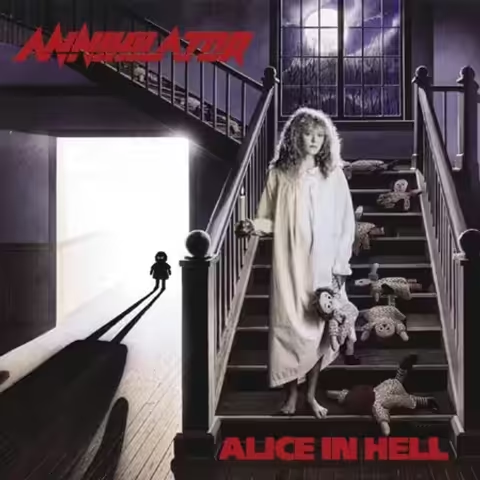
The album’s budget was modest. Waters financed much of the recording himself, working in short bursts at Live West Productions and Fiasco Bros. Studios. He learned the basics of studio work from engineer Paul Blake, who would go on to work with Waters on several future albums. The artwork, created by Len Rooney, matched the album’s eerie themes—depicting a group of ghostly children in a haunted asylum, setting the tone for the music’s dark, psychological edge. The title itself, a play on “Alice in Wonderland,” reflected Waters’ interest in horror and mental illness, which ran through the album’s lyrics.
For Annihilator, Alice in Hell was a leap into the unknown. They had no guarantee of success, but their blend of technical thrash, haunting melodies, and unsettling themes quickly caught the attention of fans and critics alike. The next step was to capture that energy in the studio.
Recording Process
The making of Alice in Hell was as intense as the music itself. Recording took place in 1988 at Live West Productions and Fiasco Bros. Studios in New Westminster, Canada. These were small, local studios, but Waters’ drive and technical knowledge made up for any lack of big-budget facilities. He produced and mixed the album himself, with Paul Blake and Frank Donofrio serving as engineers. Blake’s role was crucial, as he not only engineered but also taught Waters how to get the best sound out of limited resources.
Waters approached the sessions with meticulous attention to detail. He played all the guitars and bass himself, tracking one rhythm guitar part per side (left and right) to avoid muddiness—a technique he believed kept the music tight and clear. For guitar tones, he used Marshall JCM 800 amplifiers and Marshall Lead Series 1960 cabinets, always miking the Greenback speakers with a Shure SM57 microphone. Waters used little in the way of effects or processing during recording, relying on his technique and the natural sound of the amp. For bass, he used a direct input chain through a Summit preamp and an ADL tube compressor. Vocals were tracked with an Audio-Technica AT4060 tube microphone and a Focusrite ISA preamp/EQ, followed by an ADL compressor.
The drum recording was left to professionals, as Waters admitted he did not have the skills or patience for it at the time. Ray Hartmann’s drums were recorded live, with minimal overdubs. Mixing was done in Cubase, using UAD-1 plugins for compression and EQ. The overall sound was sharp, dry, and aggressive—fitting the technical thrash style Annihilator was aiming for. The sessions were not without problems: budget constraints meant recording was done in short, sporadic bursts, and Waters often worked late into the night to save money. Despite these challenges, the result was an album that sounded fresh, clear, and far heavier than many of its contemporaries.
Here is a table of the likely hardware and techniques used in the studio, based on Waters’ own accounts and the era’s typical setups:
| Equipment/Technique | Details |
|---|---|
| Guitar Amps | Marshall JCM 800 (50/100W), Marshall Lead Series 1960 cabs with Greenback speakers |
| Guitar Microphones | Shure SM57 (main), AKG 414 (occasionally used) |
| Bass Chain | Direct input, Summit preamp, ADL tube compressor |
| Vocal Chain | Audio-Technica AT4060 mic, Focusrite ISA pre/EQ, ADL compressor |
| Recording Platform | Cubase SX3, UAD-1 plugins for mixing |
| Drums | Live tracking, minimal overdubs, engineer-led setup |
| Guitar Recording | Single take per side, no doubling, minimal effects |
Waters was not only the producer but the creative engine of the band. He went on to produce and engineer many of Annihilator’s later albums, and his technical approach influenced a generation of Canadian and European metal bands. Here is a list of other albums produced by Jeff Waters (excluding Alice in Hell):
| Producer | Artist | Album | Year |
|---|---|---|---|
| Jeff Waters | Annihilator | Never, Neverland | 1990 |
| Jeff Waters | Annihilator | Set the World on Fire | 1993 |
| Jeff Waters | Annihilator | King of the Kill | 1994 |
| Jeff Waters | Annihilator | Refresh the Demon | 1996 |
| Jeff Waters | Annihilator | Remains | 1997 |
Commercial Performance and Reception
When Alice in Hell hit the shelves in April 1989, it quickly gained attention from metal fans and critics. The album did not chart on the Billboard 200, but it sold well enough to become Roadrunner Records’ first gold record. Its success helped the label expand its roster and invest in more heavy metal acts. Songs like “Alison Hell” received regular play on MTV’s Headbangers Ball, and the band’s technical skill was widely praised in metal magazines. In Canada and Europe, the album sold especially well, building a devoted following that remains strong to this day.
Below is a table of Annihilator’s studio albums, showing where Alice in Hell fits in their discography. Since there is no specific sales data available for all albums, I have included the main producer for each release:
| Album Title | Year | Producer |
|---|---|---|
| Alice in hell | 1989 | Jeff Waters |
| Never, neverland | 1990 | Jeff Waters, Glen Robinson |
| Set the world on fire | 1993 | Jeff Waters |
| King of the kill | 1994 | Jeff Waters |
| Refresh the demon | 1996 | Jeff Waters |
| Remains | 1997 | Jeff Waters |
| Criteria for a black widow | 1999 | Jeff Waters |
| Carnival diablos | 2001 | Jeff Waters |
| Waking the fury | 2002 | Jeff Waters |
| All for you | 2004 | Jeff Waters |
| Schizo deluxe | 2005 | Jeff Waters |
| Metal | 2007 | Jeff Waters |
| Annihilator | 2010 | Jeff Waters |
| Feast | 2013 | Jeff Waters |
| Suicide society | 2015 | Jeff Waters |
| For the demented | 2017 | Jeff Waters, Rich Gray |
| Ballistic, sadistic | 2020 | Jeff Waters |
| Metal II | 2022 | Jeff Waters |
Alice in Hell did not receive any major awards at the time, but its legacy has grown over the years. In 2014, Loudwire named it the 9th best thrash album outside the Big Four, and in 2017, it was ranked 30th on their all-time thrash list. VH1 included it among the greatest thrash debuts, and Revolver called it one of the “10 Criminally Underrated 80s Thrash Albums.” These accolades underline its lasting influence.
Looking at other heavy releases from 1989, the competition was fierce. Here are some albums released that year by similar artists:
- Practice What You Preach by Testament
- Beneath the Remains by Sepultura
- Extreme Aggression by Kreator
- Fabulous Disaster by Exodus
- Headless Cross by Black Sabbath
- Louder Than Love by Soundgarden
- Dr. Feelgood by Mötley Crüe
- The Real Thing by Faith No More
- Agent Orange by Sodom
- Slip of the Tongue by Whitesnake
- Bleach by Nirvana
Other key events in heavy music in 1989 included the Moscow Music Peace Festival, the first Grammy for Best Hard Rock/Metal Performance (won by Jethro Tull in a controversial decision), and the emergence of new bands like Pantera, Nine Inch Nails, and Soundgarden. This was a year when metal was diversifying, with thrash, glam, and the seeds of grunge all jostling for space.
Track Analysis
The singles from Alice in Hell were “Alison Hell” and “Word Salad.” “Alison Hell” was released as a single in 1989, with “Word Salad” following as a promotional track. Both were written by Jeff Waters, with co-writing credits for John Bates and Jody Weil on selected tracks. Neither single charted on the Billboard Hot 100, but “Alison Hell” became an underground favourite and remains Annihilator’s signature song.
Below is a detailed table of every song on the album, including length and writing credits. Singles are marked with a *.
| Track Name | Length | Writing Credit |
|---|---|---|
| Crystal Ann | 1:40 | Jeff Waters |
| Alison Hell* | 5:00 | Jeff Waters, John Bates |
| W.T.Y.D. | 3:56 | Jeff Waters, John Bates |
| Wicked Mystic | 3:38 | Jeff Waters, Jody Weil |
| Burns Like a Buzzsaw Blade | 3:33 | Jeff Waters, John Bates, Jody Weil |
| Word Salad* | 5:49 | Jeff Waters |
| Schizos (Are Never Alone) Parts I & II | 4:32 | Jeff Waters |
| Ligeia | 4:47 | Jeff Waters |
| Human Insecticide | 4:50 | Jeff Waters, John Bates |
| Powerdrain (Demo, 1998 reissue) | 2:49 | Jeff Waters |
| Schizos (Are Never Alone), Parts I & II (Demo, 1998 reissue) | 4:18 | Jeff Waters |
| Ligeia (Demo, 1998 reissue) | 4:56 | Jeff Waters |
Note: Tracks marked with * (“Alison Hell” and “Word Salad”) were singles. There is no official chart data for these singles, but “Alison Hell” remains the band’s most recognised song.
Song Meaning and Lyrics
Few thrash albums dig as deep into psychological horror as Alice in Hell. The lyrics explore madness, paranoia, and the thin line between reality and nightmare. The singles “Alison Hell” and “Word Salad” stand out for their storytelling and intensity.
“Alison Hell” tells the story of a young girl, Alison, who is tormented by visions and fears that no one else can see. Waters and John Bates based the lyrics on a real case of a girl whose parents could not help her with her psychological struggles. The song’s lyrics, such as “Alice, isn’t it frightening? Alice, aren’t you scared?” and “Sitting in the corner, you are naked and alone,” create a vivid portrait of mental anguish (source: Genius Lyrics). The chorus, “Alison hell, your mind begins to fold,” captures the sense of a mind unravelling under the weight of fear. This theme of isolation and misunderstood suffering runs throughout the album.
“Word Salad,” meanwhile, is a frenetic track that takes its title from a psychiatric term for disorganised, nonsensical speech. The lyrics are a barrage of imagery, reflecting the chaos of a mind in disarray. Waters has said the song was meant to convey the feeling of losing control over one’s thoughts, using jarring shifts in rhythm and tempo to match the lyrics’ instability (source: Metal Archives).
Waters wrote most of the lyrics, with John Bates co-writing four songs and Jody Weil contributing to two. The collaboration between Waters and his co-writers brought extra depth to the stories. The rest of the album follows similar themes: “Schizos (Are Never Alone)” explores split personalities, “Ligeia” draws on Edgar Allan Poe’s gothic tales, and “Human Insecticide” is a violent, surreal nightmare. There is little light or humour; the lyrics are as relentless as the music.
Touring and Promotion of Alice in Hell
Promotion for Alice in Hell was ambitious, especially for a Canadian band with a debut album. Annihilator supported Onslaught on their “In Search of Sanity” tour across Europe, playing dates in Germany, Belgium, Switzerland, Italy, France, the Netherlands, and the UK. In the United States, they opened for Testament and Wrathchild America on the “Practice What You Preach” tour. These tours covered more than 40 shows across North America and Europe, with Annihilator playing to thousands of new fans each night (source: Metallipromo).
Not only that, but Annihilator shared the stage with Exodus, Leeway, Biohazard, Metal Church, and Primus during key dates. The band’s high-energy performances and technical skill made a strong impression, helping the album sell even better in Europe and Japan. “Alison Hell” was given a music video, which received airplay on Much Music in Canada and MTV in the US. After touring, the band quickly began work on their next album, Never, Neverland.
Despite the album’s success, the line-up changed almost immediately after the tour. Randy Rampage left at the end of 1989, and new members joined for the next phase of the band’s journey. Touring for Alice in Hell established Annihilator as a serious force in thrash metal, especially outside North America.
Influences and Legacy
Alice in Hell was shaped by a mix of influences. Waters has cited Elton John, Kiss, Sweet, AC/DC, Black Sabbath, Judas Priest, Iron Maiden, Loudness, Van Halen, Razor, and Exciter as inspirations. The technical precision and melodic touches set Annihilator apart from the more brutal thrash bands of the time.
Here is a table showing the key influences on the album, and some of the artists who were influenced by Alice in Hell after its release:
| Influences on “Alice in Hell” | Artists Influenced by “Alice in Hell” |
|---|---|
| Metallica | Opeth |
| Megadeth | Children of Bodom |
| Slayer | In Flames |
| Judas Priest | Slipknot |
| Iron Maiden | Trivium |
| Razor | Lamb of God |
| Exciter | Nickelback (specifically, “Crystal Ann” as inspiration for “Here Without You”) |
1989 was a year of change in music and the world. The Berlin Wall fell, the first GPS satellite was launched, and the Soviet Union withdrew from Afghanistan. In Britain, the Hillsborough disaster changed football forever, and the economy was heading for recession. In music, alternative rock was gaining ground with releases like Doolittle by Pixies and Disintegration by The Cure. Metal was at a crossroads, with thrash, glam, and the beginnings of grunge all present. Alice in Hell captured this sense of transition—technical, dark, and forward-looking.
Five Things About Alice in Hell
Let’s look at five facts about Alice in Hell that you might not know:
| Fact | Details |
|---|---|
| First gold record for Roadrunner | Alice in Hell was the first album to go gold for Roadrunner Records, launching the label’s metal legacy. |
| Songs written years before release | Most songs were written between 1984 and 1987, demoed on three cassettes before the album was recorded. |
| Megadeth’s Rust in Peace inspired | Dave Ellefson and Nick Menza of Megadeth listened to Alice in Hell daily while writing and recording Rust in Peace. |
| Jeff Waters played almost everything | Waters played all guitars and bass, wrote all drum parts, and produced the album himself. |
| Influence on Scandinavian metal | Waters’ guitar work is credited with shaping the sound of Scandinavian metal bands in the 1990s. |
Critical Reviews and Retrospectives
Alice in Hell has received glowing reviews over the years. Eduardo Rivadavia of AllMusic called it “arguably the best release of the band’s career.” Adam McCann of Metal Digest wrote, “A real classic thrash metal album… tracks like ‘Human Insecticide,’ ‘W.T.Y.D.,’ and ‘Alison Hell’ are thrash metal anthems.” The album’s technical skill, production, and dark themes have been praised in many retrospectives. In 2014, Loudwire ranked it as the 9th best thrash album not by the Big Four, and in 2017, they put it at number 30 in their all-time thrash list. VH1 and Revolver have also listed it among the best thrash debuts and underrated 80s albums.
Here is a table of selected reviews and notable quotes:
| Publication | Score | Quote | Link |
|---|---|---|---|
| AllMusic | 4.5/5 | “Arguably the best release of the band’s career.” | AllMusic |
| Metal Digest | N/A | “A real classic thrash metal album.” | Metal Digest |
| Loudwire | N/A | “9th best thrash album not by the Big Four.” | Loudwire |
| Revolver | N/A | “10 Criminally Underrated 80s Thrash Albums.” | Revolver |
After Alice in Hell
After Alice in Hell, Annihilator quickly recorded and released Never, Neverland in 1990, which sold even better than their debut. The band’s line-up changed frequently, with Waters remaining the only constant member. Over the years, Annihilator released more than fifteen studio albums, shifting between thrash, groove, and even industrial metal. They remained most popular in Europe and Japan, with North American success fading after the early 1990s. As of April 2025, Annihilator are still active, with Waters living in England and Stu Block now handling live vocals. The band continues to tour and record, with a new album completed as of June 2023. Recent years have seen tributes to former members like Randy Rampage and Coburn Pharr, both of whom have passed away.
Conclusion
Alice in Hell remains one of the defining albums of technical thrash metal. Its sharp production, complex guitar work, and dark lyrics have stood the test of time. The album’s influence can be traced through countless bands, from Children of Bodom to Slipknot, and it helped put Canadian metal on the map. Jeff Waters’ relentless drive and musical vision have kept Annihilator going for more than thirty years. Even today, the band draws crowds worldwide and continues to inspire new generations of metal musicians. With no sign of slowing down, Annihilator’s legacy—and that of Alice in Hell—is secure.
Further Reading
For more on Annihilator, thrash metal, and the albums that shaped the genre, explore our own articles and podcasts below. Each link opens in a new tab:
- Annihilator’s Never, Neverland: Thrash Metal’s Hidden Gem (blog)
- Sepultura’s Beneath the Remains: A Thrash Metal Icon (blog)
- The Making of Among the Living – Anthrax’s Iconic Album (blog)
- Rust In Peace: Megadeth’s Defining Thrash Legacy (blog)
- Master of Puppets: Unraveling Metallica’s Pivotal Album (blog)
- Reign In Blood: Slayer’s Game-Changing Album Explored (blog)
- Unveiling Arise: Sepultura’s Thrash Metal Evolution (blog)
- The Making of Ixnay on the Hombre by The Offspring (blog)
- Wikipedia page for Alice in Hell
- Official Annihilator website
- Roadrunner Records website
Comments