
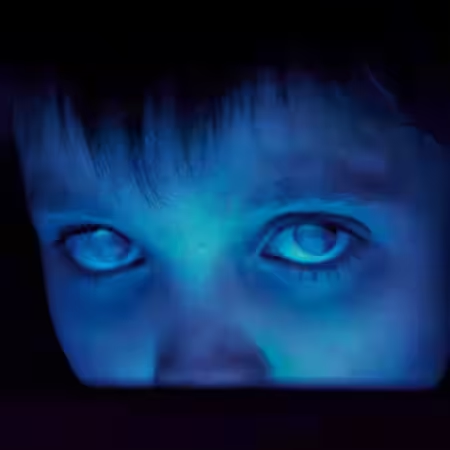
Steven Wilson built the most successful Porcupine Tree album of his life around a cold email to a Canadian guitarist he had never met, a Bret Easton Ellis novel about a bored eleven-year-old, and a seventeen-minute song the four of them wrote in the back room of a touring schedule. Fear of a Blank Planet was finished in December 2006, released by Roadrunner on 16 April 2007, and would do something none of the band's previous eight records had managed: drag a quietly enormous English progressive rock act onto the Billboard 200, into the European Top 30, and onto the cover of magazines that had largely ignored them for fifteen years.
The trick was that Wilson did not write it as a comeback record, or a crossover record, or a record about anything as Porcupine-Tree-shaped as the previous two. He wrote it about a kid with the curtains shut, an iPod in one ear, a PlayStation controller in his lap, a phone full of pornography and a head full of nothing. Lasse Hoile shot the cover, Alex Lifeson played one solo, Robert Fripp added two layers of soundscape, and the album that emerged was sharper, heavier and more disciplined than anything the band had ever attempted. This is the complete story of how it was made, who played on it, what it meant, and why a generation of prog and metal musicians still cite it as the moment the genre re-grew teeth.
Album Facts
| Field | Detail |
|---|---|
| Artist | Porcupine Tree |
| Album | Fear of a Blank Planet |
| Release Date | 16 April 2007 (UK/Europe), 24 April 2007 (US), 25 April 2007 (Japan), 1 May 2007 (Canada) |
| Label | Roadrunner Records (Europe), Atlantic Records (US), WHD (Japan), WEA (Canada), Tonefloat (vinyl), Transmission (DVD-A) |
| Producer(s) | Porcupine Tree (self-produced); Steven Wilson (mixing, mastering) |
| Studio(s) | No Man's Land (Wilson's home studio, Hemel Hempstead), Bourne Place, New Rising, The Artillery, Nightspace, Mark Angelo, Red Room Recorders, DGM (Robert Fripp's studio) |
| Genre / Subgenre | Progressive rock, art rock, alternative rock, progressive metal |
| Track Count | 6 |
| Total Runtime | 50:48 (CD and remastered vinyl); 79:32 (2007 double vinyl with Nil Recurring) |
| Billboard 200 Peak | 59 (debut) |
| UK Albums Chart Peak | 31 |
| Other Notable Chart Peaks | Netherlands 13, Finland 16, Poland 16, Germany 21, Italy 34, Norway 34, Sweden 38, Switzerland 41, Australia 66, France 70; European Top 100 #21; US Billboard Top Rock Albums 17; US Top Internet Albums 3 |
| Certifications | None reported; the 10,000-copy limited two-disc special edition sold out worldwide on the day of release |
| Estimated Sales | Approximately 250,000 copies worldwide; the band's best-selling album until The Incident (2009) |
| Key Singles | "Fear of a Blank Planet" (April 2007), "Way Out of Here" (2007) |
Cultural Context: 2007
Fear of a Blank Planet landed in a music year that the prog world would later treat as a turning point. Dream Theater put out Systematic Chaos that summer, Opeth (whose first three Roadrunner-era albums Wilson had produced) released The Roadrunner Years box set, and a relatively unknown Swedish-American outfit called Mastodon released Blood Mountain into a metal scene that had spent the previous five years drowning in nu-metal and screamo. Radiohead were six months from giving away In Rainbows as a pay-what-you-want download, the iPhone was four months from going on sale, and the surveillance state Wilson sang about on Sentimental was about to find itself permanently in everyone's pocket.
Roadrunner had spent 2006 quietly restocking. The label that had been built on death metal in the 1990s now had Slipknot, Opeth, Killswitch Engage, Megadeth, Trivium and Type O Negative on its roster, and signing Porcupine Tree gave it something it had never really had: a critically untouchable English prog act with surround-sound ambitions and a vocalist who insisted on releasing every record as a 5.1 mix. The album also sat in a peculiar gap nobody else was filling. Pink Floyd had stopped making records, Tool were four years past Lateralus and would not release another album until 2019, and Radiohead had moved away from rock structures entirely. Wilson noticed the gap, and walked straight into it.
- Top of the UK album chart on release week: Mika's Life in Cartoon Motion.
- Top of the Billboard 200 the same week: Modest Mouse's We Were Dead Before the Ship Even Sank.
- iPod sales globally in 2007: roughly fifty-two million units.
- Other prog-leaning releases that year: Dream Theater's Systematic Chaos, Rush's Snakes and Arrows, Marillion's Somewhere Else, Devin Townsend's Ziltoid the Omniscient.
The Band's Story Up to This Point
Porcupine Tree had been a band for fifteen years and a fictional band for four years before that. Wilson started it in 1987 as a private joke with his friend Malcolm Stocks, inventing a 1970s psychedelic group complete with imaginary members, imaginary prison sentences, and an imaginary festival appearance. He then recorded fictitious "evidence" for the fictitious band in his bedroom, sent the tapes to a few people on the UK underground psychedelic circuit, and was bewildered when Delerium Records offered him a real album deal.
That album, On the Sunday of Life (1992), led to Up the Downstair (1993), The Sky Moves Sideways (1995) and Signify (1996), through which Wilson hardened a solo bedroom project into a touring four-piece with keyboardist Richard Barbieri (ex-Japan), bassist Colin Edwin and drummer Chris Maitland. Stupid Dream (1999) and Lightbulb Sun (2000) on Snapper pushed the songwriting closer to alternative rock; by 2002 the band had signed to Lava/Atlantic and dismissed Maitland in favour of Gavin Harrison, the unflashy and devastatingly precise English drummer whose arrival would change the band's centre of gravity for the next decade.
Two records had followed in the Lava era: In Absentia (2002), a heavier, darker pivot built around Wilson's then-recent infatuation with the extreme metal he had discovered through producing Opeth, and Deadwing (2005), a half-conceptual album drawn from a film script Wilson had co-written with Mike Bennion. Deadwing was the band's biggest commercial moment yet, and won Album of the Year at the 2005 Classic Rock awards. Then, in August 2006, the band signed to Roadrunner UK and announced they were already deep into a successor. Steven Wilson, who had spent every spare day of the previous four years producing other people's albums (Opeth, Anathema, Marillion, his own Blackfield side-project with Aviv Geffen), was about to make the heaviest, most direct, and most thematically focused Porcupine Tree record of his career.
Pre-production and Demos
Writing began in January 2006 in Tel Aviv, where Wilson was holed up working on the second Blackfield album with Aviv Geffen. Between Blackfield sessions, in a small room in an unfamiliar city, he started writing what he would later describe as a record about boredom, screens and the children he saw growing up around him. One of the first songs from that Tel Aviv period was called Always Recurring; it would never be released in its original form, but parts of its lyric and melody resurfaced two years later in What Happens Now? on the Nil Recurring EP. While Wilson was in Israel, Barbieri wrote most of the music for what would become My Ashes, sending demos back and forth.
The Blackfield sessions wrapped in June 2006 and Wilson flew home to London. The four members of Porcupine Tree convened in July and August at his home studio in Hemel Hempstead, working on what Wilson described as a pool of perhaps ten or twelve songs from which six would eventually be chosen. Cheating the Polygraph, a Harrison/Wilson composition, made it as far as the September live shows in support of the Arriving Somewhere DVD; when the band heard the running order play back in full at rehearsal, they decided the song was weaker than its neighbours and dropped it. In its place they wrote Way Out of Here, the only track on the finished album credited to all four band members, in a single short session.
"It was very much conceived in the way bands used to conceive records in the '70s, where you've got two sides of vinyl, and you can lay down a piece of music which is around the 50-minute mark, which plays in a continuous way, and deals with the same subject matter, and tries to immerse you in a world for that time. That's always been the Porcupine Tree way, but we've definitely taken it to the next level."
Steven Wilson, MTV News, March 2007
The Arriving Somewhere tour, between September and November 2006, doubled as the album's live pre-production. The band played the new material in the first half of each show, listening to how songs scanned in a room full of strangers, then went back to Hemel Hempstead at night to track parts. By the time the tour ended, most of the album was already on tape.
Creating the Album
The bulk of Fear of a Blank Planet was recorded between October and December 2006. The base of operations was Wilson's home studio, No Man's Land, in Hemel Hempstead, north of London; this was where Wilson tracked vocals, most guitars, piano and keyboards, and where he mixed and mastered the finished album. Drums were tracked at a small clutch of studios that the band rotated through: Bourne Place, New Rising, The Artillery, Nightspace, Mark Angelo, Red Room Recorders. Robert Fripp's contributions were recorded at DGM, his own facility in Wiltshire. Steve Price engineered. There was no outside producer; the band produced themselves and Wilson took the chair for the final mix.
The signature production move was the surround mix. Wilson had been an evangelist for 5.1 audio since the In Absentia DVD-A and was now genuinely obsessed with it. He mixed Fear of a Blank Planet in two formats from day one: a conventional stereo mix for CD, and a discrete six-channel surround mix that he treated as a separate compositional layer rather than an upmix. Voices moved between speakers, Gavin Harrison's cymbals lived in the rears, Barbieri's synth pads breathed across the whole room. The DVD-A edition that came out in October 2007 on the band's own Transmission label would be nominated for a Grammy.
The other production fingerprint was Harrison's drum sound. By 2006 Harrison was already being talked about as the best progressive drummer working in rock, and Wilson had decided that on this record the drums would be allowed to dominate. The kit was recorded close and dry, with very little room ambience, in deliberate contrast to the more reverberant Deadwing. Songs were built around the rhythmic figures rather than worked in around them. Harrison would win Modern Drummer magazine's Best Progressive Drummer reader poll for both 2007 and 2008 on the back of his playing on this album; in 2014 Rhythm magazine's readers would vote Fear of a Blank Planet the fifth greatest drumming album in the history of progressive rock.
The Lifeson cameo arrived in early autumn 2006. Wilson had read an interview in Classic Rock magazine in which the Rush guitarist mentioned, almost in passing, that he was a fan of Porcupine Tree. Wilson got Lifeson's email address, wrote to him asking whether he would consider playing on the new album, and got back an enthusiastic yes within days. Wilson then wrote a specific section of Anesthetize, the seventeen-minute centrepiece, around the rhythmic and harmonic profile he wanted Lifeson to solo over. Lifeson recorded the take in his own home studio in Toronto, layered in a second harmony part for good measure, and emailed the files back. Wilson dropped them straight into the mix.
The Fripp contribution arrived through a slower channel. Fripp had known Wilson for years through their shared interest in soundscaping (and through Wilson's friendship with Adrian Belew, who had guested on Deadwing), and was already on the same Roadrunner-adjacent prog circuit. Fripp recorded soundscapes for Way Out of Here at DGM and also tracked a full lead guitar part for Nil Recurring, the song that would later become the title track of the EP. He documented both sessions in his online diary in January 2007.
Dave Stewart wrote the album's orchestral arrangements. Not the Eurythmics Dave Stewart: the other one, the keyboardist and arranger from the Canterbury scene bands Egg, Hatfield and the North and National Health, who had spent the previous twenty years as one of the most quietly respected arrangers in British progressive music. Stewart wrote the parts; the London Session Orchestra played them. John Wesley, Porcupine Tree's regular touring second guitarist, contributed backing vocals.
Personnel and Credits
| Role | Player | Notes |
|---|---|---|
| Porcupine Tree | ||
| Lead vocals, guitars, piano, keyboards | Steven Wilson | Also mixed and mastered the album; wrote five of the six tracks alone |
| Synthesizers, keyboards, sound processing | Richard Barbieri | Co-wrote My Ashes; ex-Japan, member since 1993 |
| Bass guitars | Colin Edwin | Co-wrote Way Out of Here; member 1993 to 2010 |
| Drums, percussion | Gavin Harrison | Co-wrote Way Out of Here and the dropped Cheating the Polygraph; the dry, close-miked kit is one of the album's signatures |
| Guest musicians (credited) | ||
| Lead guitar solo on Anesthetize | Alex Lifeson | Rush; recorded the solo at his Toronto home studio after a cold email from Wilson and emailed the files back |
| Soundscapes on Way Out of Here | Robert Fripp | King Crimson; recorded at his own DGM studio in Wiltshire. Also played lead guitar on Nil Recurring (released later on the EP of the same name) |
| Backing vocals | John Wesley | Porcupine Tree's regular touring second guitarist throughout the 2002 to 2010 period |
| Orchestra | London Session Orchestra | Performed the string arrangements written by Dave Stewart and Steven Wilson |
| Production and engineering | ||
| Producers | Porcupine Tree | Self-produced; no outside producer was hired |
| Mixing, mastering, string arrangements | Steven Wilson | Mixed both the stereo and the 5.1 surround versions; the surround mix was Grammy-nominated |
| String arrangements | Dave Stewart | The Egg / Hatfield and the North / National Health keyboardist and arranger, not the Eurythmics one |
| Engineer | Steve Price | Tracked most of the basic sessions across the rotating drum studios |
| Artwork and visuals | ||
| Photography, sleeve concept and accompanying short films | Lasse Hoile | Danish photographer and filmmaker; the band's visual collaborator since In Absentia. Also directed the Anesthetize live film and the uncensored Fear of a Blank Planet promo video |
The Songs
| # | Title | Writer(s) | Length | Single? | Notes |
|---|---|---|---|---|---|
| 1 | Fear of a Blank Planet | Wilson | 7:28 | Single, April 2007 | The opening salvo; Lasse Hoile directed both a censored and an uncensored promo video |
| 2 | My Ashes | Barbieri, Wilson | 5:07 | No | Lyric adapted from the closing chapter of Bret Easton Ellis's Lunar Park; later used in The Shield (October 2008) |
| 3 | Anesthetize | Wilson | 17:42 | No | Three-movement centrepiece (Anesthetize / The Pills I'm Taking / Surfer); Alex Lifeson plays the middle-section solo |
| 4 | Sentimental | Wilson | 5:26 | No | NPR's Song of the Day on 4 June 2007 |
| 5 | Way Out of Here | Barbieri, Edwin, Harrison, Wilson | 7:37 | Single, 2007 | The only full four-way band composition on the album; Robert Fripp adds soundscapes |
| 6 | Sleep Together | Wilson | 7:28 | No | String-driven closer; arrangement performed by the London Session Orchestra |
The opening title track is the album's mission statement, delivered in seven minutes that move from the cold, mechanical groove of the verses (Harrison's hi-hat patterns alone are worth a doctorate) into one of the heaviest choruses Porcupine Tree ever recorded. The lyric is the album's argument condensed: a child reciting the symptoms of bipolar disorder and attention deficit disorder in the first person, with iPod, PlayStation and pornography as the only adult presences in the room. Lasse Hoile's promo video, shot in a washed-out half-light around a small boy in a featureless bedroom, was banned in an uncensored form on most TV networks and released as the censored cut you can watch below.
"My fear is that the current generation of kids who are being born into this information revolution, growing up with the Internet, cell phones, iPods, this download culture, American Idol, reality TV, prescription drugs, PlayStations, all of these things kind of distract people from what is important about life, which is to develop a sense of curiosity about what is out there."
Steven Wilson, MTV News, March 2007
My Ashes is the album's grieving heart, and the most direct lift from Bret Easton Ellis's Lunar Park. The novel ends with the narrator scattering his estranged father's ashes; Wilson's lyric replays that scene from the son's perspective, with Barbieri's melancholic chord sequence (he wrote most of the music while Wilson was in Tel Aviv) framing one of Wilson's most plainly emotional vocal performances. The London Session Orchestra glides in at the bridge, restating the chord changes in horns and strings, before the song dissolves into a long instrumental coda.
Anesthetize is the seventeen-minute, three-movement centrepiece and the song most likely to be played whenever anyone tries to argue that prog had a second golden age in the late 2000s. Three movements, signposted in the original tracklist: an opening Anesthetize section in which a slow, sour groove builds for nearly five minutes; a middle The Pills I'm Taking section that hits a single, brutally heavy riff (Harrison's snare placement on the verses is widely studied by drummers); and a closing Surfer section that drifts down into a wash of ambient guitars and Wilson's most resigned vocal on the album. Alex Lifeson's solo arrives roughly halfway through, soaring across the middle riff, and is the only guest contribution to a Porcupine Tree album whose presence shifts the song's centre of gravity.
Sentimental, the album's most conventional song, is also its quietest gut-punch. The narrator (Robby, the eleven-year-old of Lunar Park) lists the small humiliations of being a child in 2007 ("Sentimental, sentimental, I'm fifteen, and I'm crying") over a slow, almost folk-rock chord cycle that breaks open into one of Wilson's signature choruses. NPR made it Song of the Day on 4 June 2007.
Way Out of Here is the album's prog showpiece: the only song credited to all four members, written specifically to replace the dropped Cheating the Polygraph, and built around a Fripp soundscape that lurks in the rear channels of the 5.1 mix like a ghost. Live, the band routinely stretched it past nine minutes; on record it punches through a single seven-minute arc from quiet to apocalyptic. Sleep Together closes the album on a long, string-heavy build that finally releases at the seven-minute mark, the only moment on the record where the orchestra is allowed to take the foreground from the band.
B-sides, Outtakes and the Nil Recurring EP
Because the album was deliberately edited down to a tight fifty minutes, Fear of a Blank Planet generated more outtakes than any Porcupine Tree record before it. Almost all of them were assembled into Nil Recurring, an EP released on 17 September 2007 (and reissued through Peaceville Records on 18 February 2008) that runs to almost thirty minutes and entered the UK Indie Albums chart at number eight.
- Nil Recurring (6:08) — the instrumental title track, with Gavin Harrison's "taped guitar" and a lead guitar part by Robert Fripp recorded at DGM.
- Normal (7:09) — a reworking of Sentimental from Fear of a Blank Planet, sung from a different angle.
- Cheating the Polygraph (7:06) — the Harrison/Wilson composition dropped from the album. Wilson later rerecorded it for his solo Cover Version compilation; the song became a live favourite on his solo tours.
- What Happens Now? (8:23) — built on lyrics and music recycled from the unreleased Tel Aviv demo "Always Recurring", with electric violin from Ben Coleman.
The 2007 Tonefloat double-vinyl edition (a 1,000-copy run on marbled vinyl with a 12x12 sixteen-page booklet) included Nil Recurring as side four, so for vinyl buyers in 2007 the album and the EP were already a single seventy-nine minute work. A 500-copy pink-vinyl edition followed in May 2008 to coincide with the band's Pinkpop appearance; the Dutch-store-only run sold out in less than five days.
Album Artwork and Packaging
Danish photographer and filmmaker Lasse Hoile had been Porcupine Tree's visual collaborator since In Absentia, where his washed-out, fluid-dripping, faceless figures had given the band the unmistakable aesthetic that all but defined them through the Roadrunner era. For Fear of a Blank Planet he photographed a model in soft, almost antiseptic light, then ran the image through a wash of desaturation and digital blur so that the face is present but blank; you can read every feature without recognising any of them. The title was set in a thin, almost generic sans serif on the front cover, with the band name as small text. The visual was the argument: the more screen time the figure has had, the less of him is left.
Hoile's involvement went well beyond the sleeve. He directed two cuts of the title-track promo video (a softer broadcast version and an uncensored cut shot around a younger model), a five-minute Blank Planet Introduction short film, and the seventeen-minute Anesthetize live film that played behind the band during the 2007 to 2008 tour. All three works appeared on the DVD-A release. The standard CD shipped in a single jewel case with a sixteen-page booklet; the limited two-disc Special Edition (10,000 copies, sold out the day of release) added the 5.1 mix and a forty-page hardback booklet of Hoile's stills and Wilson's lyrics. The Tonefloat double vinyl in its gatefold sleeve, with the marbled-vinyl second pressing, is now one of the most collected Porcupine Tree items on the second-hand market.
Release and Reception
Roadrunner released the album in Europe on 16 April 2007, four days ahead of schedule because Italian retailers had broken the street date on the 12th and the CD had already leaked to file-sharing networks. Atlantic followed in the United States on 24 April. The pre-release rollout had been deliberately old-fashioned: a listening party at Legacy Studios in New York in January, another at Abbey Road in London on the same day, an early-21 February medley posted to the band's MySpace page, and an Italian preview leaked-to-iTunes drop on 6 March of the title track bundled with Blackfield II. By the time the album shipped, anyone who cared had already heard it.
The reviews were the best of the band's career. Metacritic recorded an aggregate score of 82 out of 100 across nine reviews; only In Absentia had previously scored as highly. AllMusic gave it 4.5 out of 5, calling it a record in which "most songs transcend their complex structure and feel as provocative as any traditional rock tune". Q magazine described it as "a dramatic, wide-screen, expertly executed, even genuinely thrilling rock record worthy of an audience way beyond nu-prog's regular constituency". Rolling Stone's David Fricke, who had largely ignored the band for fifteen years, ran a feature in November 2007 that committed Porcupine Tree to print as something genuinely new.
"A dramatic, wide-screen, expertly executed, even genuinely thrilling rock record worthy of an audience way beyond nu-prog's regular constituency."
Q magazine review, 2007
"Porcupine Tree have evolved into an aggressively modern merger of Rush's arena art rock, U.K. prog classicism, especially Pink Floyd's eulogies to madness and King Crimson's angular majesty, and the post-grunge vengeance of Tool."
David Fricke, Rolling Stone, November 2007
European critics were if anything warmer. Germany's Rock Hard gave it a perfect 10, Drowned in Sound 9/10, Metal Storm 9.2/10, Mojo four stars, musicOMH four stars. The Aquarian Weekly gave it an A+ and The Phoenix called it the band's best record to date. PopMatters placed it at number five in its Best Metal Albums of 2007 list, and Sound and Vision (the home-cinema bible) voted the DVD-A its number three release of the year.
Commercially the album achieved exactly what Roadrunner had hoped for. It debuted at number 59 on the Billboard 200, the first Porcupine Tree record ever to chart inside the US Top 100. It reached number 31 in the UK, number 21 in Germany, number 13 in the Netherlands, and the Top 40 in Finland, Italy, Norway, Poland, Sweden and Switzerland. It entered the European Top 100 Albums at number 21. Total worldwide sales reached around 250,000 copies and the album would remain the band's best seller until The Incident in 2009.
The accolades kept arriving for years afterwards. The album won Album of the Year at the 2007 Classic Rock magazine awards (the band's second win in three years after Deadwing) and was named Metal Storm's number one record of the year. The 5.1 surround mix was nominated for Best Surround Sound Album at the 50th Grammy Awards in December 2007, losing to the Cirque du Soleil mashup album Love by The Beatles. Gavin Harrison won Modern Drummer's Best Progressive Drummer reader poll for both 2007 and 2008. In 2012 PopMatters named Fear of a Blank Planet the best progressive rock album of the 2000s; in 2014 Rhythm readers voted it the fifth greatest drumming album in the history of prog; in 2015 Rolling Stone ranked it the 39th best prog album of all time, and Prog magazine ranked it 18th in the same list. Loudwire later placed it at number 27 in its Top 100 Hard Rock and Heavy Metal Albums of the 21st Century.
Singles and Music Videos
| Single | Release | Video Director | Notes |
|---|---|---|---|
| Fear of a Blank Planet | April 2007 | Lasse Hoile | Two versions: a broadcast cut, and an uncensored version included on the DVD-A. The video centres on a small boy alone in a featureless bedroom and was widely flagged as unsuitable for daytime rotation |
| Way Out of Here | 2007 | Lasse Hoile | Promo edit; the full Anesthetize-tour live film (also Hoile) repeatedly drew on the same imagery |
Neither single was meaningfully serviced to radio in the way a major-label rock single usually is, which is why both songs barely registered on singles charts despite the album's strong placements. Wilson's view, articulated repeatedly in interviews around release, was that the album was a single fifty-minute work and that pulling individual songs off it was almost beside the point.
Touring and Live
The Fear of a Blank Planet tour ran from 18 April 2007 (two days after European release, opening in Glasgow) through to mid-October 2008, taking in ninety-two dates in 2007 alone and another extended run the following year. The early shows played all six album tracks in sequence, often before the album had even been released in a given territory; once Nil Recurring came out in September 2007, the EP material was folded into a longer set. Support acts changed by leg: Pure Reason Revolution, Amplifier and Absynthe Minded in Europe; the American band 3 across the US; Anathema across most of the November to December 2007 European run; Doug Wimbish's Head>>Fake at New York's Beacon Theatre; Hidria Spacefolk for the Finnish shows; Oceansize on the UK leg.
- Festival highlights: Hurricane and Southside (Germany), Download (Donington Park), Voodoo Music Experience (New Orleans), Ilosaarirock (Finland, the band's first ever appearance in the country), Pinkpop (Netherlands, May 2008), Nova Rock (Austria), Hellfest (France).
- Firsts: first ever Porcupine Tree shows in Mexico (Teatro Metropolitan, Mexico City, October 2007); first ever Porcupine Tree shows in Australia (Melbourne, Sydney and Brisbane, 25 to 27 April 2008); first ever headline performance in Portugal (October 2008).
- Filmed: the Anesthetize concert film was shot across two nights at the 013 venue in Tilburg, the Netherlands, on 15 and 16 October 2008 and released on Blu-ray on 20 May 2010. A radio broadcast of the 2007 Ilosaarirock performance was later issued as the fan-club-only live album Ilosaarirock in March 2009. The 29 October 2007 show at Atlanta's Roxy Theatre would later be released, in June 2010, as the digital-only live album Atlanta, with proceeds donated to Mick Karn for his cancer treatment.
- Visuals: Lasse Hoile created a full-length back-projection film, synchronised to the entire album, that played behind the band during the early Fear of a Blank Planet run; the seventeen-minute Anesthetize film was the most-discussed element.
In TV, Film and Media
The album's most prominent sync placement was My Ashes, used in the seventh-season episode of The Shield titled "Animal Control" (episode 81), which originally aired in the US on 7 October 2008. Sentimental was selected by NPR as Song of the Day on 4 June 2007. The title track has subsequently turned up across hundreds of YouTube and Spotify-built "screen time" and "modern alienation" playlists, and the Lasse Hoile Anesthetize film is regularly cited in music-video critical writing as a high-water mark for narrative-led prog visuals in the late 2000s.
Controversy and Censorship
There was no major controversy around Fear of a Blank Planet, but the uncensored Hoile-directed video for the title track ran into the standard TV-rotation problems for content built around an adolescent protagonist on a bed in a darkened room; the version most viewers saw on Kerrang TV and MTV2 was softened. The album's clinical references to prescription drug abuse and pornography drew the predictable parental-advisory pushback in some US markets, but Wilson and the band declined to be drawn into it; their argument throughout 2007 was that they were describing a generation rather than endorsing anything.
Covers, Samples and Tributes
Wilson himself rerecorded Cheating the Polygraph for his 2014 solo compilation Cover Version, and a big-band version of the same song appeared in 2015 on his Hand. Cannot. Erase. tour as a recurring encore. The Norwegian prog-metal group Leprous, who would later become Wilson's regular solo touring band, frequently namechecked Fear of a Blank Planet in interviews and played both Anesthetize and the title track at soundchecks. Steven Wilson's own later solo work, particularly Hand. Cannot. Erase. (2015) and The Future Bites (2021), is unimaginable without the conceptual and production groundwork laid here. The album does not sample anything itself; its title is the obvious nod to Public Enemy's Fear of a Black Planet, a parallel Wilson has acknowledged in interviews and which is the source of the album's most-discussed pun.
Reissues, Remasters and Anniversaries
Fear of a Blank Planet has remained continuously in print since release, in three principal physical formats: the standard single-disc CD; the limited two-disc Special Edition with the 5.1 mix; and the various Tonefloat double-vinyl pressings including the Nil Recurring EP. The Grammy-nominated DVD-A on the band's Transmission label (released 3 October 2007) carries the 5.1 surround mix in advanced resolution MLP lossless and DTS, plus all four Nil Recurring tracks in surround, plus the three Hoile short films. As of 2026, the band have not yet released a formal anniversary edition; Wilson has stated in multiple interviews that he is wary of the late-2000s "deluxe edition" inflation and prefers his catalogue to stay focused on its original artefacts.
The album has been re-released on assorted vinyl colour variants over the years, including the 500-copy 2008 pink-vinyl run tied to the Pinkpop performance and various box-set inclusions across European reissue labels. Bootlegs of the 2006 pre-album live performances (where four of the six tracks debuted before they had even been finished in the studio) circulate widely on the trading scene and have been a primary source for fan analysis of how the songs evolved between rehearsal and final master.
Legacy and Influence
Fear of a Blank Planet is the record that broke Porcupine Tree out of the cult-favourite ghetto in which the band had spent the previous fifteen years. It is also the record that hardened the band's reputation as one of the few late-2000s acts capable of carrying the progressive rock tradition into the streaming era without sounding either retro or self-conscious about it. Wilson would tour the album for eighteen months, deliver one more Porcupine Tree album in 2009 (The Incident, a single-disc song cycle clocking in at fifty-five minutes that pushed the same long-form ambitions further), and then announce in 2010 that he was stepping away to concentrate on his solo career.
The band did not formally split, but they did not record again for over a decade. Closure/Continuation, the eleventh studio album, arrived in June 2022; bassist Colin Edwin was not invited back, the remaining three-piece of Wilson, Barbieri and Harrison toured the album through 2022 and 2023 with Randy McStine on guitar and Nathan Navarro on bass, and in February 2025 Wilson confirmed in an NME interview that the band were quietly writing again, with Barbieri suggesting in a separate interview that a 2027 release was viable.
The album's influence on the wider prog and metal landscape is straightforward and well documented. Anders Nystrom of Katatonia has cited Porcupine Tree generally as a defining influence on his band's post-death metal direction. Luc Lemay of Gorguts called The Incident (the immediate sequel to Fear of a Blank Planet) "a big revelation" for his more recent writing. Bands as different as Haken, Leprous, TesseracT, The Pineapple Thief and Caligula's Horse have all built their careers on the production aesthetic, songwriting structures and conceptual ambition that Fear of a Blank Planet codified for the 2000s. When Metal Hammer compiled its 2022 list of the twenty greatest prog metal bands of all time, Porcupine Tree placed; when Louder Sound ranked the hundred greatest progressive albums in 2015, Fear of a Blank Planet placed at number 18. It is now, by some distance, the most cited Porcupine Tree album of the band's career.
Things You Might Not Know
| Fact | Detail |
|---|---|
| The Lifeson cold-email | Steven Wilson read a Classic Rock magazine interview in which Alex Lifeson casually mentioned being a Porcupine Tree fan, found his email address, wrote and asked whether he would consider playing on the new album, and got an enthusiastic yes within days. Lifeson recorded the solo at home in Toronto and emailed the file back. |
| The other Dave Stewart | The string arrangements were written by Dave Stewart of Canterbury-scene bands Egg, Hatfield and the North and National Health, not the Eurythmics guitarist of the same name. The two Stewarts are routinely confused on press sheets to this day. |
| The song they threw out | Cheating the Polygraph, a Harrison/Wilson composition that had been part of the live set throughout the autumn 2006 Arriving Somewhere tour, was dropped at the last minute when the band heard the album running order play back in full. Way Out of Here, the only full four-way band composition on the record, was written from scratch to replace it in a single short session. |
| The Robby of the lyrics | Most of the album's lyrics are spoken from the perspective of an eleven-year-old narrator named Robby, lifted directly from Bret Easton Ellis's 2005 novel Lunar Park. My Ashes in particular is built almost line-for-line on the novel's closing chapter. |
| The Public Enemy joke | The title is a deliberate echo of Public Enemy's 1990 album Fear of a Black Planet. Wilson has said that where Public Enemy were writing about race relations as the defining anxiety of late twentieth century America, he was writing about screen-induced blankness as the defining anxiety of the early twenty-first. |
| Fripp's diary | Robert Fripp documented both his Way Out of Here and Nil Recurring sessions in entries to his publicly readable online DGM diary in January 2007. The diary entries are still the primary source for the contemporary chronology of the EP recording. |
| The Tel Aviv demo that never died | Always Recurring, one of the very first songs Wilson wrote for the album in Tel Aviv in January 2006, was rejected, dismantled, and recycled lyrically and musically into What Happens Now? on the Nil Recurring EP eighteen months later. |
| The 10,000 that vanished | The limited two-disc Special Edition (with the 5.1 mix and the forty-page hardback booklet) was capped at 10,000 copies and sold out worldwide on the day of release. Sealed copies now sell on Discogs for several times the original retail price. |
| The 500-copy pink vinyl | A 500-copy pink vinyl run released on 1 May 2008 to coincide with the band's Pinkpop festival appearance was provided to Dutch record stores only. When the band made the remaining stock available through its online store on 14 June 2008, the run sold out in less than five days. |
| The drumming-as-art accolade | Gavin Harrison's playing on this album won him Modern Drummer magazine's Best Progressive Drummer reader poll for both 2007 and 2008, came second for Best Recorded Performance in 2008, and saw the album voted the fifth greatest drumming album in the history of progressive rock by Rhythm magazine readers in 2014. |
| The Grammy that nearly was | The 5.1 surround mix of Fear of a Blank Planet was nominated for Best Surround Sound Album at the 50th Grammy Awards in December 2007. It lost to Love, the Beatles / Cirque du Soleil mashup album mixed by George and Giles Martin. |
| The song that made it to NPR | Sentimental, the album's quietest track, was selected as NPR's Song of the Day on 4 June 2007. It was one of the very few Porcupine Tree songs of the era to receive serious mainstream American radio attention. |
| The Shield placement | My Ashes appeared in the seventh-season episode of The Shield titled "Animal Control" (episode 81), originally aired on 7 October 2008. The sync remains the highest-profile US television placement of any Porcupine Tree song. |
Riffology Podcast
If you have enjoyed this complete story of Fear of a Blank Planet, the Riffology podcast goes deeper into the albums that shaped this corner of progressive and alternative rock, with new episodes covering the records, the producers and the lineages that made them. You can find Riffology on Apple Podcasts, Spotify, Amazon Music, Pocket Casts and every other major podcast platform; subscribe wherever you usually listen, and we will see you in the next one.

Comments