Five musicians walked into the Record Plant in Sausalito in February 1976 with three collapsing relationships between them, an open studio budget and an instruction from Lindsey Buckingham to make a pop record. By the time they walked out eleven months later, the McVies had stopped speaking outside band meetings, Buckingham and Stevie Nicks had finished each other off in writing, Mick Fleetwood had fired the producer who got them the gig, and the multitrack tapes were so worn out from repeated playback that an outside specialist had to rebuild the kick and snare tracks one snare hit at a time using a vari-speed oscillator.
The album they made out of that wreckage sold over forty million copies, sat at the top of the Billboard 200 for thirty-one non-consecutive weeks and won Album of the Year at the 1978 Grammys. It is the rare record where the gossip about the gossip is built into the songs themselves, where the bass player is asked to play a love song his ex-wife wrote about her new boyfriend, and where the lyrical sniping turned out to be more durable than any marriage in the band. Rumours is what happens when five people refuse to leave the room.
This is the story of how it got made, what is on the tapes, and why almost every household in the Western world ended up with a copy.
| Field | Detail |
|---|---|
| Artist | Fleetwood Mac |
| Album | Rumours |
| Release date | 4 February 1977 (US); 11 February 1977 (UK) |
| Label | Warner Bros. Records |
| Producers | Fleetwood Mac, Ken Caillat, Richard Dashut |
| Studios | Record Plant (Sausalito and Los Angeles), Wally Heider Studios (Hollywood), Criteria (Miami), Davlen (North Hollywood), Producer''s Workshop, Sound City, Zellerbach Auditorium (Berkeley) |
| Genre | Pop rock, soft rock |
| Track count | 11 |
| Total runtime | 39:03 |
| Billboard 200 peak | 1 (31 non-consecutive weeks) |
| UK Albums Chart peak | 1 (January 1978) |
| Other notable peaks | 1 in Australia (Kent), Canada (RPM), New Zealand, Netherlands, South Africa |
| Certifications | 21x Platinum (RIAA), 17x Platinum (BPI), 13x Platinum (ARIA), 2x Diamond (Music Canada) |
| Worldwide sales | Over 40 million copies |
| Singles | Go Your Own Way, Dreams, Don''t Stop, You Make Loving Fun |
A pop record in a year that was supposed to belong to punk
1977 was the year the music press wanted to be about punk. The Sex Pistols released Never Mind the Bollocks that October. The Clash put out their debut in April. CBGB had already become shorthand for a new American underground. Across the Atlantic, the New Wave of British Heavy Metal was less than two years from forming, and Lynyrd Skynyrd were five months away from the plane crash that ended their original line-up.
Fleetwood Mac walked straight through that landscape carrying a soft rock album about their own break-ups and sold more copies than any of it. The other big releases of 1977 give a sense of how peculiar that was: Pink Floyd''s Animals, the Eagles'' Hotel California at full chart altitude, Steely Dan''s Aja, Queen''s News of the World, AC/DC''s Let There Be Rock, Bowie''s "Heroes", Iggy Pop''s The Idiot and Lust for Life. Rumours outsold every one of them, and over the following decades it kept doing so.
What made the album hold against the cultural drift was that it was not really a 1977 record at all. It was finished in late 1976. The lyrics were written in 1975 and 1976 about events from 1974 and 1975. By the time anyone bought a copy, the band were already months into the consequences of having put their own private lives on a major-label release. The record became a hit not because it spoke to the moment but because it ignored it.
The band up to this point
Fleetwood Mac were on their tenth studio album by the time they made the record before Rumours. The band had begun in 1967 as a British blues outfit fronted by Peter Green, gone through a slow disintegration as Green, Jeremy Spencer and Danny Kirwan each departed in turn, and survived a 1973 incident in which manager Clifford Davis sent a fake "Fleetwood Mac" out on a US tour while the actual band were on hiatus.
By 1974 the survivors were Mick Fleetwood on drums, John McVie on bass and Christine McVie (then McVie by marriage to John) on keyboards and vocals. They had a US deal with Reprise, no front line, and a guitarist-shaped hole left by Bob Welch. Fleetwood, hunting for a studio for the band''s next record, was given a tour of Sound City in Van Nuys by engineer Keith Olsen. The demo Olsen played to show off the room was a track by an unsigned California duo called Buckingham Nicks. Within weeks Fleetwood had asked Lindsey Buckingham to join Fleetwood Mac. Buckingham agreed on the condition that Stevie Nicks came too.
The 1975 self-titled album that resulted reached number one on the Billboard 200 in 1976 on the back of "Rhiannon", "Over My Head" and "Say You Love Me". The band toured non-stop. By the end of that touring cycle, John and Christine McVie''s eight-year marriage had collapsed, Buckingham and Nicks were in the late stages of a long unravelling, and Mick Fleetwood had discovered that his wife Jenny Boyd was having an affair with his best friend.
That is the band that walked into the Record Plant in February 1976.
Pre-production and songwriting
The band convened in Florida in early 1976 to work up new material. The original plan was to use Keith Olsen, the engineer who had produced the 1975 album, as producer again. That plan ended quickly. Fleetwood and John McVie sacked Olsen for what they felt was a tendency to bury the rhythm section in the mix. The two of them then formed a company called Seedy Management to handle the band''s affairs and put themselves in charge.
The album''s working title in those Sausalito sessions was Yesterday''s Gone, a phrase lifted from the chorus of "Don''t Stop". John McVie suggested the eventual title, Rumours, on the grounds that the band were writing journals about each other and turning them into songs. He could see what was being said about him on the tapes and was unsentimental about it.
Several of the songs arrived almost finished. Nicks wrote "Dreams" in a single afternoon at the Record Plant on a Fender Rhodes piano in a small room next to the studio that had previously belonged to Sly Stone. Buckingham brought "Never Going Back Again" in as a fingerpicked acoustic instrumental called "Brushes". "Second Hand News" arrived as a demo titled "Strummer" and was rebuilt in the studio after Buckingham heard the Bee Gees'' "Jive Talkin''" and decided he wanted that bounce on his song. "I Don''t Want to Know" predated Fleetwood Mac entirely; Buckingham and Nicks had written it together in 1974 as a Buddy Holly homage, when they were still trying to make Buckingham Nicks happen.
The rest were assembled in the room. "The Chain" was stitched together from a discarded Christine McVie demo called "Keep Me There", a different Nicks fragment, and a coda the band built from the bottom up around John McVie''s ascending bass figure. It is the only credit on the record that lists all five members.
Creating the album: Sausalito, drugs and damaged tape
The Record Plant''s Sausalito studio was a windowless wooden building at 2200 Marinship Way, a few minutes from San Francisco Bay. The control room was tiny, the live area was a 20-by-30-foot box, and Caillat felt the speakers were dead and the room over-treated. The band hated the building and wanted to record at home. Fleetwood, who had assembled the operation, refused to let anyone leave.
The women rented condominiums in the harbour. The men slept in a lodge up in the hills above the studio. They did not socialise after sessions. Caillat and Dashut spent the first nine days trying every microphone and amplifier combination in the cupboard before realising the API console''s 550A equalisers could give them most of what they were after if they stopped treating EQ as an emergency button.
The day-to-day rhythm of the sessions has been documented by everyone who lived through it, and almost nobody describes it the same way twice. Chris Stone, one of the Record Plant''s owners, watched it from the outside.
"The band would come in at 7 at night, have a big feast, party till 1 or 2 in the morning, and then when they were so whacked-out they couldn''t do anything, they''d start recording."
Chris Stone, Record Plant co-owner, Billboard, 1997
Cocaine was on the table from the start and never quite left. The hippie infrastructure of mid-seventies Sausalito made it trivial to get hold of, and the open-ended budget meant nobody on the studio side was incentivised to slow anyone down. Christine McVie''s recollection of the sessions in Cameron Crowe''s 1977 Rolling Stone cover story is one of the most-quoted descriptions of the period in rock journalism.
"Trauma, Trau-ma. The sessions were like a cocktail party every night, people everywhere. We ended up staying in these weird hospital rooms, and of course John and me were not exactly the best of friends."
Christine McVie to Cameron Crowe, Rolling Stone, March 1977
The technical problems compounded the personal ones. Fleetwood often set his drum kit up outside the partition screen so he could read Caillat''s and Dashut''s reactions to the groove on his face rather than guess at it through talkback. Baffles were built around the kit and around John McVie, who played facing Fleetwood. The two-month Sausalito block ran into a ten-day tour Fleetwood arranged to test the songs in front of fans, and when the band returned to finish the record at Wally Heider Studios in Hollywood, they found the Sausalito multitracks had been played so many times that the kick and snare audio was starting to disintegrate.
An outside specialist was hired to fix the damaged tape. He sat with the worn multitrack in his left ear and a safety master in his right, riding a vari-speed oscillator until the two recordings locked together by ear, then bouncing the surviving snare and hi-hat tracks across. It was, by any reasonable measure, an act of audio archaeology rather than mixing. A planned autumn 1976 US tour was cancelled to give Caillat and Dashut time to finish.
One song escaped the studio entirely. Caillat felt Christine McVie''s "Songbird" needed the air of a real concert hall, so the band booked Zellerbach Auditorium across the Bay in Berkeley for a single overnight session, mic''d up the empty room, set down a nine-foot Steinway, and recorded McVie alone at the piano. It is the only Rumours track that does not feature Lindsey Buckingham.
Personnel and credits
| Role | Player | Notes |
|---|---|---|
| Fleetwood Mac | ||
| Guitars, vocals, percussion | Lindsey Buckingham | Percussion on "Second Hand News" and "You Make Loving Fun" |
| Lead and backing vocals | Stevie Nicks | Wrote "Dreams", "Gold Dust Woman", "I Don''t Want to Know" |
| Keyboards, synthesiser, vocals, vibraphone | Christine McVie | Vibraphone on "Dreams"; Steinway grand on "Songbird" |
| Bass guitar | John McVie | Fretless solo on "The Chain" |
| Drums, percussion, electric harpsichord | Mick Fleetwood | Electric harpsichord on "Gold Dust Woman" |
| Production and engineering | ||
| Producers | Fleetwood Mac, Ken Caillat, Richard Dashut | Caillat and Dashut also engineered |
| Assistant engineer | Chris Morris | |
| Studio crew | Rhyno, Ray Lindsey, Jeff Jacobs | |
| Mastering | Ken Perry, Charlie Watts | Not the Rolling Stones drummer |
| Artwork | ||
| Album design | Desmond Strobel | |
| Photography and concept | Herbert Worthington | Front cover and back-cover montage |
| Hand lettering | Larry Vigon (Vigon Nahas Vigon) | The Rumours wordmark |
| Replaced before sessions | ||
| Original producer | Keith Olsen | Fired by Fleetwood and John McVie before tracking; produced the 1975 self-titled album |
The songs
Side one
Second Hand News. The opener arrived as a Buckingham acoustic demo titled "Strummer". After hearing the Bee Gees'' "Jive Talkin''" on the radio, Buckingham and Dashut rebuilt it with four overdubbed electric guitars and a percussion track played on the back of a leather chair, aiming for a Celtic-rock bounce. The lyric is plainly about Nicks. Two minutes and forty-three seconds, no chorus, fades out.
Dreams. Nicks wrote "Dreams" in an afternoon, in a small studio next door to the main Sausalito room, on a Fender Rhodes. The song is built on two bass notes and an entire band performing under her vocal. It is the only Fleetwood Mac single ever to reach number one on the Billboard Hot 100. It re-entered the chart in 2020 after Nathan Apodaca''s viral TikTok of himself drinking cranberry juice on a longboard, prompting Fleetwood, Nicks and Buckingham to film their own versions.
Never Going Back Again. Buckingham''s fingerpicked solo number, played on a high-strung acoustic with the low E removed and the remaining strings tuned to the upper octave. The original demo was titled "Brushes" because Fleetwood played snare rolls on the demo with brushes. The band layered vocals and guitars across it but kept the arrangement transparent. Lyrically it is the rock equivalent of having confused contentment with permanence: written about a brief fling on tour, then immediately undermined by everything that followed.
Don''t Stop. Christine McVie''s optimism song, sung as a duet with Buckingham. Tack piano and conventional acoustic piano are layered together. McVie has said Buckingham helped her finish the verses. Released as a single in April 1977, it later became Bill Clinton''s 1992 campaign anthem and dragged Fleetwood Mac out of retirement to play the inaugural ball.
Go Your Own Way. Buckingham''s direct response to Nicks, with a four-to-the-floor groove Fleetwood developed after Buckingham asked him to listen to the Rolling Stones'' "Street Fighting Man" and then play something that was not that. The line "packing up, shacking up is all you want to do" stuck with Nicks for decades; she has said in interviews that it was untrue and that being made to sing harmonies on it nightly was its own kind of punishment. Released first, on 20 December 1976, as the album''s lead single. It peaked at number ten in the US.
Songbird. Christine McVie alone at a nine-foot Steinway in Zellerbach Auditorium in Berkeley, recorded in a single overnight session because Caillat felt the song needed real-room ambience. There is no other instrument on the recording. McVie has called it "a little prayer" written about nobody and everybody.
Side two
The Chain. The only collaborative writing credit on the album, glued together from three different recordings. A discarded Christine McVie demo called "Keep Me There" supplied the verse. A Nicks song supplied the lyric. The famous coda, with John McVie''s ascending bass figure leading into the band''s "running in the shadows" tag, was built last. Since 1978 it has soundtracked the BBC''s Formula One coverage in the UK, which is how an entire generation of British viewers first heard it.
You Make Loving Fun. Christine McVie''s R&B-leaning song, built around a Hohner clavinet. She wrote it about the band''s lighting director, Curry Grant, with whom she had begun a relationship after splitting from John. She told John it was about her dog. Released as the album''s fourth single in September 1977, it reached number nine in the US.
I Don''t Want to Know. A Buckingham and Nicks song from 1974, predating their move to Fleetwood Mac. The recording uses a twelve-string acoustic and stacked harmonies between the duo. Some early cassette pressings swapped its position with "Second Hand News".
Oh Daddy. Christine McVie''s closing song before "Gold Dust Woman", improvised in the room with John on bass and Christine on keyboards. The "Daddy" of the title is Mick Fleetwood, the band''s nickname for him; the lyric is McVie''s tart appreciation of his stewardship of the band, written while Fleetwood and his wife Jenny Boyd were briefly back together.
Gold Dust Woman. Nicks closes the album with a song about Los Angeles and her own deepening cocaine use. Mick Fleetwood plays electric harpsichord. A dobro, a Stratocaster and a harpsichord all share the arrangement. The vocal take used was the seventh attempt, recorded between three and four in the morning with Nicks sitting on the studio floor in headphones; the engineer kept rolling tape after she said she was too tired to sing again.
B-sides, outtakes and "Silver Springs"
The most famous casualty of the Rumours sessions is "Silver Springs". Nicks wrote it about Buckingham, and the band recorded it intending it for the album. It was cut at the last stage because the running time of the LP would have pushed it past the point at which mastering engineers could keep the bass response intact. It was demoted to the B-side of the "Go Your Own Way" single and assigned to her mother as a publishing gift, a decision Nicks did not learn about until later and which she has not entirely forgiven.
"Silver Springs" was finally restored to the running order on the 2004 reissue, where it appears as track five on the main disc. It has since been added to most CD pressings, and on some it sits at track six, on others at twelve, depending on the mastering. The song''s cult status was sealed by the 1997 reunion concert The Dance, where Nicks delivered the closing repetition of "you''ll never get away from the sound of the woman that loves you" directly into Buckingham''s face on a darkened stage and waited for him to react.
Other songs from the sessions surfaced on the 2013 35th-anniversary box set as "More From The Recording Sessions" and "Recording Sessions, Roughs & Outtakes". They include two demos of "Planets of the Universe", which Nicks finally recorded in studio form on her 2001 solo album Trouble in Shangri-La, and "Think About It", a Nicks song dedicated to Christine McVie that ended up on Nicks'' 1981 solo debut Bella Donna.
- "Silver Springs", cut at sequencing stage to protect the LP''s bass response; demoted to B-side of "Go Your Own Way".
- "Planets of the Universe", rehearsed at Sausalito, never tracked properly; finally released by Nicks in 2001.
- "Think About It", Nicks song dedicated to Christine McVie, eventually recorded for Bella Donna.
- Outtakes from the Sausalito multitracks formed two of the four CDs in the 2013 super deluxe box set.
Album artwork and packaging
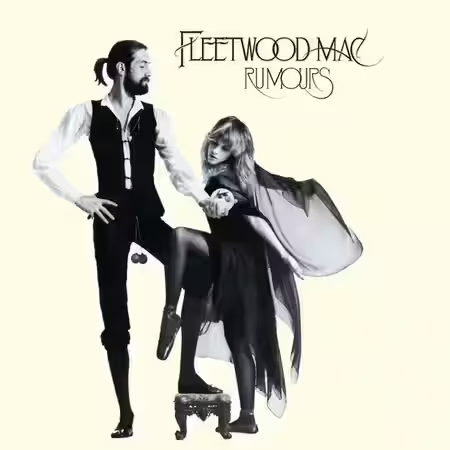
The cover photograph was taken by Herbert Worthington in 1976. Mick Fleetwood stands in his "Big Daddy" stage costume, foot up on a stool, holding a crystal ball in his left hand. Two wooden balls hang from chains between his legs; they are repurposed lavatory chains he had picked up touring British pubs and adopted as a stage prop. Nicks is dressed in her "Rhiannon" persona, mid-twirl. The pose was meant to capture the ringmaster-and-witch dynamic the band had settled into on the road.
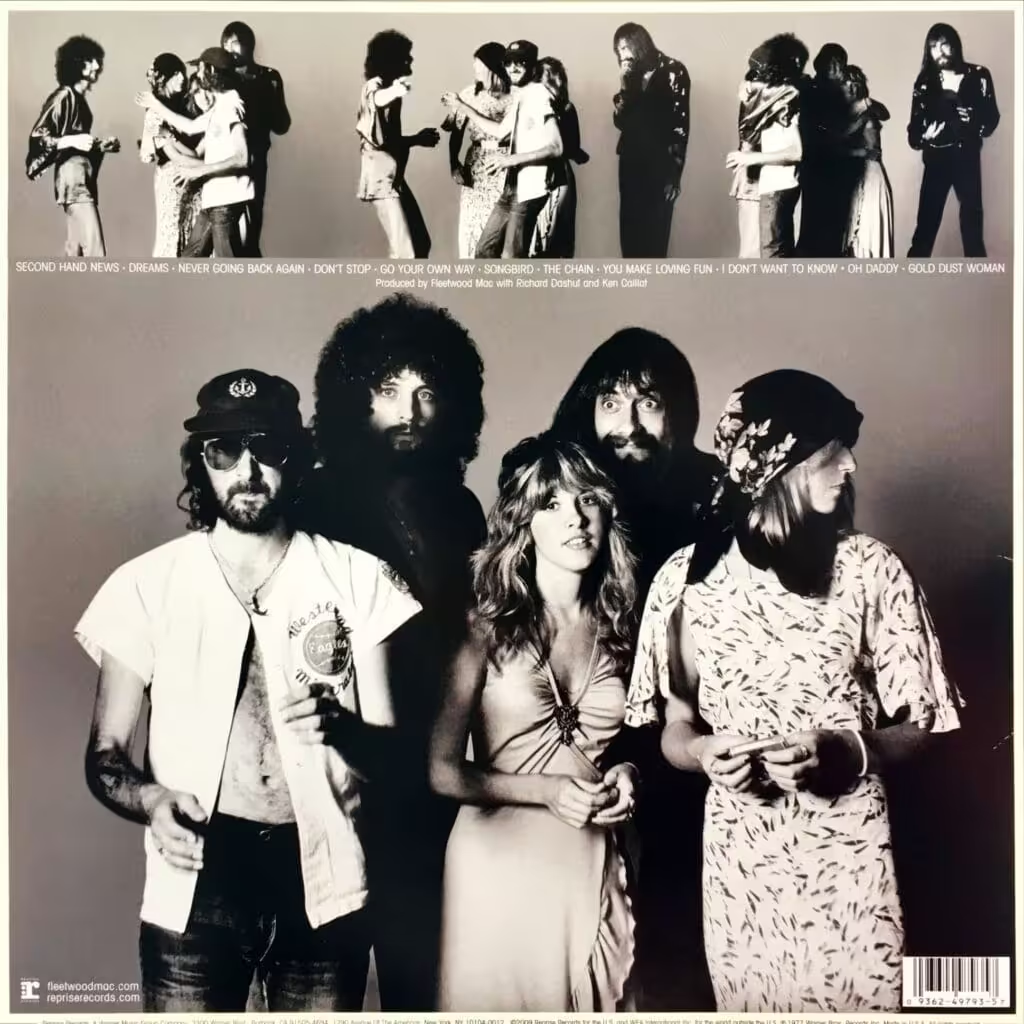
The back cover is a montage of band portraits, also by Worthington, taken in the same Los Angeles session. The shots that ended up on the back happened, by Worthington''s account, when John McVie and Buckingham started spontaneously hugging each other and Nicks and Christine McVie joined in. He kept shooting and the band let it happen. Album design was by Desmond Strobel, with the Rumours wordmark hand-lettered by Larry Vigon of Vigon Nahas Vigon.


Release and reception
Warner Bros. confirmed the release in December 1976 and chose "Go Your Own Way" as the lead single, going to radio on 20 December. The advance order for the album, 800,000 copies, was the largest in Warner Bros.'' history at the time. Rumours was released on 4 February 1977 in the United States and 11 February in the United Kingdom.
The contemporary reviews were strong rather than ecstatic. John Swenson''s Rolling Stone review in April 1977 was one of the more enthusiastic.
"Despite the interminable delay in finishing the record, Rumours proves that the success of Fleetwood Mac was no fluke."
John Swenson, Rolling Stone, April 1977
Robert Christgau in The Village Voice graded it an A and called it "more consistent and more eccentric" than its predecessor. John Rockwell in the New York Times called it "a delightful disk". Robert Hilburn at the Los Angeles Times dissented, calling it "frustratingly uneven". The Voice''s 1977 Pazz & Jop critics'' poll placed it fourth.
The retrospective verdict has been less divided. Stephen Thomas Erlewine at AllMusic gave the album five stars and described it as "an unparalleled blockbuster" whose every phrase regains its raw emotional power on every listen. The Pitchfork rating that arrived for the 2013 reissue was even more emphatic.
"What distinguishes Rumours, what makes it art, is the contradiction between its cheerful surface and its anguished heart. Here is a radio-friendly record about anger, recrimination, and loss."
Patrick McKay, Stylus Magazine, 2007
Andy Gill in The Independent reviewed the same 2013 reissue and placed the record alongside the Eagles'' Their Greatest Hits 1971 to 1975 as the high-water mark of the seventies American rock-culture expansion, "the quintessence of a counter-cultural mindset lured into coke-fuelled hedonism". Pitchfork''s Jessica Hopper gave the reissue a 10 out of 10 and a Best New Reissue tag, a designation Pitchfork rarely awards to anything older than its own existence.
Singles, charts and music videos
| Single | Released | US Hot 100 peak | UK peak | Notes |
|---|---|---|---|---|
| Go Your Own Way | 20 December 1976 | 10 | 38 | Lead single, first taste of the album at radio |
| Dreams | 24 March 1977 | 1 | 24 | Fleetwood Mac''s only US number one single |
| Don''t Stop | April 1977 | 3 | 32 | Bill Clinton''s 1992 campaign theme |
| You Make Loving Fun | September 1977 | 9 | 45 | Written about lighting director Curry Grant |
All four singles cracked the US top ten, a feat the band have never matched since. Dreams reached number one on the Billboard Hot 100 in June 1977, more than three months after the album''s release, and is the only single in the band''s catalogue to do so. The album itself first hit number one on the Billboard 200 on 2 April 1977 and held the top for thirty-one non-consecutive weeks across 1977 and 1978. It debuted at number seven in the UK and finally reached number one there in January 1978.
Promotional videos for the singles were straightforward 1977 affairs: studio playback footage, the band miming on a soundstage, no narrative. The Rumours-era live performances ended up doing more cultural work than the videos. The 1977 tour was filmed extensively and a single-night recording from The Forum in Inglewood on 29 August 1977, captured by Caillat himself, was finally released in September 2023 as Rumours Live.
The Rumours tour and after
Fleetwood Mac began the Rumours tour on 28 February 1977 after rehearsals at SIR Studios in Los Angeles. The tour visited North America, Europe, Oceania and Asia and ran into 1978. Early audiences were not always sympathetic; Nicks later told Billboard that fans who had bought tickets on the strength of the 1975 self-titled album were initially cool on the new material because the new material had not yet sold them.
By the autumn of 1977, the album had passed eight million in US sales alone. By March 1978 the worldwide figure was over ten million. By 1980 it was thirteen. In February 1978 the band and the two co-producers walked away with the Grammy for Album of the Year at the 20th Annual Grammy Awards.
The longer-tail success was even more striking. Rumours re-entered the Billboard 200 top ten in May 2011 after the Glee tribute episode, and again in October 2020 after Nathan Apodaca''s "Dreams" longboard TikTok went viral mid-pandemic. As of November 2023, it had spent more than 1,000 weeks in the top 100 of the UK Albums Chart. As of 2017, worldwide sales had passed 40 million copies. The RIAA has certified it 21 times platinum, the BPI seventeen times.
In film, TV and media
- "The Chain" has been the BBC''s Formula One theme music in the UK since 1978; it returned in 2009 and again in 2018, and is now permanently associated with the sport for British viewers.
- "Don''t Stop" was Bill Clinton''s 1992 presidential campaign anthem; the band reunited to play it at his inaugural ball in January 1993.
- "Dreams" became a TikTok phenomenon in October 2020 after Nathan Apodaca''s longboard video, returning the song to the Billboard Hot 100 for the first time since 1977.
- The 2011 Glee episode "Rumours" was built entirely around the album and pushed the record back into the Billboard top 20 thirty-four years after release.
- The Tony-winning 2023 Broadway play Stereophonic dramatised a thinly veiled version of the recording sessions and was sued in 2024 by Ken Caillat, who alleged the production used material from his 2012 memoir Making Rumours without permission.
Covers, samples and tributes
In 1998, Mick Fleetwood produced and released Legacy: A Tribute to Fleetwood Mac''s Rumours, an album of full-album covers featuring Tonic, Matchbox 20, the Goo Goo Dolls, the Corrs, the Cranberries, Elton John, Duncan Sheik and Jewel, among others. The Dixie Chicks took "Landslide" from Fleetwood Mac to country radio in 2003 but their reading of "Songbird" appeared on later editions of the tribute. The Smashing Pumpkins, the Kills and Bat for Lashes have all covered "Dreams". The xx and Halsey have covered "Silver Springs". Lorde cited Rumours as a key influence on her 2013 debut Pure Heroine; the Haim sisters have spoken of growing up on the record at length.
The 2023 stage play Stereophonic won five Tony Awards and was extended on Broadway into 2024. It tracks a fictional band recording a 1976 to 1977 album in a Sausalito studio with two engineers; the band consists of an English bassist and his estranged American singer-keyboardist wife, plus an American couple in the late stages of separation, plus an English drummer. The lawsuit against the production''s creators is ongoing.
Reissues, remasters and anniversaries
| Edition | Year | Format | Notable contents |
|---|---|---|---|
| Original LP | 1977 | LP | Original 11-track running order; gatefold sleeve |
| Expanded reissue | 2004 | 2xCD | "Silver Springs" restored as track 5; second disc of outtakes |
| 35th-anniversary super deluxe | 2013 | 4xCD + DVD + LP | Remastered album, full 1977 live disc, two discs of session outtakes, "The Rosebud Film" DVD |
| Vinyl reissue | 2017 | LP | Cut from original masters; 40th-anniversary stock for resurgent vinyl market |
| Rumours Live | 2023 | 2xCD / 2xLP | Caillat''s 29 August 1977 Forum recording, lacquers cut by Chris Bellman at Bernie Grundman |
The 2013 super deluxe edition is the definitive package. It pairs a remastered version of the album with twelve previously unreleased live tracks from the 1977 tour, sixteen new session outtakes under "More From The Recording Sessions", an additional eighteen outtakes carried over from the 2004 reissue, a 140-gram gatefold vinyl pressing, and a DVD of The Rosebud Film from the European leg of the tour. Rumours Live in 2023 finally delivered an officially sanctioned full-album-era live document.
Legacy and influence
What Rumours proved is that an album can be famous twice in completely different ways. The first wave was the simple commercial fact of it: 31 weeks at the top of the Billboard 200, four top-ten singles, a Grammy, an industry that did not yet realise an album could sell ten million copies and was forced to invent the word "blockbuster" to describe what was happening. The second wave is the critical re-evaluation, which arrived slowly and fully landed only with the 2013 reissue: that the gloss is not the obstacle to the pain, it is the delivery system for it.
"Rumours is the most important album we ever made. Without it, none of the rest exists."
Mick Fleetwood, Classic Albums documentary, 2004
The list of records explicitly built in Rumours'' shadow is now too long to itemise. Wilco''s Sky Blue Sky, Father John Misty''s I Love You, Honeybear, Haim''s Days Are Gone, Phoebe Bridgers'' Punisher, Taylor Swift''s Red and folklore, Lorde''s Melodrama, the War on Drugs'' Lost in the Dream, every singer-songwriter pop record made in California in the last fifteen years that uses warm tape compression and triple-tracked harmonies as a delivery system for an autobiographical lyric. Rumours built the template for the confessional pop-rock album, and the pop-rock album has been pushing back against it or surrendering to it ever since.
The official accolades stack up. The album was inducted into the Grammy Hall of Fame in 2003. The Library of Congress added it to the National Recording Registry in 2017 for being "culturally, historically, or aesthetically significant". Rolling Stone placed it at number seven in its 2020 reboot of the 500 Greatest Albums of All Time, the highest position for a Fleetwood Mac record. Q placed it third in its 1998 list of the 50 Best Albums of the 70s, behind only London Calling and Dark Side of the Moon. Time magazine included it in its All-TIME 100 Albums.
Things you might not know
| Fact | Detail |
|---|---|
| The working title | The album was provisionally called Yesterday''s Gone until John McVie suggested Rumours on the grounds that the band were writing diaries about each other. |
| The fired producer | Keith Olsen, who had produced the 1975 self-titled album, was sacked by Fleetwood and John McVie before sessions began for de-emphasising the rhythm section. |
| Sly Stone''s old room | Stevie Nicks wrote "Dreams" on a Fender Rhodes in a small studio at the Record Plant that had previously been built out for and used by Sly Stone, complete with a sunken pit. |
| The vari-speed rescue | The Sausalito multitracks wore out from repeated playback, and the kick and snare audio had to be transferred to fresh tape by a specialist using a vari-speed oscillator and a pair of split headphones. |
| "Songbird" was tracked in a concert hall | Christine McVie''s solo piano performance was recorded overnight at Berkeley''s Zellerbach Auditorium on a nine-foot Steinway, the only Rumours track recorded outside a studio. |
| The dog cover story | Christine McVie wrote "You Make Loving Fun" about the band''s lighting director Curry Grant. She told her ex-husband and bassist John McVie that the song was about her dog. |
| "The Chain"''s Formula One afterlife | The song''s coda has soundtracked the BBC''s Formula One coverage in the UK on and off since 1978, generating a second wave of recognition for an entire generation of British viewers. |
| Silver Springs sacrifice | "Silver Springs" was cut at the sequencing stage to protect the LP''s low-end response and demoted to a B-side, a decision Stevie Nicks did not learn about until later. |
| The TikTok comeback | "Dreams" returned to the Billboard Hot 100 in October 2020, 43 years after release, after Nathan Apodaca filmed himself drinking cranberry juice on a longboard to the song. |
| The 800,000 advance order | Warner Bros. logged an advance order of 800,000 copies before Rumours shipped, which was the largest advance order in the label''s history at that point. |
| Two of the four singles took longer than the album to chart | "Don''t Stop" and "You Make Loving Fun" were not released as singles until April and September 1977 respectively, months after the album had already gone to number one. |
| Stereophonic on Broadway | The 2023 Tony-winning play Stereophonic is a near-direct dramatisation of the Sausalito sessions, with the band''s line-up disguised but recognisable; Ken Caillat sued the production in 2024 over alleged use of his 2012 memoir. |
Listen to the Riffology Podcast
Riffology is the album-deep-dive podcast for the records that raised us. Hosts Neil and Chris spent ninety-nine minutes on Rumours in episode RIFF035, working through Sausalito, the damaged tape, the hospital rooms, the Formula One theme, "Silver Springs", and how a band that had once been a British blues outfit ended up making the best-selling pop record of the seventies. New episodes weekly. Subscribe wherever you get podcasts.
Comments