Led Zeppelin refused to hand over the master tapes for Led Zeppelin IV until Atlantic Records agreed to release it with no title, no band name and no text on the front or back cover. Atlantic was strongly against it. Jimmy Page has said a press agent warned him that after a year away from records and touring, the move would be professional suicide. The band stood their ground. The album is officially untitled, which is why it is also catalogued or known as Four Symbols, The Fourth Album, ZoSo and Runes.
What the label got instead was a record cut mostly in a cold Hampshire country house with the Rolling Stones' mobile studio parked outside, a duet with Sandy Denny, a drum sound captured in the hallway and the eight-minute "Stairway to Heaven", which the band would not release as a single.
Album Facts
| Field | Detail |
|---|---|
| Artist | Led Zeppelin |
| Album | Untitled, commonly Led Zeppelin IV |
| Release Date | 8 November 1971 |
| Label | Atlantic |
| Producer(s) | Jimmy Page (Peter Grant, executive producer) |
| Studio(s) | Island Studios, London; Headley Grange, Hampshire (Rolling Stones Mobile Studio); Sunset Sound, Los Angeles |
| Genre / Subgenre | Hard rock, folk, blues rock |
| Track Count | 8 |
| Total Runtime | 42:37 |
| Billboard 200 Peak | 2 |
| UK Albums Chart Peak | 1 |
| Other Notable Chart Peaks | Canada (RPM) 1; Australia (Kent Music Report) 2; Italy 2; Japan 2. Reissue in 2014: UK 6, US Top Catalog Albums 1 |
| Certifications | US 24x Platinum (2021); UK 6x Platinum (2007); Canada 2x Diamond (1995); Australia 9x Platinum (2009) |
| Estimated Sales | More than 37 million worldwide as of 2014 |
| Key Singles | "Black Dog" / "Misty Mountain Hop"; "Rock and Roll" / "Four Sticks" |
| Riffology Vault | Release dates, pressings and cover art |
Why Led Zeppelin Stripped Everything Away
Led Zeppelin released Led Zeppelin III in October 1970 to lukewarm, if not confused and sometimes dismissive, reviews. Its acoustic and folk-rock approach had also alienated some of the hardcore fanbase, although copies still shifted by the stack load. The group's answer was to step back. They took a break from live performances and turned down every touring offer, including a proposed New Year's Eve gig that would have been broadcast on television.
Page later told Brad Tolinski that the bare sleeve was the band's response to critics who maintained that the success of their first three albums was driven by hype rather than talent: "we stripped everything away, and let the music do the talking."
Writing the Songs: Bron-Yr-Aur to Headley Grange
Writing began in late October 1970 back at Bron-Yr-Aur, the cottage in south Snowdonia where Page and Plant had conceived many of the previous album's songs. They arrived with a backlog of half-finished songs and fragments, and "Going to California" was written there before being recorded later at the Grange. Its working title was "Guide to California"; the final name came from the trip to Los Angeles to mix the record.
Other pieces arrived part-formed. Page had much of the chord sequence of "Stairway to Heaven" on a demo when the band first tried it. John Paul Jones's riff for "Black Dog" was originally in 3/16 time, "but no one could keep up with that," he recalled. Jones had used a mandolin on "That's the Way" and brought it to the Grange, where Page picked it up one night and, in his words, the chords for "The Battle of Evermore" just came out.
The location itself took some finding. The band considered Mick Jagger's home, Stargroves, but judged it too expensive. Andy Johns recalled that the Stones' recording truck cost about £1,000 a week and so did Jagger's house, and that Page refused to pay Jagger that much for an old mansion. Page said he would find somewhere else, and the band ended up at Headley Grange, where parts of the previous album had been recorded.
Bonham in the Hallway: Recording Led Zeppelin IV
Sessions began on 5 December 1970 at Island Records' new studios on Basing Street, London, with "Black Dog". The band moved to Headley Grange the following month, using the Rolling Stones Mobile Studio with engineer Andy Johns, who had just worked on Sticky Fingers and recommended the truck. Ian Stewart of the Stones assisted. The truck was parked at the front of the house with cables fed through the drawing-room windows, and that room became the main recording space. They arrived on a bitterly cold morning in January 1971, and had only six days of recording time with the truck before heading to Basing Street.
Opinions of the house differed. Plant called it a falling-down mansion and said it was incredible. Jones was less charmed:
"We all ran in when we arrived in a mad scramble to get the driest rooms. There was no pool table or pub. It was just so dull."
John Paul Jones, quoted in Louder, 2020
The house's best trick was acoustic. Johns said Bonham complained he was not getting the sound he wanted, so they put his kit in the hallway, known as the Minstrel's Gallery, and hung two microphones from the staircase.
"I remember sitting there thinking it sounded utterly amazing, so I ran out of the truck and said, 'Bonzo, you gotta come in and hear this!' He shouted: 'Whoah, that's it! That's what I've been hearing!'"
Andy Johns, quoted in Louder, 2020
Some of the gear on the album:
- Page's rig was mostly Hiwatt amps, Johns recalled, with a sunburst Les Paul and a Telecaster.
- The hallway drums used two Beyerdynamic M 160 microphones, a limiter and a Binson Echorec delay.
- "Black Dog" guitars went direct into the mixer through a couple of Universal limiters, then were double-tracked.
- On "When the Levee Breaks", Plant's harmonica went through a battered Fender Princeton with a missing speaker and the tremolo on.
- The solo on "Stairway to Heaven" was played on the Telecaster Jeff Beck had given Page.
The Sunset Sound Fiasco
With the basic tracks down, the band spent five days at Island in February adding overdubs. Page then took the multitracks to Sunset Sound in Los Angeles on 9 February, on Johns's recommendation, with an April release in mind. Page recalled that as they landed there was a mild earthquake, and noted the coincidence with the "Going to California" lyric about mountains and canyons trembling. Mixing took ten days. Back in London, the band played the tapes at Olympic Studios and disliked them.
"I put the tape on and the first song goes by and sounds bloody awful and then the second one comes along and that's really horrid, too."
Andy Johns, quoted in MusicRadar, 2023
Page was damning at the time: "Basically, Andy Johns should be hung, drawn and quartered for the fiascos he's played." Page remixed the whole album in July, after touring through the spring and early summer, and "When the Levee Breaks" was the only song on the album mixed at Sunset Sound. The release was further delayed by arguments over the cover and whether the record should be a double album, or even a set of EPs. That remixing session at Island was the last time Johns worked with the band.
Personnel and Credits
| Role | Player | Notes |
|---|---|---|
| Core band | ||
| Guitars, mandolin | Jimmy Page | Electric and acoustic guitars; mandolin on "The Battle of Evermore" |
| Vocals, harmonica | Robert Plant | Harmonica on "When the Levee Breaks" |
| Bass, keyboards | John Paul Jones | Bass, electric piano, mandolin, recorders, synthesiser |
| Drums | John Bonham | Hallway kit on "When the Levee Breaks" |
| Guest musicians | ||
| Vocals | Sandy Denny | Duet on "The Battle of Evermore" |
| Piano | Ian Stewart | "Rock and Roll" |
| Production and engineering | ||
| Producer | Jimmy Page | |
| Executive producer | Peter Grant | |
| Engineer, mixing | Andy Johns | Rolling Stones Mobile Studio sessions |
| Mixing | George Chkiantz | |
| Artwork | ||
| Illustration | Barrington Colby | "The Hermit", inside illustration |
| Photography | Keith Morris | |
| Design coordination | Graphreaks | |
Denny's cameo is the notable guest turn: she provided the only female voice heard on a Led Zeppelin recording, singing the town crier against Plant's narrator. Stewart, the Stones' former pianist, was the guest on "Rock and Roll" and also played on "Boogie with Stu", which was not released until 1975's Physical Graffiti.
The Songs
| # | Title | Writer(s) | Length | Single? | Notes |
|---|---|---|---|---|---|
| 1 | Black Dog | Page, Plant, Jones | 4:57 | Yes, 1971 | Named for a black Labrador that wandered the Headley Grange grounds. |
| 2 | Rock and Roll | Page, Plant, Jones, Bonham | 3:41 | Yes, 1972 | Born from a Keep A-Knockin' jam; Ian Stewart on piano. |
| 3 | The Battle of Evermore | Page, Plant | 5:52 | No | Page's first mandolin piece; Sandy Denny duets with Plant. |
| 4 | Stairway to Heaven | Page, Plant | 8:03 | No | Never commercially released as a single in the US; solo played on a Telecaster. |
| 5 | Misty Mountain Hop | Page, Plant, Jones | 4:39 | B-side of "Black Dog" | Written at Headley Grange; title comes from The Hobbit. |
| 6 | Four Sticks | Page, Plant | 4:45 | B-side of "Rock and Roll" | Bonham played two sticks in each hand; Jones on synth. |
| 7 | Going to California | Page, Plant | 3:32 | No | Working title "Guide to California"; written at Bron-Yr-Aur. |
| 8 | When the Levee Breaks | Page, Plant, Jones, Bonham, Memphis Minnie | 7:08 | No | Reworked from a 1929 Memphis Minnie and Kansas Joe McCoy song. |
"Black Dog" takes its name from a dog that hung around Headley Grange. Jones is credited with the main riff, and Page adapted the a cappella vocal sections from Fleetwood Mac's "Oh Well". The turnaround gave the band trouble until Bonham simply played straight through it. The fade-out solo was triple-tracked and pieced together by splicing four passages; Page later said that on the tapes the guitars sounded like an analogue synthesiser.
"Rock and Roll" began when the band, stuck on "Four Sticks", took a break and Bonham started the intro to Little Richard's "Keep A-Knockin'". The tapes were rolling. Page said the song was virtually complete within 15 minutes. On stage Plant first introduced it as "It's Been A Long Time", and from 1972 until 1975 it was the opening number.
"The Battle of Evermore" has lyrics inspired by a book Plant was reading about the Scottish wars. He felt it needed a second voice, and Denny came in. Plant sang a guide vocal at the Grange and left her response lines for later. "We started out soft but I was hoarse by the end, trying to keep up with him," Denny said.
"Stairway to Heaven" was recorded at Island. Johns remembered Page playing acoustic guitar in the isolation booth, Bonham in the main room and Jones on a Honer electric piano. Jones came up with the opening by picking up a bass recorder and playing along with Page, while Plant's lyrics came together at the Grange. Page took three attempts at the solo and said the one they used was definitely the best. Atlantic wanted to issue it as a single, and manager Peter Grant refused requests in both 1972 and 1973. "We wanted them to hear it in the context of the whole album," Page said.
"Four Sticks" had the band stumped on Jones's synth riff until Bonham put down a can of Double Diamond, picked up two sticks in each hand and, Page recalled, "just went for it. It was magic." Johns's verdict on the mix: "It was a bastard to mix."
"When the Levee Breaks" was suggested by Plant, who used many of the original 1929 lyrics. Page and Jones dropped the twelve-bar form for a droning one-chord approach. Page said an earlier studio attempt, made before the band reached Headley Grange, had sounded flat, and that the hallway drum sound made the difference immediately. Parts were recorded at a different tempo and slowed down, and Page phased the vocal and added a backwards-echoed harmonica solo. In his Rolling Stone review, Lenny Kaye noted it was "strangely credited to all the members of the band plus Memphis Minnie" and called it "a dazzler".
Outtakes, B-sides and Lost Songs
The two singles used album tracks as B-sides, so the lost material lives elsewhere. Three songs from the sessions, "Down by the Seaside", "Night Flight" and "Boogie with Stu", appeared four years later on Physical Graffiti, and an early version of "No Quarter" was also recorded. Author George Case also places "Black Country Woman" in the IV sessions.
An early version of "When the Levee Breaks" came out as "If It Keeps On Raining" on the 2015 reissue of Coda. A 1972 version of "Four Sticks" with the Bombay Symphony Orchestra appeared on that album's deluxe edition.
Artwork and Packaging
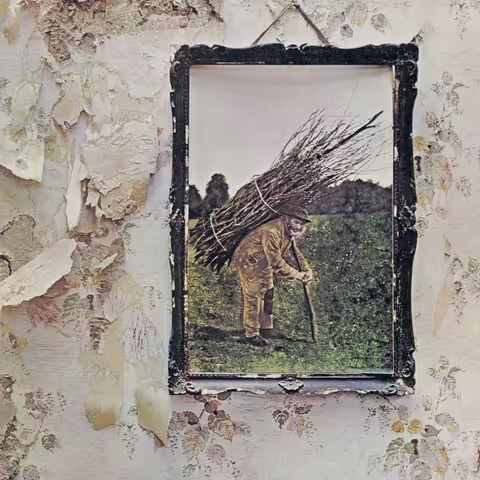
On the front, a framed picture hangs from a cord against torn, peeling floral wallpaper. In it a bearded old man in a yellow-brown coat and hat bends under an enormous bundle of sticks, leaning on a stick in a green field with trees behind him. There is no text anywhere on the front, and the original LP has none on the back either.
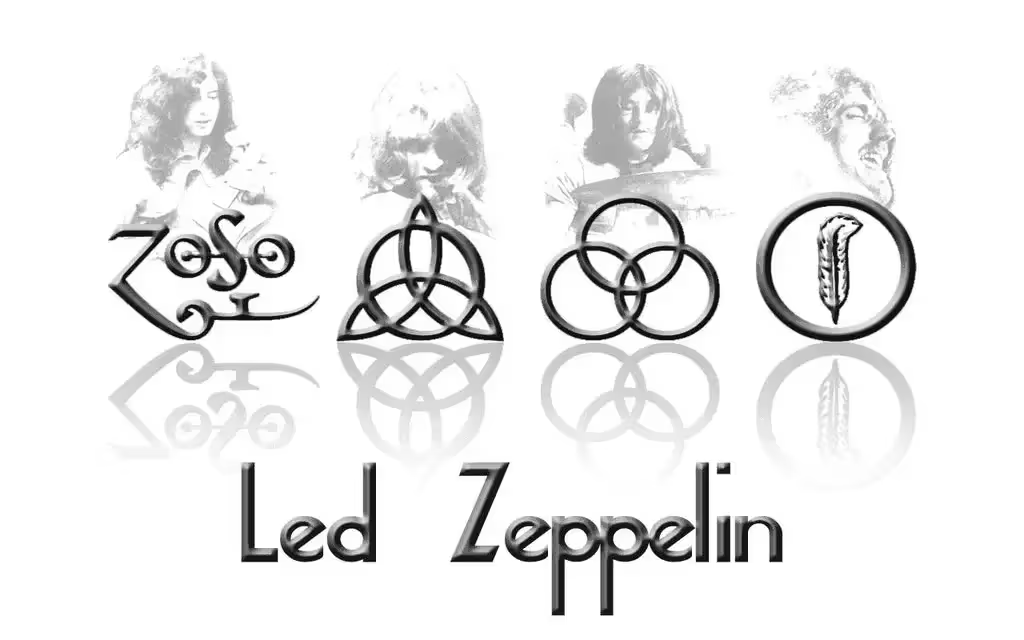
Page decided each member could choose his own emblem. His own has never been publicly explained. Jones's, a circle intersecting three vesicae piscis, came from Rudolf Koch's Book of Signs, as did Bonham's three interlocking rings. Plant's feather in a circle was based on the sign of the supposed Mu civilisation.
"By the fourth album we collectively agreed on what the visual aspect should be: total anonymity."
Jimmy Page, to Mat Snow, quoted in MusicRadar, 2023
Plant bought the picture in an antique shop, and it was fixed to the papered wall of a partly demolished house for the photograph. Research published in 2023 suggests it is a late-Victorian black and white photograph, taken by Ernest Howard Farmer and since hand-coloured, and that the figure is Lot Long, a Wiltshire thatcher. The block of flats on the back is thought to be Salisbury Tower in Ladywood, Birmingham. Page said the cover was meant to bring out a city and country contrast. Inside, "The Hermit" by Barrington Colby draws on the Rider-Waite tarot card, and the lettering for the "Stairway to Heaven" lyrics came from an Arts and Crafts magazine, The Studio. The Royal Mail put the cover on a stamp in January 2010.
Release and Reception
Atlantic released the album on 8 November 1971, promoting it with teaser adverts showing the individual symbols. It entered the UK chart at No. 10, rose to No. 1 the following week and spent 90 weeks on the chart. In the US it peaked at No. 2 on the Billboard 200, behind Sly and the Family Stone's There's a Riot Goin' On and Carole King's Music. Virgin Records set up special stalls to sell it, and airplay for "Stairway to Heaven" kept it in the US Top 40 for the next six months.
Reviewing it for Rolling Stone, Lenny Kaye said it came off as the band's "most consistently good" album:
"...the sheer variety of the album: out of eight cuts, there isn't one that steps on another's toes, that tries to do too much all at once."
Lenny Kaye, Rolling Stone, 1971
Billboard called it a "powerhouse album". Writing for the BBC in 2007, Daryl Easlea described it as "a successful marriage of the hard rock from their second album with the folkier meanderings of their third". The placings on later lists include:
- Mojo, 1996: No. 24 in "The 100 Greatest Albums Ever Made"
- Grammy Hall of Fame, 1999
- Classic Rock, 2001: No. 1 in "100 Greatest Rock Albums Ever"
- Pitchfork, 2004: No. 7 among the top 100 albums of the 1970s
- Q, 2006: No. 21 in "100 Best Albums Ever"
- Rock and Roll Hall of Fame, 2007: No. 4 in "The Definitive 200"
- Rolling Stone: No. 66 in 2003, No. 69 in 2012, No. 58 in 2020
Singles
| Single | Release (US) | B-side | Billboard Hot 100 | Other peaks |
|---|---|---|---|---|
| "Black Dog" | 2 December 1971 | "Misty Mountain Hop" | 15 | Canada (RPM) 11; Switzerland 6; Denmark 5 |
| "Rock and Roll" | 21 February 1972 | "Four Sticks" | 47 | Canada (RPM) 38; West Germany 13 |
As was the band's practice, the UK did not receive the "Black Dog" single. "Stairway to Heaven" was never commercially released as a single in the US, though download sales pushed it to No. 37 on the UK Singles Chart in November 2007.
Touring and Live
"Black Dog" and "Stairway to Heaven" were first played live at Belfast's Ulster Hall on 5 March 1971. Jones recalled that the crowd was unimpressed. "Stairway to Heaven" then became the centrepiece of the set, and the band's final performance of it came in Berlin on 7 July 1980.
The Winter 1971 UK tour began on 11 November, three days after release, and ran to 21 December across 16 shows. All tickets sold out despite going on sale less than a week before it began, and extra shows at Wembley and Manchester were added after fans queued for up to eighteen hours. The two Wembley Empire Pool concerts, dubbed "Electric Magic", ran to five hours and included vaudeville acts, trapeze artists and performing pigs in policemen's uniforms, with Stone the Crows in support. The four symbols appeared on stage equipment: Page's on an amplifier, Bonham's on his bass drum head, Jones's on a covering for his Rhodes piano and Plant's on a PA cabinet.
Controversy and Lawsuits
In January 1982 a Trinity Broadcasting Network programme claimed that "Stairway to Heaven" hid Satanic messages when played backwards. California assemblyman Phil Wyman proposed a law requiring warning labels on records containing backmasking, and a hearing followed in April 1982. George Case, author of Led Zeppelin FAQ, says the band did use backwards sounds for effect but were not putting messages on there.
A more serious dispute came in May 2014, when Spirit's bassist and a trust acting for the late guitarist Randy California sued over the song's resemblance to Spirit's "Taurus". A jury ruled in June 2016 that the similarities did not amount to infringement. A Ninth Circuit panel ordered a new trial in 2018, but on 9 March 2020 the full court ruled in Led Zeppelin's favour.
Samples and Covers
Bonham's two-bar drum opening on "When the Levee Breaks" is among the most sampled in popular music. The Beastie Boys and house DJs took it first, in the late 1980s, and Esquire's Miles Raymer lists Eminem, Dr. Dre, Mike Oldfield and Sophie B. Hawkins among those who followed. Beyoncé's "Don't Hurt Yourself" is another. Robert Plant performed the song with Alison Krauss on their 2022 tour, and Page and Plant reworked "Four Sticks" for their 1994 album and played "When the Levee Breaks" on their 1995 tour.
Reissues and Remasters
The original UK pressing carried Atlantic catalogue number 2401 012, and the US one SD 7208. Later reissues included a lilac vinyl pressing in 1978 and a box set in 1988. Page remastered the album with engineer George Marino in 1990, and it was issued individually on CD in 1994.
On 27 October 2014 a remaster appeared alongside Houses of the Holy in six formats: standard CD, deluxe two-CD, standard LP, deluxe two-LP, a super deluxe two-CD plus two-LP set with a hardback book, and high-resolution downloads. The bonus disc cover is an inverted-colour version of the original artwork, and the disc carries:
- "Black Dog" (basic track with guitar overdubs)
- "Rock and Roll" (alternate mix)
- "The Battle of Evermore" (mandolin and guitar mix from Headley Grange)
- "Stairway to Heaven" (Sunset Sound mix)
- "Misty Mountain Hop" and "Four Sticks" (alternate mixes)
- "Going to California" (mandolin and guitar mix)
- "When the Levee Breaks" (alternate UK mix)
The remaster scored 100 on Metacritic.
The Weight of Led Zeppelin IV
It is Led Zeppelin's best-selling album, with more than 37 million copies sold as of 2014 and 24x Platinum status in the US. Houses of the Holy followed in 1973 and Physical Graffiti in 1975. In 2002 "Rock and Roll" became the first Led Zeppelin song licensed for commercial use, in Cadillac television advertising.
In 2002 Spin's Chuck Klosterman named it the second-greatest metal album of all time, and in 2022 Guitar World's Jenna Scaramanga called it the greatest guitar album of the 1970s and the benchmark for every guitar band since. Steven Hyden observed in 2018 that its popularity bred a reflexive bias: listeners feel obliged to name a side-two track as their favourite and never to call it their favourite Zeppelin album.
"Stairway to Heaven" has topped New York station WAXQ's annual listener countdown every year since 2001, including November 2025, and by 2000 had been broadcast on radio more than three million times. Plant himself rates it the band's best, and has been quoted saying simply "the Fourth Album, that's it", but he has an uneasy relationship with its centrepiece.
"There's only so many times you can sing it and mean it. It just became so sanctimonious."
Robert Plant, quoted in Louder, 2020
Things You Might Not Know
| Fact | Detail |
|---|---|
| The engineer was 19 | Andy Johns was only 19 when he recorded the album, though he had already engineered the band's third LP and parts of their second. |
| Opening tape noise | The muted sounds opening "Black Dog" are guitar track openings played together, with the tape spinning up to speed audible. Page liked starting songs unexpectedly. |
| Gold on day one | Kaye wrote that the latest Cash Box noted the album was a gold disc on its first day of release. |
| Sedaka got there first | Neil Sedaka released his own song called "Stairway to Heaven" as a single in 1960, and it reached No. 9 on the Billboard Hot 100. |
| Sheet-music record | "Stairway to Heaven" is the biggest-selling single piece of sheet music in rock history, averaging 15,000 copies a year. |
| A ghost on the stairs | Johns said Page went on about seeing ghosts on the stairs at Headley Grange, and the engineer's reaction was a sarcastic "Oh yeah right, Jimmy!" |
| Sandy Denny's symbol | Denny chose a fifth, smaller symbol of three equilateral triangles, which appears on the inner sleeve and serves as an asterisk. |
The Riffology podcast covered the record in episode RIFF033, and the show is available on all major podcast platforms.
Comments