Billy Corgan turned himself into a cartoon character to break up his own band. That was the plan, anyway. The fifth Smashing Pumpkins album would be a concept record about a rock star called Zero who renames himself Glass, rebrands his group as The Machines of God, and addresses his fans as the Ghost Children. The band would tour playing exaggerated versions of themselves, the press would print whatever cartoon they wanted to print, and at the end of it all the four-piece would walk away on its own terms.

That was not what happened. Bassist D'arcy Wretzky left in the middle of recording. Virgin Records refused to release the double album Corgan had pitched. The cover concept got Grammy-nominated and most listeners still could not work out what the album was about. The Smashing Pumpkins did break up at the end of 2000, exactly on schedule, but Machina/The Machines of God arrived as a wounded thing rather than the triumphant farewell its author had drawn on his bedroom wall in chart form.

Album FactsDetail
ArtistThe Smashing Pumpkins
AlbumMachina/The Machines of God
Release Date29 February 2000
LabelVirgin Records
ProducersBilly Corgan, Flood
StudiosSadlands, Pumpkinland and Chicago Recording Company (all Chicago)
GenreAlternative rock, alternative metal
Track Count15
Total Runtime73:23
Billboard 200 Peak3 (debut, 165,000 first-week sales)
UK Albums Chart Peak7
Other Notable Peaks2 in Australia, Canada, Italy and Norway; 3 in Sweden; 4 in Belgium, France, Germany and New Zealand
CertificationsRIAA Gold (US), BPI Silver (UK), Platinum (Canada), Gold (Australia, France, Japan, New Zealand)
Estimated Sales583,000 in the US to 2005; roughly 920,000 worldwide
Key Singles"The Everlasting Gaze", "Stand Inside Your Love", "I of the Mourning", "Try, Try, Try"

The Smashing Pumpkins Before Machina

By late 1998 The Smashing Pumpkins had been the most ambitious mainstream rock band in America for the better part of a decade and most of that ambition had cost them something. Siamese Dream in 1993 was made under a cloud of breakdowns and Corgan rewriting the rest of the band's parts in private. Mellon Collie and the Infinite Sadness in 1995 was a twenty-eight-track double album that sold more than ten million copies and absorbed an entire calendar year on the road. Touring keyboardist Jonathan Melvoin overdosed in a New York hotel room in July 1996; Jimmy Chamberlin was sacked from the band the same week for being there.

Adore in 1998 was the album they made without Chamberlin. Drum machines, synths, mournful piano ballads, almost no electric guitars on top: a deliberate retreat from the heavy alternative rock that had sold them stadiums. It made a million copies in the United States and felt, by The Smashing Pumpkins' own absurd standards, like a commercial disaster. Corgan later told Stereogum he had been chasing a bigger swing than that.

"I was thinking like, you know, what the Beatles did with Sgt. Pepper's. Why can't we make a really different type of record? So that was my thinking going into it."

Billy Corgan, on Adore, Stereogum, August 2014

The Adore tour wound down in the second half of 1998 and Corgan started writing again almost immediately, demoing new songs at his Chicago house. In October the four original members convened to talk about what came next. They agreed on two things: Chamberlin would rejoin, and they would make one more proper album and one more proper tour and then the band would dissolve. The end was already on the wall before a single note of Machina was tracked.

The Concept: Zero, Glass and the Ghost Children

The concept began as a way of telling the truth by exaggerating it. Corgan's public persona had hardened, by the late 1990s, into something he barely recognised: the bald, black-clad, joyless rock star who took himself too seriously and ran his band like a tyrant. So he decided the fifth album would be about that man. A rock star called Zero hears the voice of God, renames himself Glass, rebrands his band The Machines of God, and addresses his fans as the Ghost Children.

"The band had become such cartoon characters at that point in the way we were portrayed in the media, the idea was that we would sort of go out and pretend we were the cartoon characters."

Billy Corgan, browardpalmbeach.com Q&A, July 2010

The plan was musical theatre dressed up as a rock tour. A double album would tell the full Glass story. Tour staging would lean into a scripted narrative, with the band visibly playing their fictional versions of themselves. A booklet of cryptic writings under the heading "Glass and the Machines of God" would seed the storyline; an internet treasure hunt would lead fans through clues to other websites, fan interpretations, video fragments and eventually an animated series. Corgan even drew it out by hand: a chart now filed in the band's archive that maps the loose narrative arc of Machina and its planned sequel Machina II.

Virgin Records, looking at the Adore returns, declined to release a double album. Corgan agreed to slim the project to a single LP. He also began to lose patience with how publicly esoteric the concept was becoming and quietly let it recede in interviews, framing Machina later as more of a song-driven rock record than a story album. The artwork, the song titles and the lyrics still carry the original myth; very little of it survived intact in the way the album was actually marketed.

Recording at Pumpkinland and CRC

The first sessions were the quietest. In late 1998 Corgan tracked acoustic versions of the songs in his home studio, Sadlands, the same way he had built up demos for Mellon Collie and the Infinite Sadness years earlier. Then the band moved to their long-time Chicago practice space, nicknamed Pumpkinland, and finally to Chicago Recording Company on East Ohio Street. The team running the desks was the same team that had finished Adore: co-producer Flood, with engineers Howard Willing and Bjorn Thorsrud.

The original idea had been a tightly conceptual piece of music: the songs would serve the Glass narrative, even where that meant strange structures, orchestral interludes and electronic textures inherited from Adore. Roughly three months in, with D'arcy already having walked, Corgan and Flood scrapped that plan and went back to writing.

"We decided that we were going to have to make a very different kind of record. We pretty much went back to the drawing board. Certain songs on the record are survivors from that first period, but it meant a shift in the ways songs had to be formed."

Flood, EQ magazine, October 2008

The new method was almost the opposite of Adore's painstaking computer-built arrangements. Corgan would arrive with a chord shape and a vocal line; the band would track it fast, often in a day, and then chase it down whatever stylistic alleyway felt most promising.

"We spent most of the time trying to take the songs as far as they could be taken down a particular avenue. So if it was gonna be proto-cyber metal, we tried to make it very proto and very cyber. If it was acoustic, then we tried to not fall into the typical ballad-y kind of aspects. The songs were probably written in about a day."

Billy Corgan to MTV News, March 2000

Corgan structured the running order in two halves on purpose: the first eight tracks the more direct rock songs ("a rock and roll approach with pop sensibility", he told INSite at the time), the last seven the longer, stranger, more arty material, of which the nine-minute "Glass and the Ghost Children" is the centrepiece. Flood and Alan Moulder mixed the album back in London after tracking finished, with mastering handled by Howie Weinberg in New York.

Some signature gear and production choices that shaped the sound:

  • Heavy multi-tracked guitars run through Bogner, Marshall and Fender amps, layered to a similar density as Siamese Dream but with cleaner top end thanks to Flood's mixing approach.
  • Pro Tools tracking running alongside analogue tape, allowing the kind of fast-edit experimentation Corgan and Flood had used on Adore.
  • Mike Garson, the David Bowie pianist, brought in for the closing keyboard part on "With Every Light".
  • Almost all the bass on the finished record played by Corgan and James Iha after Wretzky's departure, with Iha doubling guitar and bass on several tracks.
  • A single-day approach to vocal takes on most songs, in contrast to the layered-and-comped vocals of Mellon Collie and the Infinite Sadness.

D'arcy Leaves The Band

The band took a brief break from the Machina sessions in April 1999 for the Arising! club tour: nine small US dates to test the new lineup with Chamberlin back in the drum seat. By the time the tour ended, D'arcy Wretzky had decided she was done. Press at the time framed it gently; later interviews made clear it was bitter on both sides. She was the last bassist who had been in the band on Gish, on Siamese Dream, on Mellon Collie and on Adore, and she walked out in the middle of recording the album that was meant to put a bow on all of that.

"This put a stress obviously on the full integrity of the project, because it was connected to the band not only bringing the music to fruition fully, but also the public component of being in character. I ended up in a broken band with a half-ass enthusiasm towards finishing a project already started."

Billy Corgan, on D'arcy's exit, EQ magazine, October 2008

For the live shows that would follow Machina, the Pumpkins recruited Melissa Auf der Maur, lately of Hole, who had been one of D'arcy's closest friends. Auf der Maur is not on the studio album; the bass parts were cut by Corgan and Iha after the fact. She made her debut with the band at a small Chicago show in mid-1999 and was a permanent fixture for the entirety of the touring cycle.

Personnel and Credits

RolePlayerNotes
Core band
Vocals, guitar, bass, keyboards, pianoBilly CorganAlso co-producer, mixer, art direction
Guitar, bassJames IhaBass duties expanded after D'arcy's departure
BassD'arcy WretzkyCredited on the album sleeve; left the band before tracking was complete
DrumsJimmy ChamberlinFirst Pumpkins studio album since Mellon Collie and the Infinite Sadness
Guest musicians
PianoMike GarsonClosing piano on "With Every Light"; long-time David Bowie collaborator
Production and engineering
Co-producer, mixerFloodMark Ellis; previously co-produced Adore and worked with U2, Depeche Mode and Nine Inch Nails
Co-producerBilly Corgan
Recording, mixingHoward Willing
Recording, mixing, programmingBjorn ThorsrudLong-time Pumpkins engineer
MixingAlan MoulderMy Bloody Valentine, Nine Inch Nails, Jesus and Mary Chain
MasteringHowie WeinbergSterling Sound, New York
Artwork
Sleeve paintings and etchingsVasily KafanovRussian-born painter; the booklet artwork was Grammy-nominated for Best Recording Package in 2001
Art directionBilly Corgan, Greg Sylvester, Thomas Wolfe, Yelena YemchukYemchuk was Corgan's then-partner and frequent visual collaborator
Live lineup (post-album)
Bass, backing vocalsMelissa Auf der MaurJoined for the Sacred and Profane tour; not on the studio recordings

The Songs

Every song on Machina is credited to Billy Corgan alone. The running order moves from the heavy, declarative pop-rock of the first half into the longer, druggier, more ambient second half, ending on three songs that read as long, exhausted exhalations.

#TitleLengthSingle?Notes
1"The Everlasting Gaze"4:00Promo singleOpens with a riff Corgan said came out of Chamberlin sound-checking
2"Raindrops + Sunshowers"4:39One of the survivors from the original conceptual sessions
3"Stand Inside Your Love"4:14Lead commercial singleOriginally intended as the first single ahead of "The Everlasting Gaze"
4"I of the Mourning"4:37Promo singleBuilt around the metaphor of a radio that comforts the lonely
5"The Sacred and Profane"4:22The title later borrowed for the world tour
6"Try, Try, Try"5:09SingleFinal single; video by Jonas Akerlund banned from US TV
7"Heavy Metal Machine"5:52Promo cassette onlyCorgan's response to a critic who told him he was no longer relevant
8"This Time"4:43"This time I need to know, I really must be told, that it's over"
9"The Imploding Voice"4:24Pivot point into the album's stranger second half
10"Glass and the Ghost Children"9:56The album's narrative centrepiece, with a long spoken-word interlude
11"Wound"3:58One of several songs about survival rather than mythology
12"The Crying Tree of Mercury"3:43Originally listed on early pressings as "The Mercury Tree"
13"With Every Light"3:56Mike Garson's piano outro; Q called it "perhaps the best" song on the album
14"Blue Skies Bring Tears"5:45Dense, distorted, deliberately uncomfortable mix
15"Age of Innocence"3:55Closes the album with an acoustic guitar and a near-whisper

"The Everlasting Gaze" is the closest the album comes to a mission-statement opener. The lyric "you know I'm not dead" is delivered without a hint of irony; the riff is the heaviest piece of guitar Corgan had committed to a record since the early 1990s. It is the song most directly aimed at the Korn and Limp Bizkit moment that was eating Pumpkins radio in 2000.

"Stand Inside Your Love" is the love song. It is also the album's most successful piece of pop construction, a slow-walking ballad of devotion that sits comfortably in the lineage that runs from "Today" on Siamese Dream through "Tonight, Tonight" on Mellon Collie. It was the only Machina single to make a real dent on US rock radio.

"Try, Try, Try" became infamous before it was a hit. The song itself is a four-minute message of hope written in plain sentences. The video, by Swedish director Jonas Akerlund, depicted an addict couple living rough on the streets of Los Angeles and was so explicit that MTV in the United States refused to play it. A separately shot, sanitised version exists; neither got radio play to match the band's previous singles.

"Glass and the Ghost Children" is the song where the original concept survives most intact. Two acts of distorted rock bracket a long spoken interlude, with Corgan reading from what reads like a letter from Glass to himself. It is the longest song on any Pumpkins studio album to that point and the one that listeners either treat as the album's high point or skip entirely.

"With Every Light" closes the second half on a single piano figure, the only piece on the album where Mike Garson takes a credit. The lyric "it's almost over, it's almost over, no more war and no more soldier" is a direct goodbye, written by a man who had told his bandmates the previous year that this would be their last record together.

The Album Artwork

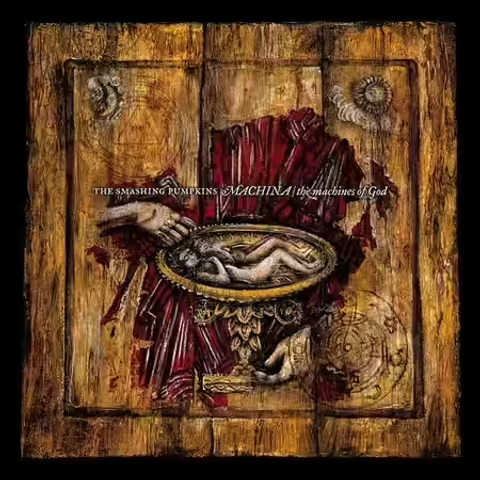
The booklet was the place where the Glass concept was allowed to run unchecked. Russian-born painter Vasily Kafanov produced a sequence of canvases that loosely tell the story of Glass and the Machines of God: a robed figure walks through alchemical and astrological symbols, framed by Latinate inscriptions and chemistry diagrams. Corgan supplied accompanying prose passages, written in the first person of Glass, that ran across the booklet pages and continued onto the band's website. The total package, between the booklet, the digipak outer sleeve and the screen-printed disc, was nominated for a Grammy in 2001 for Best Recording Package.

The cover image itself, a half-faced portrait set against deep red, became the visual shorthand for the album and is what most fans remember when the title is mentioned. It is also, deliberately, the part of the artwork that contains the least direct narrative: nothing in the painting tells you about Zero, Glass or the Ghost Children. The mythology is buried inside.

Release and Reception

Machina was released on 29 February 2000, the leap day, with a four-track bonus disc called Still Becoming Apart available from selected retailers. It debuted at number 3 on the Billboard 200 with 165,000 first-week sales, then collapsed: Rolling Stone's Eric Boehlert reported a sixty percent week-two drop, the kind of number that ends radio campaigns.

Critics, oddly, were largely on side. Metacritic aggregates the contemporary reviews to 66 out of 100, and the high marks came from outlets that had been sceptical of Adore. Jim DeRogatis at the Chicago Sun-Times had been calling the album a return to form since pre-release listening sessions.

"An exceedingly impressive and hard-driving record. The Pumpkins' masterpiece."

Jim DeRogatis, Chicago Sun-Times, February 2000

Q's Paul Elliott called Machina "mostly, a wonderful rock album", praised "Stand Inside Your Love" and "Try, Try, Try" as among the band's best work, and singled out the closing piano piece. The Daily Telegraph's Clark Collis wrote that the band sounded "back at their grunge-rocking best". The negative reviews came from publications that had loved the band early: Pitchfork awarded a 4.2; NME complained that it did not "sound like a band in love with the potential and power of music".

PublicationScoreReviewer
Q4 / 5Paul Elliott, April 2000
Spin7 / 10Eric Weisbard, March 2000
Rolling Stone3.5 / 5Jon Pareles, March 2000
Chicago Sun-Times3.5 / 4Jim DeRogatis, February 2000
AllMusic3 / 5Stephen Thomas Erlewine
Los Angeles Times3 / 4Natalie Nichols, February 2000
NME3 / 5Victoria Segal, February 2000
Entertainment WeeklyC+David Browne, February 2000
The Village VoiceC+Robert Christgau, March 2000
Pitchfork4.2 / 10Brent DiCrescenzo, January 2000

Worldwide, the album entered the top three in nine countries: number 2 in Australia, Canada, Italy and Norway, number 3 in the US, Ireland and Sweden, and number 4 in Belgium, France, Germany and New Zealand. It got to number 7 in the UK. Certifications followed in most of those territories at gold or platinum tier.

The commercial story past week one is, however, what the band remembers. The first-week number was respectable; the second-week drop made it clear the album would not cross over the way Mellon Collie or Siamese Dream had. By 2005, US sales sat around 583,000, qualifying for RIAA Gold but a long way short of the multi-platinum benchmarks the band had set.

"It was like watching your kid flunking out of school after getting straight A's for ten years."

Jimmy Chamberlin, Rolling Stone, December 2000

Corgan's own retrospective, eight years on, blamed the moment as much as the music: Korn and Limp Bizkit were running rock radio, the album was neither heavy enough for nu-metal nor weird enough for the indie press, and the audience that had loved Mellon Collie was no longer sure what The Smashing Pumpkins were for.

Singles and Music Videos

SingleRelease DateFormatDirectorNotes
"The Everlasting Gaze"9 December 1999Promo radio singleNo videoIssued ahead of the album to seed rock radio
"Stand Inside Your Love"21 February 2000Commercial singleW.I.Z.Filmed in late 1999 when the song was still planned as the lead single
"I of the Mourning"2000Promo singleNo commercial videoWon an online MTV vote and was performed live on @MTV Week in March 2000
"Heavy Metal Machine"2000Promo cassette onlyNoneNever sent to radio in any meaningful quantity
"Try, Try, Try"11 September 2000Commercial singleJonas AkerlundLong-form short-film video banned from US MTV for explicit drug content

The promotional cycle was unusual for a band of the Pumpkins' size. Corgan handled most of the press in the months around release, including a half-hour live MTV special on 9 March 2000 in which fans voted online to choose which Machina deep cut the band would perform live (the winner was "I of the Mourning"). The Try, Try, Try short film by Jonas Akerlund, conceived as a stand-alone piece of cinema rather than a music video, was a small festival hit but never reached MTV's daytime rotation in the country it was made for.

Touring: The Sacred and Profane

The world tour was named, retroactively, after the album's fifth track. It ran for ninety-one shows across nineteen countries, opening in Kansas City in May 2000 and ending in Long Beach, California in December. The original idea had been a fully scripted, theatrical staging of the Glass narrative; what the tour became was a more conventional rock show with longer set lists, occasional acoustic detours and the sense, in every venue, that this was the last time these four (now five, with Auf der Maur) would play together.

Highlights from the tour, drawn from contemporary reviews and the band's own archives:

  • The first European leg in summer 2000, including a headline slot at Pinkpop in the Netherlands and an early arena run in the UK.
  • A pair of shows at Tokyo's Nippon Budokan that were among the longest sets the band had ever played in Japan.
  • Festival appearances across Australasia in the autumn, with the Cape Town leg of the tour the first time many Pumpkins songs had been played in southern Africa.
  • A two-night stand at the Palais Omnisports de Paris-Bercy, recorded in part for a planned live release that did not materialise at the time.
  • The final two shows at the Cabaret Metro in Chicago on 1 and 2 December 2000, played as a long farewell to their hometown crowd, with William Corgan Sr (Billy's father) sitting in on guitar for parts of the set.

The tour wound up at the Metro on 2 December 2000. Corgan announced from the stage that the band were finished; the show ran for more than four hours and ended with a rare full-band performance of "I Am One", the song that had opened their first studio album Gish nine years earlier. It was the last show The Smashing Pumpkins would play in the original four-piece configuration until 2018.

Machina II and the Internet Release

Halfway through the touring cycle, Corgan announced on Los Angeles radio station KROQ-FM that the band would be breaking up at the end of the year. The announcement was made on 23 May 2000, three months after the album's release. With the schedule decided, the band returned to Chicago Recording Company in July 2000 to finish off the songs that had been left over from Machina, including the long-promised second half of the original double album.

Virgin Records, by then, had no commercial appetite for a follow-up. The label declined to release Machina II/The Friends and Enemies of Modern Music in any conventional form. Instead, in September 2000, the band pressed twenty-five vinyl copies of the new album, mailed them to fans and friends, and asked them to digitise the recordings and seed them onto file-sharing networks for free. It was one of the earliest and most consequential mainstream-band experiments with internet release. The recordings spread across Napster and the Pumpkins' fan sites within days; bootleg pressings of the vinyl exist to this day.

Machina II runs to twenty-five tracks across four sides of vinyl and three EPs, including the songs "Cash Car Star", "Real Love", "Soul Power" (a James Brown cover), "Glass' Theme" and "Speed Kills". The original Machina concept, the one Virgin had refused to underwrite as a double album, finally existed in the wild.

Legacy and the Anniversary Reissue

Machina killed the band, on time and on budget. Within weeks of the final Metro show in Chicago, Corgan and Chamberlin were working on Zwan; James Iha launched A Perfect Circle alongside Maynard James Keenan; D'arcy Wretzky disappeared from public life almost entirely. The Smashing Pumpkins reformed in 2006 around Corgan and Chamberlin, released Zeitgeist in 2007, and have continued in a series of evolving lineups ever since. James Iha rejoined in 2018; D'arcy has not.

The album's reputation has improved considerably since 2000. The DeRogatis "masterpiece" framing, dismissed at the time as Chicago hometown loyalty, looks more defensible against the long Pumpkins discography than it did at release. Bands that grew up on Adore and Machina, including Muse, Placebo, Manchester Orchestra and a long tail of post-emo American rock acts, cite the late-period Pumpkins as a direct influence; Machina in particular gets credit for showing how a heavy alternative band might survive the death of grunge by leaning further into mythology rather than away from it.

The unfinished business hung around for twenty-five years. In a 2011 Rolling Stone interview, Corgan confirmed he was working with Flood on a remixed, resequenced double-album version of Machina that would integrate the Machina II material in the order they had originally meant. Legal issues with the master tapes stalled the project repeatedly; an Instagram answer in 2018 confirmed a settlement; an NME piece in January 2021 reported the rework was finished and contained at least eighty songs.

On 31 March 2025, Corgan finally announced the release: Machina: Aranea Alba Editio, a twenty-fifth anniversary box set due 22 August 2025, containing eighty fully remixed and remastered tracks. The new edition splits into a forty-eight-song reconstruction of Machina and a thirty-two-song companion of B-sides, outtakes and live cuts. None of Vasily Kafanov's original artwork is reused; new visual identity was built around the box.

Things You Might Not Know

FactDetail
The leap-day releaseMachina came out on 29 February 2000, the leap day, a piece of calendar trivia that turned out to be the only thing about its release week that did not go wrong.
The chart on Corgan's wallCorgan drew a hand-mapped narrative chart of the entire Glass storyline including Machina II material, now archived; pictures of it have circulated online since the late 2010s.
The cartoon that never airedA Sony-funded animated series based on the Glass story was developed in 2001 alongside an early alternate-reality game viral campaign written by Jim Evans and Ben Allgood. The series was abandoned before completion; only fragments leaked.
Twenty-five vinyl copiesMachina II was pressed in just twenty-five physical copies in 2000, mailed to fans and friends with a request to digitise and share online; bootleg pressings have circulated ever since.
The Bowie pianist on the closerMike Garson, David Bowie's keyboard player from the Aladdin Sane sessions onward, plays the closing piano part on "With Every Light".
D'arcy never plays on the recordDespite being credited on the sleeve, D'arcy Wretzky's bass parts were re-recorded by Corgan and Iha after she left; she does not appear on the released audio.
The banned video that won awardsThe Try, Try, Try short film, directed by Jonas Akerlund, was refused MTV airplay in the US for its drug content but went on to win awards at independent film festivals.
The Grammy nomination nobody remembersMachina was nominated for a 2001 Grammy, not for music but for Vasily Kafanov's booklet artwork in the Best Recording Package category.
"Heavy Metal Machine" as a clapbackCorgan has said the song was written in part as a response to a critic who told him the band were no longer culturally relevant.
The first MTV online singalong voteFor the @MTV Week broadcast on 9 March 2000, fans were asked to vote online and by phone for which Machina deep cut the band would perform; "I of the Mourning" won.
Corgan's father on the farewell tourWilliam Corgan Sr, a working session guitarist for decades, joined the band on stage for parts of the final Chicago Metro shows in December 2000.
The Sgt Pepper's framingCorgan has compared the conceptual ambition of Adore and Machina to what The Beatles did with Sgt Pepper's Lonely Hearts Club Band, calling it a deliberate attempt to make a "really different type of record".

Listen to the Riffology Podcast

If this story sent you back to the album, the Riffology podcast goes deeper still: track-by-track listening sessions, side conversations about the singles, the tour, the Glass mythology and the long road to the 2025 reissue, and the kind of digressions you only get when two hosts who actually love this band sit down to argue about it. The Riffology podcast is available on Spotify, Apple Podcasts, Pocket Casts and all the other usual platforms; new episodes drop weekly. We would love to hear what you make of Machina/The Machines of God, what its place is in the wider Smashing Pumpkins discography alongside Siamese Dream, Mellon Collie and the Infinite Sadness and Adore, and which of the Glass-era B-sides you think deserved a place on the album proper.