
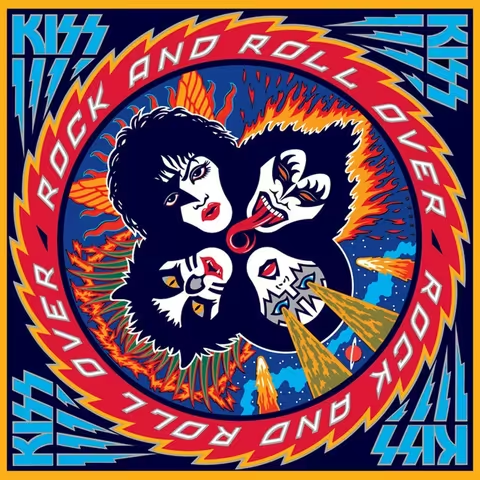
Kiss recorded the basic tracks for Rock and Roll Over in an empty theatre-in-the-round in suburban New York in twelve days, with Peter Criss playing his drums in a tiled bathroom on a video link to the rest of the band. They were back on tour with the finished record in their hands before the calendar had run out the year. That sprint, less than nine months after the band had spent half a million dollars and four months in three studios making Destroyer, is the entire story of Rock and Roll Over and the reason the album exists at all.
By autumn 1976 Kiss had become America's biggest live attraction and one of the few bands keeping their own record label, Casablanca, solvent. Destroyer had been the polished, expensive Bob Ezrin album that finally made them a household name. The single that put it over the top, Beth, was a piano ballad sung from a drummer's stool, written about a guitar tech's wife, and released as the B-side of Detroit Rock City. Casablanca's owner Neil Bogart wanted another Beth before Christmas. The band wanted to go back to making records the way they had on the first three albums. The compromise was Eddie Kramer in a rented theatre with a Record Plant truck parked outside, ten new songs already mostly written, and a deadline measured in weeks rather than months.
Album Facts
| Field | Detail |
|---|---|
| Artist | Kiss |
| Album | Rock and Roll Over |
| Release Date | 11 November 1976 |
| Label | Casablanca Records (NBLP 7037) |
| Producer | Eddie Kramer |
| Studios | Star Theatre, Nanuet, New York (basic tracks); Record Plant, New York City (overdubs and mixing) |
| Genre | Hard rock, glam rock, arena rock |
| Track Count | 10 |
| Total Runtime | 32 min 38 sec |
| Billboard 200 Peak | No. 11 |
| UK Albums Chart Peak | Did not chart |
| Other Notable Chart Peaks | No. 7 Canada; No. 9 Sweden; No. 15 Japan; No. 16 Australia; No. 39 Germany |
| Certifications | Platinum (RIAA), Platinum (Music Canada), Gold (RIAJ Japan) |
| Estimated Sales | Over one million in the US alone; the band's fourth consecutive platinum studio LP |
| Key Singles | Hard Luck Woman; Calling Dr. Love |
Cultural Context
Rock and Roll Over landed in mid-November 1976, in the middle of the strangest twelve-month stretch American rock had ever produced. Hard rock was beginning to fracture into a dozen mutually incompatible scenes. The album charts that month included Boston's self-titled debut, Stevie Wonder's Songs in the Key of Life, Hotel California by the Eagles, Wings at the Speed of Sound and Frampton Comes Alive, which had become the biggest live album in history and was still in the top ten more than nine months after release. The very same week Rock and Roll Over hit the shelves, the Ramones were finishing their second album Leave Home and the Sex Pistols were three weeks away from releasing Anarchy in the UK.
Kiss were the band that none of the new movements could quite place. Compared with Boston, they were sloppy. Compared with the Ramones, they were ornate. Compared with Frampton, they were oafish. What they had instead was scale: by the autumn of 1976 they were headlining ice-hockey arenas with a stage show that included flash pots, hydraulic risers, a fire-breathing bassist, a flame-throwing guitarist, and the largest Kiss banner anyone had yet had the budget to build. The records were the thing the live show advertised, not the other way around, and that is the lens through which to read Rock and Roll Over.
The competitive landscape against which Casablanca was selling the album included:
- Boston, Boston (released August 1976, still climbing)
- The Eagles, Hotel California (December 1976)
- Aerosmith, Rocks (May 1976)
- Ted Nugent, Free-for-All (October 1976)
- AC/DC, High Voltage (the international compilation, released worldwide May 1976)
- Heart, Dreamboat Annie (still in the charts ten months after release)
- Led Zeppelin, The Song Remains the Same (live album and film, October 1976)
Against that catalogue, the marketing problem for Rock and Roll Over was not whether Kiss could sell a record, it was whether they could sell their fifth studio album in barely thirty-three months without diluting the brand. Casablanca's answer was to put the cover of Rock and Roll Over on full-page advertisements in every American rock magazine before anybody had even heard a note, and to slip a sticker of the cover art inside every gatefold so that bedroom walls coast to coast would be plastered with Michael Doret's circular yellow and red logo by Christmas.
The Band's Story Up to This Point
Kiss had formed in New York in January 1973 out of the remains of a band called Wicked Lester. By the autumn of 1976 they had released four studio albums (Kiss, Hotter Than Hell, Dressed to Kill and Destroyer), one double live album (Alive!), and had sold somewhere in excess of three million records. The transformation had been almost entirely down to Alive!, the 1975 double LP that had finally captured what Kiss did on a stage and turned years of grinding club and theatre tours into a chart breakthrough.
Destroyer, released in March 1976, was the first attempt to apply that commercial momentum to the studio. Bob Ezrin, the producer who had made Alice Cooper a household name with School's Out and Billion Dollar Babies, took the band into Record Plant New York, hired the New York Philharmonic for the album's intro tape, put a children's choir on God of Thunder and turned Beth, a piano demo Peter Criss had been carrying around since his pre-Kiss band Chelsea, into a string-laden ballad that bewildered everybody in the band except Ezrin and Criss himself. Beth was released, almost as an afterthought, as the B-side of Detroit Rock City in summer 1976. By autumn it was a top ten single, the band's first, and Casablanca's biggest hit of the year.
The band's relationships were, by the standards of what was about to happen, still in reasonable shape. Stanley and Simmons remained the writing axis. Peter Criss had been emboldened by Beth's success and was beginning to push for ballad spotlights. Ace Frehley had spent most of the Destroyer sessions sidelined by Ezrin (the producer used session player Dick Wagner to ghost several solos), was drinking heavily on the road and would not contribute a single writing credit to Rock and Roll Over, an absence that has the distinction of being the only Kiss studio album in the band's history without an Ace Frehley co-write.
Casablanca's situation was less rosy. The label had been chronically over-extended on Kiss merchandise, on Donna Summer's emerging disco catalogue, and on a notoriously misjudged Johnny Carson tie-in album. Without another Kiss hit before Christmas the label would not see January. Neil Bogart, Casablanca's founder, met with Stanley and Simmons in summer 1976 and effectively ordered a new album by November. The Destroyer tour was still running. The band agreed.
Pre-production & Demos
What is now slightly forgotten about Rock and Roll Over is that many of the songs were not new. Three of Gene Simmons' contributions are documented re-workings of material from a 1975 Magna Graphics Studios demo session that had not made the cut for Destroyer:
- Calling Dr. Love was a re-working of Bad, Bad Lovin'
- Ladies Room was a re-working of Don't Want Your Romance
- Love 'Em and Leave 'Em was a re-working of Rock and Rolls-Royce
Peter Criss's Baby Driver was older still. It was a rewrite of a Criss / Stan Penridge demo from Lips, the pre-Kiss New York bar band Criss had played in with Penridge before Stanley and Simmons recruited him in 1972. Hard Luck Woman, the song that would become the album's lead single, had been written by Paul Stanley earlier in 1976 with Rod Stewart in mind. Stanley was an unabashed Rod Stewart fan and had been listening obsessively to Maggie May and You Wear It Well. He has also said that the lyrical voice of the song, in particular the wistful narrator, was modelled on Brandy (You're a Fine Girl) by Looking Glass. The plan was to send the demo to Stewart's people. After Beth went top ten in late summer, Bogart and Bill Aucoin (Kiss's manager) told Stanley to hold it back, hand it to Criss, and let it be the second Beth.
The remaining songs (I Want You, Take Me, Mr. Speed, See You in Your Dreams, Makin' Love) were written on the Destroyer tour in hotel rooms and dressing rooms through the summer of 1976. By the time the band convened at the Star Theatre on 28 September they had effectively a full album already arranged in their heads. There was no luxurious pre-production phase. They had a deadline.
Creating the Album
Eddie Kramer was the obvious producer. He had engineered the original Kiss debut in 1974, co-produced Alive! in 1975, and shared production with Bob Ezrin on Destroyer. He was also, crucially for what the band wanted from this record, an engineer's engineer. Kramer's Olympic and Electric Lady credits with Jimi Hendrix, his work on Led Zeppelin II and Houses of the Holy, and his then-recent work with Peter Frampton meant he understood live-room acoustics in a way that suited a band trying to escape the orchestral polish of Destroyer. For Rock and Roll Over, Kramer produced alone and engineered alone, with Corky Stasiak as his only engineering assistant.
The choice of venue was Kramer's. The Star Theatre in Nanuet, New York, was a theatre-in-the-round about half an hour up the Hudson from Manhattan. It was dark for the autumn season, the management was happy to rent it for two weeks, and Kramer wanted the natural ambience of a stage built to project sound 360 degrees through a circular auditorium. The Record Plant rolled its mobile recording truck into the car park and ran multicore cables in through a fire door. Sessions started on 28 September 1976. Basic tracks were finished on 11 October. The whole band moved back into Manhattan the following day and spent 12 to 17 October doing overdubs at the Record Plant proper, with Kramer mixing as he went.
The setup inside the theatre was deliberately weird. Kramer's brief to himself was to capture four musicians in one room playing live, with maximum separation between instruments and zero studio sheen. To get it, he scattered the band across the building:
- Paul Stanley, Gene Simmons and Ace Frehley's guitar and bass amplifiers were placed in three separate dressing rooms underneath the stage, mic'd in isolation, to prevent any bleed into the drum mics
- Peter Criss's drums were initially set up at the centre of the round stage, in the spot where the band would have played a show
- When Kramer was not happy with the stage drum sound he moved Criss into a tiled bathroom backstage, where the room's reverberant brickwork gave the snare a natural slap
- Criss communicated with the rest of the band via a closed-circuit video monitor and a headphone cue feed
- Lead and backing vocals were recorded standing in various theatre hallways depending on which natural reverb Kramer preferred for each song
- Kramer used the same tube microphones he had used on the Hendrix and Zeppelin sessions, brought up from his personal kit
The band worked sixteen to seventeen hours a day. Kramer, by his own later admission, slept on a couch in the Record Plant truck for most of the recording fortnight. There are no surviving session photos of the band in costume during the sessions. They had not yet adopted the rule that they were never to be seen out of makeup; for Rock and Roll Over they were simply four New Yorkers in jeans and t-shirts in an empty suburban theatre.
"We were trying to get back to what Kiss really was, which was a live band, a sweaty band, four guys in a room playing as loud as they could. Eddie understood that better than anyone. He'd done it with Jimi, he'd done it with Zeppelin. He knew how to put microphones in front of musicians and stay out of the way."
Paul Stanley, KISS: Behind the Mask (Leaf and Sharp), 2003
The most-told story from the sessions is one Stasiak has dined out on for forty years. During a setup break he took a skateboard down the steep ramped aisle of the theatre, intending to ollie up onto the stage. He missed, ploughed straight into the drum kit, knocked over half of Kramer's carefully placed overhead mics, and scrambled to reset everything to the exact angles and heights he had marked with gaffer tape before anyone returned. A playback half an hour later prompted Stanley to walk into the control area and remark, with no idea what had just happened, that it sounded a bit better than it had the day before.
"Paul walked in and said, 'You know, it sounds better today than it did yesterday.' Eddie nodded. I said nothing."
Corky Stasiak, recounted in Julian Gill, Rock and Roll All Nite: The KISS Sessionography, 2012
By 17 October the album was mixed. Casablanca had it pressed, sleeved and shipped within four weeks of the band leaving the Record Plant. By American major-label standards of 1976 it was an almost unprecedented turnaround.
Personnel & Credits
| Role | Player | Notes |
|---|---|---|
| Core band | ||
| Lead and backing vocals, rhythm guitar | Paul Stanley | Plays the first guitar solo on I Want You; lead vocal on I Want You, Take Me, Mr. Speed and Makin' Love |
| Lead and backing vocals, bass, rhythm guitar | Gene Simmons | Plays rhythm guitar on Ladies Room; lead vocal on Calling Dr. Love, Ladies Room, Love 'Em and Leave 'Em, See You in Your Dreams |
| Drums, lead vocal on two tracks, backing vocals | Peter Criss | Tracked the entire album from inside the Star Theatre bathroom; lead vocal on Baby Driver and Hard Luck Woman |
| Lead guitar, backing vocals | Ace Frehley | The only Kiss studio album on which Frehley receives no writing credit |
| Production | ||
| Producer, engineer, mixer | Eddie Kramer | Sole producer for the first time on a Kiss studio album; mixed at the Record Plant, New York City |
| Engineer | Corky Stasiak | Tracking engineer in the Star Theatre and the Record Plant truck |
| Co-writer credits | Sean Delaney | Co-wrote Take Me, Mr. Speed and Makin' Love with Paul Stanley; long-standing Kiss collaborator and Bill Aucoin's right-hand man |
| Co-writer credit | Stan Penridge | Co-wrote Baby Driver with Peter Criss, from their pre-Kiss band Lips |
| Artwork | ||
| Cover, lettering, all graphics | Michael Doret | New York designer best known for type-driven editorial work; would return to Kiss in 2009 for Sonic Boom |
| Sleeve extras | First pressings shipped with a sticker of the cover art and a glossy photo press pamphlet inside the gatefold | |
The Personnel table is, by Kiss standards, unusually small. No string section. No children's choir. No ghost session players. No outside producer. The album is genuinely four musicians in a room (more accurately, four musicians in five rooms) being engineered by one man with one assistant. The only outside writing credits are for Sean Delaney, who had co-written several tracks on the previous albums and was effectively a fifth Kiss songwriter in this period, and for Stan Penridge on the pre-Kiss Criss song. After the cast of dozens on Destroyer, Rock and Roll Over is almost ascetic.
The Songs
| # | Title | Writer(s) | Length | Single? | Notes |
|---|---|---|---|---|---|
| Side One | |||||
| 1 | I Want You | Stanley | 3:04 | Stanley plays the first guitar solo himself; Frehley takes the second | |
| 2 | Take Me | Stanley, Delaney | 2:56 | B-side | B-side of Calling Dr. Love in the US |
| 3 | Calling Dr. Love | Simmons | 3:44 | Single | Written in a Holiday Inn in Evansville, Indiana; title from a Three Stooges film |
| 4 | Ladies Room | Simmons | 3:27 | Re-write of Don't Want Your Romance from 1975 demo session | |
| 5 | Baby Driver | Criss, Penridge | 3:40 | Re-write of a Lips-era song from Criss's pre-Kiss days | |
| Side Two | |||||
| 6 | Love 'Em and Leave 'Em | Simmons | 3:47 | Re-write of Rock and Rolls-Royce from 1975 demo session | |
| 7 | Mr. Speed | Stanley, Delaney | 3:18 | B-side | B-side of Hard Luck Woman in the US |
| 8 | See You in Your Dreams | Simmons | 2:34 | Simmons re-recorded the song on his 1978 solo album, claiming the original was not heavy enough | |
| 9 | Hard Luck Woman | Stanley | 3:35 | Single | Acoustic; Criss on lead vocal; originally written for Rod Stewart |
| 10 | Makin' Love | Stanley, Delaney | 3:14 | Closes the album; a setlist staple from 1976 onwards | |
I Want You
The album opens with a fingerpicked acoustic-guitar intro that runs almost forty seconds before the band lurches in. It is the longest sustained quiet passage on any Kiss studio album to that point, and an unusual choice for an opener on a record specifically designed to get the band back to its heads-down rock essentials. Stanley plays the first solo himself; Frehley plays the second; the contrast between the two players is unusually audible. The song became a regular set opener through the back half of the Rock and Roll Over tour and stayed in the live rotation, on and off, for the next thirty years.
Calling Dr. Love
Simmons wrote the song in a Holiday Inn in Evansville, Indiana, on the Destroyer tour. The title and central conceit came from a half-remembered scene in The Three Stooges' 1934 short Men in Black, in which a hospital intercom announces "Calling Doctor Howard, Doctor Fine, Doctor Howard". Simmons swapped the medical farce for a strutting bar-room come-on and the song wrote itself. The riff was rebuilt from his earlier Bad, Bad Lovin' demo. On record the track runs three minutes forty-four. The Canadian 8-track tape edition, oddly, runs about fifty-five seconds longer thanks to a smoothly edited repeat of Frehley's guitar solo, a curio that has become a collector's item.
Hard Luck Woman
The album's emotional anchor. Stanley's 12-string acoustic guitar carries the whole song, Frehley adds a second acoustic, Simmons plays acoustic bass, and Criss takes the lead vocal in a deliberate Rod Stewart growl. Cash Box, reviewing the single in December 1976, said outright that the vocal "is not unlike Rod Stewart, a growling bluesy intensity, centred around acoustic rhythm work". Stanley had been clear from the demo stage that he wanted Stewart's blue-eyed-soul-meets-folk-rock template. He has subsequently described Maggie May, You Wear It Well and Looking Glass's Brandy (You're a Fine Girl) as his three explicit references.
"I wrote it thinking of Rod Stewart. I was a huge Rod Stewart fan. I had Maggie May in my head, and You Wear It Well, and that lazy, croaky narrator voice. After Beth happened, our manager said keep it, give it to Peter, let him be Rod Stewart for three and a half minutes."
Paul Stanley, Face the Music: A Life Exposed, 2014
Ladies Room
One of the album's three Simmons re-writes from the 1975 Magna Graphics tape, Ladies Room is a slab of thudding mid-tempo glam with an audible debt to Slade. Simmons plays the rhythm guitar part himself in addition to the bass, the only track on the record where he does so. The song became a regular live opener on the 1977 leg of the tour, often segueing straight from Detroit Rock City.
Baby Driver
Criss's only writing credit on the album, and the one song on the record whose pedigree dates from before Kiss existed. Criss and Stan Penridge had been playing the song in their pre-Kiss bar band Lips since the early 1970s. The Kiss version replaces the original's Latin-tinged shuffle with a four-on-the-floor stomp and gives Criss a chance to deliver a lead vocal that is conspicuously more in his natural growl than the soft-rock Beth voice. He liked it enough to revive it on the 1978 solo album, in a more elaborate arrangement.
Mr. Speed
Stanley's other Sean Delaney co-write on the record. Mr. Speed is, in retrospect, the song that points most clearly forward to Love Gun. The chord pattern, the call-and-response chorus, the deliberately silly lyric, and the cocked-hip swagger are all of a piece with what the band would do six months later. It also has the album's hardest-working chorus.
See You in Your Dreams
The lone genuine misstep, according to its own writer. Simmons disliked the recorded version enough that he re-cut it from scratch for his 1978 self-titled solo album, with a different rhythm section and significantly more bottom end. It is the only example of a Kiss-era song being publicly redone by its writer for a contemporary release, and a useful tell on the speed and corner-cutting of the Rock and Roll Over sessions.
Makin' Love
The closer. Stanley's third and final Sean Delaney co-write, and the song that arguably became the most influential of the album's deep cuts: Marilyn Manson, Type O Negative and Mike Patton have all cited it in interviews; Steel Panther's whole act runs on its lineage. It would later become a set-list staple of every Kiss reunion tour from 1996 onwards.
B-sides, Outtakes & Lost Songs
The Rock and Roll Over sessions did not produce a great deal of leftover material, mostly because the band turned up at the Star Theatre with ten finished songs and a deadline. The two B-sides are both album tracks: Mr. Speed backed Hard Luck Woman in November 1976, and Take Me backed Calling Dr. Love in February 1977. There were no exclusive flip-sides at all.
What did circulate, mostly through bootleg sources rather than authorised releases, were the 1975 Magna Graphics demos that fed three of the album's Simmons songs. Bad, Bad Lovin', Don't Want Your Romance and Rock and Rolls-Royce all turn up on collectors' tapes, in versions that show how much of the album's final shape was already locked in before Eddie Kramer was even brought in. None of them has ever been formally released by the band.
The Canadian 8-track of Calling Dr. Love, with its fifty-five-second guitar-solo extension, is a Casablanca curio that fetches collectors' money on the secondary market. The Japanese first pressing of the LP came in a uniquely glossy gatefold with bonus poster, and the original US press came with the band's Kiss Army membership flyer tucked inside as a separate insert.
Album Artwork & Packaging
The cover is the work of Michael Doret, a New York designer best known at the time for type-driven editorial work in New York magazine. Doret was not a music-industry insider. He had never designed a record sleeve before. The brief from Bill Aucoin was straightforward: give the band a logo-driven, instantly recognisable circular image that would read at any distance, including from a hundred feet away on a poster.
Doret built the cover as a circular yellow and red graphic with the four Kiss faces arranged around a central kiss-print mouth, framed by a chrome-style border. The lettering is hand-drawn in the style of 1930s vaudeville posters and pinball-machine glass. There is no photograph on the front of the album at all. The four band photos are reduced to drawn caricature.
The packaging extras were a Casablanca signature. The first pressing shipped with a glossy photo press pamphlet (essentially a Kiss-Army-branded mini-magazine), a sticker of the cover art, and a Kiss Army membership form, all tucked into the gatefold. Doret would return to design the cover of Kiss's 2009 album Sonic Boom, the only artist ever to bookend the band's recorded career with a 33-year gap between sleeves. Anthrax later paid an explicit homage to the cover with their 2018 live album Kings Among Scotland, copying Doret's circular layout, type treatment and chrome border almost beat for beat.
Release & Reception
Casablanca released Rock and Roll Over on 11 November 1976. By the end of December it had peaked at number eleven on the Billboard 200, a position it then held for two non-consecutive weeks. In Canada it went to number seven, in Sweden to number nine, in Australia to number sixteen, and in Japan to number fifteen. It missed the UK album chart entirely (Kiss would not break the UK Top 75 with a studio album until Lick It Up in 1983), although the cult fanbase was already such that import copies sold steadily through specialist London record shops.
RIAA platinum certification followed quickly, a million US shipments inside six months, making it the band's fourth consecutive platinum studio LP. Canada's Music Canada awarded a platinum disc to each band member in person at a presentation that included Ace Frehley's now-famous Quality Records platinum plaque, still in private circulation in the collector market.
Contemporary US reviews were mixed. The Village Voice's Robert Christgau gave the album a B− and dismissed Kiss as "a caricature" of themselves, though he did concede they "write tough, catchy songs, and if they had a sly, Jagger-style singer they'd be a menace". The retrospective consensus has been kinder.
"Rock and Roll Over is one of Kiss's most consistent records, a return to the raw hard rock of their first four albums after the orchestral excursions of Destroyer."
Greg Prato, AllMusic review, retrospective
"Sonically punchier than Destroyer, if not just a bit lacking in complete vitality. The album that gets the Kiss formula closest to what their best concert tapes already promised."
Jason Josephes, Pitchfork, 2002
It has never appeared on Rolling Stone's 500 Greatest Albums list, which says more about Rolling Stone's longstanding allergy to Kiss than it does about the record. It is, however, the album most frequently cited by the band themselves (and by Eddie Kramer) as the moment Kiss most successfully bottled what they were already doing live.
Singles & Music Videos
| Single | Released | B-side | US Hot 100 | Canada | Other |
|---|---|---|---|---|---|
| Hard Luck Woman | 1 November 1976 (Casablanca NB-873A) | Mr. Speed | 15 | 15 | Germany 34; Australia 67 |
| Calling Dr. Love | 13 February 1977 (Casablanca NB-880) | Take Me | 16 | 2 | US Cashbox Top 100 No. 10 |
Both singles became top twenty US hits, giving the band three consecutive top-twenty singles for the first time in their career (after Beth from Destroyer). Neither had a dedicated promotional film of the kind we would now call a music video, in 1976 the album-rock-radio promo cycle made conventional video largely unnecessary, but both songs were performed on US TV slots and on the band's syndicated Kiss in Concert special. Kiss did, however, film a famous performance of Hard Luck Woman with Stanley on lead vocal for their 1995 MTV Unplugged session, which was included as a DVD bonus track but cut from the CD release.
Hard Luck Woman has had an unusually long afterlife as a covered song. Garth Brooks recorded it in 1994 for the Kiss My Ass: Classic Kiss Regrooved tribute, with Kiss themselves providing the instrumentation; the two camps performed it together on The Tonight Show with Jay Leno later that year. Members of X Japan (Toshi, hide and Pata) performed it at Nissan Power Station in October 1991. Pretty Maids covered it on Spooked in 1997. The Hold Steady cut an electrified version for their 2014 RAGS EP. The 24th episode of the Cowboy Bebop anime takes its title from the song.
Touring & Live
The Rock and Roll Over Tour ran from 24 November 1976 to 5 April 1977, ninety-three shows across the United States, Canada, Europe (in Sweden, Germany, the Netherlands and Belgium for the first time on a headline basis) and a four-night stand in Japan that established Kiss as a permanent Japanese arena draw. It was the first Kiss tour to use the band's now-iconic Destroyer-and-after pyrotechnics package wholesale. The production highlights, drawn from contemporary tour-itinerary documents and Bill Aucoin's archive, included:
- A two-level stage with Peter Criss's drum riser on hydraulics
- Gene Simmons's fire-breathing intro to Firehouse
- Ace Frehley's smoking-and-rocket-firing Les Paul on Shock Me (introduced later in the tour)
- A larger version of the Destroyer flash-pot and pyro setup, with explosion cues programmed into the rhythm of God of Thunder
- A dropdown Kiss banner the size of a basketball court behind the drum riser, lit from behind during Black Diamond
- An acoustic spot for Hard Luck Woman, with Stanley and Frehley on stools at the front of the stage
The tour was filmed in part at the Budokan in Tokyo in April 1977, with portions of the resulting footage feeding the band's TV specials and forming the basis for Alive II, the second double live album, which was released in October 1977 and contained live versions of Calling Dr. Love, Hard Luck Woman, Ladies Room, Makin' Love and I Want You from Rock and Roll Over (the band having decided that the new album's material had outlived its short studio shelf life and now belonged on the live document). Alive II would itself go double platinum.
In TV, Film & Media
Calling Dr. Love has had the broader on-screen afterlife of the album's two singles. It plays a central role in the 1999 Adam Rifkin film Detroit Rock City (in which the song is name-checked in dialogue, a character introduces himself as "Doctor Love", and the song scores a key chase scene). It later featured in Magic Mike (2012) during the introductory strip-club montage and was the soundtrack to a Super Bowl XLIV (2010) Dr Pepper commercial that put Gene Simmons in character on a couch surrounded by women under a flashing Kiss logo. The song is also briefly referenced in Stephen King's The Waste Lands, the third installment of The Dark Tower series, and was released as downloadable content for the Rock Band music video game.
Hard Luck Woman, beyond the Garth Brooks pairing, has been more durable in cover-and-tribute culture than in straight sync. The Cowboy Bebop episode title is its most famous individual placement. Makin' Love has appeared in various Kiss-themed documentaries and several US sports-arena pre-show reels.
Controversy, Censorship & Lawsuits
There was little controversy attached to Rock and Roll Over at the time of release, in part because the album was so single-mindedly focused on what Kiss already did, and in part because there was no concept and no provocation to push back against. Christian and conservative talk-radio groups in the US had already settled into their long-running denunciation of Kiss as KISS standing for "Knights in Satan's Service" (an urban myth that pre-dated this album and outlived it). Rock and Roll Over added nothing new to the picket-line.
The one minor flap was over the cover photograph on the sticker insert, which depicted the band in full makeup and which several US Christian bookshop chains refused to stock as a result. The same chains had also refused to stock Destroyer, Dressed to Kill and Alive!, so the boycott had no measurable commercial impact. There were no sampling or plagiarism suits. Hard Luck Woman's Rod Stewart influence was discussed openly enough by Stanley that it never became an issue.
Covers, Samples & Tributes
The album is unusual in Kiss's catalogue for having generated a genuinely interesting cover-and-tribute history rather than just a fan-club paint-by-numbers one. The 1994 Kiss My Ass: Classic Kiss Regrooved tribute album contained both Garth Brooks's country reading of Hard Luck Woman and the supergroup Shandi's Addiction's reworking of Calling Dr. Love. Shandi's Addiction is a name that ought to belong in the Kiss record books: it was a one-off lineup of Maynard James Keenan on vocals, Tom Morello on guitar, Billy Gould on bass and Brad Wilk on drums. That four-piece, a song from this record, on a major-label tribute album, is the kind of arithmetic that almost feels invented.
The Pretty Maids cover of Hard Luck Woman appeared on their 1997 album Spooked. The Wildhearts' Ginger covered it on his 2001 solo acoustic live album Grievous Acoustic Behaviour. The Hold Steady covered it on their 2014 RAGS EP. Slipknot's Corey Taylor performs it acoustically at his solo Live in London show recorded in 2016. The Electric Hellfire Club cut a version of Calling Dr. Love in 1996 and renamed both the cover and the album to Calling Dr. Luv in memory of their late keyboardist. Anthrax's Kings Among Scotland live album in 2018 paid public homage to the artwork by commissioning a circular-graphic cover of their own in clear imitation of Doret's original.
The original album itself was not built on samples, though Simmons has freely acknowledged the title of Calling Dr. Love came from The Three Stooges' Men in Black, and Ladies Room's chord pattern owes a clear debt to Slade's Cum On Feel the Noize.
Reissues, Remasters & Anniversaries
Rock and Roll Over was first reissued on CD by Casablanca in 1987. Mercury reissued the album in 1997 as part of the German Remasters series, with a Bob Ludwig 24-bit master that remains the cleanest version on disc; Pitchfork's 2002 reissue review was of this Mercury edition. The album was reissued again in 2014 on 180-gram vinyl as part of the Kiss Off the Soundboard 40th-anniversary vinyl campaign.
There has, to date, never been an Immersion-style box set treatment of Rock and Roll Over. Kiss have never officially released the Magna Graphics demos that fed the album, and have never released a live recording from the 1976-77 Rock and Roll Over Tour beyond the Alive II material. The 50th-anniversary deluxe-edition window in 2026 is the obvious next opportunity, and the band's archivist has hinted that bonus material from the Nanuet sessions does exist on Eddie Kramer's tapes.
The album's 25th anniversary in 2001 was marked by a Kiss MTV Icon segment in which Brooks again performed Hard Luck Woman with the band. The 30th anniversary in 2006 coincided with the Kiss Symphony: Alive IV release. The 40th anniversary in 2016 was marked by the Off the Soundboard vinyl. The 45th in 2021 came and went without official acknowledgement, which is increasingly held against the band's archive operation by collectors.
Legacy & Influence
Within the Kiss catalogue Rock and Roll Over occupies an unusual position. It is the band's leanest classic-era studio LP, the one most often cited by the band themselves and by Eddie Kramer as the moment they got closest to their live identity on record, and the one most frequently rediscovered by every subsequent generation of younger fans drawn to its plainness. It does not have the breakout single (Destroyer has Beth), the totem (Love Gun has the title track and the cover photograph), or the cultural penetration (Alive! has the Detroit Rock City crowd noise). What it has instead is ten songs that sit comfortably on a setlist, and a sound that influences every garage-rock revival from the New Wave of British Heavy Metal through hair metal, sleaze, grunge and the early 2000s back-to-basics scene that produced The Strokes and The Hives.
Pearl Jam used the Star Theatre approach (a Record Plant mobile truck parked outside a non-studio venue, basic tracks cut live in a single ambient space) as the template for parts of Vitalogy. The Foo Fighters cited Rock and Roll Over openly when discussing the live-room approach they took to Wasting Light. Marilyn Manson's choice of Makin' Love as a live cover staple on the Mechanical Animals tour was a deliberate flag-planting on the album's behalf. Garth Brooks's 1994 Hard Luck Woman cover gave Kiss the unlikely distinction of being a Country Top 75 act for the first and only time in their history.
"Rock and Roll Over is the album Kiss should be remembered for. Destroyer is the biggest one. Love Gun is the most iconic one. But Rock and Roll Over is the one that sounds like four guys in a room, and when Kiss were a band of four guys in a room, they were as good as anybody."
Eddie Kramer, interviewed for Classic Rock, 2016
By the time the band were inducted into the Rock and Roll Hall of Fame in 2014, the critical consensus had quietly shifted: Rock and Roll Over was now spoken of, in the band's own induction speeches and in subsequent retrospective coverage, as the great hidden classic of the original lineup. Forty-eight years on, that consensus has only hardened.
Things You Might Not Know
| Fact | Detail |
|---|---|
| The bathroom drum kit | Peter Criss tracked the entire album from inside a tiled bathroom backstage at the Star Theatre, communicating with the rest of the band via a closed-circuit video monitor and a headphone cue feed. |
| The Stooges title | Calling Dr. Love takes its title from a hospital intercom announcement in the 1934 Three Stooges short Men in Black: "Calling Doctor Howard, Doctor Fine, Doctor Howard." |
| The Holiday Inn songwriting | Gene Simmons wrote Calling Dr. Love in a Holiday Inn in Evansville, Indiana, on the Destroyer tour, working on a hotel-room acoustic with the air conditioning on full. |
| The skateboard incident | Engineer Corky Stasiak attempted to skateboard down the steep aisle of the Star Theatre, crashed straight into the drum kit, knocked over half of Eddie Kramer's overhead mics, reset everything from gaffer-tape marks before anyone noticed, and was rewarded with Paul Stanley remarking that the playback sounded better than it had yesterday. |
| The Rod Stewart pitch | Paul Stanley wrote Hard Luck Woman with the intention of pitching it to Rod Stewart; only Beth's surprise top-ten success in summer 1976 persuaded the band to keep it and hand the lead vocal to Peter Criss. |
| The Looking Glass lyrical model | Stanley has cited Looking Glass's 1972 nautical pop hit Brandy (You're a Fine Girl) as the specific lyrical template for Hard Luck Woman's wistful sailor-narrator. |
| The Frehley write-up shutout | Rock and Roll Over is the only Kiss studio album in the band's history on which Ace Frehley receives no writing credit. He was drinking heavily through the Destroyer tour and contributed nothing to the writing. |
| The Magna Graphics rewrites | Three of Gene Simmons's contributions (Calling Dr. Love, Ladies Room, Love 'Em and Leave 'Em) are reworked from songs (Bad, Bad Lovin'; Don't Want Your Romance; Rock and Rolls-Royce) that had been demoed at Magna Graphics Studios in 1975 but rejected for Destroyer. |
| The pre-Kiss song | Peter Criss's Baby Driver is a rewrite of a song he had co-written with Stan Penridge for their pre-Kiss bar band Lips in the early 1970s; Criss revived it again for his 1978 solo album. |
| The Canadian extended Dr. Love | The Canadian 8-track tape edition of Calling Dr. Love runs about fifty-five seconds longer than the LP, with a smoothly edited-in repeat of Ace Frehley's guitar solo; the tape is now a high-value collector's item. |
| The Three Stooges supergroup | Maynard James Keenan, Tom Morello, Billy Gould and Brad Wilk recorded Calling Dr. Love as the one-off supergroup Shandi's Addiction for the 1994 Kiss My Ass: Classic Kiss Regrooved tribute. |
| The Garth Brooks duet | Garth Brooks recorded Hard Luck Woman in 1994 with Kiss themselves playing the backing track and performed it with the band on The Tonight Show with Jay Leno, giving Kiss their only-ever placement on the Billboard Hot Country Songs chart. |
| The Cowboy Bebop episode | The 24th episode of the cult Japanese anime Cowboy Bebop is titled Hard Luck Woman, after the song. |
| The Doret bookend | Cover artist Michael Doret would not work with Kiss again for thirty-three years until they hired him back to design the sleeve of Sonic Boom in 2009; he is the only artist who has bookended the band's recorded career. |
| The Anthrax homage | Anthrax's 2018 live album Kings Among Scotland recreates Doret's circular logo, chrome border and lettering treatment in clear public homage to Rock and Roll Over's cover. |
Podcast
The Riffology podcast covers Kiss and the Destroyer-to-Love-Gun three-album run in considerable detail across the back catalogue. Subscribe wherever you listen, including Apple Podcasts, Spotify, Amazon Music and Pocket Casts, leave a rating, and let us know which Kiss-era record you would like covered next.
Comments