Roger Waters wrote The Wall because, on the final night of the Animals tour in Montreal in July 1977, he leaned over the front of the stage and spat in the face of a fan. Within two years he had written, demoed and recorded a double album about a rock star who builds a wall between himself and his own audience, fired his keyboard player halfway through making it, and sold thirty million copies of the result.
The Wall is the album where Pink Floyd stopped pretending they were a band of equals and became, in practice, a Roger Waters solo project with very expensive session players. It is also the record that produced their only number-one US single, kept them at the top of the Billboard 200 for fifteen weeks, and bankrolled a tour so technically ambitious it lost four hundred thousand pounds even at sold-out arenas. Forty-six years on, it remains the strangest commercial juggernaut in classic rock: a four-sided concept album about fascism, abandonment, divorce, drug abuse and emotional cauterisation that found its way onto the shelves of millions of households who had never bought a progressive rock record before, and into the consciousness of every secondary-school kid who has ever wanted to chant at a teacher.
Album Facts
| Field | Detail |
|---|---|
| Artist | Pink Floyd |
| Album | The Wall |
| Release Date | 30 November 1979 (UK), 8 December 1979 (US) |
| Label | Harvest / EMI (UK), Columbia / CBS (US) |
| Producers | Bob Ezrin, David Gilmour, James Guthrie, Roger Waters |
| Studios | Britannia Row (London), Super Bear (Berre-les-Alpes), Studio Miraval (Correns), CBS 30th Street and Producers Workshop (New York / LA), Cherokee Studios (Hollywood) |
| Genre | Progressive rock, art rock, rock opera, progressive pop |
| Track Count | 26 (double LP, four sides) |
| Total Runtime | 1 hr 21 min |
| Billboard 200 Peak | No. 1 (fifteen weeks) |
| UK Albums Chart Peak | No. 3 |
| Other Notable Chart Peaks | No. 1 in Canada, France, Norway, Australia (Kent); top five across most of Europe |
| Certifications | 23 x Platinum (RIAA), 2 x Platinum (BPI), Diamond in Canada, France, Italy |
| Estimated Sales | 30 million-plus worldwide |
| Key Singles | Another Brick in the Wall, Part 2; Run Like Hell; Comfortably Numb |
Cultural Context
The Wall arrived at the very end of the 1970s, and it arrived into a record industry that, by November 1979, no longer quite believed in albums like it. Punk had supposedly finished off the dinosaurs eighteen months earlier. The Sex Pistols had broken up on stage in San Francisco in January 1978. Disco was peaking and about to crater. The biggest-selling album of 1979 in America was Billy Joel's 52nd Street, and the most talked-about new band in Britain was The Police. A four-sided concept album about a damaged rock star losing his mind in an American hotel room was, by any rational reading of the market, the wrong record at the wrong time.
It was also released into one of the most extraordinary release weeks rock has ever produced. November and December 1979 alone saw:
- The Clash, London Calling (December)
- AC/DC, Highway to Hell (already shipping platinum since July)
- Led Zeppelin, In Through the Out Door (the last Zeppelin studio album, just months old)
- The Eagles, The Long Run (their highest-charting record)
- Fleetwood Mac, Tusk (the great post-Rumours weirdo gamble)
- Talking Heads, Fear of Music
- Stevie Wonder, Journey Through the Secret Life of Plants
Against that competition, Pink Floyd put out a record without a track listing on the sleeve, without the band name on the front cover, with a lead single sung by a children's choir from Islington, and watched it become the best-selling album of 1980 in the United States. The Wall was both a perfectly timed cultural object, an album about adolescent rage in the era of Thatcher's first ministry and Reagan's first presidential campaign, and the last great gasp of the very rock excess it was busy diagnosing.
The Band's Story Up to This Point
By 1977 Pink Floyd were, on paper, untouchable. The Dark Side of the Moon had been on the Billboard 200 since March 1973 and would remain there, in one form or another, for another decade. Wish You Were Here, in 1975, and Animals, in January 1977, had each gone platinum within months. They had a custom-built London studio, Britannia Row in Islington, and a touring rig that required articulated lorries to move. They were the band other bands aspired to be.
What none of the outside world knew was that the four men in the group were, by the end of the In the Flesh tour in mid-1977, barely on speaking terms. Roger Waters had taken over as the primary lyricist on Dark Side, consolidated that position on Wish You Were Here, and on Animals had written every word and almost every note. David Gilmour, the band's guitarist and second vocalist, felt sidelined. Richard Wright, the keyboard player and a founder member, had stopped contributing material almost entirely and was deep in a cocaine habit and a collapsing marriage. Nick Mason, the drummer, was managing a divorce of his own and would later admit he was barely engaged with the music.
The Animals tour itself was a Floyd-scale event held in baseball stadiums, ice hockey arenas and bullrings across Europe and North America. Waters loathed it. The audiences struck him as drunk, inattentive and only interested in hearing greatest hits. The flying inflatable pig was getting more emotional response than the songs. The bigger the venues got, the more Waters fantasised about the literal physical barrier he would like to place between himself and the crowd.
Then came Montreal. On 6 July 1977, the final night of the North American leg, Waters watched a fan at the very front of the stage scream and whistle and beckon throughout the quieter material. Something in him gave way. He leaned down, drew the fan into what looked like a conversation, and spat in his face. Waters left the stage so disgusted with himself, he later said, that the only way he could process the moment was to write about it.
"I was so upset at the end of it that I really felt like I never wanted to do it again. And I thought, if there's a way of doing it again, it's got to involve building a wall across the front of the stage."
Roger Waters, MOJO interview, 2009
Pre-production & Demos
Through the second half of 1977 and into 1978, Waters worked at his home studio on two parallel ninety-minute demo cassettes. One was provisionally called Bricks in the Wall and dealt with the rock-star isolation theme. The other, eventually titled The Pros and Cons of Hitch Hiking, was a stream-of-consciousness piece about a middle-aged man trapped inside a single dream while his marriage rots around him. In July 1978 he played both demos to Gilmour and Mason and asked which one they wanted to make next. Wright, deep in his own troubles, was not at the meeting.
Gilmour and Mason picked the wall idea, partly because it had more obvious songs and partly because they suspected, correctly, that it was a more commercial proposition. Pros and Cons would eventually surface, in 1984, as Waters' first solo album. Hitch Hiking's loss was the Wall's gain: the demos that survive from the original 1978 Bricks in the Wall cassette already contain prototype versions of In the Flesh, Another Brick in the Wall (in three parts), Mother, Goodbye Blue Sky, Empty Spaces, Hey You and Vera, almost all of them with the same lyrics and same chord shapes that would end up on the finished record eighteen months later.
The reason the band agreed to the project so quickly had as much to do with money as with art. Their financial managers, the Norton Warburg Group, had invested the band's tax-deferred income across a portfolio of small British companies, many of which had failed. By the end of 1978 the Floyd were looking at a possible tax exposure of more than three million pounds, an existential threat at 1978 marginal rates. They needed a record they could make outside the United Kingdom, fast, and they needed it to sell.
It was at this point that Waters approached the Canadian producer Bob Ezrin. Ezrin had made his name with Alice Cooper and Lou Reed, had recently shepherded Kiss through Destroyer, and was known both as a hit-making song doctor and as a man with enough personality to stand up to Waters in a room. He flew to London, listened to the demos, and on a single bedsit sofa with Waters spent forty hours rewriting a forty-page typewritten treatment of the story into a proper running order. The result is what Ezrin always called the "table read".
"We started on a Friday and finished on a Sunday morning. By the time we got to the end and read the whole thing, everybody's eyes all twinkled. They knew it was going to work."
Bob Ezrin, on the Wall pre-production weekend, Classic Albums documentary, 2003
Creating the Album
Recording began in earnest on 1 December 1978 at Super Bear Studios, in the village of Berre-les-Alpes in the hills above Nice. Super Bear had been chosen for tax reasons. So had Studio Miraval, near Correns in Provence, where the band moved when Super Bear became unavailable. The British tax exile was strict: between April 1978 and April 1979 not one member of the band could spend more than ninety days in the United Kingdom without surrendering most of the money to Inland Revenue. They flew home in single-day shifts to see their families, and back to France by morning.
Britannia Row, the band's own London studio, was used for overdubs whenever the calendar allowed. New York, in particular CBS's 30th Street church-conversion studio, was used for the orchestral overdubs in the spring and summer. Final mixing happened at the Producers Workshop and Cherokee Studios in Los Angeles in September, October and November 1979.
The producer line-up tells its own story. Waters wanted Ezrin, Gilmour wanted James Guthrie (a young British engineer-producer the band had hired on Animals), and the compromise was that all four of them, plus Waters and Gilmour, would share the production credit. In practice Ezrin was the day-to-day boss, Guthrie ran the desk, Gilmour took charge of guitars and any track that needed a melodic save, and Waters policed lyrics, performance and what he saw as the integrity of the concept.
Ezrin's relationship with Waters was famously combative. Both men wore badges of their own design during the sessions: Waters' said WHY, Ezrin's said NOPE. Ezrin's job, more than anything, was to overrule Waters at the moments when the song demanded it, and Waters, to his enormous credit, had hired Ezrin specifically because he knew he needed someone willing to do that.
Equipment-wise, the Wall is a fascinating hybrid. The bedrock is still the same kit Pink Floyd had been touring with since Animals: Gilmour's black Stratocaster, his Hiwatt stacks, Mason's Ludwigs, Waters' Precision basses, Wright's Hammond C3 and Hohner electric piano. Onto that the album layers Ezrin's New York orchestral sensibility (Michael Kamen's string arrangements played by the New York Symphony Orchestra), a thirty-five voice disco rhythm track on Another Brick in the Wall Part 2 (Ezrin's contribution, and the part of the album that horrified Waters until it was a hit), and the most lavish multi-tracked vocal arrangements the band had ever attempted.
Six months into recording, in mid-1979, the project came to its great internal crisis. Wright, struggling personally and creatively, had contributed almost no material. When Ezrin called from Los Angeles in summer 1979 demanding that everyone return for mixing, Wright was on holiday in Greece and refused to cut it short. Waters, supported by Ezrin and Gilmour, issued an ultimatum: Wright would either resign before the album was finished or Waters would withhold the entire record from release, on the grounds that he could not personally afford another delay. Wright agreed to leave. He returned for the Wall tour only as a salaried sideman on a flat fee, an arrangement that, in one of rock's most pleasing ironies, meant he was the only member of Pink Floyd who actually made money on the tour.
"Rick was struggling. We all knew it. Bob and Roger pushed him very hard, and in the end something had to give. It's not something any of us are proud of, in hindsight."
David Gilmour, reflecting on the Wright dismissal, Uncut, 2003
The recording budget eventually came in around seven hundred thousand pounds, a fortune in 1979 money, and the album was finished by the skin of its teeth in mid-November 1979. The first pressings were on the shelves two weeks later.
Personnel & Credits
| Role | Player | Notes |
|---|---|---|
| Core band | ||
| Bass, lead and backing vocals, synth, additional guitar | Roger Waters | Sole lyricist on every track; takes lead vocal on the majority of the record |
| Lead and rhythm guitar, lead and backing vocals, bass on selected tracks, synth | David Gilmour | Co-writer on Young Lust, Comfortably Numb and Run Like Hell; lead vocal on Mother, Young Lust, Hey You and Comfortably Numb |
| Drums, percussion | Nick Mason | The only member who played on every Pink Floyd studio album |
| Piano, organ, synthesiser | Richard Wright | Uncredited as a band member by the time of release; fired during production |
| Additional musicians | ||
| Drums | Jeff Porcaro | Plays drums on Mother; Mason struggled with the shifting time signatures |
| Bass on Hey You | David Gilmour | Waters preferred Gilmour's part to his own demo |
| Backing vocals | Bruce Johnston, Toni Tennille | Beach Boys and Captain & Tennille connection, brought in by Ezrin for the Hollywood overdub sessions |
| Backing vocals | Joe Chemay, John Joyce, Stan Farber, Jim Haas | The Wall vocal stack |
| Choir | Islington Green School, conducted by Alun Renshaw | The "We don't need no education" voices on Another Brick in the Wall Part 2 |
| Strings and orchestration | Michael Kamen, New York Symphony Orchestra, New York Opera | Arranged with Bob Ezrin; principal credit on Comfortably Numb, The Trial, Bring the Boys Back Home |
| Disco rhythm track | Bob Ezrin (uncredited) | Engineered the now-iconic four-on-the-floor groove of ABITW Pt 2 against Waters' wishes |
| Spoken voice (groupie) | Trudy Young | The American voice in One of My Turns |
| Spoken voice (child) | Harry Waters | Roger's son: "Look mummy, there's an aeroplane up in the sky" on Goodbye Blue Sky |
| Spoken voice (operator) | Chris Fitzmorris | Telephone operator on Young Lust |
| Spoken voice (the Schoolmaster) | Roger Waters | Acting his way through The Happiest Days of Our Lives and The Trial |
| Production | ||
| Producers | Bob Ezrin, David Gilmour, James Guthrie, Roger Waters | Listed alphabetically by surname on the sleeve |
| Co-producer (engineering) | James Guthrie | Won the 1980 Grammy for Best Engineered Album Non-Classical |
| Engineers | Nick Griffiths, Patrice Quef, Brian Christian, Rick Hart | Griffiths recorded the school choir at Britannia Row while the band was abroad |
| Orchestral arrangements | Michael Kamen, Bob Ezrin | Kamen would go on to score Brazil, Die Hard and the X-Men films |
| Artwork | ||
| Cover, lettering, all interior illustration and animation | Gerald Scarfe | First Pink Floyd cover not designed by Hipgnosis since 1967; Waters had fallen out with Storm Thorgerson |
| Original sleeve format | Plain white brick wall, no band name, no title | |
| Designer (interior gatefold) | Gerald Scarfe | The marching hammers, the schoolmaster, the mother, the wife and the judge all originate as Scarfe drawings |
The Personnel table makes one thing very clear. The Wall is, more than any previous Pink Floyd album, a record made by a small army of outside specialists. Bringing in Porcaro to play the drums on Mother, then booking the New York Symphony Orchestra for the orchestral overdubs, then handing the lead single's most memorable hook over to a school choir, would have been unthinkable on Wish You Were Here. By 1979 Pink Floyd was a brand under which a large auteur project was being delivered, and the credits reflect it.
The Songs
| # | Title | Writer(s) | Length | Single? | Notes |
|---|---|---|---|---|---|
| Side One | |||||
| 1 | In the Flesh? | Waters | 3:16 | Surrogate-band opener; the question mark in the title is the giveaway | |
| 2 | The Thin Ice | Waters | 2:27 | Pink's birth; Gilmour and Waters share lead vocal | |
| 3 | Another Brick in the Wall, Part 1 | Waters | 3:11 | Loss of his father at Anzio | |
| 4 | The Happiest Days of Our Lives | Waters | 1:46 | The Schoolmaster sketch; segues into ABITW Pt 2 | |
| 5 | Another Brick in the Wall, Part 2 | Waters | 3:59 | Lead single | UK and US No. 1; Ezrin's disco production |
| 6 | Mother | Waters | 5:32 | Porcaro on drums; Gilmour on lead vocal | |
| Side Two | |||||
| 7 | Goodbye Blue Sky | Waters | 2:48 | Opens with Harry Waters' "Look mummy..." line | |
| 8 | Empty Spaces | Waters | 2:10 | Replaced the longer What Shall We Do Now? late in the running order | |
| 9 | Young Lust | Gilmour, Waters | 3:25 | The American hotel-room rocker; Chris Fitzmorris's operator at the close | |
| 10 | One of My Turns | Waters | 3:41 | Trudy Young as the groupie | |
| 11 | Don't Leave Me Now | Waters | 4:08 | The marriage collapse | |
| 12 | Another Brick in the Wall, Part 3 | Waters | 1:18 | "I don't need no arms around me" | |
| 13 | Goodbye Cruel World | Waters | 1:16 | Side-two coda; the wall is now complete | |
| Side Three | |||||
| 14 | Hey You | Waters | 4:40 | Pink, behind the wall, calling out to anyone | |
| 15 | Is There Anybody Out There? | Waters | 2:44 | Classical guitar from session player Joe DiBlasi | |
| 16 | Nobody Home | Waters | 3:26 | Based on the meltdown of original Floyd member Syd Barrett on the Wish You Were Here tour | |
| 17 | Vera | Waters | 1:35 | Vera Lynn reference; "We'll meet again" | |
| 18 | Bring the Boys Back Home | Waters | 1:21 | Choir and orchestra; the album's emotional axis according to Waters | |
| 19 | Comfortably Numb | Gilmour, Waters | 6:23 | Single (June 1980) | Two of the most famous guitar solos in rock music |
| Side Four | |||||
| 20 | The Show Must Go On | Waters | 1:36 | Bruce Johnston and Toni Tennille on backing vocals | |
| 21 | In the Flesh | Waters | 4:15 | The fascist reprise; no question mark this time | |
| 22 | Run Like Hell | Gilmour, Waters | 4:20 | Single (April 1980) | Gilmour's Echoplex riff |
| 23 | Waiting for the Worms | Waters | 4:04 | The Nuremberg rally inside Pink's head | |
| 24 | Stop | Waters | 0:30 | The breakdown | |
| 25 | The Trial | Waters, Ezrin | 5:13 | The album's one Ezrin co-write; full operatic arrangement | |
| 26 | Outside the Wall | Waters | 1:41 | Closing chorus that loops back to the album's opening line | |
Another Brick in the Wall, Part 2
Waters' demo was a single verse, a single chorus and a single solo, hammered out on an acoustic. Ezrin took the tape back to his hotel room, doubled the length by photocopying the chorus, and asked the band's engineer Nick Griffiths to find a local school choir to overdub the line "we don't need no education" while everyone else was abroad. Griffiths went to Islington Green School, two streets away from Britannia Row, where the head of music Alun Renshaw was running a department keen for any contact with the real recording industry. Renshaw rounded up the kids, drilled them on the line, and bussed them to the studio in batches.
"Roger wanted a choir, but he wanted a London choir, and he wanted them to sound like real kids. We had two days. The kids loved it. The headmistress, when she found out about the lyric, did not love it at all."
Alun Renshaw, head of music at Islington Green School in 1979, BBC interview, 2010
The school received a flat session fee. The headmistress, Margaret Maden, banned the children from appearing in the music video when she realised the song was about to attack the teaching profession. In 1996, after press coverage revealed how little the choir had been paid, Pink Floyd's management quietly arranged royalty back-payments for those former pupils they were able to trace.
Comfortably Numb
The song's lyric originates in Waters' own experience on the In the Flesh tour. At a show in Philadelphia in summer 1977 he had been ill with hepatitis, a doctor injected him with a muscle relaxant before the show, and Waters spent the entire concert in a strange floating dissociation. The verses of Comfortably Numb (sung by Waters) are the doctor; the choruses (sung by Gilmour) are the rock star.
The track is the only major battleground between Waters and Gilmour on the album, and the reason it is the only thing the two men still talk about more than four decades later. Gilmour had a backing track from his solo album sessions that he wanted to use. Waters wanted a more orchestrated, more Kamen-coloured arrangement. The released version is a compromise: Gilmour's basic track, with strings and orchestra over the top. Both guitar solos, the four-bar break in the second verse and the closing solo, were edited together from multiple takes by Gilmour on the very last day of recording in Los Angeles.
Mother
Mason found the shifting time signatures impossible to make convincing. Ezrin, never one to stand on ceremony, called in Jeff Porcaro, then twenty-five years old and already in demand as a session drummer, and Porcaro played the part in two takes. The story has acquired a slight mythology around it: Mason has always maintained, with some humour, that he was perfectly capable of playing the part and Ezrin simply wanted Porcaro's pocket. The track-sheet, however, lists Porcaro as the drummer on Mother and only on Mother.
Hey You
The first song on side three is, for many fans, the album's emotional pivot. It was originally the final song on side four before Ezrin reordered the running order. Gilmour plays the bass part as well as the guitar parts, and the lead vocal moves between the two of them in a way that, deliberately or not, sounds like the two men of Pink Floyd singing to each other across a wall they have just finished building.
Nobody Home
The most autobiographical thing Waters had written to that point. The "thirteen channels of shit on the TV to choose from" and the "Hendrix perm" are written about Syd Barrett, the band's original frontman, who had famously turned up unannounced at the Wish You Were Here sessions in 1975 with his head and eyebrows shaved, and whom Waters always insisted was the secret subject of half the songs Pink Floyd had ever written.
B-sides, Outtakes & Lost Songs
The first major outtake is What Shall We Do Now?, a longer companion piece to Empty Spaces that was cut from the album running order at the last moment because the four sides would not fit on a single double-LP. The full lyric of What Shall We Do Now? is, awkwardly, printed on the inner sleeve of the album anyway. It survives in the film, in the 1980 tour and on the 2012 Experience and Immersion box sets.
The B-side of Another Brick in the Wall, Part 2 was One of My Turns. The B-side of Run Like Hell was Don't Leave Me Now. The B-side of Comfortably Numb in the UK was Hey You. None of the singles had any non-album material, which is unusual for a Floyd release and characteristic of an album so tightly conceived that there was simply nothing else lying around.
The longer-form outtakes that have circulated since the 2012 Why Pink Floyd? campaign include early band demos with Waters' own scratch vocals on virtually every song, an extended version of Empty Spaces titled Backs to the Wall, and a Wright-era keyboard part on Hey You that did not make the final mix. The Immersion box also includes the complete 1980 Earls Court live recording, which is the closest official document of the original Wall tour ever released.
Album Artwork & Packaging
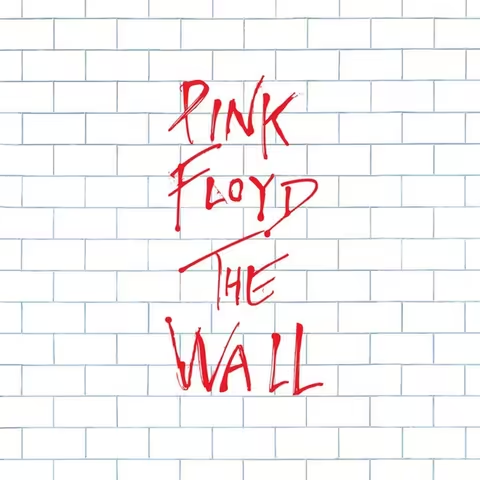
The cover is the first Pink Floyd sleeve since 1967's The Piper at the Gates of Dawn not to have been designed by Storm Thorgerson's Hipgnosis. Waters had fallen out with Thorgerson over the Animals cover (the inflatable pig over Battersea Power Station, which Thorgerson always insisted had been his idea and which Waters always insisted had been the band's), and the relationship had deteriorated further when Thorgerson included a Pink Floyd image in a Hipgnosis retrospective book without asking. Waters, in characteristic fashion, banned Thorgerson and gave the entire project to the satirical cartoonist Gerald Scarfe instead.
Scarfe's solution was the plainest sleeve in the band's catalogue: a featureless white brick wall, no title, no band name, no information of any kind. The inside gatefold and inner sleeves carry his now-iconic line drawings of the marching hammers, the snarling schoolmaster, the suffocating mother, the predatory wife and the judge with the giant bottom. Scarfe also designed and directed the animated sequences for the 1982 film, and his line drawings remained, more or less unaltered, the visual identity of the project across the 1980 tour, the film, the Berlin show in 1990 and the Wall Live tour of 2010 to 2013.
Release & Reception
The Wall came out on 30 November 1979 in the UK and on 8 December 1979 in the United States. The lead single, Another Brick in the Wall, Part 2, had been released a week earlier in Britain and was already climbing. By the third week of December it was number one in the UK, displacing The Police's Walking on the Moon. By the end of January 1980 it had repeated the trick in the United States, becoming Pink Floyd's only number-one Billboard single and the last UK Christmas number one of the 1970s.
The album itself topped the Billboard 200 for fifteen weeks (a run unbroken until the spring of 1980), peaked at number three in the UK, hit number one across most of Europe, Canada and Australia, and was the best-selling album worldwide of 1980. The contemporary American press was largely won over. Robert Christgau, in the Village Voice, gave it an A−. Rolling Stone's Kurt Loder, reviewing the album in early 1980, was almost embarrassed at how much he liked it.
"The Wall is at once a stunning synthesis of Waters' by-now familiar thematic obsessions... and a deeply personal vision of artistic isolation, the alienation of the rock star from the audience that supports him."
Kurt Loder, Rolling Stone, 1980
The British music press was, characteristically, more divided. The NME admired the production but found Waters' worldview oppressive. Sounds and Melody Maker gave it largely positive reviews. The album was not nominated for Album of the Year at the 1980 Grammys, but James Guthrie won Best Engineered Album, Non-Classical, and the album was eventually inducted into the Grammy Hall of Fame in 2008.
Retrospectively, the album has aged into the kind of canonical status that almost cancels itself out. Rolling Stone has included it on every iteration of its 500 Greatest Albums of All Time list since 2003, placing it 87th in 2003, 87th again in 2012, and 129th in the 2020 revision. The RIAA has certified it twenty-three times Platinum, which for a double LP equates to 11.5 million double-album units in the US alone. Worldwide sales are now estimated above thirty million.
Singles & Music Videos
| Single | Released | B-side | UK Peak | US Peak | Notes |
|---|---|---|---|---|---|
| Another Brick in the Wall, Part 2 | 23 Nov 1979 (UK), 7 Jan 1980 (US) | One of My Turns | 1 | 1 | Pink Floyd's only US No. 1 single; UK Christmas No. 1 1979 |
| Run Like Hell | 17 April 1980 | Don't Leave Me Now | Did not chart | 53 | Promo edit only in some territories |
| Comfortably Numb | 23 June 1980 | Hey You | Did not chart | Did not chart | Released largely as a US album-rock radio play |
The music video for Another Brick in the Wall, Part 2 was directed by Gerald Scarfe and used a slightly different choir from the album, after Islington Green School's headmistress objected to the children appearing on screen. The animation in the video (the schoolmaster as a meat-grinder feeding identical children into mince) is Scarfe's own.
The Comfortably Numb video, in the form most people now recognise it, was made later as part of the 1982 film, in which Geldof's Pink sits in a hotel-room bath while the doctor administers the injection that gives the song its lyric. The Run Like Hell film sequence is the album's most controversial: Pink, transformed by the wall into a fascist demagogue, watches his own marching hammers from a balcony in a sequence that Scarfe modelled openly on Triumph of the Will.
Touring & Live
The Wall tour was always going to be small in venue count and gigantic in production. Pink Floyd played exactly thirty-one shows between February 1980 and June 1981, in only four cities: Los Angeles (Sports Arena), New York (Nassau Coliseum, Long Island), London (Earls Court) and Dortmund (Westfalenhalle). They never took the show beyond those four buildings, and they never repeated it in their original incarnation.
The technical demands were extraordinary:
- A literal forty-foot-high cardboard wall, comprising 340 individual bricks, was built across the front of the stage during the first half of the show
- The wall was knocked down brick by brick at the end of the second set, after Waters' sledgehammer cue in The Trial
- Three giant Scarfe-designed inflatables (the Schoolmaster, the Mother, the Wife) emerged from the wall at the relevant cues
- A surrogate band of session musicians in rubber masks of the Floyd's actual faces opened the show with In the Flesh?, allowing Waters to indulge the gag that the audience had not yet noticed they were watching the wrong band
- An instrumental medley known as The Last Few Bricks was inserted into the show to buy time if the brick crew were running behind
- Gilmour played his Comfortably Numb solo standing on top of the wall, in spotlight, having climbed an internal ladder during the previous song
The shows were extraordinary, the reviews ecstatic and the financial outcome catastrophic. Pink Floyd lost approximately £400,000 on the run, even with every night sold out. Wright, on his flat salary, made more from the tour than any of the other three. The cost is the reason the band never extended the run beyond those four cities, and the reason that, when Waters revived the show for his own 2010 to 2013 Wall Live tour, the inflation-adjusted ticket prices were five times what the original Floyd shows had asked.
In TV, Film & Media
Pink Floyd – The Wall, released in summer 1982, was directed by Alan Parker (of Bugsy Malone, Midnight Express and Fame fame), produced by Alan Marshall, and starred Boomtown Rats vocalist Bob Geldof as Pink. Geldof was a controversial choice: he had publicly mocked the Floyd in the music press, and Waters initially refused to consider him. Parker insisted. The film is structurally faithful to the album, intercut with Scarfe's animated sequences, and tells the entire Wall story almost without dialogue. It opened to mixed reviews, has become a cult fixture and remains the second-biggest selling concert film of all time.
The album's other significant on-screen life is The Wall: Live in Berlin, performed on 21 July 1990 on the open ground between Potsdamer Platz and the recently fallen Berlin Wall. Waters organised the concert as a benefit for the Memorial Fund for Disaster Relief in memory of the show's first promoter Leonard Cheshire, and rebuilt the entire show with an all-star cast in front of an audience of approximately 350,000 people. Guests included the Scorpions, Cyndi Lauper, Sinéad O'Connor, Joni Mitchell, Van Morrison, Bryan Adams, Ute Lemper, Tim Curry, Marianne Faithfull and Thomas Dolby. Gilmour, Mason and Wright did not appear.
Songs from The Wall have been licensed sparingly. Another Brick in the Wall, Part 2 is the most widely sync-placed: it appears in The Wonder Years, in The Simpsons (in choral parody form), in episodes of The Sopranos and Cold Case, and in advertising on every continent. Comfortably Numb has appeared in The Departed, in House M.D., and in the Scrubs musical episode. Run Like Hell scored an entire chase sequence in the original Vanilla Sky trailer.
Controversy, Censorship & Lawsuits
The most public controversy of the album's first release was the South African government's October 1980 decision to ban Another Brick in the Wall, Part 2 from radio play, after black schoolchildren in Soweto and the Eastern Cape began using its chorus as a chant during protests against the segregated Bantu Education system. The ban turned Floyd, briefly and accidentally, into a figurehead of South African anti-apartheid resistance. The band, predictably, were delighted.
The English broadcaster the BBC did not ban the single, despite the lyric attacking schoolteachers, but Radio One famously hated playing it. The Children's Society and the National Union of Teachers both objected. The headmistress of Islington Green School wrote a letter to the Daily Telegraph denouncing the song. The Inner London Education Authority demanded that the school not be credited on the single, a request the band ignored.
There was no plagiarism suit and no sampling clearance issue. The only significant legal trouble around the project came later, with the 1985 break-up of the band itself, when Waters sued to dissolve the partnership and Gilmour and Mason countered that they intended to continue using the Pink Floyd name. The court found for Gilmour and Mason. Waters has been on partial speaking terms with Gilmour, at best, ever since.
Covers, Samples & Tributes
Comfortably Numb is, by some distance, the most-covered song from the album. Notable interpretations include Van Morrison's at the Berlin show in 1990, the Scissor Sisters' 2003 disco version (which Gilmour publicly endorsed and which charted top ten in the UK), and a regular pairing of the song between David Gilmour and David Bowie at Gilmour's Royal Albert Hall shows in 2006. Roy Harper, who had sung lead vocal on Wish You Were Here's Have a Cigar, frequently covered Hey You in his solo sets.
Another Brick in the Wall, Part 2 has been covered by Korn, by Class of 99 (an all-star metal project featuring Tom Morello), by Eric Prydz (whose 2004 club edit Proper Education was a UK top three hit), and by countless school-end-of-year discos. The Eric Prydz version is the only one with which Waters publicly co-operated, in part because the producer made a video that re-staged the song in a contemporary East End housing estate.
Tribute albums dedicated wholly to The Wall include a 2007 punk-rock version (Pink Punk: A Tribute to Pink Floyd) and a 2008 string-quartet adaptation. The full album has been performed live in its entirety by, among others, the Australian Pink Floyd Show, the Brit Floyd touring outfit and an increasing number of orchestral arrangements with massed choirs.
Reissues, Remasters & Anniversaries
The Wall was first reissued on CD in 1985, in a no-frills two-disc package. James Guthrie remastered the album for the 1994 Shine On box, then revisited it for the 2000 Capitol gold-disc edition. The most significant reissue campaign was 2011's Why Pink Floyd?, which appeared in three tiers:
- Discovery: the standard remastered double CD, James Guthrie 2011 remaster
- Experience: three CDs, adding the 1980 demo recordings and a selection of Waters' Programme One demos
- Immersion: a seven-disc box including six CDs and a DVD, with the complete 1980 Earls Court live recording (Pink Floyd's first official release of any Wall live material), additional demos, a 5.1 mix and a hardback book
Roger Waters' own Wall Live tour, running from September 2010 to September 2013, eventually became the highest-grossing solo tour of all time (a record subsequently broken). The 2014 concert film and album Roger Waters – The Wall, directed by Sean Evans and Waters, documents the final dates of that tour and is the most contemporary official document of the album's music. James Guthrie produced the Dolby Atmos / spatial-audio mix for the album in 2023 as part of the Floyd back-catalogue Atmos campaign.
For the album's fortieth anniversary in 2019 there was, surprisingly, no new physical release. Pink Floyd's official explanation was that the 2011 Immersion box had been so comprehensive that there was, genuinely, nothing left to add.
Legacy & Influence
The Wall is, in the strictest commercial sense, the largest single statement Pink Floyd ever made. It is the band's biggest-selling album in every territory outside the United States (where Dark Side of the Moon remains in the lead by virtue of its forty-six-year chart run). It is the album that established the modern arena-rock spectacle as a self-contained theatrical event, and the album whose tour every subsequent rock-spectacle (U2's Zoo TV, Madonna's Blond Ambition, the modern Taylor Swift Eras tour) is in some sense a descendant of.
It is also the album that ended Pink Floyd as a working group of equals. Wright was gone before it was released. The Final Cut, in 1983, would be made with Waters in even more total control. Waters himself would leave the band in 1985 and spend the next two decades suing them. Gilmour, Mason and Wright would carry on under the Pink Floyd name through A Momentary Lapse of Reason and The Division Bell. The reunion at Live 8 in 2005 was the only time all four men shared a stage again before Wright's death in 2008.
The album's influence on rock musicians who followed is generational. Trent Reznor has cited it as the single most important record in his musical adolescence. Billy Corgan, inducting Pink Floyd into the Rock and Roll Hall of Fame in 1996, dedicated half of his speech to The Wall.
"Pink Floyd's The Wall was, for an entire generation of suburban kids, the first time we'd ever heard a record that took our adolescent rage seriously without laughing at us."
Billy Corgan, Rock and Roll Hall of Fame induction speech for Pink Floyd, 1996
For Waters himself, the album has become both a vindication and a millstone. The 2010 to 2013 Wall Live tour, with its updated political content (the marching hammers now flanked by McDonald's logos, oil-company crests and the faces of recently killed civilians of various wars), made the album's anti-authoritarian reading explicit in ways that, in 1979, were still buried under the personal narrative. In a 1992 interview Waters reflected on what had become of him in the intervening years.
"The Wall was the moment I realised I no longer trusted the audience, and I realised I no longer trusted myself for not trusting them. Most of what I've done since has been an attempt to find my way back across that wall."
Roger Waters, Q magazine, 1992
Things You Might Not Know
| Fact | Detail |
|---|---|
| The spit that started it | The fan Waters spat on in Montreal on 6 July 1977 has never publicly identified himself, despite multiple offers of interviews over the years. |
| Bob Ezrin's two badges | Throughout sessions, Waters wore a badge reading WHY and Ezrin wore one reading NOPE; both badges were retained as relics by Ezrin and have been displayed at Pink Floyd Mortal Remains exhibitions. |
| The disco rhythm | The drum machine and four-on-the-floor groove of Another Brick in the Wall Part 2 were Ezrin's idea. Waters loathed it. Ezrin had to insist on it physically by playing the bass and drum parts himself before Waters would accept the track. |
| The Pros and Cons came first | The Pros and Cons of Hitch Hiking, eventually Waters' 1984 solo debut, was the alternative demo Waters offered the band in July 1978 alongside Bricks in the Wall. Gilmour and Mason chose Bricks because it had more obvious songs. |
| The film almost starred Waters | Roger Waters auditioned for the role of Pink himself before Bob Geldof was cast. Alan Parker has said the screen test was, in his own words, "uncompromisingly grim". |
| The Islington Green School payment | The school choir was paid £1000 in 1979 and a single platinum disc for the school hall. Following a 1996 press campaign, individual choristers were able to claim royalties; one former pupil reportedly used the back-payment for a deposit on a house. |
| The Berlin show technical scale | The 1990 Berlin Wall replica was 25 metres high and 168 metres long, the largest theatrical set ever built outdoors at that point. |
| The cardboard wall's afterlife | The original 1980 cardboard bricks were destroyed at the end of every show. The 2010 tour used fireproofed lightweight foam bricks, which were recycled at the end of each leg. |
| The surrogate band | The opening number In the Flesh? was performed on tour by a session band wearing rubber masks of the real members of Pink Floyd. Many fans in the back of the arena did not realise the band on stage was not the real Floyd until midway through the second song. |
| The film's only Floyd recording | Of the entire 1982 film soundtrack, the only piece of music that came directly off the album master tapes was Outside the Wall. Every other track was re-recorded for the film with a different orchestra under Bob Ezrin and Michael Kamen. |
| The Hey You film cut | Hey You was filmed and animated for Pink Floyd – The Wall but was excised from the final cut at the last minute. The footage is included on the 1999 DVD release. |
| Wright's tour earnings | The dismissed Richard Wright, hired back on a flat fee, was the only member of Pink Floyd to make a personal profit from the 1980 to 1981 tour. The other three members each lost approximately one hundred thousand pounds. |
| The Christmas Number One | Another Brick in the Wall Part 2 was the last UK Christmas Number One of the 1970s and is one of only a handful of British Christmas Number Ones to feature a children's choir as lead vocal. |
| The Comfortably Numb arrangement | The orchestral version Waters and Ezrin used as the final master was assembled in New York from the rhythm track Gilmour had recorded for his solo album. Gilmour later said the arrangement was his single biggest concession on the entire record. |
| The South African afterlife | Black South African schoolchildren chanted "We don't need no education" during anti-Bantu-Education protests in late 1980, prompting the apartheid government to ban the song. Waters wrote personally to several leaders of the protests to express solidarity. |
Podcast
If you would rather listen than read, the Riffology podcast covers The Wall in episode 27, where we walk through the Montreal incident, the tax-exile sessions, the Wright firing, the school choir, Comfortably Numb and the wall itself in considerably more depth than even an article this size allows. The podcast is available on Apple Podcasts, Spotify, Amazon Music, Pocket Casts and every other major podcast platform; subscribe, give us a rating, and let us know what you think.
Comments