Fifteen songs, seventy minutes, eight different guitar tunings and a deliberate refusal to cut anything. Superunknown is the album Soundgarden made when they decided they were done apologising for being heavier, weirder and longer than the rest of the Seattle class of 1991. It arrived on 8 March 1994, six weeks after Kurt Cobain checked out of a Rome hotel, six weeks before he died, and into the slipstream of In Utero, Vs. and Dirt. It debuted at number one on the Billboard 200 with first-week sales of 310,000 copies, eventually clearing six-times platinum in the United States, and won the band two Grammys for tracks that nobody at A&M Records would have predicted on a Soundgarden record three years earlier.
The sound that producer Michael Beinhorn coaxed out of the four members at Bad Animals Studio in Seattle, on the new Neve console Chris Cornell name-checked as the reason they finally stayed home to record, is the most produced album in the band's catalogue and also the most experimental. It is grunge with Sinatra reference points, Beatle-influenced bridges, viola and cello on a Ben Shepherd-sung lament, pots and pans on the lead single, and a closing seven-minute ballad written about a bird the singer killed with a brick.
Album Facts
| Field | Detail |
|---|---|
| Artist | Soundgarden |
| Album | Superunknown |
| Release Date | 8 March 1994 |
| Label | A&M Records |
| Producer | Michael Beinhorn; Soundgarden (co-production) |
| Studios | Bad Animals Studio, Seattle (recording); Southern Tracks Recording, Atlanta (mixing, except "4th of July"); mastered by David Collins |
| Genre / Subgenre | Grunge, alternative metal, hard rock, alternative rock, psychedelic rock |
| Track Count | 15 (16 on Australian/Japanese editions with "She Likes Surprises") |
| Total Runtime | 70:13 (73:33 with bonus track) |
| Billboard 200 Peak | 1 (debut, week of 26 March 1994; 310,000 first-week sales) |
| UK Albums Chart Peak | 4 |
| Other Notable Chart Peaks | Australia 1, Canada 1, New Zealand 1, Sweden 3, Scotland 4, Norway 5, Denmark 7, Finland 7, Switzerland 9, Netherlands 11, Germany 13, Austria 19 |
| Certifications | US 6× Platinum (RIAA); Canada 3× Platinum; Australia 3× Platinum; Sweden 2× Platinum; UK Platinum; New Zealand Platinum; Italy and the Netherlands Gold |
| Estimated Sales | 6 million+ in the United States; 2.5 million in its first calendar year (13th-biggest album of 1994 in the US) |
| Key Singles | "Spoonman", "The Day I Tried to Live", "Black Hole Sun", "My Wave", "Fell on Black Days" |
A Fourth Album in the Aftermath of Nevermind
By the time Soundgarden walked into Bad Animals in July 1993, the Seattle scene they had helped invent had already eaten itself once. Nirvana's Nevermind had been the dominant rock record of the previous eighteen months, Pearl Jam's Ten had cleared seven million in the United States, Alice in Chains had moved more than a million copies of Dirt and a sticker on the front of every Lollapalooza ticket. Soundgarden's third album Badmotorfinger, released in October 1991, had been pushed out of public view by Nevermind's detonation a week earlier; Soundgarden had toured it for almost two years, opening for Guns N' Roses on the Use Your Illusion run and headlining the second stage of Lollapalooza in 1992.
The pressure on the fourth Soundgarden record was the specific pressure of being last to the party. Vs., In Utero and Alice in Chains's Jar of Flies were either out or imminent. Hole's Live Through This arrived in April. Stone Temple Pilots's Purple followed in June. The narrative around Soundgarden in the music press for most of 1993 had been polite condescension about a band finally about to be lapped by their younger Seattle peers. Superunknown was the four members' answer.
The Band's Story Up to This Point
Soundgarden had been a working band for almost a decade by the time they started Superunknown. Formed in Seattle in 1984 by Chris Cornell (then on drums and vocals), bassist Hiro Yamamoto and guitarist Kim Thayil, the lineup stabilised after Matt Cameron replaced Scott Sundquist on drums in 1986. They were the first Sub Pop signing, the first grunge band to make the Billboard 200 (with 1989's Louder Than Love) and the first to sign to a major label when A&M took them on in mid-1988.
Yamamoto left in 1989 and was briefly replaced by ex-Nirvana bassist Jason Everman before Ben Shepherd settled into the role for 1991's Badmotorfinger. By the spring of 1993, the four-piece had won a Grammy nomination for Best Metal Performance every year since 1990, had been name-checked by Kurt Cobain as one of the few Seattle bands he liked, and had inadvertently become a totem of the "big four" of grunge alongside Nirvana, Pearl Jam and Alice in Chains. They had also been on the road, almost without break, for two years.
Pre-production: Sinatra, Sylvia Plath and a Change of Producer
Writing for Superunknown began in earnest about two months after Soundgarden's Lollapalooza 1992 stint finished. Where the first three Soundgarden records had largely been written in the rehearsal room, the band agreed to give each other more room this time. Each member brought in demos that they had written alone, and the other three contributed to the arrangements. Cornell was reading a lot of Sylvia Plath, an influence he later cited as the source of much of the album's lyrical preoccupation with depression, substance abuse and what he called "crawling back to the womb to die".
The first big decision was the producer. The band had made Louder Than Love and Badmotorfinger with Terry Date, and respected him, but wanted a different perspective. They settled on Michael Beinhorn, who had recently produced Soul Asylum and was best known for his work with the Red Hot Chili Peppers on The Uplift Mofo Party Plan. Kim Thayil was specific about the logic.
"We just thought we'd go for a change. Beinhorn didn't have his own trademark sound which he was trying to tack on to Soundgarden, and he had ideas we approved of."
Kim Thayil, Making Music, May 1994
Beinhorn was, in turn, specific about what he wanted to do with the band. He had been listening to European electronic music, including Aphex Twin and the Dutch gabber scene, and was looking to translate some of that intensity to the guitars. He was also obsessed with the singer's vocal sound. Cornell would later recall that before tracking the lead vocal for what became the album's biggest hit, Beinhorn played him Frank Sinatra records.
Recording at Bad Animals: A New Neve and a Slow Burn
Soundgarden tracked Superunknown at Bad Animals Studio in Seattle between July and September 1993. The studio, owned by Ann and Nancy Wilson of Heart, had just acquired a Neve console, which Cornell cited as the deciding factor in keeping the sessions in their hometown. Up to that point, every Soundgarden album had been recorded outside Seattle in part because, as Cornell put it, "there was never a decent studio in Seattle". Bad Animals was now the exception.
The sessions ran for around twelve weeks. Jason Corsaro engineered, with Bad Animals' resident engineer Adam Kasper assisting; Kasper, then early in his career, would go on to produce every Soundgarden album from Down on the Upside onwards, and to engineer Pearl Jam, Foo Fighters and Queens of the Stone Age records over the next two decades. The band worked one song at a time. Drums and bass were laid down first, then Cornell and Thayil overdubbed their parts on top. Beinhorn, by all accounts, was meticulous to the point of obsession.
"Michael Beinhorn was so into sounds. He was so, almost, anal about it, that it took the piss out of us a lot of the time. By the time you get the sounds that you want to record the song, you're sick and tired of playing it."
Chris Cornell, Kerrang!, 12 August 1995
Halfway through the schedule, the band paused for a ten-day stretch opening for Neil Young on a US tour, then returned to Seattle to finish. By the time they had tracked fifteen songs and added Beinhorn's preferred guests, viola, cello, clavinet, additional percussion, the album had run to seventy minutes. Asked why nothing got cut, Cornell told Spin's oral history that the band "didn't really want to argue over what should be cut".
Mixing was the one place Beinhorn felt the project needed help. He suggested the band hire someone with fresh ears, and Pearl Jam's Stone Gossard, who knew Brendan O'Brien from Vs., recommended O'Brien for the job. O'Brien mixed everything except "4th of July" (Beinhorn mixed that himself) at Southern Tracks Recording in Atlanta. Thayil called the process "very painless"; Shepherd, more bluntly, called it "the fastest part of the record".
Composition: Eight Tunings, Five Time Signatures and a Beatles Confession
The technical signature of Superunknown is the sheer variety of guitar tunings across its fifteen tracks. The band were not deliberately trying to invent a new toolkit; the tunings emerged from songs Thayil, Cornell and Shepherd had each written separately. The result, as catalogued in a 1994 Guitar World interview, is that no two songs on the album sit in the same place on the fretboard:
- Drop D: "Spoonman", "Black Hole Sun", "Let Me Drown", "Kickstand".
- Standard: "Fell on Black Days".
- DGDGBe: "Superunknown", "Fresh Tendrils".
- DGDGBC: "Like Suicide".
- EEBBBe: "My Wave", "The Day I Tried to Live".
- CGDGBe: "Mailman", "Limo Wreck".
- CGCGGe: "Head Down", "Half".
- CFCGBe: "4th of July".
The time signatures are equally varied: "Fell on Black Days" is in 6/4, "Limo Wreck" in 15/8, "My Wave" alternates between 5/4 and 4/4, and "The Day I Tried to Live" alternates between 7/8 and 4/4. Thayil maintained that the band rarely worked out a song's meter until after it was written, calling the use of odd meters "a total accident". The same interview produced one of the more unexpected influence admissions in Soundgarden's catalogue.
"We looked deep down inside the very core of our souls and there was a little Ringo sitting there. Oh sure, we like telling people it's John Lennon or George Harrison, but when you really look deep inside of Soundgarden, there's a little Ringo wanting to get out."
Kim Thayil, Guitar World, May 1994
The Beatles influence is most audible on "Head Down" and "Black Hole Sun", both of which would have been unimaginable on Badmotorfinger. Other songs reach further afield. "Half", sung by Shepherd over April Acevez's viola and Justine Foy's cello, has the modal feel of an Indian raga. "Limo Wreck" was credited with "harmonic guidance" from the Seattle musician Fred Chalenor, a credit unique in the Soundgarden catalogue.
Personnel and Credits
| Role | Player | Notes |
|---|---|---|
| Soundgarden | ||
| Lead vocals, rhythm guitar | Chris Cornell | All lyrics, except where noted |
| Lead guitar | Kim Thayil | |
| Bass, backing vocals | Ben Shepherd | Additional drums and percussion on "Head Down"; additional vocals on "Spoonman"; lead vocals and guitar on "Half" |
| Drums, percussion | Matt Cameron | Mellotron on "Mailman"; pots and pans on "Spoonman" |
| Additional musicians | ||
| Spoons | Artis the Spoonman | On "Spoonman" only; the song is named for him |
| Piano | Michael Beinhorn | "Let Me Drown" |
| Clavinet | Natasha Shneider | "Fresh Tendrils" |
| Viola | April Acevez | "Half" |
| Cello | Justine Foy | "Half" |
| Harmonic guidance | Fred Chalenor | "Limo Wreck" |
| Additional drums and percussion | Gregg Keplinger | "Head Down" |
| Production and engineering | ||
| Producer | Michael Beinhorn | Soundgarden credited as co-producers; Beinhorn also mixed "4th of July" |
| Engineering | Jason Corsaro | Bad Animals Studio |
| Assistant engineering | Adam Kasper | Resident at Bad Animals; later produced Soundgarden's Down on the Upside |
| Mixing | Brendan O'Brien | Every track except "4th of July"; recommended by Pearl Jam's Stone Gossard |
| Mastering | David Collins | |
| Studio assistance | Gregg Keplinger; Tony Messina | |
| Artwork | ||
| Band photography | Kevin Westenberg | The "Screaming Elf" front cover |
| Front cover design | Kelk | |
| Layout | Reyzart | |
| Management | Susan Silver | Cornell's then-wife; managed Alice in Chains and Screaming Trees in the same window |
The Songs
The album is sequenced for confrontation. "Let Me Drown" opens with a wall of drop-D riff and a Beinhorn-played piano part buried under it; Cornell described the lyric as being about "crawling back to the womb to die". "My Wave" pivots between 5/4 and 4/4 with no warning. "Fell on Black Days", the only song on the album in standard tuning, is one of the slowest things Soundgarden had written to date, and proved to be the album's most enduring radio song. "Mailman", which Cornell once introduced live as being "about killing your boss", carries Matt Cameron's mellotron part.
| # | Title | Music | Length | Single? | Notes |
|---|---|---|---|---|---|
| 1 | "Let Me Drown" | Cornell | 3:51 | No | Beinhorn plays piano (buried under the riff) |
| 2 | "My Wave" | Cornell / Thayil | 5:12 | Yes (Australia, Oct 1994) | Alternates between 5/4 and 4/4 |
| 3 | "Fell on Black Days" | Cornell | 4:42 | Yes (Nov 1994) | The only track in standard tuning; 6/4 time |
| 4 | "Mailman" | Cameron | 4:25 | No | Cornell vocals; Cameron's mellotron in the bridge |
| 5 | "Superunknown" | Thayil / Cornell | 5:06 | No | Title track; tuning DGDGBe |
| 6 | "Head Down" | Shepherd | 6:08 | No | Shepherd lyrics and music; Gregg Keplinger on additional drums |
| 7 | "Black Hole Sun" | Cornell | 5:18 | Yes (May 1994) | Won the 1995 Grammy for Best Hard Rock Performance; MTV VMA Best Metal/Hard Rock Video |
| 8 | "Spoonman" | Cornell | 4:06 | Yes (Feb 1994) | Won the 1995 Grammy for Best Metal Performance; features Artis the Spoonman |
| 9 | "Limo Wreck" | Cameron / Thayil | 5:47 | No | In 15/8; Cornell calls it a "shame-on-decadence song" |
| 10 | "The Day I Tried to Live" | Cornell | 5:19 | Yes (April 1994, UK) | Alternates between 7/8 and 4/4 |
| 11 | "Kickstand" | Thayil | 1:34 | No | Behind-the-scenes footage of its tracking featured on Bill Nye the Science Guy's "Sound" episode |
| 12 | "Fresh Tendrils" | Cameron | 4:16 | No | Natasha Shneider plays clavinet |
| 13 | "4th of July" | Cornell | 5:08 | No | About taking LSD; mixed by Beinhorn rather than O'Brien |
| 14 | "Half" | Shepherd | 2:14 | No | Sung and written by Shepherd; viola and cello arrangement |
| 15 | "Like Suicide" | Cornell | 7:01 | No | Written after Cornell mercy-killed a bird that had flown into his window |
"Black Hole Sun" is the song most people mean when they refer to Superunknown. Cornell wrote it in around fifteen minutes after misreading a TV news headline, then sat on it for weeks because he was not sure the band would want to record something quite so melodic. Beinhorn pushed him to track it as written. The chorus, with its descending arpeggios and Cornell's controlled tenor, was, by the guitarist's own description, "unusual for me, like the right side of a piano, or fairies dancing on a pin". Below is the official video, directed by Howard Greenhalgh, which won the Best Metal/Hard Rock Video award at the 1994 MTV Video Music Awards.
Cornell's vocal on "Black Hole Sun" has become the subject of detailed retrospective analysis. The video below is a vocal-coach breakdown of the performance that became one of the most-shared Cornell tributes in the years after the singer's 2017 death.
"Spoonman", the lead single, takes its title from a list of fictional song titles that Pearl Jam's Jeff Ament had drawn up for the band-within-a-film in Cameron Crowe's Singles. Cornell took the title as a challenge, wrote an actual song around it (a short acoustic demo appears in the film), and built it around the real Artis the Spoonman, a Seattle street performer who plays spoons against his thighs, chest and skull. Artis appears on the album version, with Matt Cameron adding pots and pans for rhythm. The song debuted at number 3 in Australia, gave Soundgarden their first Top 30 placement in the UK and won the 1995 Grammy for Best Metal Performance.
"The Day I Tried to Live", the album's third single in the UK, is the song Cornell described as "trying to step out of being patterned and closed off and reclusive". Its alternating 7/8 and 4/4 sections make it one of the technically most demanding rock songs of the period to play live. Director Joseph Kahn shot the video as a single tracking shot through a series of staged tableaux.
"4th of July" sits deep in the album's back half and is the song Cornell wrote about taking LSD. Beinhorn mixed it himself rather than passing it to Brendan O'Brien, the only such exception on the record, because he felt the sonic decisions on it were already inseparable from the production. The track has had an unusually long live afterlife; the version below is from the band's 2012 headline performance at Hyde Park, London, fifteen years after their first breakup.
"Half", Ben Shepherd's only lead-vocal appearance on a Soundgarden studio album, is the most divisive track on the record. Some critics, including Rolling Stone's J.D. Considine in his original review, singled it out for criticism. The band defended it as the album's necessary breath, and Shepherd brought it back for the 2014 SXSW reunion performance below.
The closer is "Like Suicide", a seven-minute Cornell ballad with the most literal origin story on the album. A bird had flown into a window of his house. Finding it severely injured, Cornell killed it with a brick to end its suffering. The lyric is unflinching about what he did and why; the music, played mainly on DGDGBC-tuned guitar, is among the most exposed Cornell ever wrote for Soundgarden.
B-sides, Outtakes and the Things That Got Away
Of all the Soundgarden albums, Superunknown spawned the most fertile B-side run. Most of the non-album tracks from the period were not, however, recorded at the Bad Animals sessions: only "Exit Stonehenge" (B-side to "Spoonman") came directly out of the 1993 album sessions with Beinhorn. "Cold Bitch", the other "Spoonman" flip, was recorded during the 1991 Badmotorfinger sessions and held back. "Kyle Petty, Son of Richard" and "Motorcycle Loop", both on the "Fell on Black Days" single, were tracked separately by Stuart Hallerman at Avast Studios in Seattle in 1994. Three songs that the band attempted at Bad Animals, "Tighter & Tighter", "No Attention" and "An Unkind", were rejected and later re-recorded for 1996's Down on the Upside.
- "She Likes Surprises", included as a bonus track on the Australian and Japanese editions and on the 2014 reissue. Cornell music and lyrics.
- "Exit Stonehenge", the only true Bad Animals outtake. B-side to "Spoonman".
- "Birth Ritual", recorded for the Singles soundtrack in 1992 and re-released on later compilations.
- "Ruff Riff-Raff" and "Bing Bing Goes to Church", instrumental rehearsal-room sketches eventually released on the 20th anniversary Super Deluxe edition in 2014.
Cover and Packaging: Kevin Westenberg's Screaming Elf
The cover image, known among collectors as the "Screaming Elf", is a distorted photograph of the four band members taken by Kevin Westenberg, placed above a black and white image of an upside-down burning forest. The front cover was designed by Kelk; the layout was by Reyzart. Cornell explained the concept at length to Melody Maker shortly before release.
"Superunknown relates to birth in a way. Being born or even dying, getting flushed into something that you know nothing about. Soundgarden has always been associated with images of flowers and lush colors and this was the opposite. I was into those stories as a kid where forests were full of evil and scary things as opposed to being happy gardens that you go camping in."
Chris Cornell, Melody Maker, 27 November 1993
The title itself came from a misreading. Cornell told Pulse! magazine in March 1994 that he had glanced at the spine of a videotape titled Superclown, registered "Superunknown" instead, and used it because "I'd never heard it before, never saw it before, and it inspired me". The album also had a limited-edition double-LP gatefold release on coloured 12-inch vinyl in blue, orange and clear pressings, which became some of the more sought-after Soundgarden collectibles of the 1990s. In May 2017, in the days after Cornell's death, Westenberg posted the full uncropped Screaming Elf photograph on Instagram for the first time.
Release and Reception
The album entered the Billboard 200 at number one on the chart dated 26 March 1994, with first-week sales of 310,000 copies. It was Soundgarden's first chart-topper and closed 1994 as the thirteenth best-selling album of the year in the United States, with 2.5 million copies sold inside its first calendar year. It topped the Australian, Canadian and New Zealand charts and reached number four in the UK. The RIAA would eventually certify it six-times platinum in 2017; it remains, by a clear margin, the biggest-selling Soundgarden album.
Critical opinion was overwhelmingly positive, though not unanimous. David Browne in Entertainment Weekly gave it an A and called it "a hard-rock milestone, a boiling vat of volcanic power, record-making smarts and 90s anomie and anxiety that sets a new standard for anything called metal". Q magazine gave it five stars. Ann Powers, writing for Blender, called the album "Soundgarden's masterpiece". Robert Christgau in the Village Voice gave it an A- and called it "easily the best, most galvanizing, kinetic, sensational, catchy, Zep rip in history". The most influential mainstream review came from J.D. Considine in Rolling Stone.
"Superunknown demonstrates far greater range than many bands manage in an entire career. At its best, Superunknown offers a more harrowing depiction of alienation and despair than anything on In Utero."
J.D. Considine, Rolling Stone, 10 March 1994
The album was nominated for Best Rock Album at the 37th Annual Grammy Awards in February 1995. It lost to the Rolling Stones's Voodoo Lounge, but Soundgarden took home two of the four awards they were nominated for that night: "Spoonman" won Best Metal Performance, and "Black Hole Sun" won Best Hard Rock Performance. "Black Hole Sun" had already taken Best Metal/Hard Rock Video at the 1994 MTV Video Music Awards, and would go on to win the Clio Award for Alternative Music Video in 1995. The album made the Pazz & Jop poll, year-end lists from Spin, Entertainment Weekly and Rolling Stone, and ranked third on the latter's Best Albums of 1994 round-up.
Singles, Music Videos and the Five-Way Single Run
The single campaign was unusually long: five tracks were worked over a period of more than twenty months, with separate territory-specific releases shaping the rollout in Australia and the UK. "Spoonman", the first single, was released on 7 February 1994, almost a full month ahead of the album. "Black Hole Sun", which arrived in May, became the song that took Soundgarden onto MTV's daytime rotation for the first time.
| Single | Release | Chart peaks | Video director / notes |
|---|---|---|---|
| "Spoonman" | 7 February 1994 | US Mainstream Rock 3, US Alternative 9, UK 20, Australia 3 | Video features Artis the Spoonman performing on Seattle streets; Grammy for Best Metal Performance, 1995 |
| "The Day I Tried to Live" | 18 April 1994 (UK) | US Mainstream Rock 21, UK 42 | Joseph Kahn directs; single-tracking-shot video |
| "Black Hole Sun" | 13 May 1994 | US Mainstream Rock 1 (7 weeks), US Alternative 2, UK 12, Australia 9 | Howard Greenhalgh directs; the surreal suburbia video won 1994 MTV VMA Best Metal/Hard Rock Video |
| "My Wave" | 31 October 1994 (Australia) | US Mainstream Rock 25, Australia 99 | No promotional video |
| "Fell on Black Days" | November 1994 | US Mainstream Rock 27, UK 24 | Jake Scott directs; vintage film-stock treatment |
Touring, the Vocal Cord Strain and Lollapalooza '96
Soundgarden began the Superunknown touring cycle in January 1994 with dates in Oceania and Japan, regions where A&M had released the record a few weeks ahead of its US date and where the band had never previously toured. They moved to Europe in March. A planned twenty-date co-headline run with Nine Inch Nails across the United States in April and May 1994 was cancelled when the band were forced to pull out; instead, they launched their own headline theatre tour from Vancouver on 27 May 1994, with Tad and Eleven supporting.
By the autumn the run had become punishing. Doctors discovered late in 1994 that Cornell had severely strained his vocal cords. Soundgarden cancelled the remaining dates of the year to avoid permanent damage, then made them up in 1995. The 1996 tour cycle that followed Down on the Upside would see them join Metallica on Lollapalooza, but it was the Superunknown tour that took them from theatres to arenas.
- January–February 1994: Oceania and Japan headline run, the band's first in either territory.
- March 1994: European theatre tour.
- May–September 1994: US theatre tour with Tad and Eleven.
- Autumn 1994: European arenas (cut short by Cornell's vocal cord strain).
- 1995: rescheduled US and European dates; live appearances at Pinkpop and Reading.
In TV, Film and Media
The album's most-cited screen presence is the connection to Singles: Cameron Crowe's 1992 Seattle-set film carried an acoustic demo version of "Spoonman" on its soundtrack two years before the album appeared, and Jeff Ament's joke list of song titles for the fictional band Citizen Dick provided the title that Cornell ran with. Bill Nye the Science Guy's "Sound" episode used behind-the-scenes footage of Soundgarden tracking "Kickstand" at Bad Animals. "Black Hole Sun" has since been placed across feature film, prestige television and video game soundtracks, including a memorable on-screen acoustic performance by Chris Cornell of "Spoonman" in the 1996 documentary Hype!.
Reissues, Remasters and the 2014 Super Deluxe
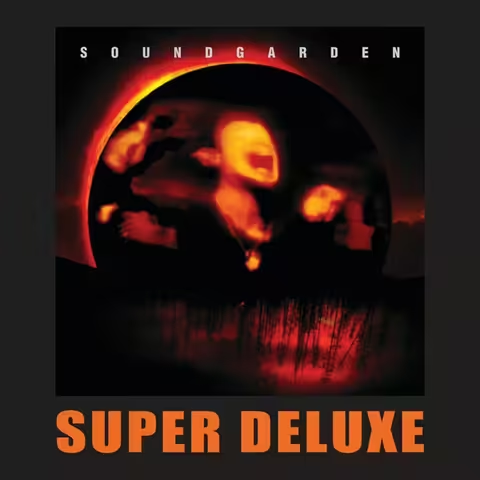
The most substantive reissue of the album is the 20th anniversary edition released by A&M and UMe in June 2014. It came in two forms. The two-CD Deluxe Edition paired the remastered album with a second disc of demos, rehearsals and B-sides. The five-CD Super Deluxe Edition added two further discs of additional rehearsal and B-side material, with the fifth disc presenting the album in 5.1 surround Blu-ray Audio. The Super Deluxe was packaged in a hardbound book with a lenticular cover (the source of the hero image at the top of this article), liner notes by Rolling Stone's David Fricke and newly reimagined artwork by Josh Graham, alongside previously unseen Kevin Westenberg band photography. A 2-LP gatefold of the original sixteen tracks on 200-gram vinyl was issued at the same time, with five 10-inch limited-edition coloured-vinyl singles released for Record Store Day on 19 April 2014 (with new sleeve artwork by Josh Graham).
Legacy and Influence
By every measurable yardstick Superunknown is the most important album in the Soundgarden catalogue: their only Billboard No. 1, the source of their first Grammy wins, and the record that pushed them out of Seattle's grunge framing and into a longer story about American rock songwriting. Rolling Stone ranked it at number 335 on the 2012 "500 Greatest Albums of All Time", number 38 on the magazine's "100 Greatest Albums of the 90s", and number 9 on its 2019 "50 Greatest Grunge Albums". Spin ranked it 70 on its 1999 "Top 90 Albums of the 90s". The Loudwire 2014 list of "10 Best Hard Rock Albums of 1994" placed it at number 3. Kerrang!'s "100 Albums You Must Hear Before You Die" included it at 70.
The album's influence on subsequent bands is most often traced through the alternative-metal lineage: Stone Temple Pilots, Helmet, Tool and Days of the New all cite it explicitly. The most surprising endorsement came from a band most listeners would not put in Soundgarden's neighbourhood at all.
"We were listening to Nirvana and Pearl Jam just like everybody else, and especially to Soundgarden, the Superunknown record. That was the record that we referenced in terms of the sonics and the mood of it when making Slang."
Vivian Campbell of Def Leppard, Classic Rock, December 2015
The album's afterlife extended well beyond rock's own conversation. Following Chris Cornell's death in May 2017, "Black Hole Sun" returned to the upper reaches of streaming charts worldwide and the album re-entered the Billboard 200. In November 2025, Soundgarden were inducted into the Rock and Roll Hall of Fame; the surviving members were joined by original bassist Hiro Yamamoto on stage, Mike McCready of Pearl Jam, Jerry Cantrell of Alice in Chains and Brandi Carlile for a two-song set anchored by "Black Hole Sun", with Cornell's daughter Toni singing "Fell on Black Days" elsewhere in the ceremony.
Things You Might Not Know
| Fact | Detail |
|---|---|
| The Sinatra reference | Before tracking the lead vocal for "Black Hole Sun", producer Michael Beinhorn played Chris Cornell Frank Sinatra records, looking for the same restraint on a song he felt was being undersung. |
| The title is a misread | Cornell told Pulse! in March 1994 that he settled on the album name after misreading the spine of a videotape titled Superclown as Superunknown. |
| Jeff Ament named "Spoonman" | Pearl Jam's bassist drew up a list of fake song titles for the fictional band Citizen Dick in Cameron Crowe's Singles. Cornell took "Spoonman" as a writing challenge and built a real song around it. |
| The spoons player is a real busker | Artis the Spoonman is a Seattle street performer who plays spoons against his thighs, chest and skull; he appears on the album version of the song he inspired. |
| Matt Cameron's pots and pans | Some of the metallic percussion on "Spoonman" is Cameron hitting actual kitchenware in the studio, not a drum kit. |
| "Like Suicide" began with a brick | Cornell wrote the seven-minute closer literally about an injured bird he had to put down with a brick after it flew into his window. |
| Eight tunings across fifteen songs | The album uses eight different guitar tunings, with only "Fell on Black Days" in standard. Most of the album was written by Cornell, Thayil and Shepherd separately and the tunings emerged song-by-song. |
| Stone Gossard recommended the mixer | Brendan O'Brien was suggested to Beinhorn by Pearl Jam's Stone Gossard, fresh from mixing Vs.. O'Brien mixed every track except "4th of July". |
| Bad Animals's Neve console kept it home | Cornell cited Bad Animals's recently installed Neve as the reason Soundgarden finally recorded in Seattle. Every previous Soundgarden album had been tracked outside the city. |
| Adam Kasper was the assistant | The Bad Animals resident engineer assisting Jason Corsaro went on to produce Down on the Upside in 1996, plus King Animal, and to engineer Pearl Jam and Foo Fighters records into the 2020s. |
| Bill Nye filmed the "Kickstand" session | Behind-the-scenes footage of the band tracking the album's 1:34 punk-blast track was used in the "Sound" episode of Bill Nye the Science Guy. |
| "4th of July" is about LSD | Cornell was explicit about the lyric in interviews of the period. The track is the only one Beinhorn mixed rather than O'Brien. |
| "Half" is a Shepherd song | The album's penultimate track is the only Soundgarden studio recording on which Ben Shepherd takes lead vocals; he also wrote it and plays guitar on it. |
| The "Screaming Elf" was finally seen in full in 2017 | Photographer Kevin Westenberg revealed the uncropped Screaming Elf cover image on Instagram in May 2017, in the days after Cornell's death. |
| Coloured vinyl pressings | The original 1994 release included a limited 12-inch double-LP gatefold edition on blue, orange and clear vinyl, now among the more sought-after Soundgarden collectibles. |
Listen on the Riffology Podcast
If you want the audio companion to this piece, the Riffology podcast covers Superunknown in episode 86, as part of its ongoing run through the defining records of 1990s American rock. Episodes are available on Apple Podcasts, Spotify, Pocket Casts, Overcast and every other major platform, with full show notes, source lists and follow-on reading at podkit.riffology.co.
Comments