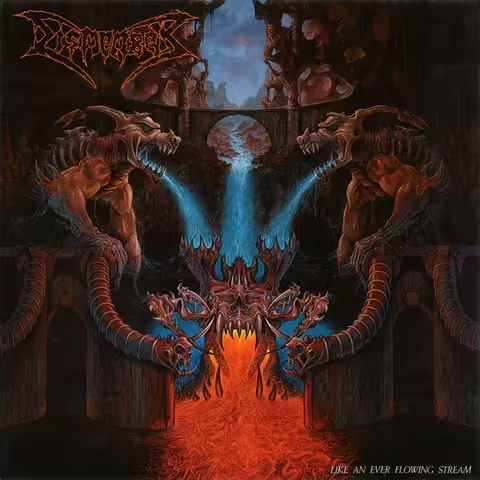
In the second week of November 1991 a customs officer at the port of Great Yarmouth in Norfolk opened a Nuclear Blast carton, lifted out a CD with a Dan Seagrave painting on the front and a track called Skin Her Alive on the back, and decided he had probable cause. Around eight hundred copies of Like an Ever Flowing Stream were impounded that afternoon, and within months the British state had begun what would become one of the only Obscene Publications Act prosecutions ever brought against a death metal record. The bench took the case seriously enough to sit through the album in full.
By the time the magistrates at Great Yarmouth ruled in July 1992 that the record was, in fact, lawful and awarded the defence GBP 7,500 in costs, Like an Ever Flowing Stream had already done its other piece of historical work. Cut in March 1991 at Sunlight Studios in Stockholm by Tomas Skogsberg and Fred Estby, it was the album that took the Boss HM-2 distortion pedal Entombed had reached for on [Left Hand Path](/posts/the-making-of-left-hand-path-by-entombed/) the year before and turned it into a movement. Eight tracks, thirty-one minutes, one of the great debut covers of the era, and a single song that nearly cost a Nottingham record label its licence. Dismember had arrived.
Album Facts
| Field | Detail |
|---|---|
| Artist | Dismember |
| Album | Like an Ever Flowing Stream |
| Release date | 28 May 1991 |
| Label | Nuclear Blast Records |
| Producers | Tomas Skogsberg and Fred Estby |
| Engineer | Tomas Skogsberg |
| Studio | Sunlight Studios, Stockholm, Sweden (March 1991) |
| Genre | Death metal / Swedish death metal |
| Track count | 8 (LP) / 10 (CD) / 12 (later reissues) |
| Total runtime | 31:06 (LP) / 39:54 (CD) / 47:45 (reissue) |
| Billboard 200 peak | |
| UK Albums Chart peak | |
| Other notable chart peaks | Germany (Offizielle Top 100) #50, Poland (ZPAV) #76, both on 2023 reissue |
| Certifications | |
| Estimated sales | Not publicly reported |
| Key singles | Skin Her Alive (1991); a music video was filmed for Soon to Be Dead |
Why This Album Matters
Death metal in 1991 was a young, fast-moving and stylistically restless thing. Florida was already exporting one version of it through Death, Morbid Angel and Obituary, and the British grindcore scene around Earache had spent three years pushing its own outer limits with Napalm Death, Carcass and Bolt Thrower. What Sunlight Studios did, almost by accident, was define a third option. The room Tomas Skogsberg ran in a Stockholm basement had a recurring guitar tone, a recurring drum sound and a recurring cast of musicians who passed in and out of each other's bands. Like an Ever Flowing Stream is the moment that recurring set of choices stopped being a quirk and started being a genre.
Entombed's Left Hand Path, recorded in the same room a year earlier, had introduced the world to the sound. Dismember's debut is the record that confirmed it as a movement rather than a one-off, and the album that bands from At The Gates to Bloodbath and Death Breath have repeatedly named as the moment Swedish death metal solidified into something other bands could copy.
The Stockholm Scene Before This Album
The Stockholm extreme-metal scene in the late 1980s was small, incestuous and largely centred on a handful of teenagers who kept swapping instruments, bands and rehearsal rooms. Dismember formed in 1988 around David Blomqvist, Robert Sennebaeck and Fred Estby; Matti Kaerki joined on vocals in 1989; Richard Cabeza, often credited under the stage name Richard Diamon or Daemon, took over bass in 1990. By that point the lineup was as much a product of the local musician swap-meet as a band founded clean.
Their two founder-era demos, Dismembered (1988) and Last Blasphemies (1989), are rough tape-trader artefacts. The 1990 demo Reborn in Blasphemy is the document that mattered. Three tracks on it, including early versions of Override of the Overture and Sickening Art, were already strong enough that Karl-Walterbach's Noise label and Nuclear Blast both circled the band. Around the same time, several members briefly decamped to Carnage to record Dark Recollections at Sunlight in 1990 with Fred Estby on drums and Michael Amott on guitar, an early Earache release. By the time Dismember themselves returned to Sunlight to track their debut, the players, the producer and the room already had a year of muscle memory.
- Dismembered demo (1988): the very earliest recordings, sometimes traded as Black Demo.
- Last Blasphemies demo (1989): four tracks, post-Sennebaeck-on-vocals lineup.
- Rehearsal tape (1989): a stop-gap circulating among tape traders.
- Reborn in Blasphemy demo (1990): the calling card that landed the Nuclear Blast deal.
- Carnage's Dark Recollections (1990, Earache): the parallel Sunlight session in which several Dismember players were involved.
Signing to Nuclear Blast
Nuclear Blast, then a small German label run by Markus Staiger out of Donzdorf, was assembling the loudest roster in Europe one demo at a time. Dismember signed for what Estby has since called a typical underground deal of the period: a modest advance, no real recording budget to speak of, and a strict turnaround. The label wanted an album fast, ideally tracked at the same Stockholm studio that had given Entombed their voice. The terms suited the band perfectly because they had nowhere else to be. Dismember booked Sunlight for March 1991 and went in with the songs largely written and the demos as their rehearsal tape.
Creating the Album
The sessions took place across roughly two weeks of March 1991 at Sunlight Studios, the basement room in Stockholm that Tomas Skogsberg ran as a one-man operation. Skogsberg himself engineered and co-produced; Fred Estby took the second producer credit, an unusually involved role for a drummer in his early twenties making his band's debut. The two men split the work down lines that suited their respective strengths. Skogsberg dialled the room, the mics and the tape; Estby pushed the band to perform.
The signature instrument in the room, then and afterwards, was a Boss HM-2 Heavy Metal pedal. Skogsberg had been running it with all four knobs turned to maximum since the Nihilist sessions in 1989. By March 1991 he was three records deep into refining the chain that fed it: a cheap solid-state Peavey, an HM-2 into the front, close-miked with a Shure SM57, and a tape sound that left in just enough of the room to give the wash of distortion something to breathe against. Dismember's two guitarists, David Blomqvist and Robert Sennebaeck, brought their own instruments but accepted Skogsberg's pedal, his amp and his settings without argument. The result is the album's defining sonic feature.
The drum sound is the other half of the Sunlight signature. Estby tracked his kit live in the same room with minimal isolation, allowing the cymbals and snare to bleed across the guitar mics. The pretty-falling-apart quality reviewers have praised since, the sense that the whole thing might detonate on the next downbeat, is a direct consequence of that decision. Skogsberg liked rooms that sounded like rooms. He very rarely re-amped.
"We just rolled in, set everything up, and tracked it pretty much live to two-inch. There was no producer telling us to do another take if a take was good. The whole thing is one of the cheapest records you have ever heard, and we are proud of that."
Fred Estby, Decibel, 2021
The most consequential outside contribution came from Nicke Andersson, then the drummer of Entombed and one of Skogsberg's closest collaborators. Andersson played lead guitar on every track of Like an Ever Flowing Stream except the album opener, Override of the Overture, where David Blomqvist took the solo himself. Andersson also drew the Dismember logo, the dripping red lettering still on every shirt and reissue today. The crossover was so total that Andersson is more or less the album's seventh member.
The Sunlight Sound
The Boss HM-2 had been on the market since 1983 and was, in its intended use, an unremarkable mid-range distortion pedal aimed at hobbyist guitarists. The Stockholm scene's contribution to its mythology was to misuse it. Plug a passive single-coil into the front, drive it with a cheap amp, set every knob to maximum, then leave it there. The pedal's two-band EQ, set to ten and ten, scoops the mids and stacks the lows and highs into the chainsaw frequency profile that Skogsberg captured on tape.
By the time Dismember tracked their debut, the chain was a known recipe. What Like an Ever Flowing Stream did was confirm that the recipe was repeatable, transferable and identity-defining. Within twelve months Skogsberg and the same pedal had cut Grave's Into the Grave, Entombed's [Clandestine](/posts/the-making-of-clandestine-by-entombed/), Therion's Of Darkness, Merciless's The Treasures Within and Darkthrone's Soulside Journey. Within five years the sound had been canonised, copied, parodied and exported to every continent. The HM-2 reissue market that exists today is downstream of decisions made in Skogsberg's basement during the spring of 1991.
- Guitar: passive humbuckers into Boss HM-2 with all knobs at maximum.
- Amp: a Peavey solid-state combo Skogsberg kept at Sunlight.
- Mic: Shure SM57 close, with minor room bleed.
- Tape: Studer two-inch analogue at the Sunlight desk.
- Bass: scooped, distorted, mixed loud enough to register as a second rhythm guitar.
Personnel and Credits
| Role | Player | Notes |
|---|---|---|
| Core band | ||
| Vocals | Matti Kaerki | Joined Dismember in 1989; his first full-length with the band. |
| Guitar | David Blomqvist | Plays lead guitar on track 1, Override of the Overture; rhythm throughout. |
| Guitar | Robert Sennebaeck | Rhythm guitar across the record; was the band's vocalist until 1989. |
| Bass | Richard Cabeza | Credited on the sleeve as Richard Diamon; later releases use Cabeza or Daemon. |
| Drums | Fred Estby | Also shares the producer credit with Skogsberg. |
| Guest musician | ||
| Lead guitar | Nicke Andersson | Plays every lead solo on the album except Override of the Overture; also Entombed's drummer. |
| Production | ||
| Producer | Tomas Skogsberg | Also engineered the record at his own Sunlight Studios. |
| Producer | Fred Estby | Co-produced from inside the band; co-mixed with Skogsberg. |
| Engineer | Tomas Skogsberg | Single-engineer setup; no separate mixing room. |
| Artwork | ||
| Cover painting | Dan Seagrave | Two-week commission; subterranean fantasy scene. |
| Logo | Nicke Andersson | The dripping Dismember wordmark, still in use today. |
| Photography | Gottfrid Jarnefors | Band photography in the original sleeve. |
The Songs
Like an Ever Flowing Stream is, in its original LP configuration, an eight-track, thirty-one-minute record. The CD added two more cuts. Later reissues pushed the runtime past forty-seven minutes with two further songs lifted from the band's parallel sessions. Every song is credited to Dismember as a band; arrangements are likewise credited to the group rather than to individual writers, in keeping with the demo-era practice of sharing royalties evenly.
| # | Title | Writer(s) | Length | Single? | Notes |
|---|---|---|---|---|---|
| 1 | Override of the Overture | Dismember | 5:15 | Album opener; Blomqvist takes the lead solo. | |
| 2 | Soon to Be Dead | Dismember | 1:55 | Subject of the album's only contemporary music video. | |
| 3 | Bleed for Me | Dismember | 3:20 | Mid-tempo lurch; one of the album's filthiest riffs. | |
| 4 | And So Is Life | Dismember | 3:11 | Old grindcore tempos collide with the Sunlight tone. | |
| 5 | Dismembered | Dismember | 5:54 | Title track in spirit; revives the band's earliest demo cut. | |
| 6 | Skin Her Alive | Dismember | 2:15 | 1991 | Issued as a single; later the subject of UK obscenity proceedings. |
| 7 | Sickening Art | Dismember | 3:55 | One of the demo carryovers from Reborn in Blasphemy. | |
| 8 | In Death's Sleep | Dismember | 5:21 | Closer on the original LP; melodic lead work over a doom passage. | |
| 9 | Deathevocation | Dismember | 4:45 | Added to the CD release. | |
| 10 | Defective Decay | Dismember | 4:03 | Added to the CD release; pure grind tempo. | |
| 11 | Torn Apart | Dismember | 4:43 | Bonus on later reissues. | |
| 12 | Justifiable Homicide | Dismember | 3:17 | Bonus on later reissues. |
Override of the Overture
Five minutes and fifteen seconds of opening statement, Override of the Overture is the song most fans reach for first when the album comes up. It is also the only track on the record where the lead solo is played by a member of Dismember rather than by Nicke Andersson. Blomqvist insisted on taking the solo himself; everywhere else on the LP, his rhythm parts share the right channel with Andersson's leads from the left. The opening tremolo figure has been called one of the foundational Stockholm riffs, repeatedly cited in interviews by younger bands who picked the album up in record shops in the mid-1990s.
The track has remained the band's standard set opener since 1991 and was the song they used to bookend the reunion-era set of August 2024 in Brooklyn, when the original five performed the album in track sequence in front of an American audience for the first time.
Skin Her Alive
Two minutes and fifteen seconds long, sixth in the running order, easy to overlook on a record this dense. Matti Kaerki has said since that the lyric was inspired by a real murder of a woman in a Stockholm apartment beneath the one he was living in at the time, written quickly and from a deliberately first-person perspective for the sake of unflinching horror. The song was issued as a single in 1991 with a sleeve that, in retrospect, was always going to attract the wrong sort of attention.
"I slaughtered the whore, skin her alive. I did it for the thrill. I had never dreamed it was nice to kill."
Matti Kaerki, lyric quoted in The Independent, 30 July 1992
That attention duly arrived. The story is told properly in its own section below, but the short version is this: HM Customs and Excise impounded around eight hundred copies of the album at Great Yarmouth in late 1991. Earache Records, the British licensee for Nuclear Blast at the time, was hauled in front of magistrates under the Obscene Publications Act. The case went all the way to a hearing in July 1992 before the bench dismissed it and awarded the defence costs.
Other Standout Tracks
Dismembered is the album's true title cut in spirit, a revisit of the earliest band demo from 1988 rebuilt with three years of writing chops on top. In Death's Sleep, the original LP's closer, is the record's most expansive arrangement, with a doom-tempo middle eight that gives Andersson's most melodic solo of the album room to breathe. Soon to Be Dead, the only song on the record short enough to fit on a 7-inch with edits to spare, was chosen for the album's promotional video clip and remains the song most casual viewers have encountered first.
Of the CD-only additions, Deathevocation is the more substantial inclusion, an early Dismember composition that pre-dated some of the LP cuts. Defective Decay is pure grindcore in tempo and structure, and the closest the band ever came to the Napalm Death lineage that Earache had championed in Britain.
B-sides, Outtakes and Bonus Tracks
There are no major shelved songs from the Like an Ever Flowing Stream sessions that have surfaced as full studio outtakes. What did circulate, and now belongs informally to the album's wider universe, are the early versions on the band's pre-album demos. Reborn in Blasphemy (1990) is the closest thing to an alternative reading of the record: it includes Override of the Overture, Sickening Art and other songs in their pre-Skogsberg form, with cleaner guitars, looser tempos and Sennebaeck's older vocal lines under the riffs. The 2005 Complete Demos compilation gathers these recordings officially.
The CD-era bonus tracks Deathevocation and Defective Decay, and the later reissue additions Torn Apart and Justifiable Homicide, are arguably the album's true B-sides. They were recorded in the same Sunlight period, omitted from the original vinyl on length grounds, and earned their place as bonus content on every successive reissue.
Album Artwork and Packaging
Dan Seagrave was, by 1991, the visual face of death metal. His covers for Morbid Angel's [Altars of Madness](/posts/the-making-of-altars-of-madness-by-morbid-angel/), Entombed's Left Hand Path and Suffocation's Effigy of the Forgotten had cemented his style of dense, painted, semi-subterranean fantasy landscapes as the genre's house aesthetic. Dismember commissioned him for the debut and gave him roughly a fortnight to deliver.
"I made some simple rough sketches, and had two weeks to make the final. The hidden subterranean scene evokes my interest in the aesthetics of old adventure fantasy type films, as well as the idea of ancient lost civilisations."
Dan Seagrave, quoted in Decibel, March 2016
The painted scene, dominated by a vast skeletal arch over a cavernous green-grey landscape, has none of the explicit gore that often defined the genre's mid-period sleeves. It works in deliberate counterpoint to the album's title, with its biblical resonance to the Book of Amos, and to Nicke Andersson's hand-drawn Dismember logo bleeding in dripping red across the top. Gottfrid Jarnefors photographed the band for the inner sleeve. The original 1991 Nuclear Blast pressing is now one of the more sought-after Stockholm-era artefacts in the collector market, with the dual reasons of low pressing run and the obscenity-case folklore that surrounds the disc.
Release and Reception
Like an Ever Flowing Stream landed on 28 May 1991 to a small but unusually enthusiastic critical response in the European metal press. Rock Hard's German team gave the album an early eight-and-a-half-star review in issue 52 of June 1991, naming it as the Swedish answer to Left Hand Path. AllMusic's Phil Freeman called it, in his retrospective five-star write-up, one of the crucial documents of the early-1990s Swedish death metal scene.
"Alongside Entombed, Grave and Unleashed, this debut album did not just help place Swedish death metal on the map, it took the flag and slammed it through a lifeless corpse. For many fans of Dismember, Like an Ever Flowing Stream is often regarded as not just their favourite Dismember album, but also one of the best death metal albums of all time."
Adam McCann, Metal Digest, May 2022
Coverage outside the specialist press was, predictably for an Earache-distributed extreme-metal record on a small German label, almost non-existent. The album's reputation grew the way records did in the pre-internet underground: by hand-traded tapes, by word of mouth at gigs, by zine reviews swapped through the post. The obscenity prosecution did, perversely, the band an enormous favour, putting Skin Her Alive and the album it came from in front of British national newspaper readers who would never have heard of either.
Charts and Sales
The album did not chart on either the Billboard 200 or the UK Albums Chart in 1991. Total contemporary sales figures have never been published by Nuclear Blast, but the disc has remained continuously in print since release and has been pressed on multiple vinyl and CD reissue runs in every decade since. The album's only confirmed national chart appearances came on the 2023 catalogue reissue, when it placed at number 50 on the German Offizielle Top 100 Albumcharts and number 76 on the Polish OLiS chart, both as catalogue entries rather than new releases.
Singles and Music Videos
Skin Her Alive was the only formally promoted single from the album, issued by Nuclear Blast in 1991 in support of the LP. A music video was shot for Soon to Be Dead, the shortest track on the album and the song best suited to the format. The clip has remained in circulation through the band's official YouTube channel, which now hosts the original promo and remastered uploads of much of the back catalogue.
| Single | Year | Format | Notes |
|---|---|---|---|
| Skin Her Alive | 1991 | Promotional single | Subject of the 1991 to 1992 UK obscenity proceedings. |
| Soon to Be Dead | 1991 | Music video | The only contemporary promotional video shot for the album. |
The Skin Her Alive Obscenity Trial
The fullest single piece of folklore attached to Like an Ever Flowing Stream is the prosecution of Earache Records under the Obscene Publications Act. The story runs as follows. In late 1991, on a routine inspection at the Norfolk port of Great Yarmouth, HM Customs and Excise officers opened a Nuclear Blast import shipment destined for Earache's UK distribution. They examined the lyric sheet, focused on Skin Her Alive, and impounded an estimated eight hundred copies of the album. The state then moved to bring an obscenity case against the British importer and licensor, which by extension placed Earache founder Digby Pearson, in his role as the company's managing director, in the dock.
The matter came before Great Yarmouth magistrates in July 1992. The defence team, instructed by Earache, argued the case on artistic merit grounds standard to the Obscene Publications Act. The court took the unusual step of listening to the entire forty-minute CD in open session before reaching a verdict. The magistrates ruled that the album, considered as a whole, did not tend to deprave or corrupt within the meaning of the Act. The case was dismissed and the defence awarded GBP 7,500 in costs against the prosecution. The Independent reported the verdict on 30 July 1992, including details that Matti Kaerki had based the lyric on a real murder of a woman in a Stockholm apartment located beneath the one he was living in at the time.
"The lyrics were described as hideous, frightful and repulsive to the senses, and liable to inspire a sense of violence in the listener. The bench then sat down and listened to all forty minutes of the album, and ruled that it was not, in their judgement, obscene."
Contemporary court report on the Great Yarmouth hearing, 1992
The case has since become a Stockholm-scene reference point. It was the only time in the early 1990s that a Swedish death metal album was the subject of a formal British obscenity prosecution, and the only contemporary occasion on which UK magistrates listened to a full death metal record on the bench. The publicity bumped the album's UK profile sharply and put Earache on the kind of front-page footing the label had never sought.
- Late 1991: HM Customs and Excise seizes around 800 copies of the album at Great Yarmouth port.
- Early 1992: Earache Records charged with possession of an obscene article for publication for gain.
- July 1992: Hearing at Great Yarmouth Magistrates' Court; full album played in open session.
- 30 July 1992: The Independent reports the verdict and the GBP 7,500 costs award.
- Aftermath: Skin Her Alive remains in print on every reissue; no further UK prosecutions of a death metal record under the Obscene Publications Act have followed.
Touring and Live
Dismember toured Like an Ever Flowing Stream more intermittently than the album's later reputation might suggest. The band were a five-piece of young Swedes on a small label and were not yet a fixture on the European arena circuit. Their visibility through 1991 and 1992 came primarily through Nuclear Blast package tours of Germany and the Benelux countries, alongside labelmates and the wider Earache distribution roster. Festival appearances and one-off support slots filled out the touring calendar.
The live document of the era is the band's own retrospective. Live Blasphemies (2004) and Under Blood Red Skies (2009) are the two official DVDs, both shot well after this era and at later lineups. Bootleg cassettes from the album's touring cycle circulate among collectors, with a 1992 Vienna show and a 1992 Bradford date among the most-traded. The band's reunion-era 17 August 2024 New York performance, which billed itself as a full Like an Ever Flowing Stream set with Vomitory, Undergang, Malignancy and Morpheus Descends opening, was the first time the album had been played in track sequence in the United States by the original five members.
In TV, Film and Media
No song from Like an Ever Flowing Stream has crossed into a notable mainstream film, television or advertising sync. The album's media life has been confined to the metal world: documentaries on the Stockholm scene, oral histories such as Daniel Ekeroth's Swedish Death Metal book and Albert Mudrian's Choosing Death, the 2010 Decibel Hall of Fame feature, and a near-permanent presence in heavy-metal press best-of and anniversary lists.
Covers, Samples and Tributes
Like an Ever Flowing Stream has been covered, name-checked and sonically copied by a long list of bands. The most visible direct inheritor is Bloodbath, the Stockholm-Stockholm-Swedish supergroup formed in 1998 around Nicke Andersson, Mikael Akerfeldt of Opeth, Jonas Renkse of Katatonia and Anders Nystrom. Death Breath, another Andersson-led project, is similarly direct in its debt. The HM-2 revival of the 2010s, including Black Breath, Trap Them, Wormrot's heavier moments and dozens of newer European bands, owes more to Dismember's debut than to any other single record in the canon, in part because Like an Ever Flowing Stream is the most accessible entry point in the catalogue.
Reissues, Remasters and Anniversaries
The album has been continuously in print since 1991, with multiple reissues across vinyl, CD and digital. A 1996 Nuclear Blast CD edition added the original CD bonus tracks. A 2005 Karmageddon Records reissue, an exact copy of the 1996 pressing with two further bonus cuts, appeared during the band's brief mid-2000s label move. Regain Records issued remastered digipak editions of the rest of the back catalogue around the same time. In July 2022 the band re-signed to Nuclear Blast and began reissuing the back catalogue digitally, with Like an Ever Flowing Stream the first title back on streaming services. A new physical reissue followed in August 2023, with Decibel marking the moment by revisiting the Soon to Be Dead video on the BraveWords site.
The album was inducted into Decibel magazine's Hall of Fame in 2010, accompanied by the long-form oral history Decibel runs for every Hall of Fame entry. A further Decibel feature in May 2021 marked the thirtieth anniversary with a fresh round-table interview with Estby, Kaerki and Blomqvist. The 2024 Brooklyn full-album performance was effectively the band's live anniversary acknowledgement.
Legacy and Influence
Three decades on, Like an Ever Flowing Stream sits in the small handful of albums routinely named as the founding documents of Swedish death metal. The phrase Big Four of Swedish death metal, used by metal historians since the late 1990s, refers to Entombed, Dismember, Grave and Unleashed. Two of the four put out their defining records out of Sunlight Studios during 1990 and 1991. Without Skogsberg's basement, the genre would still exist, but its sonic fingerprint would be different in ways the listener can hear inside three seconds of an HM-2-driven riff today.
The album's specific influence has been documented in successive retrospectives. AllMusic's reissue review cites Bloodbath and Death Breath as direct stylistic descendants. Decibel's January 2021 Fight Fire with Fire essay paired Like an Ever Flowing Stream with Entombed's Left Hand Path as the two records most often cited together as the Stockholm sound's twin foundations. Younger waves of bands, from Black Breath to Gatecreeper to Tribulation, point repeatedly to the album in interviews.
Things You Might Not Know
| Fact | Detail |
|---|---|
| Nicke Andersson's leads | Entombed's drummer plays the lead guitar on every track of the album except the opener Override of the Overture, where David Blomqvist took the solo himself. |
| The logo's author | The dripping red Dismember wordmark on the front of the sleeve was drawn by Nicke Andersson too, alongside his guesting on lead. |
| Two weeks of paint | Dan Seagrave was given roughly two weeks to deliver the final cover painting, which he later described as drawn from his love of old adventure fantasy films and lost civilisations. |
| The HM-2 settings | Tomas Skogsberg's session technique with the Boss HM-2 was to set every knob to maximum and never move them again, the same approach he had used on Left Hand Path the year before. |
| The biblical title | The album title appears to reference the Book of Amos 5:24: let justice roll down like waters, and righteousness like an ever-flowing stream. |
| The Stockholm murder | Matti Kaerki has said Skin Her Alive was inspired by an actual murder of a woman in an apartment located one floor below the one he was living in at the time. |
| Eight hundred copies | HM Customs and Excise seized approximately 800 copies of the album at the port of Great Yarmouth in late 1991, the largest single confiscation of a death metal record in UK customs history. |
| The bench listened to all of it | At the July 1992 hearing, the Great Yarmouth magistrates listened to all forty minutes of the CD in open court before dismissing the obscenity charge. |
| GBP 7,500 in costs | The court awarded the defence GBP 7,500 in costs against the prosecution, a financial verdict almost as damaging to the case as the substantive ruling. |
| Track 8 was the original closer | In Death's Sleep was the closing track of the original 1991 LP at five minutes twenty-one. Everything after it on most current pressings is a CD or reissue bonus cut. |
| The cheapest of the Sunlight class | Fred Estby has claimed in interviews that Like an Ever Flowing Stream is one of the cheapest-recorded death metal albums of the early 1990s, and that the band considered the budget a point of pride rather than embarrassment. |
| Demo carryovers | Several album tracks, including Sickening Art and Override of the Overture, had appeared in earlier form on the 1990 demo Reborn in Blasphemy. |
| Decibel Hall of Fame, 2010 | The album was inducted into Decibel magazine's Hall of Fame in 2010, joining a small group of early Swedish death metal records given that retrospective honour. |
| The Brooklyn full-album show | On 17 August 2024 the original five Dismember members performed Like an Ever Flowing Stream in track sequence in Brooklyn, the first full performance of the album on American soil. |
What Came Next
The band followed the album quickly. The Pieces EP appeared in 1992, including the title track and a re-recorded Pieces from earlier demos. The second album, Indecent & Obscene, came in 1993, again at Sunlight, with Tomas Skogsberg again at the desk and the Boss HM-2 again everywhere. From that record came Dreaming in Red, the song whose video became a Headbangers Ball staple and which probably reached more casual MTV viewers than anything on the debut.
The band's path after the debut runs through Massive Killing Capacity in 1995, Death Metal in 1997, Hate Campaign in 2000, the brief Karmageddon and Regain era of the mid-2000s and finally the self-titled Dismember in 2008. Fred Estby left in 2007, the band broke up in 2011, the original five reunited in 2019, re-signed to Nuclear Blast in 2022 and remain selective about live appearances. Estby has said in interviews that the demands of family life and home careers now take priority, and that the band will not tour at length again.
Riffology Podcast
Dismember's debut is one of the small handful of records that explains how Swedish death metal stopped being a regional curiosity and started being a movement other bands could join. If you enjoyed this deep dive, the Riffology podcast is available on Apple Podcasts, Spotify and every other major platform; we cover albums like Like an Ever Flowing Stream in conversational long-form episodes, dig into the studios and the players and the stories that the sleeve notes never told. Subscribe, and let us know which album you would like to see profiled next.
Comments