Butch Vig drew a map of the guitar overdubs on Soma because there were too many to remember without one. Billy Corgan ended up playing most of those parts himself, and most of James Iha's parts on the rest of the album, and most of D'arcy Wretzky's bass parts on top of that, because the Smashing Pumpkins were so close to falling apart in December 1992 that the only way to make their second record was for one member to play it. Jimmy Chamberlin played every drum take but kept disappearing on heroin binges for days at a time. The band's guitarist and bassist had broken up as a couple at the Reading Festival four months earlier and were barely speaking. Their singer had spent the autumn fantasising about his own funeral.
What came out of those four months in a rented studio in Marietta, Georgia was a sixty-two-minute album that went four-times Platinum in the United States, four-times Platinum in Canada, Platinum in the UK and Australia, and is currently sitting at number 341 on Rolling Stone's 500 Greatest Albums of All Time. Siamese Dream is the rare record where the chaos of the sessions and the precision of the result feel like the same story.
Album Facts
| Field | Detail |
|---|---|
| Artist | The Smashing Pumpkins |
| Album | Siamese Dream (second studio album) |
| Release date | 19 July 1993 (UK); 27 July 1993 (US) |
| Label | Virgin Records |
| Producers | Butch Vig and Billy Corgan |
| Engineer / mixing / mastering | Jeff Tomei (engineer); Alan Moulder (mix); Howie Weinberg (master); Bob Ludwig (2011 remaster) |
| Studio | Triclops Sound Studios, Marietta, Georgia |
| Recording window | December 1992 to March 1993; four months total, including a 36-day mix in the UK |
| Budget overrun | Approximately $250,000 over budget |
| Genre / subgenre | Alternative rock; grunge; alternative metal; hard rock |
| Track count | 13 (UK pressing adds "Pissant" as track 14) |
| Total runtime | 62:08 |
| US Billboard 200 peak | 10 |
| UK Albums Chart peak | 4 |
| Other notable peaks | Australia 7, Canada 3, New Zealand 3, Sweden 19 |
| Certifications | 4x Platinum US (RIAA), 4x Platinum Canada, Platinum UK, Platinum Australia, Platinum New Zealand, Gold Netherlands, Gold Sweden |
| Key singles | "Cherub Rock", "Today", "Disarm", "Rocket"; "Mayonaise" issued for 30th anniversary in 2023 |
Cultural Context
July 1993 was the month American rock radio finally accepted that the post-Nevermind world was permanent. The Billboard 200 in the week Siamese Dream debuted at number 10 was topped by Janet Jackson's janet.; the previous month had seen Aerosmith's Get a Grip drop in at number one. The same season's alternative-rock release calendar was the densest in living memory: Nirvana's In Utero in September, Pearl Jam's Vs. in October, Counting Crows' August and Everything After in September, the Breeders' Last Splash in August. Siamese Dream landed in the middle of that wave at a moment when the music press was actively casting around for "the next Nirvana".
The Smashing Pumpkins were one of the names the press kept circling. Gish had been an indie success on Caroline Records in 1991; the band had already been signed up by Virgin, Caroline's major-label parent; and they had spent eighteen months on the road behind Gish watching Nevermind explode on radio rotation that, on paper, belonged just as much to them. The pressure to deliver was external (Virgin was paying for it) and existential (Corgan in particular felt the comparison personally). The band that made Siamese Dream was, by every one of its members' later accounts, the wrong band to handle that kind of pressure gracefully. The album they delivered nonetheless reset the conversation.
The Band's Story Up to This Point
The Smashing Pumpkins had formed in Chicago in 1988 around Billy Corgan (rhythm guitar and lead vocals) and James Iha (lead guitar), with D'arcy Wretzky on bass after an initial drum-machine-only line-up was abandoned. Jimmy Chamberlin, a jazz-trained drummer with a precision and a swing rare on the Chicago rock scene, joined in 1988 and arguably became the defining sonic ingredient of the band's chemistry alongside Corgan's songwriting. By 1991 they were the Caroline Records signing whose first single, "I Am One", had circulated on indie rotation, and whose debut Gish (produced by a then-rising Madison engineer called Butch Vig) had outsold expectations.
Then came Nevermind. Nirvana's record exploded in the same autumn Gish was still being toured, and the Pumpkins spent the next year touring an album that was suddenly, in the eyes of the press, a footnote to someone else's revolution. The personal toll of that year is the through-line into Siamese Dream: by the end of the Gish tour cycle, Chamberlin was several months into a heroin habit that would dog him for the next four years; Iha and Wretzky, who had been quietly dating since the band's first year, ended their relationship at the Reading Festival in August 1992 and continued the tour without speaking; and Corgan had suffered a nervous breakdown, gained substantial weight and was, on his own later admission, actively planning his own suicide. The band that walked into Triclops in December 1992 was the same line-up that walked out of Reading four months earlier, but in name only.
Pre-production and Demos
The Siamese Dream songs were largely written in Chicago in 1992 in two distinct bursts. Some, including "Disarm" and "Spaceboy", were older Corgan compositions that pre-dated Gish and had been waiting for their moment. Others, including "Today", were written in the immediate run-up to the sessions and built around Corgan's emotional state at the time. "Today" in particular was demoed at home and played to Butch Vig as the first piece of evidence that the new record was working. According to the band's own later accounts and Vig's interviews, the demo so impressed the producer that Virgin Records executives flew down to Chicago specifically to hear it, were reassured by what they heard, and left Vig and Corgan alone for several months afterwards.
That reassurance evaporated quickly. Several Siamese Dream tracks were demoed at Soundworks in Chicago in spring 1992, and a separate batch of "Broadway rehearsal demos" surfaced from late 1992; the 2011 reissue's bonus disc collected eighteen of these alternate versions and early sketches, including a "STP" rehearsal demo from 1991, demos of "Frail and Bedazzled", "Moleasskiss", "Hello Kitty Kat" and an "Ache" rehearsal demo that contained the riff that became "Silverfuck". One song, the eventual title track, was demoed at Broadway under that name and remained an instrumental for the entire album cycle (it was never finished as a vocal track, despite giving the record its name).
"Billy wanted to make a record that people would put on and say, 'What the fuck was that?' We wanted to have things going on in the left ear and right ear all the time."
Butch Vig, Guitar World, January 2002
Creating the Album
The band relocated to Triclops Sound Studios in Marietta, Georgia in December 1992. The choice of a residential studio in the Atlanta suburbs was deliberate on two fronts: it took Corgan away from the Chicago indie-rock scene he had grown to resent (a resentment that would become the lyric of "Cherub Rock") and, more practically, it was meant to take Jimmy Chamberlin out of geographical reach of his Chicago drug dealers. Neither plan worked completely. Chamberlin still vanished from sessions for two- and three-day binges; Corgan later described the pattern as "like clockwork, a 'friend' will suddenly appear at the studio to take him into Hot-lanta for a night on the town, and he's gone". After one such disappearance, Vig later recounted, Corgan "put the hammer down" and had Chamberlin track the drum part for "Cherub Rock" until his hands bled.
The recording itself ran on the workflow Vig had brought from Nevermind and Gish, expanded to a degree that almost broke him. All recording was on analogue tape, which meant no digital cut-and-paste and no Pro Tools; every overdub was a fresh take, every edit was done with a razor blade. Vig and Corgan worked twelve-hour days, six days a week for three months, then seven-day, fifteen-hour weeks for the final two months when the schedule fell behind. Sometimes they would spend two days on a single 45-second section of music.
The signature production decision of the record was guitar layering on a scale unprecedented in alternative rock at the time. Corgan tracked dozens of overdubs per song to build a wall of sound he described in interviews as creating "sonic depth without using delays or reverbs, using tonalities instead". Vig later said as many as 100 guitar parts were compressed into a single song somewhere on the album. For "Soma" specifically, Corgan has put the number at up to 40 overdubbed guitar parts; the song's central solo, played over the back half of the track, took Corgan and Iha together to assemble in pieces. Vig had to draw a hand-written map of the Soma guitar arrangement on the back of a recording sheet to keep track of which take went where in the arrangement.
The most-discussed studio decision since 1993 has been Corgan's choice to overdub the majority of James Iha's guitar parts and D'arcy Wretzky's bass parts himself. Multiple accounts (Wretzky's own, engineer Jeff Tomei's, Corgan's later interviews) line up on what happened: Corgan had specific parts in his head, both bandmates were struggling to track them quickly under the time pressure, and Corgan opted to do them himself in single takes rather than spend days coaching. Wretzky has been the most public about not particularly resenting it ("Corgan only performed most of the guitar and bass parts because he could lay them down more easily in recording and with far fewer takes"). Iha has been quieter about it but is documented to have spent significant stretches of the sessions barely interacting with Corgan. Vig has remembered the atmosphere bluntly:
"D'arcy would lock herself in the bathroom, James wouldn't say anything, or Billy would lock himself in the control room."
Butch Vig, Guitar World, January 2002
By the time tracking ended in March 1993, Corgan and Vig were too exhausted to mix the album themselves. Corgan suggested Alan Moulder on the strength of Moulder's work on My Bloody Valentine's Loveless; Moulder booked two weeks at a UK studio, and the mix eventually took thirty-six days. The album was finally finished after four months and around $250,000 over its original budget. Howie Weinberg mastered.
Personnel and Credits
| Role | Player | Notes |
|---|---|---|
| The Smashing Pumpkins | ||
| Lead vocals, guitars, bass guitar, Mellotron, string arrangements | Billy Corgan | Co-producer; played most rhythm and lead guitar parts and most bass parts on the album |
| Guitars | James Iha | Co-wrote "Soma" and "Mayonaise"; tracked solo and texture parts on multiple cuts |
| Bass guitar, backing vocals | D'arcy Wretzky | Credited bassist throughout; backing vocals across the record |
| Drums | Jimmy Chamberlin | Played every drum part on the album, including the "Cherub Rock" intro hailed as one of the great alt-rock drum performances |
| Additional musicians | ||
| Piano on "Soma" | Mike Mills | R.E.M. bassist; cameo as a favour to Corgan |
| String arrangements and cello on "Disarm" and "Luna" | Eric Remschneider | |
| String arrangements and violin on "Disarm" and "Luna" | David Ragsdale | Later joined Kansas as fiddler |
| Production and engineering | ||
| Production, engineering, mixing, string arrangements | Butch Vig | Reprised role from Gish; came in fresh from Nevermind |
| Engineering | Jeff Tomei | Triclops, Marietta |
| Special technical engineering | Tim Holbrook | |
| Mixing | Alan Moulder | Booked two weeks at a UK room; mix took 36 days |
| Mastering | Howie Weinberg | Original 1993 master |
| Mastering (2011 remaster) | Bob Ludwig | 2011 deluxe edition; Evren Goknar mastered the bonus disc |
| Artwork | ||
| Sleeve art direction | Len Peltier | |
| Sleeve design | Steve J. Gerdes | |
| Sleeve photography | Melodie McDaniel | Independent photographer hired after the original outsider-art commission was vetoed by Virgin |
Two pieces of additional personnel are worth flagging. Mike Mills of R.E.M. plays piano on "Soma"; it was a quiet contribution and a favour to Corgan that was not heavily publicised at the time but is among the most-listened-to moments on the record. Eric Remschneider and David Ragsdale's string arrangements on "Disarm" and "Luna" are part of what allowed those songs to function on radio as ballads instead of acoustic asides.
The Songs
| # | Title | Writer(s) | Length | Single? | Notes |
|---|---|---|---|---|---|
| 1 | Cherub Rock | Corgan | 4:58 | Yes (1st) | Chamberlin's drum intro; lyric is a swipe at the Chicago indie elite |
| 2 | Quiet | Corgan | 3:41 | Quiet-loud workout in the slot most albums save for a single | |
| 3 | Today | Corgan | 3:19 | Yes (2nd) | Written on the morning Corgan decided not to take his own life |
| 4 | Hummer | Corgan | 6:57 | Album's first long-form arrangement; Chamberlin tour-de-force | |
| 5 | Rocket | Corgan | 4:06 | Yes (4th) | Closest the album gets to power-pop; "I shall be free" refrain |
| 6 | Disarm | Corgan | 3:17 | Yes (3rd) | Strings and church bells; banned by the BBC in early 1994 |
| 7 | Soma | Corgan, Iha | 6:39 | Up to 40 overdubbed guitar parts; Mike Mills of R.E.M. on piano | |
| 8 | Geek U.S.A. | Corgan | 5:13 | Chamberlin's other show-off cut on the record | |
| 9 | Mayonaise | Corgan, Iha | 5:49 | Yes (5th, 2023) | Co-written with Iha; later Rolling Stone reader poll winner for best Pumpkins song |
| 10 | Spaceboy | Corgan | 4:28 | Written for Corgan's half-brother Jesse, his childhood nickname | |
| 11 | Silverfuck | Corgan | 8:43 | Longest cut on the album; live extension piece for years | |
| 12 | Sweet Sweet | Corgan | 1:38 | Acoustic miniature between Silverfuck and the closer | |
| 13 | Luna | Corgan | 3:20 | Closing ballad with Remschneider/Ragsdale string arrangement |
The sequencing is one of the most under-discussed strengths of Siamese Dream. "Cherub Rock" opens with one of the great drum intros in alternative rock and immediately leans into the album's defining trick of swelling rhythm guitar to a near-orchestral wall; "Quiet" cools the temperature without breaking momentum; "Today" arrives third with the chiming melody that would become the band's first MTV breakthrough. The middle of the record (Hummer, Rocket, Disarm) covers three tonal extremes in twelve minutes and would be the strongest singles run on any other 1993 alternative-rock record.
"Soma" sits at the centre of the album as the technical centrepiece. Co-written with Iha, opening on a fragile clean-tone arpeggio that lasts almost three minutes before the song detonates, it builds across six and a half minutes from the Mike Mills piano part through an ascending guitar arrangement that Vig had to map by hand because no human could remember which take played which part. "Geek U.S.A." follows with Chamberlin's most aggressive playing on the record. "Mayonaise" is the deep cut everyone agrees on: never released as a contemporary single, never on the contemporary radio rotation, but voted the best Pumpkins song in a 2012 Rolling Stone readers' poll. Iha's co-write credit on Mayonaise (one of only two on the album, alongside Soma) is part of why insiders still talk about Iha's contribution to the record as larger than the credits suggest.
"Spaceboy" is the most personal song on the record. The title was the childhood nickname of Jesse, Corgan's half-brother, who was born with mild cerebral palsy and Tourette syndrome; the lyric ("spaceboy, they'll kill me before I'm dead and gone") is Corgan writing in fraternal solidarity. The closing sequence (Silverfuck, the under-two-minute Sweet Sweet acoustic miniature, the string-heavy Luna) takes the album out the way an album twice its commercial profile would have closed: long, ambitious and uninterested in radio.
"You know, I gave them a year and a half to prepare for this record. I'm surrounded by these people who I care about very much, yet they continue to keep failing me."
Billy Corgan to Spin, November 1993
B-sides, Outtakes and Pisces Iscariot
The Siamese Dream sessions produced enough usable material to fill another full album, and the band did exactly that the following year. Pisces Iscariot, released in October 1994, collected B-sides and outtakes from the Gish and Siamese Dream eras and includes some of the band's most beloved non-album songs: "Frail and Bedazzled", "Hello Kitty Kat", a cover of Fleetwood Mac's "Landslide" (which charted higher than several Siamese Dream singles), and the nine-minute "Starla", which had been a contender for the album. Pisces Iscariot was certified Platinum in the US in 1995, and is itself one of the strongest compilation albums of the era.
Other Siamese Dream-era B-sides scattered across the four singles include "Pissant" (which appears as bonus track 14 on the UK pressing of the album, labelled "Hikari Express"), "Apathy's Last Kiss", "U.S.A.", "U.S.S.R.", "Moleasskiss" and acoustic mixes of "Spaceboy" and "Disarm". The 2011 deluxe reissue (mastered by Bob Ludwig, with bonus disc mastered by Evren Goknar) bundled eighteen of these alternate versions, BBC sessions and rehearsal demos onto a second disc, including a fourteen-minute "Ache" demo that contains the early version of the "Silverfuck" central riff, and the BBC session cover of Depeche Mode's "Never Let Me Down Again".
Album Artwork and Packaging
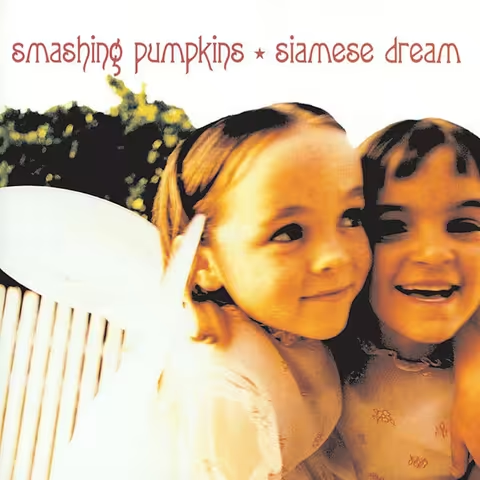
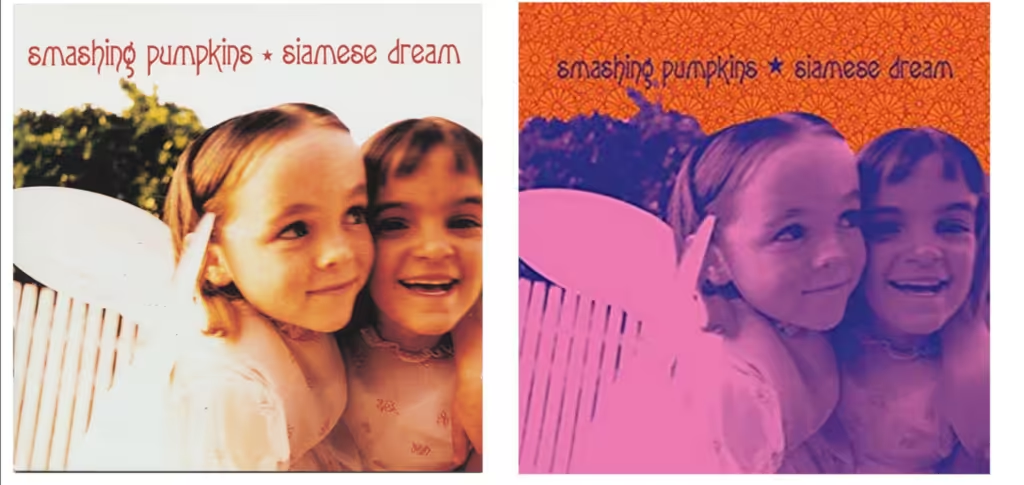
The cover is one of the most-recognised images of nineties alternative rock: two young girls in pale dresses and fairy wings, embracing cheek-to-cheek, photographed by Melodie McDaniel in soft natural light. The image reads as nostalgic and tender in a way most contemporary alternative-rock sleeves were not, and the contrast with the album's lyrical content (suicide, family trauma, broken relationships) is part of what gives the package its identity.
The original commission for the artwork had gone to an outsider artist whose work Corgan admired; disagreements between Corgan and Virgin's art department killed the concept late in the process and Corgan was left to scramble a replacement. Working with McDaniel and child models from a California agency, he settled on two girls who had never met each other before the shoot. Their names are Ali Laenger and Lysandra Roberts; Laenger has since described the shoot as "the ultimate childhood dream day" and recalled the two of them spending the session eating Lemonheads and rocket popsicles. They are not twins, not sisters, not related at all; the title Siamese Dream is poetic, not literal.
The first-pressing CD booklet was a separate effort. Twenty pages long, with old photographs of strangers and of Corgan's own family members on each spread with the relevant song's lyrics hand-written over the top, the booklet was assembled by Corgan and his then-wife the day after their wedding. Corgan has said since that he was not satisfied with the result; Virgin replaced it with a cheaper four-panel fold-out in later pressings, then restored the original twenty-page booklet for the 1999 reissue.
The cover-girl mystery became its own subplot in the band's history. For most of the nineties and 2000s nobody publicly knew who the two girls were. In 2007, after the Pumpkins reformed, Corgan posted a tongue-in-cheek search notice on the band's blog asking for information; in February 2011 he sent a Twitter post claiming the band's then-new bassist Nicole Fiorentino had just told him she was one of the girls. Rolling Stone established within days that Fiorentino was almost a decade too old to have been on the cover and the claim was a publicity prank. Laenger and Roberts were eventually traced by an independent fan researcher, and in 2018 were reunited in person for a promotional video announcing the band's Shiny and Oh So Bright reunion tour.
Release and Reception
The album was released in the UK on 19 July 1993 and in the US a week later on 27 July. It debuted at number 10 on the Billboard 200, peaked at number 4 in the UK, number 3 in both Canada and New Zealand, and number 7 in Australia. It went Gold in the US within months, Platinum in 1994 and finished at 4x Platinum on the strength of an unusually long tail driven by sustained radio rotation and the album's late-cycle UK singles. The German GfK chart was the outlier (peak 64); everywhere else it was a top-thirty record. The "Mayonaise" single release for the 30th anniversary in 2023 pushed the album back into multiple territory charts thirty years on.
Contemporary reviews were close to unanimous. Select gave it five stars and called it "the most grand-scale, expansively-passionate blasts of music you'll hear this year". NME's John Harris filed an 8/10. Q awarded four stars. Kerrang! awarded 4/5. Vox gave it 9/10. The dissents were mild and predictable: Simon Reynolds in The New York Times found it "fuzzed-up riffs and angst-wracked vocals... lacks the zeitgeist-defining edge that made Nirvana's breakthrough so thrilling and resonant"; Robert Christgau awarded a three-star "honorable mention" but praised the sonics. Entertainment Weekly's David Browne wrote one of the lines that defined the album's contemporary reception:
"In aiming for more than just another alternative guitar record, Smashing Pumpkins may have stumbled upon a whole new stance: slackers with a vision."
David Browne, Entertainment Weekly, August 1993
Lorraine Ali in Rolling Stone called the album "a strong, multidimensional extension of Gish that confirms that Smashing Pumpkins are neither sellouts nor one-offs". The Grammy Awards followed in early 1994 with two nominations for the band, for Best Alternative Music Performance (for the album) and Best Hard Rock Performance with Vocal (for "Cherub Rock"). They lost both, the alternative award going to Nirvana's In Utero.
The retrospective reappraisal has only inflated the album's standing. Pitchfork awarded the 2011 reissue a perfect 10/10 (Ned Raggett) and the 30th-anniversary 2023 reissue a 9.1 (Jayson Greene). PopMatters awarded the deluxe edition 10/10. AllMusic's Greg Prato calls it "one of the finest alt-rock albums of all time" alongside Nevermind and Soundgarden's Superunknown. Rolling Stone has placed the album at 360 (2003), 362 (2012) and 341 (2020) on successive editions of its 500 Greatest Albums of All Time, and ranked it the 12th greatest grunge album of all time in 2019. Pitchfork ranked it 18th on its 1990s list; Spin ranked it 23rd. Metacritic's score for the deluxe edition is 96/100.
Singles and Music Videos
| Single | Released | Director | Chart / notes |
|---|---|---|---|
| Cherub Rock | 21 June 1993 | Kevin Kerslake | US Modern Rock 7; UK 31; Grammy nomination for Best Hard Rock Performance with Vocal |
| Today | 13 September 1993 | Stephane Sednaoui | US Modern Rock 4; UK 44; ice-cream-truck video became MTV staple |
| Disarm | 21 February 1994 | Jake Scott | UK 11; US Modern Rock 8; banned by the BBC from daytime radio and Top of the Pops |
| Rocket | 27 December 1994 | Jonathan Dayton and Valerie Faris | UK 96; modest US alt rotation; kids-build-a-rocket-ship video |
| Mayonaise | 2023 (30th anniversary) | Stephen Reedy (lyric video) | 30th-anniversary single release; previously a deep cut |
"Cherub Rock" was the album's opening salvo in every sense. The Kevin Kerslake video was deliberately lo-fi (the band performing in a forest clearing) and the song bit the major-label hand that fed it ("who wants honey, as long as there's some money") in its opening verses. The chart performance was solid rather than spectacular; the Grammy nomination did more for the band's profile than the radio peak did.
"Today" did the heavy lifting on the album's transition from indie act to mainstream proposition. Stephane Sednaoui's video (Corgan as a depressed ice-cream-truck driver who paints the truck rainbow colours and picks up dancers in the desert) was on heavy MTV rotation through autumn 1993 and into 1994. The song's underlying story is bleaker: Corgan wrote it on the morning he decided, on his own later account, not to take his own life, and the title-line refrain about today being the greatest day is sarcasm that hardened into something closer to an actual affirmation as the song took shape. It is one of the rare alt-rock singles whose contemporary commercial peak and retrospective critical standing both kept rising.
"Disarm" is the single that almost no contemporary radio thought would work and that turned into a top-twenty international hit. Strings and church bells over an acoustic-led arrangement, no distorted guitars, lyrics about parental abuse, and a chorus line ("the killer in me is the killer in you") that the BBC interpreted at the height of the James Bulger case as too violent for daytime play. The corporation banned the song from Top of the Pops and the lunchtime Radio 1 rotation; the single charted at number 11 in the UK anyway. Jake Scott's black-and-white video, with its floating-objects imagery and Corgan's half-painted face, became one of the band's most enduring visual statements.
"Rocket" closed out the singles cycle in late 1994. Jonathan Dayton and Valerie Faris (who would later direct Little Miss Sunshine) made the video, a charming sci-fi piece about a gang of kids building a rocket in a barn to find the Pumpkins on another planet. By release the band were already deep into Mellon Collie writing and the promotional push was minimal; the single underperformed and was the only Siamese Dream release that did. "Mayonaise" finally got its own single release in 2023 as the headline cut of the 30th-anniversary campaign, three decades after the album.
Touring and Live
The Pumpkins toured Siamese Dream for roughly eighteen months between July 1993 and the end of 1994. Highlights of the cycle:
- The Metro, Chicago, 14 August 1993: a sold-out hometown release show, later partially issued as part of the 2011 reissue's bonus DVD and the Vieuphoria home video
- European theatre run, autumn 1993, with the album already gold in several territories
- Saturday Night Live debut, October 1993, performing "Today" and "Cherub Rock"
- Headline slot on Lollapalooza 1994, taking the spot that had been informally earmarked for Nirvana before Kurt Cobain's death in April; Beastie Boys and The Breeders also high on the bill
- Reading Festival, August 1994: their first festival appearance back at the venue where Iha and Wretzky had broken up two years earlier
- Corgan's visual reinvention mid-cycle: head shaved, the silver "Zero" T-shirt that would become an iconic stage look
- End-of-cycle exhaustion: Corgan has said the band were "barely speaking" by the close of the Lollapalooza run
The Lollapalooza headline slot was the moment Siamese Dream's commercial momentum locked into something larger. The Pumpkins were taking the spot every alternative-rock writer had assumed Nirvana would occupy, in the same summer Cobain had died, and were following the Beasties' set every night with songs that on record had been studio constructions but live were arena-sized monsters. Live takes from the era (the Vieuphoria home video, the Metro DVD, the 1994 Reading bootlegs) document a band that had genuinely figured out how to play this music in a room of 25,000 people. The fact that they were not on speaking terms by the end of the cycle is part of why Mellon Collie took as long as it did to make.
In TV, Film and Media
- "Today" featured on the Watchmen (2009) film soundtrack during a key scene; the song's mood-juxtaposition is one of the soundtrack's signature moments
- "Today" used in season one of Netflix's Beef (2023) to instant social-media impact
- "Cherub Rock" playable in Guitar Hero III: Legends of Rock (2007) and also released as downloadable content for Rock Band
- "Disarm" featured on the soundtrack to the Spanish film Salto al vacio (1995)
- "Today" used in a US car-commercial campaign in the late 2000s, an unintentionally dark choice given the song's origins
- "Disarm" covered by a fictional band in the TV series Paradise City (2021)
- Music videos rotated heavily on MTV's 120 Minutes, Alternative Nation and the band's own brief appearance on Beavis and Butt-Head
Controversy and the Pavement Feud
Two contemporary controversies attached to Siamese Dream. The first was the BBC's Disarm ban, covered above; the second was the Pavement "Range Life" feud. In 1994 Pavement's Stephen Malkmus included the lines "out on tour with the Smashing Pumpkins / nature kids, they don't have no function" on Pavement's Crooked Rain, Crooked Rain. Corgan took it as a direct attack and is widely reported to have given Lollapalooza ' 94's organisers an ultimatum that the Pumpkins would not play if Pavement were also on the bill; Pavement were not on the bill. Malkmus has since said the lines were affectionate ribbing; Corgan was still publicly sniping at Pavement as late as 2010.
"It's rooted in jealousy. It shows true pettiness. It's like high school all over again."
Billy Corgan to Rolling Stone, on Pavement's "Range Life", 1994
The third semi-controversy was Courtney Love's long-running claim, repeated in print over the years, that most of Siamese Dream's lyrics were written about her. Corgan dated Love briefly before her relationship with Kurt Cobain, and has consistently said the songs were largely about his then-girlfriend (and short-lived later wife) Chris Fabian, from whom he had briefly separated during the writing. The claim is unverifiable; the lyrics are about Corgan more than they are about either woman.
Covers, Samples and Afterlife
Siamese Dream has been one of the most-covered alternative records of its era. Stevie Nicks performed "Landslide" with the Smashing Pumpkins more than once after they put their own version of her song on Pisces Iscariot. James Iha has played "Mayonaise" with multiple post-Pumpkins line-ups. Among other artists, Anberlin, Manchester Orchestra and Far covered "Disarm"; Catfish and the Bottlemen and Glassjaw have both put "Today" into live sets. The song's continued sync presence in film and TV soundtracks (Watchmen, Beef, multiple commercials) keeps it in rotation in a way that almost nothing else from the 1993 alternative-rock release calendar has matched.
Beyond direct covers, the album's production fingerprint is one of the most-imitated of the nineties. Silversun Pickups built much of their early-2000s career on a Siamese Dream guitar-stacking template; Muse, My Chemical Romance and various 2000s emo and alt-metal acts owe the layered-guitar wall to this record more directly than to any other single source. The closest spiritual descendant on the band's own label was probably Hum's You'd Prefer an Astronaut (1995), which lifted the Siamese Dream guitar approach almost wholesale.
Reissues, Remasters and Anniversaries
The major reissue cycle arrived in 2011, when Bob Ludwig remastered both Gish and Siamese Dream for a coordinated Deluxe Edition campaign. The Siamese Dream deluxe spans the original album on disc one and eighteen demos, rough mixes, BBC sessions and alternate takes on disc two (mastered by Evren Goknar), including the BBC session cover of Depeche Mode's "Never Let Me Down Again", the 1991 STP rehearsal demo, multiple Soundworks Chicago demos from 1992 and an instrumental mix of Soma that lets the guitar arrangement be heard in isolation. Some configurations of the 2011 reissue also include a DVD of the 14 August 1993 hometown release show at the Metro in Chicago, which is the cleanest official document of the album's tour period.
The 30th-anniversary cycle in 2023 was lower-key than the 2011 push and led with the long-overdue "Mayonaise" single release. Vinyl reissues have continued steadily across the 2010s and 2020s, with periodic 180-gram pressings that explicitly recreate the 1993 packaging for collectors who want the original sleeve dimensions and the original twenty-page CD booklet's layout faithfully translated to LP. A wooden box-set collectors' edition was released through HUT in the UK at the time of the original album, limited to 1,000 copies and now a serious collector's item, though it is not an official Virgin US release.
Legacy and Influence
The story after Siamese Dream is partly continuous success and partly a band running out of road. Mellon Collie and the Infinite Sadness arrived in 1995, spent four weeks at number 1, sold ten million copies in the US alone and yielded the band's commercial peak in "Bullet with Butterfly Wings", "1979" and "Tonight, Tonight". But the band that made it was already starting to come apart. Touring keyboardist Jonathan Melvoin died of a heroin overdose in July 1996 with Jimmy Chamberlin present; Chamberlin was fired the same week. Adore in 1998 was the electronics-and-balladry pivot that confounded the mainstream rock audience; Machina/The Machines of God in 2000 was the conceptual swan-song. D'arcy Wretzky left during Machina promotion; Corgan officially broke up the band in late 2000 with a farewell show at the Metro in Chicago, the same venue where the Siamese Dream tour had begun in 1993.
Siamese Dream's influence has only grown since. AllMusic puts it in a three-album frame with Nevermind and Superunknown as the defining alternative-rock studio achievements of the early-to-mid 1990s. Rolling Stone's continually-revised 500 Greatest Albums of All Time has placed it ever higher (360, 362, 341 in successive editions) and ranked it twelfth on its 50 Greatest Grunge Albums list in 2019. Pitchfork awarded it perfect or near-perfect scores in both 2011 and 2023 reissue reviews. The Shiny and Oh So Bright reunion tour in 2018, which brought Corgan, Iha and Chamberlin back into the same line-up for the first time since 2000, took its name from a Today lyric and built much of its set around Siamese Dream material.
"Smashing Pumpkins are neither sellouts nor one-offs."
Lorraine Ali, Rolling Stone review of Siamese Dream, September 1993
Thirty-three years on, that line still does the job. Siamese Dream is the record that closed the question of whether the Smashing Pumpkins were going to matter as an alternative-rock act and replaced it with the question of how big the band could plausibly get.
Things You Might Not Know
| Fact | Detail |
|---|---|
| The mix took 36 days, not 14 | Alan Moulder booked two weeks to mix the album in the UK after Vig and Corgan declared themselves too exhausted to do it. The mix ended up taking thirty-six days; the album finished four months and $250,000 over budget. |
| Mike Mills of R.E.M. plays piano on Soma | Quiet favour-credit by one of the era's other major songwriters; one of the few additional-musician credits on the album. |
| Up to 40 guitar overdubs on Soma alone | Per Corgan; Vig has said elsewhere on the record up to 100 guitar parts were compressed into a single song. Vig had to draw a hand-written map on the back of a recording sheet to keep track. |
| Cherub Rock's drum part was tracked until Chamberlin's hands bled | According to Vig, Corgan "put the hammer down" after one of Chamberlin's two- or three-day drug binges and had the drummer play the part to its end. |
| The Bulger case got Disarm banned by the BBC | The corporation interpreted the "cut that little child" lyric as too violent at the height of the 1993 James Bulger murder coverage. The song still hit number 11 in the UK. |
| Iha and Wretzky broke up at Reading '92 | The couple had been quietly dating since the band's first year. They split at the August 1992 Reading Festival and finished the Gish tour and most of the Siamese Dream sessions barely speaking to each other. |
| Spaceboy is about Billy's half-brother Jesse | "Spaceboy" was Jesse Corgan's childhood nickname. Jesse was born with mild cerebral palsy and Tourette syndrome; the song is one of Corgan's most personal lyrics on the record. |
| Mayonaise has no hidden meaning | Corgan has said the title was effectively pulled from the fridge during the sessions when a working title was needed. He has joked that he has spent more time explaining the title than they spent writing it. |
| The album booklet was assembled the day after Corgan's wedding | The first-pressing twenty-page CD booklet was put together by Corgan and his then-wife the day after their wedding. Corgan was not happy with the result; the original booklet was restored on the 1999 reissue. |
| Pisces Iscariot collected the leftovers | The B-sides and outtakes compilation released in October 1994 went Platinum in the US on the strength of Landslide and Frail and Bedazzled. It is essentially a second Siamese Dream-era album. |
| December is recorded but not on the album | The Pisces Iscariot bonus track Starla was a Siamese Dream-era contender that grew to nine minutes; multiple outtakes from the sessions surfaced on the 2011 reissue's bonus disc. |
| A wooden box-set edition exists but Virgin did not release it | The UK HUT pressing was repackaged in a numbered wooden box limited to 1,000 copies. The CD and booklet inside are genuine; the box itself is not an official Virgin or HUT release. |
The Riffology Podcast
Siamese Dream is the subject of episode RIFF075 of the Riffology podcast, embedded above this article and available on Apple Podcasts, Spotify, YouTube and every major podcast platform. Subscribe to follow along with the rest of the nineties alternative-rock cycle, including upcoming episodes on the records released either side of this one.
Comments