Green Day spent the back half of 1996 hiding from their own success. They had cancelled the European leg of the [Insomniac](/posts/the-making-of-insomniac-by-green-day/) tour, climbed off the arena treadmill, gone home to Berkeley, and then sat in their houses with more than three dozen new songs and absolutely no idea what to do with them. Nimrod is the record they made when they stopped pretending to be a pop-punk band and started behaving like one of those fidgety, restless, omnivorous American rock acts that put a surf instrumental, a ska number, an acoustic ballad with a string section and a sixty-nine-second hardcore blast on the same eighteen-track LP and dared anyone to call it a sell-out.
It was released on 14 October 1997, four months in the making at Conway Recording Studios in Hollywood, and it has been quietly hijacking funerals, school proms and Seinfeld retrospectives ever since. This is the story of how three Berkeley punks talked Reprise into a sprawling, foosball-fuelled, Cockney-slang-titled record, hired Petra Haden of That Dog to play Middle Eastern violin on the lead single, sneaked the No Doubt horn section onto a song about cross-dressing, and then nearly burned down a Tower Records in Manhattan to prove they had not gone soft.
Album Facts
| Field | Detail |
|---|---|
| Artist | Green Day |
| Album | Nimrod (stylised as nimrod.) |
| Release Date | 14 October 1997 |
| Label | Reprise Records |
| Producers | Rob Cavallo and Green Day |
| Studio | Conway Recording Studios, Hollywood, California |
| Recorded | March to July 1997 |
| Genre | Punk rock, pop-punk, alternative rock |
| Track Count | 18 |
| Total Runtime | 49:01 |
| Billboard 200 Peak | 10 |
| UK Albums Chart Peak | 11 |
| Other Notable Peaks | Australia 3, Canada 4, Japan 7, Italy 15, Scotland 13, Germany 31 |
| Certifications | 2 x Platinum (US), 3 x Platinum (Australia), 4 x Platinum (Canada), Platinum (UK, Japan), Gold (Brazil, New Zealand, Spain) |
| First-Week US Sales | 81,000 copies; 70 weeks on Billboard 200 |
| Key Singles | Hitchin a Ride, Good Riddance (Time of Your Life), Redundant, Nice Guys Finish Last |
Where Green Day stood after Insomniac
The arithmetic that ended up driving Nimrod is straightforward and slightly sad. Dookie, in 1994, sold roughly twenty million copies worldwide and turned three Berkeley punks into the biggest band on commercial radio. Insomniac, in 1995, was darker, faster, more abrasive, and shifted comfortably more than two million copies in the United States, which would have been a career-defining number for any other band on the planet. To Reprise it looked like a slowdown. To Green Day it felt like the punishment for not making Dookie a second time.
"It did a lot better than I thought it was going to do," Billie Joe Armstrong told Billboards Craig Rosen of Insomniac in late 1997. "From the sound of it, we knew it wasnt going to sell as much as Dookie." That bit of resignation tells you almost everything about the headspace Nimrod came out of. The Insomniac tour put them on stages they had never wanted, in sheds and arenas built for bands twice their age, in front of audiences who only really knew Longview, Basket Case and When I Come Around. Armstrong said later they felt like they were "becoming the things we hated, playing those big arenas. It was beginning to be not fun anymore."
The cancelled European tour and the homesick winter
By autumn 1996 Mike Dirnt and Tre Cool had young families. Armstrong had a wife and a small child waiting in Oakland. The decision to bin off the European leg of the Insomniac tour was framed in interviews as homesickness, but it was also, candidly, an act of self-preservation. Green Day had spent two and a half years on the road as the most surveilled punk band in America, and they were starting to break.
What they did with the time off is the thing that really matters. Armstrong started writing on acoustic guitar, alone, at home, because he wanted the songs to survive without a wall of distortion holding them up. By the start of 1997 the band had more than thirty new songs in various states of demo, including straight-ahead pop-punk, surf instrumentals, attempts at ska, an Elvis Costello cover and a slow acoustic thing about a girlfriend who had joined the Peace Corps in 1993 and that he had sat on for four years.
Why they kept Rob Cavallo
Reprise would have happily put Green Day in a room with anybody after Insomniacs perceived underperformance. The band did not entertain it. Rob Cavallo had produced both Dookie and Insomniac, and although Insomniac had been a slog, the band described Cavallo as a "mentor" and refused to even discuss alternatives. He had earned a level of trust that no major-label executive could touch.
Cavallo had a sense of where they were heading too. He had been listening to demos throughout the homesick winter, and his read on the band, as he later told Spitz for Nobody Likes You, was that they were ready to make a record about doubt and texture rather than aggression. He encouraged the acoustic-first writing process. He did not push back when Armstrong said he wanted to put a hardcore song, a surf instrumental and an acoustic ballad on the same album. His main intervention, as it would turn out, was on the song he had been the least sure about three years earlier.
Inside Conway Recording Studios
Conway Recording Studios sits a few blocks south of Sunset Boulevard in Hollywood, a couple of converted bungalows tied together with a courtyard, a swimming pool, a lemon tree, and a control room sympathetic to mid-nineties analogue tracking. It was an upgrade on the rougher, faster, cheaper environments Green Day had used previously, and it gave Cavallo room to do the things Insomniac had not allowed time for: layered backing vocals, string overdubs, a horn session, the Petra Haden violin pass, the Armstrong harmonica he was learning on the fly.
Sessions ran from March to July 1997. The schedule was the part of the process the band consistently complained about: noon to two in the morning, six days a week, for four months. "There was a lot of glass," Armstrong said later, in reference to one of Tre Cools more memorable hotel-room incidents. "You have to live that arrogant lifestyle every now and then."
Ken Allardyce engineered the bulk of the tracking dates, with Tony Flores second-engineering, and a rotating support cast of Mike Dy, Barry Goldberg, Bill Kinsley and Wes Seidman covering overdubs and overflow. Mixing went, post-tracking, to Chris Lord-Alge, who gave Nimrod the bright, percussive, radio-shaped sheen that distinguishes it sonically from Insomniacs muddier mix.
The Sunset Marquis problem
Green Day stayed at the Sunset Marquis for the duration of the sessions, which is the kind of detail that sounds glamorous and was, in practice, a slow disaster. Four months in a Hollywood hotel with no families and a per-diem will do unpleasant things to a punk band. The drinking went up. So did the silliness. Dirnt later admitted that one night involved a member of the band wandering the corridors, naked, knocking on strangers doors. Cool threw his hotel television out of a window. The local press got bored of writing it up.
To stop the project actually collapsing, Cavallo brought in his father, Pat Magnarella, as on-the-ground supervisor and de facto manager. The arrangement was halfway between a babysitter and a producer of last resort, and it worked. Magnarella herded the band back into Conway when the foosball overran, fielded label calls, and kept Cavallo focused on the music rather than the logistics.
Acoustic guitars first: a new way of writing
The single most important production decision on Nimrod is the one that happened months before they reached Conway. Armstrong wrote almost everything on an acoustic guitar first. The faster, denser arrangements were built on top of those skeletons rather than the other way round. The point was to make sure each song could survive on melody alone before it got dressed up.
"To preserve the quality of his songwriting" was how the press kit phrased it. What it meant in practice was that Worry Rock could afford to sound like Elvis Costello, that Redundant could open on a chiming Byrds-style figure, that Good Riddance could be left almost completely undressed, and that even Take Back, the sixty-nine-second hardcore eruption near the back of the record, could be tracked at full volume without wobbling because the chord progression underneath it was robust enough to stand alone.
London Calling, Bikini Kill and the permission to sprawl
Two records dominate the conversation about Nimrods aesthetic permission slip. The first is The Clashs [London Calling](/posts/the-making-of-london-calling-by-the-clash/), which Armstrong invoked repeatedly in interviews as the model. He wanted a punk record where the rules of punk did not apply, the way reggae, rockabilly, lounge jazz and gospel had all sat on the same Clash double LP without anyone calling it a betrayal. "This is the record I have wanted to make since the band started," he told Spitz.
The second is Bikini Kills Reject All American, released in 1996, which Armstrong told Billboard taught him how to balance "rough punk rock songs" and "delicate pretty songs" on the same album without one undermining the other. The Bikini Kill influence is direct enough that Green Days song Reject takes its title from the Bikini Kill record, and uses the song to address everyone who had spent two years calling Green Day sell-outs.
The lineage of pop-leaning Californian punk that Green Day were both inheriting and pushing past in 1997 also runs straight through The Offspring. Their 1994 record [Smash](/posts/the-making-of-smash-by-the-offspring/) had hit the same arena trapdoor as Dookie a year earlier, and [Ixnay on the Hombre](/posts/the-making-of-ixnay-on-the-hombre-by-the-offspring/), released in February 1997, was wrestling with similar questions of where the genre could go next. You could draw a clean line between the experiments on [Ixnay on the Hombre](/posts/the-making-of-ixnay-on-the-hombre-by-the-offspring/) and the ones on Nimrod, although Green Day pushed further into actual genre tourism.
Bringing in the strings, horns and violins
For a band that had previously refused to put anything on tape that the three of them could not play live, the guest list on Nimrod is a small revolution. Petra Haden, of the Los Angeles indie group That Dog and a daughter of jazz bassist Charlie Haden, was brought in to play the slithering Middle-Eastern-tinged violin that opens Hitchin a Ride and the closing-credit motif on Last Ride In. Conan McCallum played the closer-miked, sweeter violin parts on Good Riddance. David Campbell, a veteran string and horn arranger and the father of Beck, wrote the charts.
For the ska number King for a Day they called Gabrial McNair and Stephen Bradley, the trombone-and-trumpet pair from No Doubts touring band, who were in the middle of the [Tragic Kingdom](/posts/the-making-of-tragic-kingdom-by-no-doubt/) victory lap. They added the same horn punctuation to Last Ride In. The cross-over between Green Days album and the ska-pop crossover that No Doubt were riding off [Tragic Kingdom](/posts/the-making-of-tragic-kingdom-by-no-doubt/) is direct, deliberate, and at the time slightly heretical for a Reprise pop-punk record.
Personnel and Credits
| Role | Player | Notes |
|---|---|---|
| Core band | ||
| Vocals, guitar, harmonica | Billie Joe Armstrong | Harmonica on Walking Alone, despite, by his own admission, not knowing how to play one |
| Bass, vocals | Mike Dirnt | Also credited with baseball bat on Desensitized (B-side) |
| Drums, bongos, tambourine | Tre Cool | |
| Guest and session musicians | ||
| Violin | Petra Haden | That Dog member; appears on Hitchin a Ride and Last Ride In |
| Violin | Conan McCallum | Lead violin on Good Riddance (Time of Your Life) |
| Trombone, trumpet | Gabrial McNair, Stephen Bradley | No Doubt horn section; play on King for a Day and Last Ride In |
| String and horn arrangements | David Campbell | Father of Beck; charted the orchestral overdubs |
| Production and engineering | ||
| Producers | Rob Cavallo, Green Day | Same production partnership as Dookie and Insomniac |
| Recording engineer | Ken Allardyce | |
| Second engineer | Tony Flores | |
| Additional second engineers | Mike Dy, Barry Goldberg, Bill Kinsley, Wes Seidman | |
| Mixing | Chris Lord-Alge | Mixed at Image Recording, Hollywood |
| On-site producer-manager | Pat Magnarella | Rob Cavallos father; brought in mid-sessions to keep the band on schedule |
| Guitar tech | Timmy Chunks | |
| Bass tech | Bill Schneider | Long-term Green Day tech and Pinhead Gunpowder member |
| Artwork | ||
| Photography | Snorri Brothers | |
| Photography, art direction, design | Chris Bilheimer | Friend of Armstrong; previously known for designing R.E.M. sleeves |
Tracklist
| # | Title | Writer(s) | Length | Single? | Notes |
|---|---|---|---|---|---|
| 1 | Nice Guys Finish Last | Armstrong / Green Day | 2:49 | Yes (1999) | Eases the transition from Insomniac territory; aimed at lawyers and managers |
| 2 | Hitchin a Ride | Armstrong / Green Day | 2:51 | Yes | Petra Haden violin intro; lyrically about staying sober |
| 3 | The Grouch | Armstrong / Green Day | 2:12 | No | Fear of "wasting away, getting fat, becoming impotent" |
| 4 | Redundant | Armstrong / Green Day | 3:17 | Yes | Byrds-style chiming guitars; about marital monotony |
| 5 | Scattered | Armstrong / Green Day | 3:02 | No | |
| 6 | All the Time | Armstrong / Green Day | 2:10 | No | |
| 7 | Worry Rock | Armstrong / Green Day | 2:27 | No | Compared to Elvis Costello; about Armstrongs marriage |
| 8 | Platypus (I Hate You) | Armstrong / Green Day | 2:21 | No | Cool: "some of the most punk songs we have ever done" |
| 9 | Uptight | Armstrong / Green Day | 3:04 | No | Subject is depression and references suicide |
| 10 | Last Ride In | Green Day | 3:47 | No | Surf-rock instrumental with horns and violin |
| 11 | Jinx | Armstrong / Green Day | 2:12 | No | |
| 12 | Haushinka | Armstrong / Green Day | 3:25 | No | |
| 13 | Walking Alone | Armstrong / Green Day | 2:45 | No | Armstrong harmonica; lyrics about old friends fading away |
| 14 | Reject | Armstrong / Green Day | 2:05 | No | Title taken from Bikini Kills Reject All American |
| 15 | Take Back | Armstrong / Green Day | 1:09 | No | Hardcore punk; "revenge and hurting someone when they least expect it" |
| 16 | King for a Day | Armstrong / Green Day | 3:13 | No | Ska number with No Doubt horns; lyrics narrate a cross-dresser |
| 17 | Good Riddance (Time of Your Life) | Armstrong / Green Day | 2:34 | Yes | Acoustic guitar, vocals and strings only; written 1993 |
| 18 | Prosthetic Head | Armstrong / Green Day | 3:38 | No | Closes the album; described as a "typical ticked-off kiss-off" |
Total runtime 49:01. All lyrics by Billie Joe Armstrong; all music credited to Green Day.
Hitchin a Ride, Nice Guys Finish Last and the singles strategy
Reprise opened with Hitchin a Ride on 29 September 1997, two weeks ahead of the album, and it was the right call. The song begins with twenty seconds of Petra Hadens violin doing its best snake-charmer impression, hits a Stray Cats-style upright bass figure, and then turns into one of the catchiest things Armstrong has ever written. It hit number twenty-five on the Modern Rock chart in the United States and became a permanent live fixture.
Nice Guys Finish Last was the closing single, almost eighteen months later, when the album was already platinum and Reprise wanted one last push. The song reaches back towards the angrier register of [Insomniac](/posts/the-making-of-insomniac-by-green-day/), full of contempt for industry types who think they know what is best for you, and acts on the album as a kind of bridge between where the band had been and where they were now going. The video features the band in American football uniforms being pummelled by what appear to be moderately bemused stadium employees.
Good Riddance: the song that was nearly a Dookie offcut
The song that ended up swallowing Nimrods cultural footprint whole was written in 1993, four years before the album it appeared on. Armstrong wrote it about a girlfriend who had broken up with him to join the Peace Corps, and he showed it to Cavallo and the band during the Dookie sessions. They binned it. It did not sound anything like Dookie, Cavallo had no idea what to do with the arrangement, and the band considered it too acoustic, too vulnerable, too tender for what they were trying to make.
Four years later, when Armstrong dragged it back out of the demo pile, Cavallo finally heard the move that would unlock it. He suggested adding strings, sent the band off to play foosball in another room, and tracked Conan McCallums violin and Campbells string arrangement in something between fifteen minutes and half an hour. "I knew we had done the right thing," Cavallo told Spitz later. "I knew it was a hit the second I heard it."
The cultural overshoot of Good Riddance is hard to overstate. It is a Green Day song that no longer really belongs to Green Day. It is a graduation song, a wedding song, a funeral song, the closer of countless high-school yearbook montages, and the soundtrack of choice for any television sequence that needs to telegraph the end of an era. It became the song that overshadowed every other Green Day song until American Idiot.
King for a Day, Last Ride In and the genre detours
King for a Day is the Nimrod track most likely to elicit a double-take from anybody whose Green Day knowledge stops at Dookie. It is full-bore, late-nineties, third-wave ska, with the No Doubt horn section punching upbeats and Armstrong telling the story of a cross-dresser whose family has just found out about him. Armstrong said in 1997 that he hoped "a bunch of macho fraternity guys" would sing along without realising what the lyric was actually about, and twenty-eight years later, that is more or less exactly what happens at every Green Day live show.
Last Ride In is the moment that puts the lie to any reading of Nimrod as a focus-grouped pivot to adult contemporary. It is a three-minute-forty-seven-second surf-rock instrumental, all reverbed twangy lead, Petra Haden violin and McNair-and-Bradley horn punctuations, and it sits in the middle of the album like an unexpected aside about how much Tre Cool likes Dick Dale. Nothing about its inclusion makes commercial sense, which is exactly why it is on the record.
Take Back, Platypus, Reject: the punk that survived
For everyone who insisted Green Day had abandoned the genre on Nimrod, the album answered three times in a row in the back third. Platypus (I Hate You) is two minutes and twenty-one seconds of pure, cheerful, articulate animosity directed at a specific person Armstrong has never named. "A vicious song about wanting to strangle someone I have deep animosity for," he told Kerrang in 1997, "and the pleasure of watching this person die." Pleasant.
Reject is the closest thing on Nimrod to a Bikini Kill homage, and it explicitly addresses the part of the punk audience that was loudly worrying about Green Days credibility. "We have moved on," Armstrong told Kerrang, "and are telling everyone who worries about such shit to fuck off." Take Back, the sixty-nine-second hardcore blast at track fifteen, is Green Days fastest, ugliest song since Dookies F.O.D. It is also the moment on the record that most clearly shows what they could still do if they wanted to. They did not, particularly, want to do it again. But they wanted you to know they could.
Walking Alone, The Grouch, Worry Rock: songwriting in adulthood
The Nimrod songs that have aged the strangest are the ones that are openly, undefendedly about being twenty-five and married and a bit terrified. The Grouch is a song about Armstrongs fear of "wasting away, getting fat, becoming impotent, and losing his ideals". Walking Alone has him reflecting on childhood friends who were drifting away, with the kicker that he was "too drunk to figure out they were fading away". Worry Rock is about the "vicious fights" inside his marriage. Redundant is about the way the spontaneity of an early relationship sours into routine.
None of these are subjects a 1990s pop-punk band was meant to be writing about. Green Day wrote about them anyway, on a major-label record, with a string section on standby, four years before American Idiot turned them into the most ambitious commercial rock band of the next decade. They are also the songs that explain why Nimrod has aged so much better than its 1997 reception suggested it would.
Cover art, the redacted booklet and Chris Bilheimer
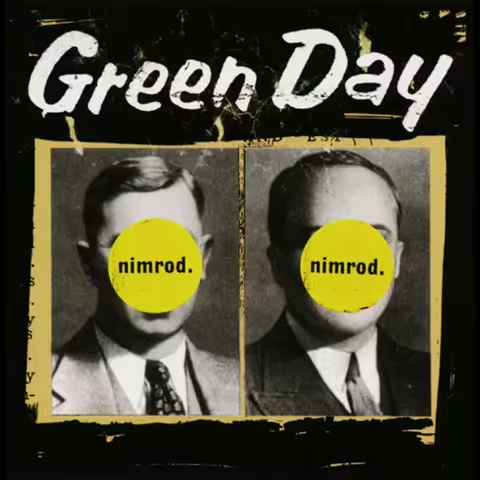
The artwork came together late and fast. Three art directors had already been rejected by the band, the pressing schedule was slipping, and Armstrong called in his friend Chris Bilheimer, a designer who had been doing sleeves for R.E.M. on Warner. Bilheimer had only the title to work with. He had recently seen a defaced political poster where the candidates face had been entirely removed, and that became the visual hook.
The front cover took two encyclopaedia photos of suited middle-aged men and stamped yellow "nimrod." circles over their faces. The back cover did the same trick with a 1950s American yearbook page Bilheimer had picked up in a Los Angeles bookstore, "from the era of the Leave It to Beaver idyllic America". The booklet presents the lyrics as if they were a redacted classified document, with thick black bars across them, "so they seemed like they were part of something else". It is the most sustained piece of art-direction conceptual work Green Day had ever put on a record. Sharp-eyed fans can spot Armstrong, Cool and Dirnt themselves hidden among the yearbook headshots on the back cover.
The title and the Bugs Bunny lineage
The American slang sense of "nimrod" as a clueless idiot is, by linguistic consensus, almost entirely Bugs Bunnys fault. The biblical Nimrod was a hunter, and at some point in the Looney Tunes shorts of the 1940s and 50s, Bugs began sarcastically using the name to describe Elmer Fudd, a hopeless hunter. The audience missed the joke, took the word at face value as an insult, and within a couple of generations the dictionary had to add the secondary meaning. Green Day picked the title because it carried both senses at once: the biblical hunter and the self-deprecating idiot. As Armstrong told NY Rocks Gabriella Schleinkofer in 1998, the band saw themselves as both.
Singles, B-sides and music videos
| Single | Released | Notable Chart Peaks | B-sides / extras | Video director |
|---|---|---|---|---|
| Hitchin a Ride | 29 September 1997 | US Modern Rock 25; UK 25 | Espionage (instrumental) | Mark Kohr |
| Good Riddance (Time of Your Life) | 2 December 1997 | US Modern Rock 11; US Hot 100 Airplay-charting; UK 11 | Desensitized; Rotting | Mark Kohr |
| Redundant | 15 April 1998 | US Modern Rock 30; UK 27 | Suffocate; You Lied; Do Da Da | Evan Bernard |
| Nice Guys Finish Last | 23 March 1999 | US Modern Rock 21; UK 36 | Evan Bernard |
The Mark Kohr-directed Good Riddance video is one of the more cinematic Green Day clips, all fairy-light close-ups of strangers tagged with intercuts of the band, but the song really did most of its cultural lifting through synchronised television placements rather than the music video itself.
Release, charts and certifications
Nimrod arrived on 14 October 1997 and debuted at number ten on the Billboard 200, shifting 81,000 units in its first week and going on to spend seventy weeks on the chart. It peaked at four in Canada, three in Australia, eleven in the United Kingdom, seven in Japan, fifteen in Italy and thirteen on the Scottish albums chart. It is, on those numbers, a hit; it is also, in proportion to Dookie, a smaller hit, and the press took its place fairly quickly in writing the apparently inexorable decline of Green Day. They were wrong, but it took American Idiot to embarrass them about it.
The certifications, with hindsight, tell the longer story. The RIAA gave Nimrod double platinum on 16 March 2000, and the album has sat there ever since. Music Canada has it at four times platinum. ARIA in Australia certified it triple platinum. The BPI has it platinum. Even now, on streaming, Good Riddance and Hitchin a Ride pull catalogue numbers that make most contemporary singles look quiet.
Critical reception then and now
The 1997 reviews were warmer than Green Day expected, and warmer than the band themselves remember. Greg Kot in Rolling Stone gave Nimrod three and a half stars and praised "a measure of sincerity in Armstrongs vocals". He noted approvingly that "this music is a long way from Green Days apprenticeship at the Gilman Street punk clubs, in Berkeley, California. But now that the band has seen the world, it is only fitting that Green Day should finally make an album that sounds as if it has."
"This is a record we have been thinking about for the past six years. We knew we wanted to change, but we did not want to change too much too soon. The records about vulnerability in a lot of ways, throwing yourself out there. Why the fuck not put out that fucking stupid acoustic song or that stupid surf song? This is who we are. Why hide it?"
Billie Joe Armstrong, November 1997, in conversation with The Denver Posts Greg Brown
AllMusics Stephen Thomas Erlewine awarded three and a half stars and called it "an invigorating, if occasionally frustrating listen", flagging Armstrongs "gift for hooky, instantly memorable melodies" but warning that "the eighteen tracks whip by at such a breakneck speed that it leaves you somewhat dazed". Sandy Masuo in the Los Angeles Times celebrated the "mature songwriting that really makes this album tick". Pitchfork gave it 7.0 out of 10. Spin gave it 6 out of 10. NME, in a kicking-while-down move that has not aged well, gave it 5 out of 10.
The retrospective evaluation has been kinder. Alternative Press now treats Nimrod as the moment Green Day "ripped up their own rulebook". Treble called it the band "at their most authentically eclectic". Kerrang has put it inside its forty-best-punk-albums list. Entertainment Weekly published a 2017 anniversary piece calling it "Green Days unsung masterpiece", which is very nearly correct.
The Tower Records riot and the Nimrod tour
The Nimrod promotional tour opened on 11 November 1997 with an in-store performance and signing at the Tower Records on Broadway in Manhattan, in front of around 1,400 fans. The band were already irritated by reviews suggesting they had lost their punk edge, and the show, which was meant to last eight songs, escalated into an actual riot. Armstrong wrote "fuck" and "nimrod" in black spray paint on the storefront windows and mooned the crowd. Cool launched his bass drum off the stage and into the audience. Armstrong tried to do the same with a stage monitor and was wrestled out of it by a Tower manager. No charges were filed, no injuries were reported, the store was closed for the day to repair the damage, and the legend wrote itself.
The proper tour that followed was the opposite of the Insomniac arena run. They played theatres rather than sheds. They refused, deliberately, to bring out a horn section or a violinist, on the principle that the album was the album and the live show was the live show. "We do not want to bring a horn section or a violin player out with us," Armstrong told CMJ. "A lot of people want to hear the old stuff, and that stuff is still just as significant to us." The Nimrod tour also marked the first time Green Day pulled audience members onstage to play instruments, a ritual that has now been a fixture of every tour since.
One incident on the tour leg has not aged well, and is worth recording precisely because it is part of the records history. At the 1998 KROQ Weenie Roast in Irvine, California, Third Eye Blind bassist Arion Salazar ran onstage and bear-hugged Mike Dirnt mid-set as a stunt, which spiralled into a backstage argument later that night. While the two were arguing, a beer bottle, thrown by a Third Eye Blind fan, struck Dirnt in the head and caused a small fracture in his skull. Salazar publicly apologised; Dirnt recovered.
Cultural afterlife: Seinfeld, ER, Deadpool and Wolverine
Good Riddance soundtracks a cancer-patient death scene on ER. It closes the penultimate Seinfeld episode in May 1998, the famous fictional retrospective montage, and is forever soldered to that broadcast in the American cultural memory. It plays over the X-Men blooper reel during the credits of 2024s Deadpool & Wolverine, the kind of placement that exists specifically because the cue is so familiar that it does not need explaining. It has scored more graduation montages than anybody can count, more wedding-procession videos than is reasonable, and at least one well-publicised funeral every couple of years.
King for a Day has had its own afterlife as a live-show anchor, where Green Day routinely extend it into a fifteen-minute medley that drops in everything from Stand by Me to the Isley Brothers Shout. Hitchin a Ride is the most reliable live opener in the bands catalogue. Even Prosthetic Head, which closes the album, has been recycled as a King of the Hill cue in a 1997 episode.
The 25th Anniversary edition and the lost songs
On 27 January 2023, Reprise issued Nimrod 25, a remastered version of the original eighteen-track album with two extra discs. The first contains thirty-three previously unreleased tracks, including a demo called "You Irritate Me" trailed in October 2022, an Elvis Costello cover ("Alison") trailed in January 2023, and a demo titled "Black Eyeliner" whose pre-chorus Armstrong later salvaged for the song "Church on Sunday" on the next Green Day album, Warning, and whose chord progression he reused for "Kill Your Friends" on his side project The Longshot in 2018. The second bonus disc collects a 1997 Philadelphia live show in full.
The Nimrod 25 box set also gives a glimpse of how loose the original sessions were: Cool reportedly attempted a polka instrumental ("Tre Polka"), the band tracked a Ramones cover ("Chain Saw"), and there is an instrumental called "Espionage" that became, in its non-album form, the B-side of Hitchin a Ride. The 25th anniversary release is the closest thing the catalogue has to a definitive document of how much music Green Day were churning out in the homesick winter of 1996 and 1997.
Legacy and what Nimrod did to Green Day
The band have, in retrospect, treated Nimrod as the album that gave them permission to attempt American Idiot. The acoustic-first writing, the willingness to track a string section, the blending of genres on a single LP, the use of the album as a sequence of standalone songs rather than a unified statement: every one of those moves on Nimrod is rehearsed for the bigger move on the 2004 record. The path from Hitchin a Ride to Holiday is shorter than it looks.
The album also sits in a particular pocket of late-1990s pop-punk that almost no other band managed to occupy. The Offspring were trying similar tricks on Ixnay on the Hombre and Americana. No Doubt had crossed pop and ska on Tragic Kingdom. The acts immediately downstream of Green Day, Blink-182 most obviously, kept the pop-punk template tight rather than stretching it. Nimrod is the record that holds the door open between mass-market pop-punk and the more ambitious, omnivorous, genre-flexible American rock that defined the next decade. Without it, the line from [Dookie](/posts/green-day-dookie/) to American Idiot does not exist; with it, the line is suddenly so obvious it looks deliberate.
Things You Might Not Know
| Fact | Detail |
|---|---|
| Foosball strings | Rob Cavallo recorded the entire string section on Good Riddance in fifteen to thirty minutes while sending the band off to play foosball in another room. |
| Four-year-old reject | Armstrong wrote Good Riddance in 1993 and pitched it for Dookie; Cavallo and the band rejected it as too acoustic and too out of place. |
| The same ex-girlfriend | Good Riddance, She from Dookie, Whatsername from American Idiot and Amanda from Tre! are all about the same woman, who left Armstrong in 1993 to join the Peace Corps. |
| Not a hunter | The title nods to the biblical hunter Nimrod, but the slang sense was popularised by Bugs Bunny calling Elmer Fudd "nimrod" in 1940s Looney Tunes shorts. |
| Hidden in the artwork | Armstrong, Cool and Dirnt are all hidden among the 1950s yearbook photos on the back cover of the sleeve. |
| Belated cover art | Three art directors were rejected before Armstrong called in his R.E.M.-affiliated friend Chris Bilheimer with only the album title to work from. |
| Petra Hadens day job | Petra Haden, who plays violin on Hitchin a Ride and Last Ride In, was a member of Los Angeles indie band That Dog and is the daughter of jazz bassist Charlie Haden. |
| The Beck connection | String and horn arranger David Campbell, who wrote the Good Riddance and King for a Day charts, is Becks father. |
| Tower Records riot | The Nimrod promotional tour opened with a 1,400-strong in-store at the Manhattan Tower Records that descended into a riot, with Armstrong spray-painting "fuck" and "nimrod" on the windows. |
| Mike Dirnts skull | At the 1998 KROQ Weenie Roast, Dirnt sustained a small fracture to his skull from a beer bottle thrown by a Third Eye Blind fan during a backstage argument with their bassist. |
| The Bikini Kill homage | The Nimrod track Reject takes its title directly from Bikini Kills 1996 album Reject All American, which Armstrong cited as a key influence. |
| The producers father as babysitter | Cavallos father, Pat Magnarella, was brought in mid-sessions as a manager-of-last-resort to keep the band on schedule when the foosball and the Sunset Marquis began to outweigh the recording. |
| Reused riffs | The lost demo "Black Eyeliner" was raided twice: its pre-chorus turned up on Church on Sunday on Warning, and its chord progression became Kill Your Friends by Armstrongs side project The Longshot in 2018. |
| Harmonica he could not play | Armstrong plays the harmonica on Walking Alone despite, by his own admission, "not knowing how to play it at all". |
| The Trump shirt | In August 2023 the band reissued the Nimrod cover as a charity T-shirt, replacing the obscured suited men with the Donald Trump mug shot, with proceeds going to the 2023 Maui wildfire relief effort. |
Hear more on the Riffology podcast
Riffology is the podcast for people who think the best argument about a record is the one that runs an extra forty-five minutes after the kitchen lights go off. The hosts dig through albums like Nimrod week in and week out, alongside everything from [Nevermind](/posts/the-making-of-nevermind-by-nirvana/) to the latest releases nobody has heard of yet. Search for Riffology on Apple Podcasts, Spotify, Pocket Casts or wherever you get your podcasts, and join in.
Comments