Ron Nevison was hired to make Ozzy Osbourne sound expensive, and on no other Ozzy record has the price tag been quite so audible. The Ultimate Sin is the album where the man who invented British heavy metal was put through a glossy California rock-radio filter, came out at number six on the Billboard 200, sold two million copies, and was then quietly buried by the artist himself. By 2002 the original mix had been struck from the catalogue. By 2019 Ozzy was still calling it his least favourite record. It is the only Ozzy solo album where the singer's verdict on his own work is "I would like to remix it and do it better."
It is also the only Ozzy solo album to feature bassist Phil Soussan, the only one to feature the late Randy Castillo's first studio appearance, the second and last with Jake E. Lee on guitar, and the album that briefly rescued Ozzy commercially while permanently bruising his relationship with the long-suffering Bob Daisley. It produced his first ever Hot 100 single. It put Metallica on stage in front of arenas. And then, with the timing only Ozzy could manage, it disappeared.
Album Facts
| Field | Detail |
|---|---|
| Artist | Ozzy Osbourne |
| Album | The Ultimate Sin |
| Release Date | 27 January 1986 (US), 10 February 1986 (UK) |
| Label | CBS Associated (US), Epic (UK) |
| Producer(s) | Ron Nevison |
| Studio(s) | Townhouse, London; AIR, London; Studio Davout, Paris |
| Genre / Subgenre | Heavy metal, glam metal |
| Track Count | 9 |
| Total Runtime | 40:51 |
| Billboard 200 Peak | 6 |
| UK Albums Chart Peak | 8 |
| Other Notable Chart Peaks | Finland 3, Sweden 4, Norway 6, Canada 19, Germany 31, Australia 36 |
| Certifications | RIAA 2x Platinum (1994), Music Canada Platinum, BPI Silver, ARIA Gold |
| Estimated Sales | Over 2,000,000 worldwide |
| Key Singles | Shot in the Dark; The Ultimate Sin / Lightning Strikes |
Cultural Context: Heavy Metal at High Tide in 1986
The first three weeks of 1986 told you everything you needed to know about where heavy music was heading. Mainstream metal was about to outsell almost everything else in rock, and the bands defining the moment were not Black Sabbath and Deep Purple, the touchstones Ozzy had grown up on, but a younger, glossier, hairier set of acts being made for MTV. Bon Jovi were nine months from Slippery When Wet. Van Halen with new singer Sammy Hagar would land 5150 in March. Metallica had just delivered Master of Puppets to Elektra in California; the LP would arrive on 3 March 1986. Iron Maiden were finishing Somewhere in Time. Cinderella, Poison and Europe were preparing breakthrough records.
Into this landscape walked Ozzy Osbourne with a record that consciously chased radio. The drum sound on The Ultimate Sin is enormous and gated, the vocals are double-tracked and chorused, the guitars sit in the same shimmering mid-range you can hear on Heart's Heart and on Survivor's later records. None of that is accidental. It was the dominant production grammar of late-1985 American rock, and Ron Nevison, fresh from Heart and Jefferson Starship, was hired specifically to provide it.
The Band's Story Up to 1985
Ozzy had been a solo artist for six years and had spent at least four of them in some kind of crisis. Randy Rhoads's death in March 1982 had ended the original band; Bob Daisley and Lee Kerslake had been credited and uncredited and credited again across reissues; Tommy Aldridge and Rudy Sarzo had passed through; and Bark at the Moon in 1983 had introduced Jake E. Lee, the brilliant guitarist Sharon Osbourne had picked over a list of well-known competitors. Lee had also been promised writing credits and publishing royalties on Bark at the Moon and ended up with neither.
By the spring of 1985 Ozzy was, by his own description, physically and mentally trashed. On 1 April 1985 he checked into the Betty Ford Center in Rancho Mirage, California, for treatment for alcohol and drug dependency. He later joked to the Birmingham Mail that Sharon had told him it was a club where he would be taught to drink like a gentleman, and that he had asked Betty Ford herself where the bar was. The truth was less funny. He came out six weeks later with a deal already brewing in Los Angeles for the next album.
While Ozzy was in treatment, Jake E. Lee and Bob Daisley had been writing in Palm Springs. Drummer Jimmy DeGrasso, later of Y&T, Suicidal Tendencies and Megadeth, played on the demos. That early line-up did not survive. Ozzy had committed to a Black Sabbath reunion at Live Aid on 13 July 1985, the band's first live appearance with him in nearly seven years, and the Live Aid commitment plus a falling-out with Daisley pulled the new project apart. By the time recording began, DeGrasso and Daisley were out and Randy Castillo and Phil Soussan were in.
Pre-Production, Demos and the Killer of Giants Album That Almost Was
Lee had learned from Bark at the Moon. This time he refused to write a single bar of music until his publishing contract was on the table. "I refused to contribute anything until I had a contract in front of me guaranteeing my writing credit and publishing rights," he later told Blabbermouth. The contract appeared and the music followed, and Lee delivered what most fans now agree is some of the most underrated guitar of his career: the rhythmic shove of the title track, the wide cinematic phrases on Killer of Giants, the bluesy fire on Never Know Why.
Working on the early demos at SIR Studios in Hollywood, Lee, Daisley and DeGrasso sketched a record that even now exists only in fragments on collectors' tapes. Greg Chaisson, who would later play bass with Lee in Badlands, auditioned. Ozzy liked the playing but, in his words, did not feel Chaisson's image fit the band. Soussan, a London-born bassist who had played with Wildlife, Beggars and Thieves and others, got the job almost on the eve of recording.
The album already had a title. It was Killer of Giants, after the slow anti-nuclear ballad that Daisley and Lee had written together. At the last minute, after the sleeves were already in production planning, Ozzy decided The Ultimate Sin was the better hook. The change irritated some of the band, who felt Killer of Giants summed up the record's mood far better than the title-track lyric. The replacement painting Boris Vallejo would deliver, all swords, demons and bare flesh, was very much an Ultimate Sin cover, not a Killer of Giants one.
Creating the Album: Three Studios, One Producer, No Daisley
Recording began in mid-1985 and ran through the autumn at three studios. Townhouse, in Shepherd's Bush, London, was Virgin's flagship by then and had become famous for the gated reverb on Phil Collins's In the Air Tonight. AIR, founded by George Martin in Oxford Circus, gave the project its second London base. Studio Davout, on the other side of the Channel in Paris, picked up overdubs and mixing time when London availability ran out. Three studios for one record is not unusual for the mid-1980s; the band's previous album, Bark at the Moon, had used five.
Ron Nevison's brief was simple. Heart's Heart, which he had produced for Capitol, had just hit number one on the Billboard 200. CBS wanted that polish on Ozzy. Nevison engineered as well as produced, with Martin White and Richard Moakes as additional engineers. He made decisions on the fly that the band sometimes resisted. Castillo's drums went through the gated-reverb treatment that defined the era. The vocals were stacked and chorused. Mike Moran, a session keyboardist who had worked with Queen, George Harrison and the Bee Gees, was brought in to add the synth pads and sweeteners that would become one of the album's most divisive features.
Ozzy's verdict on the sessions, given to Rolling Stone for the Kory Grow piece in 2019, has not softened with time. "Ron Nevison didn't really do a great production job. The songs weren't bad, they were just put down weird. Everything felt and sounded the fucking same. There was no imagination." Lee, while less public about his frustrations, has noted in interviews that his guitar tone on the record is closer to the producer's vision than to his own.
"If there was ever an album I would like to remix and do better, it would be The Ultimate Sin."
Ozzy Osbourne, quoted in Rolling Stone, 2019
Personnel and Credits
| Role | Player | Notes |
|---|---|---|
| Core band | ||
| Lead vocals | Ozzy Osbourne | All tracks |
| Guitars | Jake E. Lee | Charvel and Strat-style instruments through Marshall |
| Bass | Phil Soussan | Co-wrote Shot in the Dark; only Ozzy studio album |
| Drums | Randy Castillo | First Ozzy studio album; remained until 1995 |
| Additional musicians | ||
| Keyboards, programming | Mike Moran | Pads and sweeteners across the record |
| Songwriting (lyrics) | ||
| Lyrics, uncredited on first pressing | Bob Daisley | Initial 500,000 US copies omitted credit; restored on later pressings |
| Lyrics and music | Ozzy Osbourne, Jake E. Lee | Eight of nine tracks |
| Lyrics and music, Shot in the Dark | Ozzy Osbourne, Phil Soussan | Sole non-Lee composition |
| Production and engineering | ||
| Producer, engineer | Ron Nevison | Heart, UFO, Survivor, Jefferson Starship |
| Additional engineers | Martin White, Richard Moakes | Townhouse and AIR sessions |
| Mastering (1995 reissue) | Brian Lee with Bob Ludwig | Edited Shot in the Dark to 4:16 |
| Artwork | ||
| Cover painting | Boris Vallejo | Specialist in fantasy and sword-and-sorcery imagery |
| Sleeve concept | Sharon Osbourne, management team | Final logo appearance until Scream in 2010 |
| Pre-production and demos (uncredited on final album) | ||
| Drums, demos | Jimmy DeGrasso | Replaced before sessions began |
| Bass auditionee | Greg Chaisson | Later joined Lee in Badlands |
The Songs: A Track-By-Track Walkthrough
The album leans hard on a small set of motifs. Almost every song is in a major or minor key with a strong chorus and a Lee guitar solo placed exactly where rock radio expected it. There are no acoustic interludes, no Diary-of-a-Madman epics. It is, by design, the most concise album Ozzy had made.
| # | Title | Writer(s) | Length | Single? | Notes |
|---|---|---|---|---|---|
| 1 | The Ultimate Sin | Osbourne, Lee, Daisley | 3:45 | Yes (US, 1986) | Anti-Cold-War title track, late-stage rename |
| 2 | Secret Loser | Osbourne, Lee, Daisley | 4:08 | Promo | Side-one rocker; live staple |
| 3 | Never Know Why | Osbourne, Lee, Daisley | 4:27 | No | Bluesy mid-tempo, Lee feature |
| 4 | Thank God for the Bomb | Osbourne, Lee, Daisley | 3:53 | No | Sardonic Cold-War lyric |
| 5 | Never | Osbourne, Lee, Daisley | 4:17 | No | Closes side one |
| 6 | Lightning Strikes | Osbourne, Lee, Daisley | 5:16 | Yes (Australia) | Storm-themed; later official video |
| 7 | Killer of Giants | Osbourne, Lee, Daisley | 5:41 | No | Anti-nuclear ballad; almost the album title |
| 8 | Fool Like You | Osbourne, Lee, Daisley | 5:18 | No | Mid-tempo break-up song |
| 9 | Shot in the Dark | Osbourne, Soussan | 4:16 / 4:28 | Yes (lead) | Reworked Wildlife song; only non-Lee track |
The opening title track is one of the album's better moments, a blunt galloping rocker built on a Lee riff that nods to early Iron Maiden. Daisley's lyric punctures the eighties self-help boom: "Tell me where it tells you in the bible / Thou shalt only think of yourself." Castillo's drums announce themselves immediately, gated and huge, and the chorus is one of the easiest singalongs Ozzy had ever recorded.
Secret Loser and Never Know Why play to the strengths of the line-up. Lee solos with a fluency he rarely got to display on Bark at the Moon, and Soussan's bass, far higher in the mix than Daisley's had been on previous records, drives both songs. Thank God for the Bomb is the album's strangest lyric, a cynical Cold-War reading that on later listens feels closer to Strangelove satire than to a serious anti-war statement.
The instrumental high point is Lightning Strikes, where Mike Moran's keyboard pads finally make sense and Lee plays the album's longest sustained solo. The song was issued as a single in Australia and given an official Andy Morahan-directed studio-performance video, since uploaded to Ozzy's official YouTube channel.
Killer of Giants is the moment the album touches greatness. Built around a slow Lee figure and an arrangement that lets the song breathe, its lyric is unambiguously anti-nuclear. The chorus runs: "Killer of giants threatens us all / Mountains of madness standing so tall / Rising so proudly, it has nowhere to fall." Daisley has said in later interviews that he considered it the strongest single piece of writing he ever did with Ozzy. The fact that it was almost the title track tells you how serious the band took it.
Closing the record is Shot in the Dark, the only track Lee did not co-write, and the song that made the album commercially. It originally belonged to a different band entirely.
The strange story of Shot in the Dark
Around 1983, a London band called Wildlife recorded a demo of a song Phil Soussan had written with Steve Overland, Chris Overland, Mark Booty and Bad Company drummer Simon Kirke. The demo was never released. When Soussan joined Ozzy's band a couple of years later, he and Ozzy reworked the song and Ozzy supplied new lyrics. The 1986 single credits only Soussan and Osbourne, but Steve Overland has argued in interviews since that the original Wildlife arrangement is largely intact, and that the Overland brothers ought to share writing credit. The Overland brothers' post-Wildlife AOR band, FM, eventually re-recorded their own version on the 2012 EP Only Foolin'.
Whatever the legalities, Shot in the Dark became Ozzy's first single ever to chart on the Billboard Hot 100, peaking at number 68 and at number ten on Mainstream Rock. The Andy Morahan-directed promo, played in heavy rotation on MTV from late February 1986, made Ozzy a regular MTV face for the first time since Bark at the Moon. The song's later disappearance from Ozzy compilations is a separate, equally messy story.
B-sides, Outtakes and the Tracks That Got Away
The Ultimate Sin singles cycle was thinner on B-side surprises than most Ozzy releases of the period. Shot in the Dark was paired with Rock 'n' Roll Rebel from Bark at the Moon. The 28 July 1986 The Ultimate Sin / Lightning Strikes double-A picked from album tracks, as did the territory-specific Lightning Strikes single in Australia. There were no exclusive non-album studio recordings.
What does survive on tape, mostly in collector hands, are alternate versions and demos with Jimmy DeGrasso on drums. The 1986 home video The Ultimate Ozzy, filmed at Kemper Arena in Kansas City on 1 April 1986, also captures live versions of every album track in their tour-fresh arrangements. Lee plays a 1958 Stratocaster on most of that footage; on the studio album he favoured Charvel-built superstrats.
- Demo recordings with Jimmy DeGrasso on drums, Lee and Daisley, taped at SIR Hollywood, summer 1985
- Greg Chaisson audition tapes, mid-1985, never officially released
- Wildlife's original Shot in the Dark demo, circa 1983, unreleased until referenced on FM's Only Foolin' EP in 2012
- Live performance tapes from the Kansas City filming on 1 April 1986, used for The Ultimate Ozzy home video
Album Artwork and Packaging
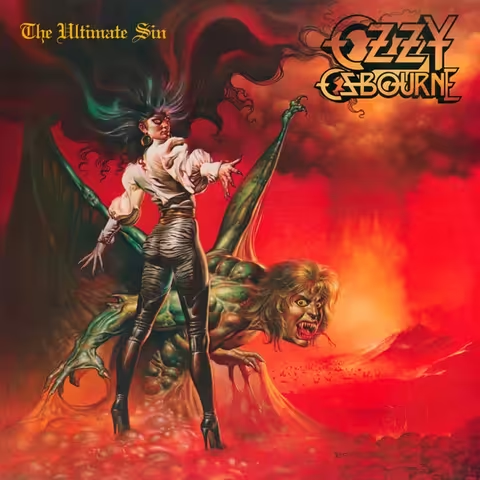
Boris Vallejo, the Peruvian-American fantasy painter best known for his Conan the Barbarian and Tarzan covers, was commissioned to produce the sleeve. The painting shows a sword-bearing angelic figure with feathered wings poised astride a horned demon, against a deep red sky scattered with bone-white moons. It is unsubtle and very 1986, an MTV-era reading of medieval iconography that fits the album's lyrical preoccupation with sin and judgment.
The reverse and inner sleeves carry the band photo, a moodily-lit black-and-white shot of the four-piece in studio leather. The Ozzy Osbourne logo on the front is the classic 1980 type design that had appeared on every record since Blizzard of Ozz; it would not appear again on a studio album cover until 2010's Scream. There were no significant territory-specific artwork variants, although the Japanese vinyl edition shipped with an obi strip and a translated lyric insert that has become collectable.
Release and Reception
The album was released on 27 January 1986 in the United States and on 10 February 1986 in the UK. The week of 22 February 1986 it entered the Billboard 200 at number 14 and rose to its peak of number 6 in early April. In the UK it reached number 8 on the Albums Chart on 16 February 1986. The RIAA awarded Platinum on 14 May 1986, just over four months after release; the BPI awarded Silver in April. Double Platinum followed in October 1994 once the 1995 reissue was being prepared.
Critically the response was mixed. Tim Holmes, writing for Rolling Stone in April 1986, gave the album a favourable review and singled out Lee's playing. AllMusic's Steve Huey, in his retrospective two-star verdict, was less generous, calling the production slick to a fault and arguing that the songwriting could not survive the gloss. Martin Popoff, in The Collector's Guide to Heavy Metal: Volume 2: The Eighties, scored the record six out of ten, a markedly higher mark than most retrospective takes.
For the band itself the chart success was tempered by the Daisley songwriting issue. The first 500,000 US pressings did not credit Bob Daisley for any of his lyrical contributions, despite his having written the bulk of them. The omission was rectified before the matter reached court but the legal sting lingered, and would resurface in the early 2000s when Daisley and Lee Kerslake sued the Osbournes over royalties on Blizzard of Ozz and Diary of a Madman.
Singles and Music Videos
| Single | Released | B-side | Director (video) | Chart highlights |
|---|---|---|---|---|
| Shot in the Dark | 20 January 1986 (UK) | Rock 'n' Roll Rebel | Andy Morahan | UK 20, US Hot 100 68, US Mainstream Rock 10, Ireland 15 |
| The Ultimate Sin / Lightning Strikes | 28 July 1986 | Pairing only | Andy Morahan (Lightning Strikes) | Promotional rotation; minor chart action |
| Lightning Strikes | 1986 (Australia) | The Ultimate Sin | Andy Morahan | Australia airplay |
Andy Morahan, then a rising name in British music video, would later direct major clips for George Michael, Wham!, Elton John and Prince. His Shot in the Dark video, a stalker-thriller miniature in low-light hotel corridors, ran in heavy MTV rotation from February 1986 onwards. The Lightning Strikes video is closer to a straight performance clip, lit in blue strobes against billowing smoke and intercut with on-stage footage from the early Ultimate Sin Tour rehearsals.
Touring and Live: The Ultimate Sin Tour
The Ultimate Sin Tour ran from March 1986 through the end of the year, taking the band through North America, Europe and Japan. The opening leg of the North American run paired Ozzy with Metallica, who were promoting the freshly-released Master of Puppets. It was Metallica's first arena tour as a national support act, and the dates put their album within reach of an audience several times the size of the clubs they had been playing.
That partnership ended in tragedy on 27 September 1986, when Metallica's tour bus crashed on a remote stretch of road outside Ljungby in southern Sweden during a separate European leg, killing bassist Cliff Burton. By that point the European arm of the Ultimate Sin Tour had moved on, with other support acts taking the slot. The North American shows that Ozzy and Metallica played together remain among the most-discussed double bills of the 1980s metal era.
The 1 April 1986 show at Kemper Arena in Kansas City was filmed and released later in the year as the home video The Ultimate Ozzy, the first official long-form Ozzy concert video. Phil Soussan toured every date of the cycle. By the time the road work was over in early 1987, internal frictions, particularly Lee's well-known habit of staying in his hotel room while the rest of the band socialised, had hardened into something terminal. In 1987 Sharon Osbourne dismissed Lee by telegram. He was not given a reason, and the next album, No Rest for the Wicked, would feature a young Zakk Wylde in his place.
- March 1986 to early autumn 1986: North America with Metallica supporting on the opening leg
- Spring 1986: European arena dates, including UK shows
- Late summer 1986: Japan and Pacific Rim
- 1 April 1986: Kemper Arena, Kansas City, Missouri (filmed for The Ultimate Ozzy)
- 13 July 1985: Black Sabbath reunion at Live Aid in Philadelphia, shortly before tour rehearsals began
In TV, Film and Media
The Ultimate Sin's songs were never as visible in film and television as Crazy Train or Mr. Crowley would later become. Shot in the Dark turned up on early-1990s VH1 and MTV nostalgia rotations, and the title track has been used in wrestling entrance music compilations. Killer of Giants featured on Wikipedia's reference list of anti-war songs and has been regularly cited in academic discussions of metal's Cold-War-era political writing. The 2019 reissue campaign brought renewed attention but no major sync placements.
Controversy, Censorship and Legal Trouble
The album collected an unusual amount of legal weather for a record that was never the subject of a formal censorship campaign. Daisley's missing songwriting credit on the first 500,000 US copies was settled out of court but generated bad blood that would echo for two decades. The Shot in the Dark authorship dispute has never been formally resolved; Steve Overland's claim, articulated in a 2015 interview with My Global Mind, that the Wildlife recording remains substantially the song Ozzy released, has not been answered with detailed counter-evidence by the writers credited on the single.
The most consequential legal fight, however, was about packaging rather than music. Sometime around 1995, when the original mix was withdrawn and replaced by the remaster, the writers' credits for Shot in the Dark became entangled in a separate Phil Soussan dispute over publishing on the song. By 2002 the entire album, in any form, was deleted from Ozzy's catalogue. As of late 2025 it remains unavailable as a new physical purchase, although streaming platforms continue to carry the 1995 remaster. Ozzy himself, talking to Rolling Stone in 2019, framed the deletion partly as commercial choice: the album had been double platinum, and it had been deleted, and that, he said, told you something.
Covers, Samples and Tributes
Few of the album's tracks have attracted the cover-version attention that Crazy Train, Mr. Crowley or Suicide Solution have received. Shot in the Dark has had the most coverage, with FM's 2012 Only Foolin' EP delivering the back-to-Wildlife reading the Overland brothers had wanted to record for nearly thirty years. Killer of Giants has been performed live by Last in Line, the Dio-alumni band that Phil Soussan joined in 2016, in arrangements that draw out its anti-nuclear lyric. There is no dedicated tribute album to The Ultimate Sin specifically, although tracks have featured on multi-album Ozzy tribute compilations released by smaller labels in the 2000s.
The album itself does not sample anything. Lee composed all his guitar parts from scratch, and the keyboard textures Mike Moran contributed are studio-built rather than borrowed. The song that has cast the longest shadow is, oddly, not on the record at all: Close My Eyes Forever, the 1989 Lita Ford duet with Ozzy that became the highest-charting single of his solo career, peaking at number eight on the Billboard Hot 100. It was reportedly sketched late one night in 1987 while Ozzy and Ford were both drunk on the post-Ultimate Sin touring cycle.
Reissues, Remasters and Anniversaries
The 1995 CD reissue, mastered by Brian Lee with Bob Ludwig, replaced the original 4:28 album mix of Shot in the Dark with the 4:16 single edit, a change that has irritated fans ever since. That reissue was deleted in 2002 and has not been replaced. The album's 1986 vinyl, the 1986 cassette and the original 1986 CD have therefore become the only sources of the unedited recording, and the original CDs in particular now sell for substantial sums.
Bob Daisley's missing songwriting credit was restored on early-1990s vinyl repressings before the 1995 remaster cycle began. Subsequent best-of compilations have been highly selective. The 2014 box set Memoirs of a Madman omitted Shot in the Dark entirely, and the 2017 The Essential Ozzy Osbourne also passes over it. The original 1997 release of The Ozzman Cometh did include it; the 2002 reissue replaced it with the previously-unreleased Miracle Man. There has been no fortieth-anniversary box set as of 2026.
- 1986: Original LP, CD and cassette, Shot in the Dark at 4:28
- Early 1990s: Vinyl repressings restore Daisley credit
- 1995: Brian Lee remaster with the 4:16 Shot in the Dark single edit
- 2002: Album deleted from Ozzy's catalogue
- 2019: Available again on streaming as part of catalogue clean-up
- 2026: Still no anniversary edition; physical remains out of print
Legacy and Influence
The Ultimate Sin sits awkwardly in the Ozzy discography. It was, at the time, his highest-charting solo album. It produced his first ever Hot 100 single. It was the first record to feature Randy Castillo, who would remain his drummer until the mid-1990s and whose loose, swinging feel would shape the next decade of records. It introduced Phil Soussan, who would never make another Ozzy studio album. And it ended his working relationship with Jake E. Lee, one of the most distinctive guitarists ever to play with him.
Critically it has spent forty years being damned with faint praise. Decibel's 2015 Justify Your Shitty Taste feature, by Adrien Begrand, made the case that Lee's playing alone justifies a re-evaluation. Loudwire's anniversary piece by Joe DiVita argued the album's commercial-glam orientation makes it a better representative of mid-1980s metal than the more cherished Bark at the Moon. Both writers concede that the production is the problem and the songs the buried treasure.
For musicians of the next generation, the album's reach is wider than its reputation suggests. Skid Row's Sebastian Bach has cited the album in interviews; Warrant's Jani Lane talked about Lee's playing in the early 1990s; the late-1980s wave of glam-leaning bands consistently nodded to Ozzy's mid-decade work. And by sending Metallica out as the support act on a national arena tour, the album indirectly accelerated the thrash crossover that would dominate the next half-decade of American metal.
Things You Might Not Know
| Fact | Detail |
|---|---|
| Working title | The album was set to be called Killer of Giants until Ozzy renamed it shortly before pressing. |
| Bob Daisley's missing credit | The first 500,000 US copies omitted his writing credit altogether; later pressings restored it before any case reached court. |
| Live Aid in the middle of writing | Ozzy interrupted pre-production to perform the Black Sabbath reunion at Live Aid on 13 July 1985 in Philadelphia, the band's first live appearance with him in nearly seven years. |
| Three studios, one producer | Townhouse and AIR in London plus Studio Davout in Paris all hosted parts of the recording, with Ron Nevison engineering as well as producing. |
| Boris Vallejo's classic-fantasy cover | The painter best known for his Conan covers delivered a sword-and-sorcery sleeve that became one of the most recognisable Ozzy images of the 1980s. |
| Greg Chaisson nearly got the bass gig | The future Badlands bassist auditioned but Ozzy felt his image did not fit; Chaisson would later reunite with Jake E. Lee in Badlands instead. |
| Jimmy DeGrasso on the demos | The future Y&T, Suicidal Tendencies and Megadeth drummer played on early Lee and Daisley demos before being replaced by Randy Castillo for the album sessions. |
| Shot in the Dark's hidden Wildlife origin | The album's biggest hit was originally written and demoed around 1983 by Soussan's previous band Wildlife, with the Overland brothers and Bad Company drummer Simon Kirke involved. |
| Mike Moran's invisible hand | The keyboard pads underneath every track came from a session player whose other 1980s credits include Queen, George Harrison and the Bee Gees. |
| First Ozzy single on the Hot 100 | Despite four albums of mainstream rock-radio play, Shot in the Dark was the first Osbourne solo single ever to chart on the Billboard Hot 100, peaking at number 68. |
| Metallica's arena breakthrough | The Ultimate Sin Tour opening leg put Metallica in front of arena audiences for the first time, as part of the Master of Puppets album campaign. |
| Jake E. Lee fired by telegram | In 1987, after the tour ended, Sharon Osbourne dismissed Lee by telegram with no stated reason; he learned the news from his guitar tech. |
| Ozzy's classic logo, last bow | The bat-and-sword Osbourne logo on the cover would not appear on another studio album sleeve until 2010's Scream, twenty-four years later. |
| Out of print since 1995, deleted in 2002 | The original 1986 mix has been unavailable as a new physical purchase since 1995, and the 1995 remaster was deleted in 2002, making the album unique in Ozzy's catalogue. |
| The album Ozzy hates the most | In a 2019 Rolling Stone interview, asked to name his least favourite solo album, Ozzy answered immediately: The Ultimate Sin. |
From the Riffology Podcast
The Riffology podcast spends entire episodes on this kind of record, the divisive ones the artists themselves disown but the fans never quite let go of. Look up Riffology on Apple Podcasts, Spotify, Pocket Casts, Overcast and YouTube to hear the hosts dig into the Killer of Giants and Ultimate Sin name change, the Shot in the Dark authorship row, and why a double-platinum album by the most famous heavy-metal singer in the world spent two decades quietly out of print.
Comments