
Introduction
In the mid-1990s, as the musical landscape was being reshaped by the rise of grunge and alternative rock, Slayer, the stalwarts of thrash metal, unleashed their sixth studio album, Divine Intervention. Released on September 27, 1994, the album marked a significant moment in the band’s storied career, not only for its musical content but also for the introduction of drummer Paul Bostaph. Despite facing challenges from emerging musical trends, Slayer’s commitment to their thrash roots shone through, resulting in an album that both reinforced and expanded their sonic palette.
This article will explore the genesis, recording process, commercial performance, and lasting legacy of Divine Intervention. We’ll delve into the creative forces behind the album, its critical reception, and its place in Slayer’s discography. Additionally, we’ll provide insights into the album’s cultural impact and how it has influenced both contemporaries and successors in the metal genre.
| Attribute | Details |
|---|---|
| Release date | September 27, 1994 |
| Album title | Divine Intervention |
| Genre | Thrash metal |
| Total runtime | 36:33 |
| Number of tracks | 10 |
| Record label | American Recordings |
| Recording studio | Ocean Way, Sound City |
| Producer(s) | Rick Rubin, Toby Wright |
Despite mixed reviews upon its release, Divine Intervention made a notable impact on the charts, peaking at number eight on the US Billboard 200. Its raw energy and thematic exploration of violence and existential dread ensured its place in the heavy metal canon. “Instead of doing something calculated like emulating Nirvana or Pearl Jam—or for that matter, Nine Inch Nails or Ministry—Slayer wisely refused to sound like anyone but Slayer,” noted AllMusic. Such determination to maintain their identity amid changing musical trends underscores the album’s enduring significance.
The Genesis of “Divine Intervention”
As the early 1990s progressed, Slayer found themselves at a crossroads. The musical environment was shifting rapidly, with grunge and alternative rock bands like Nirvana and Pearl Jam dominating the airwaves. Slayer, however, remained steadfast in their dedication to thrash metal, determined to evolve without sacrificing their core sound. Their previous album, Seasons in the Abyss, had cemented their status as thrash titans, and the band was eager to build on this legacy.
The departure of drummer Dave Lombardo in 1992 marked a significant change for the band. His replacement, Paul Bostaph, brought a new dynamic to Slayer’s sound. Bostaph’s precise and aggressive drumming style complemented the band’s ferocious energy, and his influence is evident throughout Divine Intervention. Guitarists Kerry King and Jeff Hanneman continued to spearhead the songwriting process, crafting intricate compositions that balanced speed with technical prowess.
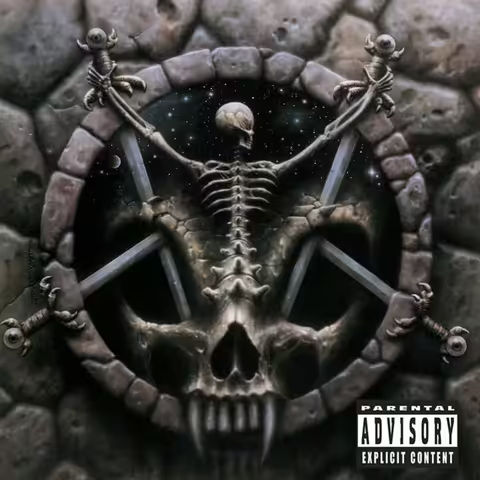
The album’s title, Divine Intervention, and its concept were deeply rooted in the band’s fascination with the darker aspects of human nature. The cover artwork, designed by Wes Benscoter, featured a striking reimagining of the band’s iconic “Slayergram” graphic, symbolizing the album’s thematic exploration of violence and chaos. The recording sessions took place at the renowned Ocean Way and Sound City studios, with production led by Toby Wright and executive producer Rick Rubin. The financial backing came from American Recordings, ensuring that the band had the resources needed to realize their artistic vision.
| Band Member | Instrument |
|---|---|
| Tom Araya | Bass, Vocals |
| Kerry King | Guitars |
| Jeff Hanneman | Guitars |
| Paul Bostaph | Drums |
The financial aspects of the album’s production were significant. American Recordings financed the project, providing a substantial budget that allowed the band to take their time in the studio. This financial support was crucial, as it enabled Slayer to experiment with their sound and ensure that the final product met their high standards. Despite the challenges posed by the changing musical landscape, Divine Intervention emerged as a testament to Slayer’s unwavering commitment to their craft.
Recording Process
The recording process for Divine Intervention was as intense and meticulous as the music itself. Spanning from March to June 1994, the sessions took place at two of Los Angeles’ most esteemed studios: Ocean Way and Sound City. These studios were chosen for their state-of-the-art equipment and acoustics, which were essential for capturing the raw energy and precision that defined Slayer’s sound.
Rick Rubin, serving as the executive producer, brought his minimalist approach to the project, emphasizing the band’s core elements. Toby Wright, known for his work with Alice In Chains and Metallica, handled the day-to-day production duties, ensuring that every note and beat was meticulously crafted. Engineers Sylvia Massy and Jim Scott were integral to the process, bringing their expertise to the mixing and mastering stages.
Ocean Way and Sound City were renowned for their high-quality recording capabilities. Although specific equipment details for Divine Intervention aren’t fully documented, it is likely that the studios’ legendary Neve consoles and a selection of vintage microphones and compressors were utilized. This assumption is based on the studios’ reputation and typical setups during that era.
| Equipment | Details |
|---|---|
| Mixing Console | Neve 8028 |
| Microphones | Assumed vintage Neumann, Shure |
| Compressors | Likely Urei 1176, LA-2A |
| Guitars | BC Rich, ESP |
| Drum Kit | Tama |
The recording sessions were not without their challenges. Integrating Paul Bostaph into the band was a notable hurdle, as his drumming style differed from that of his predecessor, Dave Lombardo. However, Bostaph’s precision and power ultimately added a new dimension to Slayer’s sound. The band also faced pressure to deliver an album that would satisfy both their fanbase and the expectations of the record label. Despite these challenges, the recording process was a success, resulting in an album that captured the essence of Slayer’s unyielding spirit.
Rick Rubin and Toby Wright’s contributions to Divine Intervention were part of a broader body of work that included numerous iconic albums. Rubin’s production discography is extensive, with highlights including Reign in Blood by Slayer and Master of Puppets by Metallica. Toby Wright, meanwhile, had made his mark with albums such as Dirt by Alice In Chains.
| Producer | Artist | Album | Year |
|---|---|---|---|
| Rick Rubin | Slayer | Reign in Blood | 1986 |
| Rick Rubin | Red Hot Chili Peppers | Blood Sugar Sex Magik | 1991 |
| Toby Wright | Alice In Chains | Dirt | 1992 |
| Toby Wright | Korn | Follow the Leader | 1998 |
Commercial Performance and Reception
Upon its release, Divine Intervention was met with both anticipation and skepticism. The album’s commercial performance, however, proved that Slayer still commanded a formidable presence in the music world. Debuting at number eight on the US Billboard 200, it marked the band’s highest chart position to date. In its first week, the album sold over 93,000 copies, a testament to the loyalty of Slayer’s fanbase and the band’s enduring appeal.
Despite its success on the charts, Divine Intervention received mixed reviews from critics. Some praised its relentless energy and thematic depth, while others critiqued its production quality and perceived lack of innovation compared to previous works. Nevertheless, the album’s raw intensity and commitment to thrash metal resonated with fans, solidifying its status as a key entry in Slayer’s discography.
| Album Title | Sales | Year Released |
|---|---|---|
| South of Heaven | 610,000 | 1988 |
| Seasons in the Abyss | 550,000 | 1990 |
| Divine Intervention | 550,000 | 1994 |
| Reign in Blood | 500,000 | 1986 |
| Decade of Aggression | 423,000 | 1991 |
The album was certified gold in the United States and Canada, reflecting its strong sales performance. It faced stiff competition from other significant releases in 1994, including Far Beyond Driven by Pantera and Youthanasia by Megadeth. While these albums also achieved commercial success, Divine Intervention stood out for its unflinching dedication to thrash metal during a time when many bands were exploring new directions.
Other albums released in 1994:
- Far Beyond Driven by Pantera [Physical Sales: 1 million]
- Youthanasia by Megadeth [Physical Sales: 500,000]
- Vitalogy by Pearl Jam [Physical Sales: 6 million]
- MTV Unplugged in New York by Nirvana [Physical Sales: 5 million]
Overall, Divine Intervention received a number of accolades, including a Grammy nomination for Best Metal Performance. Its recognition within the metal community further cemented its place as a vital part of Slayer’s legacy.
Singles and Track Analysis
The singles released from Divine Intervention played a crucial role in the album’s commercial success and helped to showcase the band’s musical evolution. “Dittohead” and “Serenity in Murder” were among the standout tracks, each demonstrating Slayer’s ability to balance speed and aggression with lyrical depth.
While “Dittohead” was released as a single, it did not chart, yet it became a fan favorite for its blistering pace and biting social commentary. “Serenity in Murder,” with its more melodic approach, highlighted the band’s versatility and garnered attention for its atmospheric qualities.
| Track Name | Length | Writing Credit |
|---|---|---|
| Killing Fields | 4:57 | King, Hanneman |
| Sex. Murder. Art. | 1:50 | King, Hanneman |
| Fictional Reality | 3:38 | King, Hanneman |
| Dittohead* | 2:31 | King |
| Divine Intervention | 5:33 | Hanneman |
| Circle Of Beliefs | 4:30 | King, Hanneman |
| SS-3 | 4:07 | Hanneman |
| Serenity In Murder* | 2:36 | King, Hanneman |
| 213 | 4:52 | Hanneman |
| Mind Control | 3:04 | King |
Note: Tracks marked with * were released as singles. “Dittohead” and “Serenity in Murder” were the album’s singles, although they did not chart significantly.
Each track on the album explores a different facet of the human experience, from the brutal realities of war in “Killing Fields” to the chilling narrative of “213,” inspired by the life of serial killer Jeffrey Dahmer. This thematic diversity, coupled with the band’s technical prowess, makes Divine Intervention a compelling listen for both long-time fans and newcomers to Slayer’s music.
Influences and Legacy
Divine Intervention stands as a testament to Slayer’s ability to draw from a wide array of influences while maintaining their unique identity. The album’s sound is rooted in the aggressive energy of early thrash metal, yet it also incorporates elements of progressive rock and hardcore punk, reflecting the band’s diverse musical interests.
Slayer’s influences during the creation of Divine Intervention included pioneering thrash bands like Metallica and Megadeth, as well as the darker themes explored by artists such as Black Sabbath. The album’s raw energy and thematic complexity have since inspired a new generation of metal musicians, including bands like Lamb of God and Slipknot, who have cited Slayer as a significant influence.
| Influences on “Divine Intervention” | Artists Influenced by “Divine Intervention” |
|---|---|
| Metallica | Lamb of God |
| Megadeth | Slipknot |
| Black Sabbath | Gojira |
Released in 1994, Divine Intervention emerged during a year marked by significant cultural and global events. The North American Free Trade Agreement (NAFTA) was established, altering economic dynamics across the continent. Meanwhile, the music world mourned the loss of Nirvana’s Kurt Cobain, whose death symbolized the end of an era for the grunge movement. In cinema, The Lion King and Forrest Gump captivated audiences worldwide, becoming cultural touchstones of the year.
Against this backdrop, Divine Intervention offered a sonic counterpoint to the prevailing trends, reinforcing Slayer’s position as one of the leading forces in metal. The album’s legacy continues to resonate, inspiring both established artists and emerging talents to explore the darker, more intense aspects of the genre.
Five Things about Divine Intervention
Divine Intervention is an album that holds a special place in Slayer’s discography, not only for its music but also for the stories and facts surrounding its creation. Here are five intriguing and verified facts about the album:
| Fact | Details |
|---|---|
| Drummer Debut | Paul Bostaph made his studio debut with Slayer on this album, replacing original drummer Dave Lombardo. |
| Artwork Controversy | The album cover, designed by Wes Benscoter, faced controversy for its graphic depiction of a fan carving “Slayer” into his arms. |
| Chart Success | Divine Intervention debuted at number eight on the US Billboard 200, marking Slayer’s highest chart position at the time. |
| Song Inspiration | The track “213” was inspired by the life of serial killer Jeffrey Dahmer, with the title referencing his apartment number. |
| Gold Certification | The album was certified gold in the United States and Canada, underscoring its commercial success. |
Media and Television Usage
While Slayer’s music has often been featured in various media, it appears that songs from Divine Intervention have not been prominently used in film or television. This lack of media usage does not detract from the album’s impact, as its influence is felt more strongly within the music community itself.
Unfortunately, we were unable to find any uses of songs from this album in known media.
Critical Reviews and Retrospectives
At the time of its release, Divine Intervention received a mixed reception from critics, a response that has evolved over the years. Many initial reviews focused on the album’s raw production and thematic intensity, while later assessments have highlighted its importance within Slayer’s discography.
Over time, critics have come to appreciate the album’s unyielding energy and the band’s commitment to their thrash metal roots. Retrospectives have noted its influence on subsequent generations of metal musicians, and it is now regarded as a key entry in Slayer’s oeuvre.
| Publication | Review Score | Notable Quote | Source |
|---|---|---|---|
| Dead End Follies | 8.5/10 | “Divine Intervention is a darker, more complex record that embodies the essence of extreme music.” | Dead End Follies |
| Encyclopaedia Metallum | 8.5/10 | “A strong addition to Slayer’s discography with only minor flaws.” | Encyclopaedia Metallum |
| MetalBite | 7.9/10 | “A return to Slayer’s roots, reminiscent of their earlier works.” | MetalBite |
After Divine Intervention
Following the release of Divine Intervention, Slayer continued to evolve, both musically and in terms of their lineup. The album’s success reaffirmed their status as leaders in the thrash metal genre, allowing them to explore new creative directions in subsequent projects.
Paul Bostaph’s integration into the band was solidified with the release of Undisputed Attitude in 1996, a collection of punk covers that showcased Slayer’s diverse influences. However, the band experienced further lineup changes in the following years, with Bostaph leaving and later returning to the fold.
As of October 2023, Slayer has officially retired from touring, following a farewell tour that celebrated their illustrious career. Despite their retirement from live performances, the band’s music continues to inspire and influence metal artists worldwide, ensuring that their legacy endures.
Remasters and Reissues
Since its original release, Divine Intervention has seen several remasters and reissues, ensuring its continued relevance in the metal community. These editions have provided fans with enhanced audio quality and additional content, offering a deeper insight into the album’s creation.
| Edition | Format | Release Date |
|---|---|---|
| Remastered Edition | CD, Digital | 2004 |
| 20th Anniversary Edition | Vinyl, Digital | 2014 |
These reissues have included bonus tracks and remastered audio, allowing both new listeners and long-time fans to experience the album in a fresh light. The continued interest in Divine Intervention highlights its enduring appeal and significance within Slayer’s body of work.
Conclusion
In conclusion, Divine Intervention remains a pivotal album in Slayer’s discography, representing a period of transition and reaffirmation for the band. Its raw energy, thematic complexity, and unwavering dedication to thrash metal have ensured its lasting impact on the genre. As Slayer’s legacy continues to inspire new generations of metal musicians, Divine Intervention stands as a testament to their enduring influence and commitment to their craft.
Further Reading
- The Making of South of Heaven by Slayer (Blog Article)
- The Making of Seasons In The Abyss by Slayer (Blog Article)
- Reign In Blood by Slayer (Blog Article)
- The Making of Divine Intervention by Slayer (Blog Article)
- Wikipedia page for “Divine Intervention”
- Official Slayer website
- American Recordings’ website
Let us know in the comments what your thoughts are on Divine Intervention by Slayer. Did we miss anything? Share your experiences and join the conversation!


Comments