Clandestine is the only Entombed album whose credited lead singer never set foot in the vocal booth. By the time the band rolled tape at Sunlight Studio in 1991, original vocalist Lars-Goran Petrov had been fired, his temporary replacement Orvar Safstrom had walked away after a single EP, and the man whose name would soon appear under "vocals" on the sleeve, Johnny Dordevic of Carnage, had not yet been asked to join. So drummer Nicke Andersson did what drummers occasionally do when the rest of the band runs out of options: he sat behind the kit, played a record, then walked across the room, stepped up to the microphone, and screamed every word himself.
The result is one of the strangest success stories in Swedish death metal. Where Left Hand Path had announced a sound, Clandestine had to defend it, and it did so with longer songs, sharper writing and the same Boss HM-2 buzzsaw tone that had already started to define a city. Released in Europe by Earache on 12 November 1991 and in North America by Relativity in February 1992, it is the album where a scene that had just learned how to make a noise figured out how to write a record around it.
Album at a glance
| Field | Detail |
|---|---|
| Artist | Entombed |
| Album | Clandestine |
| Release date | 12 November 1991 (Europe), 11 February 1992 (North America) |
| Label | Earache Records (Europe), Relativity Records (North America) |
| Producer | Tomas Skogsberg with Entombed |
| Studio | Sunlight Studio, Stockholm, Sweden |
| Genre | Death metal, Swedish death metal |
| Track count | 9 |
| Total runtime | 43:41 |
| Billboard 200 peak | Did not chart |
| UK Albums Chart peak | Did not chart |
| Other notable chart peaks | Cult success across European metal markets; no national chart placements |
| Certifications | None reported |
| Estimated sales | Not publicly reported |
| Key singles | "Stranger Aeons" (EP, 1992) |
Stockholm 1991: the scene that made the record
To understand Clandestine you have to understand the room. By the autumn of 1991, Sunlight Studio in Stockholm had become a kind of capital city for European death metal, a small commercial room turned engine room for a style that nobody outside the Swedish scene was building yet. Tomas Skogsberg had cut Left Hand Path there in 1990, Dismember had recorded Like an Ever Flowing Stream in the same room, and a queue of younger bands was already forming in the corridor. The signature ingredient was a guitar tone, the heavily distorted Boss HM-2 set with every knob to maximum, that allowed even a single guitar to fill the lower mids with what sounded like a chainsaw being run through a wall.
Outside the studio, 1991 was a banner year for heavy music in general. Metallica released its self-titled black album in August. Nirvana put out Nevermind in September. Guns N Roses unloaded both halves of Use Your Illusion two weeks before Clandestine arrived in shops. Death metal had its own internal calendar that ran in parallel: Morbid Angel had issued Blessed Are the Sick, Suffocation were finishing Effigy of the Forgotten, and Cannibal Corpse had just put out Butchered at Birth. Sweden was not the only place making this music, but it was the only place where every record made in town sounded as if it had come out of the same amplifier.
Clandestine arrived into that crowded marketplace with very specific work to do. Left Hand Path had been recognised almost immediately as a milestone, but milestones can also turn into millstones. A second album that simply repeated the trick would have started the conversation about whether the Sunlight sound was a sound or a gimmick. The record had to feel like a continuation and a step on at the same time.
The British weekly metal press, then the closest thing the genre had to a centre of critical gravity, was paying particular attention. Kerrang and Metal Hammer had treated Left Hand Path as a curiosity worth investigating; by late 1991 they were treating the second Entombed record as a litmus test for whether the Stockholm scene was a movement or a flash in the pan. The peer pressure was equally pointed from inside the city. Dismember had just put down a marker with their own Sunlight-produced debut, Unleashed were a year away from their first album for Century Media, and Therion were beginning to mutate out of straight death metal entirely. None of those bands was waiting politely for Entombed to set the pace a second time.
From Nihilist to Entombed: the road to Clandestine
Entombed did not start as Entombed. The band emerged from Nihilist, an earlier Stockholm outfit built around Andersson, Hellid and Cederlund that had been one of the first Swedish acts to commit the new HM-2 sound to tape on a series of late-1980s demos. Nihilist split in 1989 and the surviving members regrouped under the new name within weeks, retaining most of the material and almost all of the aesthetic. Petrov, who had been the voice of Nihilist, walked into Entombed by default.
Left Hand Path, released in June 1990, did the rest. The album sold well by the standards of any new Earache act, picked up unusually warm coverage in the British weekly metal press, and put Entombed on the road in support of acts whose audiences had never knowingly heard a Swedish death metal band before. The buzzsaw tone became a calling card, the Dan Seagrave cover became a familiar object on bedroom walls, and the band returned to Stockholm with a manifestly bigger audience than they had left it with.
They also returned with the tensions that early success tends to introduce. Petrov had been the public face of the band on tour, but inside the rehearsal room the working relationships had begun to fray. By early 1991 the disputes had passed the point where they could be resolved by another argument, and Petrov was out. He would, in time, come back, but not for this record.
Firing the singer: the line-up that walked into Sunlight
Losing a death metal vocalist between albums is rarely a catastrophe, because the role tends to attract local replacements quickly. The first candidate Entombed tried was Orvar Safstrom, who came in to handle vocals on the Crawl EP later that year. The session worked well enough for the record to be released, but Safstrom did not stay. By the time the band was ready to start the album proper, the vocal chair was empty again.
There was a more practical change in the same window. Where Left Hand Path had been recorded with no permanent bassist, with Andersson and Cederlund splitting the parts between them, the Clandestine sessions had a dedicated bass player for the first time in the form of Lars Rosenberg. The line-up that walked into Sunlight to make the album was therefore Andersson on drums, Cederlund and Hellid on guitars, and Rosenberg on bass. None of those four was, on paper, the singer.
The solution, when it came, was unromantic and obvious. Andersson knew the songs better than anyone, had written or co-written every line of lyric, and had a vocal range and grain that already sat naturally in the band. Rather than press-gang another auditionee through the door, he agreed to put down a guide vocal himself and see what happened. The guide vocals became the album vocals, and the band never replaced them. Andersson is the singer on every track of Clandestine. The fact that the sleeve does not say so is one of the most quietly unusual credits in the genre.
Inside Sunlight Studio: making Clandestine
Recording took place at Sunlight during 1991, with Tomas Skogsberg engineering and producing alongside the band. The toolbox was the same one that had built Left Hand Path. Two guitars running into HM-2 pedals with every knob pegged. Bass tuned low and pushed hard. Drums tracked live without click-track precision, with the natural drift of the take left in. Andersson tracked vocals last, often in single passes per song, working close to the microphone with a deliberately dry, in-the-room sound rather than the cathedral reverb that some American producers were starting to apply to similar material at the same time.
What changed, between the two records, was the writing. Clandestine has only nine tracks but runs nearly four minutes longer than Left Hand Path, an average song length that crept past four and a half minutes for the first time in the band's career. The compositions ask more of the players. Riffs are stacked into longer sequences. Tempos shift more often. There is more space inside the songs, more contrast between the wide-open mid-tempo grooves and the sudden double-time passages. Listened to back to back with the debut, the band sounds like a different ensemble: more rehearsed, more confident, less interested in just blowing a hole through the speaker.
Skogsberg's working method has always been about capturing what the band is actually playing rather than building a sound around them in the mix, and Clandestine is a particularly clean example of that approach. The room is the room. The guitar tone is the guitar tone, set on the floor with the pedals on the floor and not sweetened afterwards. The drums sound like drums in a small Swedish studio in 1991. The vocals sound like a man standing in front of a microphone, not a vocalist in a booth. That is partly an aesthetic choice and partly a budget reality, but the combination is what gives the album its peculiar physical presence.
Personnel and credits
The credit page of Clandestine is short, but two of its lines reward a second look. The vocalist named on the sleeve is not on the record. The bassist is on the record for the first time as a permanent member. Everything else, on paper, looks like the same band that made Left Hand Path eighteen months earlier.
| Role | Player | Notes |
|---|---|---|
| Core band on the record | ||
| Drums, all vocals | Nicke Andersson | Also art direction, logo and back cover; recorded every vocal on the album after the band failed to settle a permanent singer |
| Guitar, backing vocals | Uffe Cederlund | Co-writer on five of the nine tracks |
| Guitar | Alex Hellid | Sole holdover, with Andersson, from the earliest Nihilist line-up |
| Bass | Lars Rosenberg | First Entombed studio appearance as the permanent bass player |
| Credited but not on the album | ||
| Vocals (sleeve credit only) | Johnny Dordevic | Formerly of Carnage; recruited after recording to sing on the supporting tour and listed on the sleeve as the band vocalist; does not appear on the record |
| Production and engineering | ||
| Producer, engineer | Tomas Skogsberg | Sunlight Studio owner; the architect of the Stockholm death metal sound |
| Co-producer | Entombed | Credited collectively alongside Skogsberg |
| Songwriting contributors | ||
| Co-writer (three tracks) | Kenny Hakansson | Credited on "Stranger Aeons", "Chaos Breed" and "Through the Collonades" |
| Artwork | ||
| Cover art, art direction | Dan Seagrave | English painter; his second consecutive Entombed cover after Left Hand Path |
| Logo, back cover, art direction | Nicke Andersson | Continued the in-house visual involvement he had begun on Left Hand Path |
Cederlund's writing footprint expanded considerably between the two records. On Left Hand Path much of the material had carried over from Nihilist demos, with Andersson as the dominant author. On Clandestine, Cederlund is credited as co-writer on most of the album. The two of them, in effect, became the engine of the band's writing room.
Track by track: the nine songs
| # | Title | Writer(s) | Length | Single? | Notes |
|---|---|---|---|---|---|
| 1 | "Living Dead" | Andersson, Hellid | 4:26 | No | Album opener; sets out the longer-song template |
| 2 | "Sinners Bleed" | Andersson, Cederlund | 5:10 | No | Mid-album showcase for the new writing partnership |
| 3 | "Evilyn" | Andersson, Cederlund, Rosenberg | 5:05 | No | Only co-writing credit on the record for the new bass player |
| 4 | "Blessed Be" | Andersson, Cederlund, Hellid, Rosenberg | 4:46 | No | Only track on the album credited to all four members |
| 5 | "Stranger Aeons" | Andersson, Cederlund, Hakansson | 3:25 | Yes, EP 1992 | Title track of the 1992 EP; only music video from the record |
| 6 | "Chaos Breed" | Andersson, Cederlund, Hakansson | 4:52 | No | Second of the Hakansson co-writes |
| 7 | "Crawl" | Andersson | 6:13 | No | Re-recorded from the 1991 Crawl EP after Safstrom left; longest track on the album |
| 8 | "Severe Burns" | Andersson | 4:01 | No | Tightest and shortest of the Andersson sole compositions |
| 9 | "Through the Collonades" | Andersson, Hakansson | 5:39 | No | Closing track; sleeve misspelling of "Colonnades" preserved on every pressing |
"Living Dead" sets out the manifesto in its first thirty seconds. A long, almost rolling intro riff gives way to a vocal entry that is recognisably Andersson rather than Petrov, more chest-throated than throat-shredded, and the song spends nearly four and a half minutes finding ways to keep moving without ever falling back on the all-out blast that a less confident band would have reached for. It is a strikingly mature opener for a record by men in their early twenties. The two-guitar arrangement is also more visible here than on Left Hand Path: Hellid and Cederlund frequently sit on different lines underneath the riff, with one carrying the rhythmic engine and the other holding a longer-form harmonic shape across it, a technique they would lean on more heavily as the album goes on.
"Sinners Bleed" and "Evilyn" sit at the heart of the first side and show off the new four-piece configuration. Rosenberg's bass is audible as bass, not just as low-end thickening behind the guitars, and Cederlund's writing favours arrangements that move through three or four distinct sections rather than the riff-on-repeat structures the debut tended toward. "Blessed Be" is the one track credited to every member, a sign of how unusual collective writing was in this camp by 1991.
"Stranger Aeons" is the album's calling card. At three and a half minutes it is by far the shortest song on the record and arguably the most direct piece of writing on it, all hook and momentum. It was the obvious choice for a single, the obvious choice for the only video Entombed shot from the record, and remains one of the songs most reliably present in their live set. "Chaos Breed" picks up the title-flavour and the same Hakansson co-credit and plays the role of late-album battering ram.
"Crawl" is the album's emotional centre and its longest song. The version on Clandestine is a re-recording of the title cut from the 1991 Crawl EP, originally sung by Orvar Safstrom; with Safstrom out of the band, Andersson took the song into the studio again, re-recorded the vocal himself, and let it run to over six minutes. The slower middle section is the longest sustained piece of writing on the record and gives the album its name-check moment for the rock and roll instincts that would come to dominate Wolverine Blues two years later.
"Severe Burns" is the closest the album gets to old-school Nihilist directness, a four-minute Andersson sole composition that feels deliberately stripped back after the previous track's sprawl. "Through the Collonades" closes the record at five and a half minutes, ending not with a final blast but with one of Hellid's slower, more lapidary lead phrases. The sleeve misspelling of the title, "Collonades" for "Colonnades", has survived every pressing since, including the 2022 vinyl reissue.
Stranger Aeons and the Friday night session
Clandestine produced a single video and two related short-format releases, and the story behind both EPs is part of the record's character. The first, the Crawl EP, was issued in 1991 ahead of the album and is the only piece of recorded Entombed to feature Orvar Safstrom on vocals. When Safstrom left the band the song was re-cut for the album proper, which makes the EP, almost by accident, a small piece of vocal archaeology.
The second, the Stranger Aeons EP, followed in 1992 and packaged the album version of the title track with two new songs. The extra material was recorded in an unusually informal way: one Friday evening in November 1991, with only Andersson and Cederlund in the studio. Cederlund later recalled the session to Daniel Ekeroth for the book Swedish Death Metal:
"It was recorded during one Friday evening in November 1991, it was only Nicke and I in the studio, and I think it turned out pretty cool."
Uffe Cederlund, Swedish Death Metal by Daniel Ekeroth, Bazillion Points, 2008
That casual provenance fits the record's wider character. Clandestine is a careful album but it is not a glossy one, and the EP material around it carries the same hand-built feel. Even the album's signature single was promoted with a video shot in the deliberately unstaged style that the European metal press at the time treated as a virtue.
Dan Seagrave's painted nightmare: the cover
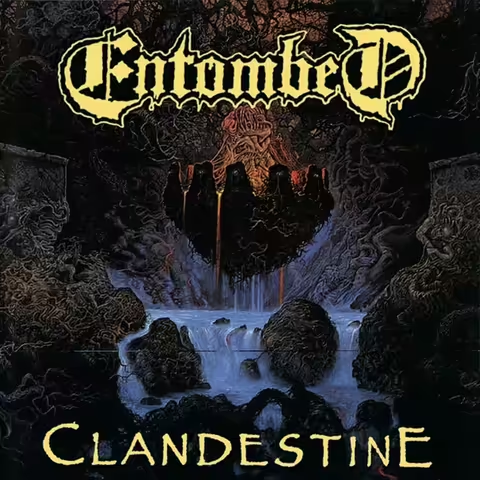
Dan Seagrave's painted Clandestine cover is one of the most quietly distinctive sleeves in the early death metal canon. Where Left Hand Path had used a cooler, blue-green underworld populated by hooded skeletal figures, Clandestine works in browns, ochres and dirty whites, a sand-coloured landscape of broken stonework and crumbling forms whose religious or architectural origin is left deliberately ambiguous. The eye keeps trying to resolve it into either a ruined cathedral or a buried catacomb and never quite settles on either.
Seagrave was, by 1991, the painter the European death metal scene wanted on its covers. He had already done Left Hand Path the year before, and his catalogue from that period reads like a checklist of the genre's milestones: Morbid Angel's Altars of Madness, Suffocation's Effigy of the Forgotten, Gorguts, Pestilence, Dismember. The reason bands kept commissioning him was not just the imagery but the texture: paintings that read clearly at twelve-inch vinyl size and still held their detail when shrunk to a CD booklet. The Clandestine cover is small enough to print on a tape spine and large enough to fill a wall poster.
Andersson handled the inside-the-sleeve visual decisions, as he had on Left Hand Path: logo placement, back cover layout, art direction. The result is a package in which the front is unmistakeably a Seagrave painting, the back is unmistakeably an Andersson layout, and the credits page does not bother explaining that the man named as the band's vocalist is not on the record.
Release and reception
Earache released Clandestine in Europe on 12 November 1991, with Relativity following in North America on 11 February 1992. The album did not enter the Billboard 200 and did not chart in the United Kingdom. That was no surprise: at the start of the 1990s, Earache was a dedicated underground label and even its more visible releases tended to live on the metal specialist racks rather than in the mainstream album charts. Sales were never publicly reported in detail, but the record was a steady seller through the early 1990s and helped fund the next two Entombed albums.
The critical reception was warm from the start and has grown warmer over time. AllMusic awarded the album four and a half stars out of five in its retrospective review by Jason Birchmeier, treating it as a genuine sophomore step up rather than a Left Hand Path retread. Martin Popoff gave it nine out of ten in his Collector's Guide to Heavy Metal. The European metal weeklies covered it as the second statement of a band that had already mattered.
The biggest single piece of critical canonisation came much later. In October 2016, Decibel Magazine inducted Clandestine into its Hall of Fame in a feature written by Greg Pratt, making it the second Entombed album in the Hall after Left Hand Path. Hall of Fame inductions are by their nature retrospective, but for a record that had spent twenty-five years as the slightly under-discussed middle entry between two more famous Entombed albums, the induction read as an overdue catch-up by the critical consensus.
On the road with a borrowed singer: the Clandestine tour
Touring an album whose lead vocals had been tracked by your drummer is awkward, because the drummer cannot sing them and play them at the same time. Entombed's solution was to bring in Johnny Dordevic, formerly of Carnage, as the touring vocalist. Dordevic had not played on the record, did not contribute to the writing, and was hired specifically to be the man at the front of the stage while Andersson stayed behind the kit doing what he did before he was a vocalist as well as a drummer.
The sleeve credit on Clandestine reflects that arrangement rather than the recording reality. Dordevic is listed under "vocals". To anyone who only ever heard the record, he was the singer. To anyone who actually attended one of the early-1990s Entombed tours, he was the singer. To anyone in the studio that year, he was not.
The supporting tour itself ran through Europe in 1992 and put the new line-up in front of audiences who had only ever heard the album with Andersson on the microphone. The line-up was not stable for long. Dordevic was out within months and Petrov, the original vocalist who had been fired before the album sessions, returned for Wolverine Blues in 1993. From a certain angle the entire Clandestine era reads as an interruption in Petrov's tenure: an album-shaped gap in the band's vocal history, plugged by a drummer who never wanted the job permanently.
The tour itself was shaped by the economic realities of early-1990s death metal touring. Earache routes through the period tended to bundle the label's roster onto small-club bills, with three or four bands sharing a van and a sound engineer between them; venues averaged a few hundred capacity and budgets ran on merchandise margins rather than ticket guarantees. Entombed were one of the first Swedish bands to break out of that ecosystem and onto support slots with larger international acts, a trajectory that would accelerate sharply once Wolverine Blues arrived. Clandestine, in retrospect, was the album that earned the band the right to travel with a crew rather than a transit.
Covers, samples and influence on others
Clandestine has not generated the catalogue of high-profile covers that Left Hand Path has, and that probably reflects the songs as much as the relative profile of the two records: the Clandestine material is longer, more arranged and harder for another band to cover in any way that adds value. There is no canonical Entombed-tribute version of "Stranger Aeons" the way there are several of "Left Hand Path". What the album has instead is influence at the level of sound and approach.
Several strands of the wider European extreme-metal landscape pick up directly from the Clandestine template. The longer, more arranged songs anticipate what bands like Edge of Sanity would do later in the decade. The willingness to let a single grooving mid-tempo riff carry a full verse rather than gunning straight for the blast beat helped pave the way for the bridge between Swedish death metal and the death-and-roll style that Entombed themselves would commit to on Wolverine Blues. The HM-2 tone, captured here at arguably its most fully realised, became a sonic shorthand that hardcore and crust bands well outside the original death metal scene would pick up two decades later.
- The album is regularly cited by members of acts like Nails, Black Breath and Trap Them when they discuss the HM-2 influence on contemporary hardcore.
- Clandestine and Left Hand Path are typically named together when retrospective lists nominate the foundational Stockholm records.
- The band's own subsequent move toward rock-and-roll structures on Wolverine Blues is widely traced back to the longer arrangements and groove-led passages on Clandestine.
For a record that never charted, Clandestine has had an unusually long sonic afterlife.
Reissues, remasters and the Hall of Fame
Clandestine has been reissued repeatedly since 1991, with formats moving in step with the wider catalogue economics of metal across the past three decades. The two most substantive packages are the 2008 Earache Records reissue, which paired the remastered album with a DVD as part of the label's Earache Classic Series, and the limited coloured-vinyl Full Dynamic Range pressing in 2022, which preserved the original mix and the original "Collonades" sleeve typo while improving the cut.
The Stranger Aeons EP from 1992 was reissued alongside the album on several occasions and has appeared as bonus material on later CD pressings. The Crawl EP, by contrast, is the rarest piece of the early Entombed discography on physical media, because it is the only widely-circulated recording featuring Orvar Safstrom on vocals and was never given a full reissue campaign in its own right.
The 2016 Decibel Hall of Fame induction was accompanied by a fresh round of new interviews with the band, in which the Petrov firing and the Andersson vocal switch were discussed in more detail than they had been at the time. By that point the cast of the album had largely settled into its retrospective shape: Andersson as the unexpected vocalist of record, Petrov as the singer who came back, Dordevic as the man who happened to be on the sleeve, Safstrom as the EP-only footnote. Twenty-five years after the fact, the press had finally agreed on the line-up.
Legacy: the bridge to Wolverine Blues
Read inside Entombed's own discography, Clandestine is the bridge. Left Hand Path is the explosion. Wolverine Blues is the swerve into death and roll. Clandestine is the record that connects them, the one where the band first writes songs long enough and varied enough to support the looser, groovier structures they would commit to two years later. Without it, the move on Wolverine Blues would look like a sudden lurch. With it, the move becomes the logical next step.
Read inside the wider Swedish death metal canon, Clandestine is the answer to a question that Left Hand Path had posed without quite answering. The question was whether the Sunlight sound could carry a second album. The answer was yes, and not by repeating the trick, but by building bigger songs around the same tonal palette and giving the players room to be a band rather than a sound. That answer mattered: it told every younger Stockholm act forming in the early 1990s that the buzzsaw guitar was a starting point, not a stylistic dead end.
Petrov rejoined for Wolverine Blues. Rosenberg stayed for two more albums and then left to join Therion, with Jorgen Sandstrom coming in to replace him. Andersson stayed behind the kit until 1997, then left the band he had effectively built to form The Hellacopters and devote the rest of his career to the rock and roll that Clandestine had only hinted at. Dordevic, briefly the most famous non-singer in Swedish metal, returned to the periphery of the scene. Skogsberg kept Sunlight Studio open and continued to engineer records into the 21st century. The Boss HM-2 became a religion.
Things you might not know
| Fact | Detail |
|---|---|
| The phantom singer | Johnny Dordevic is credited on the sleeve as the band's vocalist but does not sing a single note on the record. Every vocal on Clandestine was recorded by drummer Nicke Andersson. |
| The Crawl EP outtake | The only recorded Entombed vocal performance by Orvar Safstrom appears on the 1991 Crawl EP. When he left, the title track was re-cut for the album with Andersson on vocals, leaving the EP as his only studio appearance with the band. |
| The Friday-night EP | Two of the three tracks on the 1992 Stranger Aeons EP were recorded in a single Friday evening at Sunlight with just Andersson and Cederlund in the studio, according to Cederlund's own recollection in Daniel Ekeroth's Swedish Death Metal. |
| The new bass player | Clandestine is the first Entombed studio album with a dedicated permanent bassist, Lars Rosenberg; on Left Hand Path the bass parts had been split between Andersson and Cederlund. |
| The sleeve misspelling | The closing track is listed as "Through the Collonades" on every pressing of the album, with the double-L misspelling of "Colonnades" preserved through the 2022 vinyl reissue. |
| The outside writer | Three songs on the album, "Stranger Aeons", "Chaos Breed" and "Through the Collonades", carry a co-writing credit for Kenny Hakansson, the only non-band-member to appear on the writing credits. |
| The Seagrave run | Dan Seagrave's Clandestine sleeve was the second of three consecutive paintings he produced for Entombed in the early 1990s, alongside Left Hand Path and adjacent catalogue artwork. |
| The Decibel Hall of Fame | Inducted in October 2016 in a feature written by Greg Pratt, making Clandestine the second Entombed album in the Hall after Left Hand Path. |
| The AllMusic score | Jason Birchmeier's retrospective AllMusic review awards the record four and a half stars out of five. |
| The Popoff score | Martin Popoff awarded the album nine out of ten in his Collector's Guide to Heavy Metal, ranking it on a par with the consensus picks from the Stockholm scene of the period. |
| The line-up that did not last | The Clandestine four-piece never recorded another album in this exact configuration: Petrov returned for Wolverine Blues, Dordevic left after the supporting tour, and Rosenberg departed after two more albums. |
| The Andersson side door | Andersson left Entombed in 1997 to form The Hellacopters, a project whose rock and roll DNA can be heard in embryo in the longer mid-tempo grooves on Clandestine. |
How to listen now
Clandestine is widely available across the major streaming services in its original 1991 sequence. The 2022 Full Dynamic Range vinyl pressing is the most carefully-mastered physical edition currently in print and preserves the original sleeve in full, misspelling and all. The 2008 Earache Classic Series CD remains the easiest second-hand pick-up and includes the DVD bonus content from that campaign. For listeners coming to the band fresh, the recommended sequence is still Left Hand Path, then Clandestine, then Wolverine Blues: three records that show a band figuring out what its own sound could do across thirty-six months.
On the podcast
The Riffology podcast covers Clandestine and the wider Stockholm death metal story across its Entombed run, with discussion of the Petrov firing, the Dordevic sleeve credit, the Stranger Aeons EP session and the bridge into Wolverine Blues. The podcast is available on Spotify, Apple Podcasts, Amazon Music, Pocket Casts and every other major podcast platform, with a fresh episode on a different classic record landing every week.
Comments