By the spring of 1989 Queen had spent two decades as one of the defining acts in British rock, and Freddie Mercury was sitting in Mountain Studios in Montreux trying to work out how much time he had left. He had been privately diagnosed HIV-positive in 1987. By the time the band reconvened to begin Innuendo, the condition had progressed to full AIDS, and the diagnosis was being kept entirely out of the public eye. Rumours about his appearance had been running in the British press since 1988, fuelled by his visible weight loss at the 1990 BRIT Awards, where Queen had accepted the Outstanding Contribution to British Music award and Brian May had spoken because Mercury did not feel able to. Mercury's stated approach to all of it was to keep working until he could not. Innuendo, the fourteenth Queen studio album and his last, is the record that approach produced.
It is a strange piece of work to come back to in 2026. A UK number one bought enthusiastically by a British public who did not know the man on the cover was dying, then canonised after his death as a farewell letter in which every line sounds deliberately autobiographical. The truth, as is so often the case with this band, sits somewhere awkward in the middle. Three of the four members later said in interviews that nobody in the room ever sat down and named what was happening; they just worked, kept working, and built the most structurally ambitious Queen record since A Night at the Opera around a singer who was rationing his strength one vocal at a time.
A band at the edge of an era
Queen had released The Miracle in May 1989 and made what was, in hindsight, an obvious decision: they would not tour it. The Magic Tour of 1986, in support of A Kind of Magic, had been the last time the four of them played live together, and although the official line at the time was that they fancied a break from the road, the real reason was Mercury's health. Without a tour the album cycle was compressed. The Miracle came out, the band did promo, and they were back in Montreux writing new material within weeks. By March 1989, with The Miracle still climbing European charts, demo work for the album that would become Innuendo had already begun.
The wider rock landscape in early 1989 was not obviously a Queen-shaped one. Guns N' Roses had taken the heavy-rock centre with Appetite for Destruction; Metallica were about to release the breakthrough commercial production of ...And Justice for All into mainstream rock radio; the British indie scene that would harden into Britpop a few years later was still scrappy and underground. Queen had been written off as an Eighties band stranded between trends after the Hot Space backlash earlier in the decade. The Miracle had begun to reverse that perception across Europe, where the band's commercial position had never really wavered, but in the United States their stock was at its lowest point since the mid-Seventies. None of that obviously called for a six-and-a-half-minute progressive-rock single with a flamenco interlude as the opening shot of the next record, which is exactly what they made.
After The Miracle: the collective credit decision
The single most consequential decision Queen made on the way into Innuendo was administrative rather than musical. After The Miracle they agreed that every song on the new record would be credited collectively to Queen, regardless of who actually wrote it. For a band whose internal politics had been organised around individual songwriting credits and the publishing royalties that came with them since A Night at the Opera, this was a significant change. Roger Taylor put it later in interviews as cutting "much of the egotistical friction" that pulled groups apart, and the band as a whole framed it as a way of ending the lifelong question of which Queen song belonged to which member.
The decision shaped the record in subtle but real ways. Brian May took two of his own songs from what would become his Back to the Light solo project and rerouted them to Queen because the collective credit took the edge off the question of which catalogue they belonged in. Mercury brought "All God's People", a song he had originally written with Mike Moran for the 1988 Barcelona solo project, into the band sessions because the four-way credit gave it a clean home. Taylor's two big contributions, the title track lyric and "These Are the Days of Our Lives", went onto the record without any of the negotiating that "Radio Ga Ga" had needed in 1984. The only song with an external co-writer credit was "I'm Going Slightly Mad", which carries Peter Straker's name because Straker was Mercury's friend rather than a Queen member and the collective policy only covered the four of them.
Mountain Studios and twenty months of work
The sessions ran from March 1989 through November 1990, twenty months of stop-and-start work timed around Mercury's health. Tracking was split between Mountain Studios in Montreux and Metropolis Studios in Chiswick, west London, with Mountain doing the bulk of the work. Queen had bought Mountain outright in 1979 after using it as their European base for the Jazz sessions, and by 1989 it was effectively a private workspace. The room sat directly above the Montreux Casino on the lakefront, the SSL desk had been built up over a decade of European projects, and the studio's anonymity was the point. London had become impractical: reporters were camping at Mercury's garden gate at Garden Lodge in Kensington, and the British tabloids were running weekly stories about his appearance. Switzerland gave the band the room to work without the daily intrusion, and Mercury the privacy to record vocals on the days he felt able to.
Metropolis Studios in Chiswick was the secondary location and a relatively new one. The Edwardian power station on Chiswick High Road had been converted into a recording complex that opened in 1989, and Queen were among the first major clients through the door. The London sessions were used for overdubs and for the parts of the record where the four of them needed to track together as a band, with Mountain reserved for the more piecemeal work around Mercury's vocal schedule. The band would later return to Metropolis for parts of Made in Heaven, the 1995 album built from sessions Mercury continued at Mountain after Innuendo wrapped. The original commercial plan for the record had been a Christmas 1990 release to catch the lucrative seasonal market; Mercury's worsening condition slipped the schedule into early 1991, where it finally landed in shops on 4 February.
David Richards in the producer's chair
David Richards was Queen's longest-serving outside collaborator by the time Innuendo started. He had engineered The Game in 1980, produced Hot Space in 1982, taken co-production credit on A Kind of Magic in 1986 and produced The Miracle in 1989, and for Innuendo he was credited alongside the band as co-producer. His Innuendo job description was wider than usual. He engineered the bulk of the record, programmed the synth-orchestra arrangement at the centre of the title track, handled the keyboard programming on several other tracks, and engineered every Mercury vocal across twenty months of variable health. The often unspoken part of the job was that he was the person in the control room making sure tape was rolling whenever Mercury walked in, because there was no way of knowing when the next chance would come.
Richards' working method was light-touch where Brian May's guitar arrangements were concerned. May ran his own guitar sessions, kept his own counsel about how the Red Special was being recorded, and Richards essentially built the sonic frame around whatever May brought in. The two assistant engineers, Noel Harris and Justin Shirley-Smith, both later worked on Made in Heaven and on the posthumous Mercury solo material; Shirley-Smith in particular became the studio engineer most closely associated with the Mercury vocal archive in the decades after. Between them, the three engineers covered the desk for the full twenty months of recording, which made the album's production team smaller and more continuous than any Queen record since Jazz.
The instruments and the studio chain
The instrument list on Innuendo is recognisably Queen and recognisably late-Eighties. Brian May played the Red Special through his bespoke Vox AC30 stack, the rig he had played on every Queen record since 1973, with the treble booster he had refined over twenty years. He used a talk box on the guitar solo on "Delilah" to mimic the sound of a cat. Mercury's keyboard rig was built around a Korg M1 and a Yamaha DX7, both standard issue for high-end studio work at the end of the decade. The Korg M1 in particular has one famous moment on the album: the opening of "Don't Try So Hard" is the M1's "00: Universe" preset, the patch the keyboard plays the first time you switch it on. The band liked the sound, kept it as the song's intro rather than replacing it with anything more bespoke, and left the album with one of the few moments in rock history where a synthesiser's factory demo is doing the heavy lifting on a finished track.
The studio chain at Mountain ran through the SSL desk the band had built up over a decade of European base operations. The live room had the lake-acoustic Queen had been using since Jazz, and the album as a whole sits closer to the polished mid-period sound of The Game than to the dense layered bombast of A Night at the Opera, despite being routinely compared to Opera in retrospective reviews because of the title track's structure. Synth-string arrangements run through the record in place of the orchestral overdubs Queen had used in earlier decades, a deliberate choice as much about cost and Mercury's stamina as anything else. The mastering for the original Parlophone CD was done with a 53:48 total runtime across twelve tracks, the longest sequence Queen had ever released on a single disc.
Innuendo: a deliberate Bohemian Rhapsody for 1991
The title track was the opening statement and, by the band's own later admission, a deliberate echo of "Bohemian Rhapsody" fifteen years on. It began as a jam in Switzerland in spring 1989. May, Taylor and Deacon were working in Mountain's live room while Mercury was upstairs; the three of them locked into a bolero rhythm, Mercury heard it through the building, came down and sang a melody on top, and the song took shape from there. The lyric is largely Taylor's, written explicitly as a tribute to Led Zeppelin's "Kashmir" both rhythmically and in the scope of its imagery. The middle section was Mercury's idea: a synth-orchestral arrangement programmed by David Richards, opening into a flamenco-guitar interlude played by Steve Howe of Yes, who was visiting Mountain Studios during the sessions and was asked to play.
Howe's contribution is the often-told anecdote that has attached itself to the song. He has said in interviews since that he was at Mountain to talk to David Richards about an unrelated project, was walked into the live room, played the part in a single afternoon, and was told to take whatever credit he wanted. The Spanish-guitar middle ten bars of "Innuendo" are unmistakably his. The song was released as the album's lead single on 14 January 1991 across Europe, debuted at UK number one and stayed at the top for one week, becoming Queen's third UK number one single after "Bohemian Rhapsody" in 1975 and "Under Pressure" in 1981. It reached number 17 on the US Mainstream Rock chart. Releasing a six-and-a-half-minute progressive-rock single as the lead from a 1991 album was a hugely ambitious commercial choice, and one that worked on its own terms.
I'm Going Slightly Mad and the Limehouse video
"I'm Going Slightly Mad" is the only song on the record with an outside co-writer credit. Mercury wrote it with his close friend Peter Straker, the cabaret singer and actor he had known since the late Seventies, in an all-night session at the Garden Lodge kitchen. Mercury wanted a song about madness with Noel Coward's camp wordplay at the centre, and the resulting lyric is the album's most quotable, with the "banana tree", "one needle short of a haystack" and "knitting with only one needle" lines that have followed the song around since 1991. Straker did not get a Queen songwriting credit alongside the four members because the collective-credit policy only applied within the band; the song is credited to Queen with Straker's name added separately.
The video, directed by DoRo Productions, was shot in black and white at Limehouse Studios in February 1991. Mercury appears in heavy theatrical make-up, a long white wig and a costume designed by Diana Moseley to camouflage the extent of his weight loss, with bananas hanging from a tree behind him for the chorus and a Brian May in penguin costume in the wider band shots. Taylor later confessed in the Champions of the World documentary that the band already knew by then that Mercury "looked pretty ill" and that the styling choices were a deliberate response. The single reached UK number 22 in March 1991, and number one in Hong Kong, where the lyric apparently translated even better than the band had hoped.
The Brian May songs
May brought three songs to the Innuendo sessions that survived to the finished album: "Headlong", "I Can't Live with You" and "The Hitman". "Headlong" was originally written for what would become his Back to the Light solo album. He had been recording his own version at the same time as the Queen sessions, but after hearing Mercury sing the demo he decided it worked better as a Queen track and rerouted it. The Queen version was issued as the lead promotional single in the United States, peaked at number three on Mainstream Rock and reached number 14 on the UK singles chart on 13 May 1991, making it the album's third UK single after the title track and "I'm Going Slightly Mad".
"I Can't Live with You" was also originally a May solo demo, rerouted to Queen for the same reason. May has been frank in interviews since that the released album version was largely his original demo with Mercury vocals added, and that he and Taylor were never satisfied with the mix. The 1997 "97 Rocks Retake" on the Queen Rocks compilation gave the song the harder guitar-driven arrangement they had wanted from the start. The original Innuendo version reached number 28 on US Mainstream Rock as a Brian Malouf promo remix. "The Hitman", the longest sustained heavy-rock workout on the record, was originally sketched by Mercury on keyboards in a different key; May took the riff, transposed it, recorded a demo with himself singing and a Mercury spoken aside ("Bite the bullet, baby") that survives on bootleg versions, then Deacon restructured the song and the four of them finished it together. All the backing vocals on the released version are May overdubbing himself.
Roger Taylor at the centre
Roger Taylor wrote more of Innuendo than any other single member, though the collective credit hides it. He wrote the bulk of the lyric to the title track, he wrote "Ride the Wild Wind" and he wrote "These Are the Days of Our Lives". "Ride the Wild Wind" is effectively a 1990 sequel to his 1975 A Night at the Opera track "I'm in Love with My Car", a high-tempo car-chase song with a sampled racing engine panning across the mid-section and May's solo accelerating the song into its second half. Taylor's original demo had him singing lead; the album version restored Mercury at lead with Taylor on harmony, which is the version that most listeners now think of as definitive.
"These Are the Days of Our Lives" is the album's emotional centre and the song most listeners associate with the record in retrospect. The keyboards were programmed collectively in the studio, David Richards added congas, and the song's arrangement is the most restrained piece of writing Taylor has put his name to. The video, shot in May 1991 at Limehouse Studios, became Mercury's last appearance in front of a camera. It was filmed in colour and converted to black and white in post-production to soften the visual evidence of his illness, and the closing whispered "I still love you", spoken directly to camera, has become one of the most quoted moments in British rock television. In the UK the song was held back as a single until December 1991, when Parlophone released it as a double A-side with "Bohemian Rhapsody" and watched it become the Christmas Number One of 1991, two and a half weeks after Mercury's death.
Don't Try So Hard, All God's People, Delilah
"Don't Try So Hard" carries the most fragile Mercury vocal on the album. Ostensibly a song of consolation, it has been read by most listeners since as an oblique self-address, and the falsetto chorus is the one place on the record where you can hear the singer audibly conserving his voice. The track opens on the Korg M1 "00: Universe" rain preset already mentioned, an arresting choice the band kept rather than replaced. "All God's People" is the song the album rescued from Mercury's 1988 Barcelona solo project, where it had carried the working title "Africa by Night". Mike Moran played the keyboard parts on the Queen version, as he had on the Barcelona original, and the song contains Mercury's highest full-voice note on any Queen record, an F5 sung after the line "around the world", reaching for the gospel feel he had first played with on "Somebody to Love" from A Day at the Races in 1976.
"Delilah" is the album's most divisive track and a piece of writing only Mercury would have brought to a Queen record. It is a love letter to one of his cats, a calico Mercury called Delilah and singled out from the eleven cats he kept at Garden Lodge. May used the talk box on the guitar solo to mimic the sound of the cat's voice. Taylor has been openly unenthusiastic about the song in interviews since, going as far as saying "I hate Delilah, that's just not me" in one British rock magazine, but the band recorded it because Mercury wanted it on the record, and there was a tacit understanding in the studio that Mercury got the songs he asked for.
Bijou and The Show Must Go On
"Bijou" is Mercury and May's experiment in inverting song structure. May's Red Special carries the verses as a wordless guitar line, and Mercury sings only the middle eight. The title came from May's mother's nickname for her pet budgerigar, and from May's description of the vocal break as a jewel buried at the heart of the piece. Mercury sang only one line and then May transferred the melody to his guitar; Taylor and Deacon had no input on the track, which makes it the most pared-back Queen recording of the period and structurally the most adventurous song on the album after the title track.
"The Show Must Go On" is the album's closing statement and the song that, in retrospect, has come to define Mercury's recorded career. May wrote it around a chord sequence he had been developing privately, built the bridge from a Pachelbel's Canon-inspired progression, and worked with Mercury on the thematic shape of the first verse before completing the lyric himself. The vocal demanded a top D that May was concerned Mercury would not be able to reach in his condition. The often-told story, which May has confirmed in multiple interviews since, is that Mercury responded with "I'll fucking do it, darling", downed a vodka and nailed it in a single take. The song was released as the album's fifth single on 14 October 1991 to coincide with the launch of Greatest Hits II, peaked at UK number 16 on its first run, and after Mercury's death in November re-entered the chart and stayed in the top 75 for as long as it had been there on its original release.
The Grandville sleeve
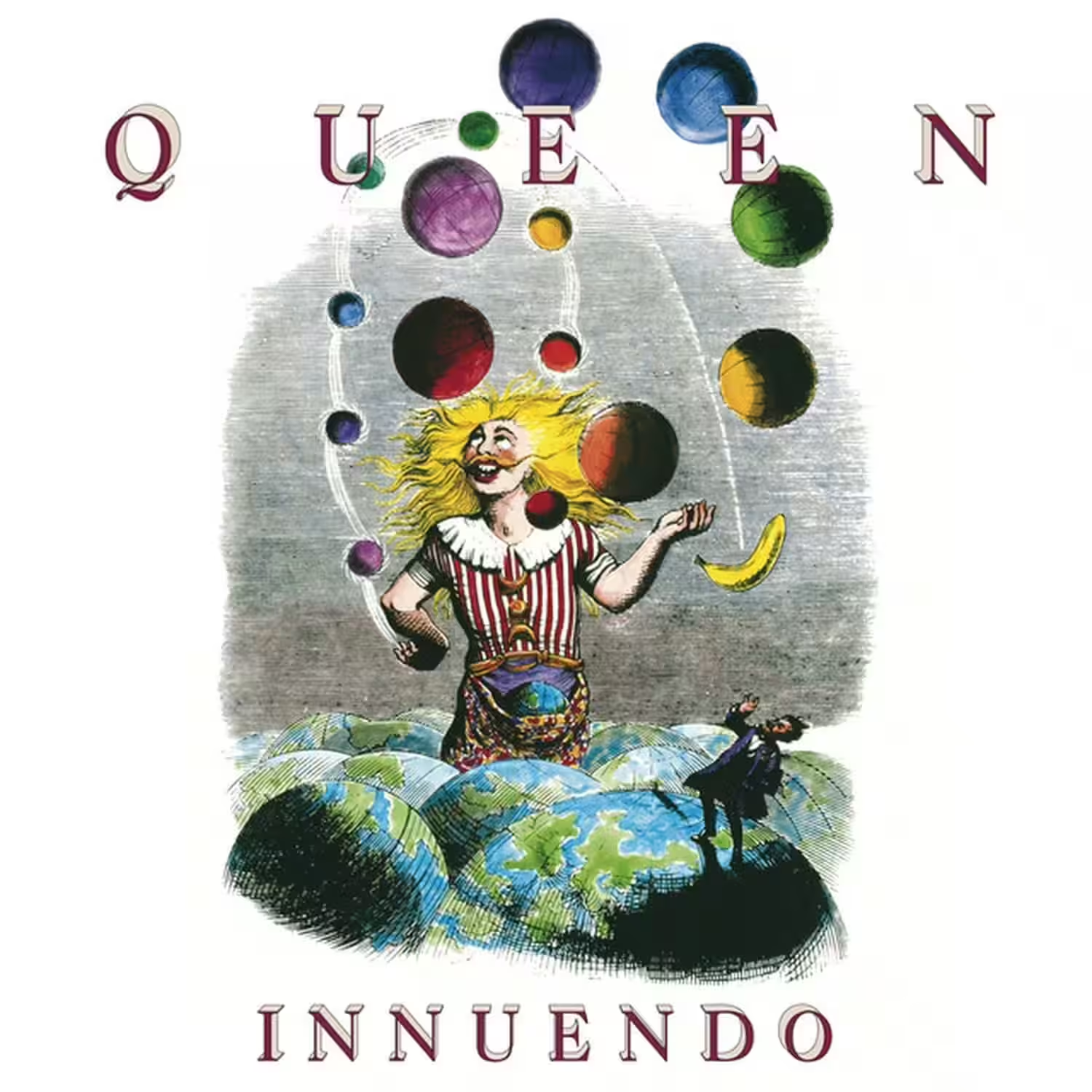
The sleeve is one of the most distinctive Queen ever released and the only one built around 19th century French illustration. The French artist Jean Ignace Isidore Gerard, who worked under the pen name J. J. Grandville (1803 to 1847), had published Un Autre Monde in 1844, a satirical collection of fantastical wood-engraved illustrations of animal-headed humans, surreal landscapes and dream sequences that prefigured the visual language of the Surrealists by almost a century. The Innuendo sleeve uses colourised reproductions of Grandville's plates, designed by Queen with Richard Gray, with additional illustration work by Angela Lumley and the band photography on the inner spread by Simon Fowler.
The choice of a long-dead French illustrator as the visual identity of a 1991 Queen album rather than a fresh photograph of the band was a quiet acknowledgement of the situation. There was no Queen sleeve to be built around new studio shots of Mercury without making his illness public, and the Grandville plates gave the record a visual world that was unmistakably theatrical, slightly off-kilter and not built on the singer's face. The same approach would carry through to the Made in Heaven sleeve four years later, where Anton Corbijn's photograph of an empty Mountain studio chair facing Lake Geneva would do the same job in colour. The Innuendo sleeve, in retrospect, reads as the start of that visual strategy rather than the end of the band's run of band-photo covers.
Hollywood Records and the US rollout
Innuendo was the first new Queen studio album released in the United States by Hollywood Records, the Disney-owned label founded in 1989. The Queen catalogue had moved from Capitol and Elektra to Hollywood ahead of the Innuendo release as part of a wider deal that gave Hollywood the back-catalogue reissues for Queen's twentieth-anniversary year in 1991, and the label saw the new record as the chance to lift the band's US profile, which had slid through the Eighties since the Hot Space backlash. Parlophone, EMI's UK rock imprint, retained the rest of the world.
- Hollywood Records founded 1989 as a Walt Disney Company music division.
- Queen catalogue moved to Hollywood ahead of the Innuendo release, ending the Capitol and Elektra arrangements that had stretched back to the Seventies.
- Twentieth-anniversary reissues of the Queen back catalogue in 1991 were Hollywood's first big project under the new deal.
- Hollywood continued as the US Queen label through the Made in Heaven era in 1995 and beyond.
The strategy mostly worked. Innuendo reached number 30 on the US Billboard 200, Queen's best US showing since The Works in 1984 and the band's first US Gold record since that album. American rock radio took "Headlong" to number three on the Mainstream Rock chart, the title track to number 17 and "I Can't Live with You" to number 28, and the album's promotional push in the United States ran through the spring and summer of 1991 with a coordinated single rollout that was more aggressive than anything Capitol had done for the band in the Eighties. The US sales never caught up with the European numbers, but the trajectory had been pointed back upwards by the time Mercury died in November.
Release, charts and the critical response
The album was released on 4 February 1991 and went straight to number one in the UK, where it stayed for two weeks. It also reached number one in Italy, the Netherlands (four weeks at the top), Germany (six weeks), Switzerland (eight weeks), Finland and Portugal, and reached the top ten across the rest of continental Europe. Certifications eventually reached UK Platinum (300,000), US Gold (500,000), Switzerland double Platinum, Germany Platinum and France Platinum.
| Single | Released | UK Peak | Notes |
|---|---|---|---|
| Innuendo | 14 January 1991 | 1 | Queen's third UK number one single; US Mainstream Rock 17. |
| I'm Going Slightly Mad | 4 March 1991 | 22 | Hong Kong number one; black and white Limehouse Studios video. |
| Headlong | 13 May 1991 | 14 | US Mainstream Rock 3; the lead US promotional single. |
| The Show Must Go On | 14 October 1991 | 16 | Released to launch Greatest Hits II; re-charted after Mercury's death. |
| Bohemian Rhapsody / These Are the Days of Our Lives | 9 December 1991 | 1 | Double A-side re-release; the 1991 Christmas Number One. |
Contemporary reviews were mixed. Chuck Eddy at Rolling Stone called it "the group's most playful top-to-bottom pile since The Game" but also "lightweight". Entertainment Weekly handed out a C minus. The British weeklies were warmer: Sounds gave it five stars, NME scored it seven out of ten and Q reviewed it favourably, with Kerrang the most enthusiastic of the rock press. The retrospective consensus has been kinder. AllMusic now rates it three stars and calls it "a fitting way to end one of rock's most successful careers". In 2016 Ron Hart at Rolling Stone called it "Queen's last masterpiece" and likened the record to Bowie's Blackstar, and Malcolm Dome at Classic Rock ranked it ninth among Queen albums in the same year. The BBC's 2006 national poll of the all-time greatest albums placed it at number 94.
Mercury's death, the Christmas Number One and the legacy
On 23 November 1991 Freddie Mercury issued a public statement, written with his manager Jim Beach, confirming that he had AIDS. He died at Garden Lodge in Kensington on 24 November 1991 of AIDS-derived bronchopneumonia, twenty-four hours after the statement had been read out on the evening news. Parlophone re-released "Bohemian Rhapsody" within a fortnight as a double A-side with "These Are the Days of Our Lives", with proceeds donated to the Terrence Higgins Trust, the UK AIDS charity. The single went straight to UK number one and became the Christmas Number One of 1991, the first single in British chart history to reach number one twice with the same A-side (it had done so the first time in 1975 to 1976) and the only Christmas Number One ever made up of two existing tracks.
The Freddie Mercury Tribute Concert at Wembley Stadium on 20 April 1992 closed the cycle. Elton John performed "The Show Must Go On" with the surviving Queen members and Tony Iommi of Black Sabbath on rhythm guitar, an arrangement which has since been released several times on video and which made the song the live document most associated with Mercury's death. Innuendo became the centrepiece of the Greatest Hits II compilation, released on 28 October 1991 a month before Mercury died, which has since shifted more than 16 million copies worldwide and is one of the best-selling albums in UK chart history. The Riffology podcast covers Innuendo and the year that followed it in episode RIFF020, Queen, Innuendo, which sits alongside this article on the site and runs through the same material in conversational form for anyone who would rather listen than read.
The recordings on Made in Heaven (1995) were built from sessions Mercury continued at Mountain Studios after Innuendo wrapped, working through 1991 on whatever the band could write for him. May has said in interviews since that Mercury's instruction in those final months was simply "write me anything and I'll sing it". That archive eventually produced the 1995 album, the 2014 Queen Forever compilation track "Let Me in Your Heart Again" and the Mercury vocal on the Smile track "Doing All Right" that May and Taylor reworked for various projects in the years after. Innuendo, in the catalogue, is the last complete piece of work Mercury saw released, the most ambitious and structurally adventurous record Queen made between The Game in 1980 and the end of the band as a four-piece, and the clearest piece of evidence that the four-way collaborative credit system the band adopted at the start of these sessions had been the right decision. Touring lineups in the decades since, first Queen plus Paul Rodgers from 2005 to 2009 and then Queen plus Adam Lambert from 2011 onwards, have kept "The Show Must Go On" and "These Are the Days of Our Lives" as setlist fixtures without ever attempting to rebuild the title track live, which is perhaps the best measure of how much of Innuendo belonged specifically to the room and the man who sang it.
Personnel
- Queen: Freddie Mercury, lead vocals, keyboards; Brian May, guitars, keyboards, harmony vocals, lead vocals on "Lost Opportunity"; Roger Taylor, drums, percussion, keyboards, harmony vocals; John Deacon, bass guitar, keyboards.
- Additional musicians: Steve Howe, Spanish guitar on "Innuendo"; Mike Moran, keyboards on "All God's People".
- Production: David Richards, producer, engineer, programming; Queen, co-producers; Noel Harris, assistant engineer; Justin Shirley-Smith, assistant engineer.
- Artwork: Richard Gray, sleeve design; Queen, sleeve design; J. J. Grandville, illustrations (from Un Autre Monde, 1844); Angela Lumley, additional illustrations; Simon Fowler, photography.
Tracklist
| # | Title | Length |
|---|---|---|
| 1 | Innuendo | 6:31 |
| 2 | I'm Going Slightly Mad | 4:22 |
| 3 | Headlong | 4:38 |
| 4 | I Can't Live with You | 4:33 |
| 5 | Don't Try So Hard | 3:39 |
| 6 | Ride the Wild Wind | 4:42 |
| 7 | All God's People | 4:21 |
| 8 | These Are the Days of Our Lives | 4:15 |
| 9 | Delilah | 3:35 |
| 10 | The Hitman | 4:56 |
| 11 | Bijou | 3:36 |
| 12 | The Show Must Go On | 4:35 |
Things you might not know
| Fact | Detail |
|---|---|
| One credit for all | Every song on Innuendo is credited collectively to Queen, a deliberate band decision taken after The Miracle to end the question of which song belonged to which member and remove the publishing-driven friction it had created since the Seventies. |
| Steve Howe drops in | The flamenco-guitar interlude in the middle of the title track was played by Yes guitarist Steve Howe, who happened to be visiting Mountain Studios during the sessions and was asked to play the part in a single afternoon. |
| A factory preset opens a song | The opening rain sound on "Don't Try So Hard" is the Korg M1's "00: Universe" preset, the patch the keyboard plays the first time you switch it on, which the band liked enough to keep as the intro. |
| The only outside writer | "I'm Going Slightly Mad" was co-written by Mercury and his close friend Peter Straker in an all-night session at Garden Lodge, the only Innuendo song with a non-band co-writer credit. |
| A song for a cat | "Delilah" is a love letter to one of Mercury's eleven cats at Garden Lodge, with a Brian May talk-box solo mimicking the cat's voice; Roger Taylor has said openly in interviews that he hates the song. |
| Verses without words | "Bijou" inverts song structure entirely: May's Red Special carries the verses as a wordless guitar line and Mercury sings only the middle eight, with Taylor and Deacon absent from the track. |
| A 19th century French sleeve | The album cover uses colourised reproductions of 1844 wood engravings by J. J. Grandville from Un Autre Monde, the only Queen sleeve built around 19th century illustration rather than band photography. |
| A new US label | Innuendo was the first new Queen studio album released in the United States by Hollywood Records, the Disney-owned label that took the Queen catalogue from Capitol ahead of the album's launch. |
| The statement, then the silence | Mercury's public statement on 23 November 1991 confirmed his AIDS diagnosis to the world a single day before his death at Garden Lodge on 24 November 1991. |
| A double A-side at Christmas | "These Are the Days of Our Lives" became the UK Christmas Number One of 1991 as a double A-side with "Bohemian Rhapsody", reissued in aid of the Mercury Phoenix Trust two weeks after Mercury's death. |
How to listen now
The original 1991 Parlophone CD and LP and the matching Hollywood Records US edition are both still widely available second-hand and in any decent record-shop Queen rack. The version most readers will reach for now is the 2011 Universal and Island remaster, the source of the deluxe edition reissue whose cover sits at the top of this article, which adds a bonus disc of session material and a much-improved master of the original twelve tracks. Streaming is handled by Universal and Hollywood across all the major platforms. The 2015 Virgin EMI and Hollywood two-LP vinyl reissue put the album on vinyl in full for the first time across two discs, finally giving the longer tracks the room they had been compressed out of on the original single LP. Innuendo footage appears on Greatest Video Hits 2, on the various editions of the Freddie Mercury Tribute Concert and in part on Queen Rock Montreal, with the videos for the title track, "I'm Going Slightly Mad", "Headlong", "These Are the Days of Our Lives" and "The Show Must Go On" all officially available on the Queen Official YouTube channel.
Comments