In the autumn of 1975 Queen were simultaneously one of the most talked-about rock bands in Britain and one of the most miserable. Sheer Heart Attack, released the previous November, had reached number two on the UK Albums Chart and number twelve on the US Billboard 200. Its lead single Killer Queen had become a UK top five hit and given the band their first significant American airplay. By any reasonable measure they were on the verge of breaking through to a wider world. Behind the scenes the picture was less encouraging. Three of the four members of Queen were close to broke, locked into a punitive production contract that paid each of them sixty pounds a week, and the band's bassist had been refused a four thousand pound advance to put down a deposit on a house. Freddie Mercury later described the fourth album as a live-or-die record.
What they produced over the following four months, working across seven British studios with a producer who had just walked out of the same management company they were trying to leave, was an album that did not so much follow up Sheer Heart Attack as detonate the category Queen had been placed in. A Night at the Opera, released on 28 November 1975, took the band's appetite for layered vocals, classical detail and music-hall mischief to a point that several reviewers thought was either madness or revolution and which time has confirmed was both. It contained a six-minute mock-operatic single that nobody in the business thought would ever get played on the radio, and a folk song about Einsteinian time dilation, and Roger Taylor singing love letters to a car, and a hate letter set to piano. It also became Queen's first UK number one album, their first US platinum record, and the moment a successful British singles band became one of the four or five biggest rock acts in the world.
A band on the brink of bankruptcy
The contradiction at the heart of Queen's position in early 1975 was that being famous on Top of the Pops was not, on its own, paying any bills. The four-piece had signed in 1972 with Trident Audio Productions, a production company built around the Sheffield brothers' Trident Studios in Soho. Trident funded the recordings, paid the band a small weekly retainer, and then licensed the finished records on to EMI for distribution. It was the kind of deal common in the early seventies for unproven bands and it had given Queen access to one of the best studios in London. By 1975 it had also become a financial straitjacket.
Brian May was renting a bedsit in Earls Court. Freddie Mercury was in a damp flat in Kensington. Roger Taylor and John Deacon were in similar circumstances. Deacon, the youngest member and the only one with a wife, had just married Veronica Tetzlaff and asked Trident for a four thousand pound advance to put a deposit on a house. The request was refused. The salary was sixty pounds a week each, less than a senior session player would expect for a single afternoon's work, and the band were watching Killer Queen climb the charts knowing that the lion's share of the receipts was being paid into a company they did not own.
That a band scoring top five singles could be on the breadline at the same time was not lost on Mercury, who began telling anyone who would listen that something had to change. The mood inside the camp by spring 1975 was bleak. Mercury later said that he viewed the next record, whatever it turned out to be, as a final throw of the dice. Either it would force the band into a position of leverage that could be used to escape Trident, or it would not, and in the latter case there might not be a Queen left to fight about.
Breaking free from Trident
In December 1974 the band had hired Jim Beach, a music lawyer in his late twenties at the firm Harbottle and Lewis, to look at their contracts and find a way out. Beach, who would go on to manage Queen for the rest of their career and beyond, spent nine months in negotiation with the Sheffield brothers. The dispute was unpleasant, was conducted partly in public and partly through gritted teeth, and ended in the summer of 1975 with the band buying themselves out of Trident for an estimated one hundred thousand pounds plus a one per cent royalty override on each of the next six Queen albums. The settlement was costly and the resentment ran deep on both sides. By the time it was signed, the band were free to deal directly with EMI in the United Kingdom and to sign a separate North American deal with Elektra, but they were also more or less starting from zero financially.
Roy Thomas Baker, the staff producer who had worked on all three previous Queen albums, walked out of Trident at the same time and went freelance. So did engineer Mike Stone. The break with Trident was not merely a contractual reset for the band; it cleaned out the entire creative team that had built the Queen sound. When sessions for the new album began in August 1975 they did so with the same producer, the same engineer and the same four musicians, but with all of them in a new working relationship and with the very clear understanding that whatever they made next had to justify the previous nine months of trench warfare.
EMI, Elektra and John Reid
Management was the last piece of the jigsaw. With Trident gone, Queen briefly considered approaching Peter Grant, who was at that point at the height of his powers steering Led Zeppelin. Grant was interested but made it plain that joining the Swan Song stable would mean a degree of subordination the band were not willing to accept after what they had just been through. They turned instead to John Reid, the young Glaswegian who had built Elton John into the biggest pop act in the world. Reid took on Queen on a handshake.
His advice when he met the band, according to several later interviews, was simple and almost dismissive. Go into the studio, he told them, and make the best record you can. Reid would handle the rest. For four musicians who had spent the better part of a year fighting a management company over every penny, the instruction landed like a door opening. The fact that the next twelve months would see Queen become the biggest-selling British band in the world, and that the relationship with Reid would itself end acrimoniously in 1978, did not yet matter. In August 1975 the band, the producer and the engineer were free to start work without anyone in the building telling them what would or would not be a hit.
Seven studios and a barn in Surrey
Recording for A Night at the Opera began with rehearsals in a barn at what would later become Ridge Farm Studio in Surrey. From there the band relocated for three weeks to a rented house near Kington in Herefordshire, owned by the mother of the novelist Tiffany Murray, where they worked up arrangements and demoed material on portable gear. Formal recording started at Rockfield Studios in Monmouthshire, the residential studio set up in a working farm by the Ward brothers, which by 1975 was already becoming a favourite of bands who wanted to work away from the music industry's London centre of gravity. Sessions at Rockfield ran from August into September.
From there the production moved through what is generally listed as a further five London studios: Lansdowne in Holland Park, Sarm East in Whitechapel, the Roundhouse in Chalk Farm, Scorpio Sound near Euston, and Olympic in Barnes. The reason for the studio-hopping was partly practical, in that no one room was ever booked out for long enough to take the whole record, and partly creative, in that Baker and the band had become accustomed to choosing rooms for specific tasks. Trident itself is sometimes listed in the credits, but the only piece of music on A Night at the Opera actually recorded there was the closing instrumental arrangement of God Save the Queen, which Brian May had laid down on 27 October 1974 in the days immediately before the Sheer Heart Attack tour. It was held back for over a year and slotted onto the end of the new album.
The band rented houses near each studio for the duration of sessions and worked, by all accounts, around the clock. The expense of running the operation across so many rooms with so much overtime contributed to A Night at the Opera being widely reported, at the time, as the most expensive record ever made, with an estimated production cost of forty thousand pounds. That figure is small by later standards but in 1975 was roughly four times the budget of an average rock album, and it was money the band, having just bought themselves out of Trident, did not really have.
Roy Thomas Baker and the 24-track leap
Two technical decisions shaped what A Night at the Opera would end up sounding like. The first was producer Roy Thomas Baker's insistence on multitracking the band's already complex vocal arrangements until they could be treated as a separate instrument. The second was the upgrade from sixteen-track tape, on which Queen's first three albums had been recorded, to twenty-four-track tape, which was just becoming standard at the top of the British studio market in 1975. Sixteen tracks were comfortable for a rock band that wanted layered guitars and stacked harmonies. Twenty-four tracks were what allowed Baker and Queen to think of harmony parts in groups of eight and twelve.
Mike Stone returned as engineer, his role expanded after the success of Sheer Heart Attack. Beside him at the desk was the nineteen-year-old Gary Langan, who had served as tape op on the previous record and was now promoted to assistant engineer. Langan would go on to engineer for the Buggles, ABC and the Art of Noise; on A Night at the Opera his job was largely to keep up with Baker's ferociously detailed approach to tracking. Sessions could involve tracking a single harmony line in eight or ten passes, then bouncing those down to sub-mixes that themselves became single elements in a larger structure. The opera section of Bohemian Rhapsody, recorded by Mercury, May and Taylor in the studio for three weeks of long days, was the most extreme application of the method, but the same approach is audible everywhere on the record.
The instruments and the vocal architecture
The instrument list for A Night at the Opera reads like a manifesto for the album it ended up becoming. Mercury played a Bosendorfer grand piano on the rock and ballad material and a smaller upright "jangle" piano on the music-hall pastiches. Brian May used his homemade Red Special, the guitar he had built with his father in the early 1960s from oak from an eighteenth-century fireplace, almost exclusively as his electric instrument. He routed it through the equally homemade Deacy Amp, a small treble-booster amplifier built for him by John Deacon out of a discarded transistor radio chassis, which gave the multi-tracked guitar lines their distinctive horn-like timbre. The Deacy Amp would later be released commercially by Vox in the early 2000s on the strength of its work on this album alone.
Beyond those staples the record reaches for an extraordinary range of supporting instruments. Roger Taylor brought in timpani and a gong for the close of Bohemian Rhapsody. Deacon played a Wurlitzer electric piano on his own composition and a double bass on Brian May's '39. May added Gibson Hummingbird acoustic and harp on Love of My Life, a toy koto on The Prophet's Song, and a regular ukulele on Good Company on which the entire Dixieland jazz band is multitracked Red Special and Deacy Amp. The instrumentation is unflashy in its presentation but, when assembled, gives the album a tonal range that no Queen record before or after quite matches.
The vocal architecture follows the same principle of orchestration in miniature. The harmony stacks are typically built with Mercury in the middle, May an octave lower, and Taylor up at the top: an arrangement that on paper looks straightforward and in practice depends on Taylor reaching notes that no other rock singer of the period would attempt. Deacon, by the band's own admission, did not sing on the records. The trio of Mercury, May and Taylor was capable of producing, when stacked sufficiently, the choral effect that listeners hear on the opera section of Bohemian Rhapsody and the canon of The Prophet's Song. The illusion is of dozens of voices. The reality is three voices recorded dozens of times.
Death on Two Legs: a hate letter set to music
The album opens with the most unambiguous statement of intent any Queen record has ever made. Death on Two Legs is Mercury's settling of accounts with Norman Sheffield, the former Trident manager, set to a churning piano and one of May's most aggressive guitar arrangements. The lyric refers to its target as a blood-sucking leech and a decaying sewer rat, and dares the listener not to recognise the venom. Mercury would later admit that he had felt slightly ashamed of how nasty the song was, but only slightly. May was uncomfortable about the lyrics; EMI's lawyers were reportedly uncomfortable too. Sheffield, on hearing the finished record, sued the band for defamation. The matter was settled out of court for an undisclosed sum, an outcome which confirmed Sheffield as the song's subject without anyone having to say so on the record sleeve.
Musically Death on Two Legs sets out the album's stylistic palette in three and a half minutes: ornate piano, multitracked vocal stacks, a baroque chord progression cut through with hard rock guitar, and an arrangement that escalates rather than repeats. The song was a fixture of Queen's live sets from late 1975 onward, used as a show opener through the second half of the seventies, and was retired only at the end of the The Game tour in 1981, by which point the band had moved on from the kind of catharsis it represented. Listeners who came to Queen through the singles of the early eighties tend to find Death on Two Legs a surprise. It is not a pop song. It is a wound.
The music-hall miniatures
Three of the twelve tracks on A Night at the Opera exist in a different register from the rest of the record. They are short, pre-war music-hall pastiches, written and largely performed by Mercury, and they make up a substantial part of what made the album so confounding to American rock critics on release. The first is Lazing on a Sunday Afternoon, a 68-second piano vignette that follows Death on Two Legs directly. Mercury sang the lead vocal through headphones into a tin bucket placed elsewhere in the studio, with a microphone capturing the sound from inside the bucket to give the voice its distant, megaphone-like timbre. The guitar solo was reportedly cut on the same tape track as the lead vocal because no other tracks were free, an anecdote Baker confirmed in the 2005 Classic Albums documentary on the record.
The second is Seaside Rendezvous, Mercury's most fully realised music-hall pastiche, which features an entirely a cappella instrumental break. In the break Mercury imitates a woodwind section, clarinets in particular, while Roger Taylor takes the brass parts, including trumpets and tubas, and even a kazoo. Taylor hits a soprano C6 in the section, a note he reaches by belt rather than falsetto. The mock-tap-dance segment that follows was Mercury and Taylor sitting at the mixing desk with metal thimbles on their fingers, tapping out the rhythm directly on a hard surface. The third miniature is Brian May's Good Company, discussed in its own context further on, on which the band's hard-rock guitarist plays a ukulele and reconstructs an entire Dixieland jazz band on his own.
Roger Taylor, John Deacon and the inner-band economics
The third and fourth songs on side one announce, in succession, the arrival of Roger Taylor and John Deacon as Queen songwriters of consequence. Taylor's I'm in Love with My Car is a hard rock dedication to the band's roadie Jonathan Harris, whose Triumph TR4 was, in Taylor's words, the love of his life and who is name-checked in the lyric as a boy racer to the end. Taylor wrote the song, sang the lead vocal and recorded the original guitar parts, which May then re-cut on the Red Special. The closing engine note on the track is Taylor's own Alfa Romeo, recorded in the studio car park.
What made I'm in Love with My Car matter beyond its merits as an album cut was its selection as the B-side of Bohemian Rhapsody. Under standard music-publishing arrangements, B-side royalties were paid at the same rate as A-side royalties, and Mercury's six-minute opus was about to become the biggest single Queen had ever released. Taylor's share of the resulting income was equivalent to Mercury's, an outcome that became a source of inter-band friction for years afterward. The wider implication, which Deacon was watching closely, was that getting onto a single's B-side could be commercially transformative for the band's non-Mercury writers.
Deacon's contribution to A Night at the Opera, his first Queen single, was You're My Best Friend, written for Veronica Deacon while the bassist was teaching himself piano. The keyboard part was tracked on a Wurlitzer electric piano, an instrument Mercury openly disliked and refused to play on the record. Deacon overdubbed the bass himself and the harmony vocals were carried by Mercury, May and Taylor in the by-now familiar three-way stack. You're My Best Friend was released as the album's second single on 18 June 1976, reaching number seven on the UK Singles Chart and number sixteen on the US Billboard Hot 100. It was Deacon's introduction to the wider world as a writer of hits and the start of a run that would eventually include Another One Bites the Dust and I Want to Break Free.
Brian May's four-song showcase
Brian May contributed four songs to A Night at the Opera and in doing so established himself as a writer with as much range as the band's frontman. The most quietly remarkable of them is '39, a folk-flavoured sea shanty about time dilation in Einstein's theory of relativity. The lyric describes a crew of space explorers who depart Earth on a year-long voyage at near-light speeds and return home to find that a century has passed for those they left behind. May, who had abandoned a PhD in astrophysics at Imperial College to pursue Queen full-time, brought a scientist's literalism to the metaphor. He sang the lead vocal on the studio recording, with Mercury and Taylor on harmonies, and Mercury would take the lead when the song was performed live. May reportedly asked Deacon, half as a joke, to play the double bass part. He returned to the studio a few days later to find Deacon had already learned the instrument well enough to track the part properly. '39 would later be cited by George Michael as his favourite Queen song; Michael performed it at the Freddie Mercury Tribute Concert on 20 April 1992, having reportedly busked it on the London Underground as a teenager.
May's other contributions show the same combination of intellectual ambition and craft. Sweet Lady is a hard rock number in three-quarter time that briefly modulates into common time at the bridge, a structural conceit that pleased the band and infuriated some critics; NME's Tony Stewart called it an awful rock number on release, a judgment that has aged less well than the track itself. Good Company, the eleventh track, is a music-hall ukulele tune on which May plays every instrument on the resulting Dixieland jazz band, recreating clarinet, trombone and trumpet parts on the Red Special through the Deacy Amp. May composed the song on his father's banjo ukulele but recorded it on a standard uke. On Love of My Life, the album's central ballad, May reached even further afield. The song is structured around Mercury's piano and multi-tracked vocal harmonies, but the most striking sonic element is May's harp part, which was assembled chord by chord and edited together because May, having borrowed a harp for the session, had not learned to play it as a continuous instrument. Love of My Life became Queen's biggest South American single after their 1981 tour of the continent, and was later rearranged for May's twelve-string acoustic for live performances in which audiences took over the lyric so completely that Mercury would routinely stop singing and conduct.
The Prophet's Song: tape delay and the vocal canon
At eight minutes and twenty-one seconds, The Prophet's Song is the longest studio track Queen ever recorded, and it is the most overtly progressive thing they ever attempted. May wrote it after a dream about a great flood and what he described as humanity's lack of empathy in the face of disaster. The arrangement is built around a stretched, almost biblical structure that runs from a quiet acoustic opening, played by May on a toy koto borrowed for the session, through a hard rock middle section, to an extraordinary vocal canon in which Mercury overlaps his own voice using early tape-delay devices to create a continuous, self-answering choral effect.
The canon is the centrepiece. Mercury recorded a single vocal line and then layered it against delayed copies of itself, producing a multi-voice round in which one singer takes all the parts. The effect is something between a Renaissance motet and a panic attack. May's guitar solo, which follows, was tracked at one tape speed and the tape then sped up on playback, a now-familiar studio trick that in 1975 was still being used sparingly enough to feel novel. The song does not have a chorus in the conventional sense and was never released as a single; it was nevertheless one of the album cuts that critics most often singled out at the time as evidence that Queen were doing something nobody else in rock music was doing.
Bohemian Rhapsody: writing and recording the impossible
Mercury had been carrying the bones of Bohemian Rhapsody around in notebooks for at least three years before sessions began. He had written sections of the song on the back of a phonebook in his Kensington flat, and arrived at the first rehearsals at Rockfield with the structure broken into three blocks: a piano ballad, a mock-operatic centrepiece, and a hard rock outro. The band rehearsed each block separately and then stitched them together. May, Taylor and Deacon have all said in subsequent interviews that they did not, on first hearing, understand quite what Mercury intended to do with the middle section. Mercury, who had a clear vision of how the harmony parts should stack, simply directed the sessions himself.
The opera section was the centrepiece of the technical effort and the studio bill. Mercury, May and Taylor sang the parts in shifts of ten to twelve hours a day for the better part of three weeks, with Roy Thomas Baker and Mike Stone bouncing sub-mixes to free up tracks for further overdubs. The number of vocal passes has been variously reported as somewhere between one hundred and one hundred and eighty individual takes. The tape itself, on which the parts were repeatedly bounced, was reportedly close to transparent by the end of the sessions, the oxide thinned by so many passes through the heads. The Galileo, Scaramouche, Figaro, Beelzebub and Bismillah passages, all of which originated as in-jokes during early rehearsals, ended up as the most quoted section of any rock song in the band's catalogue.
Bohemian Rhapsody: Kenny Everett and the chart record
The argument over Bohemian Rhapsody as a single began the moment the band played the finished mix to EMI's executives. At five minutes and fifty-five seconds it was twice the length of an average 1975 single, contained no conventional chorus, and lurched between three musical idioms in a way the label considered unsellable. EMI suggested edits. The band refused. Mercury reportedly took a copy of the master to Capital Radio DJ Kenny Everett on the understanding that Everett would not play it on air. Everett, of course, played it. He played it fourteen times across a single weekend show, billing each spin as a sneak preview, and within forty-eight hours the Capital Radio switchboard had jammed with listener requests. EMI, faced with a record their audience already wanted, conceded.
The single was released on 31 October 1975, backed with Roger Taylor's I'm in Love with My Car. It entered the UK chart at number forty-seven, climbed to number one on 29 November and stayed there for nine consecutive weeks, then a record for the British singles chart. In the United States, where Capital Radio's intervention counted for little, it climbed more gradually but still reached number nine on the Billboard Hot 100. The promotional film, shot in four hours by director Bruce Gowers at Elstree during the band's tour rehearsals, used video effects then routinely employed for the BBC's Top of the Pops presentation, and is widely credited with inventing the modern music-video form. Bohemian Rhapsody received two nominations at the 19th Annual Grammy Awards in 1977, for Best Pop Vocal Performance by a Duo, Group or Chorus and for Best Arrangement for Voices. It was re-released as a double A-side with These Are the Days of Our Lives on Mercury's forty-fifth birthday on 5 September 1991, and again after Mercury's death in November of the same year, returning to UK number one in December. It has since been certified diamond in the United Kingdom and the United States and is regularly cited as one of the greatest songs in popular music history.
God Save the Queen, the cover and the Marx Brothers
The album closes with Brian May's solo arrangement of the British national anthem, recorded at Trident on 27 October 1974 in the days before the Sheer Heart Attack tour and held in the can for over a year. From late 1975 onwards God Save the Queen was used as a coda at virtually every Queen concert. Its most famous public performance came twenty-seven years later, when May played it on the roof of Buckingham Palace at the opening of Queen Elizabeth II's Golden Jubilee concert on 3 June 2002, in a setting that May has acknowledged was a deliberate homage to Jimi Hendrix's performance of The Star-Spangled Banner at Woodstock.
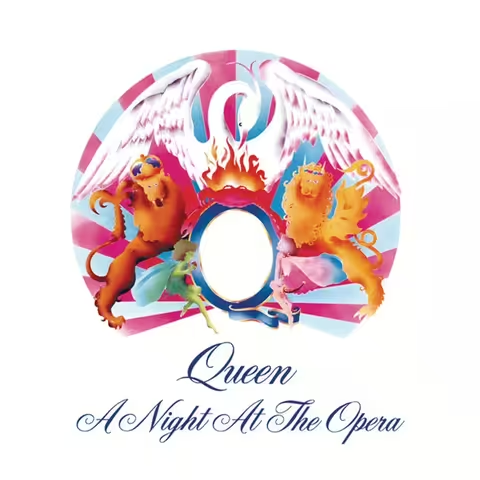
The album sleeve is the band's own crest, designed by Mercury himself, gilded against a pure white background. The crest combines the four members' zodiac signs (two lions for the two Leos, May and Taylor; a crab for Mercury, a Virgo; and two fairies for Deacon, also a Virgo, in a design entirely of Mercury's invention) around a phoenix and the letter Q. The follow-up album A Day at the Races, released in late 1976, used the same crest inverted on a black background, and the two records are routinely treated as visual companion pieces. Both album titles came from Marx Brothers films of the 1930s; the band watched A Night at the Opera on a 16mm projector during the recording sessions and adopted the name. In March 1977, on the strength of an unsolicited fan letter Groucho Marx had sent the band about A Day at the Races, Queen visited the comedian at his home in Los Angeles, five months before his death, and performed '39 a cappella for him in his living room.
Release, touring and legacy
The album was completed approximately a week before the start of the A Night at the Opera Tour, with a mixing session that ran for thirty-six continuous hours. The band had three and a half days of tour rehearsal at Elstree before the first show; four hours of that block were cut out so that Bruce Gowers could shoot the Bohemian Rhapsody film. The tour ran from late November 1975 through 1976 and covered the United Kingdom, the United States, Japan and Australia, expanding the band's live operation to a scale they had never previously attempted.
Critical reception in Britain on release was almost uniformly enthusiastic. Tony Stewart in NME, despite his reservations about Sweet Lady, called the album a triumph. Harry Doherty in Melody Maker and Phil Sutcliffe in Sounds both gave it the highest available marks, Sutcliffe's review running to a full five stars. In the United States, Kris Nicholson in Rolling Stone wrote one of the few early American reviews to take the album seriously on its own ambitious terms. Commercially the response was emphatic. A Night at the Opera reached number one on the UK Albums Chart, where it spent four non-consecutive weeks at the top and became the band's first UK number one and their first Christmas number one album. It reached number four on the US Billboard 200, becoming Queen's first American platinum record and eventually being certified three times platinum for three million shipments. It reached number one in Australia, the Netherlands, Finland and New Zealand, number two in Canada (three times platinum), number five in Germany (platinum), and number nine in Austria and Japan (platinum, for two hundred and fifty thousand shipments).
Its retrospective standing has only grown. Rolling Stone's 2020 revision of its 500 Greatest Albums of All Time placed it at number 128. A BBC poll of the greatest British albums put it at number nine. Channel 4's Greatest 100 Albums survey placed it at number thirteen. Classic Rock's 100 Greatest Rock Albums Ever ranked it at twenty-five, and its 2018 50 Best Rock Albums Ever feature at number six. Q's 50 Best British Albums Ever placed it at seventeen. In 2018 the album was inducted into the Grammy Hall of Fame. Bryan Singer's 2018 biopic Bohemian Rhapsody, which took its title from the album's signature song and grossed nearly a billion dollars at the worldwide box office, introduced a generation of cinemagoers to the record for the first time.
The longer arc is harder to summarise without sounding triumphalist, but the bare facts are these. Before A Night at the Opera Queen were a successful British band with a growing American audience. After it they were one of the four or five biggest rock acts in the world, in a position from which the imperial late-seventies run of A Day at the Races, News of the World and Jazz became possible. Bohemian Rhapsody set the template for the high-concept multi-section rock single that runs from Stairway to Heaven through Paranoid Android to Take Me to Church, and Brian May's guitar-orchestration approach to overdubs became, in the years that followed, a recognised production technique studied by other guitarists. The record made all of that possible and remains, on its own terms, one of the most ambitious things a four-piece rock band has ever attempted.
Personnel
- Freddie Mercury: lead and backing vocals, Bosendorfer grand piano, jangle piano
- Brian May: electric guitar, acoustic guitar, backing and lead vocals, koto, harp, ukulele
- Roger Taylor: drums, backing and lead vocals, percussion, timpani, gong, additional electric guitar
- John Deacon: bass guitar, Wurlitzer electric piano, double bass
- Roy Thomas Baker: producer
- Mike Stone: engineer
- Gary Lyons: engineer
- Gary Langan: assistant engineer
- John Harris: equipment supervision
- David Costa: art direction
Tracklist
| # | Title | Length |
|---|---|---|
| 1 | Death on Two Legs (Dedicated to...) | 3:43 |
| 2 | Lazing on a Sunday Afternoon | 1:08 |
| 3 | I'm in Love with My Car | 3:05 |
| 4 | You're My Best Friend | 2:50 |
| 5 | '39 | 3:30 |
| 6 | Sweet Lady | 4:01 |
| 7 | Seaside Rendezvous | 2:13 |
| 8 | The Prophet's Song | 8:21 |
| 9 | Love of My Life | 3:38 |
| 10 | Good Company | 3:26 |
| 11 | Bohemian Rhapsody | 5:55 |
| 12 | God Save the Queen | 1:11 |
Things you might not know
| Fact | Detail |
|---|---|
| The album title | Taken from the 1935 Marx Brothers film the band screened during sessions. They later became friends with Groucho Marx and performed '39 a cappella for him in his Los Angeles living room in March 1977, five months before his death. |
| The lawsuit | Death on Two Legs triggered a defamation lawsuit from former Trident manager Norman Sheffield, settled out of court for an undisclosed sum, which had the side effect of confirming Sheffield as the song's target. |
| The tin bucket vocal | Mercury sang the lead vocal on Lazing on a Sunday Afternoon through headphones into a metal bucket placed elsewhere in the studio, with a microphone capturing the resulting megaphone-like timbre. |
| The double bass | John Deacon learned to play the double bass from scratch within a few days, after Brian May asked him as a joke to provide the part on '39. |
| George Michael's favourite | George Michael named '39 his favourite Queen song and performed it at the Freddie Mercury Tribute Concert on 20 April 1992, having reportedly busked it on the London Underground as a teenager. |
| Kenny Everett's fourteen plays | Capital Radio DJ Kenny Everett played a leaked copy of Bohemian Rhapsody fourteen times on a single weekend show, jamming the station's switchboard with listener requests and forcing EMI's hand on releasing the six-minute single. |
| The closing instrumental | God Save the Queen was actually recorded at Trident on 27 October 1974, more than a year before the rest of the album, in the days before the Sheer Heart Attack tour. |
| The Palace rooftop | Brian May performed God Save the Queen on the roof of Buckingham Palace at the opening of Queen Elizabeth II's Golden Jubilee concert on 3 June 2002, a deliberate homage to Hendrix at Woodstock. |
| The price tag | Reportedly the most expensive album ever made at the time, at an estimated forty thousand pounds, roughly four times the cost of an average 1975 rock record. |
| The format upgrade | A Night at the Opera was the first Queen album cut on 24-track tape, after three sixteen-track records, which is what made the extreme vocal stacks on Bohemian Rhapsody and The Prophet's Song possible. |
How to listen now
A Night at the Opera is in print continuously and is available across all the major streaming services through Universal Music. The version pictured on this article is the 2011 EMI/Universal remaster, which is the default digital and CD release in most territories and which restores a noticeable amount of clarity to the multi-tracked vocals over earlier CD masters. Listeners who want to dig further have several options: the 2002 DVD-Audio surround mix and its 5.1 Blu-ray Audio reissue, which place the listener inside the operatic harmonies; the 2005 thirtieth-anniversary deluxe edition, which adds an audio commentary recorded by all four band members; and a series of vinyl reissues, including half-speed masters, that have kept the original album cover and gatefold artwork in print on physical media. The Queen + Adam Lambert touring band, fronted by Brian May and Roger Taylor with Lambert on lead vocals, continues to perform Love of My Life, '39 and Bohemian Rhapsody as fixed points in the set, the latter still using a recorded vocal of Mercury for the operatic section as it had since the original 1975 tour.
Comments