Introduction
Andreas Kisser broke a finger in a freak accident, the singer was openly ripping off U2, the bassist did not actually play on the record, and the whole thing was cut in a Tampa studio better known for death-metal grindcore than for breakout albums. None of that should have produced the record that turned Sepultura from a respected underground name into the first Brazilian metal band the wider world genuinely cared about. Arise, released on 25 March 1991, did exactly that.
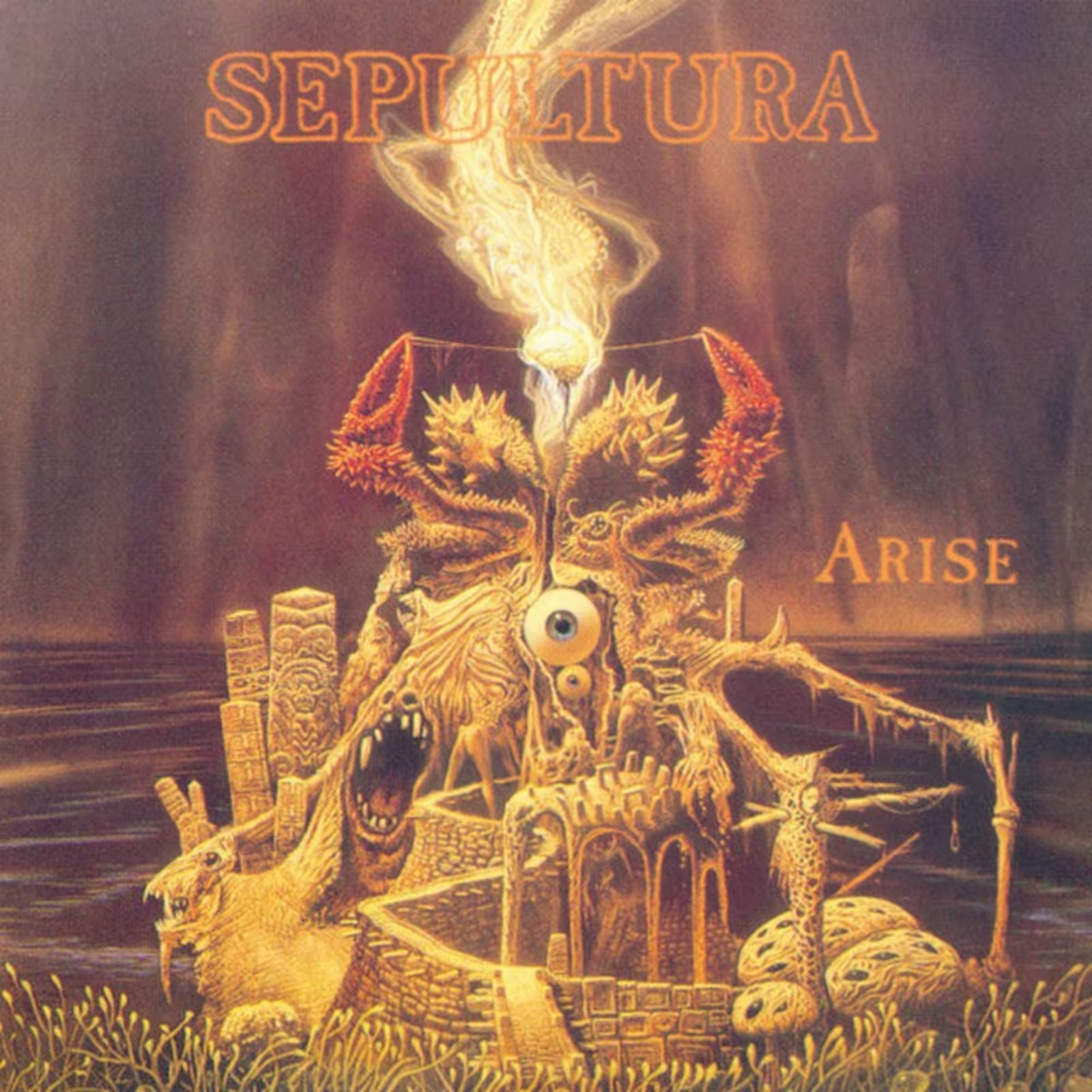
It is the album where the band's death and thrash instincts hit their logical peak and then started to crack open, letting in industrial samples, hardcore punk and the first traces of the tribal percussion that would later define Roots. It made the band's name on its own terms, and it remains, for a large share of the Sepultura faithful, the high point of everything the four founding members built together. This is the full story of how Arise was written, recorded, released and turned into a worldwide phenomenon over two relentless years on the road.
Album Facts
| Field | Detail |
|---|---|
| Artist | Sepultura |
| Album | Arise |
| Release date | 25 March 1991 (US), 8 April 1991 (UK) |
| Label | Roadrunner Records |
| Producers | Sepultura and Scott Burns |
| Studio | Morrisound Recording, Tampa, Florida (mixed at Quantum Sound Studios, Jersey City) |
| Genre | Thrash metal, death metal, with industrial and hardcore touches |
| Track count | 9 (original album) |
| Total runtime | 42:26 |
| Billboard 200 peak | 119 |
| UK Albums Chart peak | 40 |
| Other notable chart peaks | Finland 14, Switzerland 24, Germany 25, Sweden 46, Netherlands 68 |
| Certifications | Gold (Indonesia, 1992), Silver (UK, 2001) |
| Estimated sales | Over 1 million worldwide by 1993 |
| Key singles | Arise, Dead Embryonic Cells, Under Siege (Regnum Irae) |
Cultural Context: Metal in 1991
To understand why Arise mattered, you have to remember where metal sat in early 1991. Thrash had spent the late 1980s becoming the dominant strain of heavy music, and its biggest names were about to either cross over or burn out. In August 1991 Metallica would release the self-titled Black Album and sell tens of millions, leaving pure thrash behind for good. A month after that, Nirvana's Nevermind detonated, and within a year the entire commercial centre of gravity in heavy music had lurched towards grunge and alternative rock.
Death metal, meanwhile, was reaching its own creative summit in exactly the place Sepultura chose to record. Morrisound Recording in Tampa, Florida, with Scott Burns at the desk, was the engine room of the American death-metal scene. Death's Human, Obituary's Cause of Death and Cannibal Corpse's Butchered at Birth all came out of that orbit. Sepultura arrived as a band caught precisely between worlds, too musical and political for the gore-obsessed death-metal underground, too extreme and too foreign for the American mainstream.
- February 1991: the Gulf War ground offensive ended, dominating headlines worldwide.
- Spring 1991: the Soviet Union was visibly disintegrating, the Cold War order collapsing in real time.
- Summer 1991: Metallica's Black Album and the Use Your Illusion records redrew the commercial map of hard rock.
- September 1991: Nevermind landed and grunge began swallowing the mainstream whole.
Sepultura's lyrics on Arise, full of war, disease, social collapse and institutional rot, did not feel like fantasy in that climate. They felt like the news, filtered through four young men who had grown up watching Brazil lurch out of military dictatorship into hyperinflation and chaos.
The Band's Story Up to This Point
Sepultura formed in Belo Horizonte in 1984, founded by brothers Max and Igor Cavalera, teenagers obsessed with the most extreme records they could get their hands on. Their early releases, the Bestial Devastation EP and the 1986 debut Morbid Visions, were primitive even by the standards of the day. By the band's own later admission, the instruments on Morbid Visions were barely in tune and the lyrics were sung in fractured, phonetic English.
The turning point was the arrival of guitarist Andreas Kisser in 1987, in time for the Schizophrenia album. Kisser was a genuinely accomplished player and, crucially, a writing partner for Max. Roadrunner A and R man Monte Conner signed the band on the strength of the leap between Morbid Visions and Schizophrenia, and that bet paid off spectacularly with 1989's Beneath the Remains, the band's first album for Roadrunner and their first with Scott Burns, who travelled to Brazil to record it for a heavy discount because he wanted to see the country.
"It was the album where the true, modern Sepultura sound began, and it became the foundation for all the music to follow."
Monte Conner, Roadrunner Records, on Arise, Kerrang!, 2021.
Beneath the Remains earned the band their first proper international touring, a European run supporting Sodom, and a slot at the second Rock in Rio festival. By the time they came to make a follow-up, they had relocated from Brazil to Phoenix, Arizona, taken on new American management, and were no longer the scrappy underdogs from Belo Horizonte. They were a band with momentum, a real budget for the first time, and everything to prove.
Pre-production and Writing
Much of Arise was written in the same intense, collaborative way that had produced Beneath the Remains, with Max Cavalera and Andreas Kisser as the primary engine. Kisser was always careful not to oversell the leap. He acknowledged that Arise "took a lot of the same direction" as its predecessor, building on the death and thrash template rather than tearing it up. What changed was the level of ambition and the willingness to let outside influences bleed in.
Those influences were broad. Alongside the obvious thrash touchstones of Slayer and Metallica, the band were listening hard to industrial and post-punk acts, names that would have horrified the death-metal purists in their audience. Einsturzende Neubauten, Nine Inch Nails, The Young Gods and Ministry were all part of the band's listening diet, and the marks show up on Arise as samples, sound effects and an unsettling sense of texture that no other thrash record of the era had.
The first true sign of where the band was heading came on the song Altered State, which introduced Latin percussion and a more tribal approach to rhythm. It was a small detail at the time, almost buried, but it was the seed of the sound that would later make Chaos A.D. and Roots into landmark records. The band's lingering love of hardcore punk, meanwhile, surfaced in the blunt, battering structure of Subtraction and the desperate momentum of Desperate Cry.
Creating Arise at Morrisound
In August 1990 the band travelled to Florida to begin work, and this time Sepultura came to Scott Burns rather than the other way round. Morrisound Recording in Tampa was Burns's home turf, a studio fully equipped to handle the speed and density of extreme metal, and the difference in resources was night and day compared with the Brazilian sessions for Beneath the Remains. Roadrunner granted a budget of 40,000 US dollars, a sum that sounds modest now but represented real money for a band that had previously recorded on a shoestring.
That budget bought time, and time is what Arise is built on. The most famous example is the drums. Burns and Igor Cavalera spent an entire week doing nothing but testing the drum kit's tunings and experimenting with microphone placement before a single album take was committed. For a band used to recording in days, the luxury of a week on drum sounds alone was transformative, and it is a large part of why Arise hits so much harder than anything the band had done before.
| Stage | Detail |
|---|---|
| Recording | Morrisound Recording, Tampa, Florida, August 1990 to early 1991 |
| Production | Sepultura and Scott Burns |
| Engineering | Scott Burns, with Fletcher McLean assisting |
| Mixing | Andy Wallace at Quantum Sound Studios, Jersey City, New Jersey |
| Mastering | Howie Weinberg |
| Budget | Approximately 40,000 US dollars from Roadrunner |
The mixing was handed to Andy Wallace, working at Quantum Sound Studios in Jersey City. Wallace was about to become one of the most in-demand names in heavy music, his work on Nirvana's Nevermind later that year making him a household name among producers. His relationship with Sepultura started here and continued through Chaos A.D. and Roots, and even into the first couple of Soulfly albums. The clarity and punch he brought to Arise gave the band a sound that could sit comfortably next to anything coming out of America, without sanding off any of the menace.
There is one persistent wrinkle in the Arise story that the credits only hint at. Bassist Paulo Jr. is credited on the album, but did not actually perform the bass parts. Those were played, uncredited, by Andreas Kisser. It is the kind of detail that has fuelled decades of fan debate, and the band have generally let it stand without much comment, but it is there in black and white in the album's own personnel listing.
Personnel and Credits
Arise is, on paper, the work of the classic four-man Sepultura, but the studio reality is a little more complicated, and the supporting cast of engineers and artists is larger than the band's lean image suggests.
| Role | Player | Notes |
|---|---|---|
| Sepultura | ||
| Lead vocals, rhythm guitar | Max Cavalera | Principal lyricist and co-writer of most of the album. |
| Drums, percussion | Igor Cavalera | Spent a full week on drum sounds with Burns; introduced Latin percussion on Altered State. |
| Lead guitar, backing vocals, bass | Andreas Kisser | Played the album's bass parts uncredited as well as all lead guitar. |
| Bass | Paulo Jr. | Credited on the sleeve, but did not perform on the record. |
| Production and engineering | ||
| Producer, engineer | Scott Burns | Also provided lyrical and translation assistance; the band co-produced. |
| Mixing | Andy Wallace | Mixed at Quantum Sound Studios; began a long association with the band. |
| Assistant engineer | Fletcher McLean | Also helped with lyrics and translation. |
| Assistant mix engineer | Steve Sisco | Worked alongside Wallace on the mix. |
| Mastering | Howie Weinberg | Mastered the record for release. |
| Synthesizers | Henrique Portugal | Added keyboard textures. |
| Sound effects | Kent Smith | Created the industrial-flavoured samples and effects. |
| Artwork | ||
| Cover illustration | Michael Whelan | Renowned fantasy and science-fiction artist; the painting predated the album. |
| Art direction | Patricia Mooney | Oversaw the album's visual design. |
| Photography | Tim Hubbard, Carole Segal, Alex Solca and others | Band and live photography for the package. |
| Tribal S logo | Bozo | Designed the band's distinctive tribal lettering. |
The Songs
The original Arise is a lean nine tracks, just over forty-two minutes, with not an ounce of fat on it. Later remasters padded the running order with bonus material, but the album as released in 1991 is a tightly sequenced statement that never lets up. Below is the original tracklisting as it appeared on the first pressing.
| # | Title | Writer(s) | Length | Single? | Notes |
|---|---|---|---|---|---|
| 1 | Arise | Max Cavalera | 3:18 | Yes | Title track; video banned by MTV. |
| 2 | Dead Embryonic Cells | Max Cavalera | 4:52 | Yes | Headbanger's Ball airplay. |
| 3 | Desperate Cry | Andreas Kisser | 6:40 | Twin-lead centrepiece. | |
| 4 | Murder | Max Cavalera | 3:26 | Short, blunt thrasher. | |
| 5 | Subtraction | Andreas Kisser | 4:46 | Hardcore punk influence. | |
| 6 | Altered State | Andreas Kisser | 6:34 | First Latin percussion. | |
| 7 | Under Siege (Regnum Irae) | Max Cavalera | 4:52 | Yes | Live film shot in Barcelona. |
| 8 | Meaningless Movements | Andreas Kisser | 4:40 | Mid-paced grinder. | |
| 9 | Infected Voice | Andreas Kisser | 3:18 | Closes the original album. |
The title track is the obvious statement of intent, a compact three-minute assault built around one of the most recognisable riffs in the band's catalogue. Lyrically it is about war and apocalypse, but its most famous line has a surprisingly cheerful backstory. The chorus, "under the pale grey sky, we shall arise", was lifted more or less wholesale from U2.
"I think that out of all of the Sepultura stuff, probably Arise is the closest to my heart. I love the chorus, 'Under the pale grey sky, we shall arise.' Of course it came from U2's Under A Blood Red Sky. I totally rip off U2 there. But don't tell anyone."
Max Cavalera, Kerrang!, 2021.
Dead Embryonic Cells is the album's other calling card, a slightly longer and more dynamic piece that became the song most American metal fans first encountered, thanks to its airplay on MTV's Headbanger's Ball. Desperate Cry, written by Kisser, is the album's emotional and technical centrepiece, all twin-lead harmonies and shifting tempos across nearly seven minutes. It is the track most often cited as proof that Sepultura had become a genuinely sophisticated band rather than just a fast and brutal one.
Elsewhere the album shows its range. Altered State drops in the Latin percussion that would later become a trademark. Subtraction channels the band's hardcore punk roots into something blunt and direct. Under Siege (Regnum Irae) became a live staple and the centre of the band's Barcelona concert film. By the time the original album closes on the short, vicious Infected Voice, Arise has covered more ground than any previous Sepultura record without ever loosening its grip.
Album Artwork and Packaging
The cover of Arise is one of the most recognisable images in metal, and it was not created for the album at all. The painting is the work of Michael Whelan, the celebrated American fantasy and science-fiction artist responsible for countless book covers, including work for Stephen King and Isaac Asimov. The piece Sepultura used was an existing Whelan painting, a nightmarish, crab-like beast clutching a smoking human brain in its claws, with a single huge eyeball staring out of its centre and tortured human forms scattered through its limbs and the smoke above.
It is a genuinely unsettling image, the kind that rewards long, uncomfortable inspection, and it suited the album's themes of disease, war and collapse perfectly. Whelan's involvement also lent the band a credibility outside the metal world. This was not a quick airbrushed gore cartoon of the sort that adorned many death-metal sleeves of the period, but a serious, museum-grade piece of fantastic art. The package was completed with the band's distinctive tribal S logo, designed by an artist credited only as Bozo, which has remained part of the band's identity ever since.
Release and Reception
Arise was released on 25 March 1991 in the United States and on 8 April in the United Kingdom. It became the first Sepultura album to enter the Billboard chart, debuting at 145 and eventually peaking at 119. That might sound modest, but for an extreme metal band from Brazil singing about apocalypse in 1991, simply appearing on the Billboard 200 at all was a landmark. The album also charted respectably across Europe, reaching number 14 in Finland, 24 in Switzerland, 25 in Germany and 40 in the United Kingdom.
The reviews were extraordinary, and not just in the metal press. Brazilian newspapers, by now aware they had a genuine national success story on their hands, gave the album glowing notices. The British weeklies, normally indifferent to extreme metal, took notice too. Melody Maker ran a long feature describing the band as on the verge of getting big, "maybe even bigger than Slayer, their only true rival". Select magazine awarded the album five out of five.
"A classic example of rock music as pure cathartic release. Few metal LPs released this year, if any, will triumph over Arise."
Neil Perry, Select, May 1991.
That enthusiasm has never really faded. AllMusic's Eduardo Rivadavia later called it "a classic of the death metal genre", and Q magazine offered one of the great one-line reviews in metal history, calling it the band's "thrash high water mark, sounding like an angry man throwing tools at a urinal while reading the Book of Revelations". The album appeared in the reference book 1001 Albums You Must Hear Before You Die, and in January 2016 it was inducted into Decibel magazine's Hall of Fame, making Sepultura the first band to have three albums in that list. Decibel went further still, naming Arise the single greatest album of 1991.
Commercially the album kept growing as the band toured. It earned the band's first ever certification, going gold in Indonesia in 1992 for sales of 25,000 copies, and by 1993 had sold a million copies worldwide. In 2001 it picked up a UK silver disc for shipments past 60,000. For a band that had started out recording out of tune in Belo Horizonte, these were astonishing numbers.
Singles and Music Videos
Three songs were pulled as singles: the title track, Dead Embryonic Cells and Under Siege (Regnum Irae). The most notorious was the Arise video itself, which MTV flatly refused to broadcast. The clip featured imagery of several gas-masked Jesus figures being crucified amid a post-apocalyptic landscape, and the network deemed it too blasphemous and disturbing to air. The ban, as bans usually do, only added to the song's mystique.
Dead Embryonic Cells fared better on television, becoming a regular on MTV's Headbanger's Ball, the late-night programme that was the main shop window for heavy metal in America at the time. For huge numbers of fans in the United States and Europe, that video was their first real exposure to Sepultura. The band also filmed a full live video, Under Siege, around their concert in Barcelona, complete with interview footage with all four members, which served as both a single and a document of the band at the height of their touring powers.
Touring and Live: 220 Shows in 39 Countries
If the album made the band's name, the tour cemented it. Just one day after finishing the recording, Sepultura set off on what would become the longest tour of their career, a worldwide campaign that ran across 1991 and 1992 and totalled some 220 shows in 39 countries. It began with a small headlining run alongside fellow Roadrunner extremists Obituary and Sadus, and snowballed from there into a genuinely global undertaking.
- January 1991: Rock in Rio 2, playing to a crowd of around 70,000 in their home country.
- Mid-1991: a European tour with Sacred Reich and Heathen, and the band's first ever Kerrang! cover in June.
- Late 1991: the New Titans on the Block North American tour with Napalm Death, Sick of It All and Sacred Reich.
- December 1991: a German run supporting Motorhead, with Morbid Angel also on the bill.
- 1992: major arena tours supporting Ozzy Osbourne on the No More Tears run, and alongside Ministry and Helmet.
Along the way they racked up a string of firsts for a Brazilian band: the first to play Russia, the first to play the Monsters of Rock festival at Donington, and the first to appear at the Dynamo festival in Holland. They also played two enormous stadium shows in Indonesia to crowds of around 100,000 people. There was disappointment too. The band had been lined up to open the prestigious Clash of the Titans tour with Megadeth, Slayer and Anthrax, but were dropped and replaced by Alice in Chains, a snub Max Cavalera has not forgotten in interviews since.
The tour's darkest moment came at home. On 11 May 1991, before heading out to Europe, the band played a free concert at Praca Charles Miller in Sao Paulo, in front of the Pacaembu stadium. Local military police had planned for around 10,000 people. Roughly three times that number turned up, crowd control collapsed entirely, and the day ended in chaos. Six people were injured, eighteen were arrested, and one young man was murdered with an axe. Coming just a week after a fatal stabbing at a Ramones show in the same city, it triggered a wave of mainstream media hysteria in Brazil against rock music in general, and headbangers in particular.
In TV, Film and Media
For all its extremity, Arise has had a long afterlife in film and television, usually deployed as a shorthand for aggression, chaos or comic excess. Desperate Cry turned up in the 2006 Will Ferrell comedy Talladega Nights: The Ballad of Ricky Bobby, an unlikely home for a six-minute Brazilian thrash epic. The title track appeared in the 1994 Generation X drama Reality Bites, placing the band squarely in the cultural soundtrack of the early nineties.
Beyond specific placements, the album's real media legacy is its influence on how extreme metal was presented to the wider world. The banned Arise video and the Headbanger's Ball rotation of Dead Embryonic Cells made Sepultura one of the few genuinely extreme bands to break through the visual gatekeeping of early-1990s music television, opening a door that countless heavier bands would later walk through.
Controversy and the MTV Ban
The MTV ban on the Arise video was the most visible controversy around the album, but it sat within a wider pattern. Sepultura's imagery and lyrics, steeped in apocalyptic religious symbolism and unflinching social commentary, made them a natural target for the kind of moral panic that surrounded heavy metal throughout the late 1980s and early 1990s. The crucified, gas-masked Christ figures in the video were calculated to provoke, and they did.
The Sao Paulo concert tragedy fed into the same climate. In the aftermath, sections of the Brazilian press treated metal and its fans as a social menace, and the band found themselves cast as folk devils in their own country even as they were being celebrated as national heroes abroad. It was a contradiction the band would wrestle with for years, and one that fed directly into the angrier, more politically explicit material of their next album, Chaos A.D.
Reissues, Remasters and Anniversaries
Arise has been reissued and remastered several times. The most significant edition is the 1997 Roadrunner remaster, which added new liner notes by the music critic Don Kaye and four bonus tracks previously gathered on the compilation The Roots of Sepultura. Those extras are a cover of Motorhead's Orgasmatron, the short instrumental Intro, the song C.I.U. (Criminals in Uniform), and a rougher Scott Burns mix of Desperate Cry. The expanded booklet also included a previously unseen photo shoot from the Arise period.
| Edition | Format | Year | Additional content |
|---|---|---|---|
| Original release | CD, vinyl, cassette | 1991 | Nine-track album, 42:26 |
| Remaster | CD | 1997 | Don Kaye notes, four bonus tracks including the Orgasmatron cover |
| Anniversary reissue | Double vinyl | 2018 onward | Various pressings with live tracks and alternate mixes |
The album's various anniversaries have been marked with affection by the metal press. The 25th anniversary in 2016 brought the Decibel Hall of Fame induction, and the 30th in 2021 prompted long retrospective features, including the Kerrang! piece that drew out Max Cavalera's confession about borrowing the chorus from U2. For a record made on a tight budget in a Tampa studio, Arise has aged with remarkable grace.
Legacy and Influence
Within Sepultura's own catalogue, Arise is the hinge. Everything before it, from Morbid Visions through Beneath the Remains, is the sound of a band climbing towards it. Everything after, starting with Chaos A.D. in 1993 and the genre-bending Roots in 1996, is the sound of a band using the platform Arise built to push into groove metal, hardcore and Brazilian tribal music. The departure of Max Cavalera in 1996 split the band's history in two, and for many fans Arise remains the definitive document of the classic, founding line-up at full power.
"The album represented the band taking their initial death and thrash sound to its logical conclusion."
Don Kaye, Arise CD booklet liner notes, 1997.
Beyond the band, Arise's fingerprints are all over the metal that followed. The groove and tribal experiments it hinted at helped lay the groundwork for the entire nu-metal and groove-metal wave of the later 1990s. Bands as varied as Slipknot, Lamb of God and Gojira have cited Sepultura's early-1990s run as foundational, and the idea that a band from outside the traditional American and British metal heartlands could become a genuine global force owes an enormous amount to what Sepultura achieved here.
Sepultura played their final shows in 2025 after more than four decades, bringing the story full circle to Brazil. Through every lineup change and stylistic turn, Arise endured as the record most often held up as their peak, a true classic of extreme metal and the album that proved heavy music's future would be written far beyond its old borders.
Things You Might Not Know
| Fact | Detail |
|---|---|
| The U2 confession | Max Cavalera admitted the title track's chorus, "under the pale grey sky, we shall arise", was lifted directly from U2's Under a Blood Red Sky, joking "but don't tell anyone". |
| The phantom bassist | Paulo Jr. is credited with bass on Arise but did not perform on the album. Andreas Kisser played all the bass parts as well as lead guitar, uncredited. |
| A week on the drums | Producer Scott Burns and drummer Igor Cavalera spent an entire week just tuning the drum kit and experimenting with microphone placement before any album takes were recorded. |
| The cover came first | Michael Whelan's apocalyptic cover painting was an existing work by the renowned fantasy artist, not commissioned for the album. Whelan is best known for science-fiction and fantasy book covers. |
| Banned by MTV | The title-track video was refused airplay by MTV because it depicted gas-masked Jesus figures being crucified in a post-apocalyptic landscape. |
| First chart entry | Arise was the first Sepultura album to enter the Billboard 200, debuting at 145 before peaking at 119. |
| Gold in Indonesia | The band's very first sales certification was a gold disc in Indonesia in 1992, for 25,000 copies sold, years before any Western certification. |
| The Sao Paulo tragedy | A free 1991 show in Sao Paulo drew triple the expected crowd, ending with six injured, eighteen arrested and one man murdered with an axe, sparking a media backlash against rock in Brazil. |
| Andy Wallace connection | Arise was mixed by Andy Wallace, who went on to mix Nirvana's Nevermind later in 1991 and stayed with Sepultura through Chaos A.D. and Roots. |
| Replaced by Alice in Chains | Sepultura were lined up to open the Clash of the Titans tour with Slayer, Megadeth and Anthrax, but were dropped and replaced by a then-rising Alice in Chains. |
| Decibel's album of 1991 | Decibel magazine inducted Arise into its Hall of Fame in 2016 and named it the single greatest album of 1991, ahead of a year that included Metallica's Black Album. |
| A two-year world tour | The Arise tour ran to roughly 220 shows across 39 countries over two years, the longest touring campaign of Sepultura's entire career. |
Conclusion
More than three decades on, Arise still sounds like a band reaching the absolute limit of one idea and finding the door to the next one. It is the record where Sepultura's death and thrash instincts peaked, where the first hints of the tribal, industrial future crept in, and where four young men from Belo Horizonte became, briefly, the most exciting heavy band on the planet. The U2 borrowing, the uncredited bass, the banned video and the riot in Sao Paulo are all part of the legend now, but underneath the stories is simply one of the greatest extreme metal albums ever made.
If you want to hear more about Arise and the records that shaped heavy music, the Riffology podcast digs into the stories behind the albums every episode, and is available on all major podcast platforms. We would love to hear your own memories of discovering Sepultura, so come and join the conversation.