By the time Death entered Morrisound Recording in late 1994, Chuck Schuldiner had spent almost a decade dragging extreme metal towards somewhere most of its founding bands could not follow. Scream Bloody Gore had codified Florida death metal in 1987. Human in 1991 had bolted progressive rock chops onto that template. Individual Thought Patterns in 1993 had pushed the technicality so far that some fans wondered where the riffs had gone. Symbolic, released on 21 March 1995, would be the record that resolved the tension. It was leaner than its predecessor, more melodic than anything the band had recorded, and built around clean tones and arpeggiated figures that no death metal album of that vintage had any business carrying.
It was also a record made by a line-up that existed nowhere else. Gene Hoglan had returned from the Individual Thought Patterns sessions, but the rest of the band was new. Two unknown Florida players, guitarist Bobby Koelble and bassist Kelly Conlon, joined Schuldiner in the studio for what would be the only Death album either ever appeared on. Behind the glass sat Jim Morris, the Morrisound co-owner whose room had recorded almost every important Florida death metal record of the previous five years. Over roughly six weeks they produced the album that most listeners now name when asked for the single best Death record, and the one Schuldiner himself thought might be the last.
This is the story of how nine songs, one painting by Rene Miville, a six-week studio block on Tampa's 56th Street and a quietly defiant frustration with Roadrunner Records added up to a record that has not gone out of print since.
Florida death metal in 1994 to 1995
To understand Symbolic, it helps to remember what the scene around it sounded like. Tampa was the world capital of death metal in the early 1990s, anchored almost entirely by one studio. Morrisound Recording, opened by brothers Tom and Jim Morris in 1981, had become the de facto sound of the genre. Morbid Angel had cut Altars of Madness there. Obituary had recorded Cause of Death and The End Complete in the same rooms. Cannibal Corpse had recently completed The Bleeding with Jim Morris at the desk. Deicide, Six Feet Under, Atheist, Cynic and Sepultura had all passed through. By 1994 the Morris brothers had become, between them, the equivalent of what Rick Rubin was to early hip hop or George Martin to Merseybeat: a single studio shaping a whole regional sound.
That sound was beginning to fracture, however. The first wave of Florida death metal had defined itself through brutality, downtuning and lyrical horror. Cynic's Focus in 1993 had introduced jazz fusion phrasing, vocoders and shimmering clean guitars. Atheist's Elements, recorded in the same year, had married progressive metal to bossa nova. At the Gates in Sweden were sharpening melodic death metal into something snarling and tuneful with Slaughter of the Soul, due that November. Carcass had pivoted from grindcore to melodic death with Heartwork. The genre's purists were complaining that the music was losing its identity. Schuldiner, whose entire career had been spent restless and ahead of the curve, saw an opportunity.
The other thing happening around the album was a quiet contraction of the underground's commercial ceiling. Earache and Roadrunner, the two labels that had funded most of death metal's growth, were retrenching in 1995. Earache's deal with Columbia had cooled. Roadrunner had Sepultura's Chaos A.D. still selling and a young Type O Negative breaking through, and was beginning to treat extreme metal as a back catalogue rather than a growth area. Death's contract for Symbolic was, tellingly, a one-record deal.
Tampa itself was changing too. The local scene had been remarkably collegiate in the late 1980s, with members of Death, Morbid Angel, Obituary, Deicide and Cannibal Corpse all crossing paths in the same handful of clubs and rehearsal spaces. By 1994 some of that had cooled, partly through the simple effect of bands becoming successful enough to spend their lives elsewhere. Schuldiner's social orbit during the Symbolic writing period was tighter and more private than it had been on earlier records. The album reflects that. It sounds like a record made by a small group of musicians focused on what they were doing rather than by a band responding to a scene around them.
Death by 1995: line-up overhaul again
Death's personnel had never been stable. The band had been a vehicle for Schuldiner since its Mantas days in 1983, and every album to that point had been recorded with a different supporting cast. The Human line-up had included Paul Masvidal and Sean Reinert from Cynic and bassist Steve Di Giorgio. The Individual Thought Patterns band had paired Di Giorgio with King Diamond guitarist Andy LaRocque and brought Gene Hoglan in on drums. By the end of the 1993 touring cycle the LaRocque and Di Giorgio chapter was over.
Hoglan stayed. Schuldiner had come to depend on the drummer's precision and his ability to absorb intricate arrangements quickly, qualities that had earned Hoglan the nickname The Atomic Clock. Filling the other chairs proved harder. Schuldiner needed players who could handle the new material's technical demands without overplaying it, and who were prepared to subordinate themselves to his vision. He found them locally. Bobby Koelble was a jazz-schooled Florida guitarist with no death metal pedigree. Kelly Conlon was a young Floridian bassist similarly removed from the scene. Both auditioned, both got the job, and both would appear on a Death album exactly once.
Steve Di Giorgio remained close enough to be invited back for an intermediate stage. The instrumental demos that Schuldiner cut in March 1994 to map out the new material featured Di Giorgio on bass before Conlon was brought in to track the final album. Those demos, eventually released on the 2008 reissue, capture a parallel version of Symbolic in which a more familiar Death rhythm section feels out the arrangements. They are also the only place a fan can hear Di Giorgio play this material.
Pre-production and the January and March 1994 demos
Schuldiner's writing process was a one-man operation. He demoed at home, playing every instrument or programming what he could not, then took the resulting tapes to the band for rehearsal. Two distinct demo stages survive from the Symbolic writing cycle. The earliest is a January 1994 four-track recording of the title track in its embryonic form, with Schuldiner handling guitars, bass and vocals himself and a programmed drum part standing in for Hoglan. It is rough by design, more sketch than performance, but the architecture of the song is already visible: the clean introduction, the principal riff, the chorus phrasing, the long instrumental middle.
The second stage came in March 1994, when Schuldiner cut a set of instrumental demos with Di Giorgio at the studio rather than at home. Four songs were captured in this form: Symbolic, Zero Tolerance, Crystal Mountain and Misanthrope. With a real bassist and a more developed arrangement, the songs sound recognisable as their final selves, though without vocals and without the polish of the Morrisound sessions to come. The 2008 reissue gathered all five of these tracks, the January 1994 four-track version of Symbolic (listed as Symbolic Acts) and the four March 1994 instrumental cuts, as bonus material.
The substance of what Schuldiner was writing during these months represented a quiet revolution in his playing. The riffs were still fast, the rhythms still complex, but the new songs were carried by melody in a way that no Death album had been before. Schuldiner had been listening to European heavy metal for years, with Iron Maiden a long-standing favourite, but the lesser-known reference points on Symbolic were the French bands Sortilege and H-Bomb, whose mid-1980s records had used twin-guitar harmonies and modal scales in ways that fed directly into the writing for Crystal Mountain. The clean guitar passages owed something to progressive rock but more to the simple ear-pleasing instinct of someone who had decided, after a decade of brutality, that prettiness was no longer the enemy.
Recording with Jim Morris at Morrisound
The sessions began at Morrisound's Studio A in late 1994 and ran for approximately six weeks. Jim Morris produced and engineered. Schuldiner co-produced, which in practice meant that he had final say over guitar tones, vocal takes and the running order, while Morris ran the desk and shaped the room sound. The two men had an established working relationship: Morris had engineered Human in 1991 and Individual Thought Patterns in 1993 in the same rooms, so the trust required to push for a different kind of Death record was already in place.
The most audible production decision on Symbolic is its clarity. Earlier Death albums had used the thick, blanketing rhythm guitar tone that had become standard at Morrisound: heavily distorted, low in the mids, dense in the low end. The guitars on Symbolic are tighter and more articulated, with the upper harmonics intact and the picking attack pushed forward. The clean tones that open the title track and surface throughout the record are present in the mix without being buried, which had not always been the case on prior Death records. Hoglan's drums are recorded dry rather than smothered in reverb. The kick is punchy rather than clicky, the snare crisp rather than slapping, the cymbals sharply defined.
Schuldiner's vocal performance is another departure. Where the growl on Leprosy had been guttural and the rasp on Human had been measured, the voice on Symbolic is higher in pitch, more clearly articulated and shouted through gritted teeth more in the manner of a hardcore vocalist than a death metal one. Lyrics that had previously been buried under the production were now intelligible enough to follow. That decision was as much editorial as sonic: Schuldiner wanted listeners to hear what he had written about surveillance, propaganda, gullibility and grief.
Bobby Koelble's contribution was largely confined to lead work. Schuldiner tracked the rhythm guitars himself for consistency of feel, and Koelble layered the harmony parts and several of the lead breaks on top. Conlon's bass tracking happened relatively late in the process and is sometimes audible as a distinct melodic voice rather than a doubled root, particularly on Crystal Mountain and Perennial Quest. Hoglan, by all accounts, recorded his parts faster than anyone else on the record, occasionally finishing songs in one or two takes. Once the band tracks were complete, Schuldiner overdubbed vocals at the end of the schedule. Mastering was handled by George Marino, the veteran engineer whose credits stretch from heavy metal to jazz across several decades, and who would later remaster the album for the 2008 reissue.
Personnel and credits
| Role | Personnel |
|---|---|
| Vocals, guitar | Chuck Schuldiner |
| Guitar | Bobby Koelble |
| Bass | Kelly Conlon (album); Steve Di Giorgio (March 1994 demos) |
| Drums | Gene Hoglan; drum programming on January 1994 four-track demo by Chuck Schuldiner |
| Producer | Jim Morris |
| Co-producer | Chuck Schuldiner |
| Engineer | Jim Morris |
| Mastering | George Marino (1995 original and 2008 remaster) |
| Cover painting and photography | Rene Miville |
| Design | Patricia Mooney |
| Label | Roadrunner Records (with Relativity distribution in North America) |
| Studio | Morrisound Recording, Tampa, Florida |
Tracklist
| # | Title | Writer | Length | Note |
|---|---|---|---|---|
| 1 | Symbolic | Chuck Schuldiner | 6:32 | Title track; opens with clean arpeggio figure |
| 2 | Zero Tolerance | Chuck Schuldiner | 4:48 | One of the album's most direct riffs |
| 3 | Empty Words | Chuck Schuldiner | 6:22 | Long, structurally adventurous mid-album piece |
| 4 | Sacred Serenity | Chuck Schuldiner | 4:27 | Built on a major-key main riff unusual for the genre |
| 5 | 1,000 Eyes | Chuck Schuldiner | 4:28 | Surveillance themed lyric, choppy mid-tempo groove |
| 6 | Without Judgement | Chuck Schuldiner | 5:28 | Clean guitar interlude, melodic lead break |
| 7 | Crystal Mountain | Chuck Schuldiner | 5:07 | Acoustic outro, often cited as the album's standout |
| 8 | Misanthrope | Chuck Schuldiner | 5:03 | The closest the record comes to traditional Death brutality |
| 9 | Perennial Quest | Chuck Schuldiner | 8:21 | Album closer, extended instrumental section |
All nine songs were written by Chuck Schuldiner. The 2008 Roadrunner Expanded Edition adds five bonus tracks, all from 1994 demos, which are listed in the legacy and reissues section below.
The songs, track by track
1. Symbolic
The title track is the album's mission statement. It opens with a clean, arpeggiated figure that on a 1989 Death record would have been unthinkable. Within fifteen seconds the distortion lands and the song is moving at speed, but the clean motif returns repeatedly through the arrangement, anchoring the song and signalling what the rest of the album will do. The lyric is the most philosophical Schuldiner had written to that point, an extended meditation on how childhood symbols and rituals shape adult belief. Hoglan's drumming is showy but disciplined, with restraint where the song calls for it and detonations exactly where it does not. The lead break is shared between Schuldiner and Koelble, the latter contributing the more obviously jazz-inflected phrasing.
2. Zero Tolerance
The shortest piece of muscle on the album, Zero Tolerance is built around a hammered tritone riff and a swung mid-tempo groove. The lyric is a brisk denunciation of bigotry, the chorus a flat refusal to negotiate with it. After the title track's ambition the song works as a palate cleanser, a reminder that the band has not forgotten how to write a riff that wants to break things.
3. Empty Words
One of the album's more structurally restless pieces. Empty Words moves through several distinct sections, with a long instrumental passage in the middle that lets Hoglan and Conlon stretch out. The lyric reads as a portrait of someone whose entire vocabulary has been bent into self-protective dishonesty, with Schuldiner's vocal occasionally shouted at the front of the mix in a way that recalls hardcore more than death metal.
4. Sacred Serenity
The album's most surprising opening riff: an unaccompanied figure in a major key that, in another band's hands, could have launched a power metal anthem. Once the band joins, the song settles into a propulsive gallop. Schuldiner's lyrics turn inward, addressing the way grief leaves people unable to rest. Koelble's lead break is one of his most expressive on the album, with a long sustained bend at its apex.
5. 1,000 Eyes
The album's most explicitly political song. Released in 1995, well before mass digital surveillance entered ordinary conversation, the lyric describes a society watched constantly by unseen authorities. The riff is choppy and angular, the chorus chant-like. In retrospect it is one of the album's most prescient pieces of writing and a favourite among fans who came to the album later through Schuldiner's lyrical reputation rather than his guitar playing.
6. Without Judgement
A long, patient song with a clean guitar interlude at its midpoint. The arrangement gives Conlon some of his most prominent bass work on the record, with a counter melody under the main riff that is easy to miss on a first listen but impossible to unhear once spotted. Schuldiner's vocal is one of his most controlled performances on the album.
7. Crystal Mountain
The song most frequently named as the album's peak, and the clearest single example of what made Symbolic different from anything else on Roadrunner's 1995 release schedule. The main theme is an unmistakably European heavy metal melody, owing as much to French bands like Sortilege and H-Bomb as to anything from the death metal canon. The lead break is melodic rather than virtuosic, the rhythm guitars churning underneath in a way that lets the melody float on top. The song's most striking moment comes at the very end: a brief, unaccompanied acoustic guitar outro, an instrumental gesture almost no death metal album of the period would have permitted.
8. Misanthrope
The song that gives the older Death audience a piece of red meat. Misanthrope is the closest Symbolic comes to the brutalist guitar tone and snarling delivery of Leprosy. Even here, however, the songwriting discipline is from 1995, not 1988. The riffs are tighter, the transitions cleaner, the dynamics more measured. The lyric is a stripped-down portrait of a person who has decided, deliberately, to dislike everyone.
9. Perennial Quest
The album closer is also its most ambitious piece. At eight minutes and twenty-one seconds it is the longest song Death had recorded, and it uses the length to roam across moods that would have been unthinkable a few years earlier. The opening figure is almost balladic, the central riff among the most melodic on the album, and the long instrumental passage in the song's second half includes a clean guitar duet that Paste later described as quaking in its own melody like a pop song stripped for parts. The lyric describes the search for self-knowledge as a journey that does not end and is the closest Symbolic comes to articulating the philosophical position behind its title.
Cover artwork by Rene Miville
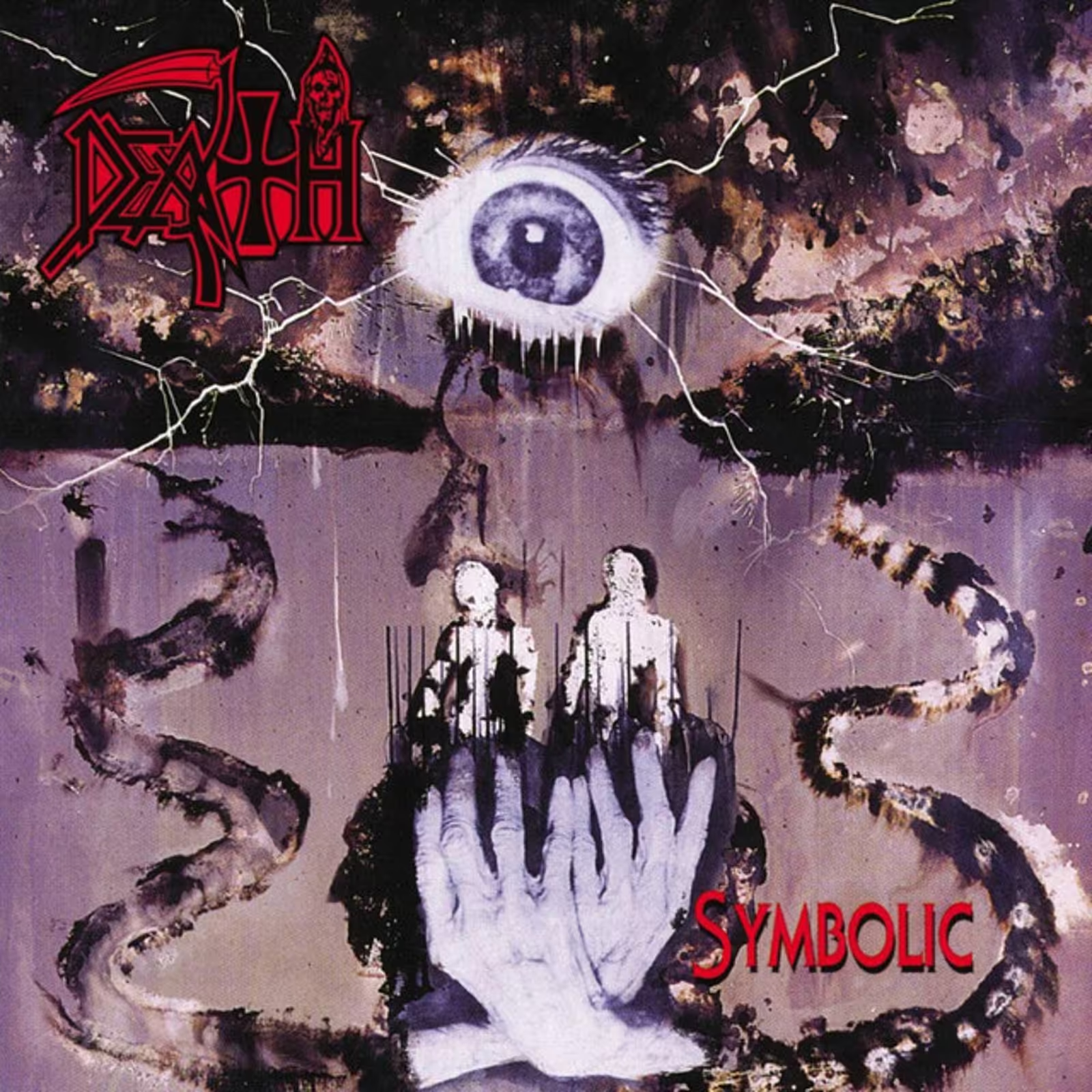
The cover of Symbolic is one of the more enigmatic in the Death catalogue. The painting and the photography are both credited to Rene Miville, with design by Patricia Mooney. The central image is a skeletal figure in a posture that could be read as either contemplation or despair, set against a layered backdrop that fades from warm to cold tones. The Death logo, redesigned by Mooney for this album, sits in a band across the upper portion of the sleeve rather than crowning it in the manner of the earlier records.
The most common reading of the image is as a memento mori, the medieval European motif in which a depiction of death serves as a reminder of life's impermanence. The album title invites that reading without insisting on it. The sleeve avoids the gore imagery that had been standard on earlier Death covers and which had drawn distributor objections in the late 1980s. In retrospect the cover anticipates the shift towards more abstract, design-led artwork that would characterise the band's remaining output and Schuldiner's subsequent Control Denied work.
Miville also shot the band photographs for the album packaging, giving the visual presentation a consistency unusual for a Roadrunner release of that era. The inner sleeve photographs are formal portraits rather than the studio snapshots common at the time, with Schuldiner, Koelble, Conlon and Hoglan presented as a working ensemble rather than four faces gathered for promotion.
Release and promotion
Roadrunner Records released Symbolic on 21 March 1995. Distribution in North America was handled via Roadrunner's arrangement with Relativity Records, an established independent distribution partner of the time. The contract was for one album. Schuldiner had taken the deal in part because Roadrunner had been the band's European home for years and in part because no other label of comparable reach was prepared to commit to extreme metal at that point in the cycle.
The promotion that followed underwhelmed everyone in the camp. Lack of Comprehension from Human and The Philosopher from Individual Thought Patterns had both received music videos. Symbolic received none, despite the album containing material that, in retrospect, looks like obvious single fodder. The title track and Crystal Mountain in particular were the kind of songs that could have been edited into something usable for the heavy metal video shows that still existed on cable in 1995. None was made. In a 1997 interview with Sentinel Steel, Schuldiner attributed the absence of promotional support to a label that had stopped prioritising the band, and in a 1998 interview with the French magazine Metallian he repeated that the lack of a video had hurt the album commercially.
Despite that, the record sold. In 1995 it reached number 30 on the UK Rock and Metal Albums chart and number 68 on the Dutch Albums chart, modest but real numbers for an album with no radio profile and no television promotion. European print press, which had always been kinder to Death than the US mainstream rock magazines, gave the album extensive coverage. In the United States the album was reviewed widely in the metal specialist press and lightly elsewhere.
The Symbolic tour
Touring began in the spring of 1995. According to Schuldiner, he, Gene Hoglan and Bobby Koelble collectively decided to remove Kelly Conlon from the band soon after the European Full of Hate Festivals run, where Conlon did play with Death, and his replacement for the North American leg was Brian Benson of the Florida band Pain Principle, an established figure on the Tampa scene who slotted in quickly enough to keep the schedule intact.
The tour took Death across Europe, North America and, for the first time in the band's history, Japan. The Japanese leg was confirmed in a piece by Francesca Fabi for the Italian magazine Metal Shock in October 1995, and remained a point of pride for Schuldiner in subsequent interviews. The set leaned heavily on the new material but kept space for back catalogue selections, with Pull the Plug and Suicide Machine appearing in most setlists. Hoglan, as ever, was the constant in the rhythm section, and his work on the road during this period cemented his reputation as one of the most reliable drummers in extreme metal.
The tour was also notable for what did not happen on it. There is no widely circulating professional live recording from the Symbolic cycle. Bootleg audience tapes exist, particularly from European dates, but no official live release captures the line-up. By the time Death next went on the road with a different group of musicians supporting The Sound of Perseverance, the Symbolic band had effectively dissolved.
Critical reception
Contemporary press in 1995 was respectful but not unanimous. The British monthly Select, in April 1995, gave the album three out of five, with PM's review concluding politely that the band were skilled but the genre's ceiling was the genre's ceiling. Most specialist metal magazines, by contrast, treated the album as a major event. Rock Hard in Germany awarded ten out of ten. The Italian and French metal press were similarly enthusiastic.
The album's standing has hardened upwards over the decades. AllMusic's Stephen Thomas Erlewine, writing retrospectively, gave it three out of five and argued that some of the riffs were starting to sound tired and that the record was not the great leap forward that Human had been, while still praising its visceral force. That review remains the most prominent reserved take. Most retrospective coverage is closer to ecstatic. Joel McIver, writing in Record Collector, awarded the album five stars and described it as close to flawless as metal gets. Keith Bergman gave it ten out of ten at Blabbermouth. Sam Sodomsky, reviewing the album for Pitchfork in 2017, awarded it 9.1 and described it as the most melodic and refined Death release, noting that Schuldiner's vocals were shouted through gritted teeth in a way more reminiscent of hardcore than of death metal.
"The most melodic and refined work of Death's career."
Sam Sodomsky, Pitchfork, 2017
Metal Hammer's Shaun Lindsley called the album a labyrinth of technicality and cerebral lyrical meanderings. WhatCulture's Matt Mills described it as the perfect union of melody, brutality and intricacy. Martin Popoff, in his Collector's Guide series, gave it eight out of ten and called it the band's most impressive and crossover-ish record. Metal Rules ranked it the seventh greatest extreme metal album of all time and the 58th greatest heavy metal album of all time.
"As close to flawless as metal gets."
Joel McIver, Record Collector
The pattern of reception is consistent: the small number of mixed reviews tend to come from generalist outlets, while the metal specialist press has trended upward over time. By 2020 it had become unusual to find a list of essential death metal albums that did not include Symbolic in the top twenty, and most placed it in the top ten.
Legacy and reissues
The first reissue of consequence arrived on 1 April 2008, when Roadrunner released the Expanded Edition. George Marino remastered the original album, and five demo tracks were added as bonus material. The bonus disc opens with Symbolic Acts, the March 1994 instrumental demo of the title track (5:55), followed by the March 1994 instrumental demos of Zero Tolerance (4:10), Crystal Mountain (4:24) and Misanthrope (5:40). The fifth bonus track is the January 1994 four-track demo of the title song with Schuldiner's vocals and programmed drums, listed again as Symbolic Acts (5:55). Steve Di Giorgio's bass on the March 1994 instrumental tracks is the headline detail for collectors, and the inclusion of the four-track home demo gave fans a first look at the album's embryonic form.
Schuldiner had, by his own admission to the Death newsletter The Metal Crusade, considered Symbolic a possible end point for the band. In a quote from that newsletter, later widely reprinted, he said that Symbolic was a great record to leave people with to prepare them for the next journey, Control Denied. The next journey turned out to be both: Control Denied's only finished album The Fragile Art of Existence arrived in 1999, but Schuldiner returned to the Death name in 1998 for The Sound of Perseverance, a record that pushed even further from death metal's root vocabulary. He died of glioma complications in December 2001, aged 34.
The album's commercial life continues. In 2025, what appears to have been a 30th anniversary vinyl reissue programme produced a remarkable cluster of European chart re-entries. In Austria the album reached number 64 on the Albums chart. In Denmark it reached number 6 on the Vinyl chart. In Germany it returned to the Albums chart at number 35 and the Rock and Metal chart at number 10. Norway saw a number 10 on the Physical chart, Hungary a number 12, Sweden a number 10 on the Vinyl chart and 19 on the Physical chart, and Croatia a number 8 on the International chart. For an album released into a niche market thirty years earlier, the figures are striking.
The musicians have scattered as careers do. Gene Hoglan has spent the years since playing for Strapping Young Lad, Dethklok, Testament and Fear Factory among many others, and is now widely cited as one of the most consequential metal drummers of his generation. Bobby Koelble returned to local Florida music after Death and has rarely been heard from in the metal press since. Kelly Conlon recorded with Monstrosity after Death and then largely stepped away from the scene. Steve Di Giorgio is still active, with credits across Testament, Sadus, Iced Earth and many sessions. Schuldiner's memory is curated by his family, particularly his sister Beth, and his guitars, notebooks and demo tapes have become museum pieces in the genre's history.
The album's afterlife in the music it inspired is harder to quantify but easier to hear. Opeth's Mikael Akerfeldt is widely cited as carrying Schuldiner's combination of melody and aggression into a different idiom, and the wave of European progressive death metal that followed in the late 1990s owes a clear stylistic debt to Symbolic. Gojira, Between the Buried and Me, Cynic's reformed line-up, Revocation, Allegaeon, Beyond Creation and a long list of technical and progressive death metal bands working today all stand in debt to the writing here. The album's specific innovations, namely the clean introductions, the modal melody, the audible bass and the lyrical seriousness, have become so embedded in the genre's grammar that newer listeners often do not realise where the conventions came from.
Things you might not know
| Fact | Detail |
|---|---|
| Koelble's only Death credit | Bobby Koelble appears on Symbolic and on no other Death studio album, making this the entirety of his Death discography. |
| Conlon's only Death credit | Kelly Conlon was hired to record the album and played the European Full of Hate Festivals tour with Death before being replaced by Brian Benson for the North American leg. He went on to play bass on Monstrosity's 1996 record Millennium and their 1999 album In Dark Purity. |
| Di Giorgio on the demos | Steve Di Giorgio, the Death bassist on Human and Individual Thought Patterns, plays bass on the March 1994 instrumental demos of Symbolic, Zero Tolerance, Crystal Mountain and Misanthrope released on the 2008 reissue, despite not appearing on the album itself. |
| Schuldiner programmed his own drums | The January 1994 four-track demo of the title track features Schuldiner on every instrument with a programmed drum part standing in for Hoglan. |
| Hoglan's last Death album | Symbolic is the second and final Death studio album with Gene Hoglan on drums, after Individual Thought Patterns. He did not return for The Sound of Perseverance. |
| First Death tour of Japan | The 1995 Symbolic touring cycle included Death's first ever shows in Japan, confirmed in a Metal Shock interview by Francesca Fabi published in October 1995. |
| One-record Roadrunner deal | The Roadrunner contract that delivered Symbolic was a one-album commitment, not a multi-record deal, and was not renewed afterwards. Death moved to Nuclear Blast and Metal Blade for The Sound of Perseverance. |
| No music video | Despite previous Death singles The Philosopher and Lack of Comprehension having received videos, no Symbolic track was promoted with a video, a decision Schuldiner blamed publicly on the label in subsequent interviews. |
| One artist for cover and photography | Rene Miville is credited with both the cover painting and the band photography on the original 1995 packaging, a single visual sensibility unusual for a Roadrunner release of the period. |
| George Marino mastered both versions | George Marino mastered the original 1995 release and was brought back to remaster the 2008 Roadrunner Expanded Edition, giving the album a consistent mastering signature across reissues. |
| Crystal Mountain's European debt | The melodic vocabulary of Crystal Mountain owes more to the mid-1980s French heavy metal bands Sortilege and H-Bomb than to any death metal antecedent, a connection Schuldiner acknowledged in interviews. |
| Schuldiner planned it as the end | Schuldiner told the Death newsletter The Metal Crusade that he had viewed Symbolic as a great record to leave people with before he turned to Control Denied, suggesting the album was originally intended to close the Death chapter. |
Closing thought
Thirty years on, Symbolic is the Death album most often recommended to a curious listener who has heard the name and does not know where to start. It is also the album most cited by the generation of bands, from Opeth and Gojira to Between the Buried and Me, who absorbed Schuldiner's lessons about melody and structure and built careers on the foundations. The line-up that made it never played together again. The label that released it stopped pushing it within months. The frontman who wrote it died six years later. None of that has stopped the record. If anything, the chart re-entries of 2025 suggest Symbolic is in the early decades of a long second life.
Comments