
In February 1988 a twenty year old Max Cavalera stepped off a long haul flight at JFK with a battered cassette of demos in his bag and a poor grasp of English, walked into the Roadrunner Records office in midtown Manhattan, and walked out with a seven album contract that no other Brazilian metal band of his generation could even imagine. Ten months later, with eight thousand dollars on the table and a Florida engineer flying south with a flight case full of Mesa Boogie heads, his band Sepultura began nightshift sessions in a Rio de Janeiro studio that had previously hosted bossa nova and tropicalia singers. The record they cut over fourteen days in December 1988 was Beneath the Remains, and within two years it had been certified as the first thrash album from outside Europe or North America to stand without apology beside Reign in Blood and Master of Puppets.
That story did not start in a studio. It started in Belo Horizonte, a hilltop city in the interior state of Minas Gerais, in a country still recovering from twenty one years of military dictatorship and now in the throes of hyperinflation that would reach four figures by the end of 1989. The Brazil that produced Beneath the Remains had record shops that could not reliably stock Kreator or Slayer imports, customs officials who treated heavy metal LPs as contraband, and a national currency that lost a third of its value during the fortnight Sepultura were actually tracking the album. The improbable fact of the record is not that it exists at all but that it sounds, when you drop the needle, like a band who had no idea any of that was a disadvantage.
Album facts
| Field | Detail |
|---|---|
| Artist | Sepultura |
| Album | Beneath the Remains |
| Release date | 7 April 1989 |
| Label | Roadrunner Records (Roadracer in the US) |
| Producers | Scott Burns and Sepultura |
| Studios | Nas Nuvens Studio, Rio de Janeiro (recording, 15 to 28 December 1988); Morrisound Recording, Tampa, Florida (mixing, January 1989) |
| Engineer | Scott Burns, with Antoine Midani as assistant engineer |
| Mixing | Tom Morris, Scott Burns and Max Cavalera |
| Executive producer | Monte Conner |
| Genre | Thrash metal, death metal |
| Tracks | 9 (10 on CD with bonus cover) |
| Runtime | 41:48 |
| UK Indie Chart peak | 9 |
| Other chart peaks | Germany Offizielle Top 100 number 96; Hungary MAHASZ number 22; Croatia Foreign Albums number 3 (reissue entries) |
| Budget | Roughly 8,000 dollars, ending at close to double that |
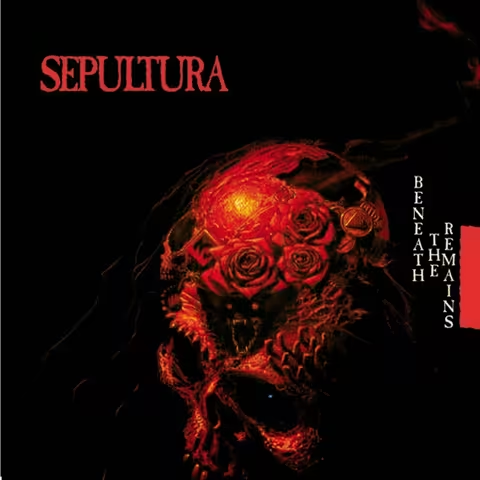
| Cover art | Nightmare in Red, by Michael Whelan |
| Singles | None; one promotional music video for Inner Self |
| Accolades | AllMusic 4.5 out of 5; Decibel Hall of Fame, January 2013 |
From Belo Horizonte to a Roadrunner deal
Sepultura formed in 1984 around the Cavalera brothers, Max on rhythm guitar and Igor on drums, both still living at home in the working class Bairro Santa Tereza district of Belo Horizonte. Their father had died unexpectedly in 1980 and the family was scraping by; the band name, Portuguese for grave, was lifted in part from the lyrics of Motorhead's Dancing on Your Grave. Bassist Paulo Jr. came in early, lead guitarist Jairo Guedz completed the original quartet, and within a year the four teenagers had recorded the split EP Bestial Devastation alongside fellow locals Overdose for the Belo Horizonte label Cogumelo Records.
The earliest Sepultura output sounded like what it was: a band who had spent more time listening to dubbed cassettes of Venom, Hellhammer and Bathory than to anything available in a Brazilian record shop. Morbid Visions, their first full length, arrived on Cogumelo in 1986 with first wave black metal imagery and a production so murky that drum hits read as a single thud. It did, however, travel. Sepultura's appetite for trading tapes with fanzine networks in Europe and the United States meant the LP reached Roadrunner's New York office in late 1986, and by the time of the follow up, Schizophrenia, the band had already started fielding interest from the Dutch label that would shortly become Roadrunner Records proper.
Schizophrenia, released by Cogumelo in 1987, was the turning point. Jairo Guedz had left, replaced by the seventeen year old Andreas Kisser from Sao Paulo, a player whose disciplined approach to scales and harmony immediately reshaped the band's writing. The Schizophrenia sessions, recorded at JG Studios in Belo Horizonte across late 1987 with engineer Joao Vianna, sounded astonishingly tight for a band whose previous studio time had been counted in hours rather than days. Tracks like From the Past Comes the Storms and Inquisition Symphony married Slayer's tempo to a Brazilian percussive instinct, and the production, while still primitive by international standards, finally let Igor's double kick patterns breathe.
Monte Conner, then a young A and R man at Roadrunner Records, had been tracking the band since the Morbid Visions cassette landed on his desk. When a copy of Schizophrenia arrived in mid 1987 he played it for the label's owner Cees Wessels and pushed hard for a deal. The terms were unusual by metal standards of the period: a seven album commitment, a modest advance, and the promise of a properly budgeted production for the next record. To finalise it, Max Cavalera flew alone to New York in February 1988, his first time outside South America, and signed the contract in person at the Roadrunner office. He spoke later about staring at the skyscrapers in disbelief from the back of a cab on the way back to JFK and wondering whether the label would still be there when he came home.
Choosing Scott Burns and Nas Nuvens
Conner had a producer in mind. Scott Burns was a thirty year old Florida engineer who had moved through a sequence of demo and EP credits at Morrisound Recording in Tampa, the small commercial studio owned by brothers Tom and Jim Morris that had quietly become the world centre of death metal. By late 1988 Burns had already worked on Death's Leprosy, Obituary's Slowly We Rot and a clutch of Morbid Angel demos, and his name on a record sleeve was beginning to function as a genre marker on its own. The Burns sound, a wall of detuned guitars sitting on a punishingly compressed kick drum, was exactly what Conner thought Sepultura needed.
Burns himself was less interested in money than in travel. The fee Roadrunner offered for the album was two thousand US dollars, well below his Morrisound rate, and he accepted it largely because he had never been to Brazil and wanted to see the country. He flew to Rio in early December 1988 with a hard case full of microphones, a personal pair of Mesa Boogie Mark II C heads, his own snare drum and a set of trigger pads, on the reasonable assumption that nothing he needed would exist in a Brazilian studio. Even the multitrack tape stock travelled with him.
The choice of Nas Nuvens, perched in the Botafogo neighbourhood of Rio de Janeiro, was made for two reasons. The first was that the city offered something Belo Horizonte and Sao Paulo did not: a studio with a Studer twenty four track machine that had been kept in working order. The second was cultural cover. Nas Nuvens was best known for sessions by the post punk and pop rock bands of the Brazilian Rock movement, including Titas, whose 1986 album Cabeca Dinossauro had been recorded there. If a label A and R man in New York needed to be reassured that the Brazilian end of the budget was being spent on a real studio, Nas Nuvens was a name he could point to. Sepultura, conversely, had to be reassured by Conner that Burns was the right man for the job. Years later Max Cavalera recalled that they had been hoping to fly to Florida and record at Morrisound itself; the compromise of bringing Burns and a Morrisound flight case south was, in the end, what the budget allowed.
Inside the sessions: 8pm to 5am in Rio
Tracking ran from 15 December to 28 December 1988, fourteen consecutive nights with sessions starting at eight in the evening and breaking up at five the following morning. The schedule was practical rather than romantic. Rio in December is a furnace, with daytime temperatures north of thirty five degrees Celsius and a humidity that turns guitar tuning into a moving target; the studio's air conditioning could just about hold a stable temperature once the sun had set. The band, all of them in their early twenties, slept through the day in a rented apartment a short drive from the studio and worked through the night.
The language barrier between Burns and the band was substantial. Max Cavalera had enough English to function as the band's spokesman; Igor had less; Paulo Jr. and Andreas Kisser had almost none. Antoine Midani, the assistant engineer assigned to the session by Nas Nuvens, became the de facto translator, fielding Burns's requests for snare changes or guitar re amps in Portuguese and relaying the band's responses back. The conversations Burns later remembered most clearly were not technical at all but the long predawn breakfasts when somebody would attempt, in halting English, to explain a lyric.
The recording method was conservative for the period and direct. Igor's kit was tracked first across two or three nights, with Andreas playing scratch rhythm guitar in the live room to give him a reference. Burns triggered the kick and snare to internal samples, a technique he had developed at Morrisound, which gave the drums their characteristic uniform thud across the album. Rhythm guitars followed, double tracked through the Mesa Boogie heads Burns had brought from Florida, with Andreas handling the bulk of the parts and Max overdubbing his own rhythms once the foundation was down. Lead guitars and solos were last.
The most often discussed fact of the sessions concerns the bass. Paulo Jr., listed in the sleeve credits as bassist, did not play on the album. Andreas Kisser, the band have confirmed in interviews across multiple decades, performed all of the bass parts himself, working at speed in the final nights of the sessions. The reasons vary depending on the source and the interview, ranging from a polite suggestion that Paulo had no parts written in time to a less polite suggestion that he had not been turning up consistently to rehearsals; what is not in dispute is that the credit on the sleeve does not match what came off the tape.
The budget, originally set at eight thousand dollars for tracking and mixing combined, was already in trouble by Christmas. Studio time at Nas Nuvens cost more than Roadrunner had estimated, the Florida shipping costs for Burns and his gear had eaten into the contingency, and the band were paying for accommodation and food out of the same envelope. By the time the multitracks were ready to fly to Tampa for mixing the project had climbed to something close to sixteen thousand dollars, with the overage split between Roadrunner and a personal advance Max negotiated against future royalties. Igor later described the budget situation as "the kind of crisis that becomes funny only ten years later".
- Two Mesa Boogie Mark II C heads brought from Florida by Scott Burns
- Tama drum kit with Burns supplied triggers on kick and snare
- Studer A800 twenty four track at Nas Nuvens
- SSL desk at Morrisound for the mix
- Shure SM57 on guitar cabs; AKG D112 on kick; Sennheiser MD 421 on toms
Mixing at Morrisound, January 1989
The master tapes flew north with Burns on the last day of December. Mixing took place at Morrisound Recording on East Sligh Avenue in Tampa across the first three weeks of January 1989, with Tom Morris at the desk and Burns and Max Cavalera credited alongside him on the mix. Max was the only member of the band physically present, having been flown up by Roadrunner on a separate ticket so that he could sign off on the final balances. Igor, Andreas and Paulo Jr. stayed in Brazil and waited for cassette dubs to arrive in the post.
The contrast with Nas Nuvens was immediate. Morrisound in early 1989 was running back to back death metal sessions and the room was set up for the kind of dense, low end heavy mix that defined the emerging Florida sound. Tom Morris, the older of the Morris brothers and the more experienced engineer, brought the sort of corrective ear that the Rio tracking had needed: he tightened the bass guitar, brought the snare further forward in the mix, and gave Andreas's solos a top end clarity that the original tracking had buried. The mastering, again at Morrisound, gave the record a perceived loudness on a domestic stereo that no previous Sepultura release had come close to.
The choice to mix outside Brazil was not made for prestige. It was simply that nowhere in Brazil at the start of 1989 could deliver an extreme metal mix of the standard Roadrunner needed for export. The decision had a consequence that the band came to regret only later: the Morrisound mix gave the album a sonic uniformity with its Floridian death metal contemporaries that, at the time, helped place it on American radio playlists and in the right international magazines, but which has since been read by some critics as having sanded away a Brazilian roughness that the Schizophrenia sessions had captured.
Track by track
Beneath the Remains runs to nine tracks on the original 1989 vinyl pressing and forty one minutes and forty eight seconds in total. A tenth track, a cover of the Os Mutantes song A Hora e a Vez do Cabelo Nascer recorded for the 1989 Brazilian tribute album Sanguinho Novo: Arnaldo Baptista Revisitado, was added as a CD bonus on the original Roadrunner CD pressing and has appeared on most reissues since.
| Track | Title | Writers | Length | Notes |
|---|---|---|---|---|
| 1 | Beneath the Remains | Music: Sepultura; Lyrics: Max Cavalera and Andreas Kisser | 5:17 | Acoustic guitar intro by Andreas Kisser into one of the band's fastest riffs |
| 2 | Inner Self | Music: Sepultura; Lyrics: Max Cavalera | 5:08 | Lyrics about Brazilian poverty; the album's only music video |
| 3 | Stronger Than Hate | Music: Sepultura; Lyrics: Kelly Shaefer | 5:51 | Guest vocals from Kelly Shaefer (Atheist), John Tardy (Obituary), Scott Latour and Francis Howard (Opprobrium) |
| 4 | Mass Hypnosis | Music: Sepultura; Lyrics: Max Cavalera | 4:31 | Henrique Portugal credited on synthesizers |
| 5 | Sarcastic Existence | Music: Sepultura; Lyrics: Max Cavalera and Igor Cavalera | 4:43 | Mid tempo by the album's standards, with one of Andreas Kisser's most melodic solos |
| 6 | Slaves of Pain | Music: Sepultura; Lyrics: Max Cavalera | 4:00 | Compact and brutally direct; a fan favourite live |
| 7 | Lobotomy | Music: Sepultura; Lyrics: Andreas Kisser | 4:43 | Andreas Kisser's most identifiable songwriting contribution to the record |
| 8 | Hungry | Music: Sepultura; Lyrics: Max Cavalera and Igor Cavalera | 4:15 | Lyrically the bluntest track; written in the rehearsal room in a single afternoon |
| 9 | Primitive Future | Music: Sepultura; Lyrics: Max Cavalera | 3:20 | Apocalyptic closer with the album's only piece of spoken word vocal |
| 10 (CD) | A Hora e a Vez do Cabelo Nascer | Arnolpho Lima Filho | n/a | Os Mutantes cover, originally cut for a separate Arnaldo Baptista tribute compilation |
The opening title track is the strongest evidence on the record of how much Andreas Kisser had changed the band. The thirty four seconds of acoustic flamenco style finger picking that precede the first downbeat are not a stylistic flourish from a band desperate to seem sophisticated; they are a deliberate echo of the Brazilian classical guitar tradition Kisser had grown up listening to in Sao Paulo, dropped onto the front of a song that then accelerates to two hundred beats per minute and never relents. Max's lyric, written in collaboration with Kisser, takes nuclear war as its surface subject and reads in retrospect as a sketch of the late Cold War paranoia that was about to dissolve under Gorbachev's hand.
Inner Self has carried the album commercially. Its riff, a chromatic descent built around a syncopated palm mute pattern that Andreas had been demoing since the Schizophrenia tour, is the only thing on Beneath the Remains that would in time end up in a guitar method book. Max's lyric, in a deliberately broken English that he was still in the process of learning, looks directly at the Brazilian economic crisis: lines about a country eating its own and children sleeping under bridges were written about a Belo Horizonte that hyperinflation had reduced to barter. The song's promotional video, shot in Sao Paulo in March 1989, would within months be playing on heavy rotation on the MTV programme Headbangers Ball.
Stronger Than Hate has the most unusual provenance on the record. Kelly Shaefer of the Florida band Atheist sent Sepultura a typed lyric sheet by post in mid 1988, an antiracist polemic written in plain English that Max felt he could not improve. The song was recorded with a guest backing vocal arrangement involving Shaefer himself, John Tardy of Obituary, and Scott Latour and Francis Howard, the brothers behind the New Orleans band Opprobrium (then trading as Incubus). The vocal pile up at the chorus is one of the most identifiable moments on the album. Sepultura have credited Henrique Portugal, then the keyboard player in the Brazilian rock band Skank, with the brief synth lines that surface on Mass Hypnosis.
The deeper cuts repay attention. Sarcastic Existence is the closest the album comes to a mid tempo groove, with a chorus riff that anticipates the rhythmic muscle of Arise. Lobotomy, written by Andreas, has a quasi progressive structure with three discrete riff sections and one of the few solos on the record that is built around a melodic theme rather than a scalar run. Primitive Future, the closing track, was the last song written and was finished in the studio after Max ran out of material a week into tracking; its lyric, about a dystopian Brazil ten years on, has aged into something closer to documentary than science fiction.
The Nightmare in Red cover
The painting on the front of Beneath the Remains is not a Sepultura commission. Nightmare in Red is the work of the American science fiction and fantasy illustrator Michael Whelan, executed in acrylics over pastels in 1986 and originally created without an album sleeve in mind. The band came to it sideways. Their first choice for the cover had been a different Whelan painting, Bloodcurdling Tales of Horror and the Macabre, an image of a skeletal figure climbing out of an open book that Igor Cavalera had already had tattooed on his arm. Roadrunner approached Whelan's representation, were quoted a licensing figure, and reported back to the band that the rights would not be granted for a metal album sleeve.
The eventual choice was Monte Conner's. Conner had a Whelan art book on his shelf, leafed through it looking for a substitute, and identified Nightmare in Red as a piece that shared the same painterly quality with a subject more in keeping with Beneath the Remains as an album title. The painting, a tableau of grotesque human figures in a red lit interior with what appears to be a shrouded body in the foreground, was licensed without any modification beyond the addition of the band logo and album title. The original Schizophrenia logo, in a vaguely Gothic script, was redrawn in the bone white block lettering that has been the band's main logo ever since.
The Bloodcurdling Tales painting was not wasted. Roadrunner eventually licensed it for Obituary's 1990 album Cause of Death, which means that the image Igor Cavalera had tattooed on himself in 1988 ended up on the front of a Roadrunner labelmate's record eighteen months later. The wider Sepultura sleeve credits on Beneath the Remains list Glen Wexler for photography, with band shots taken in Rio on the days before mixing began. The original LP came in a single sleeve with a printed inner; later CD pressings have varied in their packaging across the Roadrunner reissue cycle.
Release, the Inner Self video and Headbangers Ball
Beneath the Remains was released on 7 April 1989, on Roadrunner in Europe and Roadracer in the United States. There were no singles in the traditional commercial sense. Roadrunner did press a small run of promotional twelve inch records for radio in the United Kingdom, and the band shot a single promotional video, for Inner Self, in Sao Paulo in March 1989 on a budget reported at the time as in the low single thousands of dollars. The video, directed by the Brazilian filmmaker Carlos Romeu, was a straightforward performance clip of the band miming the song in a derelict warehouse, intercut with footage of the favelas and street markets of Sao Paulo.
The Inner Self video changed the band's commercial trajectory. MTV's Headbangers Ball, then hosted by Riki Rachtman and broadcasting on Saturday nights to a national American audience, picked it up in the summer of 1989 and rotated it for the rest of the year. For most of the show's viewers it was the first Brazilian metal band they had heard of, and the spectacle of a guitarist with no English giving a one minute interview through a translator was a regular fixture of the show's tour cycle coverage. In the United Kingdom the album reached number 9 on the UK Indie Chart in the spring of 1989, its highest contemporary placing anywhere in the world; later European reissue chart entries in Germany, Hungary and Croatia followed.
The band's first international tour followed in the autumn of 1989, opening for the German thrash band Sodom on a European run that took them through Germany, the Netherlands, Belgium and the United Kingdom. It was the first time any member of Sepultura had played to a non Brazilian audience and the first time any of them had eaten in a restaurant that listed prices in deutschmarks. The tour bus broke down repeatedly, equipment failures forced cancelled support slots in Hamburg and Cologne, and Max Cavalera lost his voice for three consecutive nights in Belgium. They came home tired, considerably better as a live band, and aware that the next record needed to be bigger.
Reception and legacy
Contemporary reviews were mixed in the way that any extreme metal album from outside the United States and Europe was likely to be in 1989. Q magazine, in its short capsule review, awarded three stars and noted the band's "willingness to fold a Brazilian rhythmic instinct into a Bay Area template". Kerrang! ran a longer piece by Steffan Chirazi that placed the album alongside the year's stronger thrash releases. Metal Forces reviewed it positively but pointed out, fairly, that the production was the work of a Floridian engineer and that the most distinctively Brazilian sounding moments were on Schizophrenia rather than the new record.
The retrospective reception has been less hedged. Eduardo Rivadavia's AllMusic review, written for the database after the fact, awarded four and a half stars and described Beneath the Remains as "one of the most essential death/thrash metal albums of all time", a position that subsequent revisions of the review have not softened. Decibel magazine inducted the album into its Hall of Fame in January 2013, making it the second Sepultura album to take that honour after Roots, and ran a long oral history by J. Bennett in which Burns, the Cavalera brothers, Kisser and Conner reconstructed the sessions for the first time on the record.
"Beneath the Remains is one of the most essential death/thrash metal albums of all time."
Eduardo Rivadavia, AllMusic
In best of the eighties polling among the metal press, Beneath the Remains has settled into the second tier of the decade's thrash canon, ranked consistently below Reign in Blood and Master of Puppets but routinely above the band's own Schizophrenia and ahead of most of the European thrash records of the period. The Rolling Stone "100 Greatest Metal Albums of All Time" list of 2017 placed it at number 28; the Loudwire list of the same year placed it at 20. The album has been a touchstone for the Latin American extreme metal scenes that grew in its wake, with members of Krisiun, Brujeria and a generation of younger Brazilian bands citing it as the moment a Brazilian metal record proved it could be heard internationally without apology.
Why Beneath the Remains still matters
The follow up, Arise, arrived in 1991, recorded by the same lineup with Burns again at Morrisound, this time in Tampa from the start and on a budget closer to fifty thousand dollars. It went on to outsell Beneath the Remains in most territories. Chaos A.D. in 1993 took the band further into groove metal and politically explicit songwriting, and Roots in 1996 brought in Brazilian percussionists and the Xavante people for a record that fused tribal rhythms with the band's metal vocabulary. Max Cavalera left at the end of 1996 after a dispute over management following the death of his stepson Dana Wells, founding Soulfly the following year. Igor Cavalera left in 2006. The current lineup, fronted by Derrick Green since 1998, has continued to record and tour, and announced a farewell world tour in 2024 that will run into 2026.
None of those later records can detach Beneath the Remains from its position as the first Sepultura album that the rest of the world heard properly. The influence is traceable in two directions. Within Brazil, it established that a metal band from the interior could sign to a major international label, record with an internationally credentialled engineer, and reach a US television audience; the Krisiun brothers have been explicit about hearing Inner Self on Headbangers Ball as the moment they decided to form a band. Outside Brazil, it placed the production sound of Morrisound and Scott Burns alongside the songwriting traditions of the Bay Area and the Ruhr, and made the case that the genre's geography had widened in a permanent way.
The record's continued canonical status owes something to its compactness. Forty one minutes, nine tracks, no obvious filler, an opening title track that begins with acoustic guitar and ends with one of the era's strongest riff progressions; it has the kind of clean, self contained shape that long playing thrash records of the late eighties often do not. Listen to it now on a modern stereo and the Morrisound polish reads less as a glossing over than as a deliberate, honest piece of engineering that has aged better than the production on many of its contemporaries. The album survives because it is short, because it is direct, and because nothing in it is wasted.
Things you might not know
| Fact | Detail |
|---|---|
| The budget | The album was made for around eight thousand US dollars, and finished at close to sixteen thousand once the Tampa mixing costs were added. |
| Scott Burns's fee | Scott Burns took the production job for a two thousand dollar fee, largely because he had never been to Brazil and wanted to see the country. |
| The uncredited bassist | Andreas Kisser played all of the bass parts on the album; Paulo Jr. is credited on the sleeve but did not perform. |
| The wrong cover | The band's first choice for the sleeve was a different Michael Whelan painting, Bloodcurdling Tales of Horror and the Macabre, which Igor Cavalera had already had tattooed on his arm. |
| The right cover, recycled | The Bloodcurdling Tales painting later appeared on Obituary's 1990 album Cause of Death, also on Roadrunner. |
| Max's flight to New York | Max Cavalera signed the seven album Roadrunner contract in person in Manhattan in February 1988; it was his first time outside South America. |
| The nightshift schedule | Tracking sessions at Nas Nuvens ran from 8pm to 5am for fourteen consecutive nights, partly to escape the December heat in Rio. |
| The bonus track | The CD bonus, A Hora e a Vez do Cabelo Nascer, is an Os Mutantes cover recorded for a Brazilian tribute compilation to Arnaldo Baptista. |
| The guest vocal pile up | Kelly Shaefer of Atheist wrote the lyrics to Stronger Than Hate and sings on it alongside John Tardy of Obituary and the Latour and Howard brothers of Opprobrium. |
| Decibel Hall of Fame | The album was inducted into the Decibel Hall of Fame in January 2013, the second Sepultura album to receive the honour after Roots. |
| Headbangers Ball | The Inner Self video was rotated heavily on MTV's Headbangers Ball through the summer and autumn of 1989, the band's first significant exposure outside South America. |
| The first overseas tour | The band's first European dates, in autumn 1989, were as support to the German thrash band Sodom. |
Listen to the podcast
The Riffology podcast episode on Beneath the Remains takes the same fourteen night Rio session as its starting point and works through the album track by track with the same fact base used in this article. The episode embeds at the top of this page on every platform; the full back catalogue of Riffology is also available on Spotify, Apple Podcasts, Pocket Casts and every major podcast directory under the name Riffology.
Comments