Owen Morris was sitting in a Manchester pub in the spring of 1994 when his old friend Marcus Russell rang in a state somewhere between exhaustion and panic. Creation Records had spent weeks at a residential studio in the Welsh borders trying to make an album with an unsigned Manchester band that nobody outside the office quite believed in yet, and the tapes that had come back sounded, in the kindest possible reading, thin. The band were furious, the label was haemorrhaging money it did not have, and the producer they had hired off the back of his work with Big Country had been quietly let go. "I just thought, they have messed up here," Morris later recalled. "Marcus was like, you can do what you like, literally, whatever you want."
Those tapes would become Definitely Maybe. The band were Oasis. The four days Morris spent locked in a Fulham mixing room over the May bank holiday would salvage what is now, by almost any measure that matters, the fastest-selling debut album in British music history and the record that lit the touchpaper on Britpop's commercial peak. None of that was visible in May 1994. Creation was carrying nearly two million pounds of debt. The album sleeve had been shot in a guitarist's front room in Didsbury with a glass of Ribena standing in for red wine. The drummer had three songwriting credits and would be out of the band within a year. And the lead singer had spent most of February in a Welsh cottage complaining about a ghost.
Album facts
| Field | Detail |
|---|---|
| Artist | Oasis |
| Album | Definitely Maybe |
| Release date | 29 August 1994 |
| Label | Creation Records (UK); Epic (US) |
| Producers | Owen Morris, Oasis, Mark Coyle, David Batchelor |
| Studios | Clear and Out of the Blue (Manchester); Monnow Valley (Rockfield, Wales); Sawmills (Cornwall); Pink Museum (Liverpool); Studio 5 at Matrix (Fulham, London) |
| Mixed by | Owen Morris (Matrix, Fulham) |
| Mastered by | Barry Grint at Abbey Road Studios, London |
| Genre | Britpop, rock |
| Track count | 11 |
| Total runtime | 51:57 |
| UK Albums Chart peak | 1 (entered 4 September 1994) |
| US Billboard 200 peak | 58 |
| Other notable peaks | Ireland 3; Sweden 4; New Zealand 5; Iceland 15; Italy 18; Australia 23; Germany 33; Norway 34 |
| Certifications | UK 10x Platinum; Europe 2x Platinum; US, Japan, Australia, Canada, Italy, New Zealand all Platinum; France 2x Gold |
| Estimated sales | Over 15 million copies worldwide |
| Key singles | Supersonic, Shakermaker, Live Forever, Cigarettes and Alcohol |
Britain in 1993: the gap Oasis walked through
To understand why Definitely Maybe landed the way it did, it helps to remember how empty the room was. In the autumn of 1993, when Oasis began their first proper recording sessions, the British album charts were dominated by Meat Loaf's Bat Out of Hell II, Take That's Everything Changes and Bryan Adams's So Far So Good. Suede had released their debut in March and won the Mercury Prize, but the band whose name was supposed to define the next era, Blur, had stalled commercially with Modern Life Is Rubbish and were already booked into Maison Rouge to record the follow-up. Pulp were still on Island, still building. Grunge had peaked. Nirvana's In Utero was less than two months old and Kurt Cobain had less than half a year to live.
Creation Records, meanwhile, was technically insolvent. The label had been built on the back of Primal Scream's Screamadelica and bled dry by My Bloody Valentine's Loveless, two records of enormous artistic prestige and negligible cash return. By the end of 1992, Creation was reportedly two million pounds in debt, a hole that had been temporarily plugged by a forty-nine per cent stake sold to Sony's Epic Records. Alan McGee, the label's co-founder, was officially in a period of clean living after a long stretch of the opposite, and was on a sleeper train to Glasgow when he reportedly stopped off at King Tut's Wah Wah Hut in May 1993, watched Oasis play a four-song set they had bullied their way onto, and signed them on the spot. That story has been embellished over the years by everyone involved, but the contract was real, the advance was modest, and the McGee belief was total.
The band McGee saw that night had been called Rain when Bonehead, Guigsy and Tony McCarroll had recruited Liam Gallagher as their singer in 1991. Liam had renamed them Oasis, supposedly after an Inspiral Carpets tour poster on his bedroom wall. Noel, four and a half years older and at that point a roadie and guitar tech for the Inspirals, had been writing songs in hotel rooms across Europe and had no band of his own to give them to. Family legend insists that he agreed to join his younger brother's group only on the condition that he wrote all the songs and made every important decision about how they sounded. By the end of 1993, that condition had paid out enough that he was being driven to a Welsh studio with a fistful of demos that already included Live Forever, Slide Away, Rock and Roll Star, Shakermaker, Bring It On Down, Up in the Sky and Married with Children, almost the entire spine of an album.
Pink Museum: Supersonic before the album started
The first piece of Definitely Maybe to be properly recorded was not strictly part of the album sessions at all. In December 1993, the band travelled to the Pink Museum Studios in Liverpool with Mark Coyle, their live engineer, to cut their debut single. The track Sony wanted was a song called Bring It On Down. Noel, in a now-famous bit of self-mythology, sat in the canteen after dinner on the second night and wrote Supersonic in less than half an hour, using whatever was in the kitchen as lyrical raw material. Whether the gin and tonic, the elephant called Elsa and the yellow submarine arrived in that order or in some other is the kind of thing Oasis biographers argue about. The song existed by morning. They cut it that night, in essentially one take, and shelved Bring It On Down for the album.
Anthony Griffiths from the Liverpool band the Real People, who were friends of Oasis and who had let them rehearse in their basement, came in to add backing vocals to the chorus. The B-side was Take Me Away, a sweet acoustic Noel vocal that already hinted at the soft underbelly of the catalogue. Supersonic was released on 11 April 1994 and entered the UK chart at number 31. It was not, on those numbers, a hit. It was, however, instantly the kind of single that other guitar bands started playing in their van. The deal was sealed.
Monnow Valley: the residential disaster
The plan from there was almost conventional. Sony, on Creation's behalf, booked the band into Monnow Valley, the residential studio at Rockfield in Monmouthshire, and hired David Batchelor to produce. Batchelor had engineered for the Sensational Alex Harvey Band in the 1970s and had recently produced Big Country, whose stadium-rock sheen was very much not what Oasis sounded like in a room. The sessions ran through January and into February 1994 at a reported eight hundred pounds a day. They were not happy.
Bonehead later described the experience as the moment they realised the gap between what they sounded like live and what came back through a pair of expensive monitors. "We were playing like we always played," he said. "It was sounding thin. Weak. Too clean." Batchelor's instinct was to separate instruments, isolate the kit, get clean signal paths and tame Noel's wall of guitars. The band's instinct was to play loud, in one room, into one another's amps. The arguments were constant. The engineer, a Welshman called Dave Scott, was fired by Batchelor partway through the sessions after two separate clashes during the recording of Slide Away. Scott was later informed, with a particular slice of irony, that Slide Away was the only thing from those weeks that made it onto the finished record.
The other lasting feature of the Monnow Valley sessions, in Liam's later telling, was a ghost. He has told the story in various forms over the years and never deviates from the central claim that something walked the corridors of the cottage at night. Whether that was an entity, a creak in the floorboards or the second bottle of cider is unrecorded. By the end of the sessions, neither the band nor Creation were happy. Sony rejected the tapes. Batchelor was off the record. Marcus Russell, the band's manager, had to find someone to start again.
Sawmills: do it like a gig
In February 1994 the band relocated to Sawmills, a converted watermill in Cornwall accessible only by boat at high tide, with Noel and Mark Coyle now formally producing. The brief was simple. Forget separation. Forget studio polish. Set up in one room, play it like a gig, get a basic track down, and then let Noel do whatever he wanted on top. The basics were tracked live with very little soundproofing between instruments. McCarroll's drums bled into Guigsy's bass. Bonehead's rhythm guitar bled into everything. That was the point.
What followed was Noel's preferred half of the process. Bonehead has described it bluntly. "That was Noel's favourite trick. Get the drums, bass and rhythm guitar down, and then he would cane it. Less is more did not really work then." Layer upon layer of lead guitar, doubled rhythm parts, harmony lines and backing vocals went down onto the multitrack. By the end of the Sawmills sessions the band had a record that finally felt like them as a live unit, but also a record that, when played back at volume, sounded busy in a way nobody had quite cracked how to mix.
That was the state of things when Marcus Russell phoned Owen Morris.
Owen Morris and the Matrix mix
Morris was not a famous producer in 1994. He had engineered for New Order and worked at Johnny Marr's Manchester studio. What he had was an ear for compressed, in-the-red, drum-led pop records and the kind of confidence that comes from being twenty-six and being told he could do anything he liked. He took the Sawmills tapes, stripped a sizeable proportion of Noel's overdubbed guitars away again, added eighth-note tape-delay slap to the snare in a trick borrowed from Phil Spector's work on John Lennon's Instant Karma, and reached for an Eventide Harmoniser, the same box Tony Visconti had used on David Bowie's Low.
For the bass he did something cleverer. Guigsy was, by general consent, not the tightest player in the world. Morris routed the bass signal through a Minimoog and rolled the top end out, masking the imprecision and giving the low end a thick analogue glue that locked the rest of the record together. The whole mix was then compressed to a degree he has since admitted was, in his words, "more than would normally be considered professional". The result was a record that hit a domestic stereo like a single brick. It was supposed to. Morris was working in part at Johnny Marr's place in Manchester during the mix and Marr, in Morris's recollection, was appalled by how in your face the whole thing was, and questioned in particular the choice to leave the audible studio background noise at the very start of Cigarettes and Alcohol. Morris kept it.
The final mix was completed at Studio 5 in Matrix in Fulham over the May bank holiday weekend on a vintage Neve console. The album was mastered by Barry Grint at Abbey Road. Marcus Russell delivered the lacquers. The record was out by late August.
Personnel and credits
| Role | Player | Notes |
|---|---|---|
| Core band | ||
| Lead vocals | Liam Gallagher | Tambourine on several tracks |
| Lead guitar | Noel Gallagher | All songs written by; backing vocals; bass guitar on Up in the Sky and Slide Away |
| Rhythm guitar | Paul "Bonehead" Arthurs | Piano on Live Forever and Digsy's Dinner; 1980s Epiphone Riviera used throughout |
| Bass guitar | Paul "Guigsy" McGuigan | Routed through a Minimoog during mixing |
| Drums | Tony McCarroll | Ejected from the band in early 1995; partial credit on Morning Glory's Some Might Say |
| Guest musicians | ||
| Backing vocals | Anthony Griffiths | The Real People; chorus of Supersonic |
| Production and engineering | ||
| Producer | Owen Morris | Final mix and additional production at Matrix |
| Producer | Oasis | Sawmills and Pink Museum sessions |
| Producer | Mark Coyle | Sawmills and Pink Museum; band's live engineer |
| Producer | David Batchelor | Slide Away only; the single salvaged track from Monnow Valley |
| Engineering | Anjali Dutt, Roy Spong, Dave Scott | Scott was fired mid-session by Batchelor |
| Mastering | Barry Grint | Abbey Road Studios, London |
| Artwork | ||
| Sleeve concept and art direction | Brian Cannon | Microdot |
| Cover photography | Michael Spencer Jones | Shot inside Bonehead's lounge in Didsbury, Manchester |
The songs
| # | Title | Writer | Length | Single? | Notes |
|---|---|---|---|---|---|
| 1 | Rock 'n' Roll Star | Noel Gallagher | 5:23 | No | Opening statement of intent; live staple from day one |
| 2 | Shakermaker | Noel Gallagher | 5:08 | Yes | Settled out of court with the New Seekers over I'd Like to Teach the World to Sing |
| 3 | Live Forever | Noel Gallagher | 4:36 | Yes | First UK top ten single; written in response to grunge fatalism |
| 4 | Up in the Sky | Noel Gallagher | 4:28 | No | Noel plays bass on this track |
| 5 | Columbia | Noel Gallagher | 6:17 | Promo only | Released on a limited 12-inch in 1993; picked up by Radio 1 unsolicited |
| 6 | Supersonic | Noel Gallagher | 4:43 | Yes | Cut at Pink Museum in one night, December 1993 |
| 7 | Bring It On Down | Noel Gallagher | 4:17 | No | Originally intended as the debut single |
| 8 | Cigarettes and Alcohol | Noel Gallagher | 4:49 | Yes | The audible studio noise at the intro was deliberately kept |
| 9 | Digsy's Dinner | Noel Gallagher | 2:32 | No | Titled Digsy's Diner on North American pressings; about a Liverpool friend |
| 10 | Slide Away | Noel Gallagher | 6:32 | No | Only track to survive Monnow Valley; produced by David Batchelor |
| 11 | Married with Children | Noel Gallagher | 3:11 | No | Recorded on a Fostex 8-track in Mark Coyle's living room |
Rock and Roll Star is the album's mission statement, and one of the few opening tracks in British rock that has worn down very little in three decades of public ownership. It is the song that the band have closed almost every set of consequence with from the original 1994 tour to the Knebworth nights of 1996, and the song that, when Oasis announced the Live '25 reunion shows, was the first one fans assumed would still be there. Noel wrote it in his bedsit on India House in Manchester before Creation had even seen the band. The opening line is third-person aspiration. The rest of the song is first-person fact. The gap between the two was the band's whole project.
Shakermaker is the album at its most lovingly derivative. The melody borrows so heavily from the Coca-Cola jingle I'd Like to Teach the World to Sing, written by Bill Backer and recorded by the New Seekers, that the New Seekers' publishers sued. Oasis settled out of court, reportedly for half a million dollars, in what Noel has variously described as worth every penny and as the cheekiest cheque he has ever signed. Liam, asked about it on a chat show, said simply that they drank Pepsi anyway.
Live Forever is the album's emotional centre and the song that everyone in the immediate Britpop circle, including Damon Albarn, has at some point pointed at as the moment Oasis became inevitable. Noel has said many times that it was written as an explicit rejection of grunge, in particular of the Nirvana song I Hate Myself and Want to Die. He wrote it while still working as a hod carrier for British Gas. Bonehead plays piano. Released as a single on 8 August 1994 it became the band's first UK top ten record, peaking at number ten, and was the single that pushed Definitely Maybe up the pre-orders ahead of release.
Up in the Sky and Bring It On Down are the album's two most underrated tracks, a pair of mid-tempo and uptempo rockers respectively that show what the Sawmills setup did well: a band playing in a room. Columbia, named after the Bayswater hotel the band were staying in during their early London trips, was the song that, against the band's expectations, got picked up by BBC Radio 1 after a small 1993 promo pressing. The station played it nineteen times in two weeks. It was the first hint to anyone outside the band that Britain was listening.
Cigarettes and Alcohol is the album's bar-room T. Rex pastiche, built on a riff that Bonehead has cheerfully admitted is basically the riff from Get It On. The studio chatter Owen Morris insisted on leaving at the start is now part of the song's DNA. It was the fourth single, released on 10 October 1994, and peaked at number seven in the UK, by which point the album was already entrenched in the top five. Digsy's Dinner is a two-and-a-half-minute cartoon about a friend in Liverpool who could allegedly cook a decent lasagne and the title was misprinted as Digsy's Diner on the North American release, an error that the band found funnier than the label did.
Slide Away, the longest track on the record, is also its single most romantic moment. It is the one track produced by David Batchelor that the band did not insist on rerecording, and the song that Noel has more than once described as the best thing he has ever written. Liam's vocal on the final chorus, where the line gives in to a long, distorted howl, is the kind of singing nobody in British rock had heard since the 1970s. The closer, Married with Children, is a Fostex 8-track home demo recorded in Mark Coyle's living room and left almost untouched. It is the only song on the album not recorded in a proper studio. It sounds it. That is the point.
B-sides and what was left behind
One of the things that separated Oasis from their peers in 1994 and 1995 was the quality of the B-sides. The Supersonic single carried Take Me Away, I Will Believe (recorded live) and a demo of Columbia. Shakermaker came backed with D'You Wanna Be a Spaceman, Alive (an early demo) and Bring It On Down (live). Live Forever's B-sides included Up in the Sky (acoustic) and Cloudburst. By the time Cigarettes and Alcohol arrived, the band were giving away songs that any other group of their generation would have built a single around: I Am the Walrus (live at the Cathouse in Glasgow), Listen Up and Fade Away, the last of which would resurface in 1995 on the Help charity album in a recasting by Liam that strips away every instrument and leaves only the vocal and a guitar.
The longest-running myth about the album sessions was the existence of a more or less complete shadow Definitely Maybe locked in the vault at Sony, the Monnow Valley tapes that everyone in the band had hated. The myth turned out to be true. For the 30th-anniversary deluxe edition in August 2024, the surviving Monnow Valley masters were finally released, alongside a demo of Sad Song (the bonus track on the original vinyl release) sung by Liam rather than Noel. The deluxe also collected the 1994 Cigarettes and Alcohol B-side material and a previously unreleased rehearsal of Rock and Roll Star.
The cover: a lounge in Didsbury
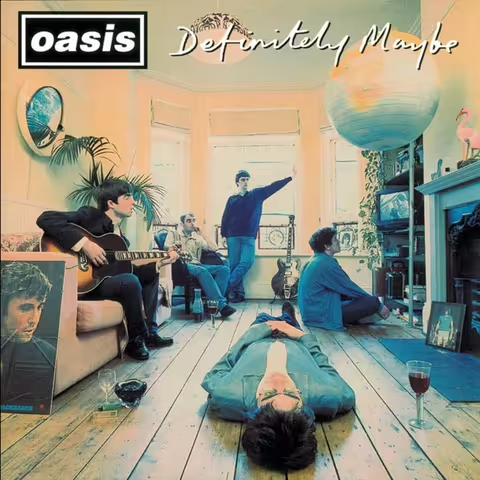
By the late spring of 1994, with the mix finished, Creation's art director Tim Abbot put Brian Cannon at Microdot in charge of the sleeve and Cannon brought in the photographer Michael Spencer Jones, with whom he had worked on the singles. Noel wanted the shoot to take place at the dining table in his flat. Spencer Jones, having visited the flat, suggested Bonehead's house in Didsbury instead, in particular the front lounge, which had a bay window, generous natural light and the right kind of suburban-rock-star clutter. Cannon brought a vanload of objects. Spencer Jones brought a camera. The shoot took an afternoon.
Every object visible in the frame is there on purpose. Spencer Jones drew on the Arnolfini Portrait by Jan van Eyck for the principle that nothing in a photograph should be accidental. The composition itself nods to the back cover of A Collection of Beatles Oldies, the 1966 Parlophone compilation. Liam is on the floor, an arrangement Spencer Jones suggested in order to draw the eye away from the wooden floor, which he thought made the room look like a varnish advert. The wine glass next to Liam is full of diluted Ribena, because red wine, photographed under tungsten light, comes out black. The story that the band could not afford wine has been repeated everywhere and is wrong.
The objects placed around the band are a catalogue of the things they cared about. A black-and-white framed portrait of George Best leans in the window, a tribute from Bonehead, who is a lifelong Manchester United supporter. A picture of the Manchester City forward Rodney Marsh sits in the fireplace, a small ecumenical balancing act. A Burt Bacharach poster (the gatefold from one of Bacharach's albums) leans against the sofa because Bacharach is one of Noel's idols. Bonehead's 1980s Epiphone Riviera, the guitar he has played on every Oasis record and tour, leans casually against the wall. The television in the corner is playing a frozen frame of Sergio Leone's The Good, the Bad and the Ugly, with Eli Wallach and Antonio Casale visible on screen. The back cover takes a still from another Leone film, A Fistful of Dollars, featuring Gian Maria Volonte. Spencer Jones has said that he picked the Leone references because Noel told him the films were his favourites.
The result is one of the most quietly cluttered album sleeves in British rock and one of the only ones that rewards close inspection a decade later. Almost every object in the frame has subsequently been pointed out, photographed, traced and, in the case of the wine glass, lawsuit-litigated.
Promotion, release and the fastest debut
Creation spent roughly sixty thousand pounds on the campaign, a sum the label could not really afford. Tim Abbot's strategy was to put the band in front of as many people as possible as quickly as possible: the Glastonbury New Bands tent in June 1994, a run of British dates, a Top of the Pops appearance for Shakermaker after it debuted on the UK chart at number eleven, and an early US tour booked to reinforce the home market by association. Mixmag, which was at that point a club magazine, gave the record a full-page review under the headline that the album was a guitar record that even dance music people would buy.
The album was released on Monday 29 August 1994. It entered the UK Albums Chart at number one the following weekend, selling roughly one hundred thousand copies in its first four days, outselling The Three Tenors in Concert 1994 (then the official competition) by fifty per cent. That made it the fastest-selling debut album in British history, a record it would hold until White Ladder by David Gray several years later. The album was also number one on the UK Independent Albums Chart, as Creation, despite the Sony stake, was still technically independent.
- UK Albums Chart: 1
- UK Independent Albums: 1
- Ireland: 3
- Sweden: 4
- New Zealand: 5
- Iceland: 15
- Italy: 18 (subsequent peak of 8 via the 2024 FIMI reissue)
- Australia: 23 (originally); 10 on the 2024 reissue
- Germany: 33 (originally); subsequent peak of 5 in 2024
- Norway: 34
- US Billboard 200: 58
- US Top Heatseekers Albums: 1
- US Top Alternative Albums (2024 reissue chart): 18
The album returned to UK number one on its 30th-anniversary reissue in August 2024 and topped the Scottish Albums Chart at the same time. Its certifications now stand at 10 times Platinum in the United Kingdom (representing three million copies shipped), Platinum in the United States, Platinum in Japan, Australia and Canada, two times Gold in France, and 2 times Platinum across Europe via the IFPI. Worldwide sales sit at over fifteen million.
Singles and music videos
The four UK singles came out roughly two months apart, a pace that kept the band on Top of the Pops, in the music weeklies and on radio playlists across the whole of 1994.
| Single | Released | UK chart peak | Notable B-sides | Video director |
|---|---|---|---|---|
| Supersonic | 11 April 1994 | 31 (debut) | Take Me Away; I Will Believe (live); Columbia (white label demo) | Mark Szaszy |
| Shakermaker | 20 June 1994 | 11 | D'You Wanna Be a Spaceman; Alive (demo); Bring It On Down (live) | Mark Szaszy |
| Live Forever | 8 August 1994 | 10 | Up in the Sky (acoustic); Cloudburst; Supersonic (live) | Carlos Grasso (UK); Nick Egan (US) |
| Cigarettes and Alcohol | 10 October 1994 | 7 | I Am the Walrus (live, Glasgow); Listen Up; Fade Away | Mark Szaszy |
The Live Forever video shoot is the only one with a story bigger than the song. The US version, directed by Nick Egan, has the band performing at a graveside while Liam is buried alive in the closing shot. Noel hated it from the first cut. Carlos Grasso's UK version, by contrast, is the band on a New York rooftop with the skyline behind them. That second video is the one MTV in the US picked up and the one that helped push the song into the American consciousness in a way that the Billboard chart position (Live Forever peaked at number two on the US Modern Rock chart) did not fully capture.
Touring 1994 and 1995
The Definitely Maybe tour had effectively begun in the spring, before the album was even out. Through 1994 the band played small UK venues, a famous run of Japanese dates in September, an American club tour in the autumn, and a wholesale stepping up of UK venue sizes in late 1994 and into the spring of 1995. There were incidents. A Newcastle show was abandoned in September 1994 after a man climbed onstage and headbutted Noel mid-set. Tony McCarroll missed gigs after a hand injury. There were arguments backstage that became briefly tabloid-famous when the band cancelled a US date in Los Angeles in September 1994 after Liam and Noel had a fight; the line was famously crossed when Noel left the US tour briefly, only for Marcus Russell to persuade him to return.
By the time the album-touring cycle wound down in the spring of 1995, Oasis had played, by NME's count, more than 150 shows in support of the record, picked up two BRIT Awards (Best Newcomer and Best Video for Whatever, the standalone Christmas 1994 single), been booked for their first major festival appearances, and effectively eaten Britpop. By the time Some Might Say became their first number one single in April 1995, McCarroll had been ejected from the band and replaced by Alan White.
Reception
The contemporary press in the UK gave Definitely Maybe the reviews that most bands wait their entire career for and never receive. NME's Keith Cameron gave it nine out of ten and called Noel "a pop craftsman in the classic tradition". Stuart Maconie's four-star Q magazine review was the one quoted back at the band most often. Select gave it five out of five. Smash Hits gave it five out of five. Melody Maker's Paul Lester, in a review that the band took as a compliment, wrote that "of all the great new British pop groups, Oasis are the least playful". Mojo's Jim Irvin called it "spunky, adolescent rock, vivifying and addictive". Music Week, the trade paper, gave it five out of five.
In the United States, where Oasis were still a club-tour proposition, the response was warmer than the chart positions suggested. Rolling Stone's Paul Evans included it in the magazine's 1994 end-of-year round-up and singled out Liam's "God-given cool" as the band's standout asset. Neil Strauss, writing in The New York Times, said the songs "sound like a classic, rippling with hard guitar hooks". The album took until early 1995 to crack the Billboard 200 at number 58. Critical respect there came in waves over the next decade rather than at release.
"One of the most gloriously loutish odes to cigarettes, alcohol and dumb guitar solos that the British Isles have ever coughed up."
Rob Sheffield, Rolling Stone, 2014 reissue review
Retrospective evaluation has been kinder still. AllMusic's Stephen Thomas Erlewine gave the album five stars. Mojo, Q and the Rolling Stone Album Guide have all given the record full marks at one point or another. Pitchfork's Ryan Dombal awarded the 2014 reissue 8.8 out of 10. Spin gave it 4.5 stars and ranked it number 160 on its 300 Best Albums of the Past 30 Years (1985-2014) list in 2014. Pitchfork's 2017 list of the 50 Best Britpop Albums put it at number 9. Rolling Stone's 2020 revision of its 500 Greatest Albums of All Time placed Definitely Maybe at number 217. The album was the subject of a 33 1/3 monograph by Alex Niven, published by Bloomsbury in 2014.
Reader polls have tended to be even more generous than the critics. A 2006 NME and Guinness Book of British Hit Singles reader poll voted Definitely Maybe the best album of all time, with the Beatles' Sgt Pepper's Lonely Hearts Club Band in second place. A 2008 Q and HMV poll voted it the greatest British album of all time outright.
Reissues and anniversaries
The album has been reissued three times in formats that mattered. The first was a DVD release in September 2004, a documentary built around the Definitely Maybe story with band, producer and engineer interviews and a generous helping of period footage. It went triple platinum in the UK and won Best Music DVD at the 2005 NME Awards. The second was the Chasing the Sun deluxe edition on 19 May 2014, a 3 disc set that paired the original record with a disc of demos and a disc of B-sides and live material. The third and most substantial was the 30th-anniversary deluxe edition released on 30 August 2024, which finally let the Monnow Valley outtakes out of the vault, paired them with the singles' B-sides and added the Liam-sung demo of Sad Song. The 30th-anniversary edition returned the album to UK number one and number one on the Scottish Albums Chart in the same week.
Legacy and the Live '25 reunion
The straight line from Definitely Maybe runs through Some Might Say in April 1995, through the September release of (What's The Story) Morning Glory? a few months later, and on to two nights at Knebworth in August 1996 in front of two hundred and fifty thousand people. The most-quoted statistic about those Knebworth shows is that 2.6 million people applied for tickets, roughly four per cent of the UK population at the time. The Britpop boom is sometimes told as a four-band story but the audience figures were always Oasis-shaped. Definitely Maybe is the album that did the shaping.
Tony McCarroll, the only musician on the album to have lost his place in the band, was ejected in early 1995. His drumming on the album is solid and powerful in ways that Noel's later choice of Alan White was not, and his ejection has been a point of dispute in fan circles ever since. McCarroll wrote a memoir, Oasis: The Truth, in 2010 and successfully sued the band for unpaid royalties.
In 2023, on the eve of the album's 30th anniversary, Liam Gallagher announced a solo tour playing Definitely Maybe in full. The shows ran in the summer of 2024 and were both critically warm and commercially enormous. By then, the larger story had already begun to move. In August 2024 Oasis announced the Live '25 reunion tour, the first joint Gallagher-brothers shows since the 2009 split. As of this writing in 2026, the tour is in progress. Whatever else Live '25 turns out to be, its core has always been the songs on Definitely Maybe. Rock and Roll Star still opens. Live Forever still closes. The arc from a Welsh studio disaster to a stadium reunion three decades later is not a straight line. It runs through one room in Didsbury, one bass line through a Minimoog and one engineer who was told he could do whatever he liked.
Things you might not know
| Fact | Detail |
|---|---|
| The Ribena glass | The drink next to Liam on the cover is diluted Ribena, not wine. Red wine photographs as black under tungsten lighting, so Michael Spencer Jones swapped it out. |
| The Coca-Cola lawsuit | Shakermaker borrowed enough of I'd Like to Teach the World to Sing that the New Seekers' publishers sued. Oasis settled out of court, reportedly for around half a million dollars. |
| Supersonic on a kitchen napkin | Noel reportedly wrote the lyrics to Supersonic during a half-hour dinner break at the Pink Museum in Liverpool in December 1993. The band recorded the song that same night. |
| The Welsh ghost | Liam Gallagher has consistently claimed that the cottage at Monnow Valley was haunted during the band's stay in early 1994. |
| The fired engineer | Dave Scott, fired mid-session by David Batchelor after two clashes during the recording of Slide Away, was later told that Slide Away was the only track from those sessions that made the album. |
| The Minimoog bass trick | To mask Guigsy's imprecise bass playing, Owen Morris routed the bass signal through a Minimoog with the high end rolled off, then heavily compressed the result. |
| The Bacharach poster | The poster of Burt Bacharach leaning against the sofa on the album cover is there because Bacharach is one of Noel Gallagher's musical idols. |
| The Manchester derby on the cover | Bonehead, a Manchester United fan, put a framed portrait of George Best in the window. To balance it, a picture of Manchester City's Rodney Marsh was placed in the fireplace. |
| The Spector slap | Morris added eighth-note tape-delay slap to the snare drum during mixing, a trick borrowed from Phil Spector's production of John Lennon's Instant Karma. |
| The Digsy's Diner misprint | Digsy's Dinner was mistitled Digsy's Diner on the North American release. The error has never been corrected on US pressings of the original album. |
| The Fostex closer | Married with Children is the only track on the album not recorded in a professional studio. It was cut on a Fostex 8-track in Mark Coyle's living room. |
| Columbia and Radio 1 | A 1993 limited 12-inch promo of Columbia was unexpectedly picked up by BBC Radio 1, which played the track 19 times in two weeks before Oasis had released a single. |
Closing
Three decades on, the survival of Definitely Maybe as both a critical and a commercial standard is harder to explain than it should be. Almost everything about its production was a near-disaster: the wrong producer in the wrong studio, a label that could not afford the bill, a band whose drummer would be replaced within months, and a mixing engineer who got the job by phone. The fact that the result still sounds, in the words of Owen Morris himself, slightly more compressed than would normally be considered professional, is part of why it has aged. It does not sound like a 1990s record that has been preserved. It sounds like a record that walked in and broke the furniture. The Riffology podcast covers Definitely Maybe in the same episode as Morning Glory; both records, and their stories, are available wherever podcasts are streamed.
Comments