Steve Albini did not record Songs for the Deaf, the Foo Fighters did not break up to make it, and the bass player who wrote a third of it would be fired eighteen months later in a row that has never properly been settled. What did happen in late 2001 was that Dave Grohl, eighteen months removed from his last serious stint behind a drumkit, asked Josh Homme if he could come to California and play drums on a Queens of the Stone Age record. Grohl put Foo Fighters on hiatus, shelved an unfinished version of One by One, and spent the next nine months helping turn a sketchbook of Desert Sessions riffs and unfinished radio skits into the album that pulled stoner rock onto MTV.
It would be the last record Queens of the Stone Age made as a three-vocal band, the last one to feature Nick Oliveri as a full-time member, and the only one to sound exactly like a stolen International Scout truck barrelling east out of Los Angeles with the dial spinning between fake FM stations. The August 2002 release would peak at number seventeen on the Billboard 200, number four in the UK, and stay on critics' best-of-the-decade lists for the next twenty years.
| Fact | Detail |
|---|---|
| Artist | Queens of the Stone Age |
| Album | Songs for the Deaf |
| Release Date | 27 August 2002 |
| Label | Interscope Records |
| Producers | Josh Homme, Eric Valentine, Adam Kasper (with Chris Goss assisting) |
| Studios | The Site (San Rafael, CA); Conway Recording Studios (Los Angeles); Barefoot (Hollywood); Sound City (Van Nuys, for the Kinks cover) |
| Mastering | Brian Gardner at Bernie Grundman Mastering, Hollywood |
| Genre | Stoner rock, hard rock, desert rock, alternative metal |
| Track Count | 14 plus a hidden pregap track ("The Real Song for the Deaf") |
| Total Runtime | 60:53 |
| Billboard 200 Peak | 17 |
| UK Albums Chart Peak | 4 (number 1 on the UK Rock and Metal Albums chart) |
| Other Notable Chart Peaks | Norway 2, Scotland 4, Eurochart Top 100 6, Australia (ARIA) 7, Germany 9, Belgium (Flanders) 9 |
| Certifications | UK 2x Platinum (BPI), Europe Platinum (IFPI, 1,000,000 sales), Canada Platinum, Australia Platinum, US Gold (RIAA, certified 27 January 2003) |
| Estimated Sales | Over 1.18 million in the US by 2007; over 1 million in Europe by 2008 |
| Key Singles | "No One Knows" (Nov 2002), "Go with the Flow" (Apr 2003), "First It Giveth" (Aug 2003) |
Cultural Context
The American rock landscape in the summer of 2002 was bracketed by two large and very different audiences. On one side sat the post-grunge mainstream that had absorbed Creed, Nickelback and Puddle of Mudd into a generic radio sludge. On the other sat a wave of revivalist garage-rock acts like the Strokes, the White Stripes and the Hives, who had made angular guitars fashionable again but whose records mostly clocked under thirty-five minutes and barely bothered with choruses. Heavy rock had not so much split as fragmented: nu-metal was still selling but already exhausted; Tool's Lateralus the year before had pushed prog-metal further into ritual; and the underground stoner-rock scene around Palm Desert, Joshua Tree and Brant Bjork's solo records remained a strictly cult concern.
The same August that Songs for the Deaf arrived also gave the world the Red Hot Chili Peppers' By the Way, Coldplay's A Rush of Blood to the Head, the self-titled Audioslave debut, and Foo Fighters' One by One two months later. It was a fertile year for big-budget rock records, but none of them sounded remotely like what Queens of the Stone Age were about to release.
- Iraq inspectors had returned to Baghdad and the United States and United Kingdom were openly debating an invasion.
- MTV was still a music network, with Total Request Live and 120 Minutes both broadcasting daily.
- Napster was dead, the iPod was a year old, and the iTunes Store would not exist for another seven months.
- Foo Fighters had scrapped the first attempt at One by One earlier in the year. Grohl's restless month off became the entire Songs for the Deaf sessions.
The Band's Story Up to This Point
Queens of the Stone Age had risen out of the wreckage of Kyuss, the Palm Desert quartet whose four albums between 1991 and 1995 had codified the downtuned, generator-party, low-end-as-religion sound that journalists later filed under stoner rock. When Kyuss split, guitarist Josh Homme spent two years touring as a hired sideman with Mark Lanegan's Screaming Trees before assembling a new band around drummer Alfredo Hernandez and, in due course, his old Kyuss bandmate Nick Oliveri on bass.
The 1998 self-titled debut was a lean, motorik record built around Homme's so-called "robot rock" concept of repetition and discipline. Rated R, released by Interscope in June 2000, blew the formula wide open: it bolted on Mark Lanegan as a guest vocalist, brought in producer Chris Goss as a co-conspirator, and opened with the chant-along drug list "Feel Good Hit of the Summer". By the time Rated R's touring cycle ended in early 2001, the line-up had churned through several drummers, the band had a reputation as a moving party, and Homme had a working idea for the next record built around the conceit of a long drive across the desert with the radio on.
The state of mind walking into the third album was a band riding high on a critically loved second record, still in the second year of their first major-label deal, and openly contemptuous of the modern-rock radio environment that refused to play them. The frustration would shape the entire concept.
Pre-production and Demos
Several songs that ended up on Songs for the Deaf were not new in 2001. "No One Knows" and "God Is in the Radio" were, by Homme's own account in a 2002 interview with thefade.net, both at least five years old by the time they were tracked. The main riff for "No One Knows" had previously surfaced on the Desert Sessions track "Cold Sore Super Stars". "You Think I Ain't Worth a Dollar, But I Feel Like a Millionaire" had opened Desert Sessions Volume 5: Poetry for the Masses with vocals by Mario Lalli of Fatso Jetson, not Oliveri. "Hangin' Tree" had appeared on Desert Sessions Volume 7: Gypsy Marches. The album was as much a curation of years of Joshua Tree jam-session material as it was a fresh writing burst.
The radio-DJ concept came together later. Homme has described the fake station idents as a deliberate jibe at Clear Channel-era commercial rock radio: "We don't get played on the radio," Oliveri told Rolling Stone in May 2002, "so I figure we should talk shit about them." The skits were demoed with friends from the Los Angeles and Hollywood scene, eventually voiced by Blag Dahlia of the Dwarves (as DJ Kip Kasper of KLON, "Clone Radio"), Lux Interior of the Cramps, Twiggy Ramirez of Marilyn Manson, Casey Chaos of Amen, Jesse Hughes of Eagles of Death Metal, plus band-adjacent figures Chris Goss, Alain Johannes, Natasha Shneider and Dave Catching.
Pre-production was handled by Bob "Mates" Brunner, with the band rehearsing in Los Angeles before moving north. Working titles for the album are not part of the public record; the title Songs for the Deaf seems to have been settled early, deriving from the album-closing title track, a Homme/Lanegan duet that had been performed live as early as the 2001 Bizarre Festival in Germany with completely different Lanegan-led lyrics.
Creating the Album
Recording began in October 2001 and ran through to June 2002, spread across three primary rooms: The Site in San Rafael north of San Francisco, Conway Recording Studios on Melrose in Los Angeles, and Barefoot in Hollywood. A small amount of additional work was done at Sound City Studios in Van Nuys, where Alain Johannes produced and mixed the Kinks cover "Everybody's Gonna Be Happy" used as a UK bonus track. Brian Gardner mastered the finished record at Bernie Grundman Mastering on Sunset Boulevard.
The production credits are deceptively tangled. Josh Homme and Eric Valentine are credited as producers on every track except "The Sky Is Fallin'" and "Do It Again", which were produced by Adam Kasper at Conway. Chris Goss is credited as assisting production and recording throughout, and would later say in interviews that his role was closer to a co-pilot than a guest. Homme has more than once given Valentine the credit for "merely recording the beginning of the album for contractual reasons", suggesting that Homme himself ran the back half of the sessions. Valentine, an engineer-producer best known at the time for Smash Mouth's Astro Lounge and Third Eye Blind's debut, was meanwhile a meticulous studio technician whose taste for clean, controlled drum recordings suited what the band wanted from Grohl.
That drum sound is the technical centrepiece of the record. Grohl performed in a small, intentionally dead-sounding isolation booth at The Site, with a separate engineer's pass for the cymbals. To get the closed, claustrophobic snare-and-tom tone Homme wanted without the cymbal wash bleeding into every channel, Grohl played each song through twice: once with the kit but hitting electronic cymbal pads in place of his real cymbals, then a second take where he played the cymbals over a dummy snare and padded toms so only the cymbals made any noise. The two passes were blended in the mix. Valentine, in a 2014 retrospective for Rhythm magazine, described the process as "very difficult" and credited Grohl's patience for making it possible.
"It's the best fucking drumming I ever did in my life."
Dave Grohl, on Songs for the Deaf, Canoe.com, October 2001
The guitar palette stayed close to Homme's signature: a Maton BB1200 semi-hollow tuned to C standard, run through a wall of Ampeg VT-22 and Marshall heads, with a battery of fuzz pedals stacked into a clean room sound. Oliveri ran a Rickenbacker 4001 bass through Ampeg SVT stacks. Chris Goss added guitar, keyboard and backing vocals on "The Sky Is Fallin'" and "Do It Again". Dean Ween of Ween, a long-time Homme friend, contributed lead guitar on "No One Knows", "Six Shooter", "Gonna Leave You" and the hidden track "Mosquito Song". Paz and Ana Lenchantin (best known then for A Perfect Circle) provided string arrangements for "No One Knows" and "Mosquito Song".
Two musicians from the production team are essentially a band-within-the-band on the record. Alain Johannes (Eleven, later Them Crooked Vultures) and Natasha Shneider added lap steel, EBow, organ, piano, theremin, flamenco guitar and accordion across at least four tracks; their fingerprints are all over the closing "Mosquito Song". Both would join Queens of the Stone Age full-time for the follow-up Lullabies to Paralyze.
Personnel and Credits
| Role | Player | Notes |
|---|---|---|
| Core band | ||
| Vocals, guitar | Josh Homme | Lead vocals on the singles and most of the heavy tracks |
| Bass, vocals | Nick Oliveri | Lead vocals on "Millionaire", "Six Shooter", "Gonna Leave You", "Another Love Song" |
| Drums | Dave Grohl | Plays on every track except "Go with the Flow" (track 8) |
| Vocals | Mark Lanegan | Lead vocals on "A Song for the Dead", "Hangin' Tree", "God Is in the Radio" |
| Additional musicians | ||
| Drums | Gene Trautmann | Tracks 1 and 8; outgoing QOTSA drummer |
| Guitar | Dean Ween (Mickey Melchiondo) | Tracks 2, 6, 9 and 14 |
| Guitar, keys, backing vocals | Chris Goss | Tracks 5 and 10 |
| Guitar | Brendon McNichol | Track 8 ("Go with the Flow") |
| Lap steel, EBow, organ, piano, flamenco guitar, theremin | Alain Johannes | Tracks 3, 6, 7 and 12 |
| EBow, organ, piano, theremin | Natasha Shneider | Tracks 4, 6, 12 and 14 |
| Strings | Paz Lenchantin, Ana Lenchantin | Tracks 2 and 14 |
| Accordion | Molly McGuire | Track 14 ("Mosquito Song") |
| Horns | John Gove, Kevin Porter, Brad Kintscher | Track 14 |
| Radio DJs (between-track skits) | ||
| DJ "Kip Kasper", KLON | Blag Dahlia (Dwarves) | The recurring lead voice on the album's radio thread |
| DJ "Hector Bonifacio Echeverria Cervantes de la Cruz Arroyo Rojas" | Alain Johannes | |
| DJ "Elastic Ass", KRDL | Chris Goss | Kurdle 109 of Chino Hills |
| DJ for KOOL | C-Minus | |
| Death-metal station ident | Casey Chaos (Amen) | |
| DJ Tom Sherman, Banning College Radio | Twiggy Ramirez (Marilyn Manson) | |
| DJ for AM580 | Lux Interior (The Cramps) | |
| Preacher | Jesse Hughes (Eagles of Death Metal) | |
| DJ for WANT, Wonder Valley | Dave Catching | |
| Production and engineering | ||
| Producer | Josh Homme | All tracks |
| Producer, recording, mixing | Eric Valentine | All tracks except "The Sky Is Fallin'" and "Do It Again" |
| Producer, mixing | Adam Kasper | "The Sky Is Fallin'" and "Do It Again", mixed at Conway |
| Recording, assisting production | Chris Goss | Long-time Homme collaborator (Masters of Reality, Kyuss producer) |
| Recording, mixing | Alain Johannes | "Everybody's Gonna Be Happy" at Sound City Studios, Van Nuys |
| Mastering | Brian Gardner | Bernie Grundman Mastering, Hollywood |
| Pre-production | Bob "Mates" Brunner | |
| Guitar tech | Dan Druff | |
| Sound tech | Hutch | |
| Artwork | ||
| Sleeve concept | Frank Kozik | Designer of the red Q logo with sperm-and-egg motif used on the US double LP |
| Disc artwork model | Dave Catching | The musician pictured on the album disc itself |
The Songs
| # | Title | Writer(s) | Length | Single? | Notes |
|---|---|---|---|---|---|
| 0 | "The Real Song for the Deaf" (pregap) | Homme | 1:32 | Hidden instrumental accessible by rewinding from track 1 | |
| 1 | "You Think I Ain't Worth a Dollar, But I Feel Like a Millionaire" | Homme, Mario Lalli | 3:12 | Lead vocal by Oliveri; reworked from Desert Sessions Vol 5 | |
| 2 | "No One Knows" | Homme, Lanegan | 4:38 | Yes (Nov 2002) | Lead vocal by Homme; Dean Ween on guitar; UK No. 15 |
| 3 | "First It Giveth" | Homme, Oliveri | 3:18 | Yes (Aug 2003) | Lead vocal by Homme; UK No. 33 |
| 4 | "A Song for the Dead" | Homme, Lanegan | 5:52 | Lead vocal by Lanegan; one of Grohl's signature performances | |
| 5 | "The Sky Is Fallin'" | Homme, Oliveri | 6:15 | Adam Kasper-produced; Chris Goss on guitar | |
| 6 | "Six Shooter" | Oliveri | 1:19 | Oliveri's punk-snarl interlude; Parental Advisory trigger | |
| 7 | "Hangin' Tree" | Homme, Alain Johannes | 3:06 | Lead vocal by Lanegan; reworked from Desert Sessions Vol 7 | |
| 8 | "Go with the Flow" | Homme, Oliveri | 3:07 | Yes (Apr 2003) | Only track without Grohl on drums (Gene Trautmann plays); UK No. 21 |
| 9 | "Gonna Leave You" | Homme, Oliveri | 2:50 | Lead vocal by Oliveri; Dean Ween on guitar | |
| 10 | "Do It Again" | Homme, Oliveri | 4:04 | Adam Kasper-produced; Chris Goss on guitar and backing vocals | |
| 11 | "God Is in the Radio" | Homme, Lanegan | 6:04 | Lead vocal by Lanegan; one of the two oldest songs on the album | |
| 12 | "Another Love Song" | Homme, Oliveri | 3:16 | Lead vocal by Oliveri; surf-noir guitar and theremin | |
| 13 | "A Song for the Deaf" | Homme, Lanegan | 6:42 | Homme/Lanegan duet; contains a hidden outtake of "Feel Good Hit of the Summer" with the lyrics replaced by laughter | |
| 14 | "Mosquito Song" (hidden) | Homme, Oliveri, Melchiondo (Dean Ween) | 5:37 | Flamenco-acoustic closer with strings, horns and accordion |
The album opens with an FM tuner sweep and Blag Dahlia's Kip Kasper announcing KLON in his car-salesman radio voice before the band detonates into "You Think I Ain't Worth a Dollar, But I Feel Like a Millionaire". Oliveri's bug-eyed lead vocal, locked to a riff Mario Lalli had originally sung on a Desert Sessions tape, is the closest the record gets to old-school hardcore. Grohl's drumming is the audition tape made flesh: a relentless, double-kick-driven pulse that reads as both showy and entirely controlled.
"No One Knows" follows. Its T. Rex-via-boogie groove, syncopated handclaps and chorus-as-promise structure are so polished it is easy to forget how strange the song is for radio rock in 2002. The verse runs in 6/8, the chorus snaps into 4/4, and the long instrumental coda is essentially a drum solo over a Dean Ween lead. The single peaked at number one on the US Alternative Airplay chart, number five on Mainstream Rock and number 51 on the Hot 100, becoming the band's biggest US single of any era. In the UK it hit number 15 and went on to be certified Platinum by the BPI.
The video, co-directed by Michel Gondry and Dean Karr, is its own short story: the band drives an International Scout into a deer on a desert road, the deer revives and goes on a rampage, ties Homme, Oliveri and Lanegan to the hood of the truck, and finally falls in love with a garden statue of a doe. Gondry, then white-hot off his Bjork videos, shot the first half in June 2002; Karr filmed the rest in July. The clip drew an MTV2 Award nomination at the 2003 Video Music Awards.
"First It Giveth" is the album's neglected single, all stop-start dynamics and a chorus that opens up into one of Homme's most punishing aggro-overdrive payoffs. It reached number 33 on the UK Singles Chart in August 2003 and went largely unplayed on US radio. Pitchfork's Eric Carr called it the third leg of "this album's triad of genius".
"A Song for the Dead" is the record's high-water mark for Grohl. A five-and-a-half-minute Lanegan-fronted brawl with two distinct movements and a drum performance so showy it works as its own argument for why a man would shelve his band to play sideman. Lanegan, then four albums into a parallel solo career, growls the verses in a register Homme cannot reach. Live in this era, Grohl would lean into the mic during the breakdown and bark Lanegan's chorus line back at him.
"Six Shooter" is eighty seconds of Oliveri screaming a one-line revenge fantasy over a hardcore-punk thrash; it is the song the Parental Advisory sticker is largely there for. "Hangin' Tree", a slowed-down redraft of a Desert Sessions piece, lets Lanegan deliver one of his most desolate readings on the record, a horror-movie soundtrack of a song.
"Go with the Flow", the second single, is the one track on the album where Grohl does not play. Outgoing drummer Gene Trautmann had recorded the basic track earlier, with Brendon McNichol added on guitar. Released in April 2003, it reached number 21 in the UK and the lower reaches of the US charts; the song's afterlife in advertising, sports highlights and video games has comfortably eclipsed its original chart placing. Shynola's animated video of pulsing red silhouettes won a Grammy nomination for Best Music Video, Short Form.
"God Is in the Radio" is the other genuinely old song on the album, a six-minute Lanegan vehicle built on a slow, hypnotic chord change that recalls the bleakest passages of Screaming Trees' Dust. "A Song for the Deaf", the title-track duet between Homme and Lanegan, closes the official tracklist with the album's only direct confrontation with its own concept: every radio station they have driven past has played the same song.
The hidden "Mosquito Song" follows, a flamenco-flavoured acoustic closer with strings, horns and accordion that has more in common with Calexico than with anything else on the record. It is the only piece of music on the album that does not even pretend to be heavy.
B-sides, Outtakes and Bonus Tracks
The singles cycle was unusually generous with off-album material. "No One Knows" went out in two UK CD formats and a European 7-inch, packaged with live versions of "A Song for the Dead", "Avon" (from the debut) and "Tension Head" (from Rated R) all recorded at The Mean Fiddler in Soho, plus an isolated Spanish-language version of "Gonna Leave You" and an UNKLE remix that was extensive enough to later anchor the band's 2004 EP Stone Age Complication.
The Japanese edition of the album added a Roky Erickson cover, "Bloody Hammer". The UK bonus material included "Everybody's Gonna Be Happy", a Kinks cover produced separately by Alain Johannes at Sound City, plus a live version of "The Lost Art of Keeping a Secret" from Rated R. A Spanish-language version of "Gonna Leave You" appeared as a bonus track on several territories.
The 2002 hidden outtake at the end of "A Song for the Deaf" is genuinely strange in its own right: a complete re-recording of "Feel Good Hit of the Summer" with all the substance names replaced with laughter. It runs for about ninety seconds before the disc lapses into silence.
Album Artwork and Packaging
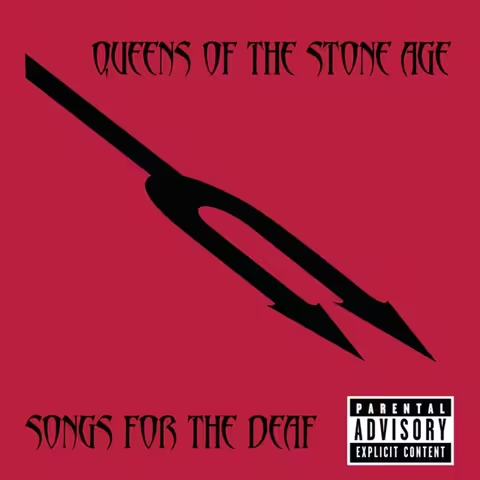
Frank Kozik, the Austin and San Francisco poster artist whose work for the Melvins, Soundgarden and Pearl Jam had defined a particular strand of US rock illustration in the 1990s, handled the sleeve. The CD jewel case came in three printed colours: red, magenta and orange, with the red version overwhelmingly the most common at retail. The US double LP wore a different cover entirely: a black sleeve with a single red Q logo, the line in the Q rendered as a sperm cell and the circle as an egg, pressed on red vinyl.
The interior artwork is identical across all three CD variants. The disc itself bears a photo of Dave Catching, the Joshua Tree musician who runs Rancho de la Luna and contributes vocals as DJ for the fictional WANT of Wonder Valley. The Parental Advisory sticker, present on most pressings, was triggered chiefly by Oliveri's "Six Shooter" lyric and by the recurring expletive in "Song for the Dead" and "Song for the Deaf".
Release and Reception
Interscope had originally booked Songs for the Deaf for an August 13, 2002 release, but pushed it back two weeks. It finally arrived on Tuesday, August 27, debuting at number 17 on the Billboard 200 and number 4 in the UK, the band's highest peaks to that point in both territories.
Reviews were close to unanimous. The album holds a Metacritic score of 89, ranking it as the third highest-reviewed record of 2002. Entertainment Weekly's Josh Tyrangiel called it "the year's best hard-rock album" and gave it an A. NME gave it 9/10, The Guardian four stars, Uncut five. Pitchfork's Eric Carr returned a 7.9, qualifying his enthusiasm by complaining about the radio skits ("after a couple playthroughs, they only serve to stifle the momentum QOTSA manage to develop") while acknowledging the front half of the album as "the wrath of the righteous". Kerrang! placed it at number 1 on its end-of-year list; Mojo at number 3.
"Anointed as the new Nirvana in 1998, the California quartet was actually proof of how much the pop scene missed Nirvana. With Songs for the Deaf, the Queens get louder and weirder and let their bone-bred artiness run loose. This is prog grunge for the unpretentious."
Arion Berger, Rolling Stone, August 2002
"No One Knows" earned a nomination for Best Hard Rock Performance at the 45th Grammys in February 2003, losing to Foo Fighters' "All My Life", a song on which Grohl was the lead singer rather than the drummer. "Go with the Flow" earned a second Best Hard Rock Performance nomination at the 46th Grammys the following year.
The album earned the band their first US Gold certification on January 27, 2003. The UK BPI certified it Gold within weeks of release and 2x Platinum (600,000 sales-equivalent units) by the late 2010s. The IFPI awarded a Platinum Europe certification in 2008 for one million sales across the continent. US sales as tracked by Nielsen SoundScan reached 1,186,000 by June 2007. Australia, Canada, Norway and Belgium all certified the album Platinum; Germany, Italy, Sweden and New Zealand reached Gold.
Singles and Music Videos
| Single | Release | US Modern Rock | US Mainstream Rock | US Hot 100 | UK Singles | B-sides / notes |
|---|---|---|---|---|---|---|
| "No One Knows" | 26 November 2002 | 1 | 5 | 51 | 15 | "A Song for the Dead" (live), "Avon" (live), "Tension Head" (live), Spanish "Gonna Leave You", UNKLE remix; video by Gondry and Karr; UK Platinum; Triple J Hottest 100 of 2002 number 1 |
| "Go with the Flow" | 7 April 2003 | 7 | 24 | 116 | 21 | Live "First It Giveth", UNKLE "No One Knows" remix; animated video by Shynola; Grammy nomination for Best Music Video, Short Form |
| "First It Giveth" | 18 August 2003 | 33 | Live tracks from V Festival 2003; performance-only video |
The Gondry-Karr "No One Knows" video got into heavy rotation on MTV2, Kerrang! TV and Top of the Pops 2 and would later be added to the MTV2 awards lineup at the 2003 VMAs. The Shynola "Go with the Flow" video, pure animated red-and-black silhouettes pulsing in time with the song, is the one most people remember; it was nominated for a Grammy for Best Music Video, Short Form at the 46th awards. The "First It Giveth" video, a stripped-back performance piece, never came close to the same attention but is the cleanest live document of the Homme-Oliveri-Lanegan-Van Leeuwen-Castillo touring lineup.
Touring and Live
The touring band that took Songs for the Deaf on the road was not the band that recorded it. Grohl played his first show as touring drummer at the Troubadour in Los Angeles on 7 March 2002 and his last at Japan's Fuji Rock Festival on 28 July. His shoes were filled within weeks by Joey Castillo, the former Danzig drummer, whose recruitment Interscope announced on 24 August 2002, three days before the album hit shops. Troy Van Leeuwen, formerly of Failure and A Perfect Circle, joined on guitar shortly after, completing the five-piece live unit that would carry the band through the next decade.
The album cycle covered every major festival circuit of 2002 and 2003: V2003 in the UK (both Hylands Park and Weston Park), Reading and Leeds, Rock am Ring, Lollapalooza, Roskilde, Big Day Out in Australia and New Zealand. The band recorded a live BBC Later With Jools Holland appearance in October 2002 and headlined two-night runs at the Brixton Academy in London and the Olympia in Paris. Their MTV2 $2 Bill Presents live concert from the Wiltern in Los Angeles in March 2003 was widely bootlegged before its DVD release.
Nick Oliveri's contentious tour-bus departure came at the end of the touring cycle. In February 2004, Homme fired him from the band over what he later described as a pattern of personal-conduct issues including alleged violence toward a partner. Oliveri's removal closed the chapter on the three-vocal Queens of the Stone Age lineup; Lullabies to Paralyze, released March 2005, was a record without him.
In TV, Film and Media
"No One Knows" became one of the most-licensed rock tracks of the 2000s. It appeared in the 2002 film xXx, the 2017 war film Sand Castle, the FX series Sons of Anarchy, Forza Motorsport, the original Guitar Hero II in 2006 where it appeared as a master recording, and in EA Sports' NHL 2003 and FIFA 2003.
- "You Think I Ain't Worth a Dollar..." opened the 2002 Vin Diesel film xXx and was later used in the 2012 party film Project X.
- "God Is in the Radio" featured in season 1 of Veronica Mars in 2004.
- "Go with the Flow" appeared in Need for Speed and Forza driving games, FIFA Street, the trailer for Bring It On Again, and dozens of US college-football highlight reels.
- "The Lost Art of Keeping a Secret" (a Rated R song, but performed live in this era) was used in Dave Grohl's 2013 Sound City documentary.
Controversy and Aftermath
The album was sticker-stickered with a Parental Advisory in most territories for the language on "Song for the Dead", "Song for the Deaf" and "Six Shooter". A radio edit of "No One Knows" trimmed the running time but left the lyrics intact. There were no major censorship rows or banned-video incidents in the cycle.
The most significant after-the-fact controversy was the Oliveri firing in February 2004 and the public exchange of accusations that followed in the rock press. Mark Lanegan also drifted out of the day-to-day band shortly after the cycle ended, although the split was amicable and he would continue to guest on later Queens of the Stone Age records up to his death in 2022. He paid tribute to the Songs for the Deaf sessions in his 2020 memoir Sing Backwards and Weep.
Covers, Samples and Tributes
"No One Knows" is the most-covered song on the album. The Section Quartet released a string-quartet arrangement on their 2007 album Fuzzbox. Mark Ronson included a cover with Domino Kirke on vocals as a B-side to his 2007 single "Stop Me", a connection that led to Ronson producing Queens of the Stone Age's Villains a decade later. The Divine Comedy played it live throughout the 2000s and released a Palladium performance on DVD. Razorlight covered it for Jo Whiley's Live Lounge Tour in 2008. The Vaccines released a studio cover in January 2021.
The album itself does not sample anyone in the conventional sense, but several songs revise earlier Desert Sessions material almost line-for-line, which Homme treats as more of an internal recycling project than self-sampling. "No One Knows" itself was remixed by UNKLE for the Go with the Flow single and the Stone Age Complication EP.
Reissues, Remasters and Anniversaries
The album was reissued on remastered double LP in 2014 by Interscope/Universal Music as part of a wider Queens of the Stone Age vinyl programme, paired with a remastered Rated R. A further European 2x LP pressing followed in 2019 with corrected sleeves.
A twentieth-anniversary deluxe edition has been a perennial fan request since 2022 and a small batch of anniversary-coloured vinyl appeared from the band's webstore that year, but no full multi-disc box with demos and contemporaneous live recordings has yet been released. The most extensive contemporary live recording in circulation is the band's Live at the Wiltern set from March 2003, originally broadcast on MTV2's $2 Bill Presents and later issued semi-officially.
Legacy and Influence
The album's reputation has hardened over time. NME placed it at number 15 on their Albums of the Decade list in 2009, Uncut at number 28, Pitchfork at number 134 of the 2000s. Loudwire named it the best hard-rock album of 2002 in their decade-by-decade ranking in 2024. The critic Steven Hyden has called it the greatest hard-rock record of the 21st century.
Its influence on the next two decades of rock is harder to pin to specific names but easy to hear. Royal Blood, Highly Suspect, Rival Sons, the Black Keys' heavier records, Mastodon's more song-oriented work, the Arctic Monkeys' Homme-produced Humbug in 2009 (which Homme produced after befriending Alex Turner on tour), and a generation of festival main-stage rock bands have all taken something from the Songs for the Deaf playbook of controlled aggression, off-kilter time, and choruses that arrive only when they are earned. "No One Knows" has become a permanent fixture on classic-rock radio in the United States and on UK alternative-rock playlists, a song that, twenty years on, no longer feels like a 2002 record at all.
Queens of the Stone Age themselves never made another album with three lead vocalists, never made another record built around a single conceptual framing device, and never again employed Dave Grohl as a full-time studio drummer (he returned as a guest on roughly half of ...Like Clockwork in 2013). In that sense, Songs for the Deaf is exactly the kind of record that can only be made once.
Things You Might Not Know
| Fact | Detail |
|---|---|
| The pregap track | The album contains a hidden 1:32 instrumental called "The Real Song for the Deaf" before track 1, written by Homme alone and accessible only by rewinding from the start of the CD. |
| Grohl on his own song | "No One Knows" lost the 2003 Grammy for Best Hard Rock Performance to Foo Fighters' "All My Life", a song Dave Grohl himself fronted. Grohl was therefore on both nominated tracks. |
| The drummer who plays on the second single | "Go with the Flow" is the only track on the album where Dave Grohl does not play drums. The basic track was recorded earlier by outgoing QOTSA drummer Gene Trautmann. |
| Songs older than they sound | "No One Knows" and "God Is in the Radio" were both at least five years old by the time they were recorded for the album, dating back to the band's pre-Interscope era. |
| The Desert Sessions tape recycle | "You Think I Ain't Worth a Dollar...", "Hangin' Tree" and parts of "No One Knows" all originated on Homme's Desert Sessions side-project tapes between 1998 and 2001. |
| The man on the disc | The figure pictured on the CD itself is not a band member: it is Dave Catching, the Joshua Tree musician and Rancho de la Luna proprietor, who voices the WANT Wonder Valley DJ skit. |
| Kip Kasper's real name | The recurring DJ "Kip Kasper" of KLON, the album's narrative spine, is voiced by Blag Dahlia of the San Francisco punk band the Dwarves, not by any member of Queens of the Stone Age. |
| The double-tracked drums | To get the album's tight, dead drum tone, Dave Grohl performed every song twice: once playing the kit but hitting electronic cymbal pads, then again playing real cymbals over a dummy snare and padded toms. The two takes were blended in the mix. |
| The Foos record that came second | Foo Fighters had been recording One by One in Los Angeles when Grohl took the QOTSA gig. He scrapped that version entirely and rebuilt the Foos album from scratch in two weeks at his home studio after coming off the QOTSA tour. |
| The Kinks cover | The UK bonus track "Everybody's Gonna Be Happy" is the only piece of music on the package not produced by Homme, Valentine or Kasper. Alain Johannes produced and mixed it separately at Sound City Studios in Van Nuys. |
| The Lenchantin twins | The string parts on "No One Knows" and "Mosquito Song" were played by Paz Lenchantin (then of A Perfect Circle, later Pixies) and her sister Ana, who at the time were both regular session players in the Los Angeles rock scene. |
Listen on the Riffology Podcast
If you want to hear the songs alongside the stories, the Riffology podcast covers Queens of the Stone Age, Josh Homme's revolving-door bands and the wider Palm Desert scene across a number of episodes. New shows arrive every week on Apple Podcasts, Spotify, Amazon Music and every other major platform.
Comments