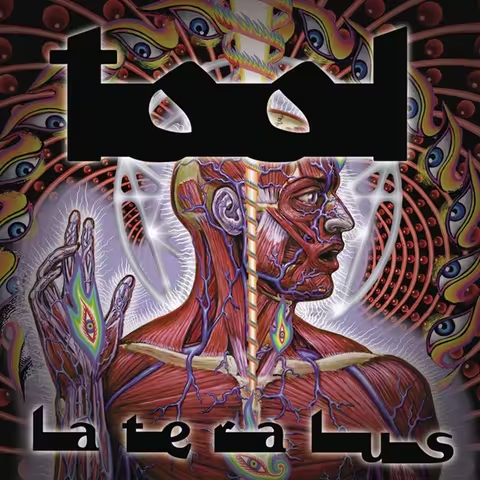
The hidden joke on the cover of Lateralus is that it does not show the cover. The piece of artwork the world sees on streaming services, a glowing red-and-blue body wrapped in spirals, is the inner layer. On the physical 2001 CD, Alex Grey wrapped that image in a translucent four-page insert that you have to flip open like a medical anatomy book, peeling away skeleton, blood vessels and nerves until you arrive at the figure underneath. Look hard at the brain matter on that last layer and the word God appears, embossed in the folds. Tool spent four years and a lawsuit getting to a record they could release, then made you take it apart with your fingers before you could see what it was.
That patience runs through everything about Lateralus. Released on 15 May 2001 through Volcano Entertainment, the band's third studio album debuted at number one on the Billboard 200 with 555,200 copies sold in its first week, knocking Destiny's Child's Survivor off the top and edging out Missy Elliott's Miss E... So Addictive for the new chart. It ran for seventy-eight minutes and fifty-one seconds across thirteen tracks, the band having quietly ordered CD plants to push the format two seconds past its guaranteed seventy-nine-minute ceiling. It went on to be certified triple platinum by the RIAA, double platinum in both Australia and Canada and gold in the United Kingdom. And it won a Grammy in 2002 for Best Metal Performance for Schism, a single in shifting 5/8 and 7/8 with forty-seven meter changes and a bass line bought on a friend's recommendation.
Album Facts
| Field | Detail |
|---|---|
| Artist | Tool |
| Album | Lateralus |
| Release date | 15 May 2001 |
| Label | Volcano Entertainment |
| Producers | David Bottrill, Tool |
| Studios | Cello (Hollywood); The Hook, Big Empty Space, The Lodge (North Hollywood) |
| Recorded | October 2000 to January 2001 |
| Genre | Progressive metal, progressive rock, art rock, alternative metal |
| Track count | 13 |
| Total runtime | 78:51 |
| Billboard 200 peak | 1 (debut, first week sales 555,200) |
| UK Albums Chart peak | 16 |
| Other notable peaks | Australia 1, Canada 1, Poland 1, New Zealand 2, Norway 2, Germany 5 |
| Certifications | 3x Platinum (US, RIAA, 2021), 2x Platinum (Australia, Canada), Gold (UK, 2015) |
| Estimated sales | Approximately 2.6 million copies in the US alone by 2010 |
| Key singles | Schism, Parabola, Lateralus |
What 2001 sounded like around it
Lateralus arrived in a year that the wider rock conversation had largely surrendered to nu-metal and post-grunge. Linkin Park's Hybrid Theory had been the best-selling album in the world for the second half of 2000 and continued to dominate into 2001. Limp Bizkit's Chocolate Starfish and the Hot Dog Flavored Water had spent four weeks at the top of the Billboard 200 the previous October. Staind's Break the Cycle, released the day before Lateralus, would dethrone it from number one in its second week with a sound at the opposite end of the rock spectrum. The week Tool went to number one, the rest of the top ten included Destiny's Child's Survivor, Janet Jackson's All for You, Shaggy's Hot Shot and the O Brother Where Art Thou soundtrack. Tool sat one slot ahead of Missy Elliott's Miss E... So Addictive, which had been expected to debut on top.
In the rock world specifically, Lateralus's closest peers were a small group of records by bands who had also resisted the radio-friendly pull of nu-metal. System of a Down's Toxicity was four months away. Opeth's Blackwater Park, also produced and shaped by a Steven Wilson at the height of his powers, had landed in March. Radiohead were a few weeks away from releasing Amnesiac, the I Might Be Wrong sister album to Kid A. Mogwai's Rock Action came out in April. Bottrill's other 2001 production credit, Muse's Origin of Symmetry, came out in June. The combined effect was that mid-2001 saw a small wave of rock records by artists deliberately walking away from the dominant format. Lateralus was the largest commercial event among them.
Tool before Lateralus
Tool had formed in Los Angeles in 1990 from a chance set of overlapping rooms and old friendships. Maynard James Keenan, a former pet store remodeler who had studied visual arts in Michigan, met aspiring film effects worker Adam Jones through a mutual friend in 1989. Jones knew Tom Morello from Electric Sheep days, and Morello introduced him to Danny Carey, who happened to live in the apartment above Keenan and would drum at their sessions because, as Carey put it, he felt sorry for them when no one else turned up. A friend of Jones introduced the four to bassist Paul D'Amour. The band signed to Zoo Entertainment, released the bruising six-song EP Opiate in March 1992, then their first full-length Undertow in April 1993.
Undertow turned Tool from a Lollapalooza second-stage curiosity into a band big enough to get bumped to the main stage at the festival's Los Angeles date, where Bill Hicks introduced them and asked ten thousand people to help him look for a lost contact lens. The single Sober went gold and won Billboard's Best Video by a New Artist for Adam Jones's stop-motion clip of meat coursing through pipes in a dungeon. Prison Sex, which dealt with childhood sexual abuse, was first praised and then quietly dropped by MTV. Undertow eventually went platinum and would later be certified triple platinum.
By September 1995 the band were ready to begin a second album, but the lineup shifted. D'Amour left amicably to play guitar instead of bass, and Tool auditioned a long list of replacements that included Kyuss's Scott Reeder, Filter's Frank Cavanaugh and Jane's Addiction's Eric Avery. They picked Justin Chancellor, a Tonbridge-and-Durham-educated Englishman who had played in Peach, a London band that had supported Tool on their 1994 European tour. Chancellor moved to the United States in September 1995 and recorded Aenima with Tool, the producer of which would prove pivotal: David Bottrill, then best known for his work with King Crimson and Peter Gabriel.
Aenima was released on 17 September 1996. Dedicated to the recently deceased Bill Hicks, it won a Grammy for Best Metal Performance for the title track in 1998 and cemented Tool's reputation as the thinking person's metal band. Then the floor fell out.
The Volcano lawsuit and the four-year gap
In late 1997 Volcano Entertainment, the successor label to Zoo, filed suit against Tool alleging they had violated their contract by listening to offers from other labels. Tool counter-sued, arguing Volcano had failed to exercise a renewal option in the contract and the band were free to leave. The deadlock lasted more than a year, until both sides settled out of court in December 1998 with a three-record joint venture deal. In 2000, Tool then fired their long-time manager Ted Gardner, the Lollapalooza co-founder who had run the band since the early days, and Gardner sued for unpaid commission.
The four-year gap between Aenima and Lateralus was not, as is sometimes claimed, indulgence. Tool largely refused to write new material during the dispute in case it ended up in the wrong label's possession. Keenan spent the downtime forming and recording with A Perfect Circle, the band built around long-time Tool guitar tech Billy Howerdel; Jones worked with Buzz Osborne of the Melvins; Carey drummed with Jello Biafra. Chancellor, Jones and Carey then spent much of 1999 and early 2000 in a rehearsal room working up the material that would become the new album, waiting for Keenan to return.
Speculation flew that Tool had broken up. The November 2000 Salival box set, a CD-and-video collection containing one new song, a cover of Led Zeppelin's No Quarter, a live version of Peach's You Lied and revised takes of older material, was partly issued to kill the chatter. Salival had its own first-pressing errors on the tracklist, an omen for what came next.
The Systema Encephale ruse
In January 2001, Tool announced that their forthcoming third album was called Systema Encephale, and circulated a twelve-song tracklist with titles such as Riverchrist, Numbereft, Encephatalis, Musick and Coeliacus. Napster and other file-sharing networks promptly filled with bogus MP3s carrying the made-up song names. The band, who were publicly hostile to file sharing at the time, had bait-and-switched the bootleggers. A month later, MTV News confirmed the real album would be called Lateralus, a portmanteau of the leg muscle vastus lateralis and the term lateral thinking, with a thirteen-song tracklist worked out down to the segues.
The hoax was characteristic. Tool had spent most of their career using deliberate disinformation, costume changes, half-explained symbols and refusal to appear in their own music videos to push attention onto the music itself. Systema Encephale was just the largest-scale prank yet.
Personnel and credits
| Role | Player | Notes |
|---|---|---|
| Tool | ||
| Vocals | Maynard James Keenan | Also recording and touring with side project A Perfect Circle during this period |
| Guitars, art direction | Adam Jones | Directed the Schism stop-motion music video |
| Bass | Justin Chancellor | Second Tool album, primary instrument a Wal MKII four-string bought on a friend's recommendation during Aenima |
| Drums, percussion, samples | Danny Carey | Sampled himself breathing through a tube for Parabol, banged piano strings for Reflection |
| Additional musicians | ||
| Machines | Statik (of Collide) | Triad |
| Production | ||
| Production | Tool and David Bottrill | Bottrill had also produced Aenima; Lateralus would be the final Tool album he worked on |
| Engineering, mixing | David Bottrill | |
| Engineering, neurocistance | Vince DeFranco | Of Synesthesia Mandala Drums; the "neurocistance" credit is unique to this record |
| Mastering | Bob Ludwig | Mastered in HDCD |
| Artwork | ||
| Illustrations | Alex Grey | Founder of the Chapel of Sacred Mirrors; would also work on 10,000 Days and Fear Inoculum |
| Art direction | Adam Jones | |
David Bottrill, back behind the desk
Bottrill was the load-bearing column of the record. The Canadian producer had spent the late 1980s as Daniel Lanois's assistant at Peter Gabriel's Real World, engineered Gabriel's 1989 soundtrack album Passion, then produced King Crimson's Vrooom EP and 1995's THRAK. Tool had picked him for Aenima after auditioning several well-known producers, partly because both Jones and Carey were devout King Crimson fans, and partly because Bottrill, by reputation, did not bend to bands. For Lateralus he was given the longest leash of his career to date: thirteen tracks averaging six minutes apiece, multiple suite-like sequences, samples ranging from Buddhist-monk simulations to Coast to Coast AM late-night radio, and time signatures that drifted in the middle of bars.
Bottrill has since spoken about how late some of the material was nailed down. In a long 2023 interview with Produce Like A Pro, he revealed that the lyrics to Schism were rewritten at the eleventh hour. The original version, he said, had been "very explicitly" about the building tensions between Keenan and Jones, and about the state of the band itself. After a long band meeting, Maynard reworked them into something more broadly applicable to any relationship falling apart, the version fans now know by heart.
"The first version of the lyrics were, very explicitly, about the building tensions between Maynard and Adam, and the band as a whole. Maynard changed them after a lengthy band meeting, to be more broadly applicable to relationships falling apart."
David Bottrill, Produce Like A Pro interview, 2023
Hollywood studios, October 2000 to January 2001
Recording ran from October 2000 to January 2001, split across four Los Angeles studios. The bulk of the tracking happened at Cello Studios in Hollywood, the former United Western Recorders complex on Sunset Boulevard whose 80-input custom SSL 9000J console gave the album its widescreen low end. Overdubs, percussion sessions and Carey's sample work moved between The Hook, Big Empty Space and The Lodge, all in North Hollywood. The album was mixed by Bottrill and mastered in HDCD by Bob Ludwig at Gateway Mastering in Portland.
Jones tracked guitars through a wall of vintage and modern amplification. His main rig combined a Diezel VH4 head, a Marshall Super Bass and a Mesa Boogie cabinet, played through Gibson Les Paul Custom Silverburst guitars from the late 1970s, a model that defines the album's combination of dry midrange grind and dark high-end. Chancellor ran his Wal MKII direct and through a Mesa Boogie M-2000 head, with a DigiTech Bass Whammy providing the octave-up harmony on the Schism riff and the swooping octave that lifts the chorus of Lateralus the song. Carey played behind a kit augmented with electronic pads to trigger his own tabla samples and looped percussion. Microphones included Shure SM57s on guitar cabinets and Sennheiser MD 421s on toms and bass, both standard tools used in extremely non-standard ways.
Carey wanted the songs long. Tool, he later told Mean Street magazine, were told that the CD format would only be guaranteed to behave up to a seventy-nine-minute runtime; they cut Lateralus to seventy-eight minutes and fifty-one seconds because they wanted to leave the manufacturer two seconds of breathing room. The band had also written segues between every track, and a lot of that connective tissue was cut in mastering simply because seventy-nine minutes did not fit. The original title for what became Reflection was Resolution; that was changed three months before release. Early pressings misspelled the ninth track as Lateralis.
"The manufacturer would only guarantee us up to 79 minutes. We thought we'd give them two seconds of breathing room."
Danny Carey, Mean Street, May 2001
Fibonacci numbers on the title track
The most-discussed structural trick on the record sits inside the title track. The first verse of Lateralus is built so that the syllable count of each line corresponds to numbers in the Fibonacci sequence: 1, 1, 2, 3, 5, 8, 5, 3, 2, 1, 1, 2, 3, 5, 8, 13, 8, 5, 3. "Black", "then", "white are", "all I see", "in my infancy", "red and yellow then came to be" reads the opening, the line lengths spiralling outward then collapsing back in. The song's main theme shifts in turn between time signatures of 9/8, 8/8 and 7/8, which, read together as the digits 9-8-7, give 987, the sixteenth integer of the Fibonacci sequence. The lyric "spiral out" closes the song and refers both to the listener's invitation to grow outward and to the Fibonacci spiral itself, the curve drawn by connecting the corners of squares sized to each number in the sequence.
None of this is offered up by the band. There are no album-sleeve diagrams of the spiral, no liner-note explanations, no Maynard interview in which it is laid out. Tool intentionally release their albums without printed lyrics in part to discourage exactly that kind of decoding, but Lateralus is the song that rewards it most.
The songs
| # | Title | Writer(s) | Length | Single? | Notes |
|---|---|---|---|---|---|
| 1 | The Grudge | Carey, Chancellor, Keenan, Jones | 8:36 | Opens in 5/4; ends on Keenan's longest sustained scream on record | |
| 2 | Eon Blue Apocalypse | Tool | 1:04 | Instrumental, named for Jones's dog Eon Blue | |
| 3 | The Patient | Tool | 7:14 | Uses Chancellor's wah-and-tone-sweep bass technique | |
| 4 | Mantra | Tool | 1:12 | Slowed-down recording of Keenan gently squeezing one of his cats | |
| 5 | Schism | Tool | 6:48 | Yes (Jan 2001) | Grammy 2002 Best Metal Performance; forty-seven meter changes |
| 6 | Parabol | Tool | 3:04 | Carey breathing through a tube to simulate Buddhist monk chant | |
| 7 | Parabola | Tool | 6:03 | Yes (Jan 2002) | Stop-motion video by Adam Jones and Alex Grey, runs ten and a half minutes |
| 8 | Ticks & Leeches | Tool | 8:10 | Carey drum performance later voted by NutSie among top 100 rock drum tracks | |
| 9 | Lateralus | Tool | 9:24 | Yes (Feb 2002) | Fibonacci syllable count; 9/8, 8/8, 7/8 main theme |
| 10 | Disposition | Tool | 4:46 | First part of the Disposition/Reflection/Triad suite | |
| 11 | Reflection | Tool | 11:07 | Originally titled Resolution; Carey banged piano strings for samples | |
| 12 | Triad | Tool | 8:46 | Instrumental; Statik of Collide on machines | |
| 13 | Faaip de Oiad | Tool | 2:39 | Samples a 1997 Coast to Coast AM caller claiming to be an Area 51 survivor; the title is Enochian for "Voice of God" |
Schism
Schism is, by any sensible measure, the most accessible thing on Lateralus and also the most rhythmically aggressive Tool single to date. Chancellor's bass riff entered the world via what he described as standard fooling around in a rehearsal room, the kind of riff he keeps playing until it locks in his memory because he refuses to write things down.
"The twiddly Schism riff came from fooling around. I just play as much as possible, and I don't write stuff down, so when I get a good idea, I play it until I can't forget it."
Justin Chancellor, interviewed by Ultimate Guitar, 2017
The song opens with two bars of 5/4, switches to a bar of 4/4, then enters its signature interlocking 5/8 and 7/8 alternation. An analysis published in Guitar One magazine in August 2001 found that the song changes meter forty-seven times across its six minutes and forty-eight seconds. The band have variously described the underlying feel as "six and six-and-a-half" or, more concisely, as "six-and-a-half / eight". Despite this complexity it became Tool's only entry on the Billboard Hot 100 until 2019's Fear Inoculum, peaking at number 67 with twenty weeks on the chart. It hit number two on both the Mainstream Rock and Alternative Airplay charts and was blocked from the top spot on both by Staind's It's Been Awhile. In February 2002 it won the Grammy for Best Metal Performance. During the acceptance speech Carey thanked his parents for putting up with him, and Chancellor concluded, "I want to thank my dad for doing my mom."
Lateralus
The title track sits at the centre of the album literally and structurally. Nine minutes and twenty-four seconds long, it builds from a quiet drone over Carey's tabla-style hand percussion, then drops into the Fibonacci verse, then opens out into the 9/8, 8/8 and 7/8 main theme. The lyrics, even at face value, are uncharacteristically direct for Keenan: "I embrace my desire to feel the rhythm, to feel connected enough to step aside and weep like a widow, to feel inspired, to fathom the power, to witness the beauty, to bathe in the fountain." The chorus, "spiral out, keep going", lands as the actual instruction the album is offering.
Parabol and Parabola
Parabol and Parabola function as a single nine-minute movement. Parabol is the prologue, three minutes of Keenan singing over Carey's tube-breathing sample stretched to resemble Buddhist throat chant; Parabola is the eruption that follows, a six-minute riff workout built on Jones's circling palm-muted figures. The two songs were eventually combined into a ten-and-a-half-minute stop-motion music video co-created by Adam Jones and Alex Grey, full of figures peeling apart into anatomical layers in direct visual conversation with the album cover.
Disposition, Reflection and Triad
The final suite, tracks ten through twelve, runs continuously for nearly twenty-five minutes. Disposition is a slow, almost ambient piece carried by Jones's clean arpeggios; Reflection, eleven minutes long, includes the sampled piano-wire percussion Carey recorded by banging directly on the strings of an instrument he had previously, in his words, destroyed. Triad is an entirely instrumental finale featuring Statik of the Los Angeles band Collide on programmed machines. On the CD edition the suite reads as a single composition. The vinyl edition, released in 2005, had to move Disposition forward to track eight to balance the side lengths, which broke the segue completely and remains a point of contention for fans.
The Grudge and Ticks & Leeches
The album opens with The Grudge, eight minutes and thirty-six seconds of churning 5/4 with one of Keenan's longest single-take vocal performances on tape. The lyric is a direct address to the kind of person who carries a wrong around for decades and lets it calcify, the imagery built around stones, weights, breath and release. The climax, between 7:24 and 7:35, is an unbroken eleven-second scream from Keenan that has been the subject of more than one online supercut. He has rarely, if ever, performed it at full intensity live.
Ticks & Leeches, at track eight, is by some distance the most aggressive thing on the record. Built around a tom-heavy Carey performance that voters at NutSie would later place in the top 100 rock drum tracks of all time, the song is a direct assault on industry parasites that Keenan has said took so much out of his voice that he had to drop it from the live set on the second leg of the 2002 tour to protect his throat. Bottrill has described tracking it as the loudest single day of the sessions.
Faaip de Oiad
The album ends with two minutes and thirty-nine seconds of pure unease. Faaip de Oiad opens with Carey playing what amounts to a long drum solo over noise, then drops in a sample of a real telephone call placed to Art Bell's late-night paranormal radio show Coast to Coast AM in 1997. The unidentified caller claims to be a former Area 51 employee and is cut off mid-sentence by what sounds like the station's transmitter dropping out. The title is Enochian, the language of the angels claimed by sixteenth-century occultist John Dee, and translates as "Voice of God". It is the only album of the four Tool studio records released up to that point that closes on something other than a peak.
The Alex Grey artwork
Tool had wanted Alex Grey on the record since the band first encountered his work. Grey, a New York-based painter who would later open the Chapel of Sacred Mirrors gallery in Wappinger, was best known for a series of life-size anatomical paintings that depicted the human body as overlapping translucent systems: skeletal, vascular, nervous, energetic, spiritual. For Lateralus he produced a four-layer image of the body that exists in two formats. The digital cover, what streaming services use, is the deepest layer, all glowing energy meridians. The physical CD case holds three additional translucent transparencies that flip open one after another to reveal skeleton, blood vessels and nervous system. Hidden on the final layer, embossed inside the brain matter, is the word God. The packaging was the most ambitious Tool had attempted to that point and set a template Jones would build on with the 3-D lenticular Grammy-winning packaging of 10,000 Days in 2006.
Singles and music videos
Three singles came from the album. Schism was issued first, on 15 January 2001, four months before the album itself, with Adam Jones directing a stop-motion video featuring two humanoid figures created by visual-effects artists Mackenzie Calhoun and Kevin Willis. The video pulled heavily on the visual language of Jones's own film background, including his time at Stan Winston Studio on Predator 2 and Terminator 2, and won regular MTV rotation despite running well over the standard radio edit length.
Parabola followed in January 2002, with a video co-directed by Jones and Alex Grey that took stop-motion and digital animation through Grey's anatomical imagery for ten and a half minutes. The Lateralus single came in February 2002 without a dedicated video. Both Parabola and Lateralus charted on the Mainstream Rock and Alternative Airplay charts, though neither crossed back to the Hot 100. Schism and Parabola were later issued as DVD singles on 20 December 2005, each containing the music video, commentary tracks, and a Lustmord ambient remix that, in the case of Schism, ran more than twenty minutes.
- 15 January 2001: Schism (US Hot 100 #67, Alternative Airplay #2, Mainstream Rock #2, UK Rock & Metal #32)
- January 2002: Parabola (Alternative Airplay #31, Mainstream Rock #10)
- February 2002: Lateralus (Alternative Airplay #18, Mainstream Rock #14)
Release and reception
Lateralus was reviewed widely and generally favourably. Rolling Stone's David Fricke awarded four stars and wrote that the prolonged running times of most of the thirteen tracks were misleading, that the entire album "rolls and stomps with suitelike purpose". AllMusic's Rob Theakston gave four stars and called the record an album "other so-called metal groups could learn from". Kerrang!'s Dave Everley filed a 5/5 review under the headline The Future Starts Here, calling it "the most perfectly played, perfectly produced record you're likely to hear this or any other year". Q ran it in their best fifty albums of 2001; Spin's Ryan Rayhil described it as a "monolithic puzzlebox".
The dissenters were vocal. Brent DiCrescenzo's Pitchfork review gave Lateralus 1.9 out of 10, accusing Tool of taking their "defining element of wanking sludge and stretching it out to the maximum digital capacity of a compact disc". The Village Voice's Robert Christgau called it "meaning-mongering for the fantasy fiction set". Both judgements stand as warnings against trusting any single publication on a band as polarising as Tool. The Metacritic aggregate landed at 75.
Commercially the record was an outright triumph. It debuted at number one on the Billboard 200 with 555,200 first-week sales, the band's first chart-topper. It hit number one in Australia, Canada and Poland, number two in Norway and New Zealand and number sixteen in the UK. It went on to be certified triple platinum by the RIAA, double platinum in both Australia and Canada, and gold by the BPI in 2015. The Schism Grammy followed in February 2002, Tool's second after Aenema's 1998 win.
Touring with King Crimson
The Lateralus touring cycle ran from mid-2001 through November 2002 and produced the longest, strangest live shows of Tool's career to that point. The personal highlight, for Keenan especially, was a ten-show joint mini-tour with King Crimson in August 2001. Robert Fripp had previously downplayed Crimson's influence on Tool when asked about it, but Keenan was effusive in the other direction.
"For me, being on stage with King Crimson is like Lenny Kravitz playing with Led Zeppelin, or Britney Spears onstage with Debbie Gibson. Now you know who we ripped off. Just don't tell anyone, especially the members of King Crimson."
Maynard James Keenan, on the 2001 Tool/King Crimson mini-tour
The wider tour put Tool in arenas and headline festival slots on a scale they had not previously occupied, including a Radio City Music Hall date in August 2002 that Rolling Stone reviewed glowingly. The live show itself developed the visual language that has defined Tool ever since: Keenan and Carey on elevated rear platforms, Jones and Chancellor forward and to the sides, backlighting rather than followspots, no live cameras, Keenan often facing away from the audience while enormous looping video projections by Adam Jones, Camella Grace, Chet Zar and Breckinridge Haggerty filled the back wall. The presentation forced focus onto the music rather than the personalities, and earned a Pollstar nomination for Most Creative Stage Production in 2002.
Eighteen years off streaming
One of the more deliberate decisions in Tool's later history was the band's refusal to put any of their catalogue on streaming services. The contracts negotiated in the 1990s predated streaming entirely, were never revisited, and the band preferred it that way. As a result, Lateralus existed for eighteen years exclusively in physical and download form. On 2 August 2019, four weeks ahead of the release of Fear Inoculum, Tool's catalogue finally landed on Spotify, Apple Music and the other major platforms. Every Tool album hit the international charts almost immediately. Keenan would later tell NME, in 2024, that the band had made a mistake by holding out as long as they did, having reduced their exposure to new listeners by years.
Legacy and influence
Lateralus is now widely regarded as Tool's defining record, and as the album that opened the door for a generation of bands working in long form, odd meters and concept-driven instrumentation. In 2016 Loudwire ranked it the number one hard rock or metal album of the twenty-first century. The magazine later placed it at number six on their Top 25 Progressive Metal Albums of All Time. Rolling Stone included it at number 32 on their 50 Greatest Prog Rock Albums of All Time. Louder Sound put it at 33 on their Top 100 Prog Albums of All Time. The Rock and Roll Hall of Fame's Definitive 200 listed it at 123.
The bands who openly cite it are a who's who of twenty-first-century heavy music: Mastodon, Karnivool, Periphery, Animals as Leaders, Gojira, Tesseract and almost the entire modern djent and progressive metal scene owe Lateralus a structural debt. The album's influence on Mastodon in particular is documented in interviews around their 2002 debut Remission, and Mastodon would go on to open for Tool on the 10,000 Days tour in 2006. Producer Joe Barresi, who would take over from Bottrill for 10,000 Days and Fear Inoculum, has spoken about Lateralus as the album he reverse-engineered when learning how to handle bands working in long, mathematical, dynamic-range-heavy structures.
Within Tool's catalogue, Lateralus sits between the rawer fury of Aenima and the more meditative grief of 10,000 Days (2006), an album partly built around the twenty-seven years Keenan's mother spent paralysed by a stroke before her death in 2003. Fear Inoculum, released in 2019, would follow Lateralus's lead structurally, with even longer songs and a deepened reliance on Carey's polyrhythmic and tabla-derived percussion. Lateralus is the pivot. It is where Tool stopped being an alternative metal band that happened to write long songs and became a progressive rock band that happened to be heavy.
Reissues and anniversaries
The most-collected physical edition of the album is the limited "double vinyl four-picture disc" issue first made available to fan club members and then publicly released on 23 August 2005. Pressed across two LPs as picture discs and presented in a holographic gatefold sleeve, it remains one of the more sought-after collectible vinyl pressings of any 2000s metal record. On 20 December 2005 the band issued two separate DVD singles for Schism and Parabol/Parabola, each containing the original music video, an audio commentary track, and a Lustmord ambient remix.
There has been no official deluxe or anniversary edition of Lateralus to mark the album's tenth, twentieth or twenty-fifth year, in keeping with Tool's general policy of leaving the original albums alone. The streaming arrival on 2 August 2019 functions, for many later fans, as the album's de facto reissue.
Things you might not know
| Fact | Detail |
|---|---|
| The fake album title | Tool announced the album in January 2001 as Systema Encephale with a twelve-song tracklist of made-up titles such as Riverchrist and Coeliacus, then watched Napster fill up with bogus MP3s before revealing the real title a month later. |
| The Mantra cat | The seventy-two-second interlude Mantra is a slowed-down recording of Maynard James Keenan gently squeezing one of his cats. |
| Carey's piano destruction | For samples on Reflection, Carey hammered directly on the strings of a piano he had previously destroyed, splicing the noise into the percussion track. |
| The Area 51 caller | Faaip de Oiad samples a real 1997 call to Art Bell's Coast to Coast AM radio show, in which an unidentified caller claiming to be a former Area 51 employee is cut off mid-sentence. |
| The Enochian title | Faaip de Oiad means "Voice of God" in Enochian, the angelic language transcribed by Elizabethan occultist John Dee. |
| Two seconds to spare | The CD format was guaranteed by manufacturers up to seventy-nine minutes; Carey deliberately cut the album to seventy-eight minutes and fifty-one seconds to leave two seconds of breathing room. |
| Misspelled on first pressing | Early pressings of the CD listed track nine as Lateralis rather than Lateralus. |
| Resolution to Reflection | The track Reflection was titled Resolution until three months before release. |
| The hidden word God | On the final translucent layer of the Alex Grey CD insert, the word God is embossed inside the brain matter of the central figure. |
| The Buddhist breathing tube | Carey sampled himself breathing through a tube to simulate Buddhist monk chant for the introduction to Parabol. |
| Eon Blue was a dog | The instrumental Eon Blue Apocalypse is named after Adam Jones's dog, Eon Blue. |
| The Grammy speech | Accepting the 2002 Best Metal Performance Grammy for Schism, Chancellor signed off with "I want to thank my dad for doing my mom." |
| Schism almost named names | Bottrill has said that the original Schism lyrics were explicitly about the rising tensions between Keenan and Adam Jones, and were rewritten only after a long band meeting. |
| Forty-seven meter changes | An analysis published in Guitar One in August 2001 counted forty-seven separate meter changes across the six minutes and forty-eight seconds of Schism. |
| 9-8-7 equals Fibonacci | The main theme of Lateralus shifts between 9/8, 8/8 and 7/8 time signatures; read together as 987 they form the sixteenth integer of the Fibonacci sequence. |
Final thoughts
Lateralus is what happened when the four members of a band stayed in the same room for long enough, with the right producer and no other label to listen to, to get an idea all the way out. Almost everything anyone has loved or hated about Tool ever since is on this record: the long songs, the math, the cover art that demands you stop streaming and pick up the physical object, the refusal to explain anything, the willingness to put a two-minute Area 51 phone call at the end of an album that opens at number one. It is also where Tool stopped being a metal band who wrote good songs and became the band that other metal bands measure themselves against.
If you would like to hear the songs picked apart in real time, by people who know them well, the Riffology podcast is available on Apple Podcasts, Spotify, Pocket Casts and every other major platform. Lateralus has provided more than enough material for several episodes already, and there is more to come.
Comments