Pantera spent the 1980s as a teased-up Texan glam band who could not get arrested outside the Dallas-Fort Worth circuit. Then a producer named Terry Date drove into Pantego in early 1990 with two weeks' notice, a $30,000 budget and instructions to capture a quartet who had quietly decided to bury every record they had ever made. What came out of those sessions did not sound like anything the major-label metal scene was selling that summer, and within a decade it had eaten the genre whole.
Cowboys From Hell was the band's fifth album, their first for Atco Records, and the first time the world heard the rhythmic, syncopated, southern-accented heaviness that Vinnie Paul liked to call "power groove". It also marked the moment when Darrell Abbott, still credited as Diamond Darrell, walked into a studio with the riffing vocabulary that almost every American metal guitarist born after 1975 would eventually steal from. Released on 24 July 1990, the record sold slowly, charted late, and is now double platinum in the United States. The story of how it got made is half stubborn re-invention, half lucky breaks, and entirely Texan.
| Field | Detail |
|---|---|
| Artist | Pantera |
| Album | Cowboys From Hell |
| Release date | 24 July 1990 |
| Label | Atco Records |
| Producer(s) | Terry Date; Pantera (co-producers) |
| Studio(s) | Pantego Sound Studio, Pantego, Texas |
| Genre / Subgenre | Groove metal, thrash metal |
| Track count | 12 |
| Total runtime | 57:43 |
| Billboard 200 Peak | 117 (on the 2010 reissue; original release charted Heatseekers No. 27) |
| UK Albums Chart Peak | UK Rock and Metal Albums No. 32 (2010 reissue) |
| Other Notable Chart Peaks | Sweden No. 46 (1995); US Top Catalog Albums No. 8 (2010) |
| Certifications | RIAA 2x Platinum; BPI Gold; ARIA Gold; RIAJ Gold; CAPIF Gold |
| Estimated Sales | Over 2 million copies sold in the US |
| Key Singles | "Cowboys From Hell", "Psycho Holiday" |
Cultural Context
Summer 1990 was a strange moment to release an aggressive guitar record. Janet Jackson's Rhythm Nation 1814 still ruled American radio. Hammer's Please Hammer, Don't Hurt 'Em had been the biggest album in the country for weeks. On the heavier end of the dial, glam metal was still selling but visibly tiring, while thrash was midway through its commercial peak: Megadeth's Rust in Peace would land in September, Judas Priest's Painkiller in early October, Slayer's Seasons in the Abyss later that same month, and Anthrax had already put out Persistence of Time. Nirvana were still on Sub Pop. Soundgarden's Louder Than Love, the album that pushed Pantera toward Terry Date in the first place, had been out since September 1989.
Into that crowded summer dropped a record by a Texan band most of the American metal press did not yet take seriously. Pantera had spent the 1980s in big hair and spandex, releasing four glam-tinged albums on their own family label. The major-label gatekeepers had passed on the new, heavier demos 28 times. Nobody outside Texas, Oklahoma and Louisiana was paying attention. Then Atco's Mark Ross got stranded in Texas by Hurricane Hugo and Pantera's quiet reinvention finally found someone willing to bet on it.
The Band's Story Up to This Point
Pantera formed in Arlington, Texas in 1981 around the Abbott brothers, drummer Vinnie Paul and his younger guitarist sibling Darrell. Their father, Jerry Abbott, was a working country songwriter and engineer who ran the local Pantego Sound Studio. That gave the boys both an apprenticeship and a workplace. The early lineup also included Terry Glaze on vocals and, from 1982, Rex Brown on bass. The first three albums, all on the family's Metal Magic Records, sounded like teenage Texans imitating Kiss and Def Leppard, with progressively more Judas Priest creeping in: Metal Magic (1983), Projects in the Jungle (1984) and I Am the Night (1985).
Glaze left in 1986 after a dispute with the Abbott family voting bloc. A short, unhappy parade of replacement singers followed, ending when an eighteen-year-old New Orleans vocalist named Phil Anselmo auditioned at the end of the year. He was hired on the spot. Anselmo brought his record collection with him, and inside it were the thrash and hardcore albums that would slowly reshape the band: Slayer's Hell Awaits and Reign in Blood, Metallica's Master of Puppets, Anthrax's Among the Living, the early Agnostic Front and Black Flag records.
The fourth album, 1988's Power Metal, was the bridge. Heavier than anything that had come before, still glam in the corners, still released on the family label. By the time it came out, the band were already plotting something more drastic. As Anselmo later told Loudwire's Jon Wiederhorn:
"I showed them the path, man. It would be a lie to say anything different. Dimebag came over to the first house I lived in in Texas in early '88 and I said, 'Look here. This is what we're gonna do. We're gonna smoke this bowl and you're gonna sit down and listen to a song.' So we smoked a bowl, and I proceeded to put on the vinyl version of 'At Dawn They Sleep' from Slayer's Hell Awaits. He sat there and stared at the turntable and by about the middle of the song that big curly head started to move a little and groove."
Phil Anselmo, Loudwire, 2010
That conversion was the wedge. By 1989 the songs they were writing for the next record bore almost no resemblance to Power Metal. They needed a major label to release them, and they needed a producer who would not try to glam them up again.
Pre-production and Demos
Songwriting for the album started in 1988 and ran through most of 1989. The first track Pantera wrote in the new style was "The Art of Shredding", followed quickly by the title track "Cowboys From Hell", "The Sleep", "Psycho Holiday" and "Heresy". They cut demos at Pantego across late 1988 and 1989, and those tapes were the calling card the band sent out to labels.
According to Vinnie Paul, three of those songs were written across a single forty-eight hour jam:
"We were on fire. We wrote all three of those songs in the same two-day jam session. And they really energized everybody and re-focused everybody. Once we laid those demos down and people started hearing them, they became really serious about wanting to sign the band."
Vinnie Paul, Loudwire, 2010
One extra song from those demo sessions, "The Will to Survive", was written and tracked but never made the album. Parts of it were quietly recycled into "This Love" on 1992's Vulgar Display of Power, and the full demo only surfaced publicly in 2010 on the 20th anniversary reissue.
The label search ran in parallel. Both Epic and Roadracer offered contracts, but Concrete Management's Walter O'Brien (the band's manager from 1989 onward) believed they were aiming at the wrong producers. Atco's A&R man Mark Ross was the one who eventually pulled the trigger. He had been due to fly out of Texas after seeing another band when Hurricane Hugo grounded his flight, and his boss Derek Shulman suggested he use the spare evening to catch Pantera at a private birthday gig. He left mid-set, which the band assumed meant he was bored. He was outside in the parking lot calling Shulman.
"By the end of the first song, my jaw was on the floor. The sonic power of it all, the attitude and the musicianship, blew me away. Basically, you had to be an idiot to not think they're amazing. I mean, how could you see these guys and not think, 'Holy shit!'?"
Mark Ross, quoted in Loudwire, 2015
Atco signed them. Pantera then had to wait six months before they were allowed into the studio to make the record.
Creating the Album
Recording started in late 1989 and ran through to April 1990, with most of the work concentrated in February to April. The whole album was tracked at Pantego Sound Studio in Pantego, Texas, the small facility owned and engineered by Jerry Abbott. Working in their father's room had a practical effect on the budget and a less obvious effect on the sound: the band had grown up watching the great blues musicians who passed through the room and engineered records under Jerry's supervision, and a lot of the album's swing came from that schooling.
The producer they wanted was Max Norman, the Englishman who had made Ozzy Osbourne's Diary of a Madman and Lynch Mob's first record. Norman flew to Houston, watched a Pantera gig, agreed in principle, then dropped out forty-eight hours before the first session because Lynch Mob had offered him more money. Vinnie Paul told the story plainly:
"Our recording budget only allowed for $30,000 for the producer. About two days before we were supposed to start recording with Max, he got offered $50,000 to go do Lynch Mob. So he calls us up and said, 'Guys I gotta take this. I need the money. I'm out.' We were like, 'What the fuck?' This guy was one of our heroes and we always wanted to make a record with him and suddenly he's gone. So Mark Ross calls us up and goes, 'Okay guys, we gotta find another producer. I got this guy named Terry Date who just finished doing Soundgarden and Overkill.'"
Vinnie Paul, Loudwire, 2010
That last-minute swap was the decisive accident of the record. Terry Date had just produced Soundgarden's Louder Than Love and Overkill's The Years of Decay, two records whose tone, in particular Overkill's, had already shaped Dimebag's playing on the demos. Date was unfazed by Pantera's volume and obsession with low-end attack, and the producer-band partnership stuck for the next four albums.
The recording method was unconventional even for 1990. Drums went down first, on their own. Then Dimebag layered guitars over the drums. Bass came last, with Rex playing along to the finished guitar parts rather than the drums. The result is a strangely interlocked sound: the bass behaves more like a second rhythm guitar than a traditional anchor, and the timing inside each beat is microscopically tight. Where the band's old playing wandered against the click, this record snapped to it. Any slight misalignments were fixed with manual tape edits.
A few other details from the sessions are worth pulling out:
- Dimebag's central rhythm tone was the Randall solid-state amp into outboard EQ that became famous on Vulgar Display of Power. This was its first studio outing.
- Dimebag also played additional bass on the title track and on "Cemetery Gates", and Rex tracked additional rhythm guitar on both songs.
- Assistant engineers Matt Lane and Matt Gililland handled day-to-day session work under Date.
- Mastering was done by Howie Weinberg, then one of the busiest mastering engineers in heavy music, who would later master Nirvana's Nevermind.
- The band famously did not drink in the studio. Rex Brown has repeatedly confirmed they saved that for after the workday.
The last two songs to be written, and the last to be cut, were "Primal Concrete Sledge" and "Clash With Reality". Both were tracked late enough that they have a noticeably more aggressive character than the songs from the earlier demo batch.
Personnel and Credits
| Role | Player | Notes |
|---|---|---|
| Core band | ||
| Lead vocals | Phil Anselmo | Still using high-register screams on "Cemetery Gates" and "Heresy"; the gutturals come in fully on the next album. |
| Guitars | Diamond Darrell (Darrell Abbott) | Credited as Diamond Darrell on the sleeve; switched to Dimebag during the Vulgar Display tour. Also tracked additional bass on "Cowboys From Hell" and "Cemetery Gates". |
| Bass | Rex Brown | Credited as Rex on this album. Played acoustic guitar and piano on "Cemetery Gates" and added rhythm guitar on the title track and "Cemetery Gates". |
| Drums | Vinnie Paul Abbott | Tracked his drums first, in isolation, before guitars and bass were added. |
| Production and engineering | ||
| Producer, engineer, mixer | Terry Date | Hired forty-eight hours before sessions started. Stayed with Pantera through 1996's The Great Southern Trendkill. |
| Co-producers | Pantera | All four band members credited as co-producers. |
| Assistant engineer | Matt Lane | Pantego Sound house staff. |
| Assistant engineer | Matt Gililland | Pantego Sound house staff. |
| Mastering | Howie Weinberg | Mastered the original release at Masterdisk in New York. |
| Family | ||
| Studio owner, mentor | Jerry Abbott | Father of Darrell and Vinnie. Pantego Sound was his studio; he had engineered the band's earlier independent albums. |
One credit that did not happen is worth noting. Max Norman, whose departure rerouted the entire record, never worked with Pantera again. The "what if" version of Cowboys From Hell with Norman's Ozzy-trained production aesthetic is one of the great unmade alternate-timeline metal records.
The Songs
| # | Title | Writer(s) | Length | Single? | Notes |
|---|---|---|---|---|---|
| 1 | Cowboys From Hell | Pantera | 4:06 | Yes | Built around a riff Darrell wrote messing with a four-track at home. |
| 2 | Primal Concrete Sledge | Pantera | 2:13 | Among the last songs written for the album. | |
| 3 | Psycho Holiday | Pantera | 5:19 | Yes | Filmed for an early Headbangers Ball video at the Basement club in Dallas. |
| 4 | Heresy | Pantera | 4:47 | One of the first three songs written for the new direction. | |
| 5 | Cemetery Gates | Pantera | 7:02 | The seven-minute power ballad that broke them on MTV. | |
| 6 | Domination | Pantera | 5:04 | Live setlist staple; later spliced into "Hollow" as the famous "Dom/Hollow" medley. | |
| 7 | Shattered | Pantera | 3:22 | NWOBHM-influenced gallop. | |
| 8 | Clash With Reality | Pantera | 5:16 | Last song written for the album alongside "Primal Concrete Sledge". | |
| 9 | Medicine Man | Pantera | 5:15 | ||
| 10 | Message in Blood | Pantera | 5:10 | ||
| 11 | The Sleep | Pantera | 5:47 | One of the first songs written in the new style. | |
| 12 | The Art of Shredding | Pantera | 4:18 | The first song Pantera wrote for the album, and a guitar showcase that gave the closing slot its swagger. |
The title track is the manifesto. Darrell built it around a four-track demo of what he called a "modal exercise" he could play forwards and backwards. The taped chatter at the front is pure Dime, a loop he made because he liked the sound, looped at length because it irritated everyone, and kept in because it set the right tone. Rex Brown later explained where the actual intro came from:
"That 'Cowboys From Hell' intro is a little form of in-the-box scaling. We were always down the street watching all these great blues guys come through because Vinnie and Darrell's dad was an engineer at Pantego studio. We'd sneak down there and sit way underneath the board listening to all this great stuff. And I think that's where Dime got the idea for that intro to 'Cowboys.'"
Rex Brown, Loudwire, 2010
The chorus syncopation, the way the guitar lands on the off-beats while Vinnie's snare hits the down, became the building block of an entire subgenre. Machine Head, Sepultura's Chaos A.D., Fear Factory, Lamb of God and every American metal band who came up through the late 1990s were rebuilding pieces of this song for a decade.
"Cemetery Gates" is the other landmark, and it nearly did not happen. It started in the back of the studio as a quiet jam between Rex and Dime on acoustics. Rex wrote the picked acoustic intro; the eerie crescendo that ushers in the band is something else entirely. As Rex explained:
"You hear the loud thunderous thing. That's eight grand pianos stacked together that I played backwards on tape. You speed the tape up and then when you turn it back around it makes this big crescendo."
Rex Brown, Loudwire, 2010
Anselmo was the holdout. He has said for years that "Cemetery Gates" is the weak link on the album, and that he agreed to sing it largely as a compromise because the rest of the band wanted a melodic vocal showcase. He also knew there was already a Smiths song called "Cemetery Gates" and kept the title because he liked the irony. The lyric, frequently misread as a love song, is in fact about loss and grief and silent conversations with someone no longer there. It became the song that broke Pantera on MTV, and the live version recorded with Rob Halford got the band their Grammy nomination for Best Metal Performance in 1998.
"Domination" is the deep-cut classic. A mid-tempo crawl with a thrash break that Vinnie Paul cited in interviews as the moment the band realised heaviness did not have to mean speed. The band later sliced its final two-and-a-half minutes onto the end of "Hollow" from Vulgar Display of Power and played the pair together as a single piece, "Dom/Hollow", for the rest of their live career. "Heresy" and "Psycho Holiday" hold over the most thrash DNA from the demos, while "The Sleep" is the closest cousin to the doomier moments on Vulgar Display. "The Art of Shredding" pulls the curtain down on the right note, a swaggering instrumental showcase that doubles as the band's earliest credit on the new record.
B-sides, Outtakes and Lost Songs
Pantera left less material on the cutting-room floor than most bands at their level. The most significant missing song is "The Will to Survive", which was demoed during the 1989 sessions but cut early in the recording. Parts of its main riff were later folded into "This Love" on Vulgar Display of Power, which is why the demo has a strange feeling of familiarity to anyone who heard the 1992 album first. The full demo was officially released for the first time in 2010 on the 20th anniversary edition, alongside ten other demo recordings from the 1989 Pantego sessions.
A small handful of live takes from the 1990 Foundations Forum showcase and the 1991 Monsters of Rock festival in Moscow were also kept in the vault until the same reissue. Beyond that, there are no significant studio outtakes, no shelved albums and no rumoured lost masters from this period.
Album Artwork and Packaging
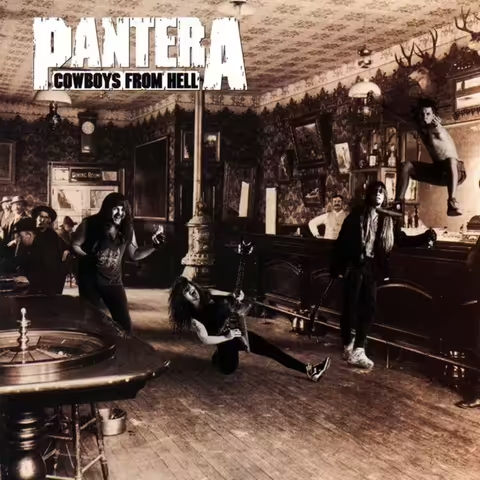
The cover photograph is one of the strangest in the heavy metal canon. It is a real 1910 documentary photograph of the Cosmopolitan Saloon in Telluride, Colorado, with the four members of Pantera composited on top of it. Dimebag stands centre playing guitar. Vinnie Paul leans on the counter counting money. Rex hangs off the bar. Phil Anselmo is captured mid-jump in the air on the left of the frame. Getting that jump in focus, Anselmo has said, took about ten attempts; he was launching himself off a bar stool out of shot.
The image fits the album's title in a way that flatters both. The original saloon shot has the slightly haunted quality of all turn-of-the-century mining-town photographs. The band, in denim and leather, look like they wandered into it by mistake and might be the reason the room is about to fall silent. The new Pantera logo, which would appear on every subsequent release until Reinventing the Steel, also debuted on this sleeve, replacing the chrome-bubble glam logo of the four Metal Magic records.
The album was released on cassette, CD, vinyl LP and a short-lived US "long box" CD format. There were no censored territorial variants.
Release and Reception
Released on 24 July 1990, Cowboys From Hell did not chart in the United States for almost two years. It finally appeared on the Billboard Heatseekers chart in 1992, peaking at No. 27, and reached No. 117 on the Billboard 200 only on the back of the 2010 reissue. Outside the US it crept onto the Swedish chart at No. 46 in 1995. The slow burn is the story: the album sold steadily across the entire decade, certified gold in September 1993, platinum in July 1997, and finally double platinum in June 2023. The UK, Japan, Australia and Argentina all certified it gold over the same period.
The critical consensus took roughly the same shape. Most contemporary reviews were positive but not overwhelmed. AllMusic later summed up the retrospective view with a four-star review that pinpointed Darrell's playing as the defining ingredient:
"Pantera's breakthrough album, Cowboys from Hell, is largely driven by the band's powerful rhythm section and guitarist Diamond Darrell's unbelievably forceful riffing, which skittered around the downbeats to produce unexpected rhythmic phrases and accents, as well as his inventive soloing."
Eduardo Rivadavia, AllMusic
The retrospective lists have been generous. Guitar World ranked it 11th on their 100 Greatest Guitar Albums in 2006. IGN placed it 19th on their most influential heavy metal albums list. Loudwire put it at No. 18 on the Top 90 Hard Rock and Metal Albums of the 1990s. Ozzy Osbourne, asked by Rolling Stone in 2017 to name his ten favourite metal albums of all time, included it on the list.
Awards-wise, the album generated one Grammy nomination, for the live version of "Cemetery Gates" performed with Rob Halford, in the Best Metal Performance category at the 1998 Grammys. It did not win. Pantera would receive three more nominations in the same category across the rest of their career.
Singles and Music Videos
Atco worked two official singles, "Cowboys From Hell" and "Psycho Holiday", both released across 1990. "Cemetery Gates" was the song that actually built the audience, even though it was never a formal single in the US. MTV's Headbangers Ball spun the video heavily, and that, more than any radio play, was what pushed the album over the line into platinum territory by the end of the decade.
| Single | Release | Video director / location | Reception |
|---|---|---|---|
| "Cowboys From Hell" | 1990 | Filmed at the Basement club in Dallas, Texas. | Heavy Headbangers Ball rotation; eventually the band's signature song. |
| "Psycho Holiday" | 1990 | Also filmed at the Basement, Dallas. | Used to introduce US club audiences to the band's new image. |
| "Cemetery Gates" | Promo only | Performance and graveyard footage. | The biggest MTV hit from the album despite never being a commercial single; the live Rob Halford version earned a Grammy nomination in 1998. |
Touring and Live
The Cowboys From Hell tour kept Pantera on the road for nearly two years. Their first proper US run began in summer 1990, supporting Exodus and Suicidal Tendencies. That paired them with two of the more chaotic live acts in American thrash and forced them to sharpen their show. Subsequent legs put them on bills with Mind Over Four, Prong, Skid Row, Sepultura, Fates Warning, Morbid Angel and Wrathchild America.
The single highest-profile date of the cycle came in September 1991, when Pantera joined AC/DC, Metallica, the Black Crowes and others at the Monsters of Rock festival outside Moscow. It was a celebration of the new freedom to play Western music in the dying days of the Soviet Union, in front of an audience eventually estimated at around half a million. Pantera's set from that show was bootlegged for years before officially appearing on later reissues.
Earlier in 1991, Rob Halford had joined the band on stage during a US date. That guest appearance pulled Pantera into the European leg of Judas Priest's Painkiller tour, alongside Annihilator. It was the first time Pantera had toured outside North America. Halford and the band later cut "Light Comes Out of Black" together for the Buffy the Vampire Slayer soundtrack, and Halford appeared on the live "Cemetery Gates" that earned the Grammy nomination.
Highlights of the touring cycle in summary:
- Summer 1990: first national US tour, supporting Exodus and Suicidal Tendencies.
- 1991: European arena dates supporting Judas Priest on the Painkiller tour.
- 28 September 1991: Monsters of Rock, Tushino Airfield, Moscow.
- Headlining their own US clubs by late 1991 and into early 1992.
In TV, Film and Media
"Cowboys From Hell" the song outlived the album as a piece of media shorthand. It has been used as walk-on music by professional wrestlers, as a soundtrack cue in films and video games (including the Guitar Hero series, where it appeared as downloadable content), and as a hockey arena standard. The NHL's Dallas Stars befriended the band in the late 1990s, and Pantera wrote "Puck Off" for the team's Stanley Cup-winning 1999 season, which remains the Stars' goal song to this day.
"Domination" was used as a guest spot in the SpongeBob SquarePants episode "Pre-Hibernation Week" in 2001 (renamed "Death Rattle" on the album version, "Pre-Hibernation" on the soundtrack). It is, comfortably, the strangest media placement in the band's catalogue.
Covers, Samples and Tributes
Cover versions of the title track have been recorded by, among others, Lamb of God (live, regularly), Five Finger Death Punch and Children of Bodom. "Cemetery Gates" has been covered by Avenged Sevenfold and is a routine pick at metal tribute and memorial shows. "Domination" has been a Hatebreed live staple at various points. The album itself does not sample any prior records, and its songs have been comparatively under-sampled in hip-hop, although the title-track main riff has been quoted in interpolations and tribute pieces across the metal world for thirty-five years.
The cleanest measure of the album's influence is who cites it. Corey Taylor of Slipknot has named it one of his ten favourite metal albums of all time. Phil Demmel and Robb Flynn of Machine Head have both pointed to it as the trigger for their band's mid-1990s sound. Mark Morton of Lamb of God has said the title-track riff was a personal year-zero. Avenged Sevenfold's M. Shadows lists Pantera in his ten favourite metal records. The reunion-era touring Pantera now playing American arenas, with Zakk Wylde and Charlie Benante, is built on the premise that this is the album an audience still actively wants to hear in full.
Reissues, Remasters and Anniversaries
The big anniversary edition is the 20th, released on 14 September 2010. Mixed from the original analogue tapes, the standard expanded edition included a bonus disc of previously unreleased live material from the 1990 Foundations Forum showcase and the 1991 Monsters in Moscow set, plus the entire Alive and Hostile EP. A deluxe edition added a third disc, Cowboys From Hell: The Demos, containing ten demo versions of album tracks plus the long-unreleased "The Will to Survive" demo. A separately pressed, limited-edition vinyl LP of the demos disc, capped at 3,000 180-gram copies, was made available exclusively through Metal Club record stores for Black Friday 2010. The reissue lifted the album to No. 117 on the Billboard 200 for the first time and No. 8 on the Top Catalog Albums chart.
A double-platinum RIAA certification followed in June 2023. As of writing there has been no full anniversary Atmos or spatial-audio remix, and no half-speed master vinyl pressing has been formally released, though that is the most-rumoured future reissue format.
Legacy and Influence
Two things happened immediately after Cowboys From Hell. The band wrote a heavier, more focused follow-up in 1991 and recorded Vulgar Display of Power with the same producer in the same studio in early 1992. And the wider American metal scene took two or three years to catch up with what they had done, then spent the rest of the decade copying it.
The verdict from AllMusic's Jason Birchmeier later in the decade was that Pantera "put to rest any and all remnants of the eighties metal scene, almost single-handedly demolishing any notion that hair metal, speed metal, power metal, et al, were anything but passe." That is overstated, but only just. Machine Head's Burn My Eyes (1994), Sepultura's Chaos A.D. (1993), Fear Factory's Demanufacture (1995), the entire nu-metal wave headed by Korn, and the early 2000s metalcore explosion (Killswitch Engage, Lamb of God, Shadows Fall) all rest on a foundation laid by these twelve songs.
The "is it really their debut" question is now mostly answered in the affirmative even by the band themselves. The four Metal Magic albums remain officially out of the discography on Pantera's website. Phil Anselmo has talked about them only sparingly, with affection but rarely as Pantera records. From Cowboys From Hell onwards, every catalogue list and every retrospective treats this as track one.
Two of the four people on the album cover are no longer alive. Dimebag Darrell was shot dead on stage in Columbus, Ohio on 8 December 2004 while playing with Damageplan. Vinnie Paul died of heart failure on 22 June 2018. The reunion tour that began in late 2022 with Anselmo, Brown, Zakk Wylde and Charlie Benante is, in effect, a long touring memorial to the two missing Abbotts. The setlist starts and ends, in most cities, with songs from Cowboys From Hell and Vulgar Display of Power. It is impossible now to listen to the album without that shadow over it, which is probably as it should be.
Things You Might Not Know
| Fact | Detail |
|---|---|
| Hurricane Hugo signed them | Atco A&R man Mark Ross only saw Pantera live because Hurricane Hugo grounded his flight out of Texas and his boss told him to use the spare evening to check the band out. |
| Twenty-eight rejections | Pantera have stated, repeatedly, that they were turned down by 28 major labels before Atco signed them in 1989. |
| The Lynch Mob accident | Producer Max Norman dropped out 48 hours before sessions started to take a $50,000 fee for Lynch Mob's debut Wicked Sensation; Terry Date was a last-minute replacement on a $30,000 budget. |
| Cemetery Gates' eight pianos | The thunderous build into the song's main riff is Rex Brown playing eight grand pianos stacked together, recorded backwards on tape and then flipped. |
| Dad's studio | Pantego Sound was owned and run by the Abbott brothers' father, country songwriter Jerry Abbott, who had engineered all four of Pantera's previous albums. |
| The cover is from 1910 | The saloon in the cover photo is the real Cosmopolitan Saloon in Telluride, Colorado, photographed in 1910; the band were composited over the original image. |
| Anselmo's ten-take jump | Phil Anselmo's mid-air pose on the album cover took about ten attempts, launching himself off a bar stool that was kept out of frame. |
| The Smiths connection | Anselmo was fully aware that the Smiths already had a song called "Cemetery Gates"; he kept the title because he found the contrast funny. |
| The Will to Survive lives | The unreleased demo "The Will to Survive" was cannibalised for parts of "This Love" on Vulgar Display of Power before being released in its original form in 2010. |
| Drums, then guitars, then bass | The band tracked Vinnie Paul's drums in isolation, then layered guitars over them, and Rex Brown's bass parts went on last alongside the guitars, not the drums. |
| Howie Weinberg mastered it | Mastering was handled by Howie Weinberg, who would master Nirvana's Nevermind eighteen months later. |
| Headbangers Ball did the heavy lifting | "Cemetery Gates" was never released as a commercial single in the US; its MTV Headbangers Ball rotation was what carried the album to platinum certification by 1997. |
| Halford and the Grammy | The album's only Grammy nomination came in 1998 for the live version of "Cemetery Gates" performed with Rob Halford. |
| Diamond, not Dimebag | Darrell Abbott is credited as Diamond Darrell on the sleeve; he only became Dimebag during the Vulgar Display of Power touring cycle. |
| Sober sessions | Rex Brown has consistently stated that the band did not drink in the studio while making Cowboys From Hell, despite the live reputation; the drinking was strictly post-session. |
The Riffology Podcast
If this deep dive has sent you back to the record, the Riffology podcast goes further still, with longer-form conversations about the albums and the bands that built modern heavy music. Find it on Apple Podcasts, Spotify, YouTube and all the usual platforms, and dig into the rest of the Pantera catalogue while you are there.
Comments