
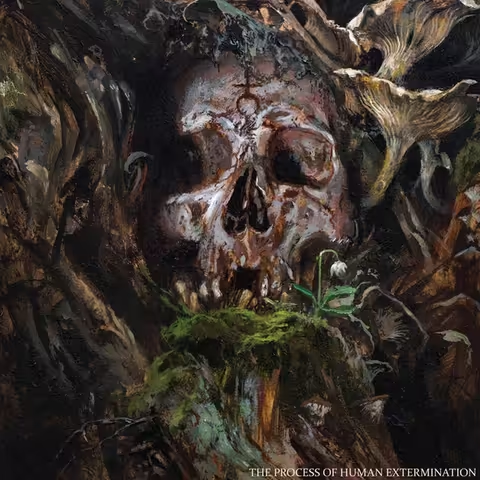
Twelve-hour studio days, a producer who was also writing every guitar part, a band that had not yet played their first real tour, and a debut album promoted on the strength of guest vocals from The Red Chord, Vision of Disorder, The Human Abstract and Full Blown Chaos. The Process of Human Extermination is the album where a Hoboken assistant engineer called Will Putney quietly built the launchpad for one of the most consequential production careers in modern metal, on a record almost nobody outside the deathcore underground heard at the time.
Released on 21 June 2011 through Black Market Activities, Fit For An Autopsy''s debut is a thirty-two-minute, ten-track exercise in calibrated aggression. It arrived at the moment deathcore was being declared finished by the same publications that had hyped it three years earlier, and it arrived almost defiantly trope-rich: down-tuned to subterranean depths, blast-beated, breakdown-loaded, the song titles all monolithic and definite-article-led. What it did differently, even then, was treat the genre as a structure to inhabit rather than a checklist to tick. That choice would only fully pay off on later records, but the seeds, and the personnel, were all in place here.
Album Facts
| Field | Detail |
|---|---|
| Artist | Fit For An Autopsy |
| Album | The Process of Human Extermination |
| Release date | 21 June 2011 |
| Label | Black Market Activities (BMA) |
| Producer | Will Putney |
| Engineer / mixer / mastering | Will Putney |
| Studios | Nuthouse Studios, Hoboken NJ; The Machine Shop, Weehawken NJ |
| Genre | Deathcore / death metal |
| Track count | 10 |
| Total runtime | 32:38 |
| Billboard 200 peak | Did not chart |
| US Heatseekers peak | Did not chart |
| UK Albums Chart peak | Did not chart |
| Certifications | None |
| Estimated sales | Not publicly reported; underground-only release |
| Key singles | "The Conquerer" (19 May 2011); "The Consumer" feat. Travis Richter (7 June 2011) |
The Deathcore Class of 2011
By June 2011 the deathcore conversation was already on its second cycle. The genre had peaked commercially in 2009 with Suicide Silence''s No Time to Bleed cracking the Billboard 200 top forty, and had then been pilloried with the kind of fervour reserved for genres that succeed too obviously and too quickly. Whitechapel''s A New Era of Corruption had landed in 2010 to a critical reception that was warm rather than ecstatic. Job for a Cowboy had spent the year before publicly distancing themselves from the term entirely. The "deathcore is dead" essays were already filed and headlined.
Into that environment, Fit For An Autopsy released a record that did not pretend to be anything other than a deathcore record. The cover art was bleak, the song titles were definite-article nouns, and the breakdowns landed exactly where the form required. The bet was not on reinventing the genre on the debut. It was on the band''s pedigree and on the producer''s eventual catalogue, and on the assumption that there was still a small, dedicated audience that wanted heavy music made carefully.
- Suicide Silence, No Time to Bleed (2009) , the genre''s commercial high-water mark
- Whitechapel, A New Era of Corruption (2010) , Metal Blade''s marquee deathcore release
- Despised Icon, Day of Mourning (2009) , French-Canadian template setters'' penultimate record before their first split
- Carnifex, Hell Chose Me (2010) , the Nuclear Blast deathcore deal
- Job for a Cowboy, Ruination (2009) , already audibly moving toward death metal proper
- Thy Art Is Murder, The Adversary (2010) , Australian future stadium-deathcore in its first form
Before Fit For An Autopsy
Nate Johnson did not arrive at Fit For An Autopsy as an unknown. By the time Pat Sheridan first joked with him backstage at a Since The Flood show about singing on a new project, Johnson had already fronted three bands of consequence in the American underground: the chaotic-grind outfit Premonitions of War, the New Jersey metalcore band Deadwater Drowning, and most notably Through the Eyes of the Dead, with whom he had recorded the well-circulated 2005 album Bloodlust. He was, in the modest but real way that mattered in 2010 deathcore, a name.
Sheridan and Will Putney came from a different end of the New Jersey scene. They had played together in a hardcore band called Nothing Left To Mourn before deciding, around 2008, that they wanted to write music with more density and more space than New Jersey hardcore was producing at the time. "Pat and I were in a hardcore band called Nothing Left To Mourn for a few years and then that came to an end," Putney recalled in a 2013 MetalSucks interview. "We still wanted to write music and we were both more into playing metal because we started getting a little better at guitar, and we weren''t that into the bands that represented the state of New Jersey hardcore at that time."
The Jersey City Formation
Fit For An Autopsy''s origin city is given on official paperwork as Jersey City, but the band''s geography was always wider: members commuted in from Sayreville, Old Bridge, Hoboken and the surrounding Bergen and Middlesex County metal scenes. The 2008 first-demo lineup was already a placeholder. The recording that became the band''s calling card was four tracks Putney pulled together at speed after Sheridan secured a tentative agreement from Johnson, with Putney himself playing every instrument except vocals on the working tapes.
The drummer who eventually slotted into the recording lineup was Brian Mathis, an old friend of Putney''s who had played in the local band Forgetting Tomorrow. "I always wanted to be in a band with him, but he was never really interested because we never really had anything cool," Putney said. "Once we got Brian, who played drums on The Process of Human Extermination, we said, okay, now we have a real lineup. We have a real drummer, a real singer and we can write good songs." That four-piece , Johnson, Putney, Sheridan, Mathis , is the lineup that recorded the debut. No second touring guitarist, no permanent bassist; Putney played bass on the record himself.
Signing to Black Market Activities
The label that signed Fit For An Autopsy was not a generic indie. Black Market Activities was the imprint run by Guy Kozowyk, frontman of The Red Chord, distributed at the time through the larger Metal Blade infrastructure. The deal was announced on MetalSucks on 3 December 2010 under the gleeful headline "Black Market Activities Is Fit For An Autopsy". Kozowyk had spent years releasing records by bands he personally cared about, and Fit For An Autopsy fit the template: a band with a credible vocalist, a producer-in-waiting on guitar, and enough underground momentum to justify the bet.
The signing carried a complication the band would later acknowledge. Putney has been candid that the album was rushed once the deal was on the table, and then slowly orphaned by the label''s promotional capacity. "That record came together really fast," he told MetalSucks in 2013. "We got offered a deal with Black Market Activities, and I had to bang those songs out relatively quickly to get them out. We just weren''t prepared. We didn''t have the long-term sight we do now."
"I really like that record, there''s some parts that are cool. But those songs, the label stalled, and a lot of time passed, and I sat on those songs for almost three years. So I really learned what didn''t work, what I didn''t want to do."
Will Putney, MetalSucks interview, September 2013
Demos and Pre-production
The pre-production for The Process of Human Extermination effectively was the recording, in the sense that Putney''s home-studio guitar demos became the spine of the finished arrangements. He has described the process in interviews as obsessive and isolated: writing songs from start to finish at the desk, rather than rehearsing them collectively, then bringing Mathis in to track drums against a near-final guitar bed.
That working method, which would later become Putney''s professional default across hundreds of records, was already in evidence on the debut. The band as a four-piece never lived together long enough to write in a rehearsal room. What Fit For An Autopsy were in 2011 was a session-band-shaped object built around a producer-songwriter, with a frontman flown in to deliver vocals on top. That is not a criticism , it is how plenty of great records get made , but it explains both the tightness and the slightly airless quality of the album. Everything you hear was deliberate.
Nuthouse Studios and The Machine Shop
Recording was split between two New Jersey rooms. Nuthouse Studios, in Hoboken, was a smaller commercial facility Putney had been working out of. The Machine Shop, in Weehawken, was the room owned and run by producer Will "Machine" Benson , best known for his work with Lamb of God, Clutch and Crowbar , and it was where Putney had effectively trained on the job since his late teens.
Putney''s route into production is worth pausing on, because it explains the album. He had been interning at marketing-and-promotion firm The Syndicate, which shared a building with Machine''s studio. Machine, recently a father, needed a junior to babysit sessions while he stepped out. Putney got hired as a placeholder. "I went into that studio and bonded with Machine," he told MetalSucks. "Three weeks after being in that room, I was trying to record local bands, and I had no idea what I was doing. I was trying to copy Machine and slowly figured it out." By 2011 he had already produced The Human Abstract''s Digital Veil and was a few records into a freelance career.
Will Putney''s Twin Role
The Process of Human Extermination is the first album in which Putney holds every meaningful production-side credit on a record he also plays guitar and bass on. He wrote the music, played the guitars, played the bass, engineered the sessions, mixed the album and mastered it. Aaron Marsh handled the layout; Johnson and Sheridan wrote and recorded their parts; Mathis tracked the drums. Otherwise the credit list is one name.
Putney has been candid about how much that arrangement loaded onto a debut. "In a way it''s easier, because I have full control over these songs when I''m in the studio," he said in 2013. "I entertain other opinions, but I don''t really have to. It gives me the freedom to do whatever the hell I want. At the same time, I''m a producer for a living, so people are going to judge my own art pretty harshly. If I record someone else''s band and the guitar riff isn''t that cool, it''s not necessarily my fault , but this time, it is."
Recording the Guitars
The guitar tone on The Process of Human Extermination is the album''s signature: low, dry, percussive, and very obviously played on seven-string instruments tuned down further than they were designed for. By 2011 standards it is a relatively un-scooped tone, with more low-mid information than the Sneap-school template that dominated American metalcore production at the time. Putney has cited his Converge and chaotic-hardcore listening as a more useful reference than the immediately surrounding deathcore catalogue, and the guitars on the debut carry some of that, particularly in how the riffs are voiced in the lower midrange rather than buried beneath a top-end fizz.
Tracking-wise, the album is layered conservatively: a single rhythm-guitar pass doubled hard left and right, with occasional third-layer accents rather than the four-and-six-layer stacking that became standard later in Putney''s career. The leads are sparse, often single-line, and almost never extended; this is a riff record with closing flourishes rather than a guitar showcase. The bass, played by Putney himself, follows the rhythm-guitar parts almost throughout, picking out the low-string runs and adding a sub-frequency body that an isolated guitar tracking pass alone could not.
Nate Johnson''s Vocal Takes
Johnson tracked his vocals last in the chain, after the music was effectively finished. He has not done much press about the debut in subsequent years , his 2014 departure from Fit For An Autopsy was abrupt and lightly explained, and Joe Badolato has been the band''s voice since 2015 , but his performance on the album is the strongest direct argument for his stature in the scene. He works across three registers: a guttural low, a serrated mid-range yell, and a thin high scream most associated with his Through the Eyes of the Dead work. He moves between them with the kind of placement-as-arrangement awareness that you only get from a vocalist who has tracked more than a couple of records.
His lyrics, co-written with Putney, refuse the genre''s usual horror-movie scaffolding. Putney would later articulate the policy explicitly: "We didn''t want to do fantasy lyrics and we didn''t want to do typical cheesy gory stuff just to be edgy and extreme. There''s real shit that happens in the world, and that''s where we get our sustenance." On the debut, that translates to a recurring vocabulary of conquerors, colonists, jackals and executioners, treated not as fantasy figures but as a deliberately archaic gloss on contemporary politics.
Brian Mathis''s Drum Tracking
Mathis is the under-discussed presence on The Process of Human Extermination. He would record only one album with the band before being replaced by Josean Orta in 2012, but his playing here is the connective tissue that keeps a producer-driven record feeling like a band performance. His blast-beats are deep-pocketed rather than mechanical, his fills are placed in a way that respects the guitar phrasing, and his kick-drum work, while heavily quantised in places by the era''s standards, retains a swing that the genre''s worst exemplars never managed.
Putney''s recollection of finally landing Mathis is one of the most telling moments in the band''s origin story: a producer who had been waiting for years to make a record with this specific drummer, and a drummer who had previously declined every project Putney brought to him. The implication is that Mathis came in with leverage, and that the drum tracks are heard as he wanted them played, not as a producer wanted them programmed.
Personnel and Credits
| Role | Player | Notes |
|---|---|---|
| Core band | ||
| Lead vocals | Nate Johnson | Previously of Through the Eyes of the Dead, Premonitions of War, Deadwater Drowning. Left the band April 2014. |
| Guitars, bass | Will Putney | Also wrote the music and acted as producer, engineer, mixer and mastering engineer. Founding member. |
| Guitars, backing vocals | Pat Sheridan | Previously of Nothing Left To Mourn with Putney. Founding member. |
| Drums | Brian Mathis | Previously of Forgetting Tomorrow. Only Fit For An Autopsy album he appears on; replaced by Josean Orta in 2012. |
| Guest vocalists | ||
| Guest vocals on "The Colonist" | Ray Mazzola | Full Blown Chaos. |
| Guest vocals on "The Desecrator" | Tim Williams | Vision of Disorder, also Bloodsimple. |
| Guest vocals on "The Wolf" | Guy Kozowyk | The Red Chord, and the founder of Black Market Activities, the album''s label. |
| Guest vocals on "The Consumer" | Travis Richter | The Human Abstract, also From First to Last. |
| Guest vocals on "The Locust" | Marc Lambert | Painted In Exile. |
| Production | ||
| Producer / engineer / mixer / mastering | Will Putney | Recorded at Nuthouse Studios, Hoboken and The Machine Shop, Weehawken. |
| Artwork | ||
| Layout | Aaron Marsh | Sleeve and packaging layout. |
The Guest Vocal Roll-Call
Five of the album''s ten tracks carry a guest vocalist, and the roster reads like a curated 2005 to 2010 American extreme-metal showcase. The most editorially significant is Guy Kozowyk on "The Wolf", because Kozowyk also owned the label, sang in The Red Chord, and was Putney and Johnson''s strongest single advocate inside the industry. Tim Williams of Vision of Disorder brings a hardcore-elder credibility to "The Desecrator"; Travis Richter of The Human Abstract gives "The Consumer" a noticeably more melodic top line; Ray Mazzola and Marc Lambert anchor the more straightforward deathcore cuts at the album''s centre.
Phil Freeman, reviewing the album for AllMusic in June 2011, focused on exactly this guest-laden quality: "they''ve got famous-ish, by underground standards, friends, a few of whom turn up to provide guest spots on the album." His verdict was four stars out of five, a quietly significant pass from a critic who had spent the previous two years filing deathcore takedowns.
"Deathcore is deathcore, for the most part. Bands operating within the genre have a few simple rules they live by, and rule number one is: get low. Fit for an Autopsy are a new deathcore band attempting to make a mark in an already saturated genre."
Phil Freeman, AllMusic review, 21 June 2011
Tracklist
| # | Title | Writer(s) | Length | Single? | Notes |
|---|---|---|---|---|---|
| 1 | "The Conquerer" | Fit For An Autopsy | 4:14 | Yes (19 May 2011) | Album opener and lead single. |
| 2 | "The Colonist" | Fit For An Autopsy | 2:59 | Feat. Ray Mazzola (Full Blown Chaos). | |
| 3 | "The Desecrator" | Fit For An Autopsy | 2:50 | Feat. Tim Williams (Vision of Disorder). | |
| 4 | "The Juggernaut" | Fit For An Autopsy | 2:53 | Mid-album breakdown showcase. | |
| 5 | "The Wolf" | Fit For An Autopsy | 2:29 | Feat. Guy Kozowyk (The Red Chord), the label boss. | |
| 6 | "The Consumer" | Fit For An Autopsy | 2:42 | Yes (7 June 2011) | Feat. Travis Richter (The Human Abstract). |
| 7 | "The Locust" | Fit For An Autopsy | 3:09 | Feat. Marc Lambert (Painted In Exile). | |
| 8 | "The False Prophet" | Fit For An Autopsy | 3:18 | The album''s longest sustained mid-tempo passage. | |
| 9 | "The Jackal" | Fit For An Autopsy | 3:22 | Late-album cut, no guest. | |
| 10 | "The Executioner" | Fit For An Autopsy | 4:38 | Longest track; the closer. |
"The Conquerer" and "The Colonist"
The album opens on what is still, fifteen years on, the most-streamed song in Fit For An Autopsy''s pre-Badolato catalogue. "The Conquerer" is a statement of intent: a four-minute composition that uses its length to set up genre expectations, opening blast, mid-section breakdown, closing chug, and then slightly subverts each by routing them through more deliberate transitions than a typical 2011 deathcore opener would attempt. It was released as the lead single on 19 May 2011, a month before the album, with theprp.com hosting the premiere.
"The Colonist" follows immediately and tightens the screws. Ray Mazzola of Full Blown Chaos enters at the second verse with a noticeably more hardcore-inflected delivery than Johnson''s, briefly turning the song into a kind of guest-spot relay. At two minutes and fifty-nine seconds it is the shortest pre-closer on the record, and it functions as a hand-off into the album''s more compressed middle section.
"The Juggernaut" and "The Wolf"
"The Juggernaut" is the album''s purest breakdown cut, a track that exists primarily to provide a fixed point for live audiences to react to. Its half-time mid-section is the closest the record gets to crowd-killing-template deathcore, and the band have generally kept it in setlists across lineup changes for exactly that reason. "The Wolf", which follows, is the song that carries the most editorial weight on the album: Guy Kozowyk is the label''s owner, and putting him on a track is both a personal endorsement from Putney and a label-side imprimatur baked into the audio itself.
Kozowyk''s vocal performance on "The Wolf" is, characteristically, abrasive in a way that distinguishes it from Johnson''s: more bark than scream, more hardcore-pit than death-metal-grave. He stays low in the mix until the song''s second half, which is itself a production choice , Putney could easily have brought him forward , and the resulting arrangement reads as a band track with a guest, rather than a guest-spot track with a band behind it.
"The Consumer" and "The Locust"
"The Consumer" was the album''s second single, released on 7 June 2011 with The Human Abstract''s Travis Richter as the headline feature. It is the most melodically open song on the record, partly because Richter brings a cleaner, more sung tone into the arrangement, and partly because the song is structured around a longer chord-cycle than its neighbours. It is also the track most often used in retrospective coverage to illustrate what Fit For An Autopsy were already doing differently in 2011: an actual chorus shape, in a genre that often refused them.
"The Locust", with Painted In Exile''s Marc Lambert, is the most technically dense song on the record. Painted In Exile were a New York progressive-deathcore band Putney had crossed paths with on the local circuit, and Lambert''s higher-register, more shrieking delivery sits on the song in conscious contrast to Johnson''s low growl. The arrangement opens out into one of the album''s only clearly post-rock-influenced passages near its halfway mark, a brief atmospheric interlude that, in hindsight, points directly at the band''s later work on The Great Collapse and The Sea of Tragic Beasts.
"The False Prophet", "The Jackal" and "The Executioner"
The album''s closing trilogy is the section the band wrote without guests, and it is where the four-piece''s actual personality registers most clearly. "The False Prophet" runs at a slower tempo than anything that precedes it, with a mid-tempo grind that recalls Mastodon at their heaviest more than it recalls any contemporary deathcore peer. "The Jackal" lifts the tempo again, briefly, and is the track most clearly aimed at the live setlist: blast, mid-section, drop, end.
"The Executioner" closes the record at four minutes and thirty-eight seconds, the longest track on the album. It is also the track most willing to take a passage and let it breathe; the second half is dominated by an extended chord progression that Johnson uses as a platform for a more declamatory, almost spoken vocal delivery. The band have rarely played it live in its full form, and on the album it acts as a quietly disproportionate closer for a record that is otherwise primarily concerned with hitting hard and clearing out.
Lyrics and Themes
The lyric sheet for The Process of Human Extermination repays the small effort of finding it. Johnson and Putney wrote together, and their shared targets are consistent: corporate environmental damage, military-imperial violence dressed in legitimising language, the erosion of public goods by private capital. The "conquerer", the "colonist" and the "executioner" are not metaphors for ancient figures; they are roles the band sees occupied by present-day actors.
That choice was, in 2011, genuinely unusual within the genre. Most deathcore lyric sheets at the time were either generic-extreme (gore, death, religious-horror imagery) or, in the more progressive bands, abstracted-philosophical. Naming political and corporate targets directly, as Fit For An Autopsy do on the debut, was closer to the lineage of metallic hardcore (All Out War, Earth Crisis, Trial) than to any of the band''s immediate genre peers. It is the most obvious continuity between the band that existed on the debut and the band that, a decade later, would build an entire late-period identity around politically and environmentally explicit songwriting.
Artwork and Packaging
The album''s sleeve, laid out by Aaron Marsh, is built around a single bleak monochrome image: a stark, dystopian rendering that pairs the title with a deliberately ambiguous figure-and-landscape composition. There is no band photograph on the front, no logo lock-up with a clear central focal point. The title type and the band name carry the full weight of the cover, and both are set in a constructed, slightly architectural lettering that doubles down on the album''s themes of organised, institutionalised violence rather than individual horror.
The packaging itself, in its original Black Market Activities jewel-case CD edition, was modest. There was no gatefold, no booklet of band photos, no producer essay. Lyrics were printed; credits were printed; the rest of the real estate went to artwork. A vinyl edition did not appear at first release; the album''s eventual presence on vinyl came later through the secondary catalogue distribution that picked the band up after their 2013 move to eOne and the subsequent partnership with Good Fight Music.
Singles and Promotion
Two singles preceded the album, both as audio-only premieres rather than music videos. "The Conquerer" was hosted by theprp.com on 19 May 2011, with MetalSucks following up the same week. "The Consumer", featuring Travis Richter, was premiered through theprp.com again on 7 June 2011, two weeks before the album dropped. There were no proper music videos shot for the debut; Black Market Activities'' promotional capacity in 2011 did not extend to video budgets for new signings.
| Single | Release date | Format | Featured guest | Outlet of premiere |
|---|---|---|---|---|
| "The Conquerer" | 19 May 2011 | Streaming audio | None | theprp.com |
| "The Consumer" | 7 June 2011 | Streaming audio | Travis Richter (The Human Abstract) | theprp.com |
Release and Reception
The album landed on 21 June 2011 to a reception that was warm in the right corners and silent in most of the others. AllMusic''s Phil Freeman gave it four stars. MetalSucks''s Axl Rosenberg, who had been one of the band''s earliest backers, called Fit For An Autopsy "the actually good deathcore band" in his pre-release coverage and reiterated the verdict on release. Lambgoat covered the album within its broader news-feed remit. Decibel did not run a full review. Kerrang! and Metal Hammer in the UK essentially ignored it, and it received no significant mainstream-press coverage in either the US or the UK.
Commercially, it did not chart. There is no Billboard 200, Heatseekers or Hard Rock Albums entry for the record in any reliable archival source, and there are no certifications from the RIAA, the BPI or any equivalent body. This was a small-label deathcore debut: praised in the right magazines, sold in the right merch booths, and seen in real numbers only by an audience that already followed the band''s members from their previous projects.
"This past December we gave you the heads up that Guy Kozowyk''s Black Market Activities had signed Fit for an Autopsy, the actually good deathcore band that features former Through the Eyes of the Dead vocalist Nate Johnson and guitarist Will Putney, who has already produced such killer records as The Human Abstract''s Digital Veil."
Axl Rosenberg, MetalSucks, 5 May 2011
Touring The Process
Touring around the debut was unglamorous. Fit For An Autopsy did not have a tour bus, did not headline, and did not cross the Atlantic on the back of the record. Through the second half of 2011 and into 2012 they worked the US club circuit as a support act, including small-room runs with bands from the wider Black Market Activities and Metal Blade orbits. Putney himself toured only sparingly, a tension that intensified once his production work began to accelerate.
The lineup as it appeared live differed from the lineup that recorded the album. Brian Mathis exited the band in early 2012 and was replaced by Josean Orta. Tim Howley joined as a third guitarist in 2013, a hire Putney has been clear was made specifically to allow him to step back from full-time touring. By the time the band were comfortably road-testing their material, Mathis was gone, Howley was in, and the four-piece that recorded The Process of Human Extermination no longer existed as a performing unit.
Afterlife: Hellbound and Beyond
The most telling thing about the debut is what happened next. Hellbound, the second album, was released in September 2013 through eOne Music. That label move alone, from Black Market Activities to a vastly larger distribution operation, implied that the debut had at least built sufficient underground credibility to justify a bigger deal. Hellbound peaked at number 18 on Billboard''s US Heatseekers chart and number 23 on the Hard Rock chart, the band''s first genuine chart placements. The trajectory from there is well-documented: Joe Badolato replaces Nate Johnson in 2015 for Absolute Hope Absolute Hell, Putney signs the band to Nuclear Blast in 2018 ahead of The Sea of Tragic Beasts, and Oh What the Future Holds hits the Billboard 200 at number 23 in 2022.
| Album | Year | Label | Vocalist | US Heatseekers peak | Billboard 200 peak |
|---|---|---|---|---|---|
| The Process of Human Extermination | 2011 | Black Market Activities | Nate Johnson | ||
| Hellbound | 2013 | eOne | Nate Johnson | 18 | |
| Absolute Hope Absolute Hell | 2015 | eOne | Joe Badolato | 3 | |
| The Great Collapse | 2017 | eOne / Long Branch | Joe Badolato | 2 | 199 |
| The Sea of Tragic Beasts | 2019 | Nuclear Blast | Joe Badolato | ||
| Oh What the Future Holds | 2022 | Nuclear Blast | Joe Badolato | 2 | 23 |
| The Nothing That Is | 2024 | Nuclear Blast | Joe Badolato | 9 |
The debut sits at the very bottom of that chart progression, but it is also the only album whose existence makes the rest of the progression possible.
Will Putney the Producer Emerges
The other afterlife to track is Putney''s. By 2011 he had produced The Human Abstract, several Stray From The Path records and some local-circuit hardcore. The Process of Human Extermination is the first time a producer-and-engineer credit on a Putney-produced album coincides with a Putney guitar credit on the same record, and it is the proof-of-concept for what would become Graphic Nature Audio, the Belleville, New Jersey studio he eventually built and ran as his primary base.
The catalogue Putney has produced, mixed or engineered since 2011 reads, in retrospect, like a parallel history of mid-2010s and 2020s heavy music: Body Count''s Manslaughter, Bloodlust, Carnivore and Merciless; Knocked Loose''s A Different Shade of Blue and You Won''t Go Before You''re Supposed To; Thy Art Is Murder''s Holy War and Dear Desolation; Every Time I Die''s Low Teens; The Ghost Inside''s eponymous comeback; Parkway Drive''s Reverence; Northlane and Northlane-adjacent records that defined Australian metalcore for half a decade; SiM''s HOOMAN AFTER ALL. He has, in the years since The Process of Human Extermination, become the single most important producer in his corner of the genre.
"I really like our first record and stuff, but I can definitely hear a sound from a time that falls out of fashion. I wanted to try to evolve the band on this record where 10 years from now, 15 years from now, these are still going to be cool songs."
Will Putney, Distorted Sound interview, February 2017
Reissues and Remasters
The Process of Human Extermination has never received a formal anniversary edition, a remaster, or a deluxe-with-demos reissue. There is no half-speed-master vinyl release, no Atmos mix, no live-album-of-the-album, and no Decibel Hall of Fame retroactive elevation. The album has been redistributed digitally at various points, most notably through Good Fight Music in 2017 when the band''s catalogue was consolidated under their eOne-era partner, but the audio that streams on Spotify, Apple Music and YouTube today is the original Putney mix and master from 2011.
There is a quietly interesting reason for this. Putney has repeatedly distanced himself from the production work on the debut in interviews, describing it as the product of a sound that "falls out of fashion" and as a record made under deadline pressure. There has, accordingly, never been a strong artist-side push to remix or remaster it. The band''s later records do not need the debut to be polished up to justify themselves; the debut is allowed to remain what it was.
Things You Might Not Know
| Fact | Detail |
|---|---|
| The label boss is on it | Guy Kozowyk, founder of Black Market Activities and frontman of The Red Chord, sings on track five, "The Wolf". The man who released the album is literally a featured vocalist on it. |
| Putney played bass too | There was no permanent bass player on the record. Will Putney tracked all the bass parts himself, in addition to writing every song, playing every guitar, and producing, engineering, mixing and mastering the album. |
| One-album drummer | Brian Mathis only ever recorded one Fit For An Autopsy album, this one. He was replaced by Josean Orta in early 2012, less than a year after release. |
| Producer-by-accident | Putney got into production by being hired to babysit sessions at The Machine Shop while owner Will "Machine" Benson stepped out for childcare. Three weeks in, he was tracking local bands on the side. |
| The first single dropped on a news blog | "The Conquerer" was premiered on 19 May 2011 by the New Jersey-run news site theprp.com, not on the label''s own channels. |
| Nate Johnson''s prior CV | The vocalist had already fronted Through the Eyes of the Dead, Premonitions of War and Deadwater Drowning before joining Fit For An Autopsy. The debut was not his first time in a recording booth, by some distance. |
| The Pat-told-Nate-as-a-joke origin | According to Putney, Pat Sheridan only suggested Nate Johnson sing on the band as a backstage joke at a Since The Flood show. Johnson took the suggestion seriously and asked for demos. |
| The album was almost-instantly orphaned | The label "stalled" after release, according to Putney, and the band sat with the songs for nearly three years before Hellbound finally arrived in September 2013 on a bigger label. |
| Nuthouse Studios is small | One of the album''s two recording rooms, Nuthouse Studios in Hoboken, is a modest commercial facility better known for indie-rock and demo work than for extreme metal records. |
| Putney apprenticed under Machine | The Machine Shop session work on the debut was effectively the back end of Putney''s apprenticeship under Will "Machine" Benson, who has produced Lamb of God, Clutch and Crowbar. |
| No music videos | Despite the album having two pre-release singles, neither received an official music video. Promotional video budgets for Black Market Activities signings did not stretch that far in 2011. |
| Five of ten tracks have guests | Half of the album features a guest vocalist from outside the band. That is a very high guest-density for a debut, and is essentially the album''s promotional engine. |
| It has never been remastered | Unlike most albums that turn ten or fifteen, The Process of Human Extermination has had no anniversary reissue, no remaster, no demo-track deluxe edition. The 2011 mix is still the only mix. |
Legacy
For a record that sold modestly, did not chart and has never been remastered, The Process of Human Extermination has aged unusually well as a piece of underground reference material. It is the first studio document of a band that, by 2024''s The Nothing That Is, would be one of the few American deathcore acts taken seriously by both heavy-music press and the wider critical apparatus. It is the first production credit that Will Putney signed on a record he also wrote and played on, and therefore the proof-of-concept for the producer-songwriter dual role that defines every Fit For An Autopsy record since.
The album''s lyrical politics, pointed at corporate, environmental and imperial targets rather than horror-movie abstractions, have aged as well as the audio. The closing trilogy of "The False Prophet", "The Jackal" and "The Executioner" still scans as a coherent argument fifteen years on, in a way that very little deathcore lyric writing from 2011 does. Listened to in 2026, the record sounds like a band already certain about what it did not want to be, even if it had not yet fully worked out what it was going to become.
Across the discography that followed, the debut is the album the band reference least and depend on most. It is the foundation under everything Fit For An Autopsy have done since, from Hellbound''s first proper chart placement, through the Nate-to-Joe transition on Absolute Hope Absolute Hell, to The Nothing That Is and the band''s quiet ascent into Nuclear Blast''s headline tier. The Process of Human Extermination is where the bet was placed. Every record after is the bet paying off.
Listen to the Riffology Podcast
The Riffology podcast picks albums apart like this one all the time, the records that did not chart, the producers who became indispensable, the debuts that quietly built whole careers. It is available on Apple Podcasts, Spotify and every other major platform. New episodes go up regularly; come find the one that covers your favourite record.
Comments