Three teenagers from Downpatrick were too young to sign their own record contract. When Ash put their names to the Infectious Records deal that would eventually produce 1977, the band's parents had to co-sign, and their headmaster Jack Ferris had to grant permission, because Mark Hamilton and Tim Wheeler were seventeen and still sitting their A-Levels. Over the next eighteen months, Wheeler would be pulled out of exam revision to do press interviews about a single sitting in the UK Top 20, fly to Los Angeles to sign an American deal, and write nearly half of his band's debut album on the spot in a residential Welsh studio because they had toured so relentlessly since leaving school that they had run out of songs.
The album they made opens with the engine whine of a Star Wars TIE fighter and closes, eleven and a half minutes after the last proper song fades, with a hidden track of the bassist and a guitar tech being violently sick into a microphone. In between sits one of the most joyous British rock debuts of the decade: twelve songs about girls, drink, martial arts films and outer space, recorded by a producer who was, in Wheeler's own words, "gradually introducing us to drugs". When it landed in May 1996 it went straight to Number 1, the first album by an Irish group ever to debut at the top of the UK chart. This is the full story of 1977.
Album Facts
| Field | Detail |
|---|---|
| Artist | Ash |
| Album | 1977 |
| Release Date | 6 May 1996 (UK); 11 June 1996 (US) |
| Label | Infectious / Home Grown (UK); Reprise (US) |
| Producer | Owen Morris and Ash |
| Studios | Loco Studios, Usk Valley, Wales; Rockfield Studios, Monmouthshire, Wales; mixing at Orinoco, London |
| Genre / Subgenre | Britpop, power pop, garage rock, pop-punk, with glam and grunge elements |
| Track Count | 12 (including the closer's hidden track) |
| Total Runtime | 61:52 |
| UK Albums Chart Peak | Number 1 |
| Other Notable Chart Peaks | Scotland 5, New Zealand 14, Australia 18, Finland 26, Norway 26, Switzerland 40, Sweden 44, Germany 65, Netherlands 75 |
| Certifications | Platinum (BPI, United Kingdom) |
| Estimated Sales | First-week UK sales reported between 122,000 and 165,000; platinum represents 300,000 shipments |
| Key Singles | "Kung Fu", "Girl from Mars", "Angel Interceptor", "Goldfinger", "Oh Yeah" |
Cultural Context: Britain in 1996
By the time 1977 reached the shops in May 1996, Britpop had stopped being a scene and become the national soundtrack. Oasis had released (What's the Story) Morning Glory? the previous October and were eight weeks away from playing to a quarter of a million people at Knebworth. Blur had won and lost the chart battle of the previous August. The press was saturated with guitar bands, and the appetite for the next teenage sensation was bottomless. Ash, three school-leavers from a small town in County Down, walked straight into the middle of it.
What set them apart was that they were not really a Britpop band at all. Where Oasis looked to The Beatles and Blur to The Kinks, Ash looked to American punk and metal: the Ramones, the Stooges, Black Sabbath, Sonic Youth, Dinosaur Jr. and Therapy?, filtered through a teenage obsession with science fiction and Jackie Chan films. They were lumped in with Britpop because they were young, British-and-Irish, played loud guitars and had hit singles, but the record they made was closer in spirit to pop-punk and grunge than to the Union-Jack-draped mod revivalism around them.
- Oasis's Morning Glory was the biggest album in the country and the band were about to headline Knebworth.
- The Prodigy, Underworld and the Chemical Brothers were dragging dance music onto the rock stage.
- American alternative rock, from Weezer to Green Day, was crossing over hard, and Ash had signed to Green Day's US label, Reprise.
- The teen-magazine machine was hungry for a band of actual teenagers, and Ash were the only credible guitar act young enough to fit.
From Vietnam to Ash: The Band's Story
The story begins at Christmas 1989, when schoolfriends Tim Wheeler and Mark Hamilton received instruments as presents and decided to form a heavy metal band. They called it Vietnam. The early line-up included a singer, a second guitarist and a drummer who all drifted away by early 1992, citing a lack of interest. After watching a local act called Lazer Gun Nun, Wheeler and Hamilton decided to move away from metal toward something closer to Nirvana, just as Wheeler was discovering ABBA and Paul McCartney's Wings on the side. Vietnam fell apart, and the pair resolved to start a punk band instead, spending two weeks writing original material in Wheeler's bedroom.
Drummer Rick McMurray completed the line-up in June 1992 after Wheeler approached him during a school play and invited him round for a jam. They found the word "ash" in a dictionary and took it as their name. Over the following year they recorded four demo tapes, Solar Happy, Shed, Home Demo and Garage Girl, one of which found its way via a friend to Paddy Davis at the PR firm Bad Moon, who in turn passed it to Steve Tavener, a would-be label boss. Tavener and Davis travelled to Belfast to see the band, and in February 1994 released Ash's debut single "Jack Names the Planets" on Tavener's La La Land label. Tavener became their manager.
When the band came to London to promote the single in April 1994, major labels circled. Ash signed to Infectious Records for a £12,000 advance and a fifty-fifty profit split, setting up their own Home Grown imprint within the deal. Because Hamilton and Wheeler were only seventeen, their parents had to sign the contract on their behalf, and their headmaster Jack Ferris had to grant permission too. Two more singles, "Petrol" and "Uncle Pat", preceded the mini-album Trailer in October 1994. The band toured with Babes in Toyland and Elastica during their school half-term holidays. In February 1995, Wheeler and McMurray flew to America and signed to Reprise, the same label having success with the stylistically similar Green Day.
Pre-production and the Demos
Finding a producer took some doing. The band met with several candidates, including Phil Vinall, who had produced The Auteurs, while Wheeler wanted Marc Waterman on the strength of his work on Ride's Nowhere. The decisive name came from Infectious founder Korda Marshall, who suggested they try Owen Morris, then finishing The Verve's A Northern Soul at the end of 1994 and fresh from engineering Oasis's Definitely Maybe. Wheeler said they wanted a "cool, young" producer, and signed off on Morris when he learned the producer was a fan of Bowie, T. Rex and Thin Lizzy, all touchstones for the band.
They agreed to record a single song first to see how the working relationship felt. Over Christmas 1994, at Loco Studios in the Usk Valley, Ash and Morris cut "Kung Fu" and an unfinished version of "Angel Interceptor". "Girl from Mars" followed at Easter 1995 at Rockfield Studios. When the band needed B-sides and the booked producer, Phil Thornalley, walked out of an unproductive London session, Morris happened to be in town and was drafted in to rescue it, finishing "Angel Interceptor" in the process. Pre-production proper happened in December 1995, with Morris visiting the band's rehearsal space and running through every idea they had.
"You idiot, that's a single!"
Owen Morris to Tim Wheeler, on hearing "Goldfinger", which Wheeler had assumed was a B-side
That rehearsal-room run-through produced one of the album's defining moments. After playing Morris everything they thought was worth keeping, including early versions of "Lose Control" and "Oh Yeah", he asked if they had anything else. They sheepishly showed him "Goldfinger", which Wheeler had written off as a B-side. Morris's reaction, that it was obviously a single, reset the band's sense of their own material and gave them the song they would open the album sessions with.
Creating the Album at Rockfield
Ash and Owen Morris began recording the album on New Year's Day 1996, starting with "Goldfinger". The rest of the material was cut at Rockfield Studios, the residential farm-studio in Monmouthshire where Queen had recorded "Bohemian Rhapsody" and where Oasis had just made Morning Glory, at a cost of around £800 a day. The plan was six weeks. It took three months.
The reason was brutally simple: the band did not have enough songs. They had toured incessantly since leaving school and had never accumulated a proper album's worth of material. By Wheeler's own estimate he wrote nearly half of the finished record in the studio, often working through the night while the others were at the pub. Rockfield's residential setup, where the band lived on site for the duration, turned the sessions feral. Wheeler later described the band becoming "very nocturnal and very crazy", and attributed it directly to Morris.
"We became very nocturnal and very crazy. That was Owen gradually introducing us to drugs, so we were off our heads a lot of the time."
Tim Wheeler, Kerrang!, 2008
The chaos is audible on the record. At the end of "Angel Interceptor" you can hear McMurray yelling "Whooo! Yeah, we've got it!", captured while he was on his first ecstasy trip. The string arrangements, by contrast, were handled with care: Wheeler, Morris and arranger Nick Ingman wrote parts for a thirty-piece orchestra, Ingman having previously scored The Verve's "History" and Massive Attack's "Unfinished Sympathy". Morris mixed most of the album at Orinoco in London, with two exceptions that still rankle. Phil Thornalley mixed "Girl from Mars" after the label and management decided Morris's version was incomplete, much to Morris's annoyance, and Mark "Spike" Stent mixed "Angel Interceptor". Studio assistants Nick Brine, Sorrel Merchant and Neil Kiely kept the sessions running.
The title arrived almost as an afterthought. The band spent two months floating joke names, including Ash - The Album, Child Abuse, A Tribute to Apache Indian, Owen's Angels, Tim, Mark and the Other and the unprintable Corporate Record Company Bullshit Wank. When Morris finally demanded to know what the record was called, they said 1977: the year Star Wars came out and the year Wheeler and Hamilton were born. Some read it as a nod to punk's breakthrough year, a reading the band's biographer Charlie Porter firmly rejected.
"It is rather a blank name, a title that sounds sassy, but which means nothing. It leaves the music to be judged on its own merit."
Charlie Porter, Ash: 77 to 97, 1997
Personnel and Credits
| Role | Player | Notes |
|---|---|---|
| Ash | ||
| Guitar, vocals, string arrangements | Tim Wheeler | Wrote or co-wrote all twelve tracks. |
| Bass | Mark Hamilton | Wrote "Innocent Smile" and co-wrote "Lose Control". |
| Drums | Rick McMurray | Co-wrote "Angel Interceptor". |
| Guest and session musicians | ||
| Extra vocals on "Oh Yeah" | Lisa Moorish | |
| String arrangements | Nick Ingman | Conducted a 30-piece orchestra; previously arranged The Verve's "History" and Massive Attack's "Unfinished Sympathy". |
| Production and engineering | ||
| Producer, string arrangements | Owen Morris | Mixed most of the album at Orinoco, London. |
| Producer | Ash | Co-production credit. |
| Mixing on "Girl from Mars" | Phil Thornalley | Mixed after the label felt Morris's version was incomplete. |
| Mixing on "Angel Interceptor" | Mark "Spike" Stent | |
| Studio assistants | Nick Brine, Sorrel Merchant, Neil Kiely | |
| Artwork | ||
| Design and sleeve direction | Brian Cannon (Microdot) | The designer behind the classic Oasis sleeves. |
| Cover photography | Ed van der Elsken | The Dutch photographer had died; clearing the image nearly delayed the album. |
| Interior photography | Ash and Rolant Dafis | |
The Songs
| # | Title | Writer(s) | Length | Single? | Notes |
|---|---|---|---|---|---|
| 1 | Lose Control | Hamilton, Wheeler | 3:37 | Punk-rock opener with tremolo octave picking and a wah-drenched solo. | |
| 2 | Goldfinger | Wheeler | 4:31 | Yes (Apr 1996) | The "B-side" Owen Morris rescued; UK No. 5. |
| 3 | Girl from Mars | Wheeler | 3:30 | Yes (Jul 1995) | Held back from Trailer so the band would not have a hit while still at school. |
| 4 | I'd Give You Anything | Wheeler | 4:31 | Stooges-esque; cribs from Black Sabbath's "N.I.B." | |
| 5 | Gone the Dream | Wheeler | 3:29 | Indie-rock version chosen over a Beatles-esque alternate. | |
| 6 | Kung Fu | Wheeler | 2:17 | Yes (Mar 1995) | A Jackie Chan tribute written in three minutes. |
| 7 | Oh Yeah | Wheeler | 4:45 | Yes (Jun 1996) | Extra vocals by Lisa Moorish; UK No. 6. |
| 8 | Let It Flow | Wheeler | 4:42 | Written in the studio; lyrics rewritten while the band were at the pub. | |
| 9 | Innocent Smile | Hamilton | 5:52 | Mark Hamilton's lone writing credit; Sonic Youth slow-build. | |
| 10 | Angel Interceptor | Wheeler, McMurray | 4:04 | Yes (Oct 1995) | Punk meets doo-wop; ends with McMurray's first ecstasy trip on tape. |
| 11 | Lost in You | Wheeler | 4:19 | Beach Boys influence; written at the stressed end of the sessions. | |
| 12 | Darkside Lightside | Wheeler | 16:49 | Iron Maiden riffs to a Pink Floyd fade; contains the hidden track "Sick Party". |
The album opens with "Lose Control", a pure burst of punk energy built on Wheeler's tremolo-enhanced octave picking and a quiet-loud dynamic that nods to Therapy?. "Goldfinger" follows, the song Morris had insisted was a single. The band had borrowed an instrumental break they believed came from Shirley Bassey's "Goldfinger", which turned out to be a different John Barrie composition entirely; they kept the title because, Wheeler said, "it has a lot of mystery". For a song whose lyric is about scoring drugs, the sweeping strings give it an almost cinematic grandeur.
"Girl from Mars" is the album's beating heart and its best-known song. Ten bars of acoustic guitar erupt into a wall of distortion reminiscent of Dinosaur Jr.'s J Mascis, the chorus inspired by a family holiday in France where Wheeler smoked and drank with strangers on a beach. It had been written around the time of Trailer but deliberately held back: the band's manager and label worried it would be bad for a band still at school to have a genuine hit single. They needn't have worried about the quality.
"Kung Fu" is the album in miniature: two minutes and seventeen seconds of Ramones-speed devotion to Jackie Chan, written at home in three minutes flat after Wheeler binged Chan films and Ramones records over a Christmas break. It became the lead single and remains the band's calling card.
The science-fiction streak runs right through the record, which Wheeler traced to a David Bowie poster of his sister's bearing the words "Life on Mars" and to the Pixies' Trompe le Monde. "Angel Interceptor", a pseudo-sequel to "Girl from Mars", borrows its title from the jet-girl characters in Captain Scarlet and the Mysterons and name-checks Yuri Gagarin and the Apollo missions in a chorus that fuses punk and doo-wop. The album even features a genuine TIE fighter sample from Star Wars; Wheeler was never sure the band had cleared it, but reasoned the label, owned by 20th Century Fox, would be relaxed about borrowing from a film the same company had made.
Then there is the closer. "Darkside Lightside" opens with Iron Maiden-style riffing and ends in Pink Floyd-style guitar drift, running nearly seventeen minutes. Roughly eleven and a half minutes after it appears to end, a hidden track called "Sick Party" begins, consisting of Mark Hamilton and guitar tech Leif Bodnarchuk vomiting. It was originally meant to be folded into an outtake called "The Scream", a 48-track wall of noise the band built up "from a murmur up to full on screaming", but when it came time to mix it they were, in Wheeler's words, "too scared", and "Sick Party" became its own thing because they found it so funny.
B-sides, Covers and Outtakes
Like a lot of mid-1990s singles bands, Ash treated B-sides as a place to show off, and the 1977-era flips are a record of three teenagers running riot through their record collection. The covers alone tell you everything about their range: a version of John Williams's "Cantina Band" from the Star Wars cantina scene, John Lennon's "Gimme Some Truth", Smokey Robinson's "Get Ready", and, best of all, a romping take on ABBA's "Does Your Mother Know". Original B-sides ran from the sci-fi novelty of "Day of the Triffids" and "Luther Ingo's Star Cruiser" to the wonderfully titled "Astral Conversations with Toulouse Lautrec".
- "Kung Fu" single: "Day of the Triffids", "Luther Ingo's Star Cruiser".
- "Girl from Mars" single: "Astral Conversations with Toulouse Lautrec", "Cantina Band" (John Williams cover).
- "Angel Interceptor" single: "5 a.m. Eternal", "Gimme Some Truth" (John Lennon cover).
- "Goldfinger" single: "I Need Somebody", "Sneaker", "Get Ready" (Smokey Robinson cover).
- "Oh Yeah" single: "T. Rex", "Everywhere Is All Around", "Does Your Mother Know" (ABBA cover).
The first 50,000 copies of the UK album went further, hiding the early singles "Jack Names the Planets" and "Don't Know" at the end of the disc as a thank-you to early fans. Much of this material was later gathered up for the 2008 three-disc deluxe edition, which collected Trailer, the live album Live at the Wireless, B-sides, unreleased demos and live recordings in one place.
Artwork and the £4.99 Cassette
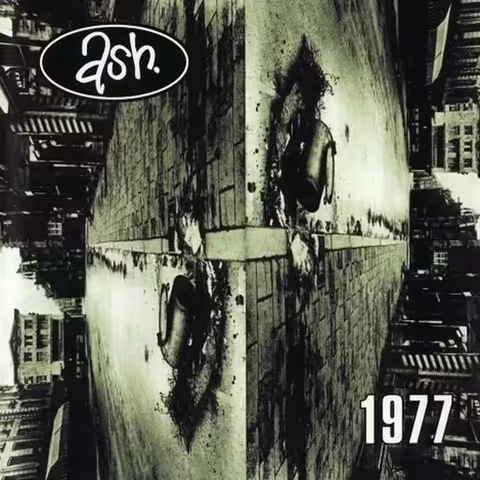
Owen Morris had developed a keen eye for album artwork and pushed the band toward Brian Cannon of design company Microdot, the man responsible for the iconic Oasis sleeves. The cover image, a disorientating mirrored photograph of a street strewn with rubbish bags and pot-holes, was the work of the Dutch photographer Ed van der Elsken. Clearing it nearly derailed the whole release: van der Elsken had died, and Cannon could not initially track down his widow to license the picture. It came through in the end, and the unglamorous, slightly grubby image became one of the more distinctive debut sleeves of its year.
The band's anti-corporate streak extended to the format. In a neat joke on the album title, the label sold the cassette edition at 1977 prices: £4.99. It was the kind of gesture that endeared Ash to a fanbase who were, by and large, exactly as young as the band themselves.
Release and Reception
Infectious and Home Grown released 1977 in the UK on 6 May 1996, with Reprise following in America on 11 June. The reviews were largely warm. AllMusic's Stephen Thomas Erlewine praised the way Ash applied a "cinematic approach to their songs", calling the album a "melting pot of pop styles" with a "distinctive, melodic, and energetic sound that's equal parts heavy grunge and light pop". Q's Andrew Collins felt the album benefited from "having its raw power harnessed" by Morris. The Guardian and Q both gave it four stars.
"What invariably saves them from mature-rock-band hell, just as it has saved them from generic-indie-band hell, are those simple, honest, priceless standbys: top-hole tunes."
Johnny Cigarettes, NME, May 1996
Not everyone was sold. Melody Maker's Victoria Segal dismissed it as "My Guy indie, boys-next-door making music for girls-next-door". MTV's Michael Krugman, while admiring the songs, laid into Morris's production as "excessively noisy and often quite murky", arguing the "punk rock gets muddied" in the mix. It was a complaint that would echo down the years; when Record Collector revisited the album in 2008 it judged the "rough spontaneity" of Wheeler's "flat vocals" and McMurray's "muffled drumming" had not aged well, even as it acknowledged how perfectly that rawness suited a debut by teenagers.
The commercial verdict was emphatic. 1977 entered the UK Albums Chart at Number 1, making Ash the first Irish group to debut at the top of the British chart. First-week sales were reported somewhere between 122,000 and 165,000 depending on the source. It reached the Top 20 in Australia and New Zealand and the Top 40 across much of Europe, and was later certified platinum by the BPI. It appeared in 1001 Albums You Must Hear Before You Die, was ranked 417 on NME's list of the 500 greatest albums of all time, and placed 17th in Hot Press's 100 Greatest Irish Albums.
Singles and Music Videos
| Single | Released | UK Peak | Key B-sides | Notes |
|---|---|---|---|---|
| Kung Fu | 20 March 1995 | 57 | "Day of the Triffids" | Lead single; released while Wheeler was still doing A-Levels. |
| Girl from Mars | 31 July 1995 | 11 | "Cantina Band" (cover) | Video by Peter Christopherson of Throbbing Gristle at Camber Sands; Top of the Pops appearance. |
| Angel Interceptor | 9 October 1995 | 14 | "Gimme Some Truth" (cover) | Preceded a short US tour with China Drum. |
| Goldfinger | 15 April 1996 | 5 | "Get Ready" (cover) | The album's highest-charting single; also No. 50 in Australia. |
| Oh Yeah | 24 June 1996 | 6 | "Does Your Mother Know" (cover) | Video sees Hamilton kissing an actress, intercut with carnival footage. |
The singles campaign was unusually long, stretching across more than a year. "Kung Fu" arrived in March 1995, when two-thirds of the band were still revising for exams; Wheeler would be interrupted from his A-Level study to do interviews. "Girl from Mars" in July 1995 was the breakthrough, its video directed by Peter Christopherson of Throbbing Gristle and Coil, shot on the beach at Camber Sands, and rewarded with a Top of the Pops appearance. "Angel Interceptor" reached the Top 15 that October. By the time "Goldfinger" hit Number 5 in April 1996, just before the album, Ash were a genuine singles band, and "Oh Yeah" followed it into the Top 10 that June.
Touring and the MTV Disaster
Ash toured 1977 almost without pause. They warmed up with a UK run alongside 60ft Dolls, Bis and Jocasta, played an appearance on Later... with Jools Holland, and then took the album around the world: the United States with Muzzle in July and August 1996, the Reading Festival, then Japan, Australia and New Zealand in the autumn, and back to the States with Stabbing Westward, I Mother Earth and Drill.
It was on that American leg that the band torpedoed their own best shot at breaking the US. Wheeler turned up late and drunk to a meeting with MTV's head programmer, who could have given the band crucial airtime. The following day, booked for an interview on the channel, Wheeler arrived late again and vomited on camera. The label was furious, and Wheeler later theorised that the two incidents cost Ash any real chance of major American success. There were happier improvisations: at a poorly-selling show in Boulder, Colorado, the band sweetened the deal by playing 1977 in its entirety, an idea they would return to on anniversary tours decades later.
- Supported Weezer on their US headline tour through to December 1996.
- Released their first live album, Live at the Wireless, recorded in Australia, in February 1997.
- Played five consecutive nights at the London Astoria in early 1997, later compiled as a live album.
- Appeared at Glastonbury Festival in June 1997, closing the 1977 era.
In TV, Film and Media
The songs from 1977 have proved durable on screen and stage. "Girl from Mars", "Goldfinger", "Kung Fu", "Oh Yeah" and "Angel Interceptor" became fixtures of the band's later compilations, including Intergalactic Sonic 7"s (2003), and have soundtracked countless retrospectives of the Britpop era on British television. "Kung Fu", with its martial-arts subject matter, found a natural home as a high-energy sync for sports montages and film trailers, and the album as a whole is regularly cited whenever broadcasters revisit the mid-1990s explosion of guitar pop. Few of these placements are exhaustively documented, but the songs' continued presence on radio and in nostalgia programming has kept the record in the public ear for thirty years.
Covers, Samples and Tributes
The most famous sample on 1977 is the one Ash borrowed rather than lent: the Star Wars TIE fighter scream woven into the record, lifted from a film made by the same corporate parent as their US label. The band were themselves enthusiastic coverists, and their B-side versions of ABBA's "Does Your Mother Know", John Lennon's "Gimme Some Truth", Smokey Robinson's "Get Ready" and John Williams's "Cantina Band" became fan favourites in their own right. In the other direction, the album's songs have been covered by countless bands at the pub-and-club level where Ash have always loomed large for aspiring teenage guitarists, even if no single famous cover has eclipsed the originals. "Sick Party", meanwhile, earned an unlikely afterlife when Pitchfork included it on a 2010 list of unusual CD-era gimmicks.
Reissues, Remasters and Anniversaries
In 2008, a three-disc deluxe edition gathered Trailer, Live at the Wireless, B-sides, unreleased demos and live recordings around the album. When BMG bought Ash's back catalogue, the company reissued 1977 on CD in 2018 and on vinyl in 2022, the latter requiring Wheeler to sift through various tape transfers and point the label toward the correct mixes. The band have repeatedly returned to the album as a live event, performing it in full on tours in 2008, 2013 and 2016, and again as a one-off livestream in 2021. Recordings from the 1997 Astoria residency surfaced as the live album Live on Mars - London Astoria 1997 in 2016, a full-circle document of the songs at the height of their original moment.
Legacy and Influence
Three decades on, 1977 stands as one of the defining British rock debuts of the 1990s, and arguably the best argument that the Britpop years produced more than mod revivalism. By cutting American punk and metal with sugar-rush pop melody and a teenage obsession with science fiction, Ash carved out a lane that bands like Bowling for Soup, Busted and a generation of UK pop-punk acts would later drive straight down. The album's influence is audible in any group that has tried to marry distortion and a giant chorus without apology.
For Ash themselves, the record set an impossibly high bar. The follow-up, 1998's Nu-Clear Sounds, was a darker, more difficult album that struggled commercially, before the band rebounded spectacularly with 2001's Free All Angels and its run of hit singles. Across a career that has now spanned more than thirty years and a string of further albums, 1977 remains the touchstone: the sound of three teenagers who were too young to sign their own contract, making a Number 1 album about girls, drink and Star Wars before they had quite worked out how. That it still sounds fresh is the whole point.
Things You Might Not Know
| Fact | Detail |
|---|---|
| Their parents signed the deal | Because Wheeler and Hamilton were only seventeen, their parents had to co-sign the Infectious contract, and headmaster Jack Ferris had to grant permission. |
| They started as a metal band | Wheeler and Hamilton's first band, formed at Christmas 1989, was a heavy metal act called Vietnam. |
| The name came from a dictionary | The trio found the word "ash" while flicking through a dictionary and adopted it as their name. |
| Half the album was written in the studio | The band had toured so hard since school that they had no album's worth of songs; Wheeler wrote nearly half of 1977 during the sessions at Rockfield. |
| Goldfinger was nearly a B-side | Wheeler assumed "Goldfinger" was a throwaway until Owen Morris told him, "you idiot, that's a single!" It went to UK No. 5. |
| The Goldfinger sample is a mix-up | The band borrowed an instrumental break they thought came from Shirley Bassey's "Goldfinger", but it was actually a different song by John Barrie. |
| A real TIE fighter is on the record | The album features a genuine Star Wars TIE fighter sample; Wheeler assumed the label, owned by 20th Century Fox, would not mind. |
| An ecstasy trip made the cut | The cry of "Whooo! Yeah, we've got it!" at the end of "Angel Interceptor" is McMurray on his first ecstasy trip. |
| The cassette cost £4.99 | As a joke on the album's title, the label sold the cassette at 1977 prices: four pounds and ninety-nine pence. |
| The hidden track is vomiting | "Sick Party", buried after "Darkside Lightside", is Mark Hamilton and guitar tech Leif Bodnarchuk being sick into a microphone. |
| The cover photographer had died | Ed van der Elsken's mirrored street photograph nearly delayed the album because designer Brian Cannon could not reach the late photographer's widow to license it. |
| Girl from Mars was held back | The song was written around Trailer but kept off it; the label worried a hit single would be bad for a band still at school. |
| Same US label as Green Day | Ash signed to Reprise in America partly because the label was having success with the stylistically similar Green Day. |
| A vomit on MTV cost them America | Wheeler turned up late and drunk to meet MTV's head programmer, then vomited during an on-air interview the next day; he believed it sank the band's US prospects. |
| First Irish debut at No. 1 | 1977 was the first album by an Irish group to enter the UK chart at Number 1. |
The Riffology Podcast
The Riffology podcast tells the full story of 1977 in episode 52, from the Vietnam days and the parental signatures to the Rockfield chaos, the Star Wars samples and the night a vomit on MTV may have cost Ash America. The episode is embedded above. New episodes land weekly on Apple Podcasts, Spotify, Amazon Music and every other major platform, as well as here on the site.
Comments