Jeremy Davis was the oldest member of Paramore by a comfortable margin, the only one of the five who could legally rent a car, and the bassist whose grown-up presence had reassured a wary Atlantic Records that this Franklin, Tennessee teen band was a serious proposition. A few days after Paramore drove down to Orlando, Florida in early 2005 to begin recording their debut album, Davis quietly walked out of the sessions, citing personal reasons, and went home. The four members left behind, none of them yet old enough to vote, kept recording anyway, and built the entire record around the empty space he had just opened up.
The result, All We Know Is Falling, was released on 26 July 2005, made for almost no money in roughly three weeks across five studios, and credited to a fifteen-year-old guitarist, a fourteen-year-old drummer, a guest bassist on loan from a Florida emo band and a sixteen-year-old singer who had already turned down a six-figure offer to be a solo pop star. It sold poorly on release. It would take another two years, a different album and a song called "Misery Business" before anyone outside the Warped Tour parking lot noticed it had happened. Two decades later it is platinum in the United States and Paramore are Grammy-winning headliners, which makes the strange, scrappy, lovesick album they made about a bandmate who quit one of the more important debuts of the 2000s emo wave.
Album Facts
| Field | Detail |
|---|---|
| Artist | Paramore |
| Album | All We Know Is Falling |
| Release date | 26 July 2005 (US); 24 April 2006 (UK); 16 May 2007 (Australia) |
| Label | Fueled by Ramen (Atlantic Records distribution) |
| Producer(s) | James Paul Wisner; Mike Green; Roger Alan Nichols and Nick Trevisick |
| Studio(s) | Wisner Productions, St. Cloud, FL; ARS Studios, Orlando, FL; Bigger Dog Studio, Franklin, TN; Stone Gables Studio, Brentwood, TN; The Skyview Church of Tone and Soul, East Nashville, TN |
| Genre / Subgenre | Pop-punk; emo; alternative rock; pop rock |
| Track count | 10 (standard edition) |
| Total runtime | 35:51 |
| Billboard 200 peak | Did not chart (peaked at No. 30 on Heatseekers Albums in 2006; No. 8 on Top Catalog Albums in 2009) |
| UK Albums Chart peak | No. 51 (2010); No. 4 on UK Rock & Metal Albums Chart (2009) |
| Other notable chart peaks | No. 21 Croatian International Albums; No. 33 Scottish Albums |
| Certifications | Platinum (RIAA, United States); Gold (BPI, United Kingdom); Gold (ARIA, Australia) |
| Estimated sales | Over 1,000,000 (US sales+streaming equivalents); 100,000+ shipped UK; 35,000+ shipped Australia |
| Key singles | "Pressure"; "Emergency"; "All We Know" |
Cultural Context: Pop-Punk at the Peak of its Mall Reign
Summer 2005 was the moment American pop-punk crossed fully into the mainstream and stopped pretending it was a subculture. Green Day's American Idiot had been the biggest rock album of the year, My Chemical Romance were a month away from filming the "Helena" video, and Fall Out Boy's From Under the Cork Tree had landed in May and would eventually go double platinum off the back of "Sugar, We're Goin Down". The Vans Warped Tour was a stadium-sized travelling carnival packed with eyeliner, side-fringes and label A&Rs with chequebooks. Hot Topic was, briefly, a tastemaker.
Into all of that, on 26 July 2005, came a debut album by a band of teenagers nobody had heard of, on a small Florida indie label, fronted by a sixteen-year-old girl from Mississippi. The combination of those last two facts was not incidental. Pop-punk's commercial wave had so far been almost entirely male; the female peer group on the Warped Tour main stage was small enough to count on one hand. Paramore did not arrive as a novelty, exactly, but their position was unusual enough that critics spent the rest of 2005 reaching for Avril Lavigne comparisons that did not really fit and that the band came to resent.
- May 2005: Fall Out Boy release From Under the Cork Tree.
- June 2005: System of a Down release Mezmerize.
- July 2005: Paramore release All We Know Is Falling the same week as the Warped Tour rolls through Salt Lake City.
- September 2005: Panic! at the Disco release A Fever You Can't Sweat Out.
- November 2005: My Chemical Romance release Life on the Murder Scene, still riding 2004's Three Cheers for Sweet Revenge.
Against that release calendar, a ten-track debut from an unknown Tennessee band on Fueled by Ramen had no obvious path to anyone's stereo. Paramore's A&R, Steve Robertson, had decided to lean into that. He told HitQuarters in 2009 that the plan was deliberately slow: no major radio push, no expensive video saturation, just a band thrown onto the Warped Tour's second stage and left to convert audiences one set at a time. "I wanted kids to discover the band without it being shoved down their throats," he said. It would take two years before that strategy started to pay off, and another seven before the record went gold in the country it was made in.
The Franklin Origin Story: A Mississippi Singer Meets the Farro Brothers
The story starts in 2002. Hayley Williams was thirteen, recently relocated from her hometown of Meridian, Mississippi to Franklin, an affluent commuter town just south of Nashville, where she had moved to live with her mother after her parents' divorce. At a weekly supplemental class for home-schooled students she met two brothers, Josh and Zac Farro, who had been playing in a band together after school for years. Williams started taking vocal lessons in Nashville with Brett Manning. She also fell in with bassist Jeremy Davis, who was already running a funk covers band called the Factory with her and a mutual friend, Kimee Read.
The Farros were initially sceptical. As Hayley later recalled, the group had been "edgy about the whole female thing" of having a girl on lead vocals. They softened when she started writing songs with them. The eventual lineup that became Paramore in 2004 added Williams's neighbour Jason Bynum on rhythm guitar, and was held together as much by parents driving the children to gigs as by anyone's professional ambition. Davis, then in his late teens and the only band member who looked his age, would later confess to a flash of doubt when he met fourteen-year-old Zac Farro at the first practice. "I had very, very, very little faith in everyone in the band because of their age," he told a 2007 Europunk interview. "I remember thinking, this is not going to work because this kid is way too young. But that first day of practice was amazing. I knew we were on to something."
The band's name came from the maiden name of an early bass player's mother. Once the group learned the homophone "paramour" meant secret lover, they kept the new spelling and never explained the joke again.
The Atlantic Records Deal a Fourteen-Year-Old Refused
Williams's path to Paramore did not start with Paramore. In 2003, aged fourteen, she was signed as a solo artist to Atlantic Records in New York by Jason Flom, after a production deal with managers Dave Steunebrink and Richard Williams had been bought out by the major. Atlantic's plan was to develop her as a pop singer in the post-Britney, post-Avril mould. Williams refused. She told the label she did not see herself as "the next Madonna", that she wanted to make alternative rock music, and that she wanted to do it with the band of friends she had just started rehearsing with in Franklin.
What happened next was unusual and would later cause Paramore the worst public row of their first decade. Atlantic's label president Julie Greenwald agreed to Williams's terms, but the marketing department decided it would damage the band's image to have the whole group attached to a major label out of the gate. The compromise: Williams stayed signed to Atlantic personally, while the rest of Paramore signed to Fueled by Ramen, the Florida indie that had recently broken Fall Out Boy. Warner Music Group boss Lyor Cohen had already identified Fueled by Ramen's CEO John Janick as a partner worth backing. Janick travelled to a Taste of Chaos show in Orlando to watch Paramore play, then signed them after a small warehouse showcase in April 2005, three months before the album was due to come out.
"She wanted to make sure that we didn't look at her as some straight-to-Top-40 pop princess. She wanted to make sure that she and her band got the chance to show what they can do as a rock band writing their own songs."
Steve Robertson, Paramore's A&R at Atlantic Records, interview with HitQuarters, 2009
The two-label split worked while the band was small and unprofitable. It later turned toxic. When Josh and Zac Farro quit Paramore in December 2010, Josh published a long blog post accusing Williams of being "a manufactured product of a major label" and her bandmates of "riding on the coattails of her dream". Williams, Taylor York and Davis confirmed the basic fact: Williams was indeed the only member signed to Atlantic. Davis himself was later expelled and reinstated, then quit for good in 2015 over what became a multi-year legal dispute about songwriting credits on the band's 2013 self-titled album. The contract that made All We Know Is Falling possible cast a fifteen-year shadow.
Pre-Production and Demos: Songs Re-Cut in a Borrowed Florida House
Before the band ever set foot in Orlando, Williams had already recorded a clutch of solo demos under her old Atlantic deal. When the plan changed and Paramore became the project, those songs were re-cut with the full band to give them, in the label's words, a more authentic sound. The new demos almost cost them the album. Atlantic's marketing team thought the recordings were terrible and considered dropping the band. Williams and Josh Farro responded by quickly writing two more commercial songs to placate the label, "Here We Go Again" and "Hallelujah". The first ended up as track five on All We Know Is Falling. The second was held back and used to open Riot! two years later, where it announced a band that could no longer be ignored.
"Conspiracy" had a particularly important place in the band's early history: it was the first song they ever wrote together as Paramore, co-written by Williams, Josh Farro and a teenage Franklin neighbour called Taylor York. York would not join Paramore officially until 2007 and would not become a full member until 2009, but his fingerprints on the band date back to before any of them had a record deal.
The band wrote the bulk of the rest of the record in Franklin in basements and home studios, with Williams's parents and Davis's day job at a local Pizza Hut keeping the operation funded. Many of the lyrics that were not about Davis's eventual exit were about Williams's parents' divorce; an early signal of how Williams would mine her family's collapse for material for the next decade. The song "Brighter", from later in the album, was written about her childhood friend Lanie Kealhofer, who died on 22 May 2005. The album's liner notes carry the dedication "In memory of Lanie Kealhofer. You shine brighter than anyone. 11.24.88 / 5.22.05".
Creating the Album: Five Studios, Three Weeks and a Missing Bassist
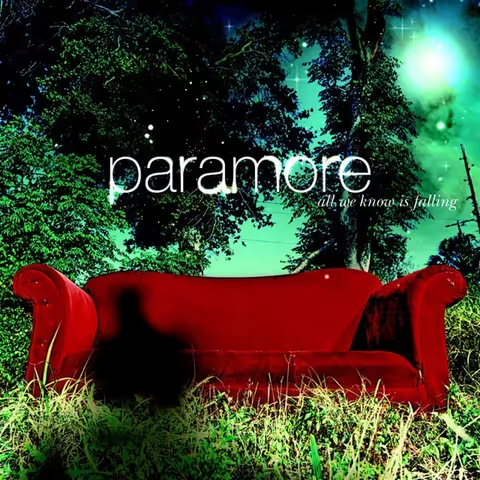
By the time Paramore arrived in Orlando, Florida in early 2005 to begin tracking with producers James Paul Wisner and Mike Green, they were a five-piece on paper. Within days they were a four-piece. Jeremy Davis, citing personal reasons that have never been fully detailed in print, left the band and went home. Williams and the Farros chose to keep recording anyway, and quickly decided to make Davis's departure the album's thematic centre. The title was lifted from a lyric in the opening track. The sleeve, designed by the Orlando art collective Electric Heat with photography by John Deeb, showed a red couch in a woodland clearing with a faint human shadow walking away from it. "The couch with no one there and the shadow walking away," Williams explained to The Trades in August 2005, "it's all about Jeremy leaving us and us feeling like there's an empty space."
To plug the gap, the band brought in Lucio Rubino, then the frontman of Florida emo act StorySide:B. Rubino played bass on every track except one. Davis returned long enough to record "Here We Go Again" at Bigger Dog Studio in Franklin, the only song on the standard album to feature an actual member of Paramore on the low end, which is one of the small, strange accounting facts that makes the record's personnel page so distinctive.
The sessions were short and divided. Josh Farro later described the whole process as "rushed". Roughly three weeks of studio time were split across five rooms. James Paul Wisner, the Florida producer whose CV at that point included Underoath's They're Only Chasing Safety, early Dashboard Confessional and Further Seems Forever, tracked "All We Know", "Brighter" and "Never Let This Go" at his own Wisner Productions in St. Cloud, Florida. Mike Green, then a young engineer making his name with the heavier end of the Fueled by Ramen roster, tracked the bulk of the album, "Pressure", "Emergency", "Whoa", "Conspiracy" and "Franklin", at ARS Studios in Orlando, then mixed every track on the record except one. "Here We Go Again" was tracked and mixed separately by Roger Alan Nichols and Nick Trevisick at Bigger Dog in Franklin. Additional overdubs were captured at Stone Gables in Brentwood and the wonderfully named Skyview Church of Tone and Soul in East Nashville. Tom Baker mastered the finished record at Precision Mastering in Hollywood. John Janick took an executive producer credit.
The budget was tight enough that the whole thing reads, in retrospect, like a Fueled by Ramen training exercise: five rooms, two producers doing most of the work, one borrowed bassist, a studio drum tech (Nath Warshowsky) on hand to cover for fourteen-year-old Zac Farro, and a deadline that did not flex. What it lacked in polish, the record gained in tightness. Wisner's three productions are sweeter and more atmospheric, Green's six punch harder and faster, and the join between them, audible if you listen for it, is one of the record's small pleasures.
"The whole thing was rushed. We were in the studio for, what, three weeks? It was an experience. We learned a lot."
Josh Farro, recalling the sessions to AbsolutePunk, May 2007
Personnel and Credits
| Role | Player | Notes |
|---|---|---|
| Paramore | ||
| Lead vocals | Hayley Williams | Sixteen by the time of release; signed separately to Atlantic in 2003 at age fourteen. |
| Lead guitar, backing vocals | Josh Farro | Co-writer of every song bar one; provides unclean (screamed) vocals on track 10, "My Heart". |
| Rhythm guitar, backing vocals | Jason Bynum | Williams's Franklin neighbour; replaced by touring guitarist Hunter Lamb in December 2005, shortly after release. |
| Bass | Jeremy Davis | Plays bass on track 5 only ("Here We Go Again"); quit in Orlando a few days into sessions, returned after five months. |
| Drums | Zac Farro | Fourteen years old at recording. |
| Additional musicians | ||
| Bass (all tracks except 5) | Lucio Rubino | Then the frontman of Orlando-area emo band StorySide:B; played bass on nine of the ten tracks. |
| Production and engineering | ||
| Producer / recording | James Paul Wisner | Tracks 1, 6 and 10. Recorded at Wisner Productions, St. Cloud, Florida. |
| Producer / recording, mixing | Mike Green | Tracks 2, 3, 4, 7, 8 and 9 at ARS Studios, Orlando; mixed everything except "Here We Go Again". |
| Producers / recording / mixing | Roger Alan Nichols and Nick Trevisick | Track 5 ("Here We Go Again") at Bigger Dog Studio, Franklin, Tennessee. |
| Studio drum technician | Nathan "Nath" Warshowsky | Every track except "Here We Go Again". |
| Engineer | Dave Buchanan | "Here We Go Again" only. |
| Mastering | Tom Baker | Precision Mastering, Hollywood, California. |
| Executive producer | John Janick | Then CEO of Fueled by Ramen. |
| Artwork | ||
| Photography | John Deeb | Red couch in woodland setting; shot to symbolise the absent Davis. |
| Album artwork | Electric Heat | Orlando-area design collective; designed sleeve, layout and band logo. |
The roster reads, on paper, like a small-label debut by a band that had to call in favours. In practice it set Paramore's working pattern for the next decade. Mike Green would resurface as engineer and mixer on other Fueled by Ramen records and went on to a long career producing Pierce the Veil, All Time Low and Set It Off. James Paul Wisner had already shaped the dominant emo guitar tone of the early 2000s and would continue to be the producer rivals reached for when they wanted that exact sound. Lucio Rubino's name remained tucked into Paramore's history as a piece of trivia that fans of StorySide:B occasionally raised on forums. Davis, the man whose absence the record is about, returned a few months later, stayed for the next decade and finally exited for good at the end of 2015.
The Songs: A Track-By-Track Walkthrough
| # | Title | Writer(s) | Length | Single? | Notes |
|---|---|---|---|---|---|
| 1 | "All We Know" | Williams, J. Farro | 3:14 | Single (Dec 2006) | Title track; explicitly written about Davis quitting. |
| 2 | "Pressure" | Williams, J. Farro | 3:06 | Single (Aug 2005) | Lead single; later certified platinum (RIAA). |
| 3 | "Emergency" | Williams, J. Farro | 4:00 | Single (Oct 2005) | About Williams's parents' arguments; certified gold (RIAA). |
| 4 | "Brighter" | Williams, J. Farro | 3:43 | Written for Williams's late friend Lanie Kealhofer. | |
| 5 | "Here We Go Again" | Williams, J. Farro | 3:46 | Co-written with Davis; the only track he plays bass on. | |
| 6 | "Never Let This Go" | Williams, J. Farro | 3:40 | Wisner production; the album's quietest opening. | |
| 7 | "Whoa" | Williams, J. Farro | 3:20 | Bridges into the album's second half with the heaviest riff on the record. | |
| 8 | "Conspiracy" | Williams, J. Farro, Taylor York | 3:42 | First song Paramore ever wrote together. | |
| 9 | "Franklin" | Williams, J. Farro | 3:20 | Named for their hometown; the band's first nostalgic song about a place they were still living in. | |
| 10 | "My Heart" | Williams, J. Farro | 4:00 | Closes the album in a Williams / Farro duet; the only track with screamed vocals. |
The album opens and closes on its strongest pair. "All We Know" is in many ways a manifesto, three and a quarter minutes of mid-tempo pop-punk built around the line that gave the record its title, with Williams's vocal landing the chorus a full octave above what most of her label peers were comfortable doing. It is unambiguously about Davis, with lines about losing a friend who walked away "in his own time". Whoever you choose to read the second verse as being about, the song's grief is uncomplicated. Paramore had not yet developed the lyrical sleight of hand they would deploy on Riot!; on the debut, the bruises are exactly where they look.
"Pressure" follows immediately and tells you what the rest of the album is going to sound like. Mike Green's production is glossier than Wisner's, the guitars hit harder, and the chorus hook is the first sign on the record that Williams is going to be a generational vocalist. The song failed to chart on the Billboard Hot 100 on release and would take a decade to crawl to platinum certification, but live, throughout 2005 and 2006, "Pressure" was the song that converted Warped Tour crowds. New Found Glory covered it on European tours within a few years and it later turned up on the console version of The Sims 2 as a re-recorded Simlish edit, an early hint of how Paramore songs would seep into pop culture.
"Emergency" is the album's emotional heart, and the song most fans first associated with Paramore. Williams later confirmed to Alternative Press that the song was rooted in a specific childhood memory of standing between her arguing parents on the night her mother walked out, screaming "Shut up, shut up, shut up". The chorus line that became Paramore's calling card, "I think we have an emergency", reads as a teenager's recasting of grown-up failure as something worth shouting about. Live, the band quickly began extending it with a piano introduction played by Williams herself; that arrangement is preserved on the live cuts collected on The Final Riot! three years later. A heavier, screamed version subtitled the "Crab Mix" surfaced on The Summer Tic EP in 2006 and was finally added to the album for its 20th-anniversary streaming reissue.
"Brighter" sits at track four as the album's first slowdown. Knowing the song was written for a friend who died two months before release recolours every line. "Never Let This Go", produced by Wisner, is the prettiest thing on the album and the closest the band come to a Dashboard Confessional template; it is also the song that travelled best into Paramore's later acoustic sets.
"Here We Go Again" is the strangest track in the running order. It is the song Williams and Josh Farro wrote in a panic to satisfy Atlantic after the marketing department threatened to drop the band, and it is the only song on which the band's actual bassist plays. The two facts give it a status the rest of the record can't match: half record-label compromise, half olive branch to a returning friend. The version that ended up on the album is leaner and poppier than anything around it.
"Conspiracy", track eight, may be the most quietly significant song on the album. It is the first song Paramore ever wrote, and it credits a teenage Franklin neighbour called Taylor York alongside Williams and Josh Farro. York would not officially join the touring band for another two years and would not become a full member until 2009, but the writing credit on All We Know Is Falling is the earliest trace of the man who would survive every lineup change to become Williams's primary collaborator.
"My Heart" closes the record on its largest scale. Built as a quasi-duet between Williams and Josh Farro, it is the only track on which Farro screams. The arrangement opens up into a four-minute closer that the band would later turn into a nine-minute live set-piece, and the structure, soft verse into climactic dual-vocal payoff, became a Paramore signature that they returned to repeatedly on Riot! and Brand New Eyes.
B-Sides, Outtakes and Bonus Tracks
The standard album is only ten tracks long, but the campaign around it eventually produced a surprisingly deep pool of extras, most of which sat unstreamed for nearly two decades.
- "Oh Star": the most loved of the leftovers. Co-written by Williams and Taylor York, it appeared as a bonus track on the Japanese edition of the album in 2006 and on the B-side of the UK "Emergency" 7-inch in August 2006. Fans circulated rips of it for years before its 2025 streaming release.
- "This Circle": added to the 10th-anniversary vinyl in 2015 and to the 2009 iTunes deluxe edition before that. A spikier, faster cut that sounds closer to the Mike Green sessions than the Wisner ones.
- "Stuck on You": a cover of Failure's 1996 power-ballad, a band Williams and the Farros have repeatedly cited as a key influence; included on the 20th-anniversary deluxe.
- "Emergency (Crab Mix)": the heavier, screamo-tinged version originally released on The Summer Tic EP in 2006.
- "Hallelujah": written during the album sessions to placate Atlantic; held back and instead used to open Riot! in 2007.
The 20th-anniversary reissue on 25 July 2025, dropped with no advance warning, finally placed the full Summer Tic EP and the surviving outtakes onto streaming services for the first time. For two decades they had circulated as fan rips of CD-Rs and Japanese imports.
Album Artwork and Packaging: The Red Couch That Lives in Hayley's House
The cover art is one of the most quietly literary sleeves of the era. Shot by John Deeb and designed by Electric Heat, it shows a single red couch placed in the middle of a clearing in a Tennessee wood, the band's logo and the album title set above it, and a faint, blurred human shadow walking away in the upper third of the frame. The shadow is meant to be Davis. The empty couch is meant to be everything he left behind. The composition is restrained almost to a fault: no band photo, no logo flourishes, no Hot Topic colour palette. For a 2005 Fueled by Ramen release, that restraint stood out.
Williams told Genius in a 2015 interview that the actual couch from the cover shoot survived. As of the most recent interviews, it lives in her Nashville home. It remains one of the more elegant pieces of band trivia from the era: a piece of furniture that doubles as a memorial to a quit bassist and a domestic souvenir for the only member who never left.
Release and Reception: The Album That Took Two Years to Get Noticed
The album landed in US record stores on 26 July 2005 with no major-label radio push. Reviews were polite. Allmusic's Neil Z. Yeung filed a three-and-a-half-star review that called the album "formulaic" pop-punk with "head-bobbing drums, straightforward riffs and a midtempo sameness throughout", a verdict Allmusic has since softened in retrospective reassessments. Alternative Press's Trevor Kelley awarded four stars and called Williams's voice the standout. The Trades's Tony Pascarella was already calling the album a "stunning debut" and predicting "a major splash in the very near future". Punknews.org's Jordan Rogowski filed a one-star review and complained that the bass "was barely existent, if existent at all", which, given the Davis situation, was almost a compliment.
"These passionate, rocking tracks are what make this Tennessee group so talented. Paramore is a band you may not yet have heard of, but look for them to make a major splash in the very near future. Hayley Williams's voice is a rich, powerful voice that rarely makes a mistake on this stunning debut."
Tony Pascarella, The Trades, July 2005
Commercially the album did almost nothing. It failed to enter the Billboard 200 entirely. The only chart it reached on release was the Heatseekers Albums chart, where it peaked at number 30 in September 2006, more than a year after release. Single sales were equally muted: "Pressure" did not chart, "Emergency" did not chart, "All We Know" did not chart. The album would only reach platinum certification in the United States in 2025, twenty years after release, on the back of two decades of catalogue streaming.
The trajectory began to change in summer 2007 when Riot! broke the band. Fans who arrived through "Misery Business" worked their way back to the debut, and the catalogue numbers on All We Know Is Falling began to climb. The album hit number 8 on Billboard's Top Catalog Albums chart in 2009. In the UK, where it had been released in April 2006 with a similar shrug, it finally entered the Albums Chart at number 51 in 2010, peaked at number four on the UK Rock & Metal Albums Chart, and was certified gold by the BPI in 2009. Australia's ARIA awarded it gold in 2012. Alternative Press eventually filed the album as a "scene classic" in a tenth-anniversary review by Tyler Sharp.
The trajectory is genuinely unusual for a major-distributed rock debut. Most pop-punk records of the 2000s either landed and grew, landed and shrank, or never landed at all. All We Know Is Falling landed quietly, sat dormant for two years, then climbed steadily for fifteen more on the back of a band that nobody had heard of when the record came out and that nobody can ignore now.
Singles and Music Videos
| Single | Released | B-side | Video director | Notable |
|---|---|---|---|---|
| "Pressure" | 2 August 2005 (US) | Shane Drake | RIAA platinum (2025 upgrade); 54+ million YouTube views by April 2026. | |
| "Emergency" | 21 October 2005 (US); 21 August 2006 (UK, as lead) | "Oh Star" | Shane Drake | RIAA gold; included on Kerrang!'s "Class of '06" compilation. |
| "Pressure" (UK) | 30 October 2006 | Shane Drake | Released as the second UK single. | |
| "All We Know" | 16 December 2006 (iTunes) | Compilation of live and backstage footage | Released with minimal promotion as the campaign wound down. |
The "Pressure" video, shot by Shane Drake at an abandoned warehouse with the band drenched mid-performance by fire-suppression sprinklers, is the cultural artefact most casual viewers associate with this era of Paramore. It is also where Hayley Williams's signature orange hair makes its first appearance on camera. Drake would go on to direct My Chemical Romance's "Welcome to the Black Parade" the following year, by which time he had become the most in-demand video director in the pop-punk world. He returned to direct "Emergency", which used a similar performance-and-narrative split, this time built around the band performing in deliberately bloody, dirtied formalwear. The single's UK release came with a 7-inch poster and a hidden B-side, "Oh Star", that fans treasured for years.
"All We Know" was released as a third single in late 2006 with almost no promotional spend; the video is a stitched-together collection of live performance and tour-bus footage and reads as a goodbye to the campaign rather than a serious push. By the time it dropped, the band were already in pre-production on Riot! with David Bendeth in New Jersey.
Touring and Live: 2005 Warped Tour, a Sixteen-Year-Old and Forty Minutes a Day
The album's promotional engine, in the absence of radio, was the road. The 2005 Warped Tour put Paramore on the small Shiragirl stage with the album dropping mid-tour. The position was symbolic. Shiragirl was a stage built specifically for the female-fronted bands the rest of the tour had marginalised, and Paramore played it day after day to crowds that, by the end of the tour, were regularly larger than the audiences at some of the main-stage acts. Williams turned sixteen that December.
The 2005 to 2006 touring schedule that followed was a textbook indie-build:
- October to November 2005: opening for Simple Plan across the United States, with John Hembree filling in on bass after Davis's exit.
- December 2005: supporting Funeral for a Friend; Davis quietly returned to the band after five months away. Touring guitarist Hunter Lamb replaced Jason Bynum.
- January 2006: Winter Go West tour with Amber Pacific and the Lashes.
- February 2006: Midwest and East Coast headlining run with Halifax, My American Heart and So They Say.
- Spring 2006: support slots for Bayside and The Rocket Summer.
- Summer 2006: a second pass of Warped Tour, this time on the larger Volcom and Hurley stages; The Summer Tic EP sold from the merch tent.
- August 2006: first US headlining tour, sold out, with support from This Providence, Cute Is What We Aim For and Hit the Lights.
The band were nominated for a string of Kerrang! Reader Awards in late 2006: Williams placed second in "Sexiest Female" and the band took home "Best New Band". NME named Paramore one of ten bands to watch out for in their "New Noise 2007" feature, with reservations Williams later publicly disagreed with. Both pieces fixated on Williams personally, which became a permanent argument between the band and the music press for the rest of the decade.
In TV, Film and Media
The album's songs went on to live a second life in soundtracks and games well after the record had failed at radio. "Pressure" was the band's first video-game placement, appearing as a re-recorded Simlish version on the console editions of The Sims 2 in 2005, the first time most casual gamers had encountered Paramore. The song was added to Rock Band 3 as downloadable content in December 2011. "Misery Business" from the follow-up Riot! became the dominant Paramore sync placement of the next decade, but All We Know Is Falling's songs continued to surface in compilation albums, including Kerrang!'s "Class of '06" CD ("Emergency") and several Punk Goes... volumes from the Fearless Records series. An acoustic re-cut of "Emergency" landed on Punk Goes Acoustic 2 in 2007, just as the band's profile started to climb on the back of Riot!.
Covers, Samples and Tributes
The album's most-covered song remains "Pressure". New Found Glory covered it on their 2008 European tour as an acknowledgement of Paramore's place in the Fueled by Ramen lineage. The Sims 2 version is itself a Simlish-language cover by Paramore themselves. "Emergency" has been a staple of acoustic singer-songwriter covers on YouTube since the early Tumblr years, but never received a major-act cover. The album's title was lifted from a lyric in Mae's 2003 song "Embers and Envelopes", a band Williams was a noted fan of; the homage is not credited in the sleeve.
The bands who cite All We Know Is Falling as an influence have become more numerous than the bands who covered it. Olivia Rodrigo, Willow Smith, Billie Eilish, Wet Leg and Snail Mail have all publicly named Williams as a touchstone; Pitchfork in 2021 ran a long feature, "Paramore's Influence Is All Around Us", that traced lines from "Emergency" through to Rodrigo's Sour. Williams herself was the first artist Eilish ever brought onstage to sing "Misery Business" together at Coachella 2022, ending a four-year self-imposed retirement of the song. None of which is exactly about the debut, except that all of it stands on it.
Reissues, Remasters and Anniversaries
- September 2005: Japanese edition released with "Oh Star" as a bonus track.
- January 2009: First vinyl pressing.
- May 2009: iTunes deluxe edition with live versions of "Pressure" and "Here We Go Again" and the music videos for every single.
- December 2015: Tenth-anniversary vinyl reissue, limited to 4,000 copies, adding "O' Star" and "This Circle" as bonus tracks.
- July 2025: 20th-anniversary deluxe streaming release, dropped without advance warning, finally placing The Summer Tic EP in full onto streaming, including "O' Star", "This Circle", the "Crab Mix" of "Emergency" and Paramore's cover of Failure's "Stuck on You".
The 2025 surprise reissue was Paramore's only release of the year and arrived during the band's announced "indefinite hiatus" between the end of the This Is Why cycle and the launch of Williams's third solo album Ego Death at a Bachelorette Party. It was, in effect, the only new Paramore-branded music for two consecutive calendar years, and the catalogue numbers it added to the debut pushed it across the platinum threshold by August 2025.
Legacy and Influence: How a Failed Debut Became a Scene Classic
On every commercial metric that matters in 2005, All We Know Is Falling was a failure. No Billboard 200 entry, no Hot 100 single, almost no radio. By every commercial metric that matters in 2026, it is a platinum-certified scene classic. The story of those twenty years is the story of how slow-build label strategies still occasionally work and of how a band can outrun its own debut so completely that the debut becomes lovable for being modest. Riot! made Paramore famous. Brand New Eyes made them important. Paramore (2013) made them a Grammy band. After Laughter made them cool. This Is Why won them the Best Rock Album Grammy, the first ever awarded to a female-fronted rock band. None of it happens without the ten songs they recorded in three weeks with one bassist who didn't want to be there and a singer who hadn't yet turned seventeen.
The album's stylistic fingerprints are also more durable than its 2005 reviewers credited. The soft-loud Williams / Farro duet at the close of "My Heart" became the template for "Decode" three years later. The chorus structure of "Emergency", a major-key hook delivered with a quasi-religious sense of urgency, became the structural ancestor of half of Williams's solo career on Petals for Armor. Even the album's restraint, ten tracks, no filler, no orchestral indulgences, became the band's house preference, with no Paramore studio album to date longer than thirteen songs.
The defining angle, though, is still the bassist who quit before recording started. Davis's exit gave the band the title, the cover art, three of the album's strongest songs and a defining bit of myth-making. He returned, stayed for a decade, was fired, was reinstated, quit, sued, settled. The empty red couch on the cover of Paramore's debut is currently in their lead singer's living room. It has never been a more accurate piece of album art.
Things You Might Not Know
| Fact | Detail |
|---|---|
| The 14-year-old solo deal | Hayley Williams was signed to Atlantic Records as a solo pop artist at age 14 in 2003, by the same Jason Flom who later signed Lorde and Greta Van Fleet. |
| The "next Madonna" line | Williams's stated reason for refusing the solo deal was that she did not envision herself as "the next Madonna", though she later said she just wanted to be in a band. |
| The two-label split | For the entire run of this album and the next decade of Paramore, Williams was signed to Atlantic personally while the rest of the band were on Fueled by Ramen, a fact that Josh Farro made public and angry on his 2010 exit blog. |
| The Pizza Hut bassist | Jeremy Davis was working at a Franklin Pizza Hut when Paramore signed their deal; the only member of the band old enough to have a regular adult job. |
| The Conspiracy connection | Track 8 was the first song Paramore ever wrote together, and the writing credit includes Taylor York, who would not officially join the band until 2007 and not become a full member until 2009. |
| The borrowed bassist | Of the album's ten tracks, the band's actual bassist plays on exactly one. Lucio Rubino of StorySide:B covers the other nine. |
| The Atlantic near-firing | Atlantic's marketing department thought the early demos were "terrible" and considered dropping the band; Williams and Josh Farro wrote "Here We Go Again" and "Hallelujah" in a panic to keep the deal. |
| The Hallelujah switch | "Hallelujah", written for this album, was held back and used to open Riot! two years later; it has been read ever since as a sequel to the songs about Davis on the debut. |
| The Brighter dedication | Track 4 was written for Williams's childhood friend Lanie Kealhofer, who died on 22 May 2005, two months before the album dropped; the liner notes carry her name. |
| The orange hair debut | The "Pressure" video is the first time Williams's now-iconic orange hair appeared on camera; she has gone through dozens of colours since but it is the one fans remember. |
| Shane Drake's other clients | The director of the "Pressure" and "Emergency" videos went on to direct My Chemical Romance's "Welcome to the Black Parade" a year later, with much of the cinematic vocabulary tested on Paramore first. |
| The Simlish cover | "Pressure" was re-recorded in the Sims's invented Simlish language for the 2005 console version of The Sims 2; this is technically Paramore's first cover release. |
| The Mae homage | The phrase "all we know is falling" appears in Mae's 2003 song "Embers and Envelopes"; Williams, a noted Mae fan, lifted it as homage and never formally credited the source. |
| The platinum that took 20 years | The album was certified gold in the US in 2014, nine years after release; it was finally certified platinum in August 2025 on the back of the 20th-anniversary streaming bump, almost exactly twenty years to the day. |
| The red couch lives | Williams kept the red couch from the cover shoot; it lives in her Nashville home today. |
| The Heatseekers peak | The album never entered the Billboard 200 on its original chart run; it peaked at number 30 on the Heatseekers Albums chart in September 2006, more than a year after release. |
Listen More: The Riffology Podcast
If this kind of deep-dive is your idea of a good time, the Riffology podcast covers the same kind of album story from the studio side: producers, sessions, the deals that made the records possible and the band rows that nearly didn't. Episodes are available on Apple Podcasts, Spotify and every other major platform. Catch up on the back catalogue, then come back here for the written companion to whichever album you fancy next.
Comments