Album Facts
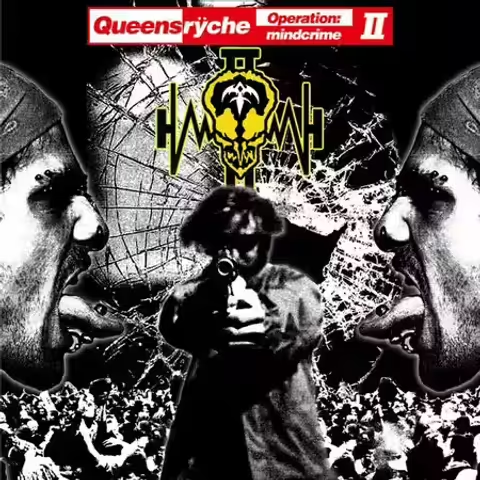
Of every album Queensryche have ever released, only one was made by a band that mostly did not play on it, and only one features Ronnie James Dio as a heavy-metal demagogue named Dr. X. Operation: Mindcrime II is both. Eighteen years after the band's third album turned a brainwashed junkie named Nikki into one of metal's most quoted characters, Geoff Tate dragged his bandmates back to the story for a sequel none of them wanted to make.
What came out the other side, on 4 April 2006, debuted at number 14 on the Billboard 200 and went on to become the most legally contested record of the band's career, with a producer's sworn court declaration eventually revealing that the drummer never played a note on it and most of the lead guitar tracks were re-cut by an engineer.
| Field | Detail |
|---|---|
| Artist | Queensryche |
| Album | Operation: Mindcrime II |
| Release Date | 31 March 2006 (international); 4 April 2006 (US) |
| Label | Rhino Entertainment |
| Producer | Jason Slater |
| Studios | The Compound Studio, Seattle; Synergy Studios, Redmond, Washington; The Annex Studios, Menlo Park, California |
| Recording Dates | 28 February to 3 December 2005 |
| Genre | Progressive metal, heavy metal, concept album |
| Track Count | 17 |
| Total Runtime | 59:00 |
| Billboard 200 Peak | #14 (43,773 first-week US sales) |
| UK Albums Chart Peak | Did not chart |
| Other Notable Chart Peaks | Sweden #18, Hungary #20, Finland #26, Norway #27, Japan (Oricon) #27, Netherlands #35; US Top Rock Albums #4 |
| Certifications | None |
| Estimated Sales | Approximately 113,000 in the US and around 10,000 in Germany by September 2006 |
| Key Singles | "I'm American" (14 March 2006); "The Hands" (16 May 2006) |
Cultural Context: 2006 and the Rock-Opera Itch
By the spring of 2006, the heavy end of rock had quietly fallen back in love with the concept album. Tool's 10,000 Days arrived on 28 April and went straight to number one in the US. Mastodon's Blood Mountain followed in September, Iron Maiden returned with the more reflective A Matter of Life and Death in August, and even Slayer used Christ Illusion in August to revisit the long-form thematic record. Stadium prog was about to enjoy its biggest comeback in fifteen years, and Queensryche had a clear, commercial reason to plant a flag.
The band knew exactly what they were sitting on. Operation: Mindcrime, their 1988 third album, was by then routinely listed alongside Tommy, The Wall and The Lamb Lies Down on Broadway in features about the greatest rock operas ever recorded. Loudwire and Revolver would soon name it the greatest metal concept album of all time. Whatever the band thought of the idea privately, a sequel had obvious commercial gravity: it was the one album fans never stopped asking about.
The world the songs would land in had moved on, too. The Iraq War was in its third year. Hurricane Katrina, the second-term Bush administration, embedded-reporter fatigue and the early stirrings of the surveillance-state debate gave the original album's themes of corrupt institutions and brainwashed foot soldiers a fresh edge. Tate, in interview after interview through 2005 and 2006, leaned hard on the contemporary parallels.
- Tool, 10,000 Days (April 2006): concept-album peer, debuts at US #1.
- Iron Maiden, A Matter of Life and Death (August 2006): also released as a song cycle.
- Mastodon, Blood Mountain (September 2006): modern prog-metal mountain quest.
- Slayer, Christ Illusion (August 2006): same political mood, blunter instrument.
- Dream Theater, Score (live, August 2006): Queensryche's friends and tour partners playing to a 20th-anniversary orchestra.
Queensryche on the Eve of the Sequel
The Queensryche that walked into 2005 was not the Queensryche of 1988. Founder-guitarist Chris DeGarmo had quit in late 1997, returned briefly to co-write four tracks on 2003's Tribe, and then disappeared again to fly business jets for a living. Rhythm guitarist Kelly Gray, who had replaced him on 1999's Q2K, had been fired in May 2002. His seat was now held by Mike Stone, a player who had first worked with Tate on the singer's 2002 solo album and had toured with the band for the Tribe cycle without ever being a full member.
Off the bandstand, the politics were equally jumbled. Susan Tate, Geoff's wife, had been promoted to band manager in 2005, replacing Lars Sorensen. Tate's stepdaughter Miranda was running the fan club. After leaving Atlantic for Sanctuary in 2001, the band had once again changed labels, signing with Rhino Entertainment for the new record. In the five albums between DeGarmo's departure and Operation: Mindcrime II, Queensryche had cycled through three rhythm guitarists, five record companies and four management firms.
The band warmed up to the idea of a sequel the only way that made commercial sense: by playing the original in full. The "An Evening With Queensryche" tour, which began in the autumn of 2004 and ran through 2005, opened with a short greatest-hits set and then performed Operation: Mindcrime end-to-end, complete with live actors and projected video, with Pamela Moore reprising her 1988 role as Sister Mary. As an encore, the band piped a pre-recorded version of an unreleased song called "Hostage" through the PA. It was the first piece of Operation: Mindcrime II the fans ever heard, and it arrived without anybody on stage actually playing it.
Pre-production: Eighteen Years On
The story Tate wanted to tell was tightly braided into the first album. Operation: Mindcrime ended in 1988 with Nikki, a politically radicalised drug addict and contract assassin, on the floor of a psychiatric ward, having seemingly killed Sister Mary, the reformed prostitute he loved. Operation: Mindcrime II picks the story up eighteen years later, with Nikki released from prison and hunting the manipulator who set him on his path: Dr. X. The sequel ends with Nikki murdering Dr. X, being haunted by Mary's ghost, and taking his own life.
Tate wrote the libretto. Mike Stone wrote most of the music with him, with bass-player Eddie Jackson and lead guitarist Michael Wilton credited on a handful of tracks. The fifth name on almost every song is Jason Slater. Slater had cut his teeth as bassist in industrial-rock band Snake River Conspiracy, and by the mid-2000s was running The Compound studio in Seattle as a producer-for-hire. He came onto the project as producer and stayed as co-writer, recording engineer, mixer, additional bassist and, by his own later admission, the person who personally ushered most of the album into existence.
The band, for their part, were lukewarm at best. In a 2017 episode of Loudwire's Wikipedia: Fact or Fiction?, Wilton was unequivocal about how the project was sold to him.
"The rest of us were reluctant to add to the original story. We thought it was a bad idea. The production process was haphazard."
Michael Wilton, Loudwire, 2017
That reluctance set the tone for everything that followed. Tate was running the conceptual and lyrical show. Slater was running the studio. The rest of the band were peripheral by design.
Inside the Recording: A Band That Mostly Wasn't There
Sessions ran from 28 February to 3 December 2005, a far longer window than the eleven-week schedule the band had publicly briefed. They were tracked across three rooms that had no connection to Queensryche's classic recording history. The Plant in Sausalito, where the original Operation: Mindcrime had been mixed, did not appear. Instead the work was split between Slater's home base, The Compound Studio in Seattle, plus Synergy Studios in Redmond, Washington and The Annex Studios in Menlo Park, California, near San Francisco.
Six years after release, in the bitter 2012 court battle that followed Tate's expulsion from the band, the studio reality of the album became public. In a sworn declaration filed in Washington state superior court, Slater testified that the album had received "very limited contributions from the band members aside from Tate and Mike Stone." Most of the music, he said, was recorded by studio players. A separate Blabbermouth report on 15 July 2012 quoted both Slater and session guitarist Mitchell J Doran:
- Drummer Scott Rockenfield did not play on the album at all. The drums were played by Matt Lucich, a Snake River Conspiracy alumnus.
- Most of Michael Wilton's lead guitar parts were re-recorded by engineer/session musician Mitchell J Doran.
- Some bass tracks were Jason Slater's own demo recordings, kept in the final mix instead of Eddie Jackson's takes.
- The drum track on the lead single, "I'm American", was a MIDI part programmed by Doran for a demo that was never meant to be used on the final record.
- Additional players Ashif Hakik (orchestration, keyboards, guitars) and Lucich, both Snake River Conspiracy connections of Slater's, filled out the rest.
For an album marketed as the long-awaited return of one of progressive metal's most beloved bands, this was an extraordinary state of affairs. The cover, the artwork, the press shots, the music videos and the touring all presented the classic five-man Queensryche lineup of Tate, Wilton, Jackson, Stone and Rockenfield. The record itself was something else entirely.
| Equipment / Studio | Detail |
|---|---|
| Primary studio | The Compound Studio, Seattle (Slater's room) |
| Additional studios | Synergy Studios, Redmond, WA; The Annex Studios, Menlo Park, CA |
| Producer / engineer / mixer | Jason Slater (production, recording, mixing) |
| Co-engineers | Mitchell J Doran; Chris Wolfe |
| Mastering | John Greenham |
| Technical assistant | Dave Scholdjen |
| Recording medium | Digital (Pro Tools-based hybrid rig) |
| Mix philosophy | Pieced together largely from demos and re-cut session parts rather than full-band live tracking |
Personnel and Credits
What follows is the credited lineup, with footnotes for the parts that the 2012 court documents put back in the public domain. The "Core band" column is what fans bought; the "Recording reality" column is what Slater testified to.
| Role | Player | Notes |
|---|---|---|
| Core band (as credited) | ||
| Lead vocals | Geoff Tate | Sang as the protagonist Nikki throughout. |
| Lead guitar | Michael Wilton | Most lead parts later confirmed to have been re-recorded by Mitchell J Doran. |
| Rhythm guitar, backing vocals | Mike Stone | The one band member, other than Tate, that Slater testified contributed meaningfully throughout. |
| Bass, backing vocals | Eddie Jackson | Some basslines on the final record are Slater's demo passes rather than Jackson's takes. |
| Drums | Scott Rockenfield (credited) | Did not play on the album; per Slater's 2012 declaration, all drums were tracked by Matt Lucich. |
| Additional musicians (credited) | ||
| Drums (actual) | Matt Lucich | Snake River Conspiracy alumnus. |
| Bass, percussion, backing vocals | Jason Slater | Also producer, engineer and mixer. |
| Guitars, percussion, MIDI programming, backing vocals | Mitchell J Doran | Programmed the MIDI demo drum part that ended up as the final on "I'm American". |
| Orchestration, keyboards, guitars | Ashif Hakik | Adds the operatic textures to "Freiheit Ouverture" and "All the Promises". |
| Backing vocals on "The Hands" | Miranda Tate | Tate's stepdaughter, then running the band's fan club. |
| Cast | ||
| Dr. X (sung) | Ronnie James Dio | Replaces actor Anthony Valentine, who had spoken Dr. X's lines on the 1988 original. |
| Sister Mary | Pamela Moore | Returns from the 1988 album in the same role. |
| Production and artwork | ||
| Producer | Jason Slater | |
| Engineers / mixers | Mitchell J Doran, Chris Wolfe | |
| Mastering | John Greenham | |
| Cover and packaging design | Hugh Syme | Long-time Rush, Megadeth and Dream Theater sleeve designer. |
The Songs
The tracklist is built as one continuous story, broken by short interstitial pieces that drop the listener in and out of Nikki's head. The opener "Freiheit Ouverture" is a Hakik-led orchestral overture, "Convict" is an eight-second prison-yard intercom moment, and the closer "All the Promises" is the afterlife reconciliation between Nikki and Mary. Of the seventeen tracks, only two were ever pulled out as proper songs for radio.
| # | Title | Writer(s) | Length | Single? | Notes |
|---|---|---|---|---|---|
| 1 | Freiheit Ouverture | Jackson, Slater, Stone | 1:35 | Orchestral overture; Ashif Hakik on strings. | |
| 2 | Convict | Tate | 0:08 | Prison-yard speaker interstitial. | |
| 3 | I'm American | Slater, Stone, Tate | 2:53 | Yes | Drum part is Doran's MIDI demo; debuted live on the 2005 Judas Priest support tour. |
| 4 | One Foot in Hell | Slater, Stone, Tate | 4:12 | Nikki's first conversation with himself outside prison walls. | |
| 5 | Hostage | Jackson, Tate, Wilton | 4:29 | First song from the album played in public, on the 2004 tour PA. | |
| 6 | The Hands | Slater, Tate, Wilton | 4:36 | Yes | Second single; features Miranda Tate on backing vocals. |
| 7 | Speed of Light | Slater, Stone, Tate | 3:12 | Up-tempo rocker referencing "Spreading the Disease" from the 1988 album. | |
| 8 | Signs Say Go | Slater, Stone, Tate | 3:16 | Tate's protagonist talks himself into the kill. | |
| 9 | Re-Arrange You | Slater, Stone, Tate | 3:11 | Direct lyrical callback to "Revolution Calling". | |
| 10 | The Chase | Slater, Stone, Tate | 3:09 | The duet with Ronnie James Dio as Dr. X; the dramatic centre of the album. | |
| 11 | Murderer? | Slater, Tate, Wilton | 4:33 | Nikki immediately after killing Dr. X. | |
| 12 | Circles | Jackson, Slater, Tate | 2:58 | Mary's ghost returns. | |
| 13 | If I Could Change It All | Slater, Stone, Tate | 4:27 | The album's nearest thing to a power ballad. | |
| 14 | An Intentional Confrontation | Slater, Stone, Tate | 2:32 | Spoken-word/sung hybrid as Nikki's reality collapses. | |
| 15 | A Junkie's Blues | Slater, Stone, Tate | 3:41 | The album's only piece in a clear blues structure. | |
| 16 | Fear City Slide | Slater, Stone, Tate | 4:58 | Nikki on the run, urban paranoia in 7/8. | |
| 17 | All the Promises | Slater, Stone, Tate | 5:10 | Closing duet; Mary and Nikki reunited in the afterlife. |
The lyric writing is heavier on direct callbacks than the 1988 original. "I'm American" reads as the 2006 mirror of "Revolution Calling", with Tate's narrator surveying the same political landscape from inside the wreckage rather than from the barricades. "Re-Arrange You" picks up the phrase "I used to trust the media" almost verbatim. "The Chase" structures itself as a Dr. X / Nikki dialogue, with Dio's voice cast in the role originally given to a spoken-word actor. For listeners who knew the first record by heart, every other line was a callback. For listeners who did not, much of the libretto was opaque.
Tate explained the writing approach plainly in a 2006 interview with KNAC.com's Philthy Phil.
"We felt it was time to continue the story of Nikki and see where his life has taken him. The first album was about a man being created. This one is about a man being undone by what he was created to do."
Geoff Tate, KNAC.com, July 2006
Ronnie James Dio as Dr. X
On the 1988 album, Dr. X had been a spoken voice played by British actor Anthony Valentine, a manipulative whisper rather than a singing character. For the sequel, Tate cast the most authoritative voice in heavy metal: Ronnie James Dio. Dio recorded his parts at Slater's compound and turned in a performance that is, in places, almost amused, as if he were enjoying being asked to sing the bad guy.
Critically and commercially, this was the album's single most quoted decision. It also remained, on stage, a near-impossibility. Dio had his own band, his own touring schedule, and within months of Operation: Mindcrime II's release he was rejoining Tony Iommi and Geezer Butler in the project that would become Heaven and Hell. The closest Queensryche came to having him as a touring Dr. X was a single night.
On the band's headlining tour in support of the album, Dio joined Queensryche on stage at the Gibson Amphitheatre in Universal City, California, to sing his part on "The Chase" live. He performed it that one time only. Every other night of the tour, a pre-recorded video of Dio's vocal was triggered while a stage actor mimed Dr. X's part. The Gibson Amphitheatre performance was filmed and ended up as a bonus feature on the Mindcrime at the Moore DVD. It is the only known live footage of Ronnie James Dio singing in character as Dr. X.
"Ronnie was the only guy on the planet who could make Dr. X feel as dangerous live as he does on the record. We were lucky to get him for one night, and on that night the whole show was about him."
Geoff Tate, KNAC.com, July 2006
Release, Charts and Critical Reception
Rhino released Operation: Mindcrime II internationally on 31 March 2006 and in the US on 4 April. The album debuted at number 14 on the Billboard 200, with 43,773 copies sold in its first week. That was Queensryche's highest US debut since Promised Land opened at number 3 in 1994. On the US Top Rock Albums chart it climbed to number 4. By September 2006, US sales had reached around 113,000, with another 10,000 or so in Germany.
The international response was patchier. The album charted across most of mainland Europe (Sweden #18, Hungary #20, Finland #26, Norway #27, Netherlands #35, Switzerland #59) and reached #27 on Japan's Oricon chart, but never breached the UK Albums Chart at all.
Critically, the reviews split along a clear line: writers who loved the original Mindcrime were prepared to argue the sequel into being a worthy companion, and writers who came at it cold mostly heard a ponderous, dated record. AllMusic's Thom Jurek gave it four stars out of five.
"This is a fitting sequel. The band are absolutely on fire here, and the guitars, in particular, are as fierce and as melodic as anything on the original album."
Thom Jurek, AllMusic review of Operation: Mindcrime II, 2006
About.com's Chad Bowar gave it three and a half stars, writing that the songs "flow perfectly into each other and the story-line is interesting." Jukebox:Metal awarded four and a half. At the other end of the table, Melodic.net's Kaj Roth gave it two stars and Cosmo Lee's Stylus Magazine review (April 2006) handed out a B minus and called it "a rock opera so respectful of its predecessor it almost forgets to be its own album." The Encyclopaedia Metallum's user-review aggregate skewed mixed-to-negative.
Singles, Videos and the I'm American Controversy
"I'm American" was released as the lead single on 14 March 2006, ahead of the album. It is a deliberately blunt, three-minute riff built around the line "I'm American, I don't care what you think." Tate's narrator is half Nikki, half Tate himself, half a satirical American everyman, and the song's politics were sharp enough to get it minor airplay on US active-rock radio but vanishingly little anywhere else. The accompanying music video was a stark, performance-driven clip in heavy-handed red, white and blue.
The second single, "The Hands", was released on 16 May 2006 with its own music video and a more melodic, mid-tempo arrangement. It featured Tate's stepdaughter Miranda on backing vocals. Neither single charted in any major territory. The 2012 court revelations would later put a strange retrospective spin on both: "I'm American", the song that introduced the album to the world, was driven by a MIDI demo drum part that engineer Mitchell J Doran had never intended for the final mix.
Touring: Mindcrime I and II in One Night
Queensryche's response to the obvious commercial opportunity, and the obvious commercial risk, of a sequel was to play both Mindcrime albums end-to-end on the same night. The headlining tour, which ran across North America, Europe and Australia from spring 2006 into late autumn, opened with a short greatest-hits set and then performed Operation: Mindcrime in full, followed by Operation: Mindcrime II in full. The show ran past two and a half hours.
The production used live actors, projected video and a cast that included Pamela Moore as Sister Mary on both albums. The band toured with Dream Theater on the European leg, played the Sweden Rock Festival and the Monsters of Rock revival shows, and made one festival run that put them in front of audiences who had only ever heard the original. Off-stage, the lineup on the tour bus matched the credited lineup of the record (Tate, Wilton, Jackson, Stone, Rockenfield) regardless of what had happened in the studio.
- Set length: typically Mindcrime I in full, followed by Mindcrime II in full, plus encores; over two and a half hours.
- Tour partners: Dream Theater (Europe), with various local supports elsewhere.
- Festival appearances: Sweden Rock Festival; Monsters of Rock revival dates; selected European arena festivals.
- Special guest: Pamela Moore on every show, performing Sister Mary on both albums.
- Dio appearance: Gibson Amphitheatre, Universal City, California; one show only.
Mindcrime at the Moore and the Dio Cameo
The tour's three-night stand at the Moore Theatre in Seattle on 13, 14 and 15 October 2006 was filmed for a live album and DVD release. Mindcrime at the Moore, released on 3 July 2007 on Rhino Entertainment, captures both Mindcrime albums performed back-to-back with the full theatrical staging, including a section in which the Seattle Seahawks Drumline marched on stage to perform the percussion intro to "Anarchy-X" from the 1988 album. Director Bruce Green shot the concert; Scott C. Wilson edited the live cut.
The DVD's most-watched bonus feature was, and remains, the single piece of footage Dio left behind in character. The Gibson Amphitheatre performance of "The Chase", with Dio on stage alongside Tate, was included as an extra. After Dio's death from stomach cancer on 16 May 2010, four years to the day after the release of "The Hands" as a single, that bonus track became a small but durable piece of his on-screen legacy. It is the only known visual document of Dio performing as Dr. X.
Legacy: The Album That Broke the Band
Six years after Operation: Mindcrime II shipped, the recording sessions came back to define everything that happened next. On 14 April 2012, before a soundcheck in Sao Paulo, Brazil, Tate confronted his bandmates over the firing of his wife and stepdaughter from their fan-club and management roles. The argument turned physical. Tate knocked over Rockenfield's drum kit, threw punches and spat in the faces of Rockenfield and Wilton. Wilton's eventual public summary of the moment, in a 2012 Blabbermouth interview, became the headline that defined the split.
"Geoff Tate spat in my face, punched me and called me a pussy. After that, there was no going back. We had no choice but to move on without him."
Michael Wilton, Blabbermouth.net, 11 July 2012
On 5 June 2012, the other three members voted to expel Tate from the band. Both parties sued, both kept using the Queensryche name in the meantime, and both released competing studio albums in 2013 (Tate's Frequency Unknown and the La Torre-fronted self-titled Queensryche). The settlement of April 2014 awarded the Queensryche name to Wilton, Jackson and Rockenfield, with new singer Todd La Torre. Tate, by court order, retained the right to perform Operation: Mindcrime and Operation: Mindcrime II in their entirety as "unique performances", and later renamed his lineup Operation: Mindcrime, which released a trilogy of albums between 2015 and 2017.
It was during this litigation that Slater's sworn declarations made public the production realities of Operation: Mindcrime II, transforming the album in retrospect from "the controversial sequel" into "the album that documented the band's disintegration before anyone outside the room knew it was happening." Drummer Scott Rockenfield, who had not played on the record at all, would eventually take paternity leave in 2017, never return, and file his own lawsuit against the band in 2023.
Within the band's wider discography, Operation: Mindcrime II sits as both the highest charting Queensryche album of the post-DeGarmo era and the one with the most catastrophic afterlife. The follow-up, 2007's covers record Take Cover, was a holding action. 2009's American Soldier finally let Wilton play all the guitars again. By 2011's Dedicated to Chaos, the cracks were structural, and by Sao Paulo in April 2012 the band that had ostensibly made Operation: Mindcrime II no longer existed.
Things You Might Not Know
| Fact | Detail |
|---|---|
| The drummer never played | Producer Jason Slater testified in a 2012 sworn court declaration that Scott Rockenfield did not play on any track. All drums were tracked by Snake River Conspiracy's Matt Lucich. |
| The lead single's drum part is a MIDI demo | The drum part on "I'm American" was a MIDI programming exercise by engineer Mitchell J Doran, never intended for the final mix; it became the released version anyway. |
| Most of Wilton's leads were re-cut | Per Slater's declaration, most of Michael Wilton's lead guitar parts were re-recorded by Mitchell J Doran without Wilton being present. |
| The Plant was a red herring | Early press materials and several retrospective articles place the recording at The Plant in Sausalito. Wikipedia's current sourced article places it at The Compound (Seattle), Synergy (Redmond, WA) and The Annex (Menlo Park, CA). |
| Dio's one-night-only Dr. X | Ronnie James Dio only performed Dr. X live on stage once, at the Gibson Amphitheatre in Universal City, California. Footage is on the Mindcrime at the Moore DVD as a bonus feature. |
| The Seahawks went prog | The Seattle Seahawks Drumline performed the "Anarchy-X" percussion intro from the original Mindcrime during the band's three-night Moore Theatre run. |
| Tate's stepdaughter sings on it | Miranda Tate, Geoff Tate's stepdaughter and then-fan-club manager, provides backing vocals on the second single "The Hands". |
| The sleeve man | The Hugh Syme who designed the cover is the same Hugh Syme behind every Rush album sleeve from Permanent Waves onward and every Megadeth sleeve from Rust in Peace onward. |
| First Rhino studio album | It was the band's first album for Rhino Entertainment, a label better known for compilation and reissue work than for new prog-metal releases. |
| The "Hostage" preview | The first piece of the album any fan ever heard live was a pre-recorded version of "Hostage" played through the PA as an encore on the 2004 "An Evening With Queensryche" tour, before the song was even finished. |
| Two and a half hours, every night | The 2006 tour played both Mindcrime albums end-to-end in a single set, with live actors and projected video tying them into one continuous narrative. |
| The court order that defined the split | The April 2014 settlement that gave the Queensryche name to Wilton, Jackson and Rockenfield also gave Tate the exclusive right to perform both Mindcrime albums in their entirety as "unique performances". |
Listen on the Riffology Podcast
If you want to hear the original Operation: Mindcrime talked through track by track, Riffology's deep-dive episode on the 1988 record is the natural companion to this piece. The Riffology podcast is available on Apple Podcasts, Spotify, Pocket Casts, Amazon Music and anywhere else that takes an RSS feed. Subscribe, then come back here to argue about whether the drummer should be on the cover of an album he did not play on.
Comments