Columbia Records had already picked the first single from Grace. It was a bluesy break-up song called "Forget Her", cut almost on the spot near the end of the Bearsville sessions, and it had made it onto the early test pressings. Jeff Buckley then took it off the album, put in a song built on a chord progression his brand-new 21-year-old guitarist had played at their first rehearsal, and told the label bosses over an Italian dinner on the Upper West Side: "If I hear the song again I'm going to throw up."
That was how the one finished studio album of Buckley's life was made. He recorded more than 20 takes of one song, overruled his label on both the tracklist and the cover, and refused to be rushed. Grace first charted in America nine months after it came out and peaked at number 149. Three decades later it has gone platinum or better on three continents, and a deep cut from it reached the Billboard Hot 100 for the first time in January 2026.
Grace: Album Facts
| Field | Detail |
|---|---|
| Artist | Jeff Buckley |
| Album | Grace |
| Release Date | 15 August 1994 (UK and Europe); 23 August 1994 (US) |
| Label | Columbia |
| Producer(s) | Andy Wallace; Jeff Buckley (So Real) |
| Studio(s) | Bearsville Studios, Woodstock, New York; Quantum Sound, Hackensack, New Jersey; Soundtrack, New York City |
| Genre / Subgenre | Alternative rock, folk rock, jazz rock |
| Track Count | 10 |
| Total Runtime | 51:48 |
| Billboard 200 Peak | 149 (June 1995); 82 on re-entry (December 2025) |
| UK Albums Chart Peak | 31 |
| Other Notable Chart Peaks | Greece 3, Australia 9, Scotland 12, Ireland 14 |
| Certifications | 8x Platinum (Australia); 3x Platinum (UK); Platinum (US, 2016); 2x Gold (France); Platinum (IFPI Europe) |
| Estimated Sales | Two million worldwide by 2011; more than 560,000 in Australia |
| Key Singles | Grace, Last Goodbye, So Real, Eternal Life |
Grace in the Grunge Year
Grace arrived in the middle of the grunge era, four months after Kurt Cobain's death. Ultimate Classic Rock summed up how odd it sounded alongside everything else: "No growl. No bark. No pained howls pulled from the bottom of the gut." No Depression notes that the charts that summer belonged to grunge, hip-hop and the soundtrack to The Lion King.
Pitchfork later explained why critics struggled with it. Reviewers who expected "the next great alt-rock savior" felt they had been handed "dinner theater for the moody crowd" instead. "It made a jazz noise where a rock one was expected," Pitchfork wrote, "and a classical one where a pop one might have sold more records."
Jeff Buckley Before Grace
Tim Buckley had walked out before his son was born on 17 November 1966. The boy grew up in Southern California as Scott Moorhead, using his stepfather's surname, and met his father once, aged eight. Tim died of an overdose in June 1975, and Jeff was not invited to the funeral. Music came through the guitar first. He studied at the Musician's Institute in Los Angeles, played in a string of heavy-metal bands, toured with the dancehall artist Shinehead, and kept his singing to backing vocals.
Everything changed at "Greetings from Tim Buckley", a tribute concert at St. Ann's Church in Brooklyn on 26 April 1991. Jeff sang his father's songs alongside the former Captain Beefheart guitarist Gary Lucas, and New York's downtown scene took him in. That autumn Lucas recruited him to sing in his band Gods and Monsters, and sent him instrumental pieces that Buckley turned into "Grace" and "Mojo Pin". After their last gig together in March 1992, Buckley took both songs with him.
His base became Sin-é, a small café at 122 St. Mark's Place in the East Village, where he got a regular Monday-night slot. He played a white Telecaster lent to him by Janine Nichols, programme director at St. Ann's, and worked through songs associated with Edith Piaf, Billie Holiday, Van Morrison and Bad Brains. One night Clive Davis, Seymour Stein and Don Ienner all squeezed into the room. Buckley signed with Columbia in October 1992, on a three-album deal reportedly worth nearly $1 million, and the label released the four-song Live at Sin-é EP in November 1993.
What he didn't have was a band. He met the bassist Mick Grondahl after a gig in a crypt at Columbia University. Matt Johnson, a young drummer from Texas, came to him through Buckley's girlfriend Rebecca Moore, though Pitchfork's account credits the executive producer Steve Berkowitz with the introduction. At Johnson's audition the three of them jammed out the skeleton of "Dream Brother". A few weeks later they were booked into a studio. "It was really scary," Johnson admitted.
Pre-production and Demos
In February 1993 Buckley spent three days in a studio with the engineer Steve Addabbo and Berkowitz, putting much of his solo repertoire on tape, singing a cappella and playing guitars, Wurlitzer and harmonium. Sony staff later found those tapes in the archives while researching the album's 20th anniversary, and they came out on 11 March 2016 as You and I.
Buckley had too few finished originals he liked. "He didn't have enough songs, I don't think, to really make a 10-song, 'Jeff Buckley wrote every song' kind of record," Johnson said in the Making of Grace documentary. The gaps were filled from the Sin-é songbook:
- "Lilac Wine", the James Shelton standard, based on Nina Simone's version.
- "Corpus Christi Carol", from Benjamin Britten's A Boy Was Born, which Buckley first heard in high school.
- "Hallelujah", which he found while housesitting for Janine Nichols in Park Slope, via John Cale's cover on the tribute album I'm Your Fan.
Buckley wasn't covering Leonard Cohen so much as covering John Cale. When the Musician editor Bill Flanagan complimented him on "the Leonard Cohen song", Buckley replied: "I haven't heard Leonard Cohen's version. I know it by John Cale."
Wallace was nervous after watching the band rehearse in the East Village. Riffs turned into ten-minute jams and then got dropped. "Wait a minute, I thought you guys were learning songs," he recalled thinking. "We've got studio time booked!"
Making Grace at Bearsville
Wallace had worked on Nirvana's Nevermind, and Columbia approached him to produce. He told Tape Op that Buckley felt reassured he "wasn't getting hooked up with a producer who was going to run him through a scheduled system". The trio were due to carpool on the morning of 20 September 1993 from Buckley's East Village flat to Bearsville Studios in Woodstock, 90 miles north. "It's twelve-thirty and nobody in the band is ready, of course," Buckley said in a message left on Moore's answering machine.
They spent about six weeks at Bearsville recording basic tracks. Johnson remembers it taking roughly a day per song to lay down everything except the vocals. Steve Berkowitz called what followed "hundreds of ideas and guitar parts and vocal parts and backward parts and extra drum parts", and Pitchfork reports that the team had to keep three different band setups ready at all times to keep up with Buckley's moods. Karl Berger, a Woodstock local, wrote the string arrangements with Buckley and conducted the players.
"It's not like a live show where you play it and it just disappears into the air like smoke. It's like painting, sound painting. It's in a crystalized form, so it's very nerve-wracking: which brain cell do I put down here forever and ever?"
Jeff Buckley, quoted in Rolling Stone, 2019
Wallace called Buckley "one of the most talented musicians I have ever met", but also said that "Jeff was very scattered at time and it was hard for him to stay focused". Then a Newsday review of Live at Sin-é lumped Buckley in with Michael Bolton as "two white vocalists with affecting voices drawn directly from black idioms". According to Wallace, Buckley was "almost apoplectic" and reportedly stopped work for two days. "If someone had thought, 'Who can I use to really get his goat?' you couldn't have chosen somebody better than Michael Bolton," the producer said.
"Hallelujah" took more than 20 takes, and the released version was edited together from several of them. Wallace never doubted it:
"There was never any question about this one going on the album. It was something special. It had a magic to it, and that was there from the beginning."
Andy Wallace, to Alan Light, quoted in Rolling Stone, 2019
"Forget Her" came days before the Bearsville sessions ended. The band worked up an arrangement on the spot, and as they started the first verse Berkowitz asked, "Andy, are you recording this?" Columbia treated it as a likely single. By early 1994 the record looked finished, and Buckley went looking for a second guitarist. He chose Michael Tighe, a 21-year-old friend of Moore's with more experience as an actor than a musician, who turned up without a guitar strap. At their first rehearsal Tighe played a descending progression that Buckley grabbed. That spring, while the band were cutting B-sides with the engineer Clif Norrell, they finished it as "So Real". Buckley took a walk around the block to finish the words. "[We recorded] the vocal in the first take, all in one take," he said. "It was three o'clock in the morning."
"'So Real' saved the record for him. And it points toward the sound he was going for, it's the sound of a door opening to the future."
Matt Johnson, No Depression, 2019
Berkowitz didn't hide his disagreement: "I thought ['Forget Her'] was the song the largest mass of people would be able to identify with." Buckley still got his way. The last piece was "Dream Brother", whose vocals weren't done when the deadline passed. Norrell told Uncut that in a Los Angeles studio Buckley sang only the choruses, asked the time, said he would be back at 1am, returned on time and nailed verses he had apparently written in the two hours away. Wallace puts the whole project at about six months.
Personnel and Credits
| Role | Player | Notes |
|---|---|---|
| Core band | ||
| Vocals, guitars | Jeff Buckley | Also harmonium, organ, dulcimer; extra tabla on Dream Brother |
| Bass | Mick Grondahl | Co-writer of Dream Brother |
| Drums, percussion | Matt Johnson | Vibraphone on Dream Brother; co-writer |
| Guitar | Michael Tighe | So Real only; co-writer |
| Guest and session musicians | ||
| "Magicalguitarness" | Gary Lucas | Mojo Pin and Grace |
| Organ | Loris Holland | Lover, You Should've Come Over |
| Tabla | Misha Masud | Dream Brother |
| String arrangements | Karl Berger | Arranged with Buckley; conducted |
| Production and engineering | ||
| Producer, engineer, mixer | Andy Wallace | |
| Producer | Jeff Buckley | So Real |
| Engineer | Clif Norrell | So Real; extra engineering on Corpus Christi Carol and Dream Brother |
| Assistant engineers | Chris Laidlaw; Steve Sisco; Bryant W. Jackson; Reggie Griffith | Bearsville; Quantum Sound; Soundtrack |
| Mastering | Howie Weinberg | |
| Executive producer | Steve Berkowitz | Columbia A&R |
| Artwork | ||
| Art direction, design | Nicky Lindeman; Christopher Austopchuk | Jennifer Cohen, design assistant |
| Photography | Merri Cyr; David Gahr | Cyr shot the cover |
The credit worth noticing is Lucas's. He wrote the music that became the first two tracks, and Buckley had quit Lucas's band in 1992, yet the two stayed on good terms and Buckley invited him to play on both songs. The liner notes credit him with "magical guitarness".
The Songs on Grace
| # | Title | Writer(s) | Length | Single? | Notes |
|---|---|---|---|---|---|
| 1 | Mojo Pin | Buckley, Lucas | 5:42 | No | Grew out of a Lucas instrumental for Gods and Monsters |
| 2 | Grace | Buckley, Lucas | 5:22 | Yes | Lucas's piece was called "Rise Up to Be" |
| 3 | Last Goodbye | Buckley | 4:35 | Yes | No. 19 on US Modern Rock Tracks |
| 4 | Lilac Wine | James Shelton | 4:32 | No | Based on Nina Simone's version |
| 5 | So Real | Buckley, Tighe | 4:43 | Yes | Late replacement for Forget Her; vocal first take |
| 6 | Hallelujah | Leonard Cohen | 6:53 | Posthumous | More than 20 takes, edited together |
| 7 | Lover, You Should've Come Over | Buckley | 6:43 | No | Harmonium intro; reached the Hot 100 in 2026 |
| 8 | Corpus Christi Carol | Trad., arr. Benjamin Britten | 2:56 | No | Sung almost entirely in falsetto |
| 9 | Eternal Life | Buckley | 4:52 | Yes | Already on the Live at Sin-é EP |
| 10 | Dream Brother | Buckley, Grondahl, Johnson | 5:26 | No | Last track recorded; verses finished in Los Angeles |
Mojo Pin
Like "Dream Brother", the opener starts with quiet mid-range vocals and climbs to louder, higher peaks near the end. Its title isn't romantic. "Plainly speaking," Buckley explained, "it's a euphemism for a dropper full of smack that you shoot in your arm." A 1991 Gods and Monsters demo of it came out in 2002 on Songs to No One 1991-1992.
Grace
Lucas posted his instrumental to Los Angeles, and Buckley wrote the words after saying goodbye to Rebecca Moore at the airport on a rainy day. He later described the song as being about "not feeling so bad about your own mortality when you have true love". At its peak his voice hits a high G.
Hallelujah
It is now Buckley's best-known recording, but it wasn't a hit at the time. In Rolling Stone's three-star review, Stephanie Zacharek wrote that he "doesn't sound battered or desperate enough to carry off Leonard Cohen's 'Hallelujah'". By 2019 it had more than 161 million Spotify streams.
Lover, You Should've Come Over
Buckley opens it on harmonium, and Loris Holland adds organ. It was inspired by the end of his relationship with Moore. A line from the song, "It's never over", later gave Amy Berg's 2025 documentary its title. The song was never a single, but it is the one that broke through on TikTok three decades later.
Eternal Life and Dream Brother
"Eternal Life" is the album's outlier, all aggressive, overdriven guitar and bass riffs, and was already in the set on Live at Sin-é. "Dream Brother", according to Songfacts, was written for Buckley's friend Chris Dowd, formerly of Fishbone, who was thinking of leaving his pregnant girlfriend. Buckley didn't want him to repeat what Tim had done.
B-sides, Outtakes and Lost Songs
"Forget Her" stayed in the vaults until 2004, when it opened the bonus disc of the Grace: Legacy Edition. It was also pressed on a blue 7-inch, backed with "Strawberry Street", which came with the 2004 vinyl reissue, and it reached number 36 in Triple J's Hottest 100 that year. Pitchfork didn't think much of it, calling Buckley's own take on the blues "comparatively pedestrian".
Elsewhere, the singles and the Legacy Edition show how wide Buckley's tastes were:
- MC5's "Kick Out the Jams" and a Screamin' Jay Hawkins-style "Alligator Wine".
- Big Star's "Kanga-Roo", stretched by an 11-minute jam.
- Bukka White's "Parchman Farm Blues" and Dylan's "Mama, You Been On My Mind".
- A "speed-metal take" on "Eternal Life", in Pitchfork's words.
- Live B-sides on the "Last Goodbye" CDs, including "Dream Brother (Live in Hamburg)".
The Grace Album Cover
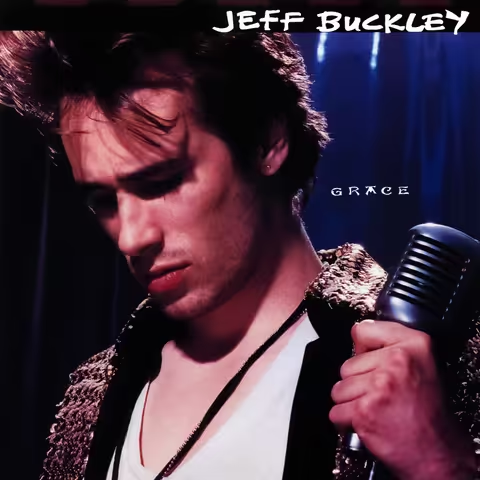
Merri Cyr, who had also photographed Buckley for Live at Sin-é, shot the cover in the last weeks of 1993 in a friend's loft at Arcadia Studios in Williamsburg. Buckley turned up with a duffel bag of unpressed clothes and tipped it out onto a bed, and Cyr chose outfits from the pile. The sequinned women's jacket, recently bought from a thrift store, was the one she called his "Judy Garland glitter jacket". In the photo Buckley looks down and away from the camera, holding a vintage chrome microphone, with the sequins against a white vest and a dark blue curtain behind him. He was listening to a cassette playback of "Dream Brother" when she took it.
Columbia hated it. Sony's Don Ienner reportedly shouted "He looks like a fuckin' lounge singer!", and other staff kept comparing it to Adam Ant. When Columbia's Leah Reid brought him alternatives in Philadelphia, including a shot of him reflected in a broken mirror, Buckley pointed at Cyr's photo: "This is the one. I love this one because I'm listening to music." His co-manager George Stein said winning the argument "was like pulling teeth."
"He wanted to be on this major label and get all this worldwide exposure, but he wanted to act like he was on an indie label."
Merri Cyr, quoted in Rolling Stone, 2019
Release and Reception
The reviews were mixed. Entertainment Weekly's Dimitri Ehrlich gave it an A+ and called the songs "dreamy and stunningly original". Greg Kot of the Chicago Tribune heard "a soulful intensity that sends chills". NME gave it 9/10 and Q gave it four stars. In the Village Voice, Robert Christgau gave it a C, called Buckley "beholden to Zeppelin and Nina Simone and Chris Whitley and the Cocteau Twins", and finished: "Let us pray the force of hype blows him all the way to Uranus."
"Buckley's voice falls smack between Freddie Mercury and Art Garfunkel, sounding like an angel and devil wrapped in one. Too good to be true."
Dimitri Ehrlich, Entertainment Weekly, 1994
Commercially it was a slow burn. It sold 500,000 copies worldwide in its first year, below what Columbia expected, and got little radio play. Its Billboard 200 debut came nine months after release, peaking at 149 in June 1995. By the time Buckley died in 1997 it had sold 175,000 copies in the US. France and Australia took to it faster. In France the Académie Charles Cros gave Buckley its Grand Prix International du Disque on 13 April 1995, and in Australia, where the album came out in early 1995, it reached number 9.
| Publication | 1994 year-end list | Rank |
|---|---|---|
| Mojo | Best 25 Albums of the Year | 1 |
| Entertainment Weekly | Best 10 Albums of the Year | 6 |
| Melody Maker | Best 50 Albums of the Year | 9 |
| NME | Best 50 Albums of the Year | 21 |
Singles and Music Videos
| Single | Released | Chart notes |
|---|---|---|
| Grace | August 1994 | Australia 91 (1996) |
| Last Goodbye | 8 May 1995 | US Modern Rock Tracks 19; Australia 88; Triple J Hottest 100 of 1995, No. 14 |
| So Real | June 1995 | Commercial CD single released only in Australia |
| Eternal Life | August 1995 | B-side: a "road version" of the song |
| Hallelujah | Posthumous | UK 2 (December 2008); No. 1 on Billboard Hot Digital Songs |
"Last Goodbye" was Buckley's biggest US song while he was alive. MTV played its video, which shows the band performing with footage projected onto them and the wall behind, and it earned a 1995 MTV Video Music Award nomination for Best New Artist in a Video.
"Hallelujah" went furthest, after Buckley was gone. It came out as a single ten years after his death, and in December 2008 it reached number two in the UK on downloads alone, behind Alexandra Burke's X Factor version of the same song.
Touring Grace
Buckley toured Grace around the world for about 18 months. According to Mojo's Jim Irvin, the shows "veered between delicate acoustic sets and full-scale sonic onslaughts". Some highlights:
- June to August 1994: the Peyote Radio Theatre Tour, his first full-band run, with Chrissie Hynde, Chris Cornell and the Edge in the audience.
- A show at the Garage in London that, per Rolling Stone, led Thom Yorke to record his vocal for "Fake Plastic Trees".
- Summer 1995: Glastonbury, and Elvis Costello's Meltdown, where Buckley sang Purcell's "Dido's Lament".
- Two sold-out nights at the Paris Olympia, the venue made famous by Piaf.
- 28 August to 6 September 1995: the Mystery White Boy tour of Sydney and Melbourne.
Jimmy Page and Robert Plant came to see him, and Plant later called the show "mind-altering". Richard Kingsmill said one of Buckley's Australian shows was "as close to a perfect concert" as he had ever seen. The Grace line-up ended on the Hard Luck Tour of Australia and New Zealand, and Matt Johnson played his last gig with Buckley on 1 March 1996.
Covers, Syncs and a TikTok Afterlife
- "Last Goodbye" appears in Vanilla Sky (2001) and Sex Education; Scarlett Johansson covered it for He's Just Not That Into You (2009).
- Jamie Cullum and Natalie Maines both recorded "Lover, You Should've Come Over"; John Mayer called it the best song of all time.
- "Hallelujah" became, as Ultimate Classic Rock put it, "a favorite among reality-show hopefuls".
- From 2008 to 2017 the exam board Edexcel set "Grace" as a GCSE Music set work.
The most recent comeback was the least expected. Thanks to TikTok edits and Berg's documentary, "Lover, You Should've Come Over" entered the Billboard Hot 100 at number 97 on the chart dated 31 January 2026, on 3.8 million US streams in a week, and rose to 84 the following week. It was Buckley's first appearance on the chart.
Reissues and Anniversary Editions
- 2004, Legacy Edition: two CDs plus a DVD, released on 23 August 2004 and led by The Making of Grace documentary.
- 2009, Grace Around the World: a deluxe set including the documentary Amazing Grace: Jeff Buckley.
- 2019, 25th anniversary: Columbia/Legacy released unseen footage of Buckley playing "Lover, You Should've Come Over" at the Middle East in Cambridge, Massachusetts, on 19 February 1994.
- 2026, Blu-ray Audio: released on 24 April 2026 with new Steven Wilson Dolby Atmos and 5.1 mixes, hi-res stereo, and "Forget Her".
The Legacy of Jeff Buckley's Grace
Buckley drowned in the Wolf River in Memphis on 29 May 1997 while working on his second album. The demos and sessions became Sketches for My Sweetheart the Drunk in 1998. Tighe thinks it "bothered him slightly the album wasn't more successful" in his lifetime. By 2011 it had sold two million copies, it was certified platinum in the US in 2016, and the Library of Congress announced on 2 April 2014 that "Hallelujah" was joining the National Recording Registry. Rolling Stone ranked the album 303rd among the 500 greatest albums in 2003 and moved it up to 147th in 2020. In 2006 Mojo named it the number-one modern rock classic.
"I started to play Grace constantly. And the more I listened to the album, the more I appreciated of Jeff's talents and Jeff's total ability ... It was close to being my favorite album of the decade."
Jimmy Page, BBC documentary, 2002, quoted in Rolling Stone
Musicians got there before the public did. David Bowie named it as a desert-island record, Bono called Buckley "a pure drop in an ocean of noise", and Morrissey listed it among his favourite albums. Matt Bellamy said he didn't think his high voice suited rock music until he heard Grace. In 2020 he bought the Telecaster Buckley had recorded it on, saying it had "a sound like nothing" he had ever heard, and used it on "Guiding Light" for his Cryosleep EP. Pitchfork's 2004 verdict still holds: Grace "remains one of the most engaging, inspired records ever made".
Things You Might Not Know About Grace
| Fact | Detail |
|---|---|
| His own press bio | Buckley described himself as "the warped lovechild of Nina Simone and all four members of Led Zeppelin", born to Piaf and "tortured by the Bad Brains". |
| Sin-é's dishwasher | Off-stage he often turned up at 2am to wash the café's dishes. "He loved to wash the dishes," a former server remembered. |
| The Bolton tapes | Years later in Memphis he bought cheap Michael Bolton cassettes from a street vendor to use as blank tape for his demos. |
| Standard tuning | Page assumed Buckley used alternate tunings, then found "He was doing things in standard tuning." |
| The film role he refused | His co-manager Dave Lory says Buckley was offered a part in Barbra Streisand's 1996 film The Mirror Has Two Faces; manager Jack Bookbinder says he turned down roles like it. |
| The Roseland visitor | Paul McCartney went backstage to say hello after Buckley's show at New York's Roseland Ballroom. |
| People's 50 Most Beautiful | He was so embarrassed at being named one of People's 50 Most Beautiful People in 1995 that he defaced the article when a fan asked him to sign it. |
| His last song | He was singing Led Zeppelin's "Whole Lotta Love" as he swam in the Wolf River on 29 May 1997. |
Listen to the Riffology Podcast
Grace has its own episode of the Riffology podcast, where the hosts dig into the record track by track. Riffology is available on all major podcast platforms.
Comments