Wayne Static spent the recording of Wisconsin Death Trip living in the band's rehearsal space because he had already given up his apartment and quit his day job to make the record, and his bandmates spent it hammering plywood trigger pads through a piezo microphone into a computer because Ulrich Wild's eight-week, fifty-thousand-dollar Warner Bros. budget would not stretch to a drum machine. The album they made on those terms became Static-X's commercial peak in the same calendar year it came out, sold a platinum million in the US, and ended up bridging the late-eighties industrial metal of Ministry and Prong with the late-nineties nu-metal wave without quite belonging to either side.
It also sounded like nothing else in 1999. While Korn, Limp Bizkit and System of a Down were arguing over how much hip-hop belonged in a metal band, Wayne Static spat out staccato downtuned vocals over thumping techno pulses and called the result "evil disco". The phrase, half-joke and half-mission-statement, would do more to define Static-X's identity than anything Warner's marketing department came up with.
Album Facts
| Field | Detail |
|---|---|
| Artist | Static-X |
| Album | Wisconsin Death Trip (debut studio album) |
| Release date | 23 March 1999 |
| Label | Warner Bros. Records |
| Producer / engineer / mixer | Ulrich Wild |
| Studios | Grandmaster Studios, Hollywood (recording); Master Control, Burbank (mix); Future Disc (master, Tom Baker) |
| Recording window / budget | ~8 weeks in 1998; approximately $50,000 |
| Genre / subgenre | Industrial metal, nu metal; self-described "evil disco" |
| Track count | 12 |
| Total runtime | 43:55 |
| US Billboard 200 peak | 107 |
| US Heatseekers peak | 1 |
| UK Albums Chart peak | Did not chart |
| RIAA certification | Platinum (1,000,000+ US shipments, certified 2001) |
| Key singles | "Push It", "I'm with Stupid", "Bled for Days" |
Cultural Context
Spring 1999 was, on paper, the worst possible week to drop a debut industrial-metal record. The American charts were owned by TLC's FanMail and Britney Spears's ...Baby One More Time; rock radio was nine months into a Korn / Limp Bizkit / Kid Rock cycle that would peak that summer at Woodstock '99; and the album that mattered to metal in the same March was Mr. Bungle's California. Slipknot's self-titled debut would not arrive until June. The Family Values Tour had just finished its inaugural run. Marilyn Manson's Mechanical Animals was sitting on rotation. MTV was about to give its summer over to TRL.
Into that, Static-X arrived on a major label with downtuned, electronic, danceable metal that did not sound like Korn, did not sound like Slipknot, did not rap, and did not whisper or scream about childhood trauma. The closest reference point on the same label was Rob Zombie's Hellbilly Deluxe, which had platinum-bombed for Geffen the previous September. Static-X were not Hellbilly Deluxe, but they were heavy, hooky and danceable in a way Warner could imagine selling, and that was enough to get them on the truck.
The Band's Story Up to This Point
Static-X's pre-history runs through Chicago, not California. Wayne Static (born Wayne Wells in rural Shelby, Michigan) had fronted a goth / alt-rock outfit called Deep Blue Dream in the late 1980s, briefly featuring a young Billy Corgan on guitar before Corgan left to focus on the Smashing Pumpkins. When Deep Blue Dream collapsed, Wayne stayed in Chicago and, by Corgan's introduction, met a drummer called Ken Jay at a Virgin Records store. Jay briefly joined the dying Deep Blue Dream; when that band finally folded, the two of them packed up and pointed a van at Los Angeles.
In LA, Wayne and Ken formed a short-lived three-piece called Battery with guitarist Emerson Swinford. They met Californian bassist Tony Campos through a Ticketmaster call-centre day job he shared with Ken. Campos was deep in the local death-metal scene and almost did not show up to the audition: he had refused to learn one of the band's demo tracks because he thought it "sucked", only to be told the song was an Aerosmith cover the band were jokingly working up. By the second rehearsal he was contributing backing-vocal death growls and was effectively in the band.
Classically trained Osaka-born guitarist Koichi Fukuda answered a flyer, walked into the audition holding the torn-out advert and announced "I am your new guitarist". He replaced Swinford on lead guitar and keyboards and locked the four-piece into place by 1997. The name went through Drill, Static, and finally Static-X (the bare word "Static" was deemed too common to service-mark; the suffix was a last-minute fix added during the album sessions).
By early 1998 they had been gigging hard around LA's clubs, flyering venues themselves, and had built enough of a local buzz that an A&R man called Andy talked Warner Bros. into signing them in February 1998 as the first act on his imprint deal. Recording began almost immediately.
Pre-production and Demos
The pre-album material is patchy on the public record but informative. A 1997 self-released demo tape (sometimes catalogued as "Demo 1997" in Static-X discographies) circulated to industry contacts and is what landed them the Warner deal. By Wayne Static and Tony Campos's own accounts, the band's pre-signing rehearsals were a year of stylistic trial and error: slow sludge, thrash, grunge, hardcore (Black Flag and Circle Jerks covers occasionally got jammed), before the four of them locked into the downtuned-and-pulsing groove that would become the album. Campos has described the period as the moment they realised "rhythmic trancecore" (their first label for it) was where the band came alive.
"I really loved that spirit of experimentation. It was different."
Tony Campos, on the pre-signing rehearsal year, 2024 interview
One track on the finished album, the closer "December", was written by Wayne and Ken during their Deep Blue Dream days in Chicago and was already several years old by the time it was tracked at Grandmaster.
Creating the Album
Static-X moved into Grandmaster Studios in Hollywood in 1998. The budget Warner Bros. allocated was approximately fifty thousand dollars; the recording window was approximately eight weeks. Both numbers are small even by 1998 major-label standards (compare Korn's first Epic-funded record at roughly four times the budget). The band had originally targeted Terry Date as producer (Pantera, White Zombie, Deftones, Soundgarden) and could not afford him; they hired his assistant Ulrich Wild instead, who would also engineer and mix the record.
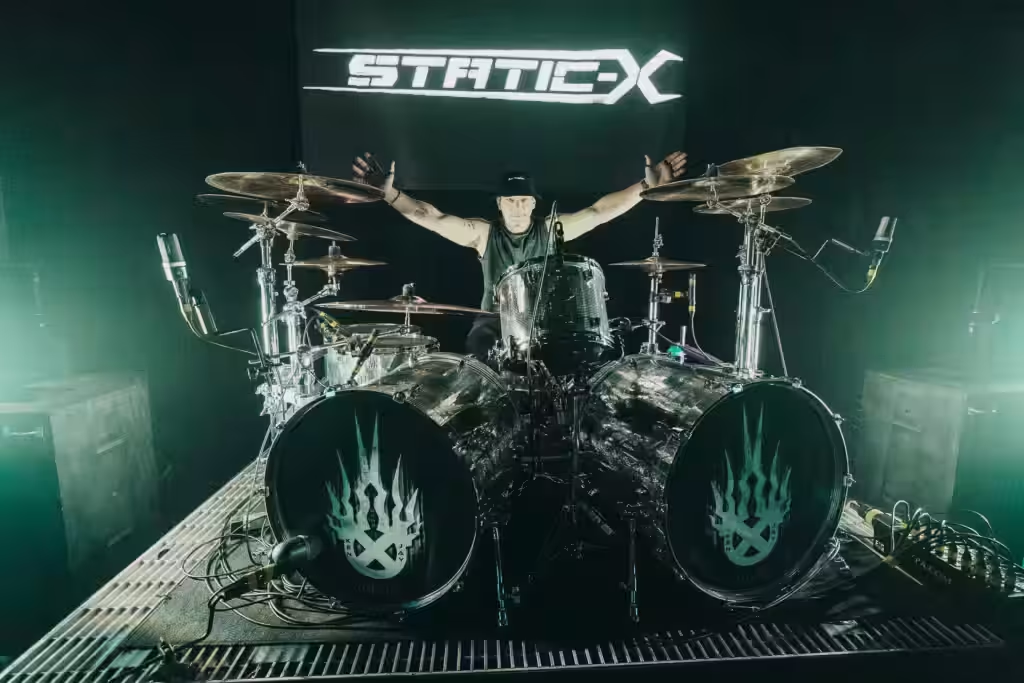
The hands-on, almost garage-built nature of the production is what makes the album sit apart sonically from anything else on Warner's metal roster that year. Wayne wanted the drums to sound "machine-like" but refused to use a drum machine. The workaround they invented is now one of the more frequently retold stories in late-nineties American metal production: Koichi Fukuda built trigger pads out of squares of plywood with piezo microphones glued underneath. Ken Jay then sat in the rehearsal space and physically hit the wooden pads as if they were drums, with the piezo signal captured into Opcode Vision software on a computer to give the kick, snare and toms a flat, repeatable, mechanical attack. Real cymbals were then overdubbed live on top of the triggered tracks in the studio.
The electronic textures were similarly hand-rolled. Wayne programmed loops and percussive samples on an Alesis HR-16 (a 1987 drum machine then almost a decade out of date and prized for its dirty, brittle character). Koichi added synth lines on a Roland MC-303 groovebox (a 1996 dance-music box that retailed for under a thousand dollars and was not on anyone's metal-album equipment list). Ulrich Wild mixed the record at Master Control in Burbank with Michael "Elvis" Baskette assisting on tracking and Jeff Robinson on the mix; Tom Baker mastered at Future Disc.
"It's always been very important to us that we be able to replicate the sound in front of an audience."
Wayne Static, on the everything-must-be-playable-live policy that ruled the sessions, 2001 interview
The Static-live constraint matters because it explains why the record does not bury its hooks under studio sweetening. Every loop on the album would later be triggered live by Koichi from a small rack of samplers; every guitar tone came off rigs they could carry on a bus. Static-X were a major-label band recording a major-label debut, but the workflow looked closer to a self-released industrial-EBM project from a Wax Trax basement.
Personnel and Credits
| Role | Player | Notes |
|---|---|---|
| Static-X | ||
| Lead vocals, rhythm guitar, programming | Wayne Static | Born Wayne Wells, Shelby, Michigan; HR-16 sample programming |
| Lead guitar, keyboards, programming | Koichi Fukuda | Osaka-born; MC-303 synth lines; built the plywood trigger pads |
| Bass, backing vocals | Tony Campos | Bay Area death-metal background; death-growl backing vocals |
| Drums | Ken Jay | Cymbals played live; kick / snare / toms triggered via piezo pads into Opcode Vision |
| Production and engineering | ||
| Production, engineering, mixing | Ulrich Wild | Mixed at Master Control, Burbank; Terry Date's assistant before going solo |
| Recording assistant | Michael "Elvis" Baskette | Later a major producer in his own right (Alter Bridge, Slash, Trivium) |
| Mixing assistant | Jeff Robinson | Master Control |
| Mastering | Tom Baker | Future Disc, Hollywood |
| Artwork | ||
| Art direction and design | Steve Gerdes | Warner Bros. in-house designer of the era |
The most consequential name in the technical staff is arguably Michael "Elvis" Baskette, who tracked as recording assistant on his first major-label metal credit. Baskette would go on to produce Alter Bridge, Slash's solo albums, Trivium, Mammoth WVH and most of the modern hard-rock canon. Several of the techniques he refined later (layered backing vocals, hyper-precise guitar tracking) trace back to engineering sessions like this one.
The Songs
| # | Title | Length | Single? | Notes |
|---|---|---|---|---|
| 1 | Push It | 2:34 | Yes (1st) | Two-and-a-half-minute opener; US Mainstream Rock 20, Alternative Airplay 36, Dance Singles Sales 5 (remix) |
| 2 | I'm with Stupid | 3:24 | Yes (2nd) | Opens with Wayne's bellowed title line; outro samples Linnea Quigley dialogue from Sorority Babes in the Slimeball Bowl-O-Rama (1988) |
| 3 | Bled for Days | 3:45 | Yes (3rd) | Released to radio in April 2000, but had appeared on the Bride of Chucky soundtrack in late 1998, six months before the album |
| 4 | Love Dump | 4:19 | Mephisto Odyssey remix later appeared in Valentine (2001) and Brütal Legend (2009) | |
| 5 | I Am | 2:47 | Reworked in unedited form on the European bonus disc | |
| 6 | Otsegolation | 3:32 | Title a nod to Otsego, Michigan; used in the US release of Omega Boost (1999) | |
| 7 | Stem | 2:54 | Intro sampled from the 1989 experimental horror film Begotten | |
| 8 | Sweat of the Bud | 3:30 | Intro sampled from the 1968 Planet of the Apes spaceship crash-landing | |
| 9 | Fix | 2:49 | One of the most direct nu-metal-leaning cuts on the record | |
| 10 | Wisconsin Death Trip | 3:09 | Title track; fast chug, evil-laugh samples, danceable pulse | |
| 11 | The Trance Is the Motion | 4:50 | The album's most overtly electronic cut | |
| 12 | December | 6:17 | Slow, droning closer; co-written by Wayne and Ken Jay in their pre-Static-X band Deep Blue Dream in the early 1990s |
The album's running order is one of its underrated assets. "Push It", at two minutes thirty-four, is the second-shortest album opener of the late-nineties major-label metal cycle (only Slayer ever opened a record more brutally and briefly) and lays out every Static-X signature in one go: downtuned riff, staccato vocal, looped electronic pulse under the chorus. "I'm with Stupid" follows with the album's biggest singalong hook ("He's a loooooser!"), and "Bled for Days" closes the opening trio with the heaviest riff on the album. Three songs in, the record has shown you everything it is going to do for the next forty minutes and dared you to argue with any of it.
The middle of the album is where the experimentation lives. "Love Dump" is a creeping, almost sleazy mid-tempo with one of Wayne's most lecherous vocal performances. "Otsegolation" is the only Static-X song with a town name in the title (a private joke for the Michigan crowd). "Stem" is the album's most overtly industrial cut, with a creeping intro built off the Begotten sample and a chorus that almost dissolves into Wax Trax territory. "Sweat of the Bud" opens with the recognisable thump-and-hiss of the Planet of the Apes crash and rides it into one of the album's most danceable grooves.
The title track does what title tracks should: it concentrates the album's identity into three minutes nine of fast chug, evil-laugh samples and a pulsing kick. "The Trance Is the Motion" is the closest the record gets to a pure techno-metal hybrid. Then "December", the six-minute Deep Blue Dream holdover, closes the album on a slow, ambient note that nothing else on the record prepares you for. It is the only Wisconsin Death Trip song that does not headbang, and dropping it at the very end means the listener walks away with the album's strangest sonic frame, not its loudest.
"Fast, cheap, and out of control. This is gutbucket thrash for the most jaded of teenaged parking lot dwellers."
Tim Sheridan, AllMusic review, 1999 (four stars)
B-sides, Outtakes and the "Down" Bonus
The European pressing of the album added a thirteenth track, "Down", running 3:15. A standalone non-LP CD single bundled "Down" with "Head", a Static-X version of the song for the Titan A.E. animated-film soundtrack, "S.O.M.", a cover of Ministry's "So What" tracked at Grandmaster, an unedited "I Am", an unedited "Wisconsin Death Trip", a demo of "Love Dump", a single-edit "I'm with Stupid", and an unedited 14-minute version of "December" that is essentially the song's full ambient outro restored. Several of these alternate versions later resurfaced on the 25th-anniversary "Corrosive Edition" reissue in 2024, alongside remastered audio and previously unseen 1998 / 1999 session and tour photos.
The other interesting orphan from the era is "The Death Trip Continues", a remix EP Static-X released in 2000. It paired the album's most groove-leaning tracks with club-style remixes, made the "evil disco" tag literal, and is in retrospect one of the cleanest examples of a major-label metal band leaning into the dance-floor side of their own work.
Album Artwork and Packaging
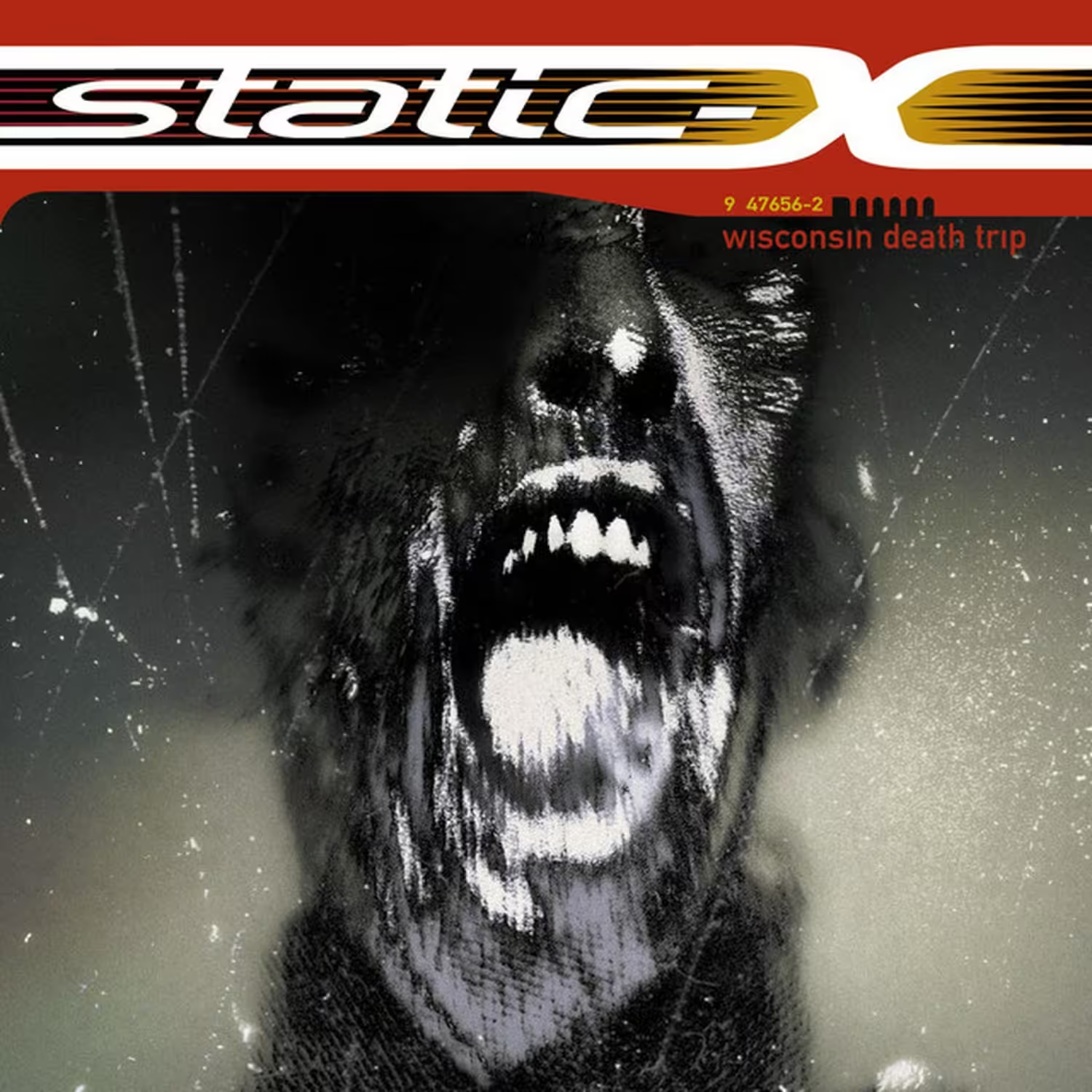
The sleeve is one of the more recognisable metal-album covers of the late nineties: a contorted, mid-scream face on a near-black background, the Static-X logo printed in stark red and white over the top, the album title underneath. The art direction is credited to Steve Gerdes, a Warner Bros. in-house designer who handled several of the label's late-nineties rock releases. The choice is deliberately minimal: one vivid central image, no band photo, no scenery.
The band have never publicly confirmed the source of the face. Long-running fan theories range from a heavily manipulated photograph of Wayne Static himself in mid-scream (claimed by at least one insider who said they had seen the original frame) to abstract stock-image manipulation. The ambiguity is part of why it stuck: the image reads as something between an electrocution victim, a 19th-century death portrait and a zombie, and refuses to settle.
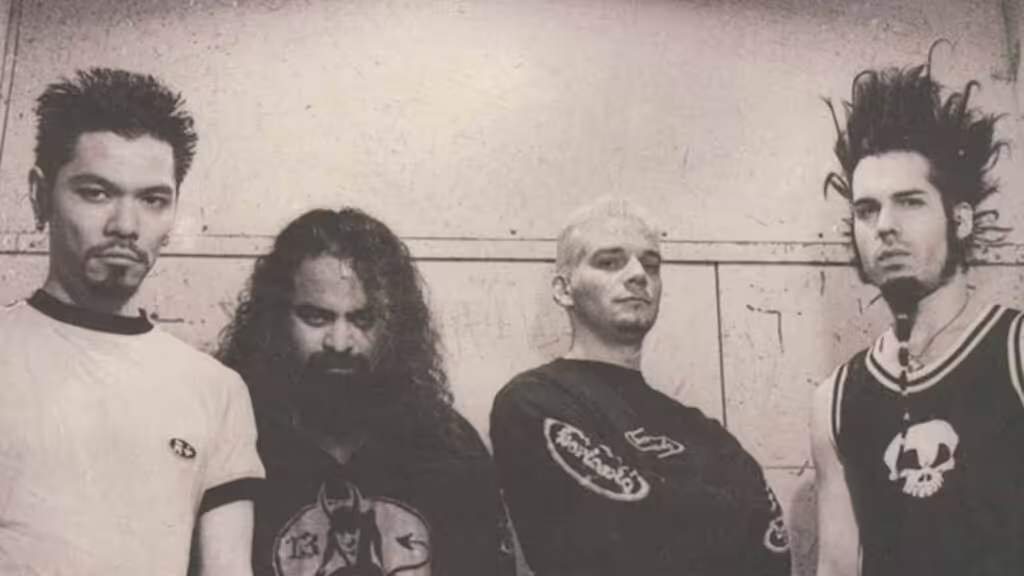
That ambiguity ties the artwork directly to the album's title source. Michael Lesy's 1973 book Wisconsin Death Trip compiles 19th-century Wisconsin death portraits and morbid newspaper clippings; the cover is, in effect, a modern fictional death portrait sitting alongside Lesy's real ones. Inside the CD booklet, the design fragments the screaming face across the credits spread and runs the band's promo shots in stark black and white, keeping the macabre tone intact across the package.
Release and Reception
The album hit US shelves on 23 March 1999 and Europe shortly after. The chart debut was modest: a peak of 107 on the Billboard 200 and, more usefully for a debut act, number 1 on the Heatseekers chart that tracks rising new artists. Critically, the response was mixed-to-positive. AllMusic's Tim Sheridan filed four stars and the line above. Robert Christgau gave it an "honorable mention" and dismissed it as "horrorshow abuse in living stereo; they mean it, man" (read by the band as a backhanded win). The Rolling Stone Album Guide later awarded four stars. Martin Popoff's Collector's Guide to Heavy Metal (Volume 3, 1990s) gave it 6 out of 10. CMJ included the album in its "Loud Rock '99 Top 5" and singled out Static-X's "industrial / metal hybrid" guitar sound as "refreshingly large, loud and groovable".
Where the album really moved was on the tour bus. Static-X spent roughly two solid years on the road behind it (more on which below) and the back-end sales caught up with the noise: gold (500,000 US shipments) in the year of release, and platinum (a full million) certified by the RIAA in 2001. For a debut from a major-label band whose lead single was two and a half minutes long, that is an unusually long tail.
The retrospective reappraisal has been kinder still. Revolver placed Wisconsin Death Trip on its 2018 list of "20 Essential Nu-Metal Albums". Metal Hammer ranked it among the 20 best metal albums of 1999 in a 2021 retrospective. Loudersound included it in the 50 best nu-metal albums of all time in 2022. Houston Press has called it "a tier-one album in the genre, up there with Deftones' White Pony, Linkin Park's Hybrid Theory, and Disturbed's The Sickness", which is the company you want a 1999 debut to keep.
Singles and Music Videos
| Single | Released | Director | Chart / context |
|---|---|---|---|
| Push It | 10 June 1999 | Mick Olszewski | Mainstream Rock 20, Alternative Airplay 36, Dance Singles Sales 5 (remix); clay-animation creatures intercut with band performance |
| I'm with Stupid | 11 February 2000 | Dave Meyers | Brought back the claymation creatures, added monkeys, featured Wayne in drag in a character cameo |
| Bled for Days | 5 April 2000 | Compiled live footage | Originally heard on the Bride of Chucky soundtrack in late 1998, before the album existed at retail |
"Push It" is the song that did the heaviest lifting for the album's commercial profile. The Mick Olszewski-directed video, built around stop-motion clay creatures cutting back to band-performance footage in strobe-lit black, ran on MTV2's specialty rock shows through the back end of 1999 and into 2000. The crossover to a Dance Singles Sales chart entry at number 5 (driven by the single's club remixes) is a quietly remarkable thing for a song that came out of a metal band on Warner: it is one of the cleanest pieces of evidence that "evil disco" was not just a marketing tag.
"I'm with Stupid" got the bigger video budget. David Meyers, then becoming the go-to director for major-label rock and hip-hop videos, reused the claymation creatures from "Push It" for continuity, added hidden monkeys throughout the cut, and let Wayne appear in drag as a recurring side character. The chart performance was lower than "Push It" but the rock-radio penetration was higher, and the chorus stuck.
"Bled for Days" was the simplest of the three: a live-footage compilation cut to the studio audio, released as the album's third single in April 2000. It had already done some of its work, though, having appeared on the Bride of Chucky soundtrack the previous October and built the album's first wave of underground buzz before the record was even out.
Touring and Live
Static-X's touring schedule behind Wisconsin Death Trip is the part of the story the band still discuss with a mix of pride and exhaustion. The headline number is the one Wayne quoted: roughly 300 shows in the first year, with no significant break. Highlights of the cycle:
- Ozzfest 1999 second stage, alongside System of a Down and Slipknot; Shavo Odadjian joined Static-X on stage at one date for "I'm with Stupid"
- Fear Factory headline tour late 1999, with Static-X, System of a Down and (Hed) PE on the bill (Dino Cazares informally mentored Tony Campos on touring craft)
- Direct support runs with Slayer and Sevendust, often back-to-back with no days off
- Performance of "Bled for Days" on Comedy Central's Chef!, scripted into a nudist-camp scene
- Promo runs through Europe in 2000, then back into the US for a second domestic cycle
- Crew and travel built around a tour bus that was repossessed at the end of one US leg before the album's cashflow caught up; the band finished in a van
"We played 300 shows in the first year and just never went home. One tour would end and we'd drive a couple of days and hook up with Slayer. That tour ends and then we'd drive to Boston to hook up with Sevendust. We just kept going."
Wayne Static, on the album's touring cycle, 2014 interview
The live show became a defining part of the Static-X brand and was deliberately built around the album's "everything must be playable" rule. Koichi triggered Wayne's HR-16 loops and his own MC-303 lines in real time from a small sampler rack. Ken Jay reproduced the plywood-trigger drum sound with conventional pads on stage. Wayne's vertical hair (gelled into the stalagmite that became his visual signature) drew most of the cameras. The energy converted: by the end of the cycle they were playing US theatres rather than the clubs they had opened on, and the album's tail-end Platinum certification was largely paid for in venue-sized sweat.
The touring cycle also broke the original line-up. Koichi Fukuda left at the end of 2000 citing burnout, replaced by ex-Dope guitarist Tripp Eisen. Fukuda would not return to the band until the post-Wayne reunion in 2019.
In TV, Film and Media
- "Push It": Idle Hands (1999) horror-comedy soundtrack; opening titles of the PlayStation game Duke Nukem: Land of the Babes (2000); chase-scene sync in Torque (2004); downloadable track for Rock Band (2008)
- "I'm with Stupid": rotation on MTV2 and US Mainstream Rock through 2000; featured in skating and BMX video compilations of the era
- "Bled for Days": Bride of Chucky (1998) soundtrack (the band's first piece of commercially released audio); Universal Soldier: The Return (1999); live performance on the Comedy Central series Chef!
- "Love Dump" (Mephisto Odyssey remix): Valentine (2001); Brütal Legend (2009) video-game soundtrack
- "Otsegolation": US release of Omega Boost (1999) on PlayStation
The cumulative effect was that even listeners who never went looking for Static-X kept tripping over them in 1999 and 2000: in a horror sequel, on a chase-scene soundtrack, on a PlayStation title screen, on MTV2 at three in the morning. The album sold platinum on the back of constant touring, but the sheer breadth of those incidental placements is part of why the run did not stop earlier.
Controversy and the "Evil Disco" Tag
Wisconsin Death Trip dodged most of the obvious 1999 metal controversies. There was no parental-advisory stand-off (the album carries the standard sticker but nothing extraordinary), no plagiarism suit, no banned video, no Satanic-panic backlash worth naming. The closest thing to a public spat was over genre. Static-X loathed being filed under nu metal, a label Wayne in particular pushed back against in interviews for years on the basis that they were a Ministry-and-Prong descendant rather than a Korn descendant.
"We were trying to rip off Ministry and Prong. We were not trying to be nu metal. We were not rapping. We were not doing any of that. The Chemical Brothers were a bigger influence on us than Korn ever was."
Tony Campos, on the nu-metal label, 2024 interview
The "evil disco" tag was Wayne's mostly tongue-in-cheek counter-label. By the second album the joke had hardened into a genuine identity, and "evil disco" is now the phrase most often used by fans and by the band itself to describe the Wisconsin Death Trip sound.
Covers, Samples and Afterlife
The album's sample lineage runs through three films that almost nobody else was sampling on a 1999 major-label metal record. The intro of "Sweat of the Bud" lifts the spaceship crash-landing audio from the 1968 Planet of the Apes. The intro to "Stem" pulls from the 1989 experimental horror film Begotten (the Edmund Elias Merhige feature shot on heavily processed reversal stock). The outro of "I'm with Stupid" carries dialogue from Linnea Quigley in 1988's Sorority Babes in the Slimeball Bowl-O-Rama. Three different decades, three different corners of cult cinema; together they tell you a fair bit about what Wayne was watching while he was writing.
Static-X's own catalogue references the album constantly. Wisconsin Death Trip songs are the bedrock of every Static-X live setlist; the reunion tours from 2019 onwards explicitly billed themselves around performing the album in full. The posthumous Project: Regeneration Vol. 1 (2020) and Vol. 2 (2023) records were built around recovered Wayne Static vocal takes recorded during and after the Wisconsin Death Trip era, which is the closest the band can now get to "new" Wisconsin Death Trip material.
Notable cover versions are thinner on the ground than the album's stature implies, but "Push It" has been a recurring choice for industrial / EBM acts to remix, and several modern industrial-tinged metal bands (Code Orange, Vended, the post-2020 wave of "rave metal" acts) cite Wisconsin Death Trip as one of the records that made the danceable-but-heavy template commercially defensible.
Reissues, Remasters and Anniversaries
The album was never aggressively reissued during Wayne Static's lifetime. The original Warner CD was joined by a European pressing with the bonus track "Down", a stand-alone "Push It" CD single with remixes, the 2000 "The Death Trip Continues" remix EP, and a vinyl reissue cycle in the mid-2010s; remasters were limited.
The full anniversary push arrived for the 25th in late 2024 / early 2025 as the "Corrosive Edition" reissue, packaged as a multi-disc set with remastered audio, the bonus and B-side material described above, previously unpublished 1998 / 1999 session and tour photography, and a contemporary-press essay package. The accompanying live performance of the album in full was the headline draw on the band's 2025 tour. The Corrosive Edition is covered in detail on Riffology in its own piece (Wisconsin Death Trip 25th Anniversary Corrosive Edition review) and is the canonical way to hear the album today.
Legacy and Influence
Twenty-six years on, Wisconsin Death Trip's place in the late-nineties American metal canon looks more settled, not less. It is the record that demonstrated, in a major-label, retail-sold, MTV-rotated context, that you could marry late-eighties industrial-metal rhythm tracking with a danceable electronic pulse and a downtuned guitar without losing your audience to either side. The line that runs from Ministry's Psalm 69 and Prong's Cleansing through Wisconsin Death Trip and into the 2000s industrial-tinged metal scene is direct.
The band themselves never quite topped it commercially. Machine (2001) certified gold; Shadow Zone (2003), Start a War (2005), Cannibal (2007) and Cult of Static (2009) all charted higher than the debut on the Billboard 200 (a sign of an established act with a built-in opening week) but none reached platinum, and Wisconsin Death Trip remains the only Static-X album certified at that level. Wayne Static's death in 2014 closed the original chapter; the post-2019 reunion with Tony Campos, Koichi Fukuda and Ken Jay around a masked vocalist billed as Xer0 (widely understood to be Edsel Dope of Dope) explicitly positioned itself as a Wisconsin Death Trip tribute outfit first and a working band second.
"To see something we did 25 years ago connecting with a whole new generation is pretty humbling."
Tony Campos, 2024 anniversary-cycle interview
That continued connection is what places the album where it now sits. Houston Press's tier-one ranking holds up: alongside Deftones' White Pony, Linkin Park's Hybrid Theory and Disturbed's The Sickness, Wisconsin Death Trip is one of a small handful of records from the late-nineties / early-millennium metal cycle that still pulls listeners who were not born when it came out.
Things You Might Not Know
| Fact | Detail |
|---|---|
| The album title came from a 1973 photo book | Wayne spotted Michael Lesy's Wisconsin Death Trip on his sister Lisa's table during a tour stay and lifted the phrase. The band wanted to use it as a band name; Warner deemed it too long. |
| Billy Corgan introduced two of the four members | Smashing Pumpkins frontman Corgan had briefly played guitar in Wayne's pre-Static-X band Deep Blue Dream and is the reason Wayne and Ken Jay met at a Virgin Records store in Chicago in the mid-1990s. |
| The drums are wood, not skins | Koichi Fukuda built plywood pads with piezo microphones glued underneath; Ken Jay hit those in the rehearsal space and the signals were recorded into Opcode Vision. Only cymbals were tracked from a real kit. |
| The whole record cost about $50,000 | Roughly an eighth of what a comparable major-label metal debut would have cost in 1999. The band wanted Terry Date and hired his assistant Ulrich Wild instead because Date's day rate was out of reach. |
| Michael "Elvis" Baskette was the recording assistant | The future Alter Bridge / Slash / Trivium producer was tracking on his first major-label metal credit. The session-craft he refined later traces back here. |
| "Bled for Days" was heard six months before the album existed | Released on the Bride of Chucky soundtrack in October 1998. By the time the album hit shelves in March 1999, the song was already underground-known. |
| "Push It" charted as a dance single | The single's club remixes hit number 5 on Billboard's Hot Dance Singles Sales chart. A two-minute thirty-four-second metal song from Warner Bros. cracked the same chart as Eiffel 65. |
| "December" predates Static-X by about a decade | Co-written by Wayne and Ken Jay in Deep Blue Dream in the late eighties / early nineties. The unedited European-bonus version runs over fourteen minutes. |
| "Otsegolation" name-checks a town in Michigan | Otsego, Michigan, where the band rented a house during early demoing. Used in the US release of the PlayStation mech-shooter Omega Boost. |
| Static-X covered Ministry on a B-side | "S.O.M." on the "Push It" CD single is a Static-X cover of Ministry's "So What", which is the most on-the-nose nod to the band's stated influences anywhere in their catalogue. |
| Wayne lived in the rehearsal space during the sessions | He had already quit his day job and given up his apartment by the time recording started. There was nowhere else for him to be while the album was being made. |
| The tour bus got repossessed mid-cycle | One US leg ended with Warner's tour-support cashflow running short of the bus rental; the band finished the run in a van and went back out the following month. |
The Riffology Podcast
Wisconsin Death Trip is the subject of episode RIFF074 of the Riffology podcast, which is available on the player embedded above this article and on Apple Podcasts, Spotify, YouTube and every major podcast platform. Subscribe to follow along with the rest of the late-nineties American metal cycle, including upcoming episodes on the records that came out either side of this one.