Tommy Victor wrote the riff that would define Prong on an acoustic guitar, at night, in the bathroom of a Williamsburg flat, strumming quietly so the neighbours would not work out that the polite new tenant was in a metal band. That riff became "Snap Your Fingers, Snap Your Neck", and the album it detonated, 1994's Cleansing, remains the closest the New York groove metal pioneers ever came to the mainstream.
The kicker is that the song's musical DNA did not even start with Prong. A stranger handed Victor a demo cassette across the sound desk at CBGB, where he worked the mixing board between bands, and one of those riffs lodged in his head until he made it heavier, meaner and entirely his own. Cleansing is full of stories like that, a record built from New York hardcore grit, ex-Killing Joke muscle, a Pantera-grade producer the label did not want, and a mix finished inside Jimi Hendrix's old studio. It should have made Prong stars. Instead it made them a band that half of modern metal quietly borrowed from.
Album Facts
Before the deep dive, here is the record at a glance, the key dates, credits, chart marks and the singles that carried it onto MTV.
| Field | Detail |
|---|---|
| Artist | Prong |
| Album | Cleansing |
| Release Date | 25 January 1994 |
| Label | Epic Records |
| Producer(s) | Terry Date and Prong |
| Studio(s) | Bad Animals (Seattle) and The Magic Shop (New York); mixed at Electric Lady Studios (New York) |
| Genre / Subgenre | Groove metal, alternative metal, industrial metal |
| Track Count | 12 |
| Total Runtime | 58:02 |
| Billboard 200 Peak | No. 126 (first Billboard 200 entry) |
| UK Albums Chart Peak | Around No. 71 |
| Other Notable Chart Peaks | Lead single reportedly reached around No. 80 in the UK |
| Certifications | None officially certified |
| Estimated Sales | More than 300,000 in the United States |
| Key Singles | Snap Your Fingers, Snap Your Neck; Whose Fist Is This Anyway?; Broken Peace |
Cultural Context: Metal in Early 1994
January 1994 was a strange, electric moment to release a heavy record. Grunge had kicked the door in, Nirvana's In Utero was barely three months old, and major labels were still signing anything loud and flannel-clad in the hope of catching the next big alternative wave. Heavy metal itself was being pulled in two directions. The old guard of thrash was creaking, while a newer, groovier, downtuned strain was rising up to replace it.
That same window produced some of the heaviest, most genre-bending records of the decade. Prong's peers and labelmates were swinging for the fences alongside them:
- Pantera released Far Beyond Driven in March 1994, a record that debuted at number one and proved groove metal could top the chart.
- Nine Inch Nails dropped The Downward Spiral the same month, hauling industrial music into arenas.
- Soundgarden's Superunknown and Sepultura's Chaos A.D. bracketed the period, blurring metal, grunge and tribal rhythm.
- White Zombie and Helmet, both openly indebted to Prong's earlier records, were breaking through commercially.
Prong sat dead centre of all of it, a band with hardcore credibility, thrash chops and a growing industrial streak, on a major label, recorded by the producer of the moment. On paper, no band was better placed to ride the wave. The cruel irony of Cleansing is that it was arguably too far ahead of the curve to cash in on it.
The Band's Story Up to This Point
Prong were born inside CBGB. Tommy Victor and original bassist Mike Kirkland both worked at the legendary Bowery club, Victor as soundman, and they formed the band in 1986 with drummer Ted Parsons, a veteran of New York no-wave noise pioneers Swans. From the start Prong were caught between worlds, too metal for the hardcore kids, too hardcore for the metalheads, and too smart to care.
The early catalogue moved fast. The self-released Primitive Origins EP arrived in 1987, followed by the abrasive debut album Force Fed in 1988, recorded for next to nothing. Epic Records signed them in 1989, and 1990's Beg to Differ slowed the tempos and locked into a precise, mid-paced churn that Victor has since claimed was effectively the first groove metal record, a sound that bands like Pantera, White Zombie and Helmet would build careers on. The title track earned Headbangers Ball rotation, but it cost them some of the hardcore faithful.
1991's Prove You Wrong pushed further into industrial textures and featured bassist Troy Gregory, the only Prong album he played on. A 1992 remix EP, Whose Fist Is This Anyway?, saw the band hand their songs to industrial figures to rework, a clear signal of where Victor's head was at. By the time the writing began for album four, Gregory was gone and Prong needed a new spine.
They found it in two veterans of the British industrial scene. Bassist Paul Raven, formerly of Killing Joke and its harder offshoot Murder Inc., joined in 1993 and brought a thunderous, mechanised low end. Alongside him came keyboardist and programmer John Bechdel, another Murder Inc. and Killing Joke man. With Parsons' noise-rock muscle behind the kit, the line-up that made Cleansing was the heaviest and most experienced version of Prong yet.
Pre-production and Demos
Powers Street, Williamsburg, Brooklyn. Long before the neighbourhood became shorthand for hipster gentrification, it was a cheap, working-class corner of the city, and it was where Tommy Victor wrote much of Cleansing, alone, on an acoustic guitar, in his bathroom.
"It was written on Powers Street in Williamsburg in my bathroom on an acoustic guitar, at night, trying to hide from the neighbors because I didn't want them to know I played in a band."
Tommy Victor, Kerrang!, 2019
That quiet, riff-first writing method shaped the whole record. Songs built on an acoustic guitar tend to live or die on the strength of the riff and the groove rather than sheer speed, and that is exactly what Cleansing trades in. Victor had grown tired of thrash and wanted something with a physical, rhythmic pull, music you could move to rather than simply outrun.
"We didn't want to do thrash or crossover. We knew we didn't want to do that. So we thought, 'Let's go back to floor-danceable metal', the kind of thing that people wanted to listen to in clubs. Regular songs rather than Master of Puppets."
Tommy Victor, Metal Hammer, 2023
The first song written to that brief was "Snap Your Fingers, Snap Your Neck", and its origin is one of the great Prong anecdotes. While working the sound desk at CBGB, Victor was handed a demo cassette by a member of the audience. The band on the tape was the Canadian industrial outfit Front Line Assembly, and a riff from that demo became the seed of the song. Victor reworked it into something far heavier and more metallic, and by his own account the band have always been relaxed about the borrowing. The lyric, meanwhile, came to him on the New York subway.
"It's one of those songs that comes from being in the moment. You want to enjoy what's going on right now instead of worrying about these things in the past or worrying about the future."
Tommy Victor, Songfacts
Creating the Album
Prong's previous two albums had been produced by Mark Dodson. For Cleansing the band wanted a bigger, harder, more modern sound, and they had one name in mind: Terry Date. Date was the hottest hard-rock producer in America, fresh from Pantera's Vulgar Display of Power and Soundgarden's Badmotorfinger, a master of enormous guitar tone and punishing low end. Epic, however, did not want him.
The band held firm. The label eventually relented, and Date's involvement proved decisive. He tightened Prong's drilling, percussive guitars and gave the industrial textures room to breathe without softening the impact. Sessions ran across two coasts: basic tracks were cut at Bad Animals, the Seattle studio owned by Heart's Wilson sisters, and at The Magic Shop in New York. Then came the part Victor still treasures most.
"Ultimately, and this is probably the greatest thing in my whole career, it was mixed at Electric Lady studios in New York. How could you go wrong with that?"
Tommy Victor, Kerrang!, 2019
Mixing at Jimi Hendrix's New York studio was a long way from a Williamsburg bathroom. The finished album carried a clarity and force no previous Prong record had, the guitars machine-tight, the rhythm section crushing, the programming woven in rather than bolted on. Yet even as the band were making the best record of their lives, they could feel the label's indifference. To Epic, a heavy, uncompromising act like Prong was an awkward fit on a roster built around pop royalty.
"It was never cool. Epic was Michael Jackson's label. The people that worked there mostly thought that alternative, heavy music was garbage. Epic just didn't know why we were on the label and they wanted to get rid of us."
Tommy Victor, Metal Hammer, 2023
Personnel and Credits
The defining change on Cleansing was the rhythm section. Two ex-Killing Joke and Murder Inc. men, Paul Raven and John Bechdel, gave the album its industrial backbone, while Ted Parsons' Swans pedigree kept the drumming heavy and inventive. Mastering came from Ted Jensen, a name that appears on a vast number of major rock records of the era. The cover credits beyond the core team are not reliably documented, so they are described rather than named in the artwork section below.
| Role | Player | Notes |
|---|---|---|
| Core band | ||
| Vocals, guitar | Tommy Victor | Founder and chief songwriter; former CBGB soundman; wrote much of the album on acoustic guitar |
| Bass | Paul Raven | Ex-Killing Joke and Murder Inc.; joined 1993; died 2007 |
| Drums | Ted Parsons | Founding Prong drummer; previously of Swans |
| Keyboards, programming | John Bechdel | Ex-Killing Joke and Murder Inc.; joined alongside Raven in 1993 |
| Production and engineering | ||
| Producer, engineer | Terry Date | Hired over the label's objections; fresh from Pantera and Soundgarden |
| Producer | Prong | Co-produced the album |
| Mastering | Ted Jensen | Mastered the record |
| Mixing location | Electric Lady Studios | Final mixes completed at Jimi Hendrix's New York studio |
The Songs
Twelve tracks, every one credited to the band, run across nearly an hour. Cleansing front-loads its hooks, the opening run is as strong an opening salvo as 1990s metal produced, then deepens into longer, darker, more industrial territory across the second half.
| # | Title | Writer(s) | Length | Single? | Notes |
|---|---|---|---|---|---|
| 1 | Another Worldly Device | Prong | 3:23 | Concise, hammering opener that sets the groove template | |
| 2 | Whose Fist Is This Anyway? | Prong | 4:42 | Yes | Re-recorded title concept from the 1992 remix EP |
| 3 | Snap Your Fingers, Snap Your Neck | Prong | 4:11 | Yes | The band's signature song; built from a Front Line Assembly demo riff |
| 4 | Cut-Rate | Prong | 4:52 | Percussive, mid-paced grind | |
| 5 | Broken Peace | Prong | 6:11 | Yes | The album's epic centrepiece and third single |
| 6 | One Outnumbered | Prong | 4:58 | Heavier industrial leanings | |
| 7 | Out of This Misery | Prong | 4:25 | Driving, hook-led deep cut | |
| 8 | No Question | Prong | 4:17 | Compact and aggressive | |
| 9 | Not of This Earth | Prong | 6:25 | One of the longest, most atmospheric tracks | |
| 10 | Home Rule | Prong | 3:57 | Tight and punchy | |
| 11 | Sublime | Prong | 3:53 | Melodic edge within the machine-metal frame | |
| 12 | Test | Prong | 6:40 | Sprawling closer |
"Snap Your Fingers, Snap Your Neck" is the song that outlived everything around it. Its percussive, almost danceable main riff owes a debt to Killing Joke, all overtones and a flanged chorus, and its title alone has become metal shorthand. It is the track that opened the record up to listeners who had never heard a Prong song, and decades later it remains the band's calling card and most-streamed song by a distance.
The deeper cuts are where the album earns its "complete" reputation. The six-minute "Broken Peace" shows the band stretching out, while "Not of This Earth" and the closing "Test" lean hard into the industrial atmosphere Raven and Bechdel brought with them. Critics have long argued that the first five tracks are essentially flawless, a run that, on a luckier band, would have been a greatest-hits side in its own right.
What holds the whole record together is restraint. Where their thrash peers chased ever faster tempos, Prong did the opposite, stripping songs back to the riff, the groove and the hook, and trusting that a heavy part repeated with conviction hits harder than a flurry of notes. It is a discipline that makes Cleansing sound less dated than much of the metal released around it, and it is why younger bands kept returning to these songs.
B-sides, Outtakes and Reissue Tracks
Prong's appetite for reworking their own material did not start with Cleansing. The 1992 Whose Fist Is This Anyway? EP had already handed their songs to industrial producers for remixing, and that remix-friendly mindset fed directly into the album's industrial sheen. When Cleansing was reissued in 2008 by SPV and Steamhammer, the package gathered up material that filled in the edges of the era.
- "Corpus Delicti" (3:33), a bonus track on the reissue.
- "No Souls Rising" (3:50), a further bonus inclusion.
- A live version of "Snap Your Fingers, Snap Your Neck" (4:32), capturing the song in its natural habitat.
For a band who built their reputation on remixes and reinventions, these extras are less throwaway B-sides and more evidence of how restlessly Prong treated their own catalogue.
Album Artwork and Packaging
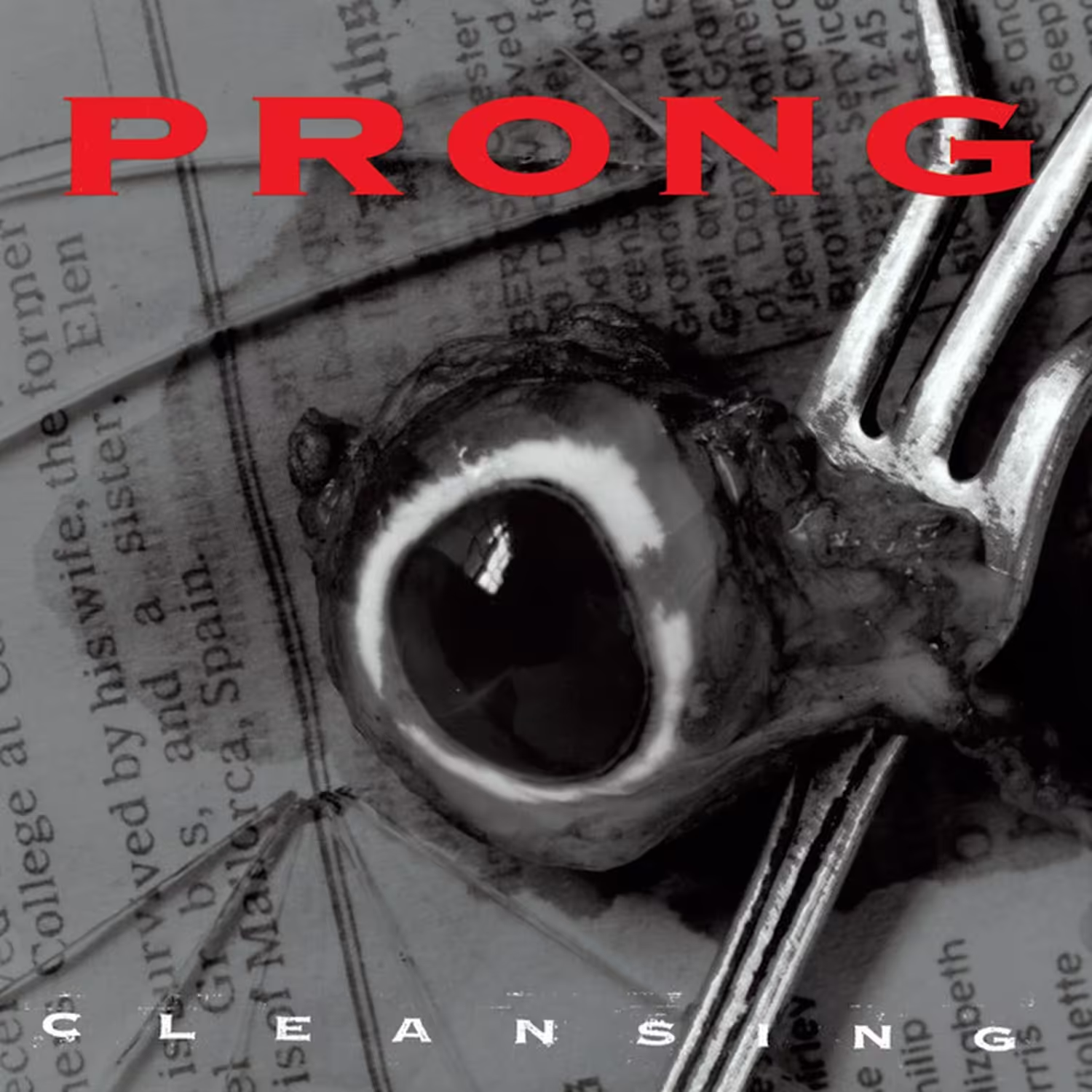
The Cleansing sleeve is one of the most quietly disturbing images in 1990s metal, and one of the cleverest. Shot in stark black and white, it shows a single, isolated human eyeball lying on a bed of torn newspaper, the print clearly visible as fragments of obituary and memorial notices, with phrases about a person being survived by his wife and sister, references to a college and to Mallorca, Spain, and scattered first names. Pressing in from the right are the tines of an ordinary metal dinner fork.
The band name sits across the top in bold red capitals, the album title in plain white along the bottom. The genius is in the fork. A prong is, literally, a tine of a fork, so the cover puns the band's own name while the eye-on-obituaries image speaks to the record's themes of mortality, decay and, well, cleansing. It is grotesque and witty at once, exactly the register Prong operated in. Reliable credits for the photographer and art director are not well documented, so they are left unattributed here rather than guessed at.
Release and Reception
Released on 25 January 1994, Cleansing became the most successful album of Prong's career. It reached number 126 on the Billboard 200, their first ever entry on that chart, climbed to around number 71 on the UK Albums Chart, and went on to sell more than 300,000 copies in the United States. For a band the label barely understood, those were striking numbers.
Critically, it was the moment the wider press caught up with Prong. AllMusic's Stephen Thomas Erlewine awarded it four and a half stars and called it the band's finest hour.
"The band's most varied and best record yet. It tightens up their trademark drilling guitars while adding some slight techno and industrial touches."
Stephen Thomas Erlewine, AllMusic
The praise was widespread. Kerrang! gave it a full five out of five, Germany's Rock Hard handed down a nine out of ten, and writers returning to the record years later have only grown fonder of it. Author Joel McIver, writing in Record Collector, compared the staccato guitar attack to Fear Factory and judged it a respectable seller rather than a monster hit, while the Village Voice later placed it among the best New York hardcore and metal albums, noting it proved to be as catchy as it was heavy. The reissue-era consensus is blunter still, that Cleansing should have been a genre-defining smash.
"It should have redefined a genre. It should have rocketed them to superstar status, and it's a tragedy that it didn't."
Dave Pirtle, Last Rites, 2014
Singles and Music Videos
Three singles were pulled from the album across 1994, each pushing Prong a little further into the light. "Snap Your Fingers, Snap Your Neck" was the obvious lead, and its video earned heavy rotation on MTV and Headbangers Ball. "Whose Fist Is This Anyway?" and the six-minute "Broken Peace" followed, the latter an ambitious choice for a single given its length.
| Single | Year | Notes |
|---|---|---|
| Snap Your Fingers, Snap Your Neck | 1994 | Lead single; heavy MTV and Headbangers Ball rotation; the band's defining song |
| Whose Fist Is This Anyway? | 1994 | Second single; reworked from the 1992 remix EP concept |
| Broken Peace | 1994 | Third single; the album's sprawling centrepiece |
The reach of "Snap Your Fingers" went well beyond music television, as the next section covers. Documented details on the individual video directors and shoots are thin, and rather than attach an unverified name to them, the focus here stays on where the songs actually landed in the culture.
Touring and Live
Prong spent 1994 on the road in the best company groove metal had to offer. In the United States they opened for two of the era's heaviest headliners, supporting Sepultura on the Chaos A.D. cycle and Pantera on the Far Beyond Driven tour, sharing stages nightly with bands operating at the absolute peak of the style.
In Europe the band stepped up to headline, with Life of Agony and stoner-metal cult heroes The Obsessed providing support on various dates. To cover the album's keyboard and programming parts live, Joseph Bishara briefly toured with the band during 1994, later far better known as a film composer. The live setting is where "Snap Your Fingers, Snap Your Neck" became a genuine anthem, its stop-start groove tailor-made for a room full of moving bodies, which is exactly what Victor had written it for.
Those touring slots told their own story about where Prong sat in the food chain. They were respected enough to share a bill with Pantera and Sepultura at the height of both bands' powers, yet still the opener rather than the headline draw in their home country, a band whose reputation among musicians outran their standing on the marquee. It is a gap that would define the rest of the decade for them.
In TV, Film and Media
For a band Epic could not market, Prong got two of the most coveted media placements of the decade. "Snap Your Fingers, Snap Your Neck" was played and gleefully approved on Beavis and Butt-Head, the MTV cartoon whose blessing could break a band as effectively as any radio playlist. Victor has rated that exposure as highly as the channel's video rotation.
The film world came calling soon after. In 1995 Prong recorded a cover of The Doors' "Strange Days" for the soundtrack to Kathryn Bigelow's film of the same name, and crucially they did it with Doors keyboardist Ray Manzarek playing on the track. By Victor's account the session cost around fifty thousand dollars, took the best part of a month during the sessions for the next album, and ended with him walking out on the mixes and calling the experience a disaster. The result, all the same, put Prong on a major film soundtrack alongside a genuine rock legend.
Covers, Samples and Tributes
The truest measure of "Snap Your Fingers, Snap Your Neck" is how many other bands have wanted to play it. Over the years it has been covered across the heavier end of the spectrum, a small canon of versions that has kept the song alive for listeners who came to it second-hand:
- Demon Hunter, on The Triptych.
- Six Feet Under, on Graveyard Classics 3.
- Dry Kill Logic, on the Rot EP.
- Grinspoon, on the Pushing Buttons EP.
- Soil, on Play It Forward.
A song first sketched from someone else's demo cassette has, in turn, become a staple for a new generation of bands to reinterpret, a neat closing of the circle for a track born at the CBGB sound desk.
Reissues, Remasters and Anniversaries
The most significant return for Cleansing came in 2008, when SPV and Steamhammer reissued the album with the bonus tracks "Corpus Delicti", "No Souls Rising" and a live "Snap Your Fingers, Snap Your Neck". The reissue arrived as Prong, reformed since 2002, were rebuilding momentum, and it served to reintroduce the record to listeners who had missed it the first time. Its reputation has only grown with each passing anniversary, the album now routinely cited among the essential heavy records of 1994 and a frequent entry on retrospective lists of the decade's most underrated metal.
Legacy and Influence
What happened next is one of metal's quieter tragedies. Prong followed Cleansing with 1996's Rude Awakening, which reached number 107 on the Billboard 200 but sold only around ten thousand copies in its first week. Epic dropped the band roughly three weeks after release, and Prong fell apart in 1997. Victor revived the name in 2002 and has kept it running ever since, and he is clear-eyed about where Cleansing sits in the story.
"Epic had Pearl Jam and that was us done."
Tommy Victor, Metal Hammer, 2023
The influence, though, kept spreading long after the sales stopped. Prong's machine-tight, groove-led heaviness fed directly into the nu-metal and industrial-metal explosion of the late 1990s. Korn's Jonathan Davis and Nine Inch Nails' Trent Reznor are among those who have name-checked the band, and the parade of cover versions speaks to a record that working musicians simply could not shake. Victor, for his part, rates it second only to 2017's Zero Days in the Prong catalogue, and has marvelled at the way the title track refuses to fade.
"That is a serious A-level banger."
Tommy Victor on Snap Your Fingers, Snap Your Neck, Metal Hammer, 2023
Cleansing is the sound of a band who were right too early. The groove metal they helped invent went on to define a decade, and the industrial textures they folded in became standard issue, yet the record that did both at once stalled outside the Top 100. Three decades on, it stands as the definitive Prong album, the one a new listener should hear first, and the proof that being ahead of your time is no guarantee of getting the credit while it counts.
Things You Might Not Know
| Fact | Detail |
|---|---|
| The bathroom sessions | Tommy Victor wrote much of Cleansing on an acoustic guitar in the bathroom of his Powers Street flat in Williamsburg, at night, hiding from neighbours who did not know he was in a band. |
| Snap's secret source | The riff to "Snap Your Fingers, Snap Your Neck" grew out of a Front Line Assembly demo cassette a stranger handed Victor while he worked the sound desk at CBGB; he made it heavier, and the band have always been relaxed about it. |
| The label fought the producer | Epic opposed hiring Terry Date, who had just produced Pantera's Vulgar Display of Power and Soundgarden's Badmotorfinger. Prong insisted, and the label eventually came round. |
| Mixed at Hendrix's studio | The album was mixed at Electric Lady Studios in New York, which Victor has called probably the greatest thing in his whole career. |
| Cartoon co-sign | "Snap Your Fingers, Snap Your Neck" was played and praised on Beavis and Butt-Head, exposure Victor rated as highly as the band's MTV video rotation. |
| A fork for a name | The eyeball-and-fork cover is a visual pun: a prong is a tine of a fork, so the artwork spells out the band's name while nodding to the album's themes of mortality. |
| The Doors connection | In 1995 Prong covered The Doors' "Strange Days" with Ray Manzarek himself on keyboards for Kathryn Bigelow's film; Victor says it cost around fifty thousand dollars and that he walked out on the mix. |
| Two ex-Killing Joke men | Bassist Paul Raven and keyboardist John Bechdel both came through Killing Joke side project Murder Inc. before joining Prong in 1993. |
| The drummer's pedigree | Ted Parsons came to Prong from no-wave noise pioneers Swans and later played in Godflesh and Jesu. |
| Victor's own ranking | In 2019 Tommy Victor ranked Cleansing the second-best Prong album of all time, behind 2017's Zero Days. |
| The covers pile up | "Snap Your Fingers, Snap Your Neck" has since been covered by Demon Hunter, Six Feet Under, Dry Kill Logic, Grinspoon and Soil. |
| Apparently they sold out | Despite Cleansing being their biggest seller, Victor has joked that fans accused the band of selling out, telling interviewers that with this record "apparently, we sold out". |
The Prong Cleansing Podcast
There is far more to say about Cleansing than any article can hold, the riffs, the rows with Epic, the band that should have been huge, and the song that simply will not die. The Riffology podcast digs into all of it, track by track and story by story, with the time and space to let the record breathe. If this deep dive has sent you back to the album, the episode is the perfect companion. The Riffology podcast is available on all major platforms, so snap your fingers, hit play, and settle in.

Comments